Topics 3-4
 Call Kai
 Learn
Learn Practice Test
 Spaced Repetition
 Match
Match Flashcards
 Knowt Play
1/45

There's no tags or description
Looks like no tags are added yet.
Name | Mastery | Learn | Test | Matching | Spaced | Call with Kai |
|---|
No analytics yet
Send a link to your students to track their progress
46 Terms
How does an unequal distribution of ions produce a resting Em?
The membrane is selectively permeable to certain ions(usually K+).
When recording injury potentials, Bernstein found that:
temperature varied linearly with temperature as predicted in the Nerst equation for K+.
When measuring the membrane potential for the squid giant axon, Em followed the Nernst equation except at low levels of K+. Why?
Due to Na+ leak into the cell
How does the GHK equation differ from the Nernst equation?
GHK considers movement of multiple ions and their permeability
In cells that do not actively pump Cl- across their membranes, Erest= _____.
Erest = ECl
How is the unequal distribution of ions maintained?
Active transport of 3 Na+ out, 2K+ in through the sodium potassium pump
What is an electrogenic pump?
A pump that exchanges unequal numbers of ions and allows electrical charge to accumulate across the membrane
Cardiac glycoside drugs ______ Na+/K+ pump activity. Give 3 examples.
inhibit; ouabain, digitoxin, and digoxin
How do cardiac glycoside drugs increase cardiac muscle contractibility?
By inhibiting the Na+/K+ pump, it increases intracellular [Na+], which reverses Na+/Ca++ pump, leaving more Ca2+ inside the cell, increasing force of contractions.
Post-tetanic hyperpolarization(PTH) an result from:
Stimulation of Na-K pump activity by a prolonged, high-frequency burst of action potentials.
In order to contribute to resting membrane potential, an ion channel must be _________.
Mostly open at rest
a type of channel that generates a large fraction of resting potassium “leak”, or “background” current
2P K+/K2P
What K+ channels contribute to RMP?
K2P, M-type, HCN type(Na+/K+ channel)
What Na+ channels contribute to RMP?
HCN type(Na+/K+ channel), NALCN cation channels, V-gated Na+ channels
What are 2 major functions of action potentials?
Rapid transmission of information over long distances
Control of effector responses (i.e., muscle contraction or release of neurotransmitters).
The translation of neural activity from a graded amplitude code to a spike frequency code
Spike transduction
1 / interval between spikes
Spike frequency
the period after an action potential during which a stimulus cannot elicit a 2nd action potential
Absolute refractory period
The period after an action potential during which the threshold for initiation of a 2nd action potential is increased.
Relative refractory period
Using a Wheatstone bridge to measure the electrical impedance of a giant squid axon, what did Cole and Curtis discover about action potentials?
membrane impedance decreased/conductance increased during an action potential
What happens to sodium permeability during APs?
There is a selective and transient increase in membrane permeability to Na+ ions
The amplitude of the AP recorded in the giant squid axon is proportional to:
Extracellular Na+ ions
What does the feedback amplifier in a voltage clamp do?
Generates a current that is directly proportional to the difference between the measured membrane potential and the command potential
What does a voltage clamp do?
Measures ionic currents flowing across a cell membrane by "clamping" the membrane potential at a set voltage, preventing it from changing in response to ion channel activity
Which 2 different voltage-gated ion currents were revealed by voltage clamping?
an early inward current and a late outward current
The outward movement of channel protein S4 during depolarization
Gating currents
Describe the relationship between sodium current, conductance, and driving force.
increasing GNa, decreasing driving force
Describe the relationship between potassium current, conductance, and driving force.
Increasing GK+, increasing driving force
Early inward current is carried by ____ ions and the late outward current is carried by ____ ions.
Early inward current is carried by Na+ ions and the late outward current is carried by K+ ions.
What does Tetraethylammonium (TEA) do?
Blocks VG K+ channels
What does the enyzme pronase do?
Blocks Na+ channel inactivation
True or false: Na+ channel activation and inactivation are dependent on one another
False, Na+ channel activation and inactivation are separate processes
Is Na+ channel inactivation or activation slower?
Inactivation is slower
How does the K+ negative feedback loop work
Depolarization—>increased K+ membrane permeability—>brings Vm closer to Ek, opposing depolarization
How does the Na+ postitive feedback loop work
Depolarization—>increased Na+ membrane permeability—>brings Vm closer to Ena, further depolarizing the membrane
How can you raise the AP threshold?
By enhancing the K+ mechanism (↑GK) and/or reducing the Na+ mechanism (Na channel inactivation)
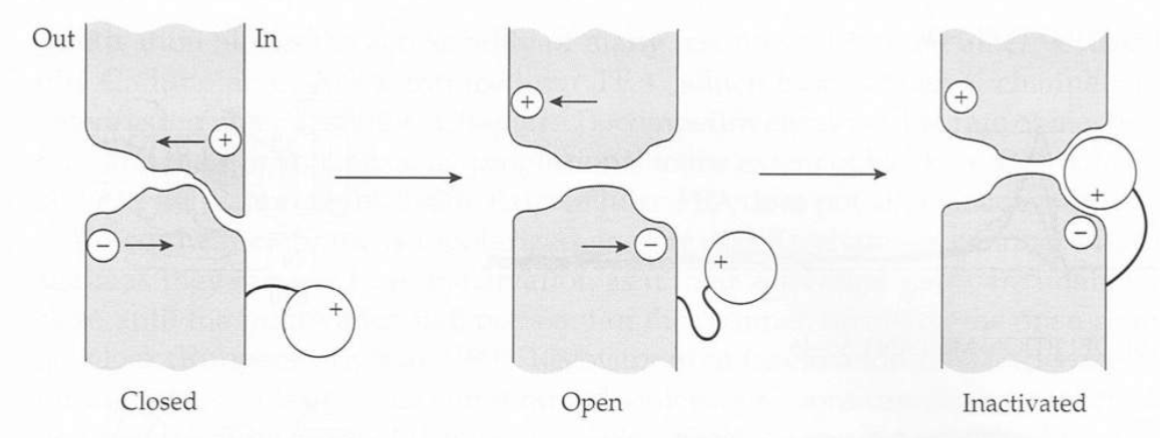
What is the ball and chain method of Na+ channel inactivation?
Inactivation gate of Na+ hangs out(ball) of the cytoplasm. Activation creates a receptor for the inactivation gate. The inactivation gate can then bind to the receptor
What is the effect of raising external Ca2+ concentration in nerve and muscle excitability?
Decreases excitability
What does Parathyroid hormone (PTH) do?
Increases the extracellular [Ca2+] in the blood
What does calcitonin do?
Decreases the extracellular [Ca2+] in the blood
Causes and effects of hypocalcemia
Caused by a decrease in extracellular [Ca2+] by hyperthyroidism or hypoparathyroidism. Increases the excitability of nerve and muscle.
Causes and effects of hypercalcemia
Caused by an increase in extracellular [Ca2+] by hypothyroidism or hyperparathyroidism. Decreases excitability of nerve and muscle.
Describe the surface potential theory
The charged surface of membranes attracts Ca2+ ions and create an electric field inside the membrane which adds to that provided by the resting potential
Absolute Refractory Period is mainly driven by _____________.
Na⁺ channel inactivation.
Relative Refractory Period is mainly driven by _____________.
Increased K⁺ conductance
What ion channels are in the node of ranvier?
Na+ and K+