Chapter 5
 Call Kai
 Learn
Learn Practice Test
 Spaced Repetition
 Match
Match Flashcards
 Knowt Play
1/18

There's no tags or description
Looks like no tags are added yet.
Name | Mastery | Learn | Test | Matching | Spaced | Call with Kai |
|---|
No analytics yet
Send a link to your students to track their progress
19 Terms
Logical Fallacy
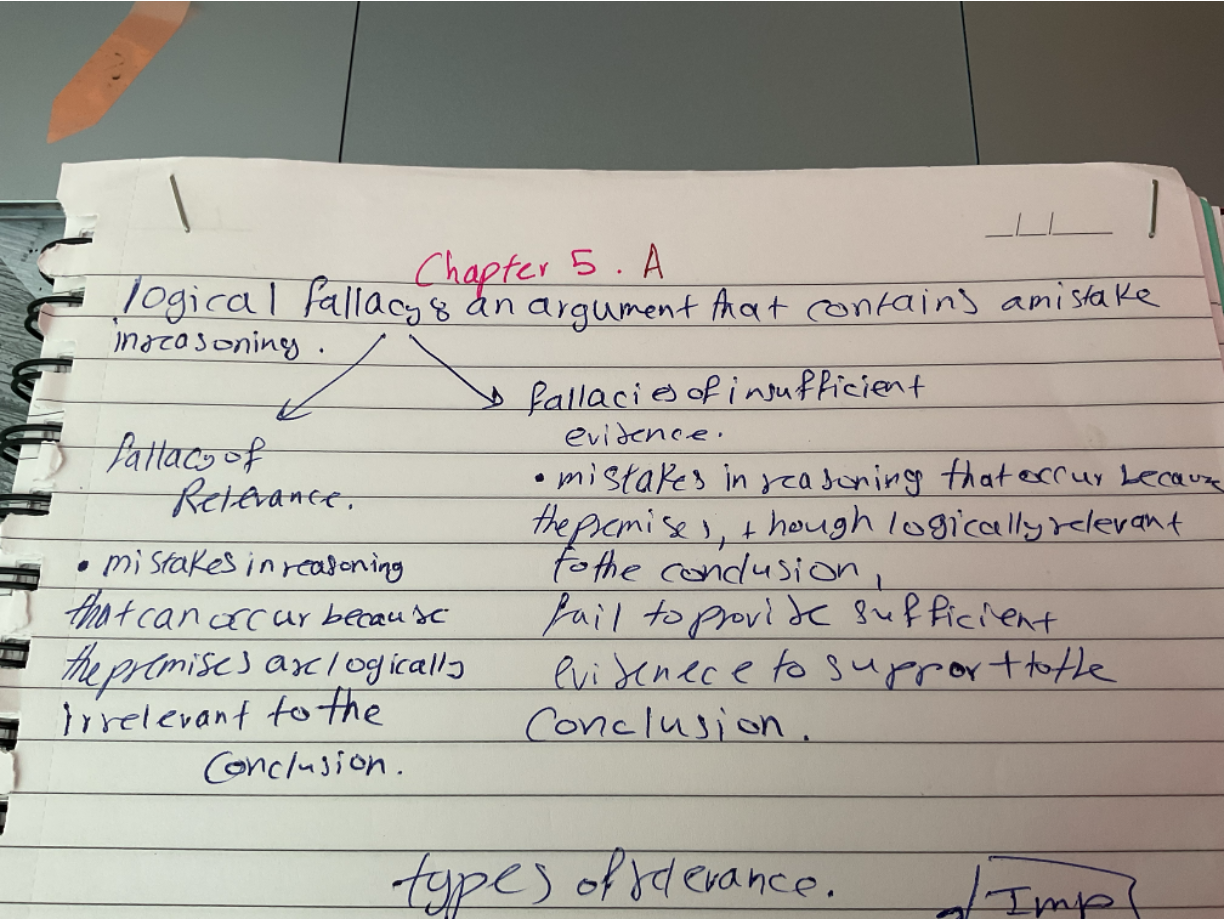
Logical fallacy, or fallacy: An argument that contains a mistake in reasoning.
•Fallacy of relevance: Mistakes in reasoning that occur because the premises are logically irrelevant to the conclusion.
•Fallacies of insufficient evidence: Mistakes in reasoning that occur because the premises, though logically relevant to the conclusion, fail to provide sufficient evidence to support the conclusion.
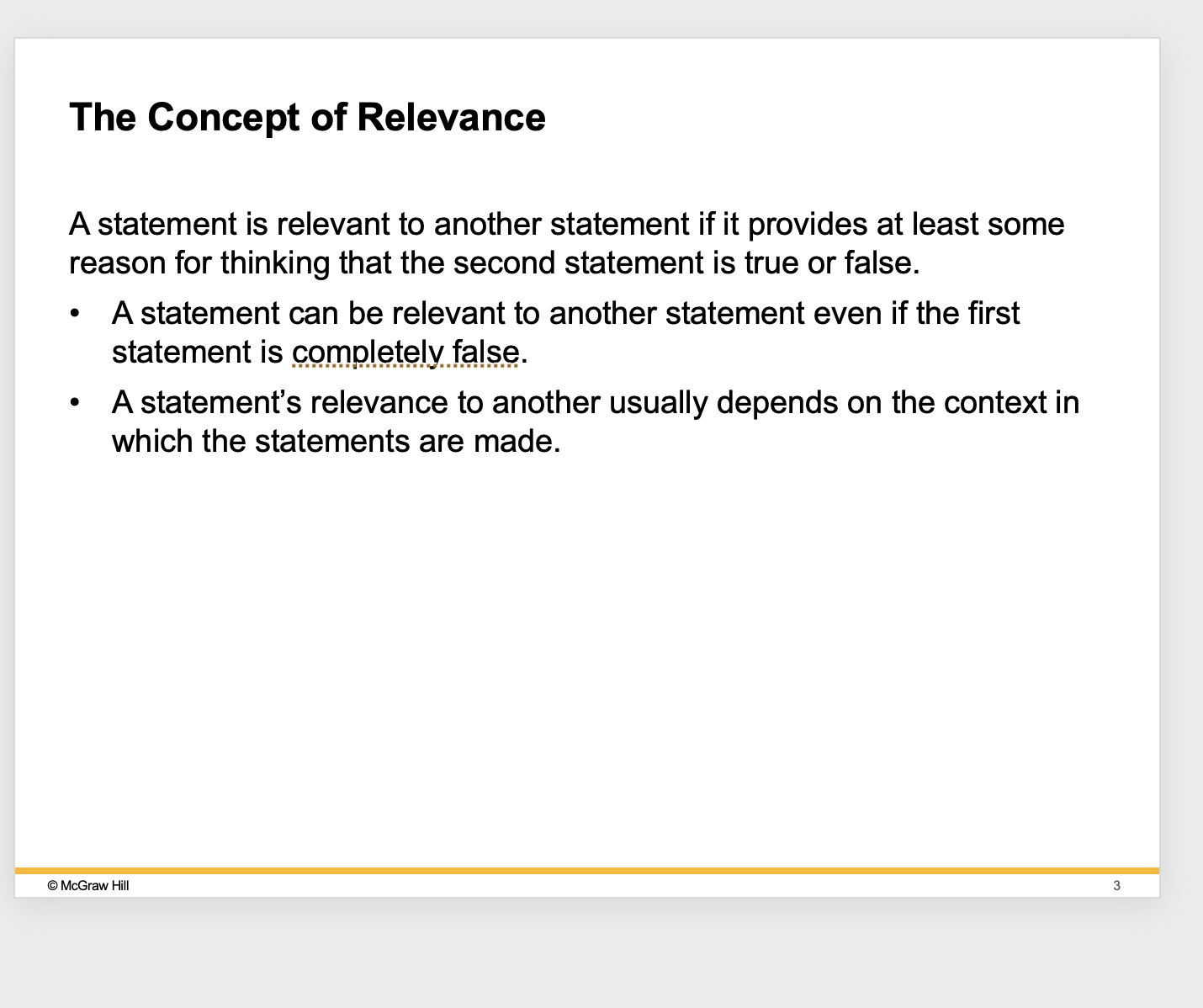
The Concept of Relevance
attached
Types of Relevance
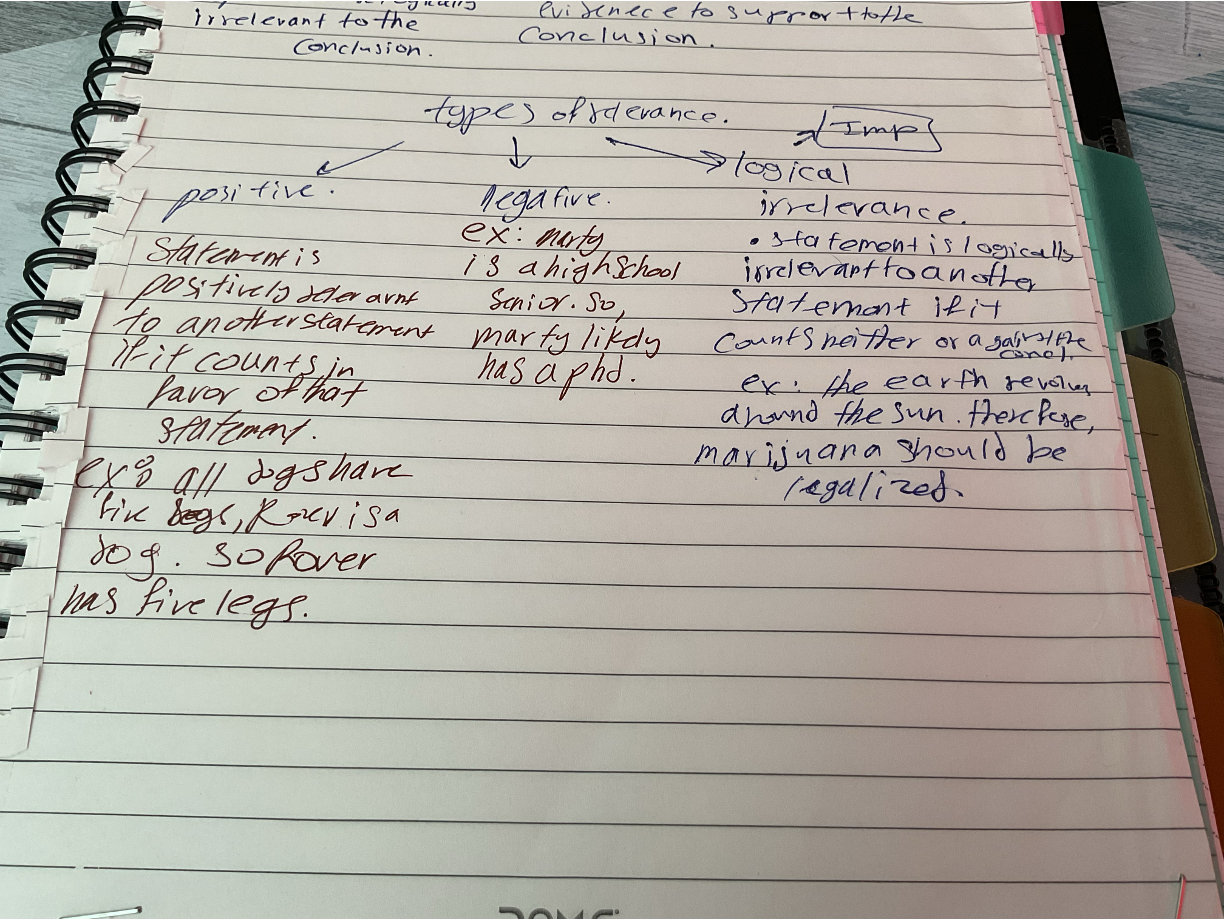
Positive relevance: Statement is positively relevant to another statement if it counts in favor of that statement.
•Example: All dogs have five legs. Rover is a dog. So Rover has five legs.
Negative relevance: Statement that counts against another statement is said to be negatively relevant.
•Example: Marty is a high-school senior. So, Marty likely has a Ph.D.
Logical irrelevance: Statement is logically irrelevant to another statement if it counts neither for nor against that statement.
•Example: The earth revolves around the sun. Therefore, marijuana should be legalized.
Fallacies of Relevance / logical irrelavance
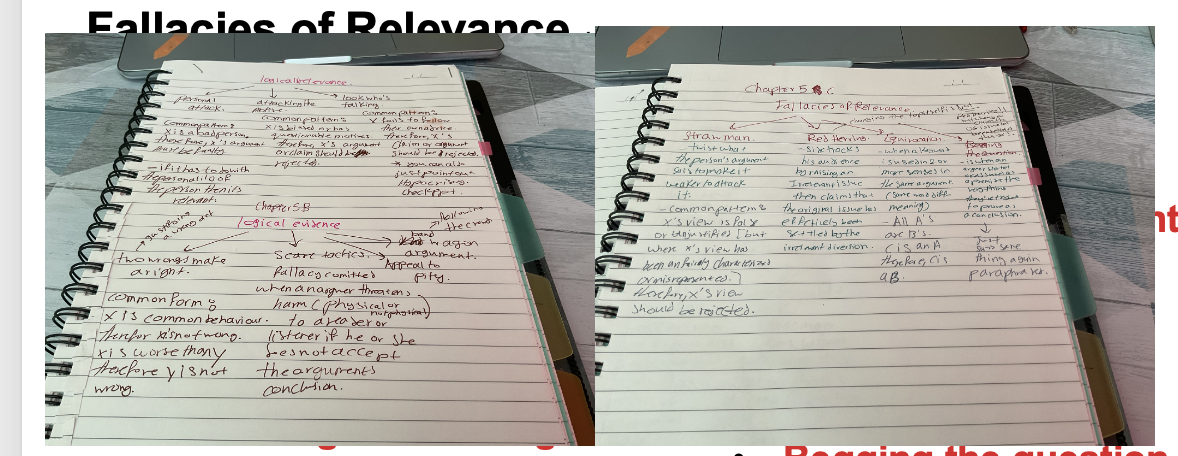
•Personal attack (Ad Hominem).
•Attacking the motive.
•Look who’s talking (Tu quoque).
•Two wrongs make a right.
•Scare tactics.
•Appeal to pity.
•Bandwagon argument.
•Straw man.
•Red herring.
•Equivocation.
•Begging the question.
Personal Attack (Ad Hominem)
This is a fallacy that dismisses an argument by attacking the person that made the argument, rather than the person’s argument or claim.
•Example: Hugh Hefner argued against censorship of pornography. But Hefner was an immature, self-indulgent millionaire who never outgrew the adolescent fantasies of his youth. His argument, therefore, is worthless.
Common pattern.
•X is a bad person.
•Therefore, X’s argument must be faulty.
Personal attacks are not fallacious when they appear in arguments that are trying to establish something about the character of the person.
•Example 1: Millions of innocent people died in Stalin’s ruthless ideological purges. Clearly, Stalin was one of the most brutal dictators of the twentieth century.
•Example 2: Becky Fibber is a pathological liar. She has twice been convicted of perjury. Therefore, her testimony is not good evidence.
Attacking the Motive
The error of criticizing a person’s motivation for offering a particular argument or claim, rather than examining the worth of the argument or claim itself.
•Example: Professor Michaelson has argued in favor of tenure. But why should we even listen to Professor Michaelson? As a tenured professor, of course he supports tenure.
Common pattern.
•X is biased or has questionable motives.
•Therefore, X’s argument or claim should be rejected.
Not all attacks on an arguer’s motives are fallacious.
•Example: Burton Wexler, spokesperson for the American Tobacco Growers Association, has argued that there is no credible scientific evidence that cigarette smoking causes cancer. Given Wexler’s obvious bias in the matter, his arguments should be taken with a grain of salt.
•The example reflects the commonsense assumption that arguments put forward by arguers with obvious biases or motivations to lie need to be scrutinized with particular care.
Look Who’s Talking (Tu Quoque)
Fallacy is committed when an arguer rejects another person’s argument or claim because that person fails to follow their own advice.
•Example: I don’t need to stop smoking just because my doctor tells me to. He smokes, and he won’t stop either!
Common pattern.
•X fails to follow their own advice.
•Therefore, X’s claim or argument should be rejected.
Arguments are good or bad because of their own intrinsic strengths or weaknesses and not because of who offers them.
•If an argument is good, it is good no matter who articulates it.
•However, hypocritical behavior can (and should) be criticized.
•Example: I should stop smoking as my doctor told me, but so should my doctor!
read if imp if note delete
attached
What logical Fallacy is used here?
Example: "How can you argue your point about climate change when you drive a gasoline-powered car?“
Explanation: This argument attacks the person instead of addressing the argument or the evidence about climate change. It suggests that the person’s behavior, which is unrelated to the argument's validity, disqualifies their stance.
Answer: Personal Attack (Ad Hominem)
What logical Fallacy is used here?
Example: "Of course the mayor supports the new public park initiative; her family owns a construction company that would likely get the contract to build it."
Explanation: This argument questions the mayor's motives for supporting the initiative rather than discussing the merits or drawbacks of the public park itself. It implies that her support is based solely on personal gain, not on the potential public benefit.
Answer: Attacking the Motive
What logical Fallacy is used here?
Example: "Why should I listen to your advice on healthy eating when you don’t eat healthily yourself?"
Explanation: This argument dismisses the advice on healthy eating by pointing out hypocrisy in the advisor, rather than engaging with the advice itself. It suggests that the validity of advice is dependent on the personal habits of the one giving it, which is a fallacious line of reasoning.
Answer: Look Who’s Talking
Two Wrongs Make a Right
This fallacy is committed when an arguer attempts to justify a wrongful act by claiming that some other act is just as bad or worse.
•Example: I don’t feel guilty about cheating on tests; everyone does it.
Common forms.
•X is common behavior. Therefore, X is not wrong.
•X is worse than Y. Therefore, Y is not wrong.
There are times when an act that would otherwise be wrong can be justified by citing the wrongful actions of others.
•Example: I killed the man because he was about to kill me. It was an act of self-defense.
•Not all cases are clear.
•Example: Jedediah Smith murdered three people in cold blood. Therefore, Jedediah Smith should be put to death.
Scare Tactics
This fallacy is committed when an arguer threatens harm (physical or nonphysical) to a reader or listener if he or she does not accept the argument’s conclusion.
•The threat is irrelevant to the truth of the conclusion.
•Example: This gun control bill is wrong for America, and any politician who supports it will discover how wrong they were at the next election.
Not all threats involve fallacies.
•Example: Parent to teen: If you come home late one more time, your allowance will be cut.
Appeal to Pity
Occurs when an arguer inappropriately attempts to evoke feelings of pity or compassion from his listeners or readers.
•Example 1: He deserves to make the football team. If he doesn’t, he will be really upset.
•A starting position is deserved by ability, not by reaction.
•Example 2: You shouldn’t give me an F in the class just because I failed all the exams. I had a rough semester.
•A grade is deserved by achievement, not by circumstance.
Such arguments are not always fallacious.
•If feelings are legitimately a motivating factor for an action, then bringing out those feelings are appropriate for persuasion.
•Example: Everyone is counting on you. Make them proud! Play like the champions you are!
Bandwagon Argument
An argument that plays on a person’s desire to be popular, accepted, or valued.
•Example: All the really cool kids at East Jefferson High School smoke cigarettes. Therefore, you should, too.
Common form.
•Everybody (or a selective group of people) believes or does X.
•Therefore, you should believe or do X, too.
Not all appeals to popular beliefs or practices are fallacious.
•Example: All the villagers say it is safe to drink the water. Therefore, the water probably is safe to drink.
Straw Man
Fallacy is committed when an arguer distorts an opponent’s argument or claim to make it weak (like a straw man) in turn making it easier to attack.
•Example: Senator Biddle has argued that we should outlaw violent pornography. Obviously, the senator favors complete governmental censorship of books, magazines, and films. Frankly, I’m shocked that such a view should be expressed on the floor of the U.S. Senate. It runs counter to everything this great nation stands for. No senator should listen seriously to such a proposal.
•The senator's claim is that violent pornography should be outlawed, not that there should be complete governmental censorship of books, magazines, and films.
Common pattern.
•X’s view is false or unjustified [but where X’s view has been unfairly characterized or misrepresented].
•Therefore, X’s view should be rejected.
Red Herring
The fallacy is committed when an arguer tries to sidetrack his audience by raising an irrelevant issue and then claims that the original issue has effectively been settled by the irrelevant diversion.
•Example: Many people criticize Thomas Jefferson for owning slaves. But he was one of our greatest presidents, and his Declaration of Independence is one of the most eloquent pleas for freedom and democracy ever written. Clearly, these criticisms are unwarranted.
It is not a fallacy simply to change the subject or evade an issue.
•Example.
•Question: Congressman, now that you have been convicted of bribery and extortion, isn’t it high time that you resigned from office?
•Answer: How about those Yankees! A ten-game lead at the All-Star break!
•Since such arguments do not attempt to settle the original argument, no fallacy is committed.
Equivocation
Committed when a key word is used in two or more senses in the same argument.
•The apparent success of the argument depends on the shift in meaning.
•Example: (1) Any law can be repealed by the proper legal authority. (2) The law of gravity is a law. (3) Therefore, the law of gravity can be repealed by the proper legal authority.
•The meaning of “law” is different in (1) than it is in (2) and (3).
Common pattern.
•All A’s are B’s.
•C is an A.
•Therefore, C is a B.
The fallacy becomes apparent when the meaning of the word “law” is clarified in the previous example.
•Example: (1) All laws regulating human conduct are things that can be repealed by the proper legal authority. (2) The law of gravity is an observed uniformity of nature. (3) Therefore, the law of gravity is a thing that can be repealed by the proper legal authority.
Begging the Question
Fallacy is committed when an arguer states or assumes as a premise the very thing they are trying to prove as a conclusion.
•Example 1: Capital punishment is wrong because it is ethically impermissible to inflict death as punishment for a crime.
•The conclusion is just a restatement of the premise.
•Example 2: God wrote the Bible. Because it says so in the Bible, and what the Bible says is true. Therefore, God wrote the Bible.
•This is an example of circular reasoning.