Bell’s Palsy
 Call Kai
 Learn
Learn Practice Test
 Spaced Repetition
 Match
Match Flashcards
 Knowt Play
1/14

There's no tags or description
Looks like no tags are added yet.
Name | Mastery | Learn | Test | Matching | Spaced | Call with Kai |
|---|
No analytics yet
Send a link to your students to track their progress
15 Terms
Bell’s Palsy
Acute, usually temporary facial paresis (or palsy) from damage to facial nerve (CN VII); usually unilateral but can be bilateral
Acute demyelination
Bell’s Palsy cause
Exact cause unknown
Reactivation of herpes virus leading to inflammation and nerve compression causing clinical features
Bell’s Palsy symptoms onset
Symptom onset is sudden; peak in 48 to 72 hours
Prognosis—very good
Recovery 2 weeks—6 months
Some have residual effects
Bell’s Palsy
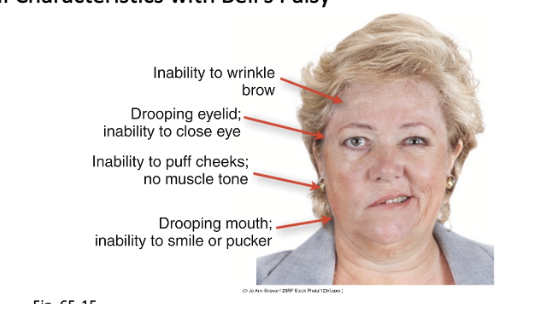
Bell’s Palsy – Clinical Manifestations
CN VII: motor, sensory, and autonomic function
Key feature: unilateral lower motor facial weakness
50% to 60% have pain behind the ear and neck
other clinical manifestations
Other: drooping eyelid (ptosis) and corner of the mouth, facial twitching, dryness of eye or mouth, facial numbness, altered taste, hearing loss, excessive tearing in one eye
Bell’s Palsy quality of life
Problems with eating, swallowing, taste, and speech
Psychologic withdrawal due to changes in appearance, malnutrition, dehydration, mucous membrane trauma, corneal abrasions, muscle stretching, and facial spasms and contractures
diagnosis
no definitive test, but to exclude other causes, CT scan
Interprofessional Care
Symptom relief, prevent complications, protection of affected eye
Oral corticosteroids: start within 72 hours
Antivirals
Eye protection
Assure did not have a stroke
Family and friend support very important
Encourage social interaction
Pain management
Mild analgesia
Moist heat
Electrical stimulation
Facial massage and Facial muscles
Physical therapy
Sling can support affected muscles, improve lip alignment, and facilitate eating
Protect face from cold to avoid trigeminal hyperesthesia (extreme sensitivity to pain or touch)
Exercises—
several times per day when function begins to return
eye protection
Dark glasses: protection and cosmetic
Artificial tears: prevent drying of cornea
Ointment and eye shield at night; tape lids
Report eye pain, drainage, or discharge
Nutrition
Chew on unaffected side
Oral hygiene after meals
Physical appearance
Can be devastating but good chance for full recovery
For a patient with Bell’s palsy, when are symptoms the most severe?
a. 12 hours after onset
b. 48 hours after onset
c. 96 hours after onset
d. 1 week after onset