bio chapter 42
 Call Kai
 Learn
Learn Practice Test
 Spaced Repetition
 Match
Match Flashcards
 Knowt Play
1/99

There's no tags or description
Looks like no tags are added yet.
Name | Mastery | Learn | Test | Matching | Spaced | Call with Kai |
|---|
No analytics yet
Send a link to your students to track their progress
100 Terms
In bull elks, the mating season is triggered by the length of daylight which has a direct role on ____.
a.
metabolism
b.
endocrine activity
c.
catabolism
d.
ecological events
e.
thermodynamics
b.
endocrine activity
While neural activity involves transmission of information through electrical events, endocrine activity involves ____.
a.
transport of hormones to trigger slow, persistent responses
b.
transport of hormones to trigger fast, transient responses
c.
release of hormones from exocrine glands for transport outside the body
d.
changes in neural activity for transport of hormones to target tissues
e.
transmission of information through chemical reactions
a.
transport of hormones to trigger slow, persistent responses
An important functional role of the endocrine system is to ____.
a.
respond rapidly to changes in the body
b.
control gene action
c.
inhibit nervous system action on muscles and glands
d.
regulate digestion
e.
fight infection
d.
regulate digestion
The release of chemical signals into the extracellular fluid to affect nearby target cells is an example of ____ regulation.
a.
autocrine
b.
endocrine
c.
paracrine
d.
systemic
e.
exocrine
c.
paracrine
A cell that contains a receptor for a hormone is known as a(n) ____.
a.
endocrine gland
b.
paracrine cell
c.
neuroendocrine cell
d.
target cell
e.
signaling cell
d.
target cell
Target cells for steroid hormones and thyroid hormones do not have membrane receptors for these hormones because they ____.
a.
stimulate the cell by changes in electrical activity
b.
are hydrophobic
c.
enter the cell by ion channels
d.
are small enough to diffuse directly into the cell
e.
dissolve readily in the extracellular fluid (ECF)
b.
are hydrophobic
Prostaglandins are ____
a.
protein molecules that act either by paracrine or autocrine mechanisms.
b.
fatty acid derivatives that act either by paracrine or autocrine mechanisms.
c.
neurotransmitters that act by paracrine mechanisms.
d.
amine molecules that act by neuroendocrine mechanisms.
e.
steroid molecules that are lipid soluble.
b.
fatty acid derivatives that act either by paracrine or autocrine mechanisms.
A hormone that is hydrophobic, derived from cholesterol, and binds to intracellular receptors is most likely a(n) ____ hormone.
a.
fatty acid
b.
steroid
c.
protein
d.
amine
e.
carbohydrate
b.
steroid
Hormone levels and action are determined by ____.
a.
other hormones or releasing agents
b.
carbohydrate activity
c.
positive feedback systems
d.
prostaglandins
e.
touch receptors
a.
other hormones or releasing agents
The secretions of endocrine glands ____.
a.
only affect their own tissue
b.
provide feedback by paracrine action
c.
reach their target tissue via the ECF
d.
reach their target tissues via the circulatory system
e.
are only active in the nervous system
d.
reach their target tissues via the circulatory system
Which hormones enter cells and alter mRNA production?
a.
steroid and peptide hormones
b.
steroid and phospholipid hormones
c.
thyroid and peptide hormones
d.
peptide and phospholipid hormones
e.
steroid and thyroid hormones
e.
steroid and thyroid hormones
Small quantities of hormone can result in profound responses in target tissues. This type of response is referred to as ____.
a.
amplification
b.
a first messenger response
c.
a gene activation response
d.
a neural response
e.
a growth factor response
a.
amplification
Select the appropriate order of hormone action.
a.
transduction, reception, response
b.
reception, response, transduction
c.
transduction, response, reception
d.
reception, transduction, response
e.
reception, translation, response
d.
reception, transduction, response
Your job is to determine if a steroid hormone is having an effect on its target tissue. Which response would indicate activation of the target tissue by the hormone in question?
a.
increased cyclic AMP levels
b.
activation of G-proteins
c.
increased levels of mRNA
d.
increased calcium level in the cytoplasm
e.
increased polysaccharide levels in the cytoplasm
c.
increased levels of mRNA
Which organ and hormone pair is incorrectly matched?
a.
pancreas and insulin
b.
thyroid gland and thyroxine
c.
hypothalamus and melatonin
d.
adrenal cortex and glucocorticoids
e.
posterior pituitary and oxytocin
c.
hypothalamus and melatonin
If adenylyl cyclase were inhibited in animal cells, ____.
a.
binding of epinephrine to beta receptors would have no affect on cyclic AMP levels.
b.
binding of epinephrine to beta receptors would increase cyclic AMP levels.
c.
an increase in mRNA for cyclic AMP would occur.
d.
an increase in mRNA for more beta receptors would occur.
e.
epinephrine would not be able to bind to beta receptors.
a.
binding of epinephrine to beta receptors would have no affect on cyclic AMP levels.
In an experiment examining adrenergic receptors, epinephrine alone was not able to trigger an increase in cAMP, but when beta receptors were fused with animal cells, there were high levels of cAMP. This indicates ____ was occurring.
a.
activation of epinephrine
b.
protein kinase inhibition
c.
activation of adenylyl cyclase only
d.
protein kinase amplification only
e.
both activation of adenylyl cyclase and protein kinase amplification
e.
both activation of adenylyl cyclase and protein kinase amplification
The pituitary gland is regulated most directly by the ____.
a.
pineal gland
b.
hypothalamus
c.
pancreas
d.
adrenal gland
e.
thyroid gland
b.
hypothalamus
The ____ gland has a neurosecretory component as well as a component that is not under direct neural control.
a.
thyroid
b.
pineal
c.
adrenal
d.
pituitary
e.
parathyroid
d.
pituitary
The posterior lobe of the pituitary gland stores and secretes ____.
a.
ADH only
b.
TSH only
c.
oxytocin only
d.
ADH and oxytocin only
e.
ADH, oxytocin and TSH
d.
ADH and oxytocin only
One of the main functions of the hypothalamus is to produce ____ hormones, which affect the ____ pituitary.
a.
releasing; posterior
b.
releasing; anterior
c.
activating; posterior
d.
amplification; anterior
e.
growth factor; anterior
b.
releasing; anterior
Which hormone has a role in both feelings of well-being and in social stress responses in both sexes?
a.
oxytocin
b.
endorphins
c.
insulin-like growth factors
d.
epinephrine
e.
norepinephrine
a.
oxytocin
Select the correct sequence of events involved in regulating secretion of thyroid hormones.
1.
pituitary releases thyroid-stimulating hormone (TSH)
2.
hypothalamus secretes thyroid-releasing hormone (TRH)
3.
thyroid hormones inhibit long-term TRH secretion
4.
thyroid secretes thyroid hormones
5.
thyroid hormones inhibit TSH secretion
a.
1, 2, 4, 5, 3
b.
2, 1, 4, 5, 3
c.
3, 1, 4, 5, 2
d.
3, 4, 1, 2, 5
e.
2, 4, 5, 1, 3
b.
2, 1, 4, 5, 3
The anterior pituitary secretes more ACTH, leading to more glucocorticoids in plasma, which causes the anterior pituitary to then secrete less ACTH. This is an example of ____ regulation.
a.
amplification only
b.
positive feedback only
c.
negative feedback
d.
cascading feedback
e.
both amplification and positive feedback
c.
negative feedback
If melanocyte-stimulating hormone were increased, you would expect ____.
a.
changes in kidney function for retention of water
b.
increase in reproductive or estrus cycles
c.
decrease in heat loss from the body surface
d.
increase in pigmentation in the skin
e.
decrease in milk production in females
d.
increase in pigmentation in the skin
The regulation of water balance, milk release, and uterine contractions during childbirth are mediated by the ____ gland.
a.
parathyroid
b.
pineal
c.
anterior pituitary
d.
posterior thyroid
e.
posterior pituitary
e.
posterior pituitary
The ____ gene is the only gene successfully targeted for breast cancer prevention.
a.
estrogen receptor
b.
BRCA1
c.
estrogen diethylstilbestrol
d.
BRCA2
e.
progestin receptor
a.
estrogen receptor
Which hormone is responsible from the release of calcium and phosphate ions from bone tissues into the blood?
a.
glucagon
b.
insulin
c.
epinephrine
d.
parathyroid hormone
e.
glucocorticoids
d.
parathyroid hormone
The actions of insulin and glucagon are ____.
a.
synergistic
b.
permissive
c.
cooperative
d.
antagonistic
e.
mutualistic
d.
antagonistic
You are studying the hormonal control of metamorphosis in amphibians. If the anterior pituitary was prevented from releasing TSH, what would be the effect on tadpoles?
a.
Metamorphosis to adult frogs would be increased five-fold.
b.
Metamorphosis to adult frogs would not occur.
c.
Calcium secretion in tadpoles would be inhibited.
d.
Metabolism in tadpoles would be greatly increased.
e.
Metamorphosis would proceed, but arrest after limb formation.
b.
Metamorphosis to adult frogs would not occur.
During stressful situations, epinephrine initiates ____.
a.
dilation of blood vessels to the skin
b.
dilation of blood vessels to the heart
c.
constriction of blood vessels to the brain
d.
a decrease in metabolic rate
e.
a decrease in blood glucose levels
b.
dilation of blood vessels to the heart
Overproduction of the mineralocoticoid ______ causes excessive water retention.
a.
cortisol
b.
aldosterone
c.
epinephrine
d.
catecholamine
e.
ADH
b.
aldosterone
Biological rhythms and the onset of sleep are regulated by ____ produced by the ____.
a.
cortisol; pineal gland
b.
melatonin; pituitary gland
c.
parathyroid hormone; parathyroid gland
d.
melatonin; pineal gland
e.
cortisol; adrenal gland
d.
melatonin; pineal gland
In humans, an adult suffering from hyperthyroidism ____.
a.
is always tired
b.
shows lack of emotions
c.
experiences insomnia and weight loss
d.
sleeps a significant amount of the time
e.
has a low heart rate
c.
experiences insomnia and weight loss
Calcium levels are primarily under the control of ____.
a.
calcitonin and thyroxine
b.
prolactin and oxytocin
c.
parathyroid hormone and thyroxine
d.
progesterone and ADH
b.
prolactin and oxytocin
Which hormone involved in reproductive functions is produced outside the gonads?
a.
testosterone
b.
estrogen
c.
progesterone
d.
follicle-stimulating hormone
e.
prolactin
d.
follicle-stimulating hormone
When rats are given high doses of anabolic-androgenic steroids (AAS), they experience ____.
a.
decreased muscle mass and overall strength
b.
increased fertility
c.
increased aggression and anxiety
d.
increased gonadotropins and gonadal hormones
e.
decreased sex drive and energy levels
c.
increased aggression and anxiety
Type 1 diabetes causes ____, while type 2 diabetes results in ____.
a.
hyperglycemia; hypoglycemia
b.
protein breakdown; protein synthesis
c.
blindness; kidney disorder
d.
insulin hypersecretion; insulin hyposecretion
e.
insulin deficiency; insulin resistance
e.
insulin deficiency; insulin resistance
Anabolic-androgenic steroids are ____.
a.
synthetic forms of testosterone
b.
synthetic forms of estrogens
c.
used to treat early puberty
d.
natural variants of testosterone
e.
natural variants of estrogen
a.
synthetic forms of testosterone
When human volunteers were given high doses of AAS, ____
a.
TSH levels increased
b.
gonadotropin levels increased
c.
natural testosterone levels increased
d.
thyroxine levels decreased
e.
TSH levels were unaffected
a.
TSH levels increased
Which statement about steroid hormones in invertebrates and vertebrates is most accurate?
a.
An invertebrate hormone injected into a vertebrate would have a greater effect than the endogenous hormone.
b.
A vertebrate hormone injected in an invertebrate would have a greater effect that the endogenous hormone.
c.
The reaction pathways stimulated by steroid hormones in invertebrates and vertebrates are similar.
d.
The reaction pathways stimulated by steroid hormones in invertebrates and vertebrates are different.
e.
Invertebrates do not produce steroid hormones.
c.
The reaction pathways stimulated by steroid hormones in invertebrates and vertebrates are similar.
In order for crustacean molting to occur, ____ secretion must ____.
a.
molt-inhibiting hormone; increase
b.
juvenile hormone; be inhibited
c.
prothoracicotropic hormone; decrease
d.
ecdysone; increase
e.
insulin-like hormone; increase
d.
ecdysone; increase
When molt-inhibiting hormone secretion (MIH) is prevented, ____.
a.
ecdysone levels increase
b.
ecdysone levels decrease
c.
molting is inhibited
d.
growth is inhibited
e.
growth is stimulated
a.
ecdysone levels increase
The reason some individual hormones have multiple effects on different target tissues is that ____.
a.
gene transcription is altered
b.
second messengers trigger cascade or amplification effects
c.
many different cells in different tissues have specific receptors for the hormone
d.
only a small amount of the hormone is required for its effect
e.
hormones can conform to multiple receptors
c.
many different cells in different tissues have specific receptors for the hormone
Target tissues often have receptors for multiple hormones. The response of the target tissue may depend on ____.
a.
blood levels of and coordinated activities of several hormones secreted by different glands, only
b.
blood levels of the hormones that affect it only
c.
coordinated activities of several hormones secreted by different glands only
d.
the effects of other signaling molecules, such as prostaglandins only
e.
blood levels of, coordinated activities of several hormones secreted by different glands, and the effects of other signaling molecules, such as prostaglandins
e.
blood levels of, coordinated activities of several hormones secreted by different glands, and the effects of other signaling molecules, such as prostaglandins
Overproduction of epinephrine and norepinephrine can cause ____.
a.
increased digestive processes
b.
the formation of a tumor in the adrenal medulla
c.
increased heart rate
d.
increased blood flow to the kidneys and intestines
e.
decreased blood flow to the heart
c.
increased heart rate
Negative feedback loops to the hypothalamus and the pituitary operate to regulate the levels of ____, the most important regulator of thyroid hormone secretion.
a.
TRH
b.
thyroid hormone
c.
TSH
d.
ADH
e.
calcitonin
c.
TSH
Select the endocrine gland whose secretory function is under direct control of the sympathetic nervous system.
a.
pancreas
b.
thyroid
c.
adrenal medulla
d.
parathyroid
e.
posterior pituitary
c.
adrenal medulla
Which hormone(s) is/are responsible for sodium reabsorption in the kidneys and intestine?
a.
insulin-like hormones
b.
glucocorticoids
c.
cortisol
d.
mineralocorticoids
e.
glucagon
d.
mineralocorticoids
How do mammalian and nonmammalian adrenal glands differ?
a.
they have totally different functions
b.
they have opposite effect on target tissues
c.
the mammalian glands consists of two distinct regions while the nonmammalian glands consist of separate glands
d.
the mammalian glands are antagonistic while the nonmammalian glands work in concert
e.
the mammalian glands are the same size while the nonmammalian glands are different sizes
c.
the mammalian glands consists of two distinct regions while the nonmammalian glands consist of separate glands
The parathyroid gland ____.
a.
functions in regulation of sodium levels in the blood
b.
produces numerous hormones active in regulating downstream endocrine glands
c.
is the largest gland outside the hypothalamus
d.
produces only a single hormone, the thyroid regulating hormone
e.
produces only a single hormone, the parathyroid hormone
e.
produces only a single hormone, the parathyroid hormone
The ovaries are regulated by the____.
a.
anterior pituitary
b.
posterior pituitary
c.
hypothalamus
d.
presence of environmental estrogens
e.
gonadal hormones
a.
anterior pituitary
The ____ hormones are vital to growth, development, maturation, and metabolism in all vertebrates.
a.
thyroid
b.
parathyroid
c.
adrenal
d.
gonadal
e.
insulin
a.
thyroid
Why do diabetes patients often display tissue degeneration in the extremities?
a.
The body is unable to process enough glucose and therefore supports only the major organs.
b.
The fat deposits protecting the extremities are utilized as an energy source.
c.
The body utilizes protein as an energy source, weakening blood vessels , especially those in the extremities.
d.
The unutilized glucose in the extremities crystallizes and damages these tissues.
e.
The excess exercise used to control the diabetic condition causes tissue degeneration.
c.
The body utilizes protein as an energy source, weakening blood vessels , especially those in the extremities.
In insects, the level of ____ controls the formation of a pupa.
a.
molt-inhibiting hormone
b.
juvenile hormone
c.
prothoracicotropic hormone
d.
ecdysone
e.
insulin-like hormone
b.
juvenile hormone
Melatonin levels in mammals are regulated by a(n) ____.
a.
inhibitory pathway
b.
stimulating pathway
c.
negative feedback loop
d.
positive feedback loop
e.
triggering signal
a.
inhibitory pathway
The synthesis and secretion of ____ is ultimately regulated by gonadotropin-releasing hormone from the ____.
a.
estrogen; posterior pituitary
b.
estrogen; ovaries
c.
testosterone; hypothalamus
d.
testosterone; testes
e.
androgens; gonads
c.
testosterone; hypothalamus
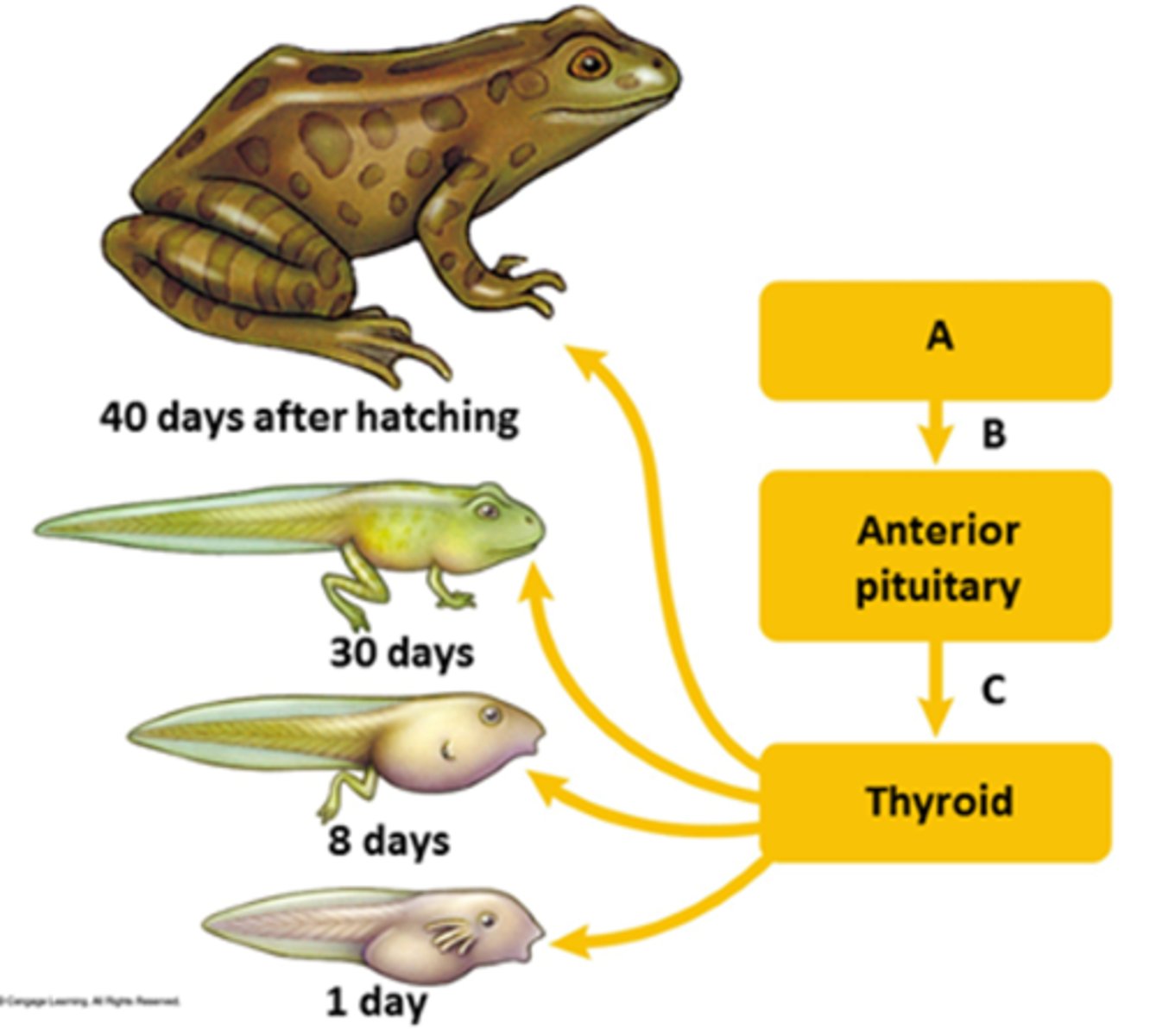
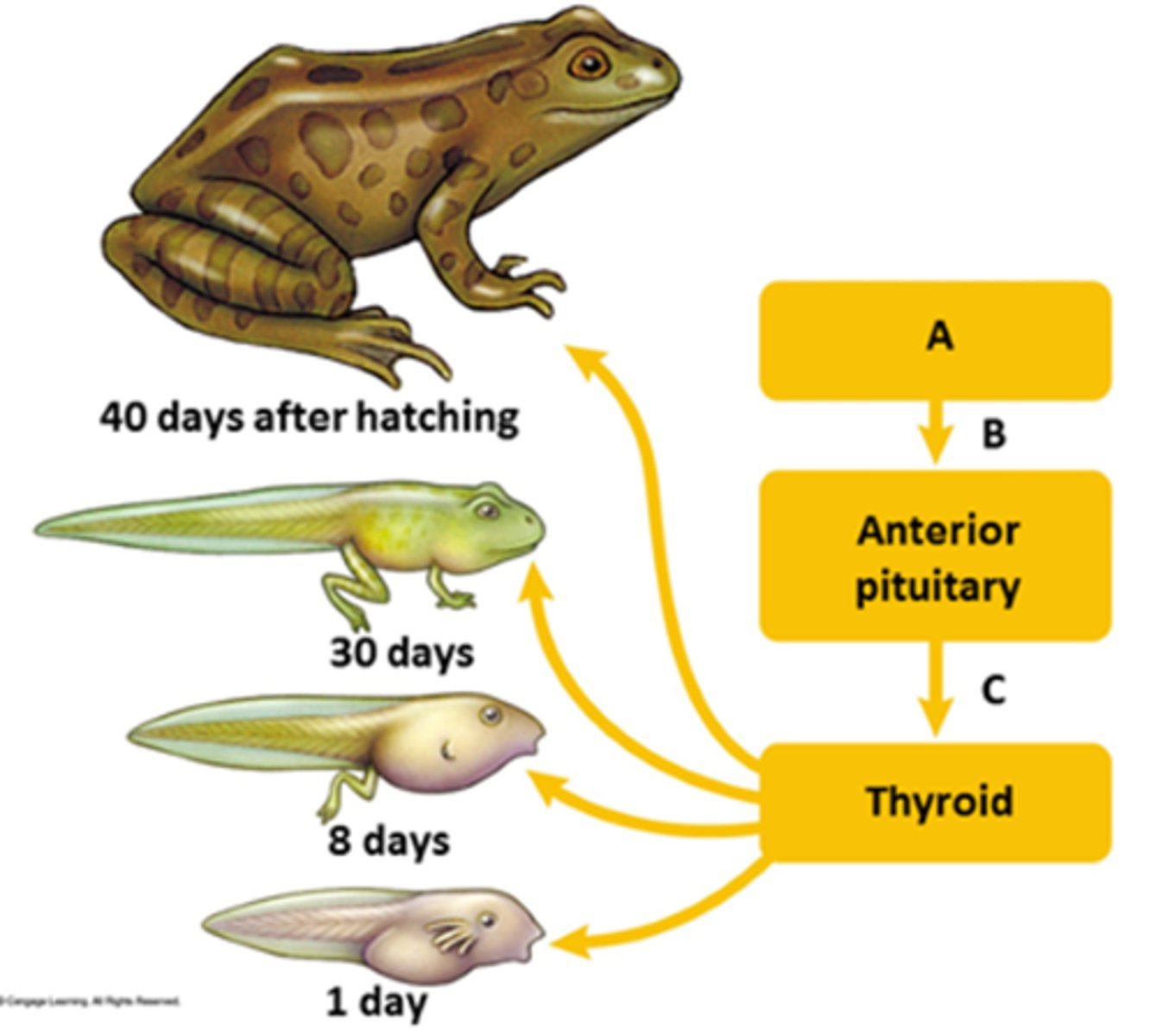
a. A
b. B
c. C
Answer the question using the accompanying figure. During metamorphosis of a tadpole, TSH is active at ____.
a.
A
b.
B
c.
C
d.
B and C
e.
A, B, and C
c.
C
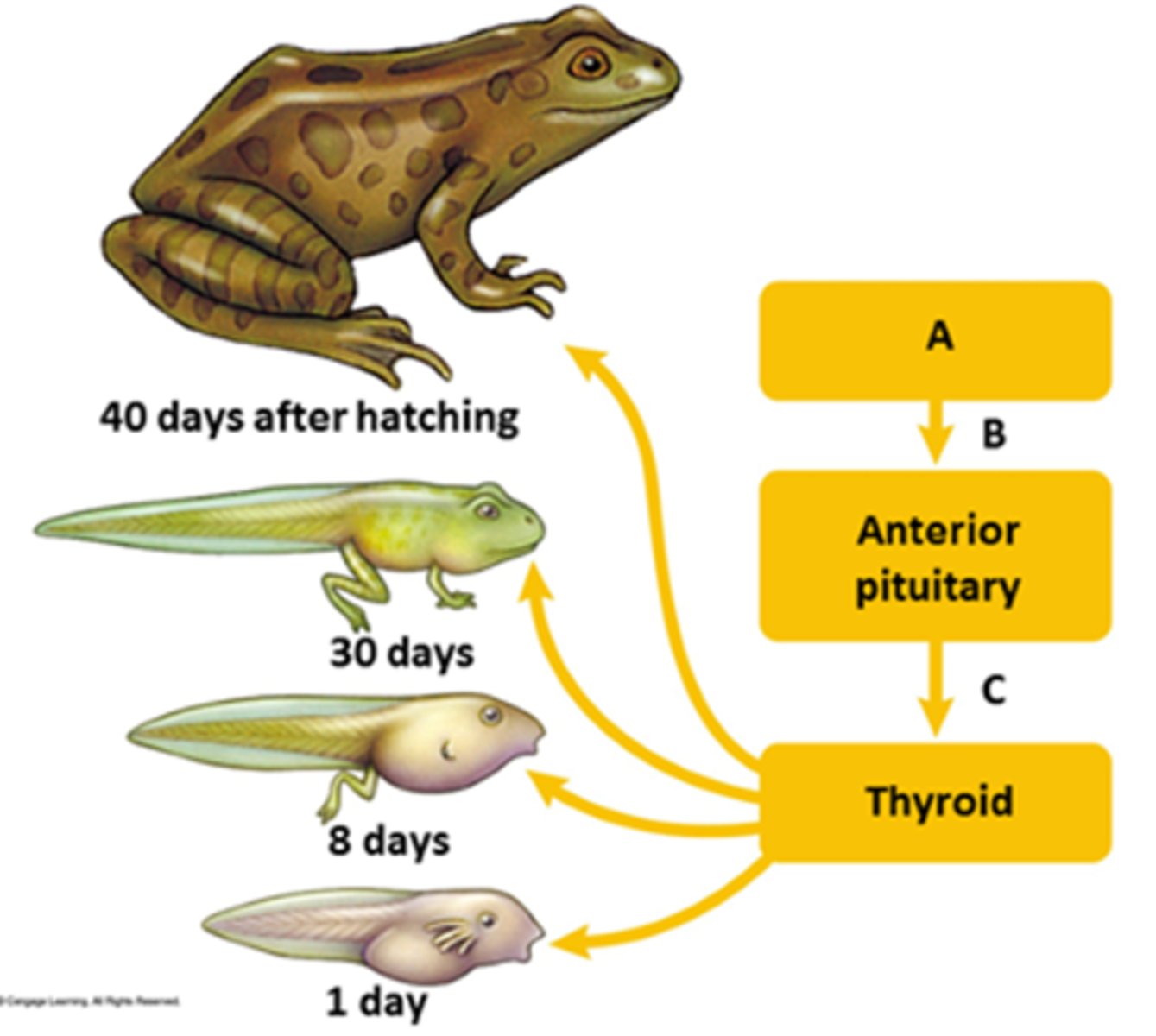
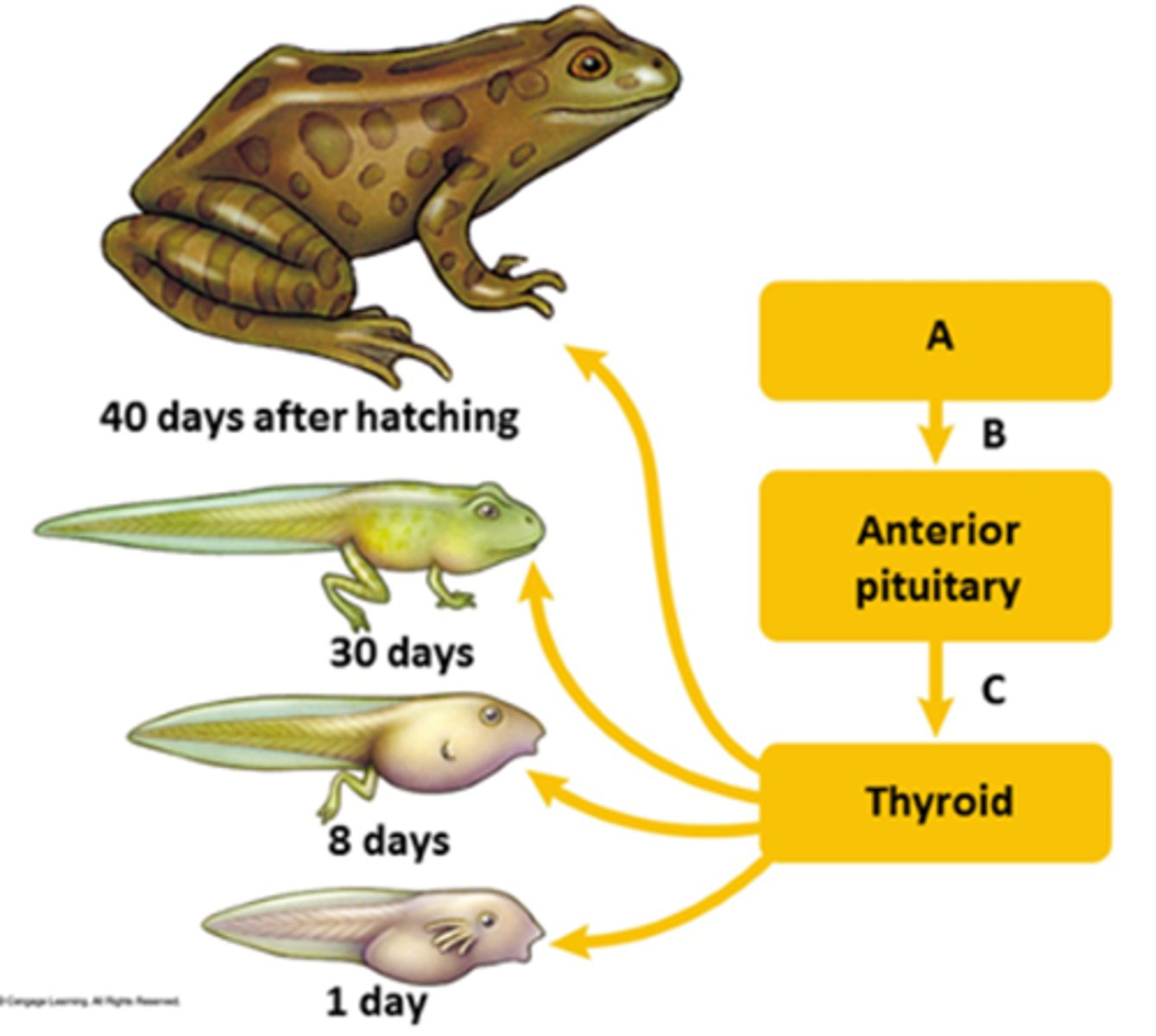
Answer the question using the accompanying figure. During metamorphosis of a tadpole, 'A' is the ____.
a.
thyroid
b.
parathyroid
c.
hypothalamus
d.
adrenal cortex
e.
posterior pituitary
c.
hypothalamus
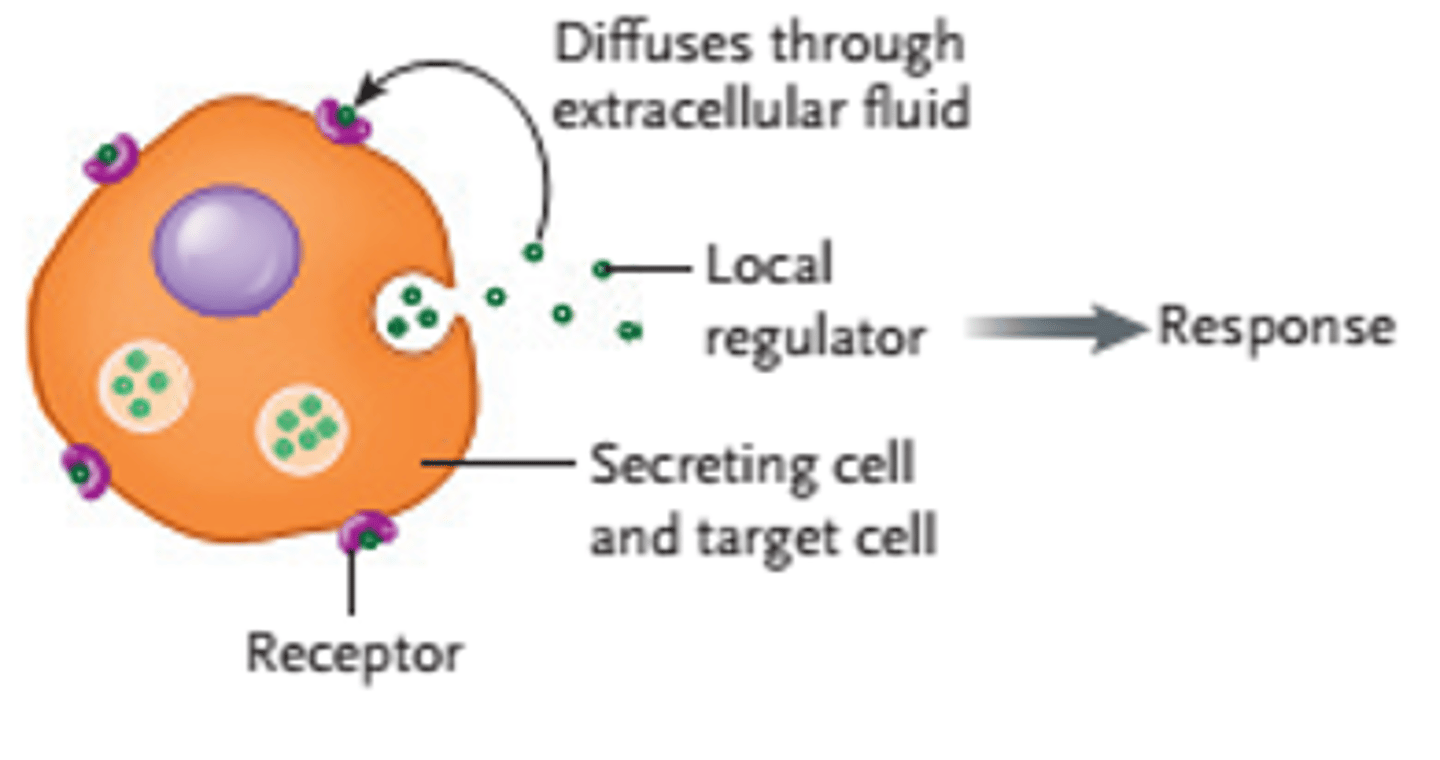
Answer the question using the accompanying figure. This figure illustrates ____ signaling.
a.
classical endocrine
b.
exocrine
c.
autocrine
d.
Paracrine
e.
neuroendocrine
c.
autocrine
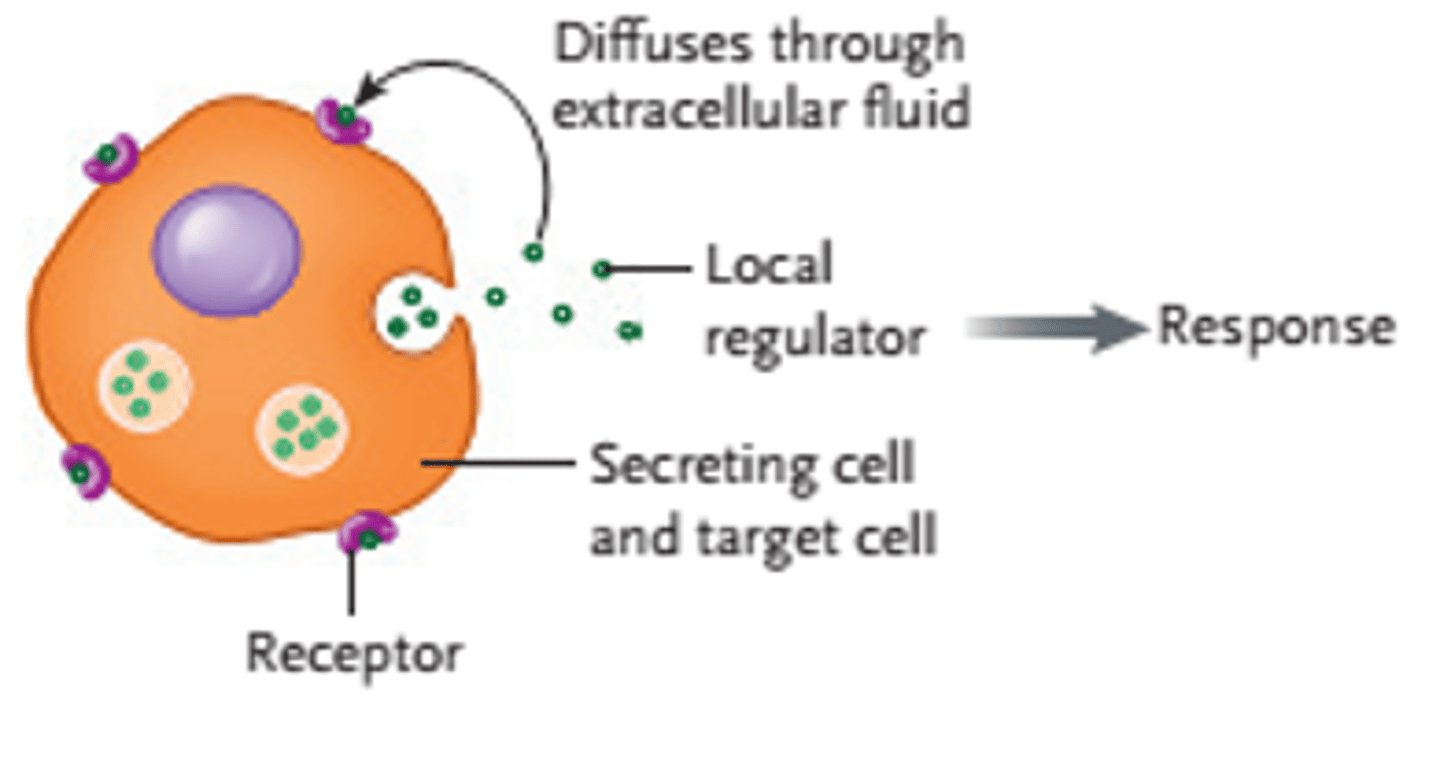
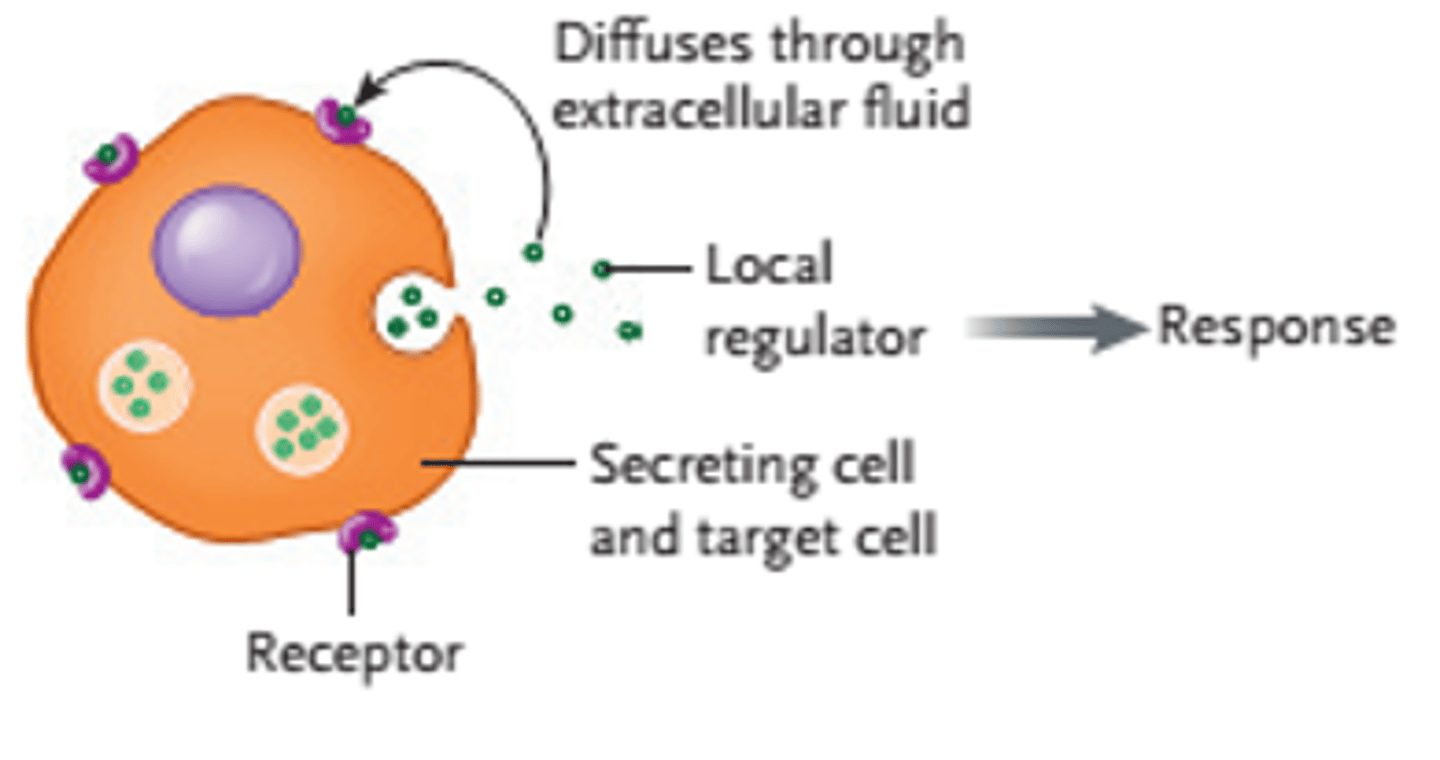
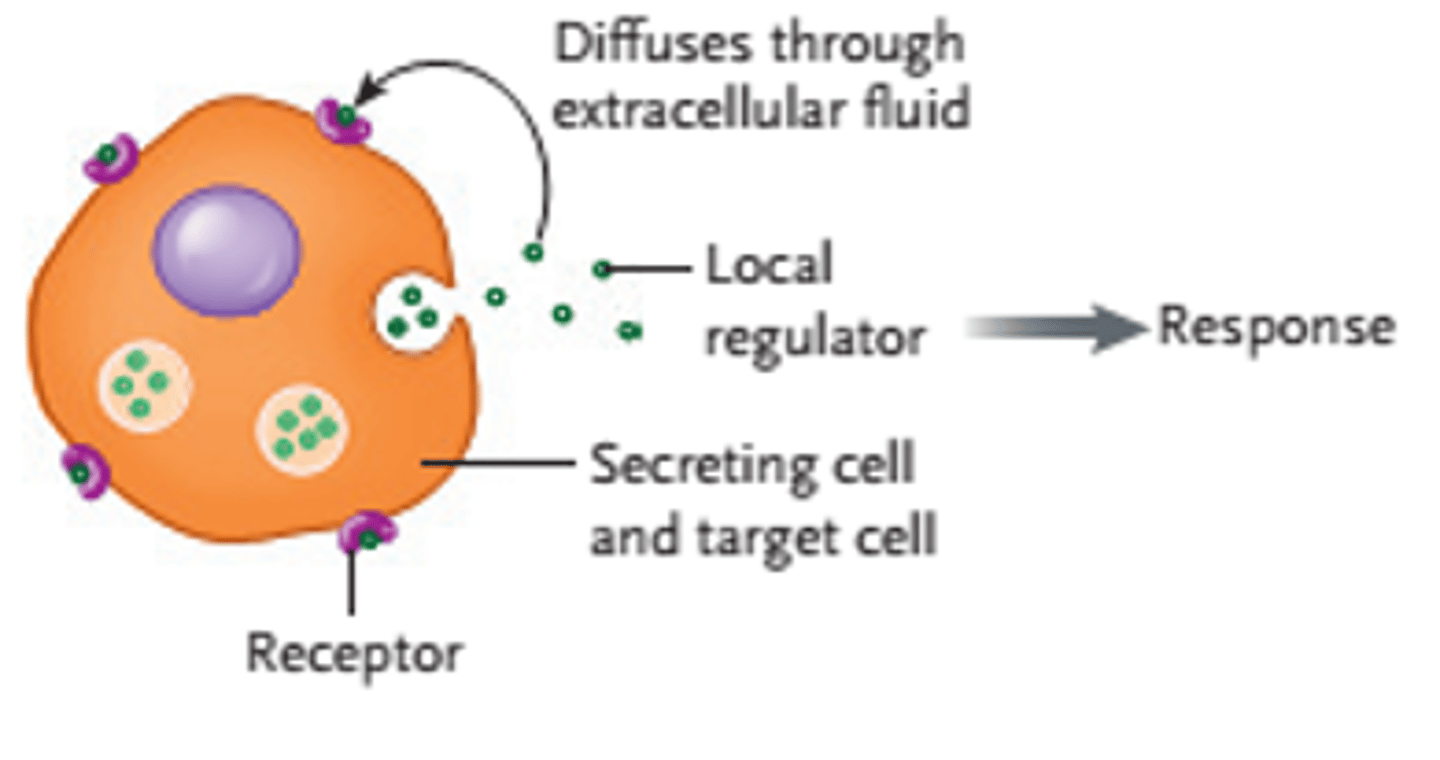
Answer the question using the accompanying figure. Many ____ act via the signaling fashion illustrated by this figure.
a.
neurohormones
b.
digestive hormones
c.
stress hormones
d.
blood sugar regulatorsc
e.
growth factors
e.
growth factors
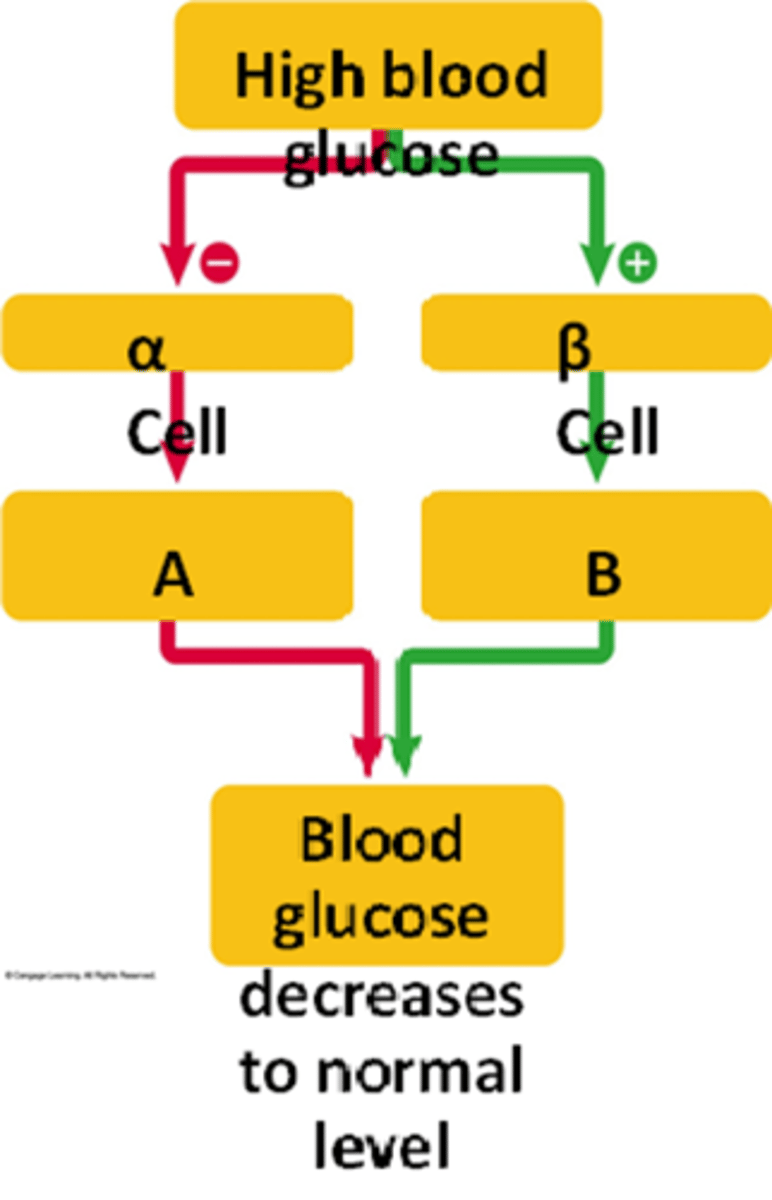
a. A
b. B
c. C
d. D
Answer the question using the accompanying figure. In the box labeled 'A', ____ levels ____.
a.
insulin; decrease
b.
insulin; increase
c.
glucagon; decrease
d.
glucagon; increase
e.
glycogen; decrease
c.
glucagon; decrease
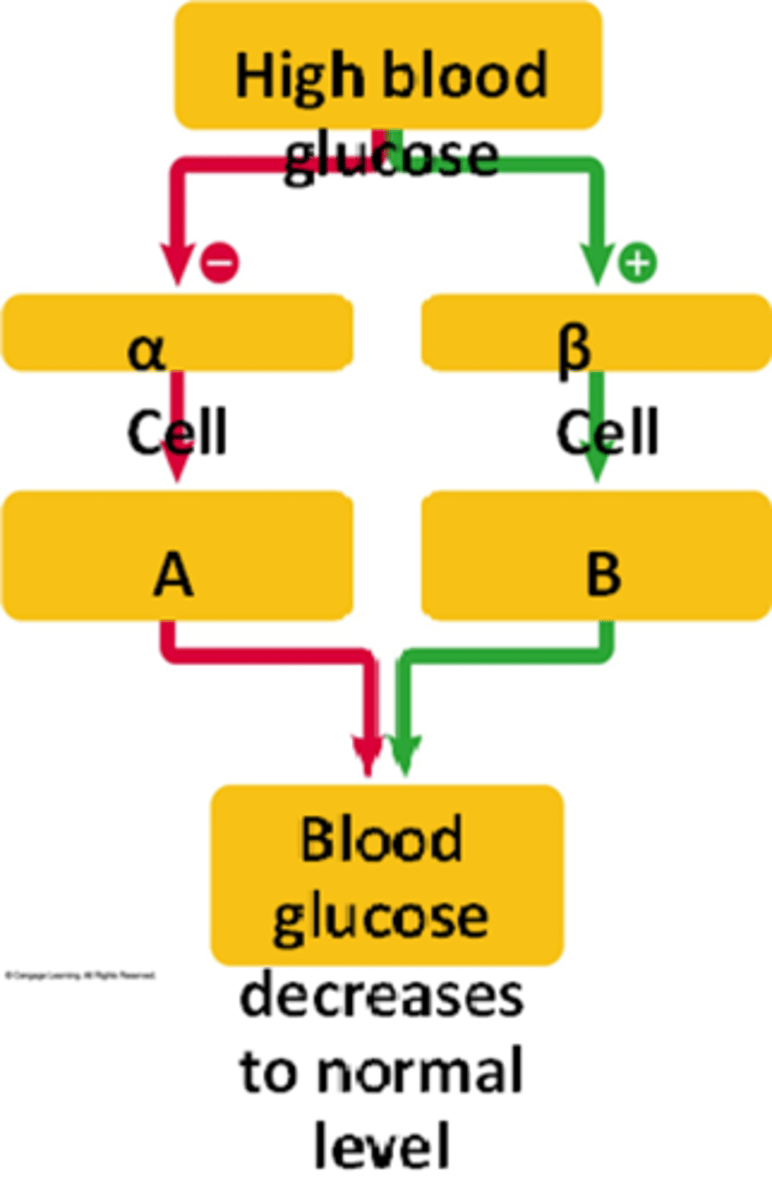
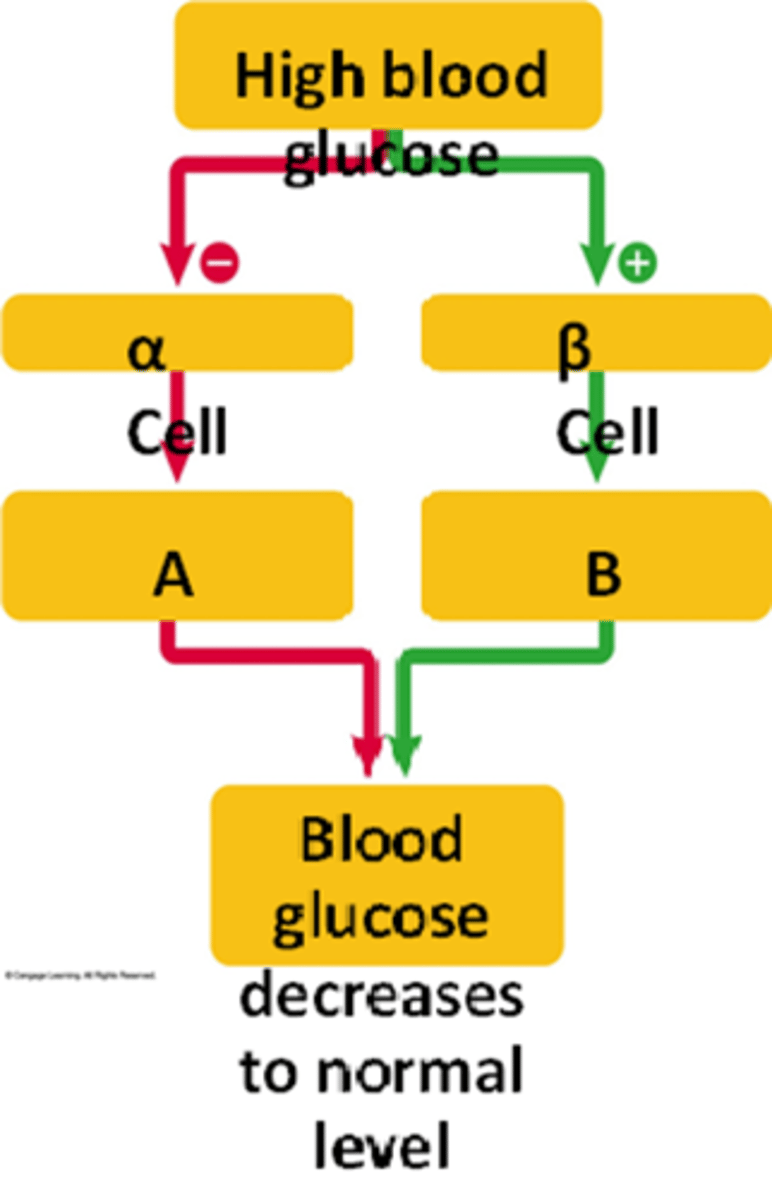
Answer the question using the accompanying figure. In type 1 diabetes, the box(es) labeled ____ malfunctions.
a.
A
b.
B
c.
C
d.
A and C
e.
B and D
b.
B
When hydrophilic hormones bind to surface receptors, the ____.
a.
signal is amplified
b.
signal is inhibited
c.
receptor is activated
d.
receptor is deactivated
e.
hormone is transduced
c.
receptor is activated
Hydrophobic hormones act by ____.
a.
triggering a genomic response
b.
triggering a signal transduction pathway
c.
activating an effector molecule
d.
inhibiting feedback loops
e.
preventing translation
a.
triggering a genomic response
In many cases, negative feedback loops maintain homeostasis by adjusting hormones that act in ____.
a.
concert
b.
sequence
c.
antagonistic ways
d.
additive ways
e.
parallel
c.
antagonistic ways
Epinephrine and norepinephrine are ____ hormones.
a.
steroid
b.
glucocorticoid
c.
mineralocorticoid
d.
gonadotropin
e.
catecholamine
e.
catecholamine
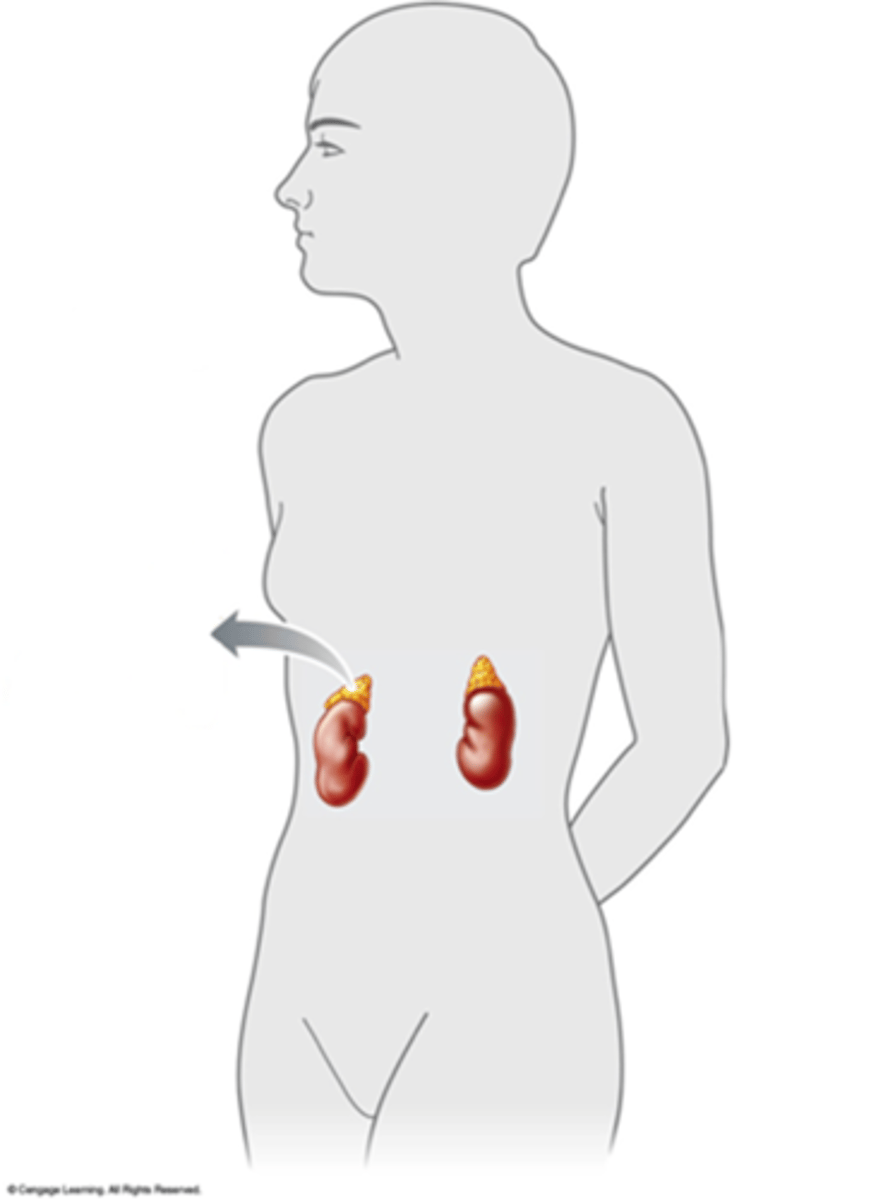
Answer the question using the accompanying figure. The ____ glands are shown in this figure.
a.
thyroid
b.
pituitary
c.
adrenal
d.
pancreatic
e.
pineal
c.
adrenal
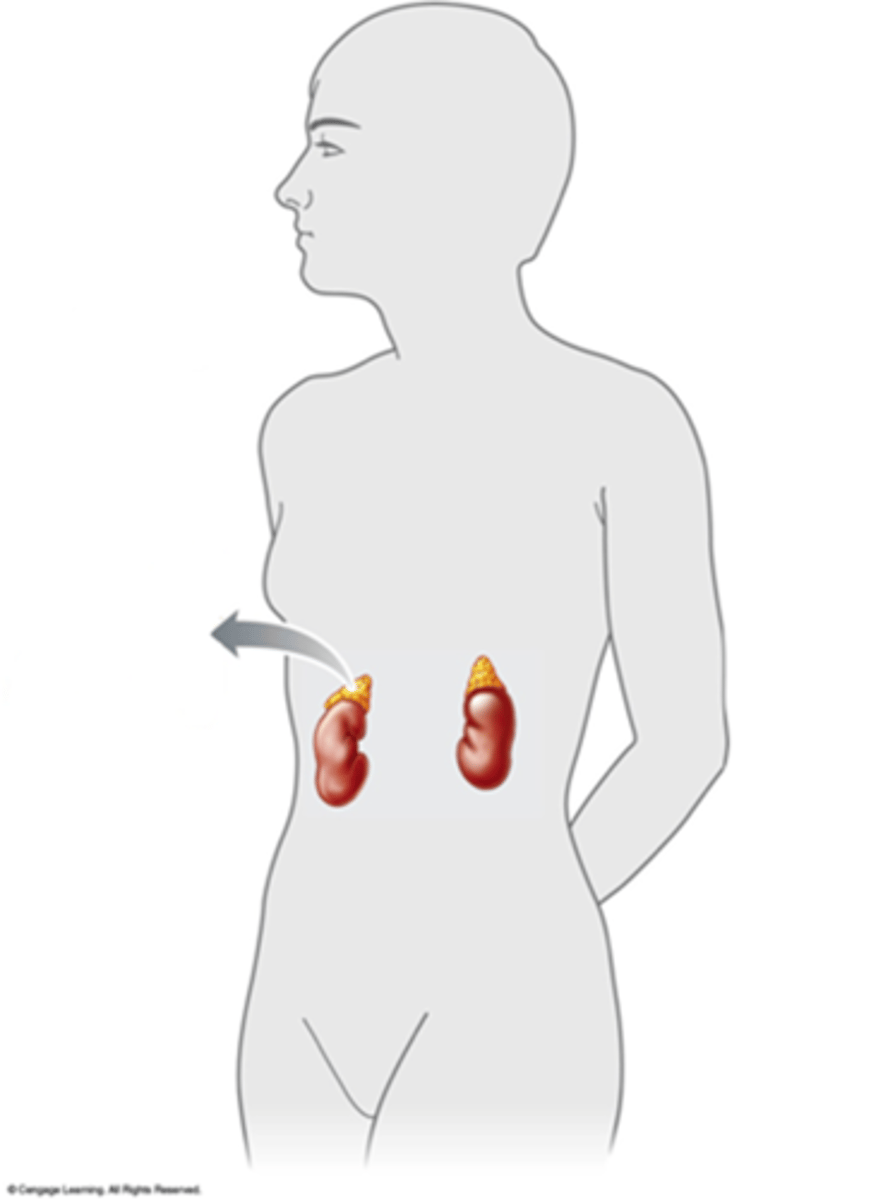
Ovaries produce ____ to prepare the uterus prior to implantation of a fertilized egg.
a.
estradiol
b.
oxytocin
c.
progesterone
d.
prolactin
e.
estrogen
c.
progesterone
Cortisol is a ____ secreted by the ____.
a.
amine; adrenal medulla
b.
glucocorticoid; adrenal cortex
c.
glucocorticoid; adrenal medulla
d.
amine; adrenal cortex
e.
catecholamine; adrenal glands
b.
glucocorticoid; adrenal cortex
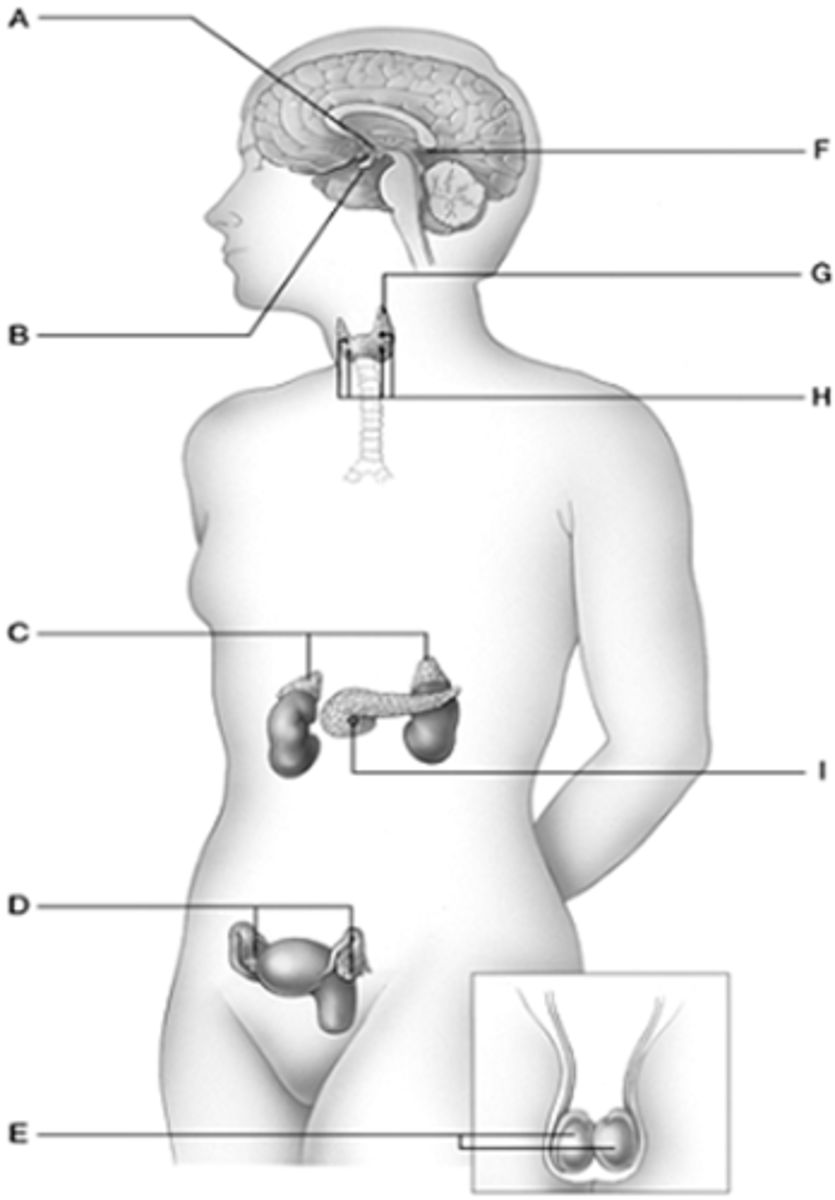
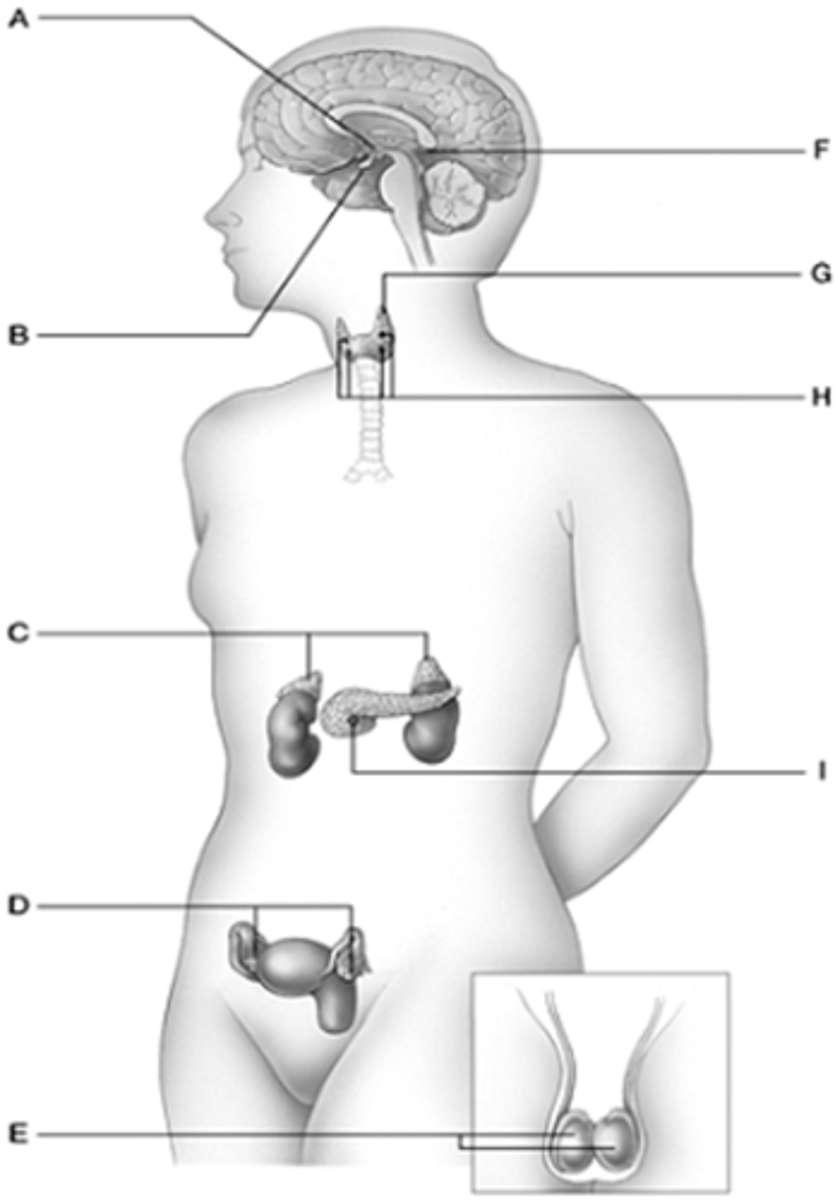
production and release of insulin
i
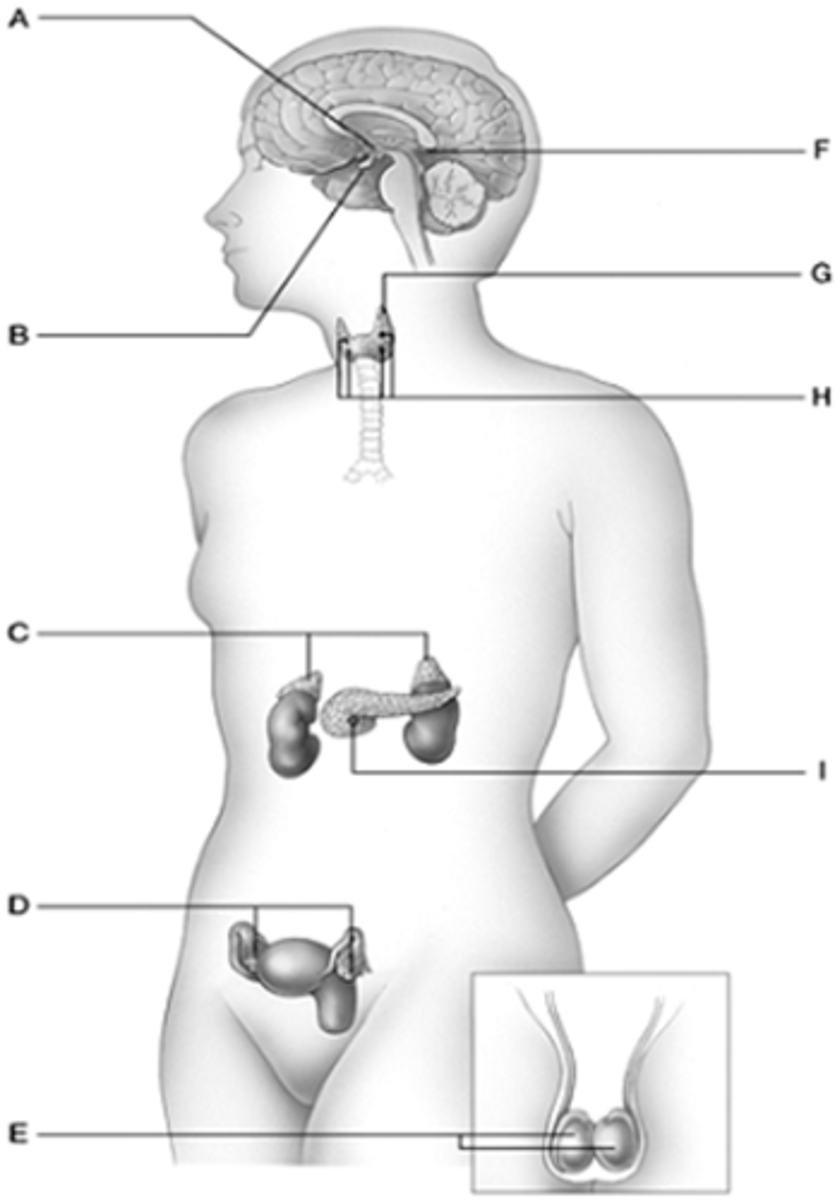
a portion is neuroendocrine and a portion is under hormonal control of the hypothalamus
b
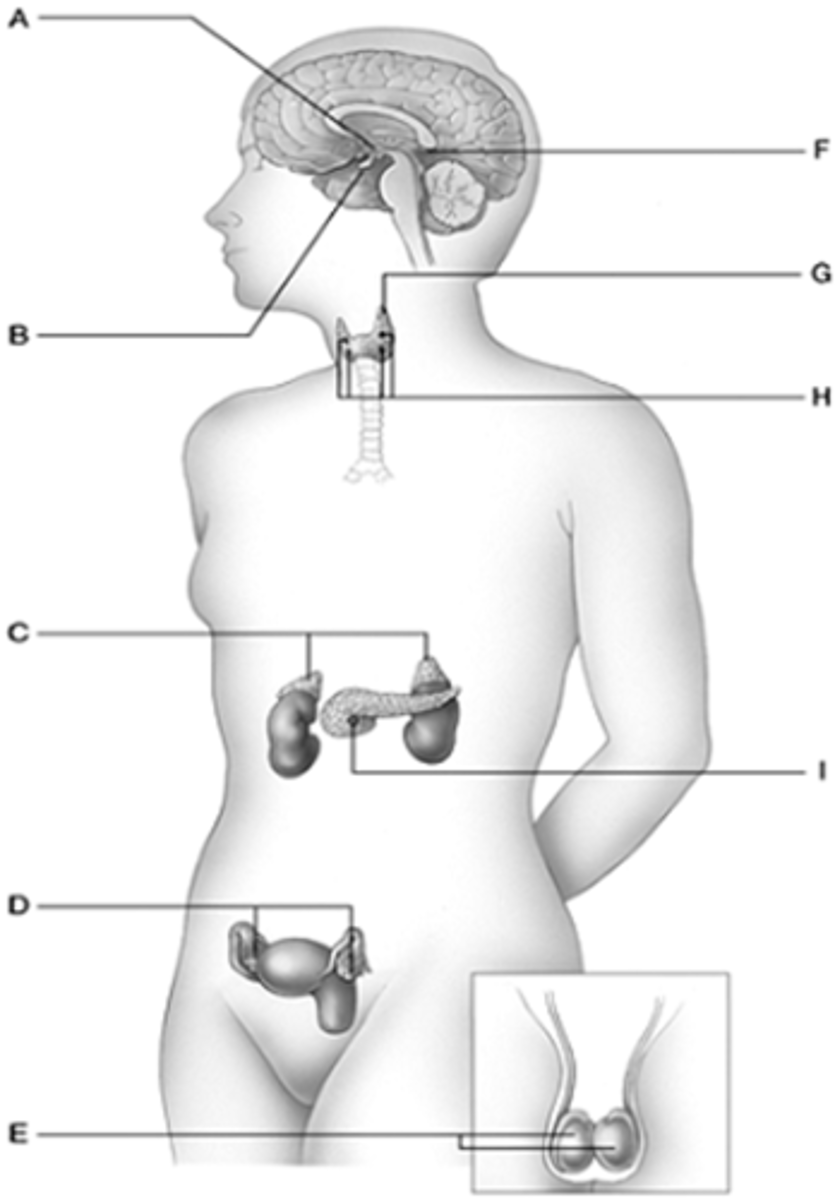
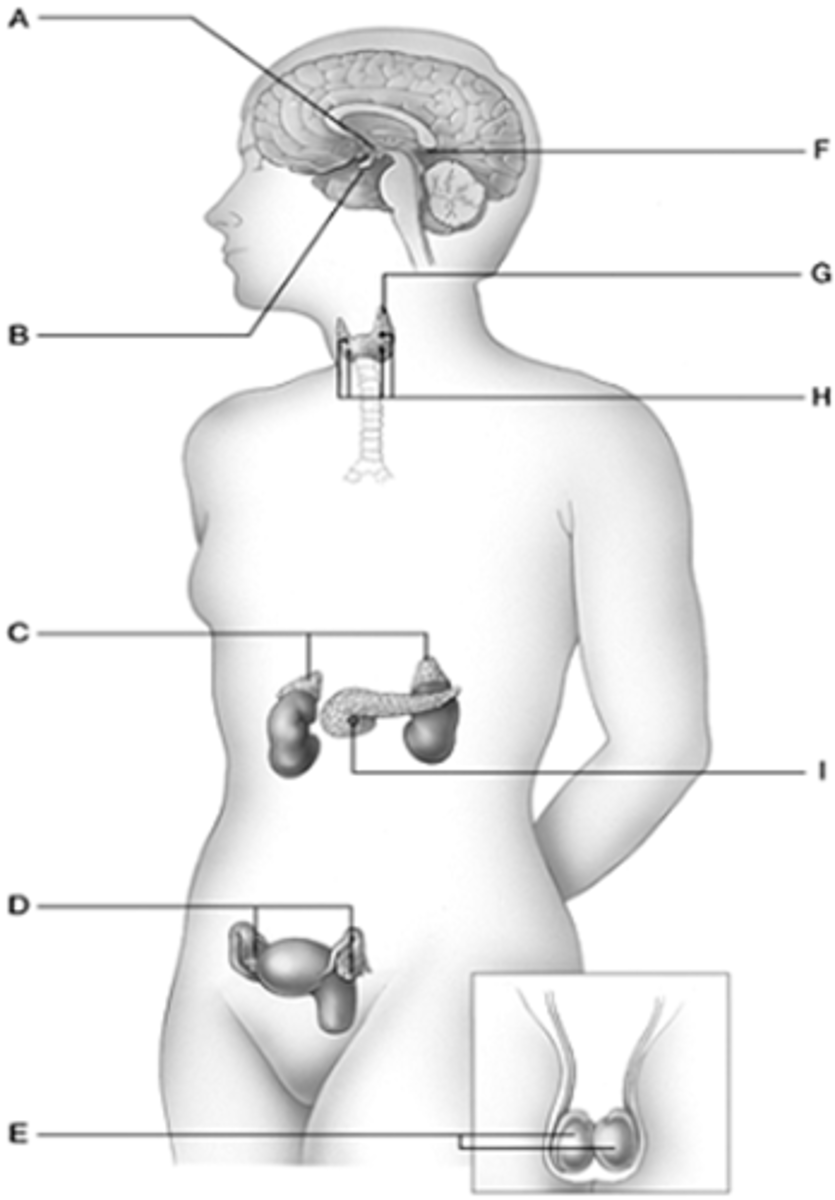
production site of the hormone that directly promotes growth in bones and muscles
b
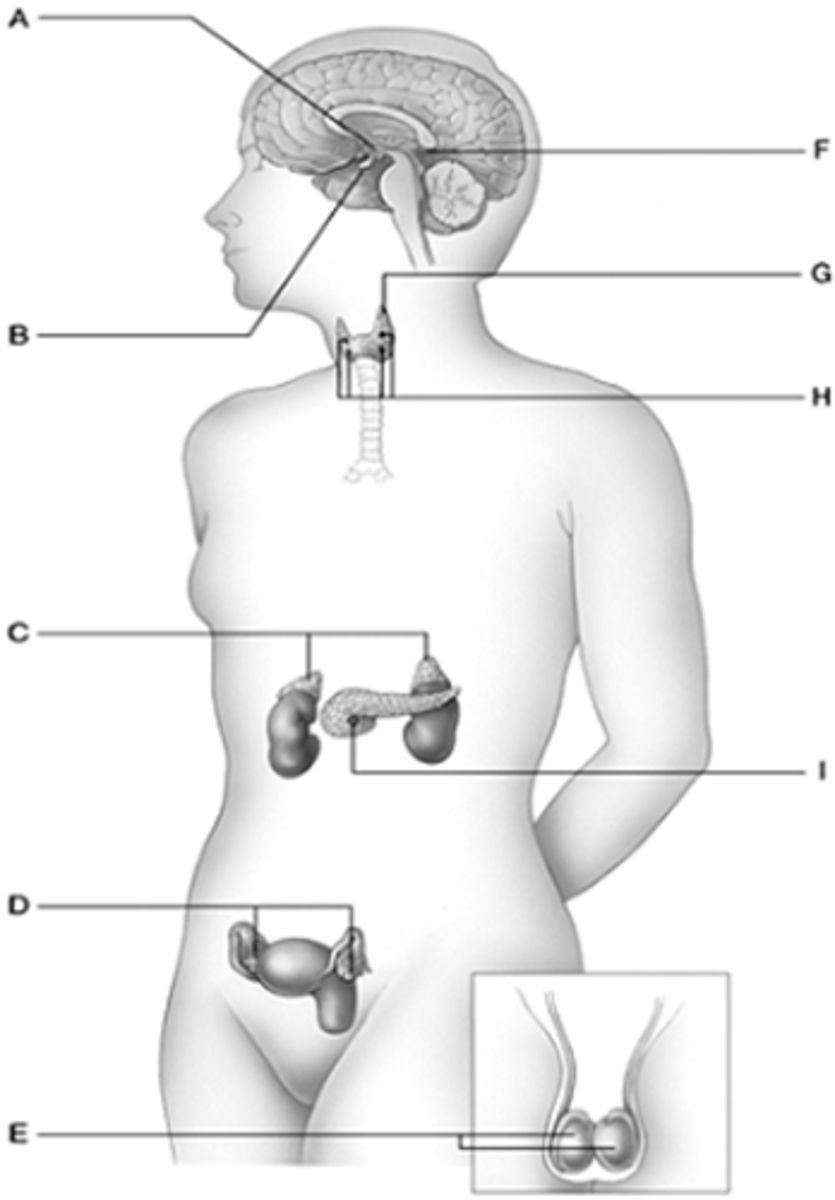
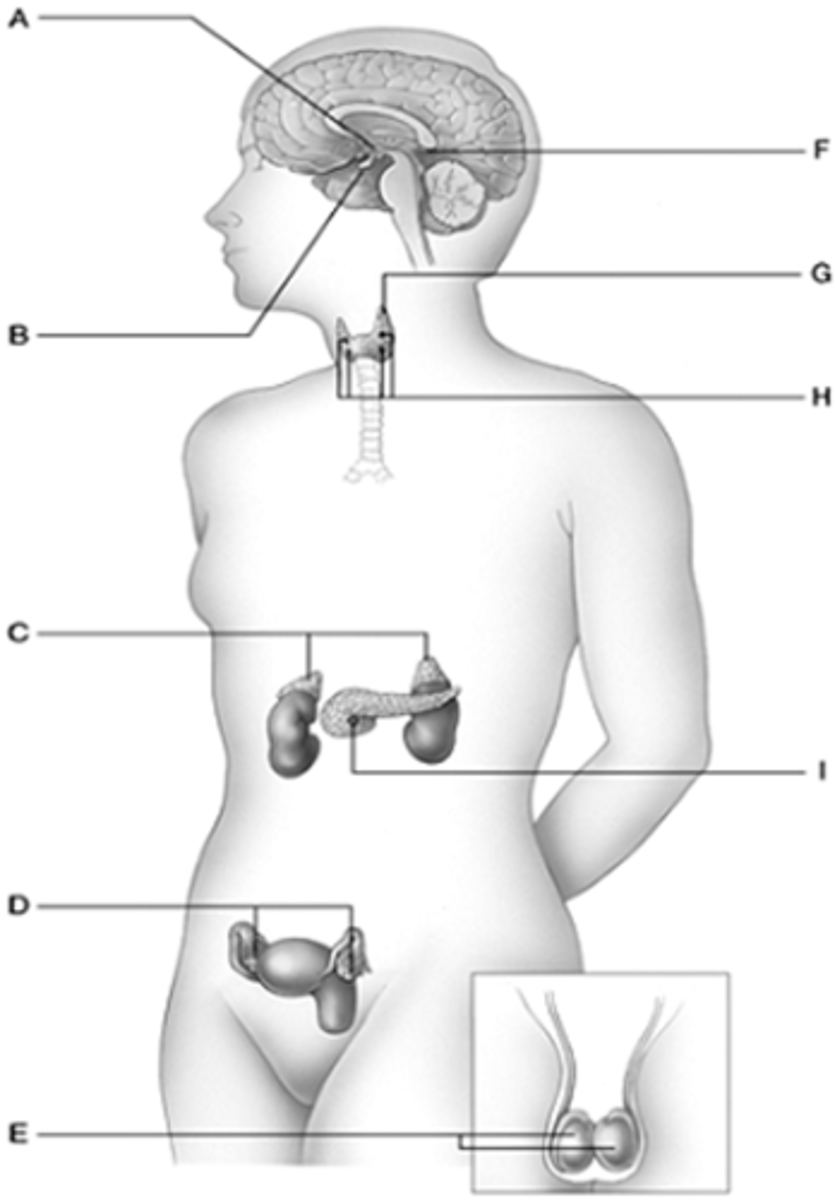
production site of the hormone that directly promotes growth in bones and muscles
b
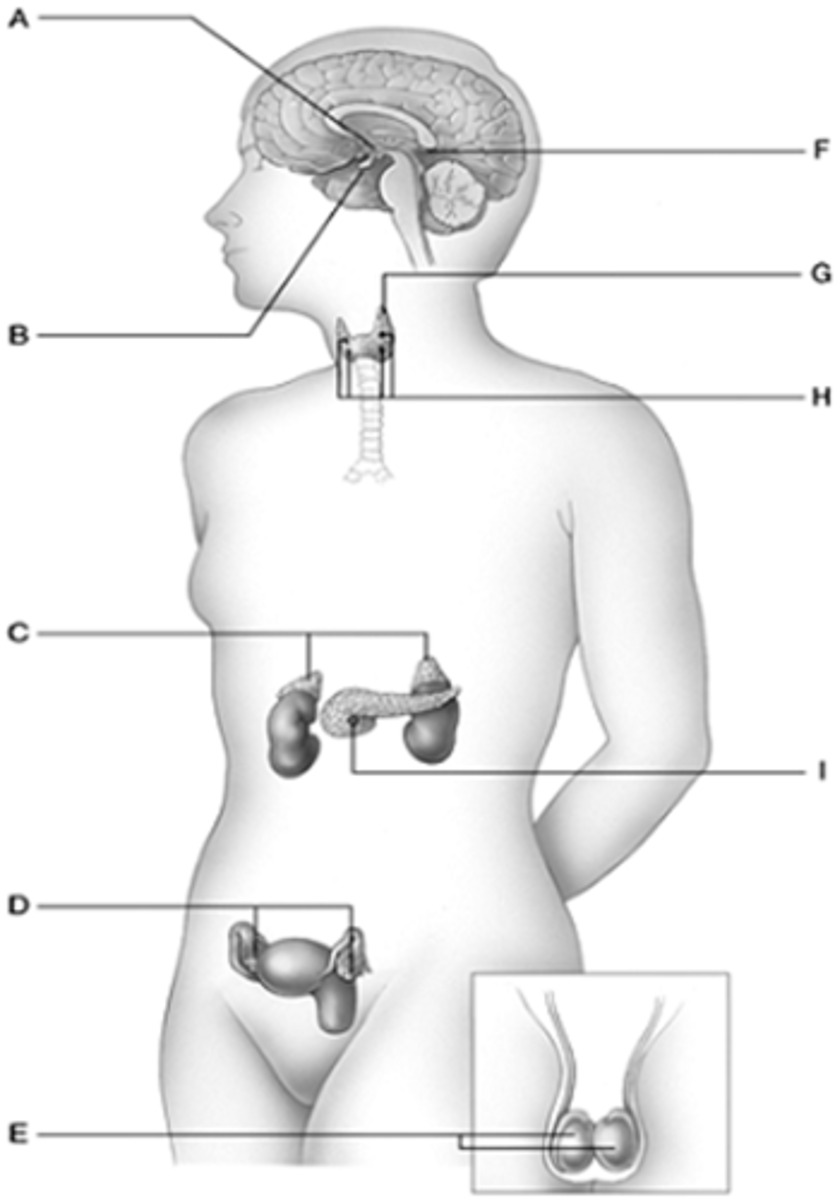
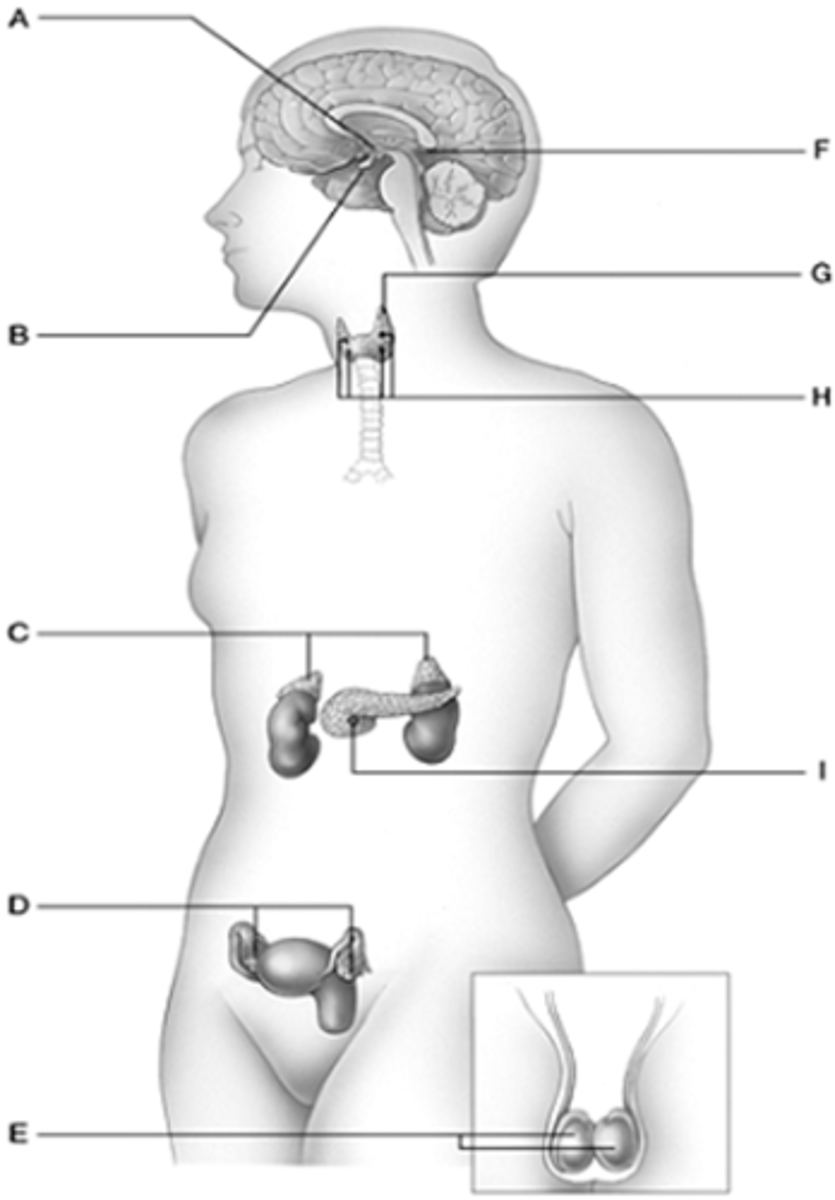
production site of hormone that targets the kidneys to stimulate water reabsorption and retention
b
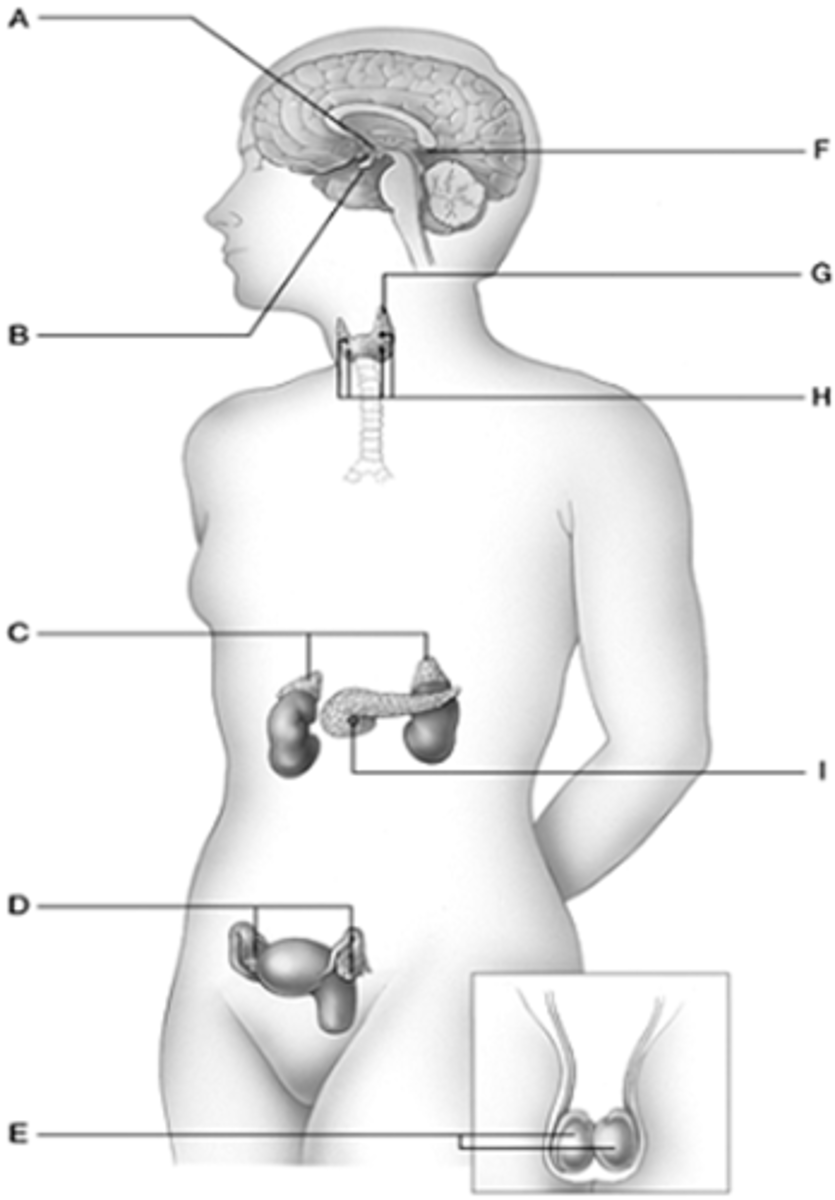
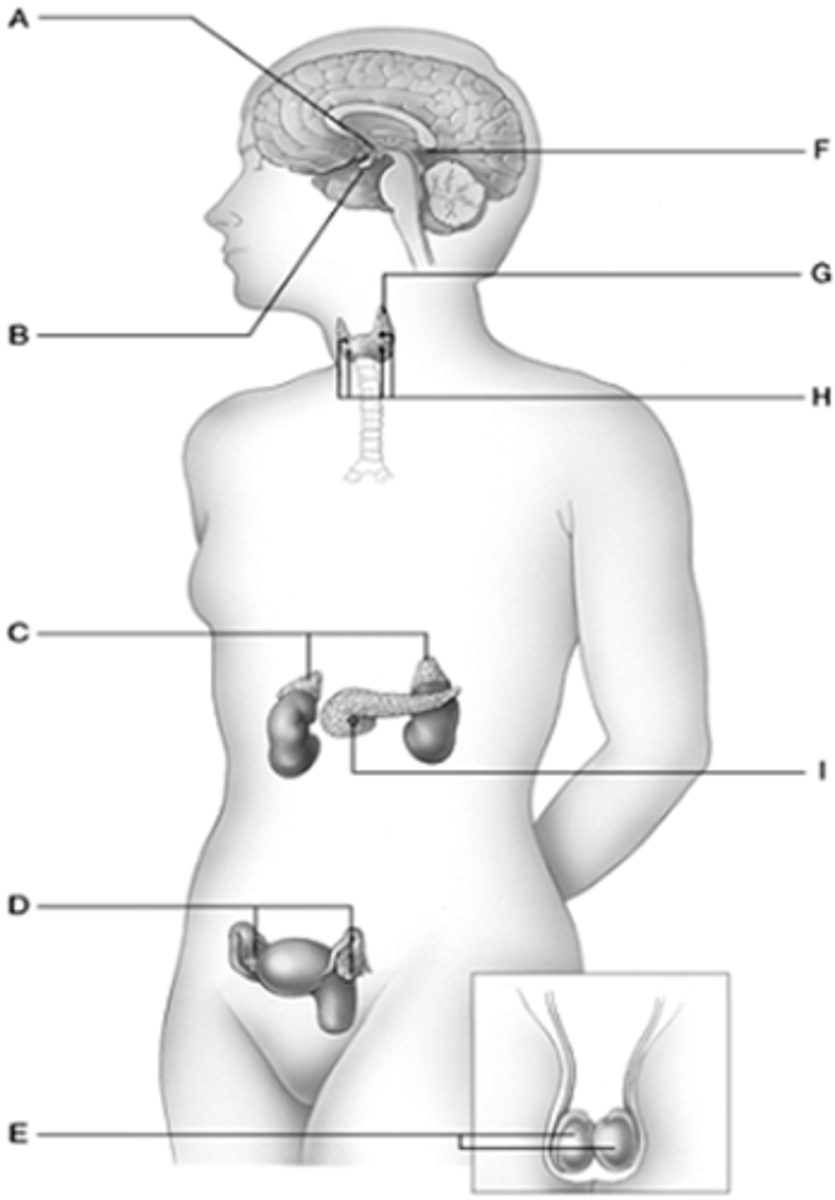
production site of androgens
e
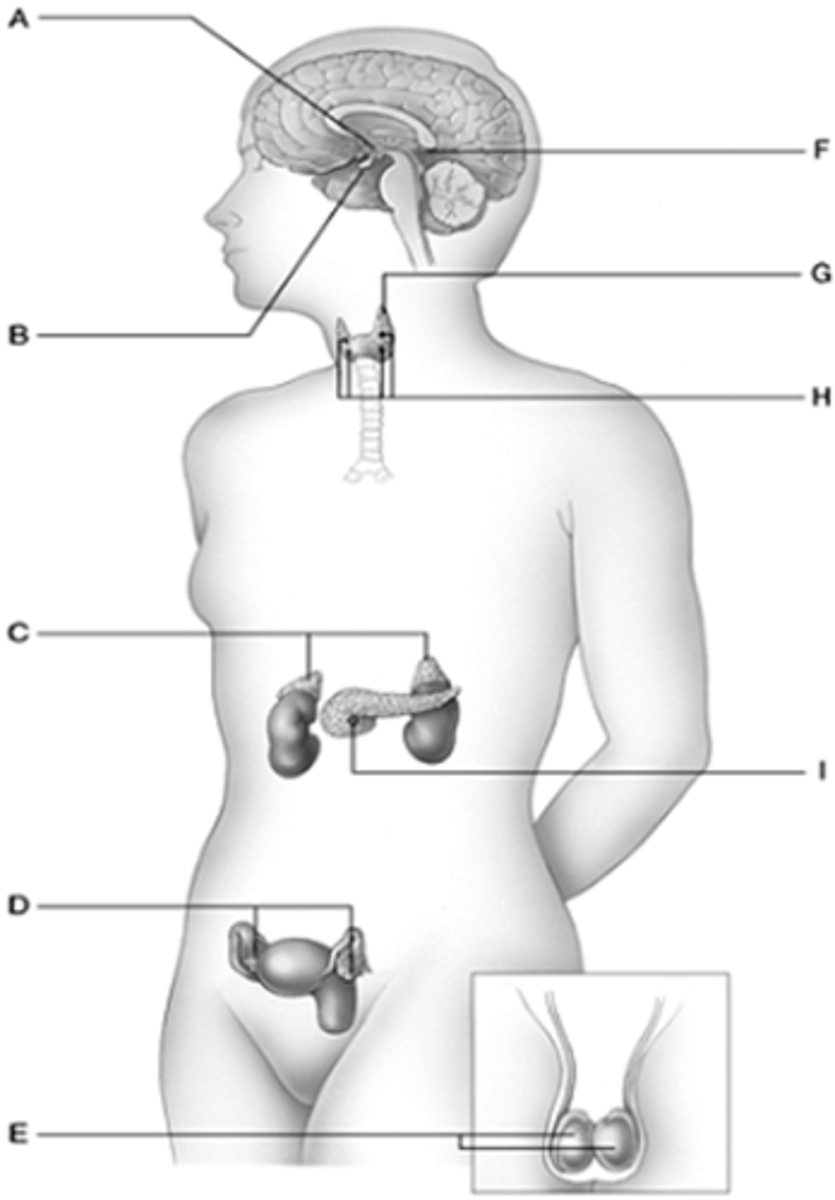
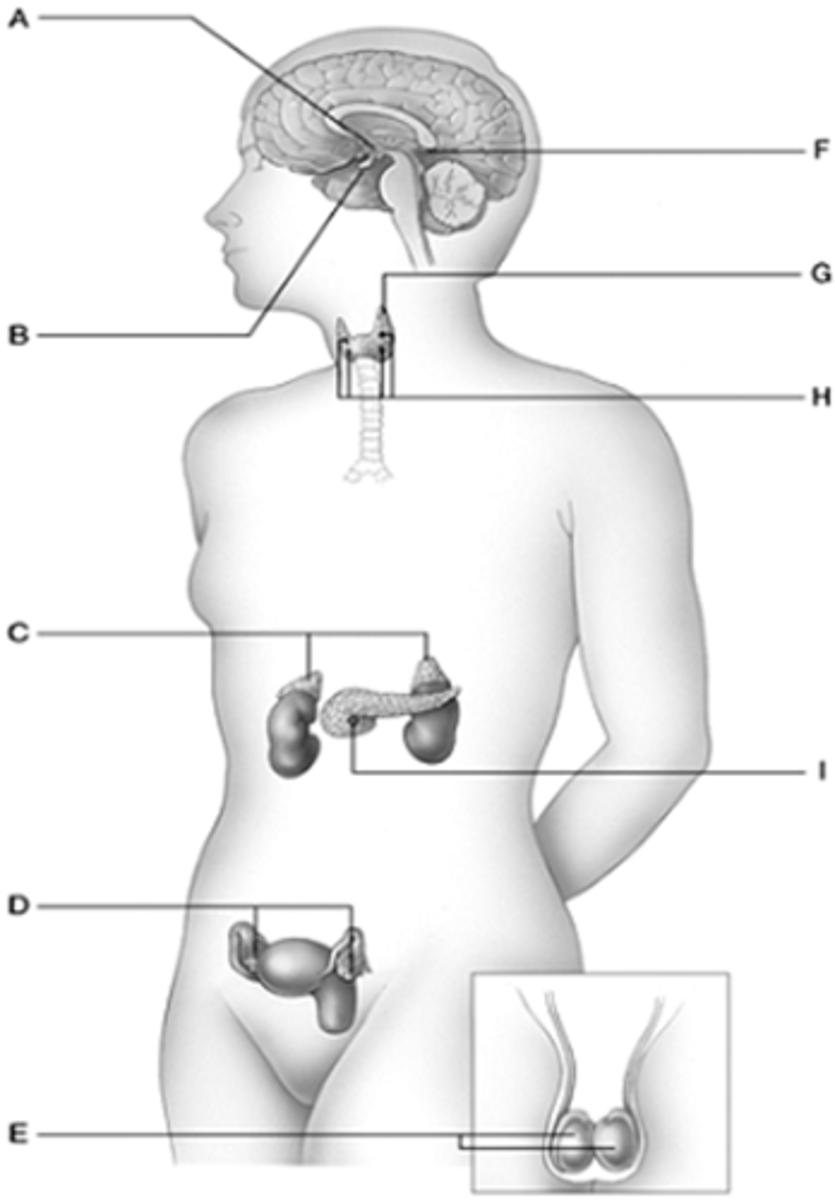
gland that produces progesterone that is under the control of GnRH
d
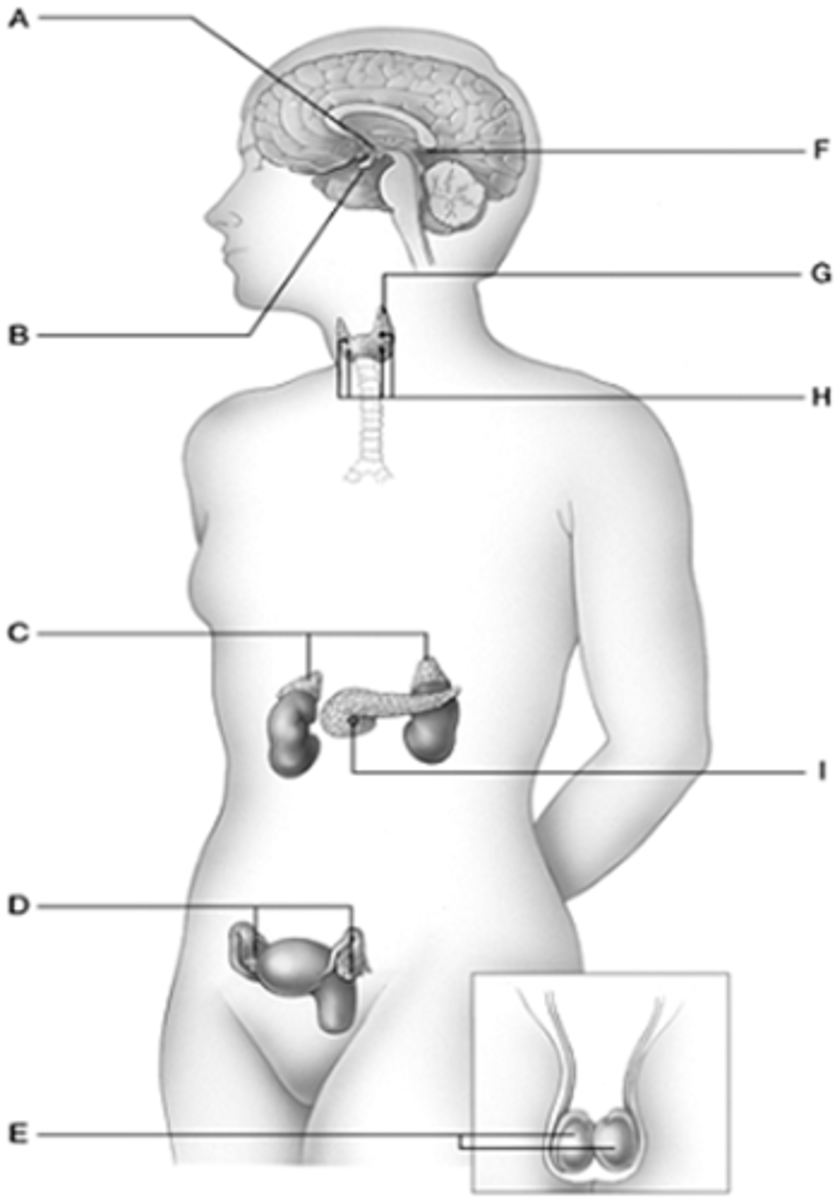
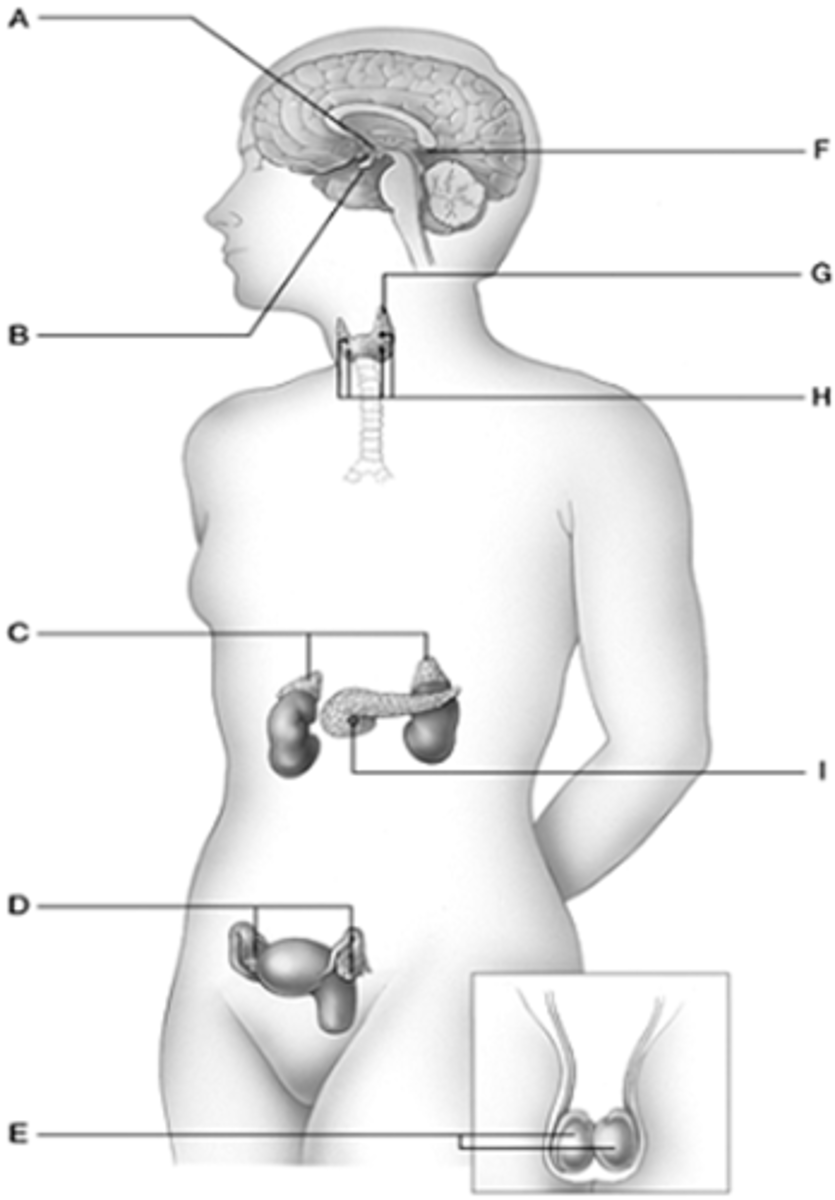
primary calcium regulation
h
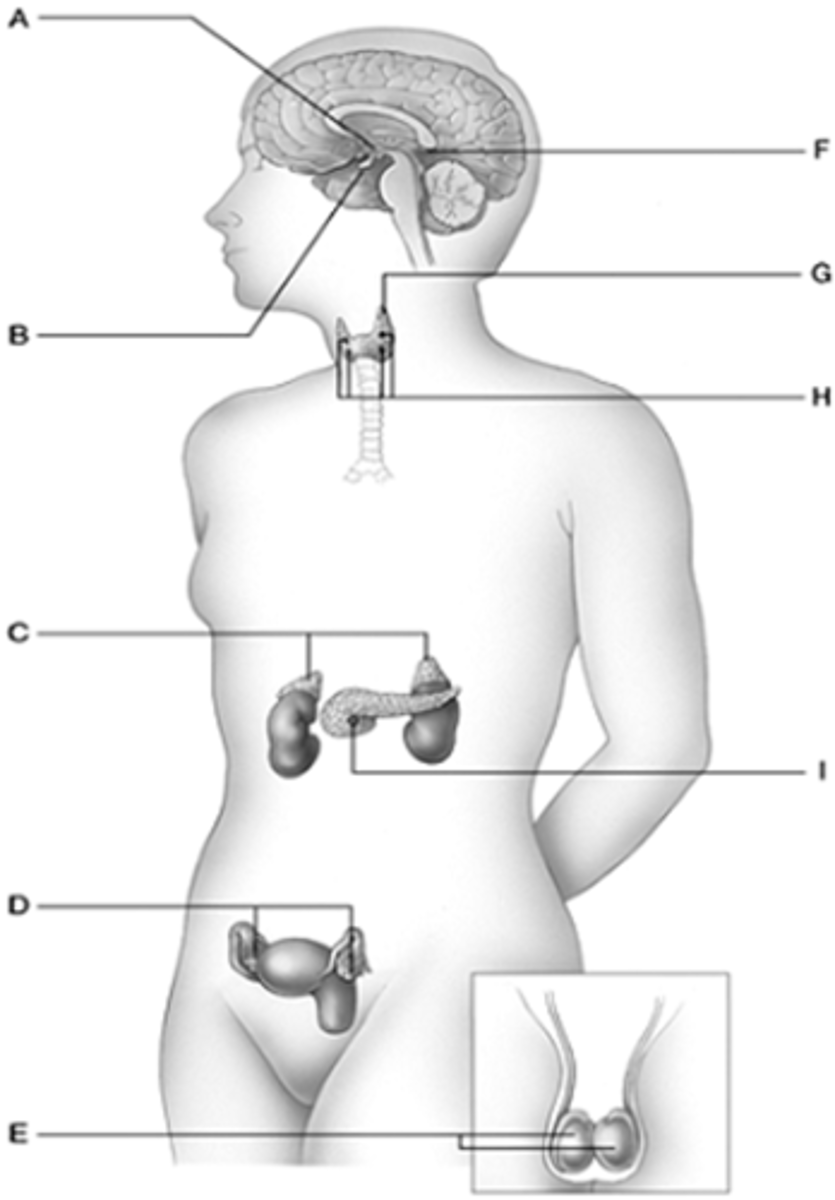
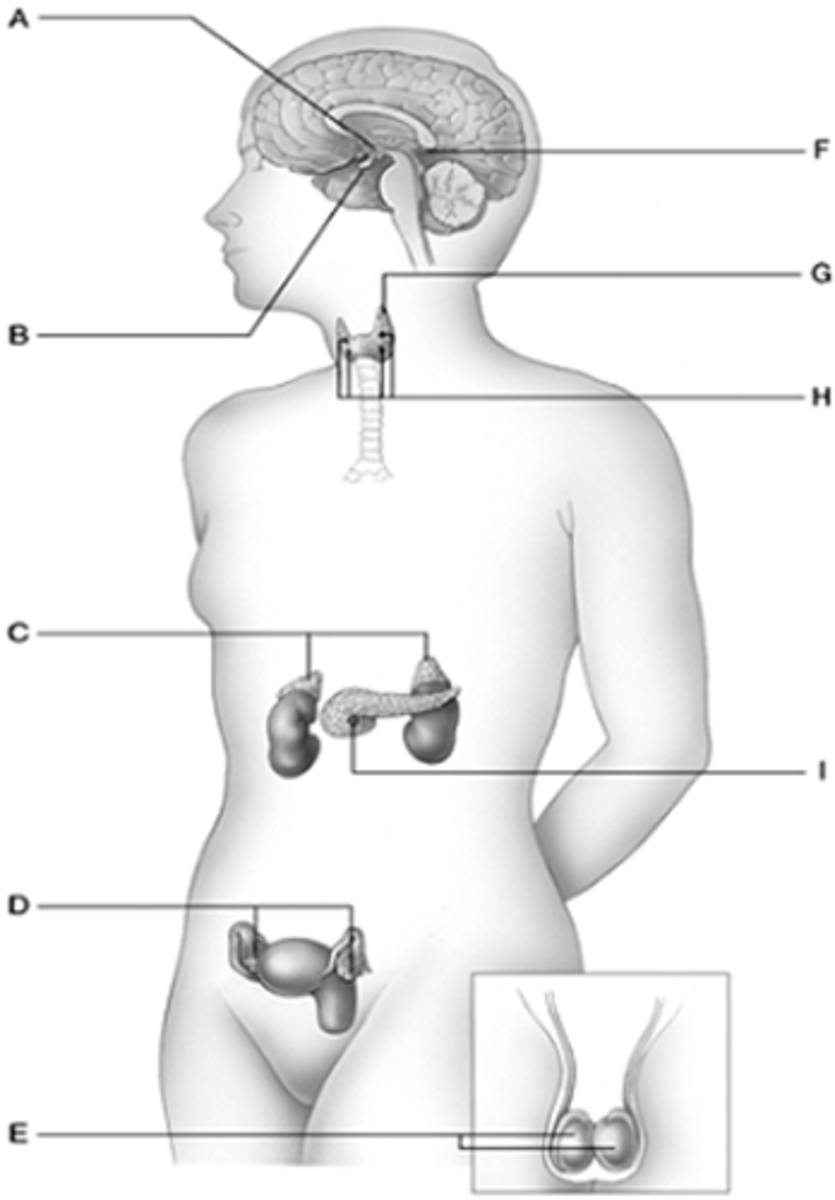
the hormone produced by this gland works in a synergistic fashion with vitamin D
h
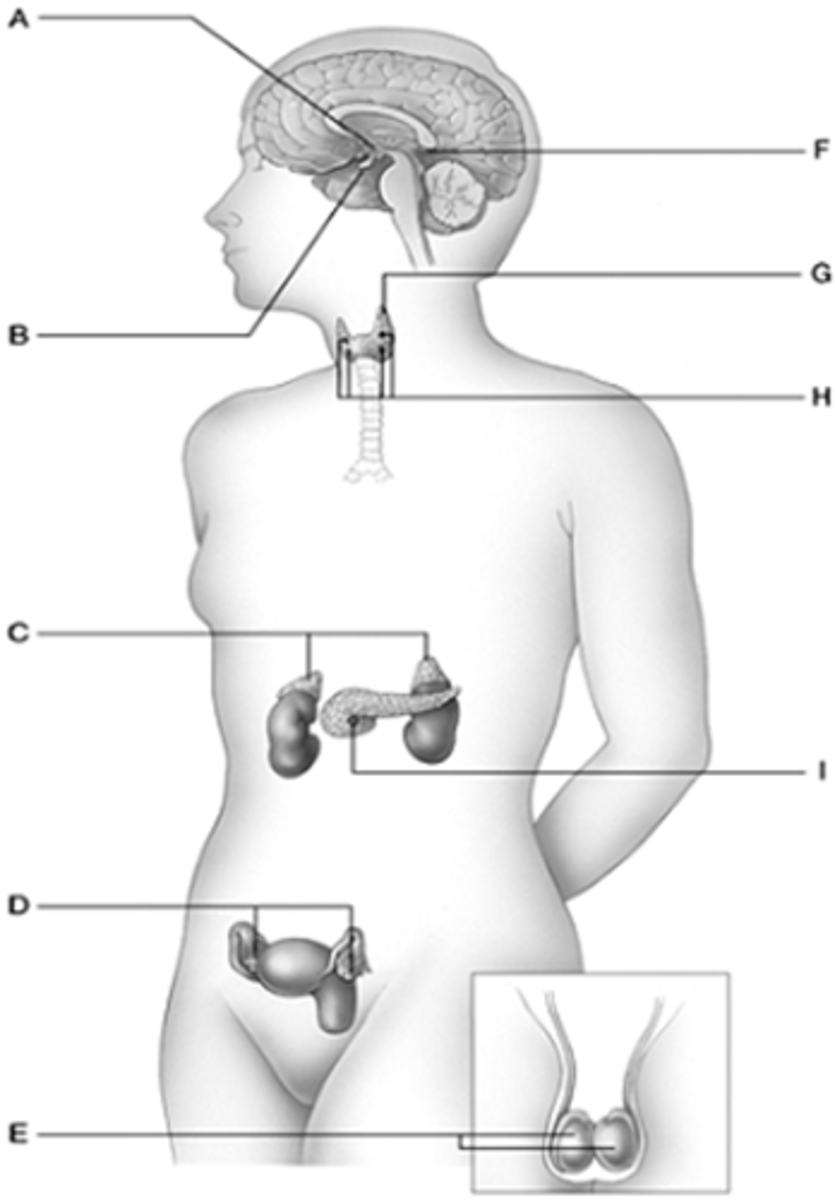
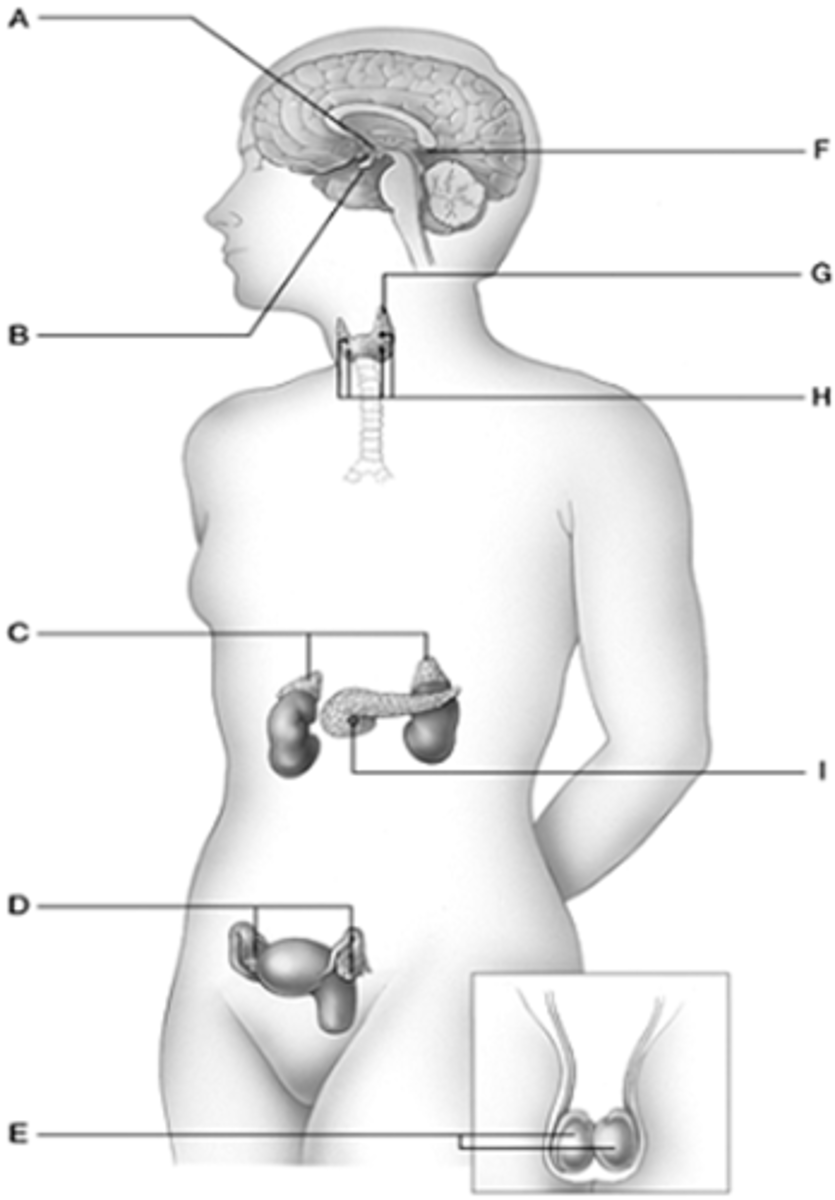
ADH production
a
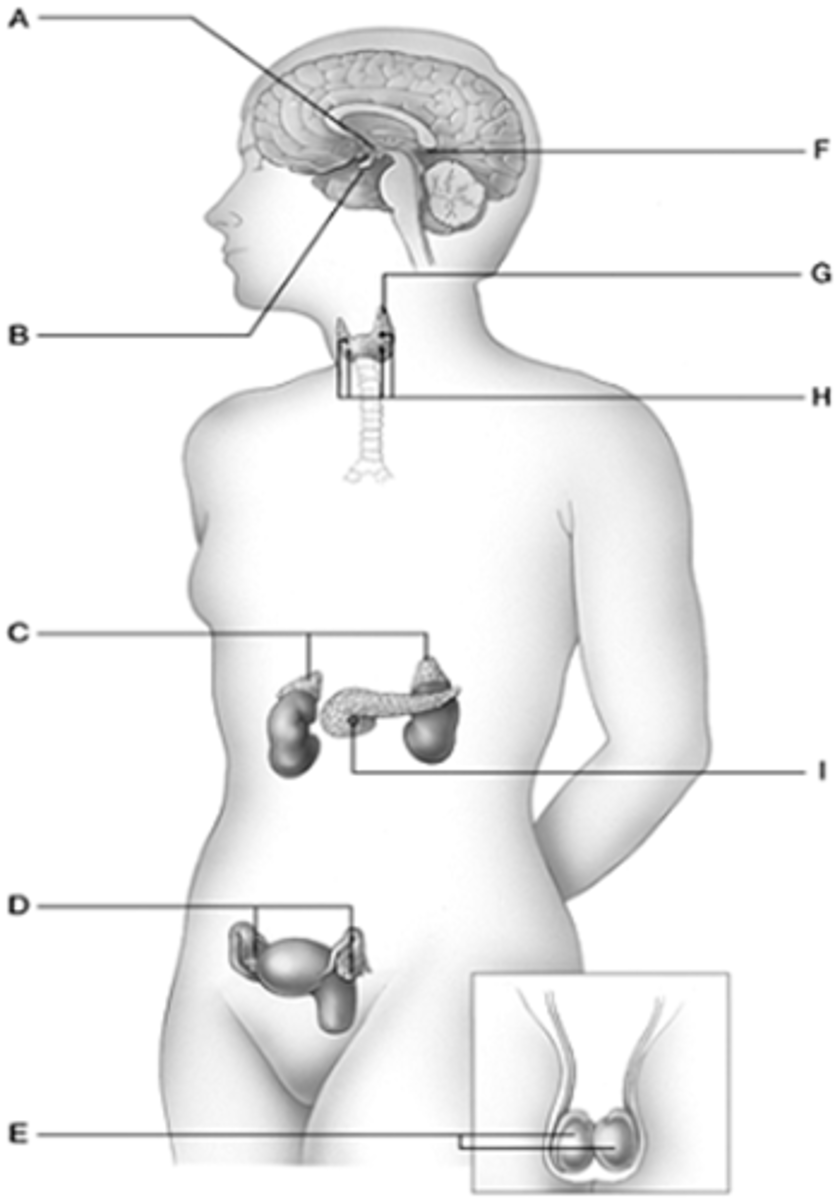
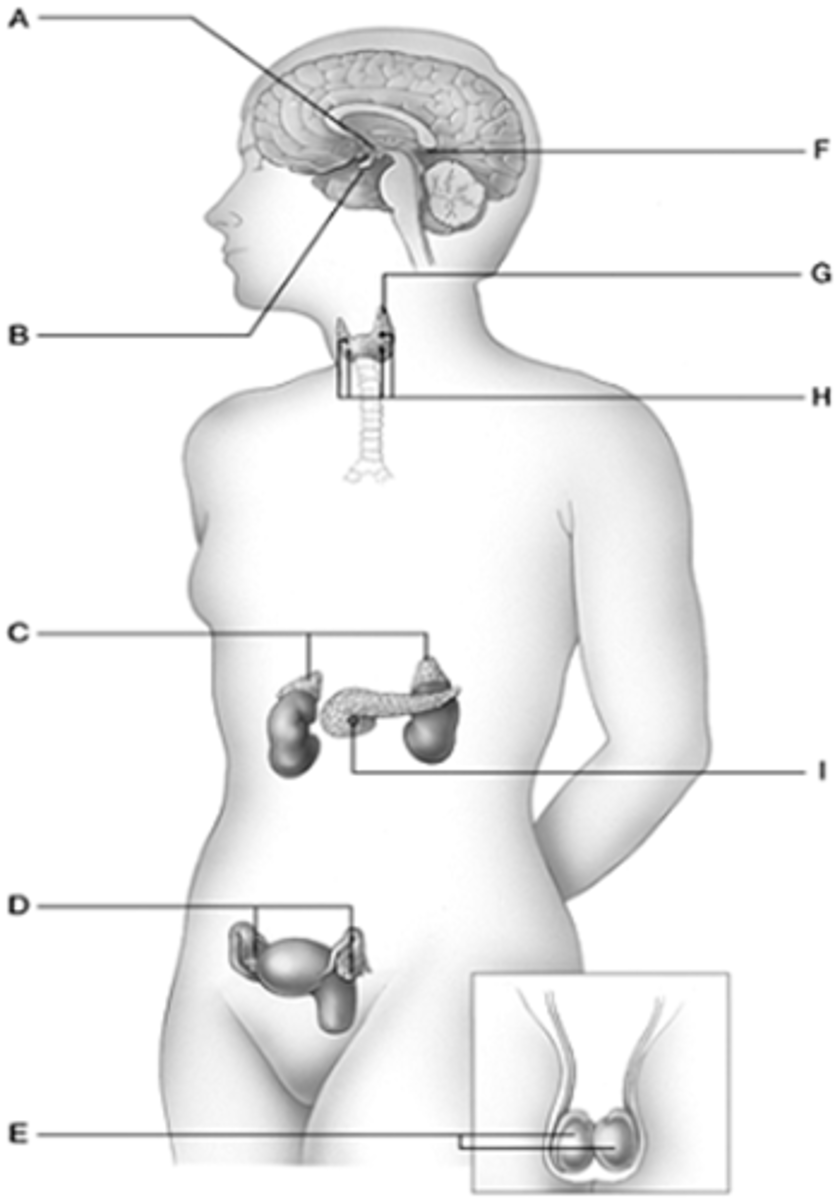
produces epinephrine and norepinephrine
c
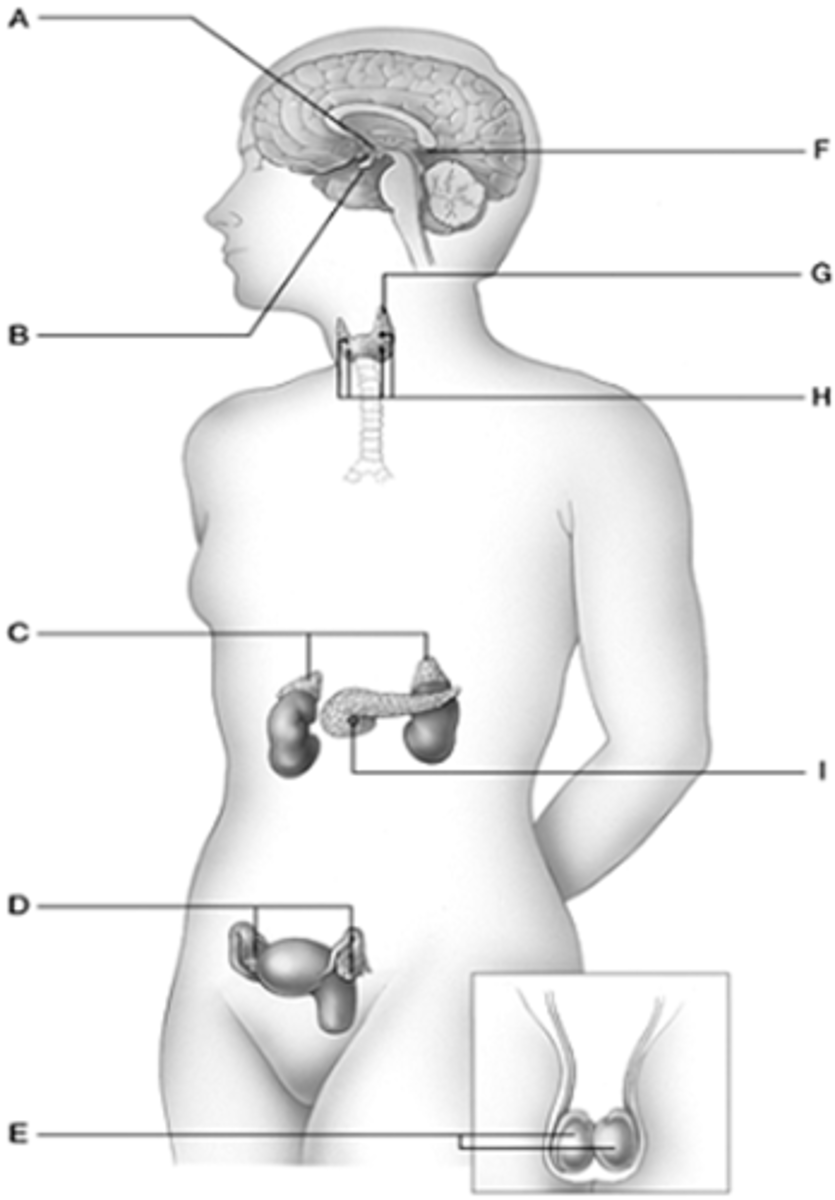
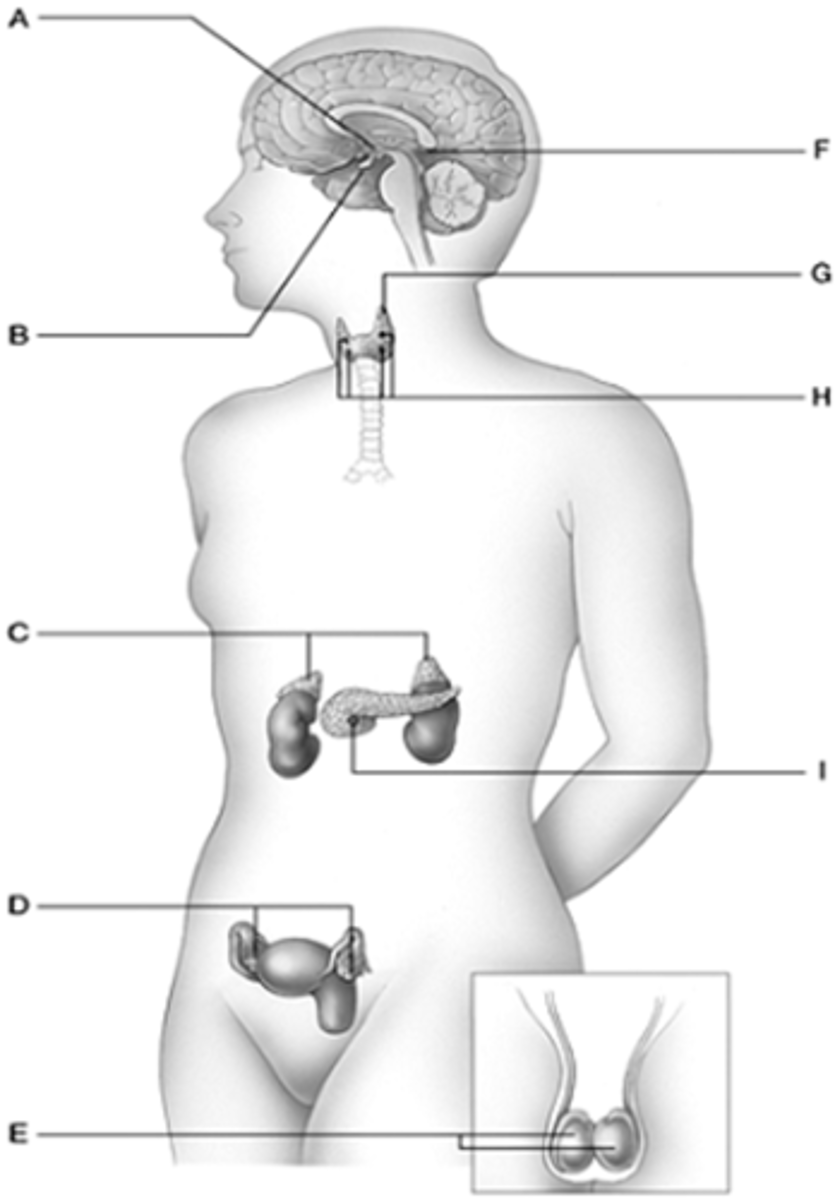
controls biological rhythms
f
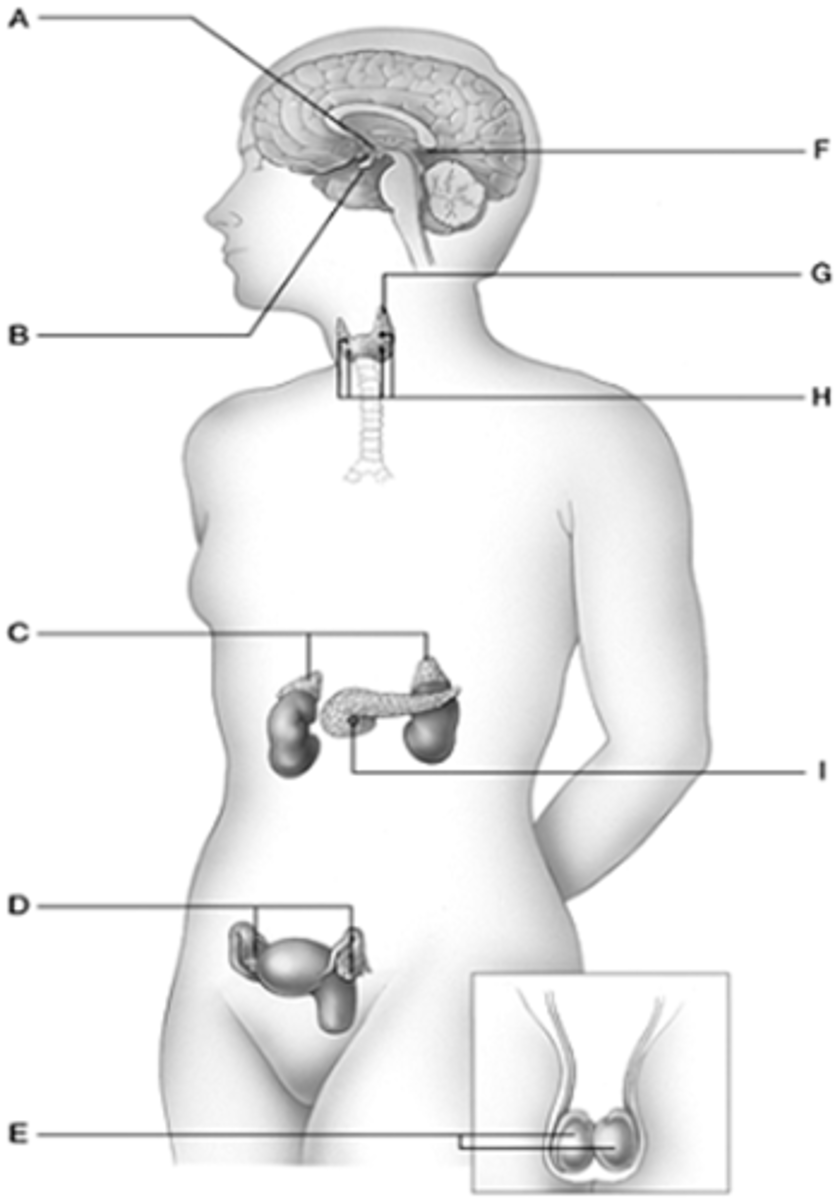
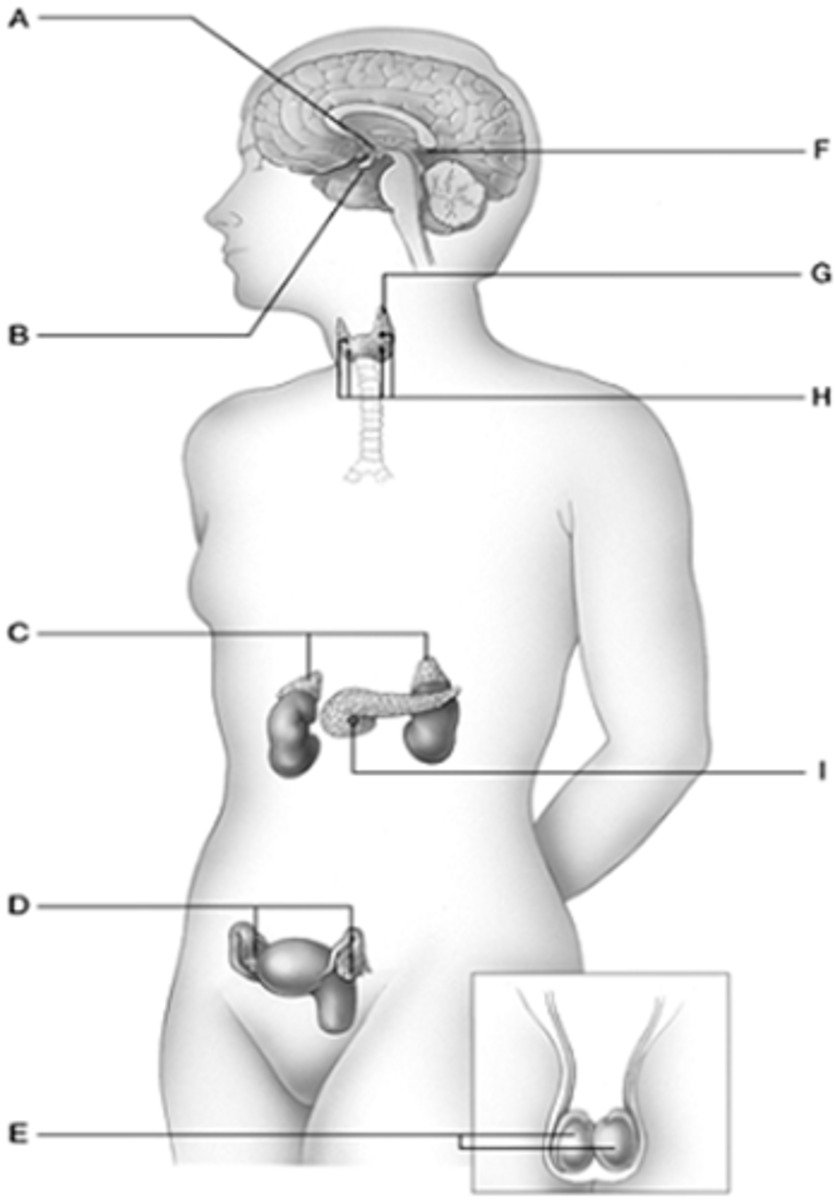
hormones from this gland play an important role in metamorphosis in amphibians
g
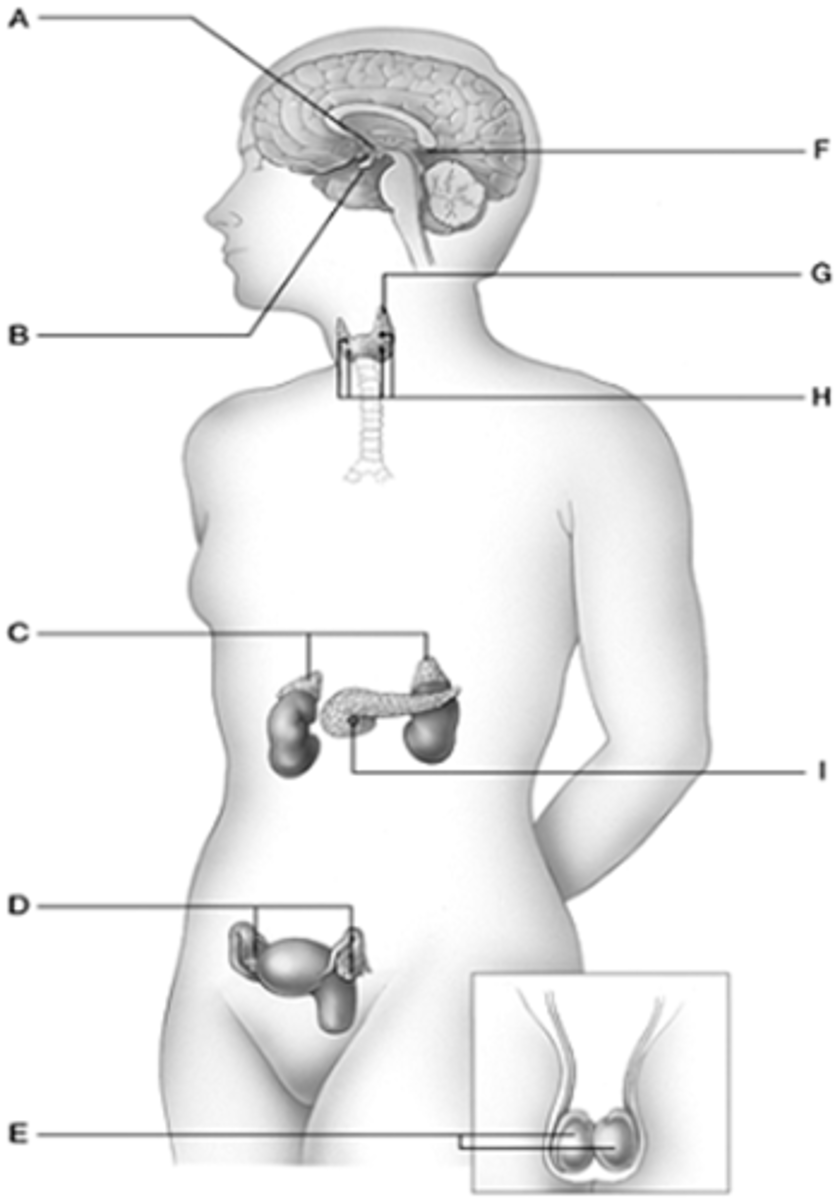
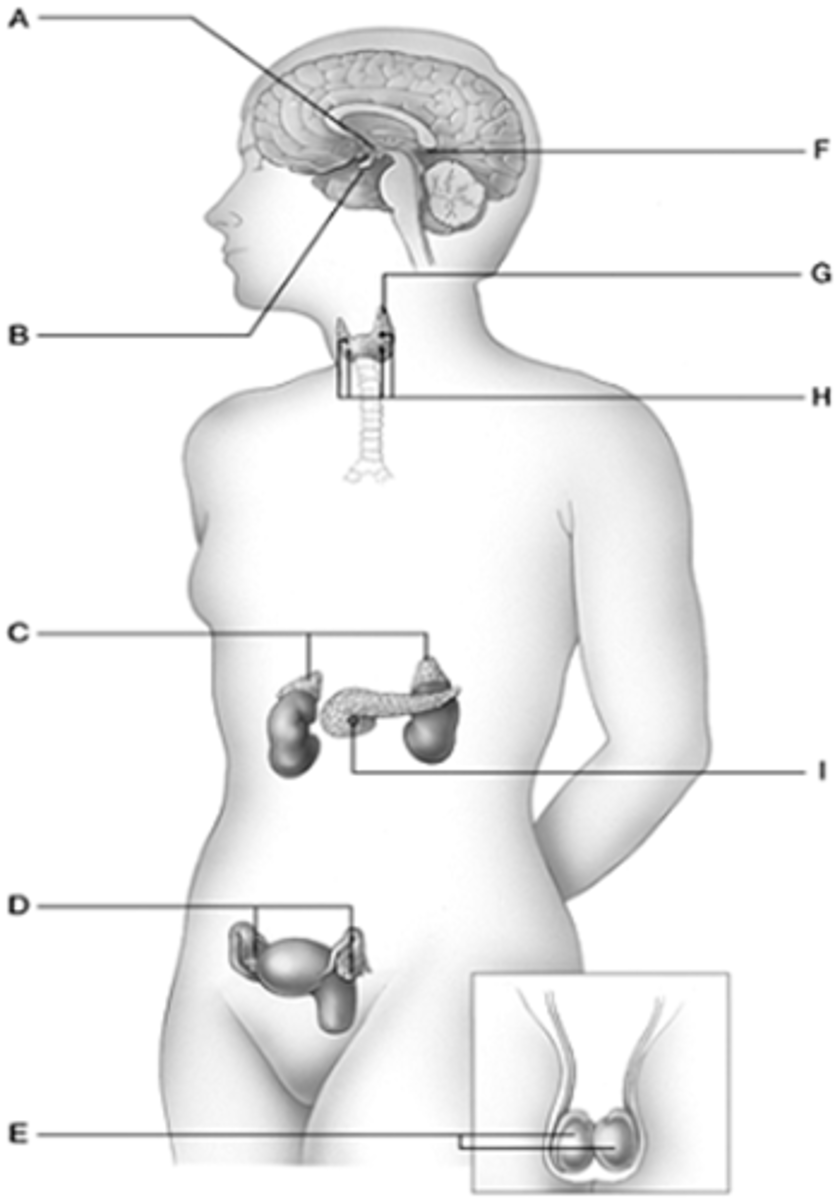
production and release of calcitonin
g
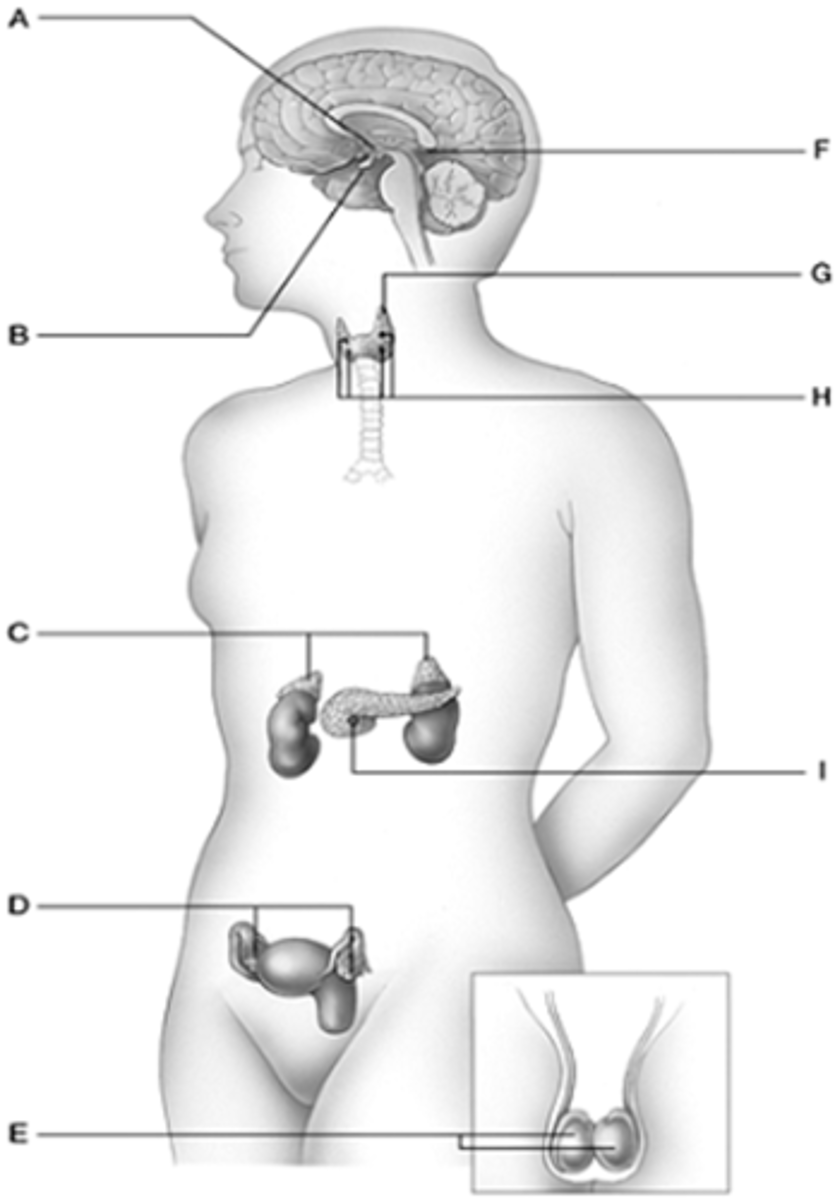
production site of the hormone that stimulates uterine contractions and milk let-down
a
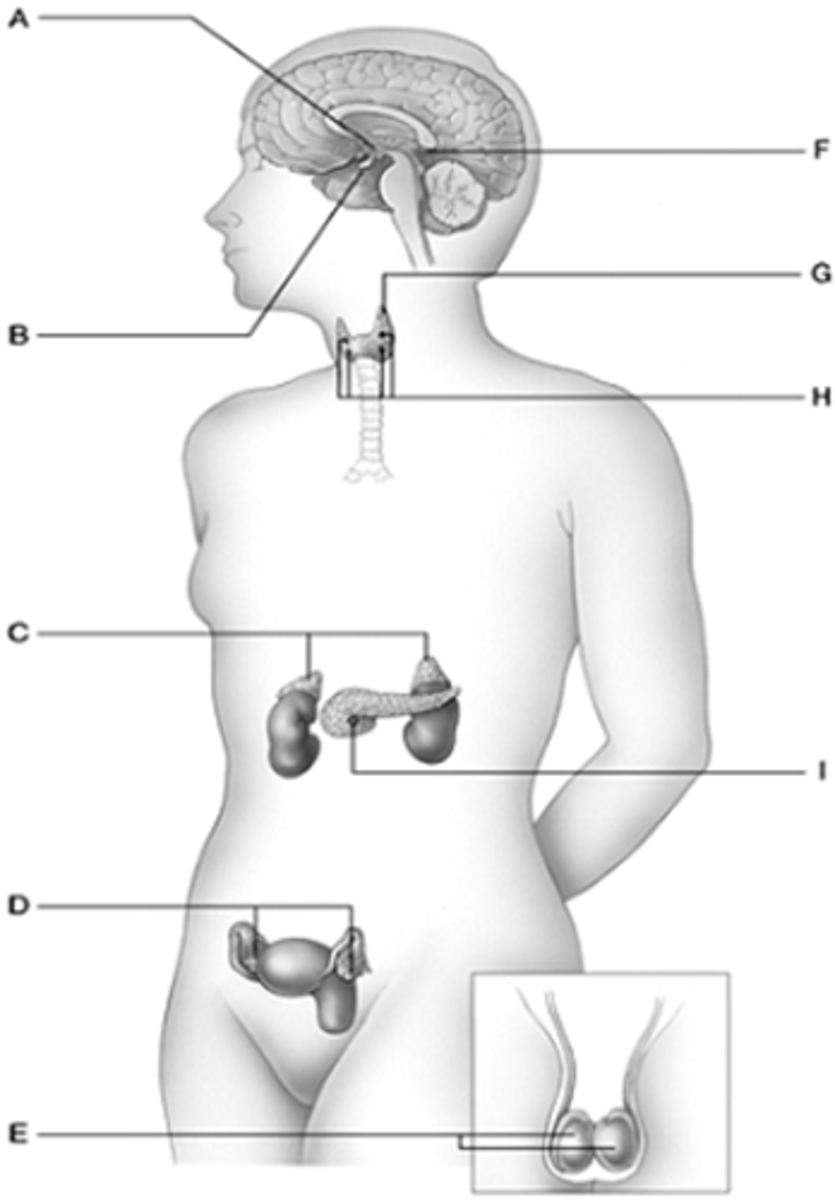
Hormones are cleared from the body by endocrine glands.
False - enzymatic breakdown
insulin is produced and released from the pineal gland
False - pancreas
Because they interfere with metamorphosis, ecdysone inhibitors could be effective as insecticides.
true
Prostaglandins are under neuroendocrine regulation
False - autocrine or paracrine
Oxytocin is secreted by the posterior pituitary in females only.
False - both males and females
Increases in melanocyte-stimulating hormone (MSH) could result in increased pigmentation.
true
Cyclic AMP activity is associated with hydrophobic hormones
false - hydrophillic
Fruit flies, mollusks, and humans all have insulin-like hormones and receptors, even though molecular studies suggest that their last common ancestor existed more than 800 million years ago.
true
Estrogens can both induce and prevent breast cancer cell proliferation.
true
Oxytocin can generate feelings of well-being as well as anxiety and stress.
true
Describe amplification of hormone action.
Binding of the hormone to a receptor triggers activation of many proteins, each of which activates an even larger number of proteins for the next step in the cellular reaction pathway, and so on, increasing in magnitude for each step in the pathway.
Explain negative feedback control using thyroid hormones as an example
When the T3 and T4 levels drop due to metabolism, the hypothalamus produces thyroid releasing hormone (TRH), which acts on the anterior pituitary to produce thyroid stimulating hormone (TSH). TSH stimulates the thyroid to produce and release T3 and T4. As the levels of T3 and T4 increase, the hypothalamus decreases the production of TRH and thus TSH from the anterior pituitary also decreases.
Compare and contrast receptor recognition between a hydrophobic and hydrophilic hormone
Hydrophobic hormones are typically lipid soluble hormones like steroids or fatty acid derivatives. These will diffuse into the cell and bind to intracellular receptors. Typical action of these hormones is to affect gene activity. Hydrophilic hormones are non-lipid soluble and thus cannot easily enter the cell. Receptors are typically membrane bound. The binding of the hormone to the receptor results in activation of a type of second messenger, which then causes a variety of effects from permeability changes to changes in enzyme activity.
A patient has very low plasma glucose levels, a condition called hypoglycemia. The problem is not associated with insulin, but with the secretion of glucocorticoids. How would you evaluate the patient to determine where in the feedback system the problem is located?
The adrenal cortex secretes glucocorticoids under the control of ACTH from the anterior pituitary. The anterior pituitary is under the control of releasing hormones (RHs) from the hypothalamus. The patient could be given an injection of ACTH and then monitor blood glucose levels. Next, the patient could be given an injection of RHs and blood glucose levels evaluated. Another way to address the problem would be to measure the levels of ACTH and RHs in the patient. If the RHs were elevated, then the problem would be ACTH production from the pituitary.
If a hormone caused an increase in protein kinase activity, predict the type of hormone responsible and the intracellular signaling mechanism of its action.
The hormone is most likely an amine, peptide, or other hydrophilic molecule. The receptor is a membrane bound receptor and a type of second messenger mechanism is involved. The second messenger could either be cyclic AMP or G-proteins.