Probability and Discrete/Continuous Random Variables in Statistics
 Call Kai
 Learn
Learn Practice Test
 Spaced Repetition
 Match
Match Flashcards
 Knowt Play
1/22

There's no tags or description
Looks like no tags are added yet.
Name | Mastery | Learn | Test | Matching | Spaced | Call with Kai |
|---|
No analytics yet
Send a link to your students to track their progress
23 Terms
What is a random variable?
A variable whose value is a numerical outcome of a random phenomenon.
What does the probability distribution of a random variable X define?
It identifies the values X can take and how to assign probabilities to those values.
What are the two requirements for probabilities in a discrete probability model?
Every probability must be between 0 and 1 inclusive, and the sum of all probabilities must equal 1.
How is the probability P(X > a) calculated using P(X ≤ a)?
P(X > a) = 1 - P(X ≤ a)
How is the probability P(a < X < b) calculated?
P(a < X < b) = P(X < b) - P(X ≤ a)
How is the probability P(X ≤ a) calculated?
P(X ≤ a) = P(X < a) + P(X = a)
How is the probability P(X < a ∪ X > b) calculated?
P(X < a ∪ X > b) = P(X < a) + P(X > b)
What defines a discrete random variable?
A variable that has a countable or finite list of possible outcomes.
What is the formula for the mean (expected value) of a discrete random variable?
The sum of each specific value the random variable can take multiplied by the probability associated with that specific value. μX = Σ(xi * pi)
What is the formula for the variance of a discrete random variable?
σ² = Σ(xi - μX)² * pi
How is the standard deviation of a random variable derived from its variance?
It is the square root of the variance.
What characterizes a continuous random variable?
It can take on all values within an interval. The probability distribution of X is described by the density curve. The probability of any event is the area under the density curve.
How are probabilities assigned in a continuous probability model?
As areas under a density curve.
What is the total area under any valid density curve?
Exactly 1.
What is the probability that a continuous random variable X takes on any single exact value c?
P(X = c) = 0.
For continuous variables, how does P(c < X < d) compare to P(c ≤ X ≤ d)?
They are equal.
What is a uniform distribution?
A continuous distribution that assigns equal probability to every number or interval of a given length within its range.
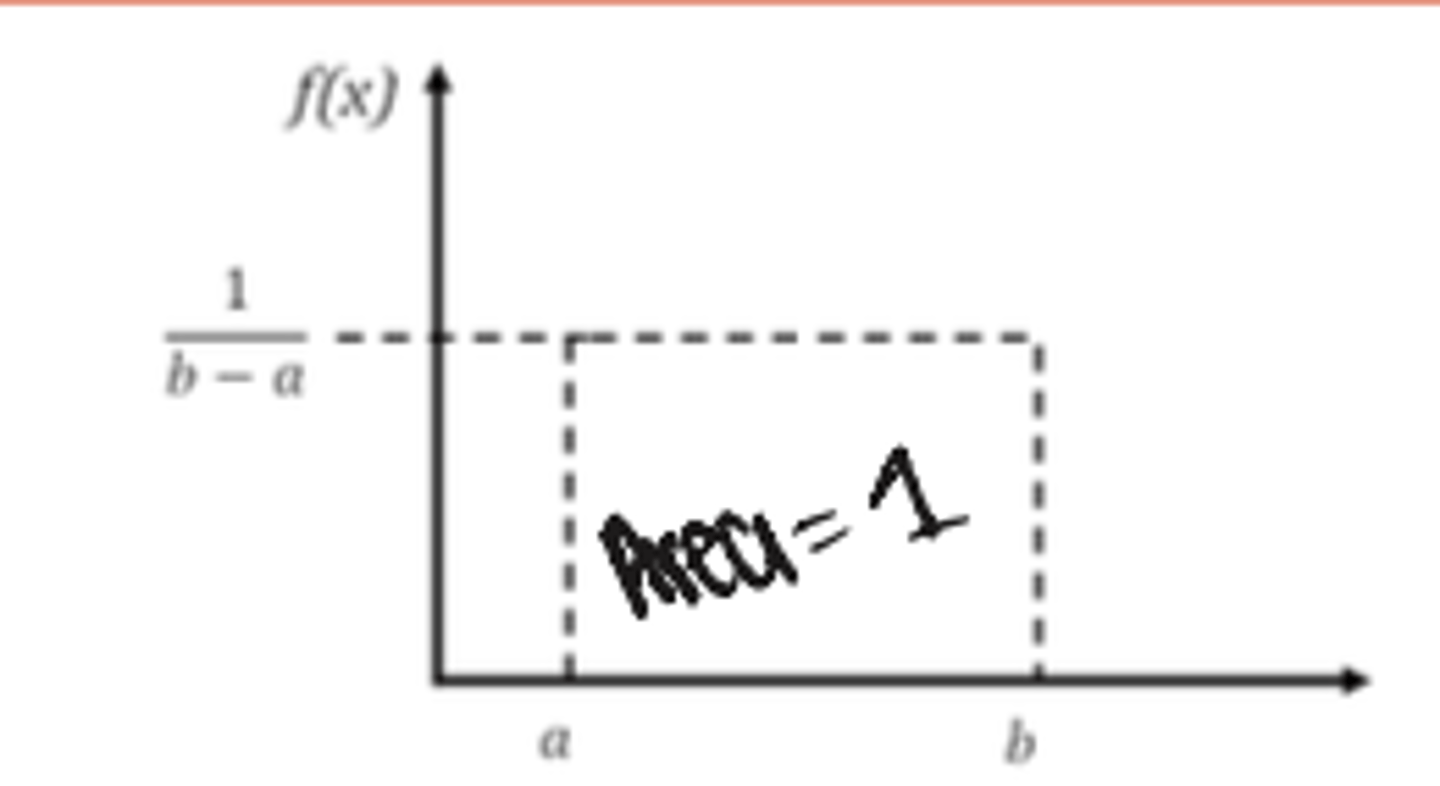
If a uniform distribution is defined over an interval [a, b], what is its height?
1 / (b - a).
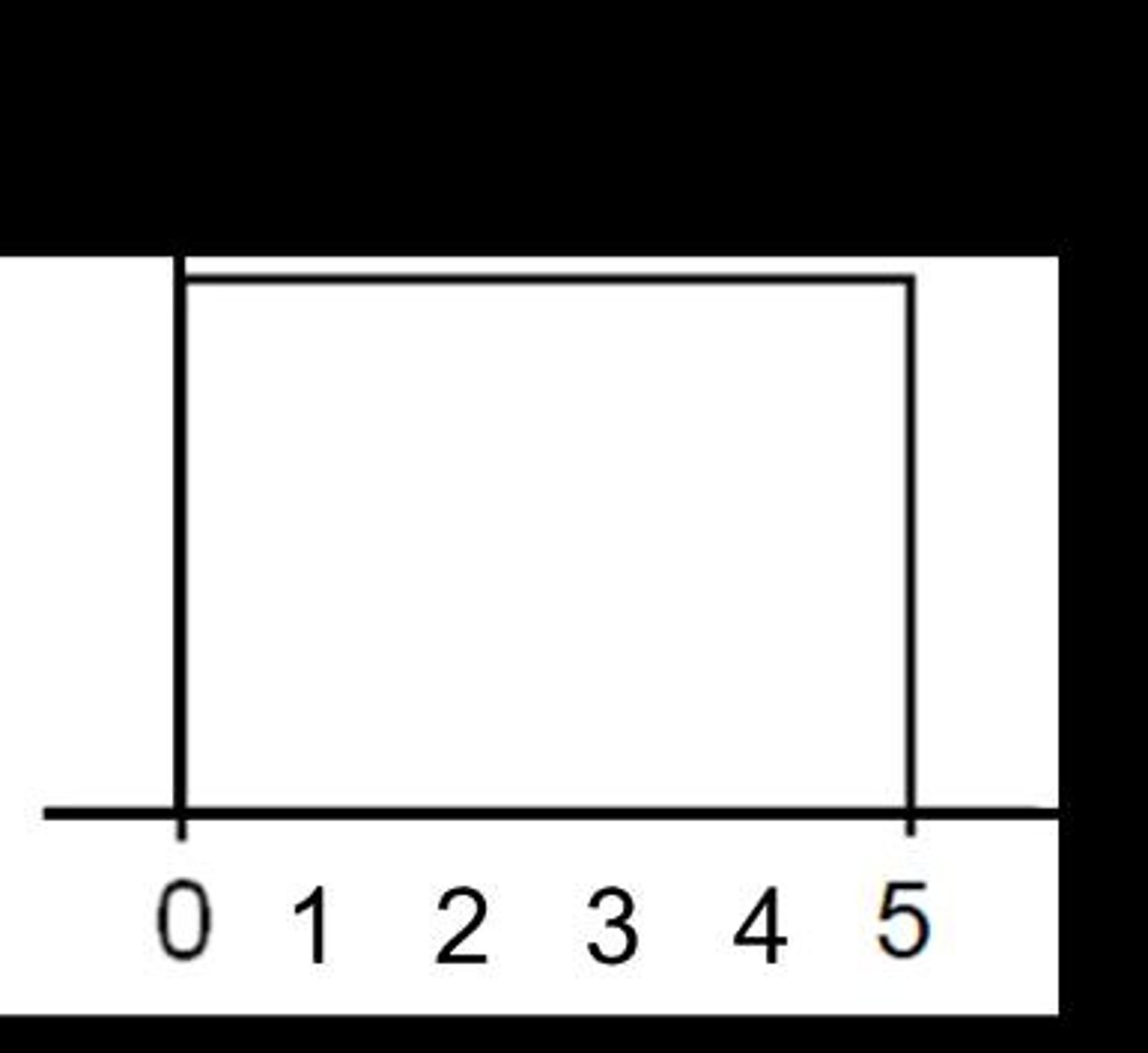
How do you calculate the probability of an interval [c, d] in a uniform distribution?
Multiply the length of the interval (d - c) by the height of the distribution.
What is the expected value of a random variable representing?
The long-term average outcome of the random variable.
What is the primary difference between discrete and continuous probability models regarding outcome values?
Discrete models have countable outcomes, while continuous models represent values in an interval.
Why is the probability of a single point in a continuous distribution zero?
Because the area of a line segment (width of zero) under a curve is zero.
What does the variance measure in a probability distribution?
The spread or dispersion of the random variable's values around the mean.