ECON 102 Final
0.0(0)
Studied by 3 people Call Kai
 Learn
Learn Practice Test
 Spaced Repetition
 Match
Match Flashcards
 Knowt Play
Card Sorting
1/63

Earn XP
Description and Tags
Last updated 1:06 PM on 5/1/23
Name | Mastery | Learn | Test | Matching | Spaced | Call with Kai |
|---|
No analytics yet
Send a link to your students to track their progress
64 Terms
1
New cards
Economic Rent
* paying for the use of any resource above its opportunity cost
* Largest when:
* resources can’t be replicated
* little competition
* goods/services are allocated to resources that place the highest value on them
* Largest when:
* resources can’t be replicated
* little competition
* goods/services are allocated to resources that place the highest value on them
2
New cards
Accounting profit
* the actual amount of money a company earns during a given period. If 0, there is no profit
3
New cards
Economic profit
* Will always ≤ accounting profit.
* If 0, you are earning as much as you could at your next-best alternative
* If 0, you are earning as much as you could at your next-best alternative
4
New cards
Economic Profits As Signals
* Negative: you could earn more money elsewhere, exit the industry
* Positive: your firm/industry is doing well, others should enter
* Zero: you are doing as well as you could elsewhere, but you could do just as well doing something else, don’t exit or enter
* Positive: your firm/industry is doing well, others should enter
* Zero: you are doing as well as you could elsewhere, but you could do just as well doing something else, don’t exit or enter
5
New cards
Total revenue (TR)
P x Q
6
New cards
Profit (π)
TR - TC
7
New cards
Short run vs long run
* Short run: capital is fixed input
* Long run: all factors of production can be varied, except for the current level of technology
* Long run: all factors of production can be varied, except for the current level of technology
8
New cards
Marginal principle
* If MR > MC, produce more
* If MR < MC, reduce to MR = MC
* If MR = MC, optimal level of production where profit is maximized
* If MR < MC, reduce to MR = MC
* If MR = MC, optimal level of production where profit is maximized
9
New cards
Total product (TP)
the total amount of output produced
10
New cards
Average product labor (APL) and Average product capital (APK)
* APL = TP/L
* APK = TP/K
* APK = TP/K
11
New cards
Marginal product labor (MPL)/marginal product capital (MPK)
* the change in total output that results from using one more unit of an input
* MPL = ΔTP/ΔL
* MPK = ΔTP/ΔK
* MPL = ΔTP/ΔL
* MPK = ΔTP/ΔK
12
New cards
Diminishing MPL vs diminishing APL
Initially the MPL/APL will increase with each additional unit of labor we add; however, when adding a worker has a positive MPL but lower than the previous worker’s MPL - diminishing marginal productivity/when the average number of units we produce per laborer starts to decrease - diminishing average productivity
13
New cards
If MPL > APL, APL curve?
If MPL < APL, APL curve?
If MPL < APL, APL curve?
* APL curve will slope upward
* diminishing APL starts and slope downward
* diminishing APL starts and slope downward
14
New cards
Total fixed costs (TFC)
constant at all activity levels within the relevant range, horizontal graph
15
New cards
Total variable costs (TVC)
changes in direct proportion to the number of units produced in the relevant range, always at the origin, positive linear graph
16
New cards
Total costs
changes in direct proportion to the number of units produced due to variable costs, positive linear graph above the origin, y-intercept = FC
17
New cards
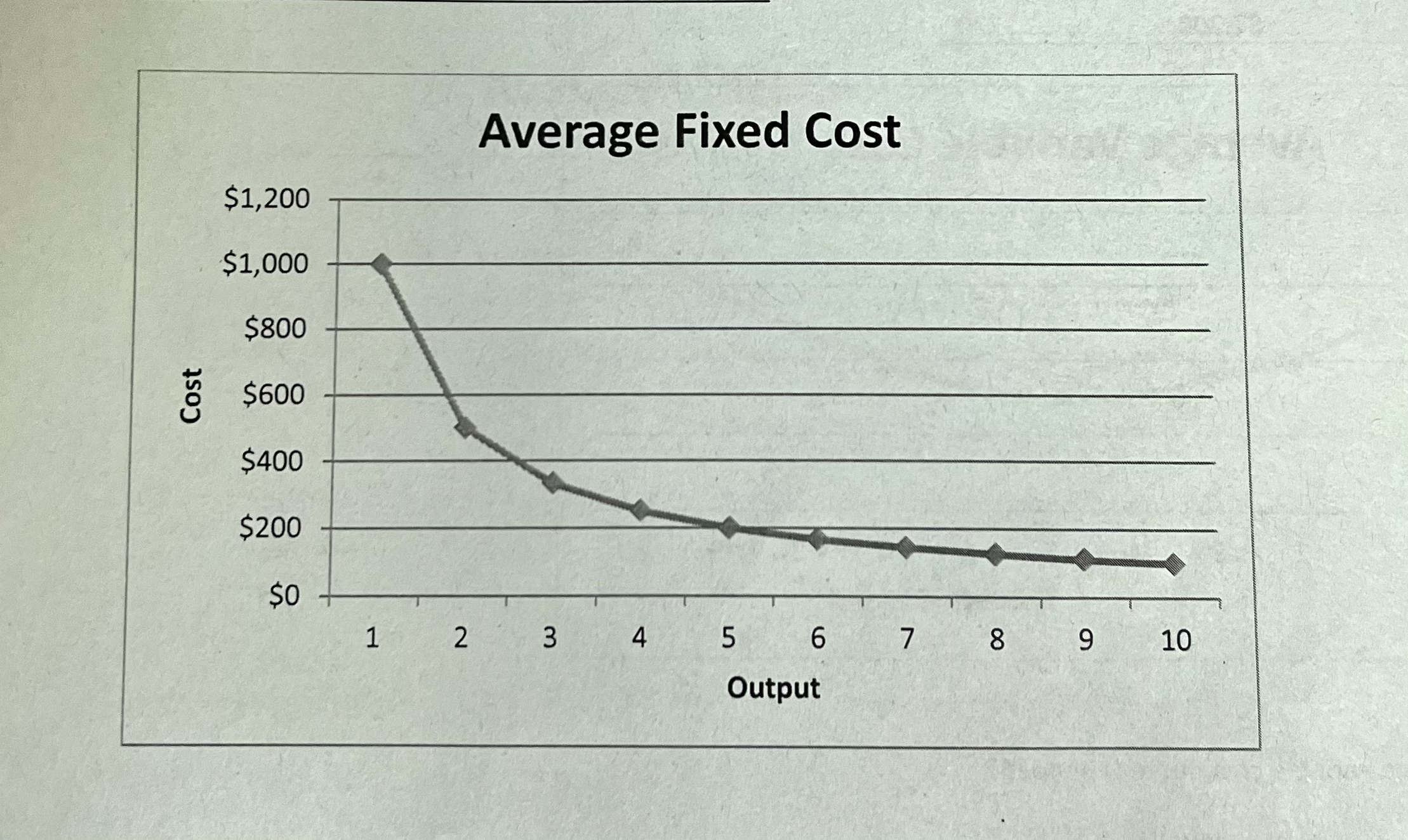
Average Fixed Costs (AFC)
fixed costs allocated to each unit produced, always decreasing as we produce more units b/c allocating TFC among more units while it’s constant
18
New cards
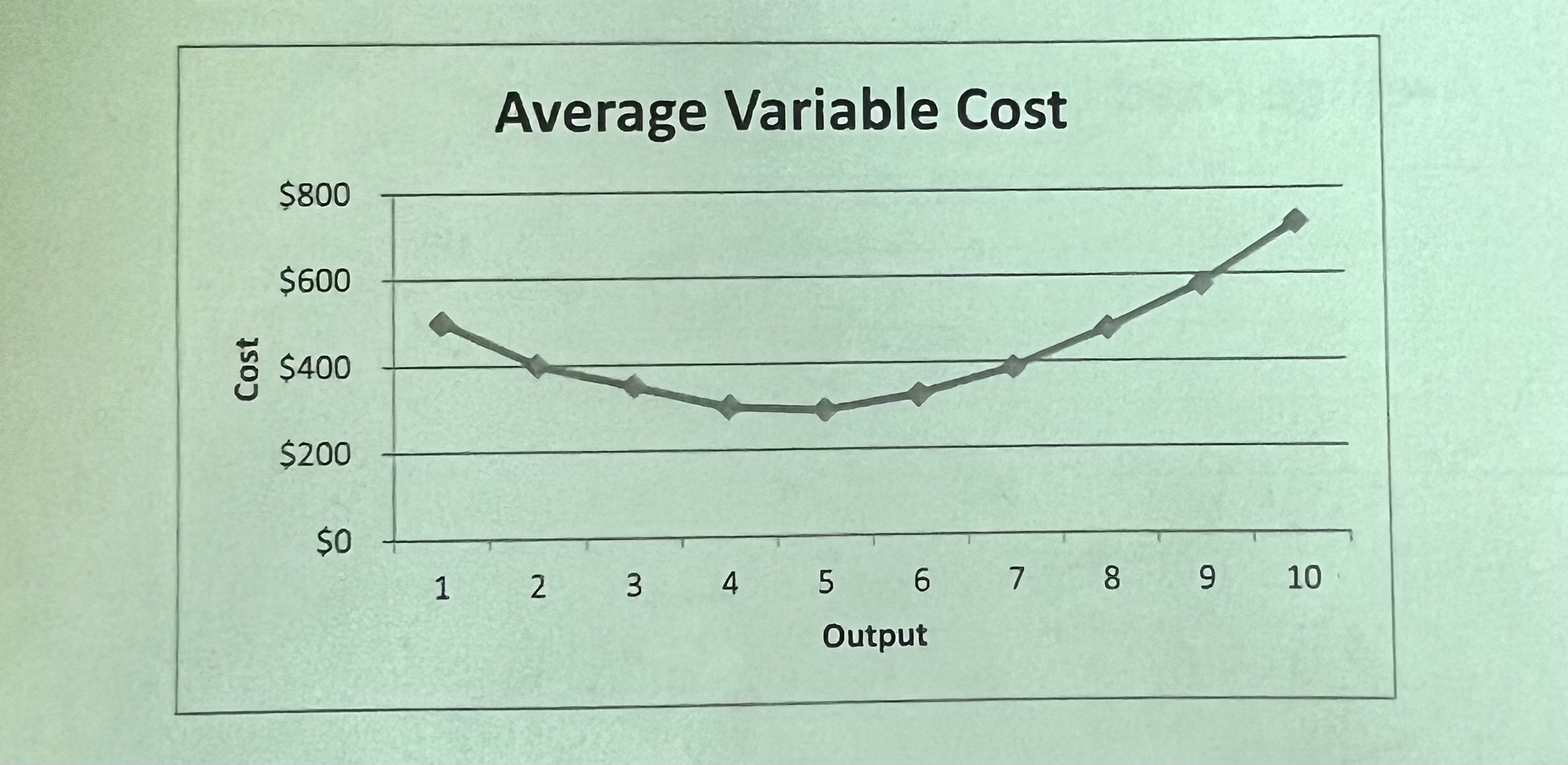
Average Variable Costs (AVC)
* variable costs allocated to each unit produced
* U-shaped b/c initially more efficient when we produce more units, but as resources get stretched producing more units becomes inefficient causing the additional variable cost per unit to increase
* U-shaped b/c initially more efficient when we produce more units, but as resources get stretched producing more units becomes inefficient causing the additional variable cost per unit to increase
19
New cards
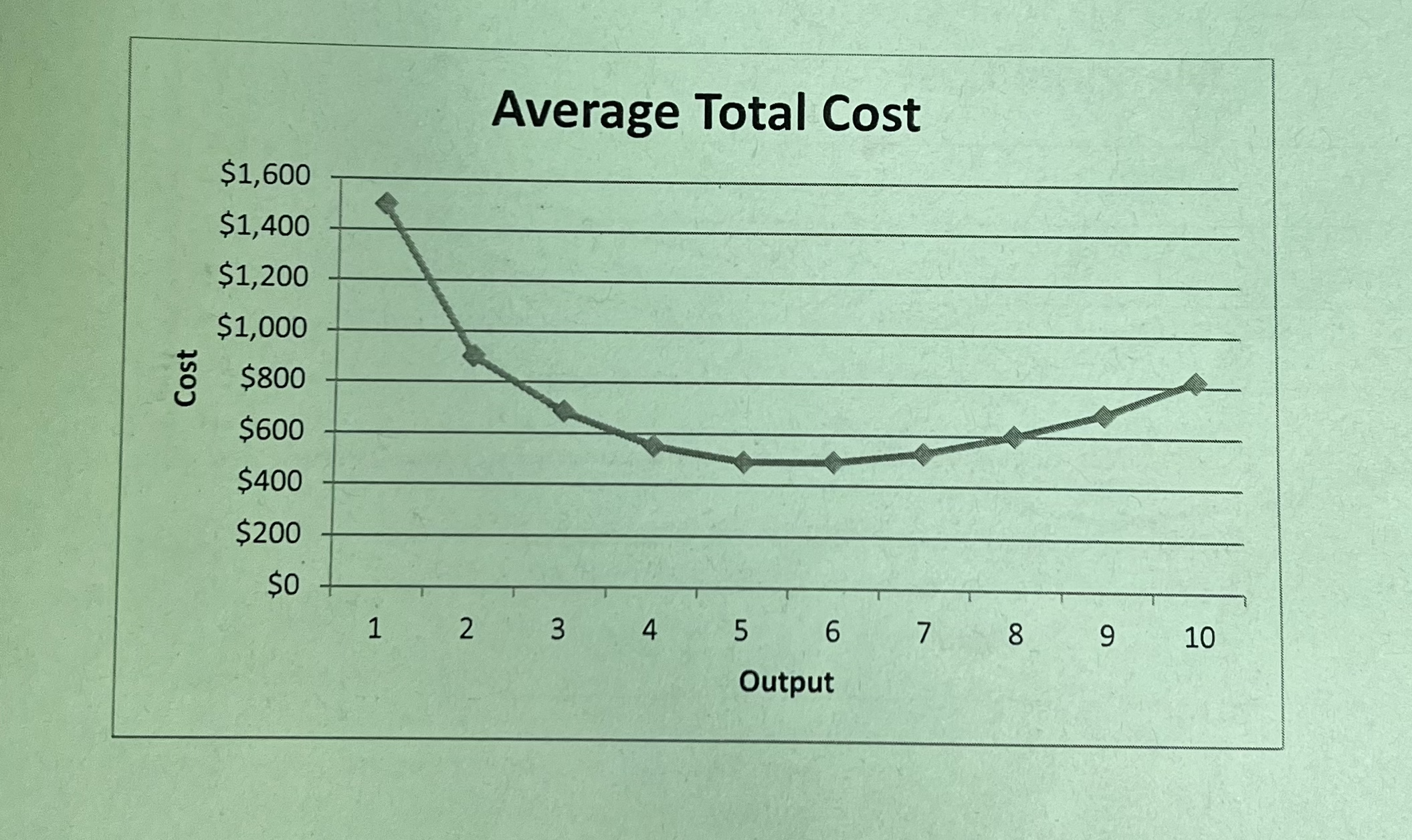
Average Total Cost (ATC)
* total cost allocated to each unit produced - on average, how much it costs or produce a unit of output
* U-shaped b/c AVC is part of ATC
* U-shaped b/c AVC is part of ATC
20
New cards
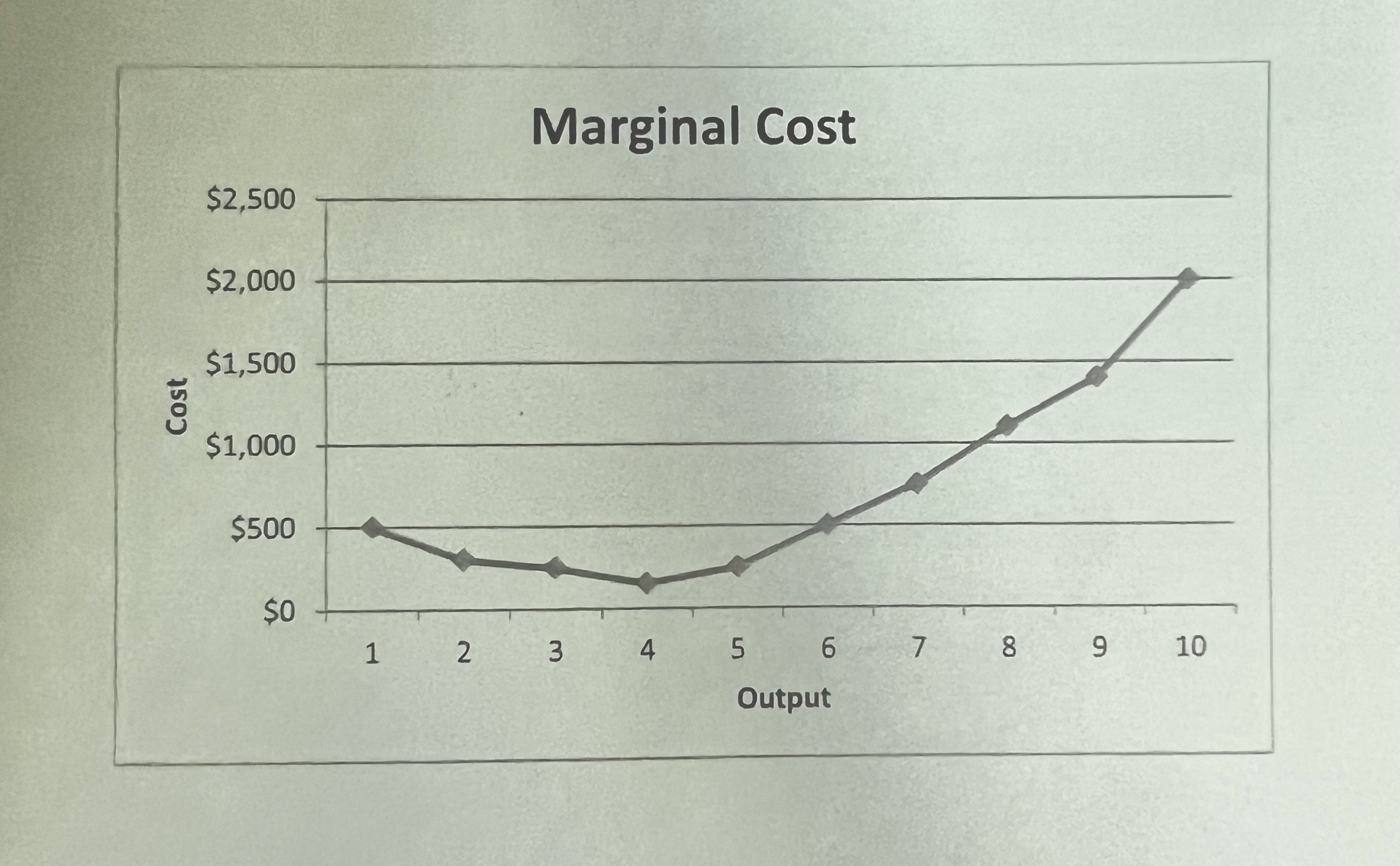
Marginal cost
U-shaped b/c the cost of producing an additional unit will increase as more are produced
21
New cards
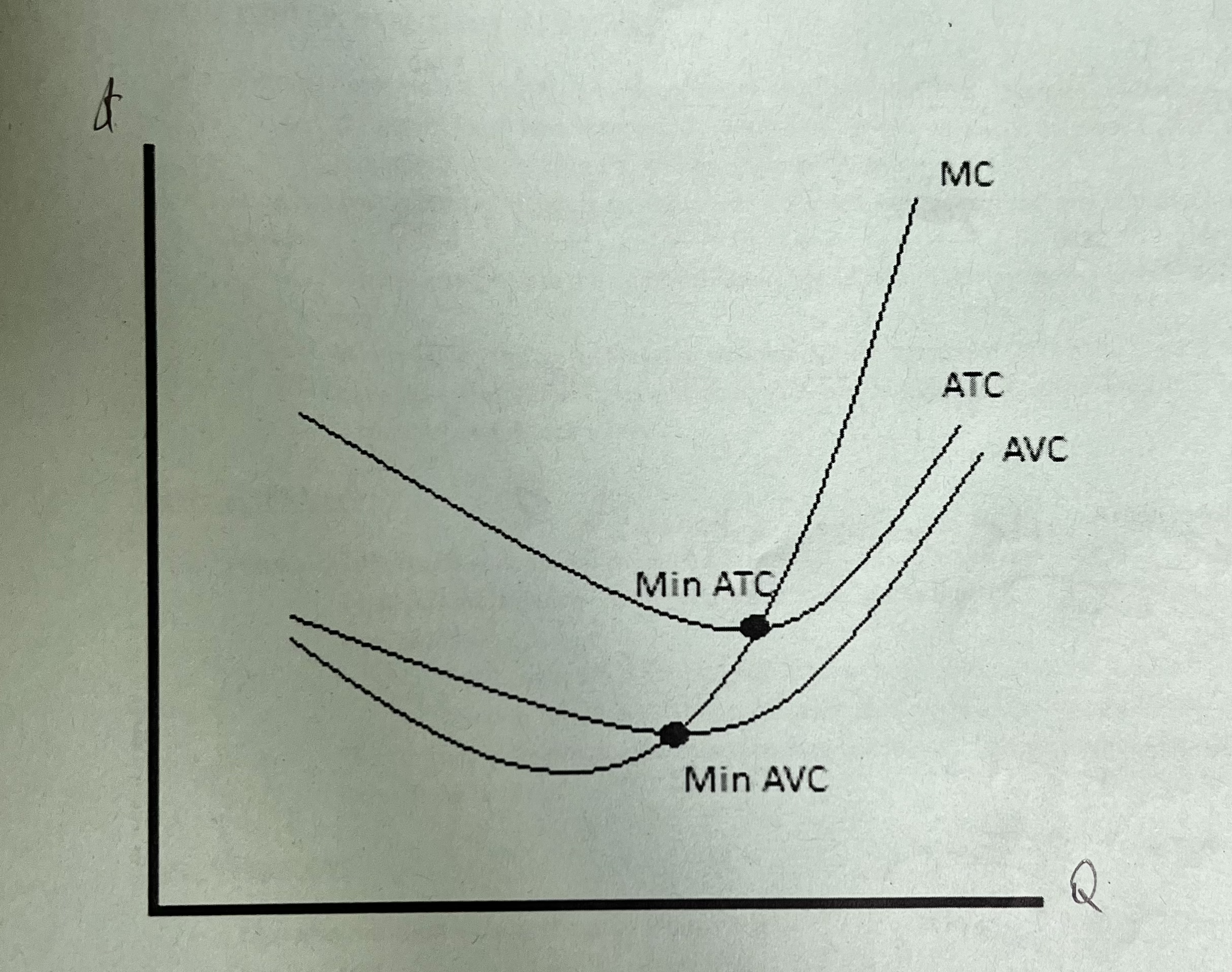
Relationship between ATC, AVC, and MC
* MC always intersects the min point of ATC and AVC
* If MC < ATC, ATC decreases
* If MC < AVC, AVC decreases
* If MC > ATC, ATC increases
* If MC > AVC, AVC increases
* If MC < ATC, ATC decreases
* If MC < AVC, AVC decreases
* If MC > ATC, ATC increases
* If MC > AVC, AVC increases
22
New cards
Cost minimization
* using the production method that produces a given level of output at the lowest possible cost, profit max = cost min
* Assume horizontal L and K supply curves, so prices of additional units of L and K are constant
* Assume MP changes as we use more or less L or K
* Assume horizontal L and K supply curves, so prices of additional units of L and K are constant
* Assume MP changes as we use more or less L or K
23
New cards
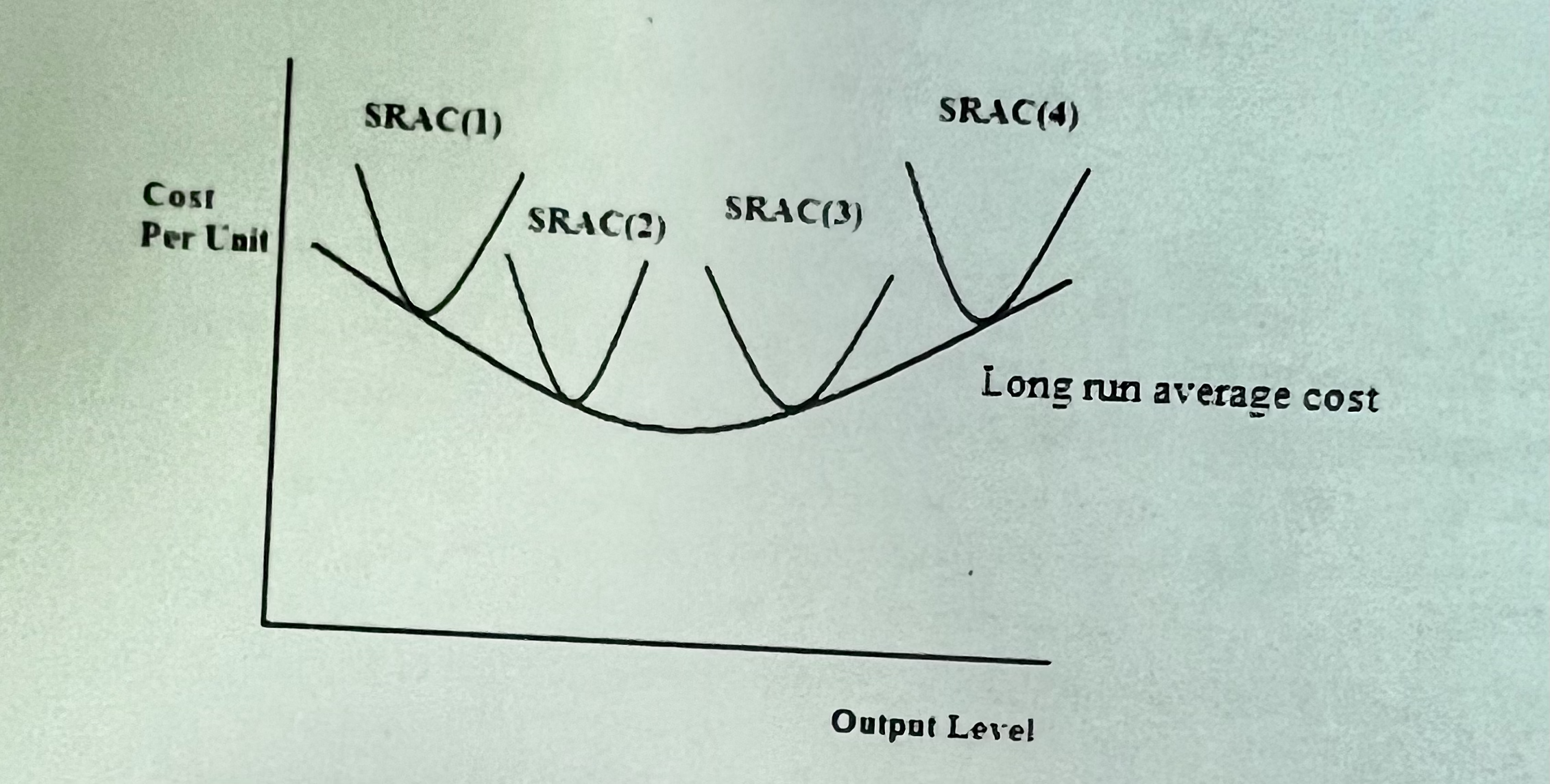
Long run cost curve
* the lowest cost of producing each level of output when all inputs can be varied
* No difference b/w ATC, AVC, and AFC b/c no fixed costs so all are variable
* MC increases faster in short than long b/c fixed capital in short run
* Short run never fall below LRAC b/c it shows lowest cost for each output level
* Optimal level of inputs b/c no fixed inputs, unlike short run
* No difference b/w ATC, AVC, and AFC b/c no fixed costs so all are variable
* MC increases faster in short than long b/c fixed capital in short run
* Short run never fall below LRAC b/c it shows lowest cost for each output level
* Optimal level of inputs b/c no fixed inputs, unlike short run
24
New cards
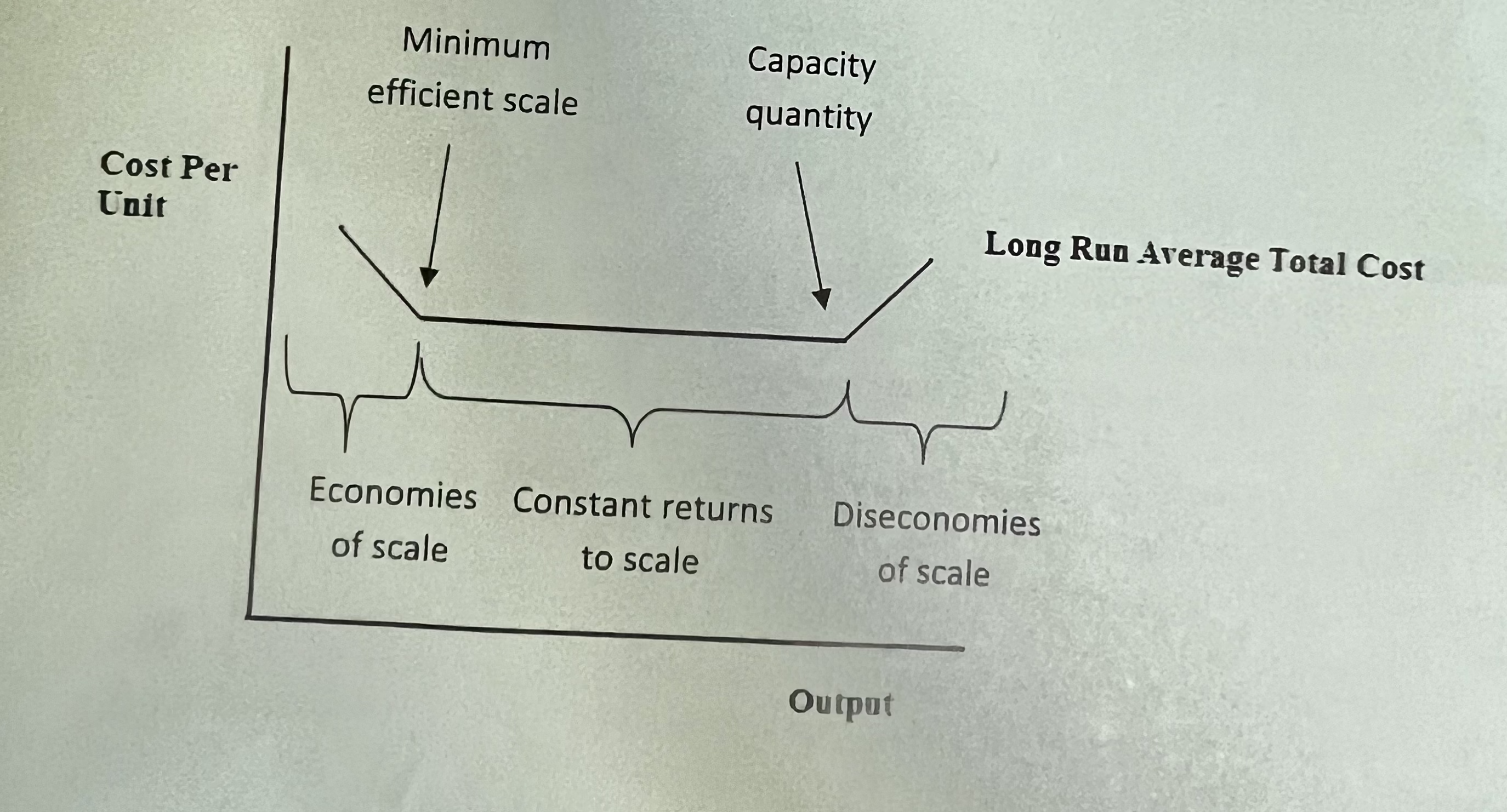
Minimum efficient scale (MES)
the first point of production where ATC is lowest for a firm
25
New cards
Small vs Large MES
* Small: only a small amount of output needed, resulting in many efficient firms and lots of competition
* Large: large amount of output needed, resulting in a small number of efficient firms and little competition
* Large: large amount of output needed, resulting in a small number of efficient firms and little competition
26
New cards
Capacity quantity
the last point of production where ATC is the lowest for a particular firm
27
New cards
Long run average cost curve (LRAC)
shows the lowest possible cost for each output level
28
New cards
Economies of scale
* ATC decrease as we produce more units
* doubling the inputs more than doubles the output
* In the range of production, increasing output allows for more efficient use of inputs
* occurs at smaller levels of output and will eventually slow down as output increases
* doubling the inputs more than doubles the output
* In the range of production, increasing output allows for more efficient use of inputs
* occurs at smaller levels of output and will eventually slow down as output increases
29
New cards
Constant returns to scale
* no change in ATC as we produce more units
* doubling inputs exactly doubles output
* plant is at the ideal size
* doubling inputs exactly doubles output
* plant is at the ideal size
30
New cards
Diseconomies of scale
* ATC increases as we produce more
* doubling inputs less than doubles output
* In this range of production, high levels of output results in less efficient use of inputs
* doubling inputs less than doubles output
* In this range of production, high levels of output results in less efficient use of inputs
31
New cards
Reasons for economies of scale
* specialization
* improvement in production equipment
* improvement in production equipment
32
New cards
Reasons for diseconomies of scale
* more output = larger plant size = larger firm size
* adding layers of management
* decrease in flexibility
* adding layers of management
* decrease in flexibility
33
New cards
Relationship b/w SRATC and LRAC
* point of SRATC that’s tangent to LRAC is where the output in the short run reaches min LRAC for the amount of the fixed input in the short run
* SRATC is steeper than LRAC when increasing output b/c firms need to make inefficient choices in the short run since one of their inputs is fixed
* SRATC is steeper than LRAC when increasing output b/c firms need to make inefficient choices in the short run since one of their inputs is fixed
34
New cards
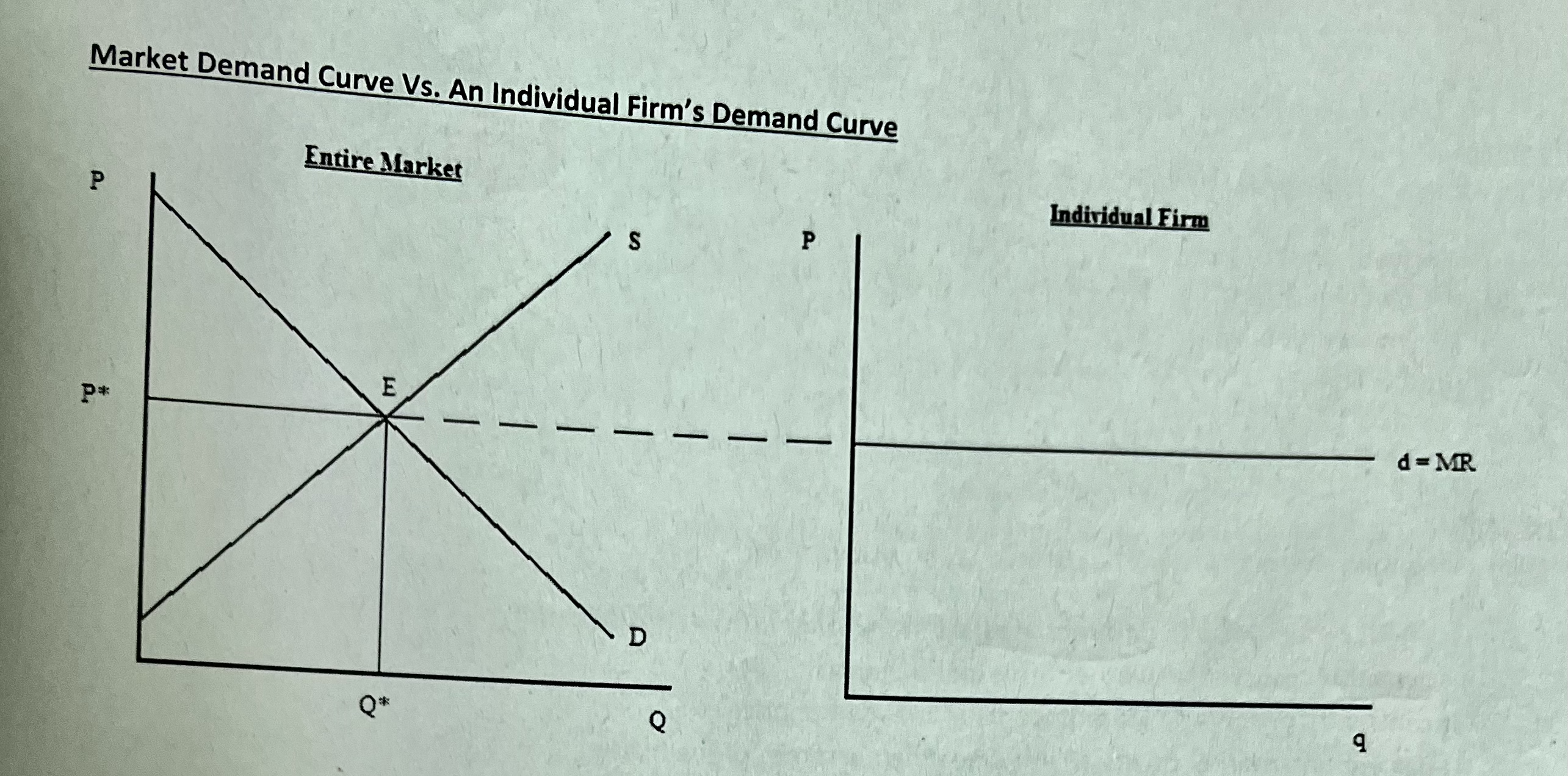
Entire market/industry graph and individual firm graph
demand curve is downward sloping for the industry/perfectly elastic demand curve
35
New cards
Profit maximizing rule
firms max profit at MR = MC for all market structures
36
New cards
Marginal revenue (MR)
* the incremental change in revenue when we sell one more unit
* MR = ΔTR/Δq
* MR = ΔTR/Δq
37
New cards
Short run: continue to operate vs shut down
* If P > min(ATC), continue to operate b/c positive economic profit
* If P = min(ATC), continue to operate b/c zero economic profit (long run equilibrium for perfect competition)
* If min(AVC) ≤ P < ATC, continue to operate in the short run with a loss
* If P < min (AVC), shut down
* If P = min(ATC), continue to operate b/c zero economic profit (long run equilibrium for perfect competition)
* If min(AVC) ≤ P < ATC, continue to operate in the short run with a loss
* If P < min (AVC), shut down
38
New cards
Short run economic profit
* If positive profit, more firms enter, causing the supply curve to shift to the right, causing prices to fall until economic profits are zero
* If negative profit, firms exit, causing the supply curve to shift to the left, causing prices to rise until economic profits are zero
* If negative profit, firms exit, causing the supply curve to shift to the left, causing prices to rise until economic profits are zero
39
New cards
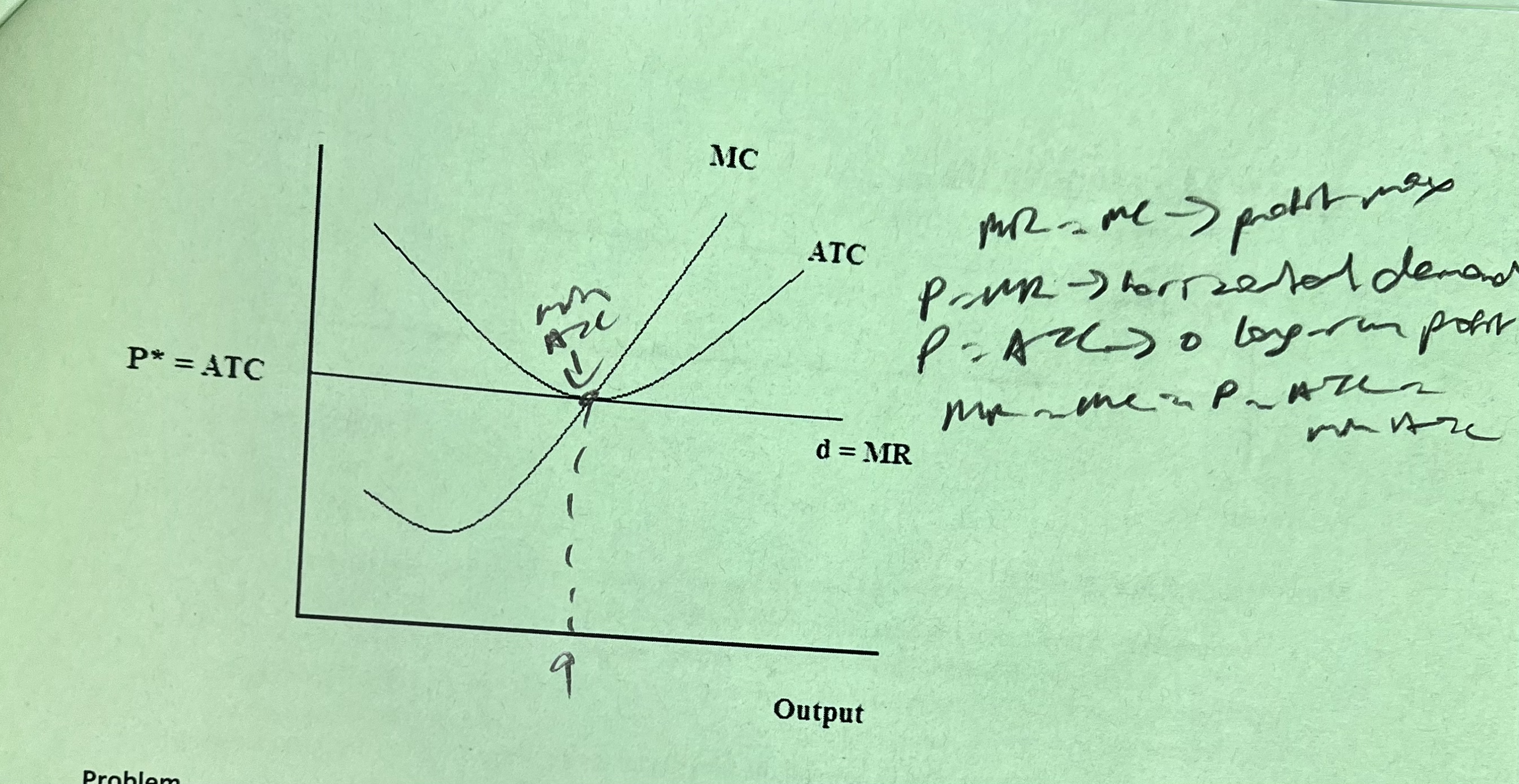
Conditions for long run equilibrium in perfect competition
* each firm max profits at P = MR = MC
* Economic profit = zero
* no entry/exit
* Economic profit = zero
* no entry/exit
40
New cards
Types of Barriers to Entry in Monopolies
* ownership of resources w/o substitutes
* economies of scale: when the cost of production goes down a lot as more is produced it’s harder for small companies to compete w/ monopolies b/c the monopolies per unit cost is so much lower
* government licensing
* economies of scale: when the cost of production goes down a lot as more is produced it’s harder for small companies to compete w/ monopolies b/c the monopolies per unit cost is so much lower
* government licensing
41
New cards
Ways Government Legislation Creates Monopolies
* licenses and franchises
* patents
* tariffs
* regulations
* quality standards
* patents
* tariffs
* regulations
* quality standards
42
New cards
Ways firms create barriers to entry
* buying up all available resources
* increasing competitor’s costs
* threats of sabotage
* predatory pricing
* increasing competitor’s costs
* threats of sabotage
* predatory pricing
43
New cards
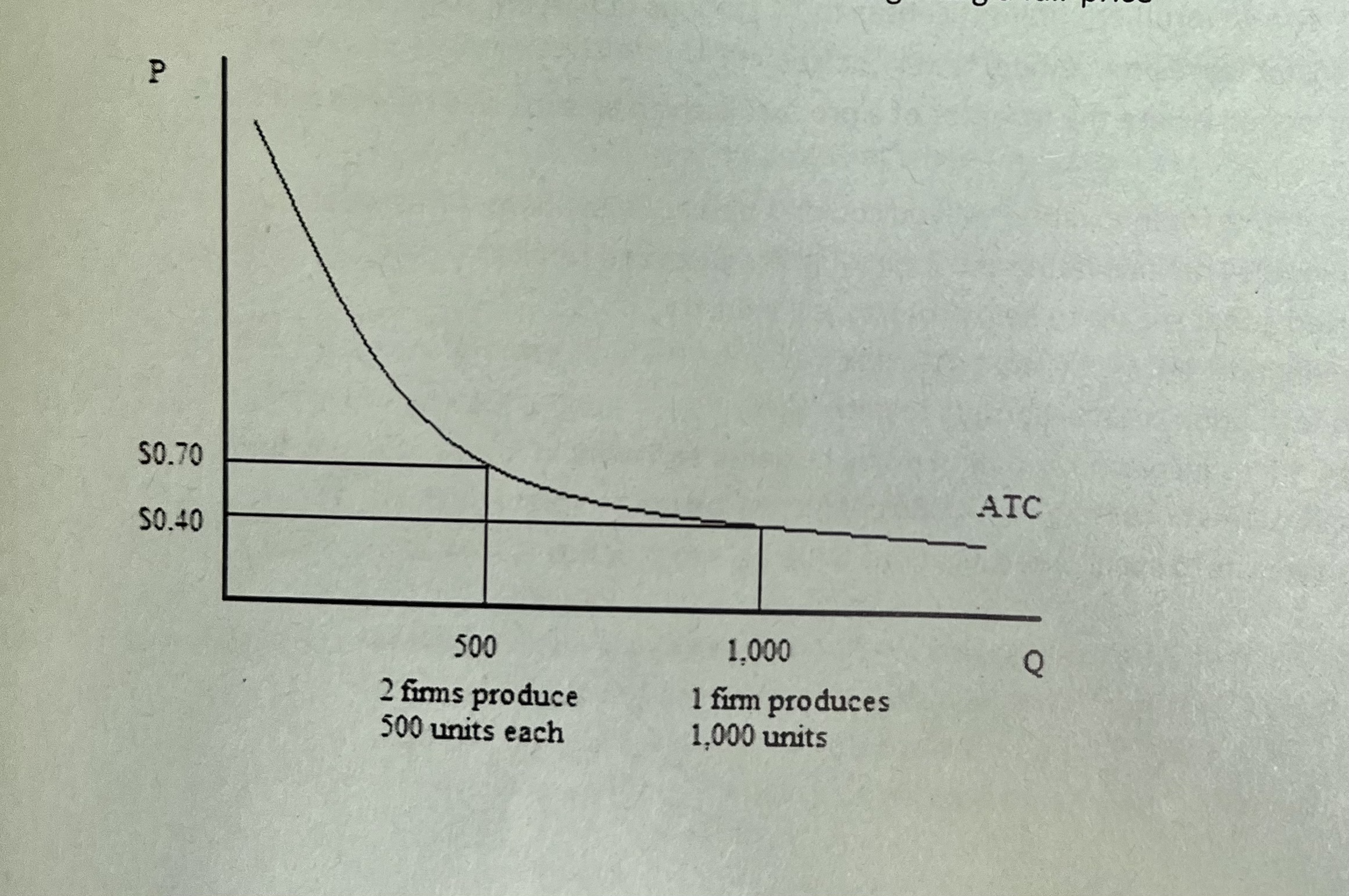
Natural monopolies
* a firm has decreasing ATC over a large range of output, ex: electric companies
* occur in industries w/ high FC
* Large firms are more efficient than small ones due to EoS b/c larger firm can drive out others by cutting their prices
* occur in industries w/ high FC
* Large firms are more efficient than small ones due to EoS b/c larger firm can drive out others by cutting their prices
44
New cards
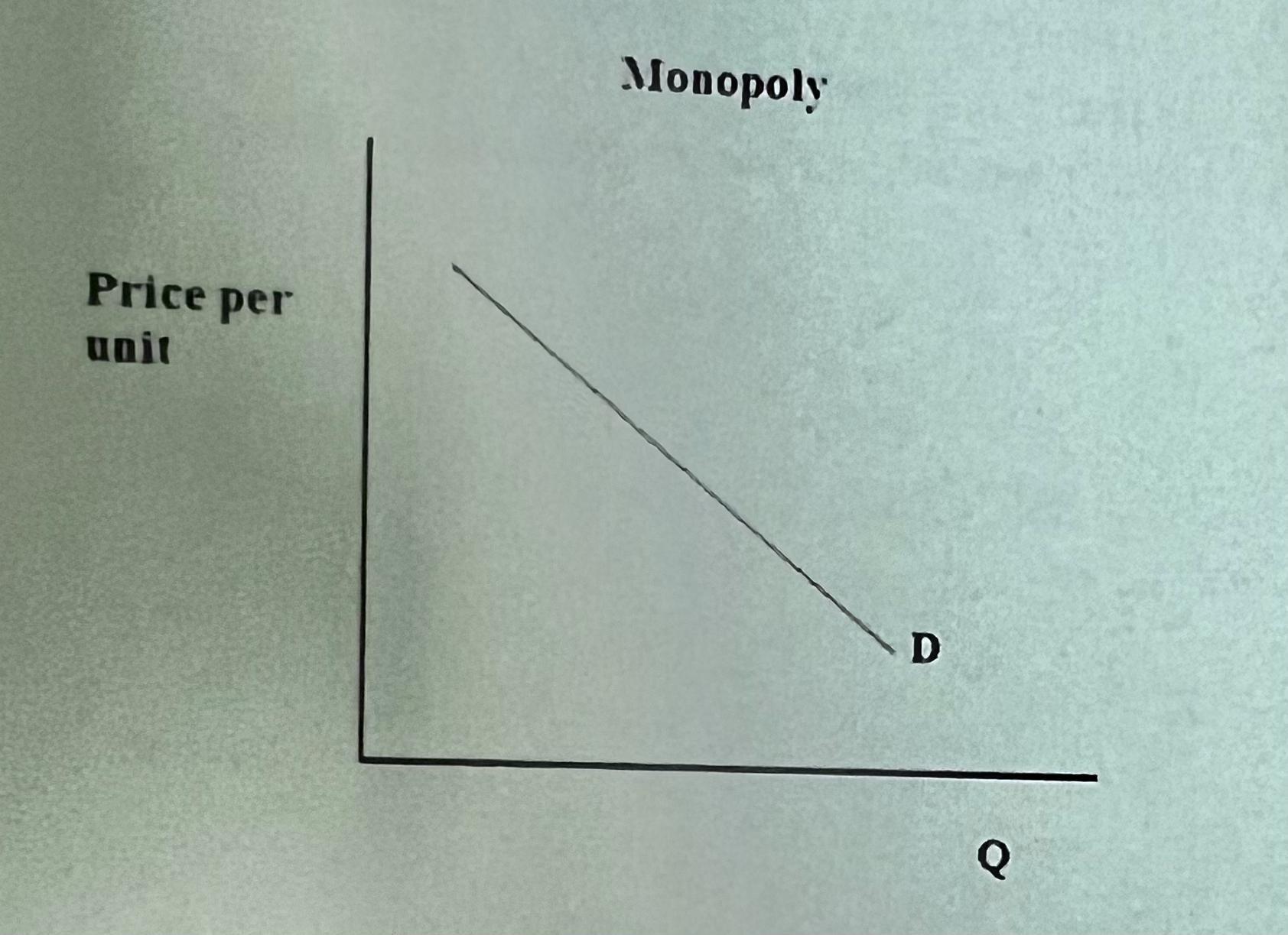
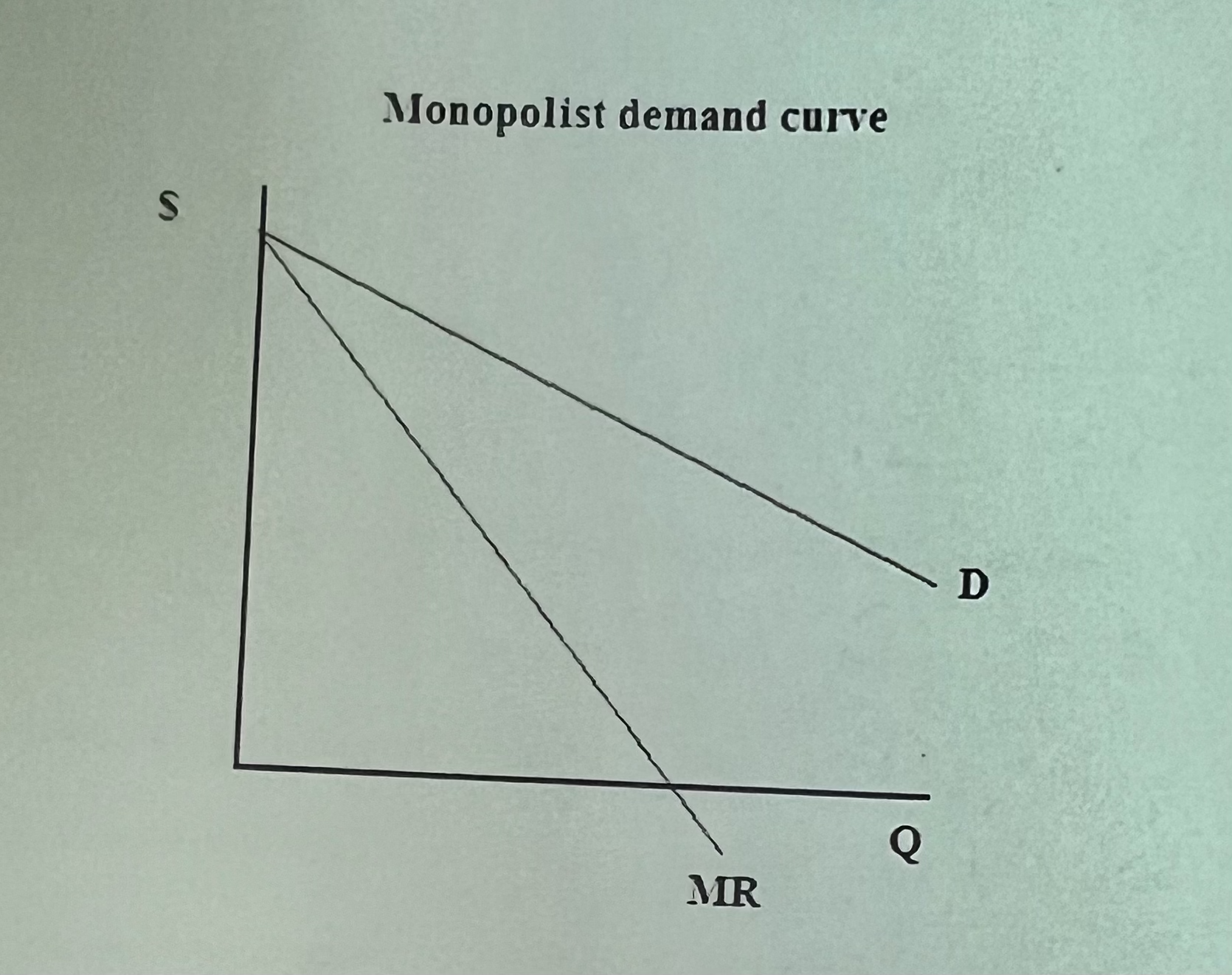
Monopolist’s demand curve
* same as market demand curve b/c one firm is the entire market
* also = monopolist average revenue (AR) curve b/c price is determined by the position of the demand curve
* also = monopolist average revenue (AR) curve b/c price is determined by the position of the demand curve
45
New cards
MR for monopolists
Produce where P > (MR = MC) b/c a monopolist’s MR curve is twice as steep as its demand curve
46
New cards
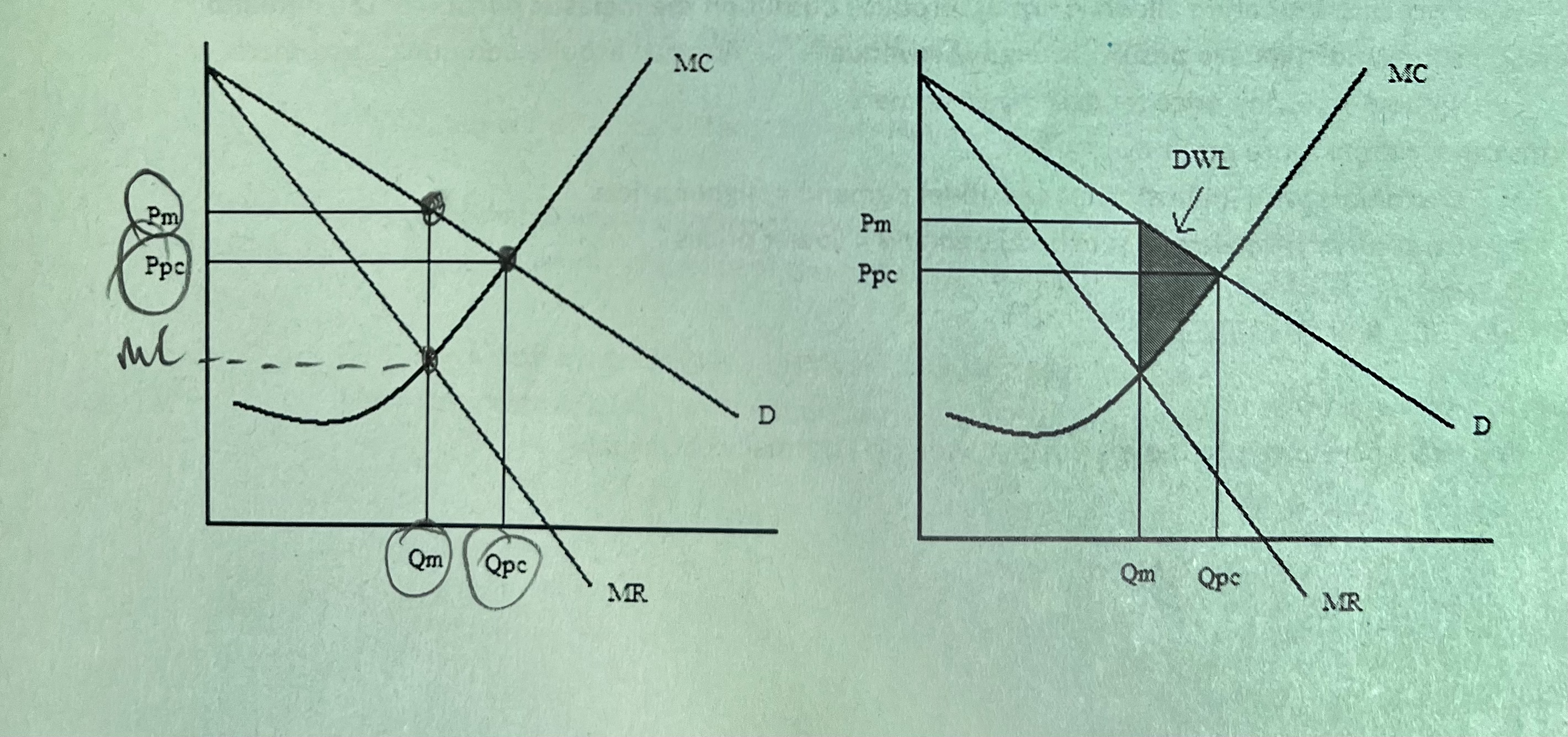
DWL for monopolies
* B/c monopolists produce where P > (MR = MC)
* Monopoly price > perfect competition price - consumers pay higher prices
* monopoly quantity < perfect competition quantity - fewer units available for consumers
* Monopoly price > perfect competition price - consumers pay higher prices
* monopoly quantity < perfect competition quantity - fewer units available for consumers
47
New cards
Price discrimination
when a business sells the same product at different prices for reasons unrelated to cost, allowing them to produce output on the inelastic portion of the demand curve but still have positive MR
48
New cards
Conditions to Price Discriminate
* firm has a downward sloping demand curve
* firm must easily and cheaply identify customers with predictably different elasticities of demand
* arbitrage opportunities can’t exist
* firm must easily and cheaply identify customers with predictably different elasticities of demand
* arbitrage opportunities can’t exist
49
New cards
Arbitrage
when consumers buy a good at a low price and then resell it to other consumers at a high price
50
New cards
First degree price discrimination (perfect price discrimination)
* charging every customer exactly what they’re willing to pay, allowing producers to extract all consumer surplus, meaning it’s efficient b/c no DWL since last unit is sold at P = MC
* producers produce the best possible (perfectly competitive) output level
* inequitable b/c some are paying a lot while others pay little
* producers produce the best possible (perfectly competitive) output level
* inequitable b/c some are paying a lot while others pay little
51
New cards
Second degree price discrimination
* customers are charged different prices depending on the quantity they purchase
* larger quantities = better price
* larger quantities = better price
52
New cards
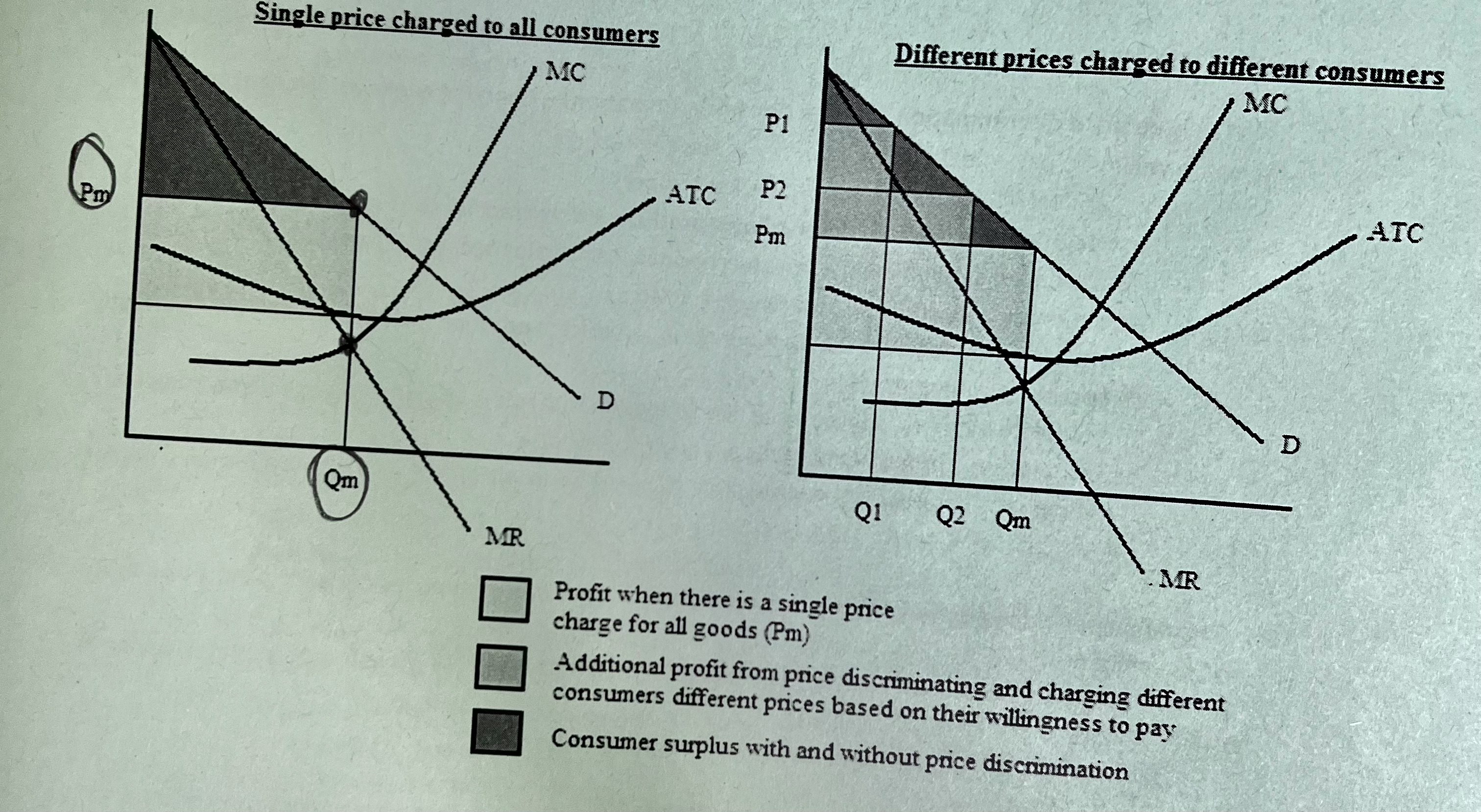
Third degree price discrimination (market segmentation)
* when a firm can segment consumers in different groups based on the elasticity of their demand and charge them different prices
* customers w/ inelastic (not sensitive) demand, higher prices
* customers w/ elastic (sensitive) demand, lower prices
* customers w/ inelastic (not sensitive) demand, higher prices
* customers w/ elastic (sensitive) demand, lower prices
53
New cards
Effect of market segmentation on the monopoly graph
effective price discrimination = higher profits than single price
54
New cards
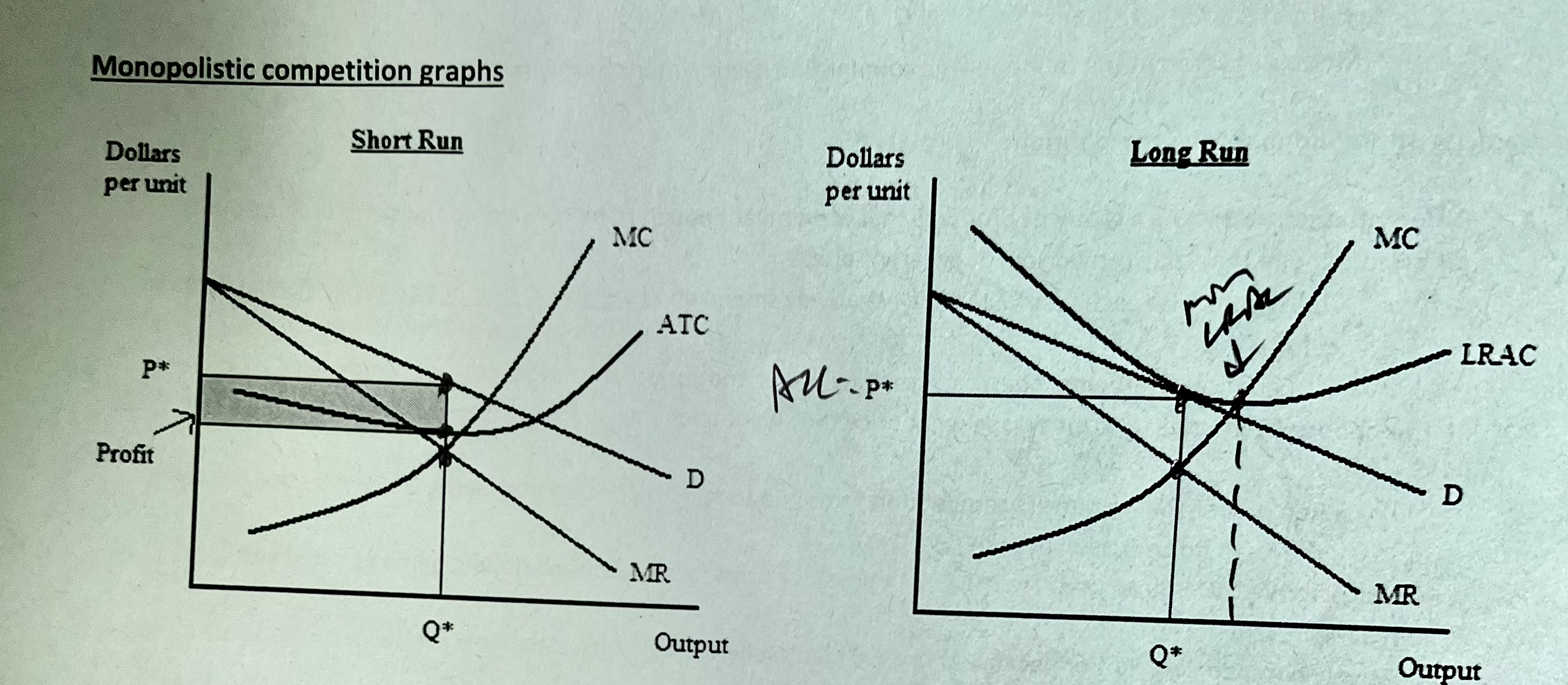
Profit maximization in monopolistic competition
* profit max at MR = MC
* short run: firms can earn profit/losses
* long run: zero profit and excess capacity
* short run: firms can earn profit/losses
* long run: zero profit and excess capacity
55
New cards
Excess capacity in monopolistic competition
* In the long-run equilibrium, goods are produced at a point where ATC is not at a min
* doesn’t mean waste if consumers are willing to pay higher prices for product variety
* doesn’t mean waste if consumers are willing to pay higher prices for product variety
56
New cards
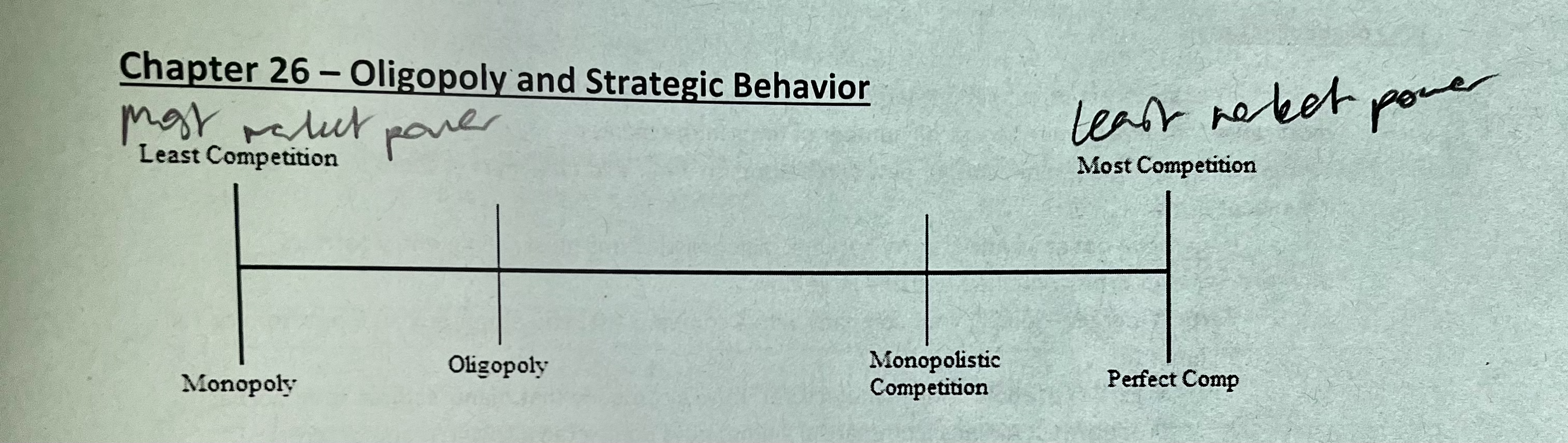
Prices vs Quantity for competition, monopolistic competition, and monopoly
* Price: perfect competition < monopolistic competition < monopoly
* Quantity: monopoly < monopolistic competition < perfect competition
* Perfect competition is best for consumers and monopoly is the worst for consumers
* Quantity: monopoly < monopolistic competition < perfect competition
* Perfect competition is best for consumers and monopoly is the worst for consumers
57
New cards
Oligopoly
* an industry containing two or more firms and at least one produces a significant portion of the industry’s total output
* firms consider the actions of their competitors when setting price
* firms consider the actions of their competitors when setting price
58
New cards
Reasons Oligopolies Occur
* Economies of scale: in some markets larger firms are more efficient than small firms, so there would be only a small number of firms in the market
* barriers to entry: if there aren’t any natural ones, oligopolistic firms need to create them
* mergers
* vertical merger: joining your company with another that you either buy an input from or sell an input to
* Horizontal merger: joining your company with another that sells a similar product
* barriers to entry: if there aren’t any natural ones, oligopolistic firms need to create them
* mergers
* vertical merger: joining your company with another that you either buy an input from or sell an input to
* Horizontal merger: joining your company with another that sells a similar product
59
New cards
Types of Entry Barriers in Oligopolies
* Brand proliferation: if a large number of differentiated products already exist, little room for new firms to take
* advertising: if a firm already in the market advertises heavily, a firm wanting to enter also would have to advertise heavily, increasing their cost
* if that firm has a low MES, the additional advertising costs could result in a higher MES for them which could prevent them from entering
* advertising: if a firm already in the market advertises heavily, a firm wanting to enter also would have to advertise heavily, increasing their cost
* if that firm has a low MES, the additional advertising costs could result in a higher MES for them which could prevent them from entering
60
New cards
Industry concentration ratios
* measure economic power in an industry and shows the market share of the industry’s largest firms
* If high (close to 100%), it’s very concentrated with little competition
* If low (close to 0%), no firm has a significant share and lots of competition
* If high (close to 100%), it’s very concentrated with little competition
* If low (close to 0%), no firm has a significant share and lots of competition
61
New cards
Four firm concentration ratio
TR for 4 largest firms/TR for all firms
62
New cards
Herfindahl-Hirschman Index (HHI)
a better way to measure industry concentraion that takes into accont when a single firm dominates an industry
Σ i=1 to N, si^2
Σ i=1 to N, si^2
63
New cards
Sales share percentage (si)
Firm’s revenue/TR for all firms
64
New cards
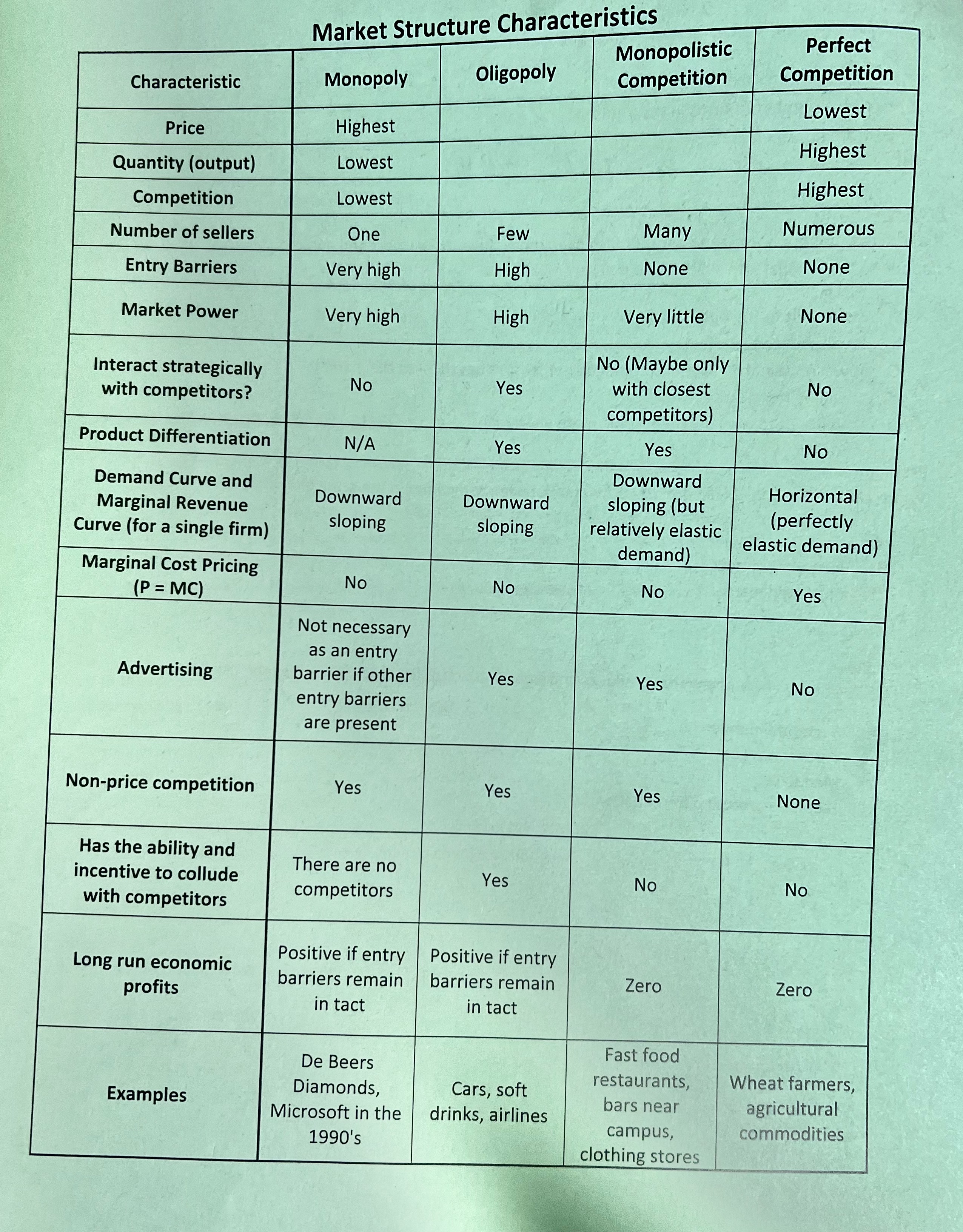
Market structure characteristics