C2.1 Chemical signaling
 Call Kai
 Learn
Learn Practice Test
 Spaced Repetition
 Match
Match Flashcards
 Knowt Play
1/19

There's no tags or description
Looks like no tags are added yet.
Name | Mastery | Learn | Test | Matching | Spaced | Call with Kai |
|---|
No analytics yet
Send a link to your students to track their progress
20 Terms
what is the term for signalling chemicals
ligands
what is quorum sensing
explain with the use of bioluminescence in a marine bacterium
Quorum sensing is a mechanism by which bacteria can alter group behaviour depending on population density.
It allows individual bacteria within colonies to coordinate their actions.
This coordination is the result of the production of ligands known as autoinducers.
As the number of bacterial cells increases, so does the concentration of the autoinducer as they are released into the environment by individual bacteria.
When the concentration of the autoinducer reaches a threshold level, the gene expression by the entire population of bacteria is altered.
Quorum sensing was first discovered in the marine bacterium Vibrio fischeri.
These bacteria can produce light through bioluminescence when autoinducer concentrations are high.
The bacteria are found free-floating in oceans, and as a symbiont of marine animals, especially a type of squid known as the Hawaiian bobtail squid (Euprymna scolopes).
Hatching squid capture the free Vibrio bacteria from the environment and house them in what is known as a light organ.
Once inside the light organ, the bacteria progress through the following steps to produce light.
1.During their reproductive cycle, individual V. fischeri bacteria produce a quantity of autoinducer molecules.
2.The autoinducer molecules pass through their cell membrane and cell wall into the exterior environment.
3.Because the bacteria are reproducing, there is an increasing number of bacterial Vibrio cells.
4.With a higher population of Vibrio cells, there is a corresponding increase in the concentration of autoinducer molecules in the surroundings.
5.When the number of autoinducer molecules reaches a threshold level, they move into the bacterial cells and bind to a protein known as LuxR.
6.LuxR binds to a DNA binding site called a lux box.
7.The lux box, a section of DNA, is activated by this binding, and begins the production of a luminescent protein known as luciferase.
The light produced by the production of luciferase allows the squid to illuminate its underside to match the surrounding light from the Sun.
This disguises the squid from predators.
Vibrio fischeri only produces luciferase and glows when inside the light organ of the Hawaiian bobtail squid (Euprymna scolopes). When free-living in the ocean, they do not glow.
Explain the reasons for this
Quorum sensing is at work and the concentration of autoinducer is not at the threshold level for luciferase production when the bacterium is free-living.
There is no benefit for the lone free-living bacterium to produce light.
However, when in the light organ of the squid, glowing provides an advantage.
It allows the bacteria to fulfil their end of the symbiotic relationship, keeping the squid safe from predators.
distinguish the categories of animal ligands
hormones
Hormones have the general function of regulation - e.g. homeostasis, development and reproduction
signalling chemicals secreted by specialized endocrine cells; they are carried through the circulation system to act on target cells at distant body sites.
A certain hormone can only bind with a specific receptor on a target cell.
neurotransmitters
carry signals between neurons and from neurons to other target cells
signalling chemicals released from one cell that act on neighbouring target cells.
A good example of this occurs at the synapse of nerve cells.
cytokines
glycoproteins that act as messengers between cells.
There are more than 50 different cytokines, but most increase cell reproduction rate and have inflammatory actions.
When a cytokine binds to a receptor on the cell membrane a signal is transmitted to the inside of the cell and many proteins within the cytoplasm are activated.
cytokine storms are harmful and can lead to death
calcium ions
Calcium ions are usually involved in cell signalling as one of the steps in a signal transduction pathway.
They are often called second messengers.
However, in the muscles of animals, calcium ions are involved in the initial stages of muscle contraction.
Additionally, in the endocrine system, calcium ions are involved in the control of hormone secretion.
describe the binding location and mechanism of action of steroid and peptide hormones
Amines and proteins are hydrophilic, which makes it difficult for them to cross a membrane. (peptide hormones)
They bind to receptors on the surface of the cell membrane.
This activates a cascade of reactions which is mediated by a second messenger (e.g cAMP) inside the cell
Steroid hormones are non-polar, which means that they are hydrophobic.
Steroid hormones easily cross the cell membrane and bind with receptors located within the cell.
This forms the receptor–hormone complex which promotes the transcription of specific genes
why do so many different chemical substances act as hormones
the ligands in these two groups must act on many different target cells, so a variety of signalling chemicals makes it easier for them to act on different cells
having different signalling chemicals means that there are many different receptors, which allows specificity
some ligands must travel long distances in the body, while others act only on nearby cells
different ligands work in different ways on target cells
some signalling chemicals create an effect that persists over a long period of time, while others have very short-term effects.
types of receptors based on their location and the polarity of the amino acids in these receptors
transmembrane receptors are embedded in the cell membrane.
Transmembrane receptors have cytoplasmic and extracellular domains.
This structure allows them to interact with molecules both outside and inside the cell.
Hydrophobic amino acids are found in the interior of the cell, while hydrophilic amino acids are found outside the membrane, in contact with the aqueous environment.
intracellular receptors occur within the cell cytoplasm.
Lipid-soluble, hydrophobic, signalling chemicals bind with these receptors because only hydrophobic or very small molecules can pass through the cell membrane.
types of transmembrane receptors
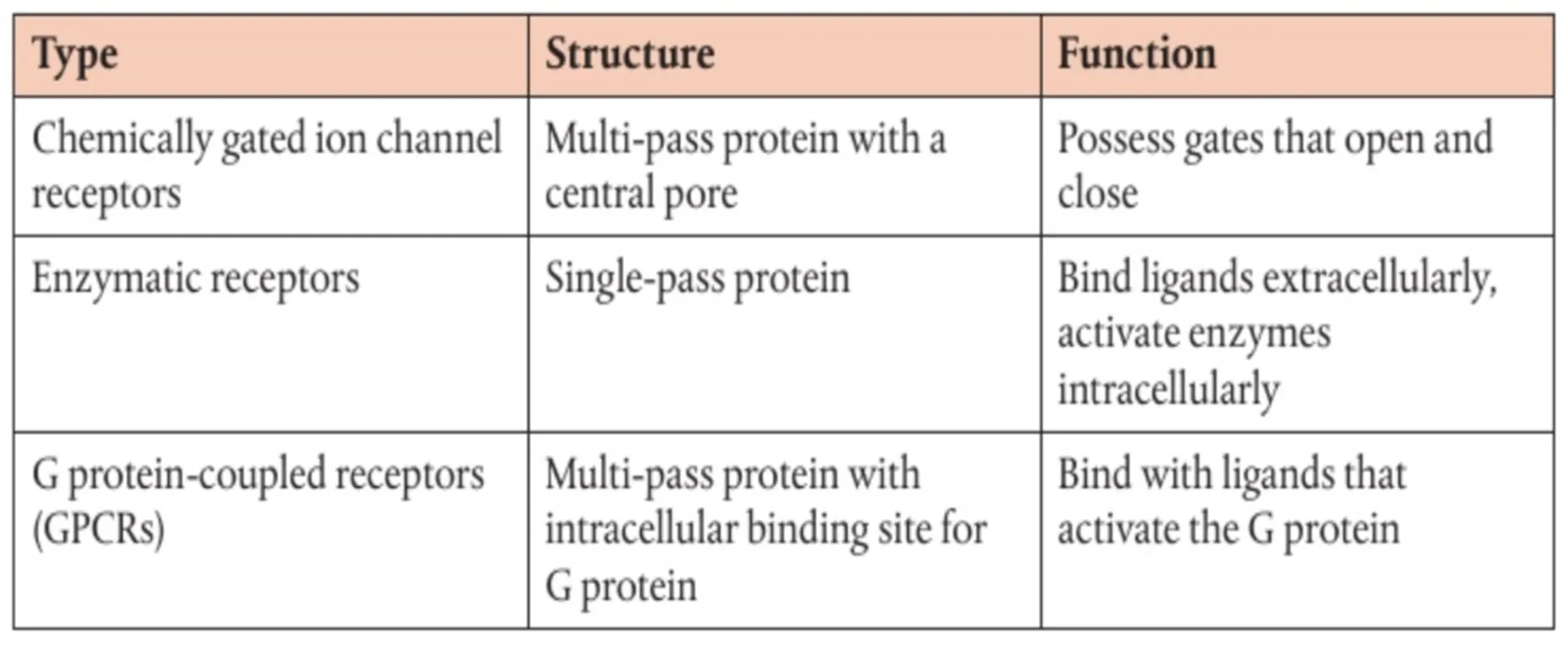
use the acetylcholine receptor as an example to explain chemically gated ion channel receptors
The acetylcholine receptor is an example of a chemically gated ion channel receptor.
This receptor is said to be a multi-pass protein because it is composed of many domains that thread back and forth across the cell membrane several times.
In the centre of this protein is a pore large enough for ions to pass through.
The channel is said to be chemically gated because it is open only when the neurotransmitter acetylcholine binds to it.
When the acetylcholine is attached, the ion channel opens and positively charged ions diffuse into the cell.
This influx of positive ions changes the voltage inside the cell membrane, which causes a cellular response.
The acetylcholine receptors in muscle cell membranes allow sodium ions (Na+) to pass into the cell, resulting in contraction.
what is a g protein coupled receptor and describe the sequence of actions in the receptor
A G protein-coupled receptor is a type of transmembrane receptor that acts indirectly on enzymes or ion channels with the aid of a protein called G protein.
This protein is called G protein because it binds to the nucleotide known as guanosine triphosphate (GTP).
*not ATP!!
GTP attaches to G protein and results in its activation when it loses its third phosphate by hydrolysis.
When GTP loses a phosphate it is then called GDP or guanosine diphosphate.
ligand binds to receptor → receptor activated → G protein activated → G protein attaches to either the ion channel, the enzyme, or both → effector protein activated.
This sequence of actions allows the signal to be conveyed into the cell.
The receptors are known as G protein-coupled receptors (GPCR) because of their association (coupling) with the G protein.
The signal would not be carried into the cell if this intermediary protein was not involved.
GPCRs are the largest type of signal receptor in animals.
They can bind many different ligands, such as peptides, proteins, ions and lipids.
These receptors are a unique group because of their characteristic structure that anchors them to the cell membrane.
describe the process of signaling initiated by adrenaline
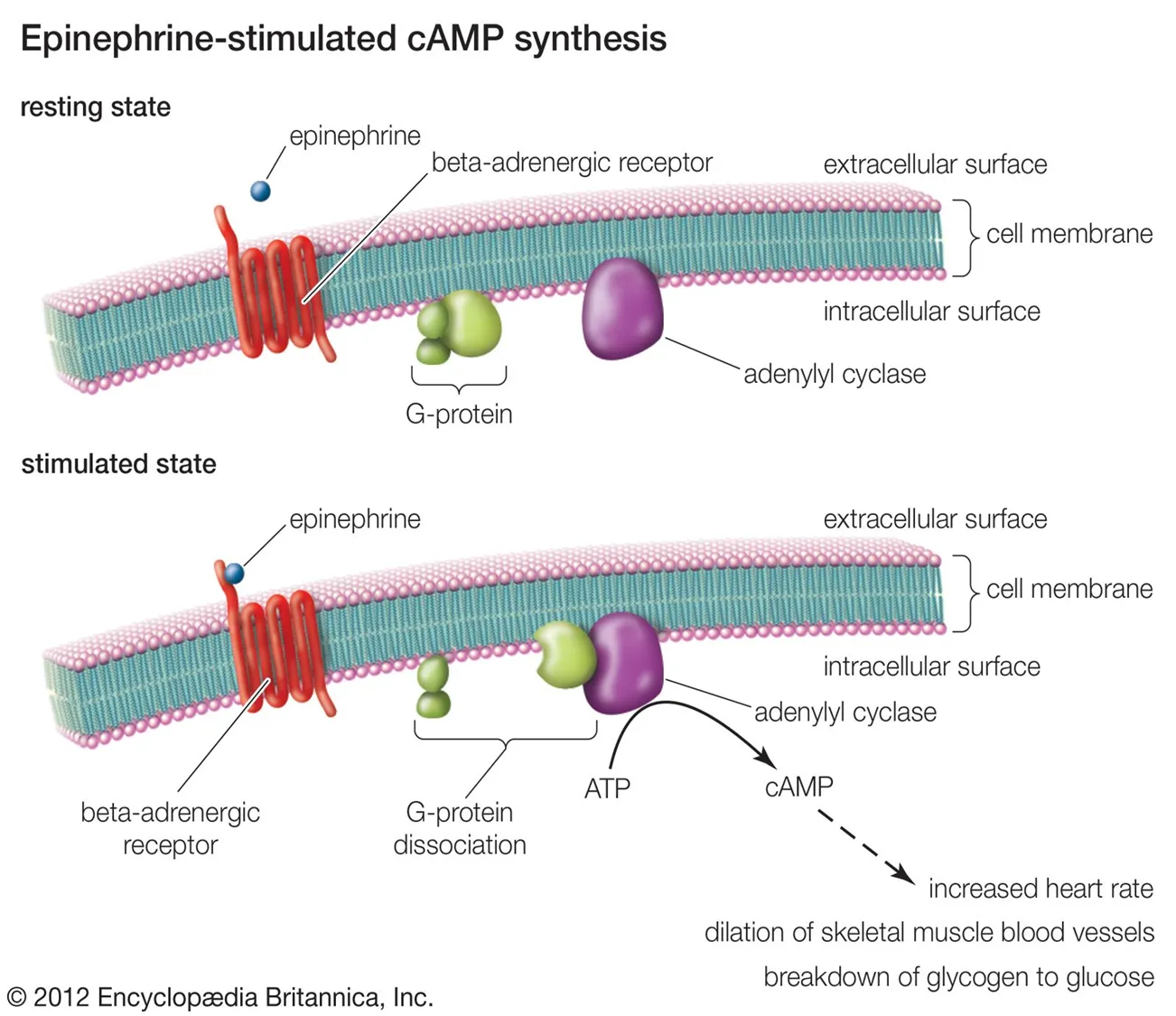
The signaling cascade initiated by the ligand epinephrine (adrenaline).
When epinephrine binds to the appropriate receptor on the cell membrane, a G protein is activated.
This activated G protein then begins a signaling cascade that involves cyclic AMP (CAMP) as the second messenger.
This signaling cascade depends on phosphorylation to activate each step.
The final cellular response shown is the breakdown of glycogen (the storage form of glucose) so that individual glucose molecules are available to the organism for energy.
describe how insulin triggers signalling
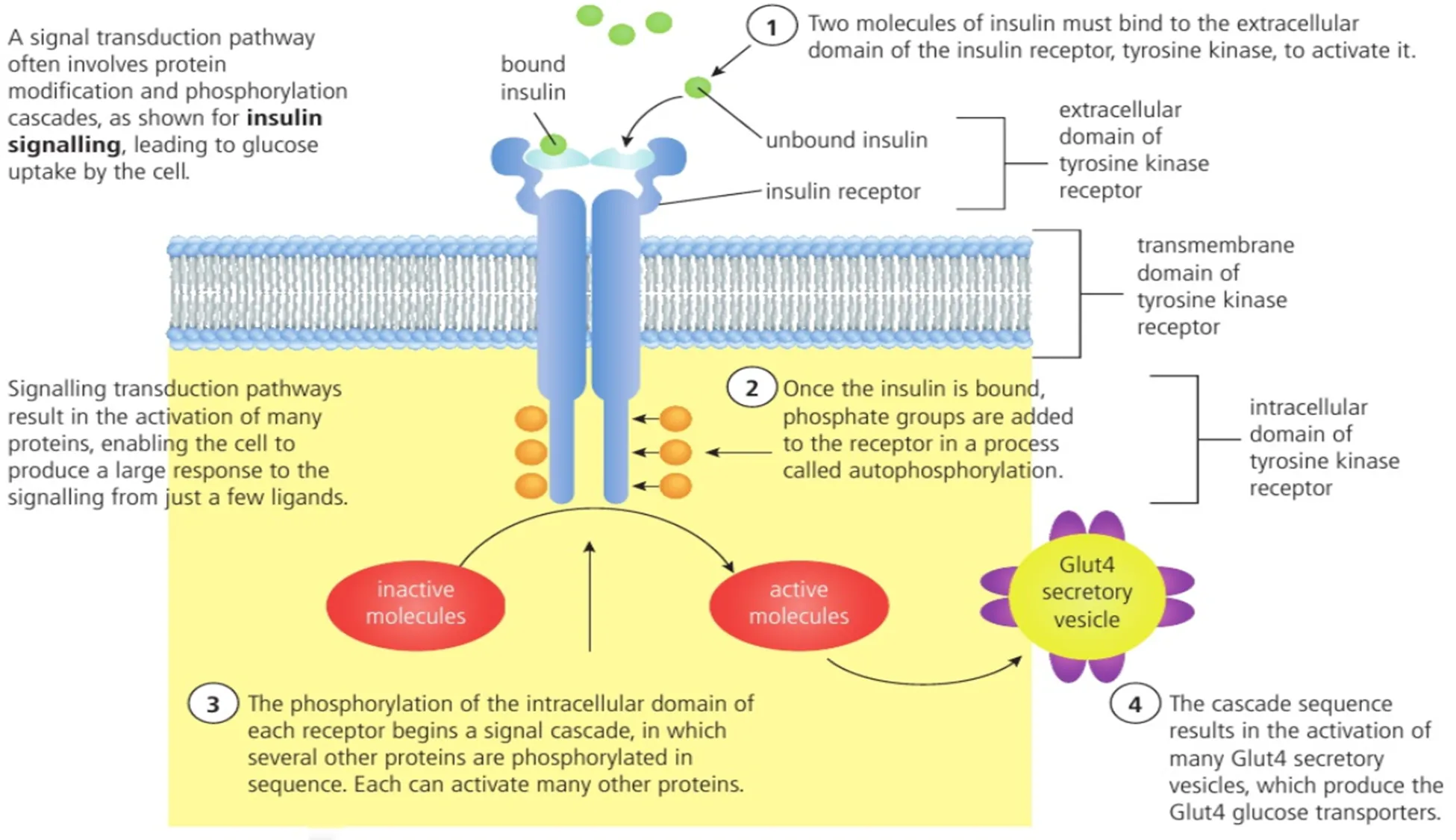
insulin binds to a receptor in the plasma membrane called tyrosine kinase
When insulin binds with tyrosine kinase, the intracellular domain acts as a kinase.
this triggers the phosphorylation of tyrosine in a cell
the intracellular domain of each tyrosine kinase receptor is phosphorylated inside the cell.
This leads to a sequence of reactions ending with glucose transporter vesicles such as Glut-4 moving towards the cell membrane and glucose being released into the bloodstream.
example of a transmembrane receptor that is directly linked to enzymes or work as enzymes
tyrosine kinase.
Like other enzymatic receptors, it is a single-pass protein and consists of three domains, the extracellular domain, the transmembrane domain and the intracellular domain.
This receptor occurs in pairs.
The transmembrane domain passes through a cell membrane only once.
The extracellular domain binds with the hormone called insulin (the ligand).
When insulin binds with tyrosine kinase, the intracellular domain acts as a kinase.
A kinase is an enzyme that catalyses the transfer of a phosphate group from ATP to another substance (the other substance becomes phosphorylated).
In this case the intracellular domain of each tyrosine kinase receptor is phosphorylated inside the cell.
This leads to a sequence of reactions ending with glucose transporter vesicles such as Glut-4 moving towards the cell membrane and glucose uptake from the bloodstream.
what are examples of hormones that bind to intracellular receptors that affect gene expression
steroid hormones oestradiol, progesterone and testosterone as examples.
how do steroid hormones affect gene expression
Most cell receptors are transmembrane receptors, and they bind with hydrophilic ligands.
Intracellular receptors bind hydrophobic ligands and are located inside the cell membrane in the cytoplasm or nucleus.
Steroids are examples of hydrophobic ligands, and they can cross the cell membrane and enter the cytoplasm of target cells.
When a steroid molecule binds with a receptor inside the cell membrane it forms a receptor-signal complex.
This complex then moves into the nucleus, where it binds to the DNA.
Binding with DNA results in a complex that affects transcription within the nucleus.
effect of oestradiol on target cells
Oestradiol influences the hypothalamus of the brain, especially the secretion of gonadotropin-releasing hormone.
The gonadotropin-releasing hormone stimulates the release of gonadotropic hormones from the pituitary gland, which in turn stimulate the ovaries to produce eggs, the female sex cells.
These hormones also stimulate the release of more oestradiol from the ovaries.
effect of progesterone on target cells
progesterone plays a significant role in preparing the wall of the uterus for pregnancy.
The interior layer of the uterus is called the endometrium and it is essential for implantation of a fertilized egg and proper development of that fertilized egg.
Progesterone causes thickening and increased blood vessel formation in the endometrium.
The progesterone maintains the endometrium during the whole pregnancy.
If a pregnancy does not occur during the menstrual cycle, secretion of progesterone is greatly decreased and the lining is lost, only to be re-established for a possible pregnancy in the next cycle.
distinguish positve and negative feedback
Negative feedback systems prevent fluctuations outside a set range.
Positive feedback systems serve to reinforce or amplify a response, often to achieve a particular response.
Positive feedback is not stable, so it is rarer in biological systems than negative feedback.
give an example of negative feedback in cell signalling pathways
The regulation of blood glucose in humans involves two hormones: insulin and glucagon.
These hormones are produced in the pancreas by specialized cells known as islet cells.
The alpha cells of the pancreas produce glucagon when blood glucose levels are low, so that glycogen in the liver can be hydrolysed to form glucose units, which, when released into the blood, elevates glucose levels.
Insulin is released from the beta cells of the pancreas when blood glucose levels are high, resulting in an uptake of glucose into the liver to form fat or glycogen. This decreases blood glucose levels
give an example of positive feedback in cell signalling pathways
Plant receptors are thought to play an important part in a large variety of cell signalling processes, including those controlling plant growth, development and disease resistance.
One of the best-studied signalling systems in plants controls the response of cells to ethylene (ethene), a gaseous molecular hormone that controls seed germination and fruit ripening.
Ethylene receptors function as enzyme-coupled receptors.
lt is the empty receptor that is active; in the absence of the ethylene molecule, the empty receptor activates a protein kinase that switches off the ethylene-responsive genes in the nucleus.
When ethylene is present, the receptor and kinase are inactive, and the ethylene-responsive genes are transcribed.