Psychology Unit 1, Area of Study 1
0.0(0)
Studied by 7 people Call Kai
 Learn
Learn Practice Test
 Spaced Repetition
 Match
Match Flashcards
 Knowt Play
Card Sorting
1/47

Earn XP
Description and Tags
Last updated 11:57 PM on 11/13/22
Name | Mastery | Learn | Test | Matching | Spaced | Call with Kai | Chat |
|---|
No analytics yet
Send a link to your students to track their progress
48 Terms
1
New cards
the central nervous system is made up of...
the brain and spinal cord.
2
New cards
the function of the brain is...
to process information from external and internal enviroments and direct responses.
3
New cards
the function of the spinal cord is...
receive sensory information from the body and send to the brain for processing and to receive information from the brain and send it to the relevant body parts.
4
New cards
the peripheral nervous system is...
the entire network of nerves outside the CNS that transmits information to and from the CNS.
5
New cards
the role of the somatic nervous system is...
carry sensory information to the CNS and motor information from the CNS.
6
New cards
the autonomic nervous system is...
the network of nerves that carry messages between the CNS and the heart, lungs and other internal organs or glands. it is also linked to the brain's cerebral cortex where decision making occurs.
7
New cards
What does the sympathetic nervous system do?
activates the flight or fight response, accelerating heart rate, constrict blood vessels, and raises blood pressure
8
New cards
What does the parasympathetic nervous system do?
It creates a reverse response of the sympathetic nervous system to help slow the body down, counter balancing the activity of the sympathetic nervous system.
9
New cards
changes to the body when the sympathetic nervous system is in action:
- pupils dilate and prevents tears
- saliva decreases so mouth is dry
- heart rate and blood pressure increases
- respiration increases
- releases adrenaline
- sugar is released
- digestion inhibited
- elimination inhibited
- saliva decreases so mouth is dry
- heart rate and blood pressure increases
- respiration increases
- releases adrenaline
- sugar is released
- digestion inhibited
- elimination inhibited
10
New cards
changes to the body when the parasympathetic nervous system is in action:
- constricts pupils and stimulates tears
- stimukates salvation
- heart rate and blood pressure decreases
- decreases respir
- stimukates salvation
- heart rate and blood pressure decreases
- decreases respir
11
New cards
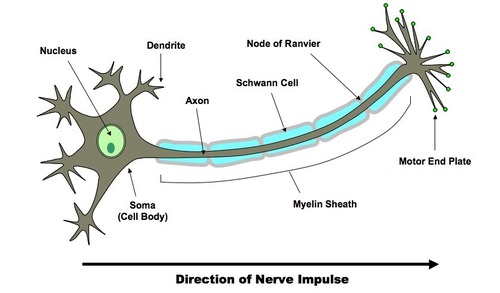
motor neuron
12
New cards
role of dendrites
during neuronal communication, the end of dendrites, known as receptor sites, receive the neuronal message before it is sent to the cell body (soma).
13
New cards
role of soma
integrates the neural information received from the neuron's many dendrites and sends it to the axon.
14
New cards
role of axon
transmits neural information away from the somato, other neurons or cells.
15
New cards
Role of myelin
the fat and protein substance that surrounds and insulates the axon of a neuron.
16
New cards
terminal/axon buttons
a small structure in the axon terminal that stores and secretes neurotransmitter that is manufactured by the neuron and carries its message to other neurons.
17
New cards
sensory neurons
neurons that carry incoming information from the sensory receptors to the brain and spinal cord (CNS).
18
New cards
motor neurons
neurons that carry outgoing information from the CNS to the muscles and glands
19
New cards
interneuron
relays information between sensory and motor neurons
20
New cards
brain
21
New cards
the cerebral cortex is
the outer layer of the brain involved in complex mental abilities, sensory proccesing and voluntary behaviours.
22
New cards
hemispheric specialisation is
that the brain's two sides serve differing functions.
23
New cards
specialisation of the right hemisphere:
- receives and processes sensations from the left side of the body
- controls voluntary movement on the left side of the body
- spatial and visual thinking
- controls voluntary movement on the left side of the body
- spatial and visual thinking
24
New cards
specialisation of the left hemisphere:
- receives and processes sensations from the right side of the body
- controls voluntary movement on the right side of the body
- logical reasoning and analysis
- controls voluntary movement on the right side of the body
- logical reasoning and analysis
25
New cards
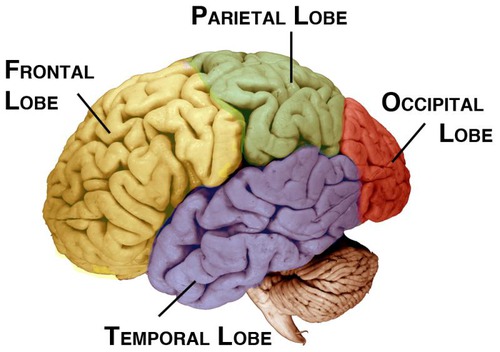
frontal lobe
associated with reasoning, planning, parts of speech, movement, emotions, aspects of our personality, and problem solving
26
New cards
temporal lobe
responsible for memory information, visual perception and emotional responses to sensory information.
27
New cards
occipital lobe
A region of the cerebral cortex that processes visual information. the right half of each eye sends information to the right occipital lobe, and the left half of each to the left.
28
New cards
pariteal lobe
processes info about touch, temperature (from the skin), information about muscle movement and the body's position.
29
New cards
Broca's area
Controls language expression - an area of the frontal lobe, usually in the left hemisphere, that directs the muscle movements involved in speech.
30
New cards
Wernicke's area
controls language reception - a brain area involved in language comprehension and expression; usually in the left temporal lobe
31
New cards
primary motor cortex
the section of the frontal lobe responsible for voluntary movement through its skeletal muscles.
32
New cards
primary somatosensory cortex
Receives and processes bodily sensory information from skin and body parts such as arms, hands, legs, feet, lip and tongue.
33
New cards
Myelination
the growth and development of a fatty sheath around the axons of a neuron
34
New cards
Synaptogenesis
formation of new synapses between the brain's neurons.
35
New cards
synaptic pruning
a process whereby the synaptic connections in the brain that are used are preserved, and those that are not used are lost
36
New cards
teenagers are more likely to indulge in risky behaviour because...
their brains are not fully developed yet, they have an immature prefrontal cortex in the frontal lobe.
37
New cards
spatial neglect
condition produced by damage to the association areas of the right hemisphere resulting in an inability to recognize objects or body parts in the left visual field
38
New cards
brain plasticity
the brain's ability to change in response to experience
39
New cards
sprouting
the growth of additional branches on axons or dendrites to enable new connections
40
New cards
Rerouting
an undamaged neuron that has lost a connection with an active neuron may seek a new active neuron and connect with it instead
41
New cards
Parkinson's disease
A neurological disorder of the central nervous system that is characterised in both motor and non-motor symptoms.
42
New cards
Non-motor symptoms of Parkinson's
- speech problems in change of vocal fluency.
- decrease or loss of sense of smell
- constipation
- decrease or loss of sense of smell
- constipation
43
New cards
Motor symptoms of Parkinson's
- tremor (predominant at rest)
- muscle rigidity (muscles seem unable to relax and are tight even at rest)
- slowness of movement (when initating and executing movement and performs repetitive movement.
- muscle rigidity (muscles seem unable to relax and are tight even at rest)
- slowness of movement (when initating and executing movement and performs repetitive movement.
44
New cards
part of brain affected by parkinson's is
the basal ganglia (part of brain that controls movement).
45
New cards
the neurotransmitter affected by parkinson's is
dopamine
46
New cards
is there a cure for parkinson's disease?
no.
47
New cards
levodopa
the most common treatment for symptoms of Parkinson's disease. It is a chemical that is converted to dopamine through neurons, and when injected it alleviates motor symptoms.
48
New cards
deep brain stimulation
An invasive procedure where a surgeon implants electrodes within the basal ganglia. The electrodes, which are connected to a pulse generator implanted under the skin of the chest, stimulate the target area with tiny amounts of electric current. The electrical activity blocks some motor symptoms.