P8.2 - Energy Resources and power transmission
 Call Kai
 Learn
Learn Practice Test
 Spaced Repetition
 Match
Match Flashcards
 Knowt Play
1/67

There's no tags or description
Looks like no tags are added yet.
Name | Mastery | Learn | Test | Matching | Spaced | Call with Kai |
|---|
No analytics yet
Send a link to your students to track their progress
68 Terms
What is an energy resource?
A large store of energy that can be used to generate electricity and heat homes and businesses
How is electricity generated from any energy resource?
A turbine is turned which spins a generator to generate electricity
How do fossil fuels generate electricity?
Fossil fuels are combusted to heat water → steam produced → steam turns turbine → turbine spins generator → electricity transferred to National Grid [DRAW: fuel → boiler → steam → turbine → generator → grid]
![<p>Fossil fuels are combusted to heat water → steam produced → steam turns turbine → turbine spins generator → electricity transferred to National Grid [DRAW: fuel → boiler → steam → turbine → generator → grid]</p>](https://assets.knowt.com/user-attachments/f2e83f97-43b6-4823-b51e-7326b916a26b.png)
How does nuclear fuel generate electricity?
Nuclear fission heats water → steam turns turbine → generator produces electricity; same process as fossil fuels but no combustion
How does geothermal energy generate electricity?
Hot rocks underground heat water → steam turns turbine → generator produces electricity; cold water pumped down and returns as steam
How does hydroelectric power generate electricity?
Water stored at height in a reservoir; gravitational PE converted to KE as water falls → turns turbine → generator produces electricity [DRAW: reservoir → pipe → turbine → generator]
![<p>Water stored at height in a reservoir; gravitational PE converted to KE as water falls → turns turbine → generator produces electricity [DRAW: reservoir → pipe → turbine → generator]</p>](https://assets.knowt.com/user-attachments/9da8a70f-4203-4e7a-ba9d-a684af758125.png)
How does wind generate electricity?
Wind turns wind turbines directly to generate electricity; no steam or water needed
How do tidal generators work?
Movement of water due to tides turns turbines directly to generate electricity
How do water waves generate electricity?
Moving water from waves turns turbines directly to generate electricity
How does solar generate electricity?
Solar cells use light to generate electricity directly; solar panels use thermal radiation to heat water for domestic use
What is a renewable energy resource?
An energy source replenished at a faster rate than it is being used — it will not run out
Examples of renewable energy resources
Wind; solar; tidal; hydroelectric; bio-fuel; geothermal; water waves
What is a non-renewable energy resource?
One that is used faster than it is replenished — it will eventually run out
Examples of non-renewable energy resources
Fossil fuels (coal, oil, natural gas); nuclear fuel
Three main uses of energy resources
Transport; electricity generation; heating
How is transport mostly powered?
Majority of vehicles run on petroleum products (petrol, diesel, kerosene) — fossil fuels; a growing number of vehicles are now powered by electricity
Advantage of electric vehicles
Produce no carbon emissions at point of use; can use renewable energy sources to charge
Disadvantage of electric vehicles
When charging it is connected to the National Grid which is currently a mix of renewable and non-renewable sources; charging takes time
Can vehicles be powered by biofuel?
Yes — biofuel is a renewable resource; however whether biofuels are truly carbon neutral is controversial
How is heating provided in most homes?
Most homes in cold countries use central heating systems burning gas (non-renewable); some geothermally active countries (e.g. Iceland) can heat homes using geothermal energy
Advantages of fossil fuels
Reliable; can produce large amounts of energy on demand at any time; well-established technology
Disadvantages of fossil fuels
Produce significant greenhouse gases; polluting; non-renewable — will run out
Advantages of nuclear power
Reliable; produces no greenhouse gas emissions during operation; large amount of energy from small amount of fuel
Disadvantages of nuclear power
Produces radioactive waste that can take thousands of years to decay; very expensive to build and decommission
Advantages of bio-fuels
CO₂ produced when burned is absorbed by plants when growing so considered carbon neutral; renewable
Disadvantages of bio-fuels
Takes up a lot of land; requires resources (water, fertiliser) that are needed for food production
Advantages of wind power
Produces no greenhouse gases during operation; renewable; relatively cheap to run
Disadvantages of wind power
Not reliable — depends on wind; turbines can be noisy and unsightly; cannot produce energy on demand
Advantages of hydroelectric power
Reliable; can produce large amounts of energy quickly; can start quickly to meet demand; no greenhouse gas emissions during operation
Disadvantages of hydroelectric power
Constructing flooding can displace people and wildlife; damages habitats; limited suitable locations
Advantages of tidal power
Reliable and predictable (tides are consistent); no greenhouse gas emissions; renewable
Disadvantages of tidal power
Very few suitable locations; expensive to build; environmental harm to aquatic habitats
Advantages of geothermal energy
Reliable; no greenhouse gas emissions; energy available around the clock; renewable
Disadvantages of geothermal energy
Limited to regions with volcanic activity; expensive to drill; not widely available
Advantages of solar power
No greenhouse gas emissions during operation; renewable; good for producing energy to return to National Grid
Disadvantages of solar power
Not reliable — only works when sunny; solar farms can take up lots of land; cannot produce energy on demand at night
What is the Greenhouse Effect?
Global warming caused by increased concentration of greenhouse gases (mainly CO₂ and methane) in the atmosphere trapping heat [DRAW: sun rays hitting Earth → some infrared reflected back → greenhouse gases trap infrared → Earth warms]
![<p>Global warming caused by increased concentration of greenhouse gases (mainly CO₂ and methane) in the atmosphere trapping heat [DRAW: sun rays hitting Earth → some infrared reflected back → greenhouse gases trap infrared → Earth warms]</p>](https://assets.knowt.com/user-attachments/49bcaf63-443b-4490-9144-100cf11c5046.png)
How does the Greenhouse Effect work step by step?
Sun emits radiation → Earth absorbs and re-emits as infrared → greenhouse gases in atmosphere absorb infrared → re-emit it back toward Earth → Earth's average temperature rises; higher concentration of greenhouse gases = higher average temperature
Main greenhouse gases
Carbon dioxide (CO₂) — from burning fossil fuels; methane (CH₄) — from livestock and landfill
Consequences of global warming
Rising sea levels (melting ice caps) flooding low-lying countries; extinction of species due to habitat loss; migration of humans from uninhabitable areas; spread of disease in warmer climates; loss of habitat (e.g. glaciers melting)
Trends in UK energy use over past 30 years
Fossil fuel use dropped from 75% to 55%; renewable energy use increased from 2% to 35%; coal use has dropped dramatically and been replaced largely by natural gas
Why has coal been replaced by natural gas?
Out of the 3 fossil fuels, coal produces the most carbon dioxide while natural gas produces the least; gas is not a solution but is a step in the right direction
What balanced approach is needed to reduce carbon emissions?
Combination of carbon-neutral energy technologies + public support + government policy; more nuclear power stations; new generation of nuclear power stations in development; moving away from coal; political, social, ethical and economic considerations all involved
What is the National Grid?
A system of cables and transformers linking power stations to consumers (houses, factories and buildings) across the UK
What two types of transformer does the National Grid use?
Step-up transformers which increase the voltage and decrease the current for transmission; step-down transformers which decrease the voltage and increase the current for domestic use [DRAW: power station → step-up transformer → transmission lines → step-down transformer → homes]
![<p>Step-up transformers which increase the voltage and decrease the current for transmission; step-down transformers which decrease the voltage and increase the current for domestic use [DRAW: power station → step-up transformer → transmission lines → step-down transformer → homes]</p>](https://assets.knowt.com/user-attachments/90833599-2083-46fe-891e-82daf2d12391.png)
Why is electricity transmitted at high voltage across the National Grid?
High voltage means lower current for the same power (P = VI); lower current means less energy lost as heat in the cables → more efficient transmission
Relationship between current and energy loss in cables
Lower current → less heating effect in cables → less energy wasted; this is why high voltage/low current is used for transmission
What is direct current (DC)?
Current that flows continuously in one direction only; potential difference across circuit is fixed positive or negative; produced by cells and batteries
What is alternating current (AC)?
Current that constantly changes direction, going back and forth around a circuit; potential difference alternates between positive and negative
UK mains electricity frequency and potential difference
Frequency: 50 Hz; potential difference: 230 V
What graph shape represents DC?
Flat horizontal line (constant current in one direction) [DRAW: current vs time graph — flat straight line]
![<p>Flat horizontal line (constant current in one direction) [DRAW: current vs time graph — flat straight line]</p>](https://assets.knowt.com/user-attachments/fa3b1ffe-e709-469c-a2e0-e2fd9146764d.png)
What graph shape represents AC?
Sinusoidal wave (current alternates between positive and negative) [DRAW: current vs time graph — sine wave oscillating above and below zero]
![<p>Sinusoidal wave (current alternates between positive and negative) [DRAW: current vs time graph — sine wave oscillating above and below zero]</p>](https://assets.knowt.com/user-attachments/f8b2de77-731e-454c-a340-9c1462d5f2e0.png)
What are the three wires in a mains cable?
Live wire (brown); neutral wire (blue); earth wire (green and yellow stripes)
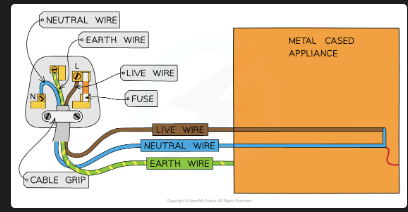
Function of the live wire
Carries alternating potential difference from the supply (230 V); most dangerous wire — can cause electrocution even if not directly touching it
Function of the neutral wire
Completes the circuit; at approximately 0 V; much less dangerous than the live wire
Function of the earth wire
Safety wire — only carries current if appliance develops a fault; provides low resistance path to earth; large current flows → blows fuse → cuts off electricity supply → appliance safe to touch
Voltages of the three wires
Live: 230 V; Neutral: 0 V; Earth: 0 V (only carries current in a fault)
Why is the live wire dangerous even when a switch is open?
It is always at 230 V relative to earth; touching it completes a circuit through your body to earth even when device is off
Why is the earth wire a safety device?
If a fault connects the live wire to the metal casing → current flows through earth wire → very large current → blows fuse → electricity cut off → safe to touch
What is a transformer?
A device that changes the potential difference (voltage) of an alternating current electricity supply
Structure of a transformer
Primary coil + secondary coil wound around an iron core; iron core is easily magnetised [DRAW: transformer diagram — primary coil, iron core, secondary coil]
![<p>Primary coil + secondary coil wound around an iron core; iron core is easily magnetised [DRAW: transformer diagram — primary coil, iron core, secondary coil]</p>](https://assets.knowt.com/user-attachments/3f9a8185-13cc-4b93-a64f-3ac46fe8d303.png)
How does a transformer work?
AC in primary coil → continuously changing current → changing magnetic field in iron core → changing magnetic field cuts through secondary coil → induces alternating potential difference in secondary coil → AC flows if circuit is complete
What is a step-up transformer?
Has more turns on the secondary coil than primary; increases voltage and decreases current; used at power stations before National Grid transmission
What is a step-down transformer?
Has more turns on the primary coil than secondary; decreases voltage and increases current; used before electricity reaches homes (e.g. 230 V for domestic use)
Transformer equation (turns ratio)
Vₚ/Vₛ = nₚ/nₛ where Vₚ = primary voltage, Vₛ = secondary voltage, nₚ = primary turns, nₛ = secondary turns
Transformer equation (ideal — power in = power out)
Vₚ × Iₚ = Vₛ × Iₛ where I = current; an ideal transformer is 100% efficient
Why are real transformers not 100% efficient?
Due to the law of conservation of energy — some energy is always lost (e.g. as heat in coils); they can increase voltage but cannot increase power output
Why does a step-up transformer increase efficiency of the National Grid?
Increases voltage → decreases current → less energy lost as heat in transmission cables → more energy reaches consumers