Chapter 1: Parametric Equations and Polar Coordinates
 Call Kai
 Learn
Learn Practice Test
 Spaced Repetition
 Match
Match Flashcards
 Knowt Play
1/35

There's no tags or description
Looks like no tags are added yet.
Name | Mastery | Learn | Test | Matching | Spaced | Call with Kai |
|---|
No analytics yet
Send a link to your students to track their progress
36 Terms
angular coordinate
𝜃 the angle formed by a line segment connecting the origin to a point in the polar coordinate system with the positive radial (x) axis, measured counterclockwise
Cardioid
a plane curve traced by a point on the perimeter of a circle that is rolling around a fixed circle of the same radius

conic section
a conic section is any curve formed by the intersection of a plane with a cone of two nappes
cusp
a pointed end or part where two curves meet
cycloid
the curve traced by a point on the rim of a circular wheel as the wheel rolls along a straight line without slippage
directrix
(plural: directrices) is a line used to construct and define a conic section; a parabola has one directrix; ellipses and hyperbolas have two
discriminant
the value 4𝐴𝐶−𝐵2, which is used to identify a conic when the equation contains a term involving 𝑥𝑦,
eccentricity
the distance from any point on the conic section to its focus divided by the perpendicular distance from that point to the nearest directrix
focal parameter
the distance from a focus of a conic section to the nearest directrix
focus
a point used to construct and define a conic section; a parabola has one focus; an ellipse and a hyperbola have two
general form
an equation of a conic section written as a general second-degree equation
limaçon
the graph of the equation 𝑟=𝑎+𝑏sin𝜃 or 𝑟=𝑎+𝑏cos𝜃. If 𝑎=𝑏 then the graph is a cardioid
major axis
of a conic section passes through the vertex in the case of a parabola or through the two vertices in the case of an ellipse or hyperbola; it is also an axis of symmetry of the conic; also called the transverse axis
minor axis
perpendicular to the major axis and intersects the major axis at the center of the conic, or at the vertex in the case of the parabola; also called the conjugate axis
nappe
one half of a double cone
orientation
the direction that a point moves on a graph as the parameter increases
parameter
an independent variable that both x and y depend on in a parametric curve; usually represented by the variable t
parameterization of a curve
rewriting the equation of a curve defined by a function 𝑦=𝑓(𝑥) as parametric equations
parametric curve
the graph of the parametric equations 𝑥(𝑡) and 𝑦(𝑡) over an interval 𝑎≤𝑡≤𝑏 combined with the equations
parametric equations
the equations 𝑥=𝑥(𝑡) and 𝑦=𝑦(𝑡) that define a parametric curve
polar axis
the horizontal axis in the polar coordinate system corresponding to 𝑟≥0
polar coordinate system
a system for locating points in the plane. The coordinates are 𝑟, the radial coordinate, and 𝜃, the angular coordinate
polar equation
an equation or function relating the radial coordinate to the angular coordinate in the polar coordinate system
pole
the central point of the polar coordinate system, equivalent to the origin of a Cartesian system
radial coordinate
𝑟 the coordinate in the polar coordinate system that measures the distance from a point in the plane to the pole
rose
graph of the polar equation 𝑟=𝑎cos2𝜃 or 𝑟=𝑎sin2𝜃 for a positive constant a
space-filling curve
a curve that completely occupies a two-dimensional subset of the real plane
standard form
an equation of a conic section showing its properties, such as location of the vertex or lengths of major and minor axes
vertex
an extreme point on a conic section; a parabola has one vertex at its turning point. An ellipse has two vertices, one at each end of the major axis; a hyperbola has two vertices, one at the turning point of each branch
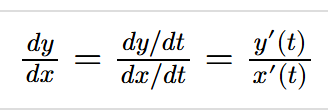
Derivative of parametric equations
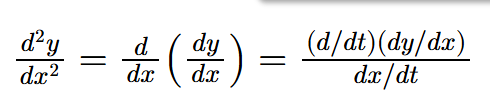
Second-order derivative of parametric equations
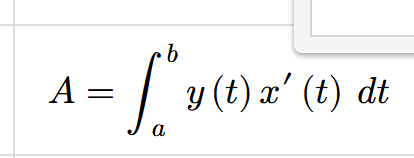
Area under a parametric curve
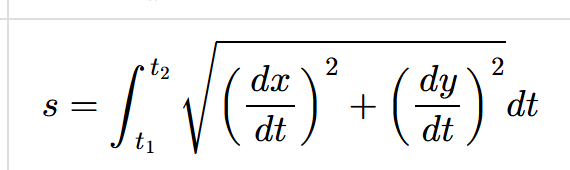
Arc length of a parametric curve
Surface area generated by a parametric curve

Area of a region bounded by a polar curve
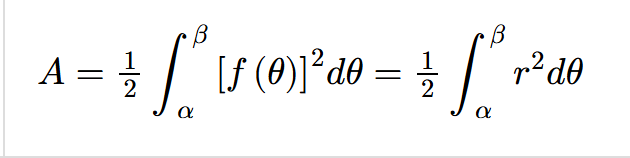
Arc length of a polar curve
