Lecture 14: Making Cells Different I - Partitioning, C.Elegans
 Call Kai
 Learn
Learn Practice Test
 Spaced Repetition
 Match
Match Flashcards
 Knowt Play
1/37

There's no tags or description
Looks like no tags are added yet.
Name | Mastery | Learn | Test | Matching | Spaced | Call with Kai |
|---|
No analytics yet
Send a link to your students to track their progress
38 Terms
C. elegan’s early development comes from…
its own genome
5 steps of fertilization
1) chemoattraction
2) binding
3) exocytosis
4) passage
5) fusion
Chemoattraction
of the sperm to the egg by soluble molecules secreted by the egg
Binding
of the sperm to the extracellular matrix (jelly or zona pellucida) of the egg
What surrounds the egg plasma membrane?
Jelly coat and vitelline envelope
Exocytosis
of the sperm acrosomal vesicle and the release of its enzymes
Passage
of the sperm through the ECM to the egg cell membrane
Components from the sperm acrosome degrade ECM
fusion
of the egg and sperm cell membranes
The acrosome reaction (sea urchin)
A specilized exocytosis - acrosome membrane membrane fused with the sperm membrane
The acrosome is a cap-like, membrane-bound organelle derived from the Golgi apparatus located on the anterior half of the sperm head.
It contains hydrolytic enzymes
Acrosomal enzymes digest the egg ECM (vitelline membrane in sea
urchin, zona pellucida in mammals)
Actin polymerization pushes the front of the sperm outward, forming a finger-like projection
The finger-like projection is coated with bindin, a species-specific protein that allows the sperm to adhere firmly to the egg's vitelline envelope
blocks to polyspermy (fast)
Change in membrane potential due to influx of Na+
Sperm cannot fuse when the membrane potential is positive
Occurs in sea urchins and potentially Xenopus, but not mammals
blocks to polyspermy (slow - cortical granules)
Release of cortical granules from the egg via exocytosis
Cortical granules contain lots of glycosaminoglycans (GAGs)
Contents modify the outer ECM layer so that sperm cannot fuse
Includes a Ca2+ wave generated in the egg
Occurs in most species, including mammals and sea urchins
blocks to polyspermy (slow - Zn2+)
‘Zn spark’ - release of Zn2+ ions around the egg that strengthens the membrane to prevent sperm entry
Occurs in mammals and fish
C. elegans development
~15 hrs to hatch
Transparent
High brood sizes
Almost all organ systems are present (except the cytoskeleton)
Asymmetric division
The 26-cell stage starts Gastrulation
First complete genome to be sequenced
what cell stage starts gastrulation in C.elegans
26
Invariant lineage (C.elegans)
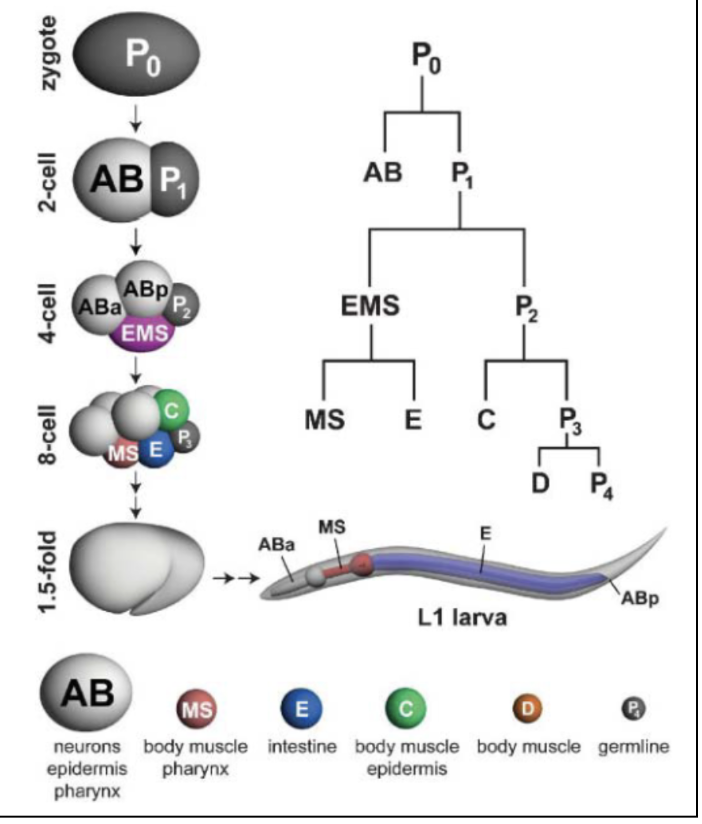
A fertilized zygote (P0) always divides into 2 cells,
One is big (AB - anterior), one is small (P1-posterior)
From AB:
Get ABa and ABp
From P1:
Get EMS and P2
From EMS:
Get MS and E
From P2:
Get C and P3
From P3
Get D and P4
Many ____ cell deaths occur a precursor cell divides asymmetrically
somatic, one daugther surives, and the other dies
assymmetric cleavage of blastomeres generates…
cell fate diversity and body axes
AB (big cell) gives rise to
anterior
small cell (P1) gives rise to
posterior
sperm entry point defines ____ in C. elegans
A-P axis
Wherever sperm enters is where the cell becomes….
P1 so posterior
Polarity proteins are
PAR proteins
Anterior PARs
PAR-3, aPKC, PAR-6, CDC-42
posterior PARs
PAR-2, PAR-1, LGL-1
before fertilization, where are PARs
Anterior PARs localized symmetrically around the cortex
Posterior PARs in the cytoplasm
cortex
thin, actin-rich network located directly underneath the plasma membrane
How does PAR function
PAR-1 (kinase) recruits PAR-2 (ring protein) to the posterior and phosphorylates PAR-3 to kick it off posterior
To put PAR-2 on membrane, need
tubulin
sperm nucleus makes the MT, oocytes can organize MT a little
How is symetry broken?
Anterior PARs are everywhere at the beginning, but sperm enters, and they start to attach to the MT
Putting MT on the cortex displaces anterior PAR proteins on the membrane
Posterior proteins bind immediately and expand
Posterior proteins phosphorylate whatever is closest
Posterior proteins also phosphorylate Air-1 (Aurora Kinase), which inhibits myosin
no contraction of actin in the posterior
aPKC phosphorylates PAR-2 and LGL-1, removing them from the cortex
Active myosin shifts to the anterior
Contraction of actin causes cortical flow of cytoplasm, which distributes things asymmetrically
Myosin activity is what gives true asymmetry
does actin contract in the posterior
no, because Air-1 is phosphorylated and inhibits myosin
P1 is ____ specified
autonomously, can laser AB and still get same fate
AB is ____ specified
inductively, if laser P1, don’t get pharynx in AB lineages
P granules
key determinants partitioned into germline founder cells
P granules are complexes of RNAs and proteins that function in specification of the germ cells
P-granules get pushed to the posterior in the one-cell zygote
PIE-1
Key determinants are partitioned into germline founder cells
PIE-1 is a transcriptional repressor that keeps gene expression off in the germline founder cells early in embryonic development
In the absence of PIE-1, germ cells adopt somatic fates
Autonomous development of P1
Regulated by the partitioning of cell fate determinants
P-granules and Pie-1 in P1, P2, P3, P4
Pharyngeal determinant in P1, EMS, MSi
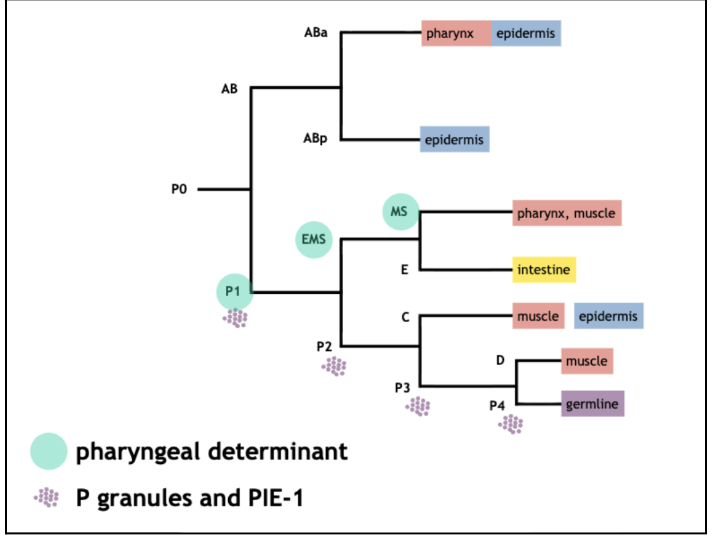
SKN-1
Pharyngeal determinant
SKN-1 = Pharyngeal determinant
Posteriorly pushed
Transcriptional factor
High levels in P1 and it’s daughters and low levels in AB in its daughters-
SKN-1 Mutants
EMS progeny not properly specified
Don't get pharynx, muscle, and intestine in mutants
Skn-1 is essential for pharynx
Skn1 is also in P2, but if Pie-1 is there, then it is inhibited, so it’s only needed in EMS