10 Science- Biology
 Call Kai
 Learn
Learn Practice Test
 Spaced Repetition
 Match
Match Flashcards
 Knowt Play
1/26

Earn XP
Description and Tags
Absoutly no idea ✌🏻
Name | Mastery | Learn | Test | Matching | Spaced | Call with Kai |
|---|
No analytics yet
Send a link to your students to track their progress
27 Terms
DNA
Deoxyribonucleic Acid is found in the nucleus of every cell. It carries the genetic instructions for the development, functioning and reproduction of all living organisms
How many chromosomes does a human have ?
46 (23 pairs)
What does DNA code for
inherited characteristics - such as eye colour, blood type
DNA replication
Replication copies DNA before cell division so each new cell receives a complete set of genetic instructions
Males chromosomes
XY (one X, one Y chromosome)
side note- X-linked recessive conditions appear more often in males because they have no second X to ‘mask’ the recessive allele
Female chromosomes
XX (two X chromosomes)
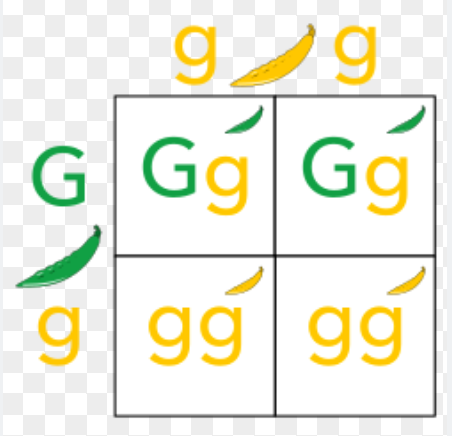
Punnett squares
are used to predict the probability of offspring inheriting particular genotypes and phenotypes
Reading Pedigree charts
Squares- males
circles- females
shaded- affected individual
unshaded- unaffected
horizontal line between two individuals- mating pair
vertical lines- offspring
Type of inheritance from a pedigree
If the trait skips a generation- likely recessive
if every generation is affected- likely dominant
if only males are affected- likely X-linked recessive
If both sexes equally affected- likely autosomal
Nucleotide
The structural (building block) unit of DNA. Consists of a deoxyribose sugar + phosphate backbone + one nitrogenous base. |
Nitrogenous bases |
Adenine (A), Thymine (T), Cytosine (C), Guanine (G). Bases pair specifically: A–T and C–G (complementary base pairing).
DNA
Long molecule made of nucleotides carrying genetic code. Makes up chromosomes
Gene
A specific segment of DNA that codes for a particular trait or protein. A section of DNA on a chromosome
Chromosome |
Tightly coiled strands of DNA found in the nucleus. Contains thousands of genes
Two Basic Functions of DNA
• Carrying genetic information — the sequence of bases stores instructions for all traits
• Coding to produce proteins — genes direct the production of proteins that control body functions
Helicase
Unwinds and 'unzips' the double helix by breaking hydrogen bonds between base pairs. STEP 1
DNA Polymerase
Reads the template strand and adds complementary nucleotides to build a new strand (A–T, C–G). STEP 2
DNA Ligase
Joins (seals) fragments of newly made DNA together to form a continuous strand. STEP 3
Allele
Different versions of the same gene (e.g. B = brown eyes, b = blue eyes).
Dominant allele
Expressed in the phenotype even when only one copy is present. Written as a CAPITAL letter (e.g. B).
Recessive allele
Only expressed when two copies are present (homozygous recessive). Written in lowercase (e.g. b). |
Genotype
The genetic make-up of an organism — the alleles it carries (e.g. BB, Bb, bb).
Phenotype
The physical expression of the genotype — the trait that is visible (e.g. brown eyes).
Homozygous
Two identical alleles (BB or bb).
Heterozygous
Two different alleles (Bb). The dominant trait is expressed.
Autosomal
On non-sex chromosomes (chromosomes 1–22). Cystic fibrosis, freckles. Affects males and females equally
Sex-linked
On the X chromosome (usually). Colour blindness, haemophilia. More common in males (they have only one X)