ACC Pre Assessment for BIO 2401
 Call Kai
 Learn
Learn Practice Test
 Spaced Repetition
 Match
Match Flashcards
 Knowt Play
1/121

There's no tags or description
Looks like no tags are added yet.
Name | Mastery | Learn | Test | Matching | Spaced | Call with Kai |
|---|
No analytics yet
Send a link to your students to track their progress
122 Terms
What is the nuclear lamina?
A layer of protein fibers located within the nuclear envelope.
What is the primary function of the smooth endoplasmic reticulum (SER)?
To make lipids, such as phospholipids and steroids.
What are two specialized functions of the SER in specific cell types?
Storing calcium ions for muscle contraction in muscle cells and detoxifying drugs in liver cells.
What distinguishes the rough endoplasmic reticulum (RER) from the smooth ER?
The RER has ribosomes docked along its membrane, giving it a rough appearance.
What are the three components of the eukaryotic cytoskeleton?
Microfilaments, intermediate filaments, and microtubules.
What is the primary plant starch used for long-term energy storage?
Amylose (unbranched) and Amylopectin (branched).
What are the three main types of lipids discussed?
Fats (triglycerides), Phospholipids, and Steroids.
What determines the unique properties of different amino acids?
The 'R' group (side chain) attached to the central alpha carbon.
What is the specific name of the covalent bond formed between amino acids?
A peptide bond.
What defines the primary structure of a protein?
The specific sequence of amino acids.
How many hydrogen bonds form between Guanine and Cytosine?
Three hydrogen bonds.
What is the formula to convert Celsius to Fahrenheit?
°F = (9/5 x °C) + 32°
When converting from a smaller unit to a larger unit, how does the decimal point move?
The decimal point moves to the left.
Convert 3 milligrams (mg) to micrograms (µg).
3,000 µg
What are the products generated by glycolysis?
Electrons (carried by NADH), pyruvate, ATP, hydrogen ions (H+), and water (H2O).
What is the final electron acceptor in the electron transport chain?
Oxygen gas (O2).
Which pathway of cellular respiration produces the most ATP?
Oxidative phosphorylation (producing 26-28 ATP).
What is fermentation?
The anaerobic production of ATP by repeating the glycolysis pathway.
What is the function of cholesterol in the plasma membrane?
It helps maintain membrane fluidity by creating space for phospholipids and other macromolecules to move.
Why can't ions and charged molecules easily cross the plasma membrane?
The negatively charged phospholipid heads repel charged molecules regardless of their size.
Define diffusion.
The net movement of atoms or molecules from an area of high concentration to an area of low concentration.
What is osmosis?
The diffusion of water across a selectively permeable membrane.
What is the primary difference between prokaryotic and eukaryotic cells?
Eukaryotic cells contain a nucleus and other membrane-bound organelles, while prokaryotic cells lack these internal structures.
What is the function of the nucleoid in a prokaryotic cell?
It is the region where DNA is located, though it is not enclosed by a membrane.
How are molecules transported from the RER to other destinations?
They are packaged into vesicles that bud off from the RER membrane.
What is the function of mitochondria?
They are the site of cellular respiration, which uses glucose and O2 to generate ATP.
What are macromolecules?
Very large molecules that are essential to living organisms, typically built by joining smaller subunits called monomers.
How are monosaccharides joined to form polysaccharides?
Through a condensation or dehydration reaction, which removes water and creates a covalent bond between them.
What is the structural polysaccharide found in plant cell walls?
Cellulose, which is composed of beta-glucose chains.
What is the general characteristic of lipids regarding water?
Most lipids are hydrophobic, meaning they are water-hating.
What distinguishes a saturated fatty acid from an unsaturated one?
Saturated fatty acids contain only single covalent bonds between carbons, while unsaturated fatty acids contain at least one double covalent bond.
What is the physical state of saturated fats at room temperature?
Solid (e.g., butter, lard).
What is the 'head' and 'tail' property of a phospholipid?
The head is hydrophilic (water-loving), and the tails are hydrophobic (water-hating).
What is the structural arrangement of phospholipids in cell membranes?
They form a bilayer with hydrophilic heads facing outward and hydrophobic tails facing inward.
What type of reaction joins amino acids together?
A condensation (dehydration) reaction.
Which nitrogenous bases are classified as pyrimidines?
Cytosine and Thymine (in DNA) or Uracil (in RNA).
Which nitrogenous bases are classified as purines?
Adenine and Guanine.
How many hydrogen bonds form between Adenine and Thymine?
Two hydrogen bonds.
What are three structural differences between DNA and RNA?
DNA uses deoxyribose while RNA uses ribose; DNA uses thymine while RNA uses uracil; DNA is double-stranded while RNA is single-stranded.
What is the basic SI unit for mass?
Gram (g)
When converting from a larger unit to a smaller unit, how does the decimal point move?
The decimal point moves to the right.
Convert 3 milliliters (ml) to liters (L).
0.003 L
What does the acronym ATP stand for?
Adenosine triphosphate.
What are the three products of cellular respiration?
ATP, carbon dioxide (CO2), and water (H2O).
What is the main purpose of glycolysis?
To split glucose molecules to extract electrons.
What must happen to pyruvate before it enters the citric acid cycle?
It must be converted into acetyl coenzyme A (acetyl CoA) in the mitochondria.
Which electron carriers are produced during the citric acid cycle?
NADH and FADH2.
What is the primary function of the electron transport chain in oxidative phosphorylation?
To receive electrons from NADH and FADH2 and pass them through a series of proteins to power ATP production.
What protein structure is responsible for creating ATP during oxidative phosphorylation?
ATP synthase.
How does ATP synthase create ATP?
It adds a phosphate group to an ADP molecule.
What are the three major principles of the cell theory?
The cell is the basic unit of life; all organisms consist of one or more cells; new cells are created when existing cells divide.
What are the four common components found in most cells?
A plasma membrane, cytosol, DNA, and ribosomes.
What is the structure of the plasma membrane?
A phospholipid bilayer with hydrophilic heads facing outward and hydrophobic fatty acid tails facing inward.
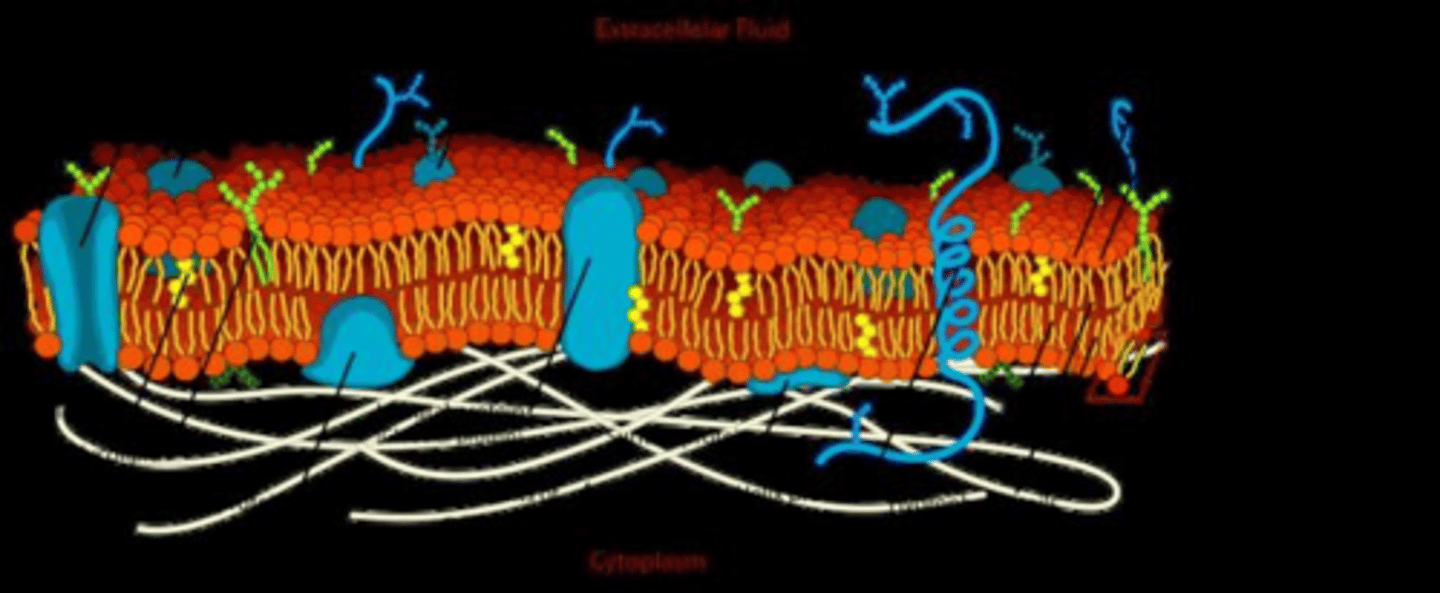
Why is the plasma membrane described as fluid?
Because phospholipids are able to move laterally within the membrane layer.
What is the role of carbohydrates on the plasma membrane?
They act as markers for cell recognition, such as determining human ABO blood types.
What substances can cross the plasma membrane unaided?
Small and uncharged substances, such as gases like O2 and CO2.
What is the function of the cell wall in prokaryotes?
It provides a rigid covering for the cell in addition to the plasma membrane.
What is the function of the nucleus in eukaryotic cells?
To store and protect most of the cell's DNA.
What is the endomembrane system?
A group of membrane-bound organelles that work together to produce and transport biological macromolecules.
What is the role of the RER in protein synthesis?
It provides a space for proteins to fold into their proper shape and allows for modifications.
What is the function of the Golgi apparatus?
It receives macromolecules, modifies them, and packages them into vesicles for their final destination.
What are lysosomes?
Vesicles containing enzymes that break down biological macromolecules.
What is the structural difference between cilia and flagella?
Cilia are much shorter than flagella, though both consist of microtubule bundles surrounded by plasma membrane.
What is the main purpose of the cytoskeleton?
To help the cell maintain its shape.
What are the four main classes of macromolecules?
Carbohydrates, Lipids, Proteins, and Nucleic Acids.
What is the primary function of carbohydrates?
They are used for energy storage or for structural purposes.
What are the building blocks of polysaccharides?
Monosaccharides (simple sugars).
What is the most common monosaccharide?
Glucose (C6H12O6).
What is glycogen?
A highly branched polysaccharide used by animals for short-term energy storage in the liver and muscles.
Why can't humans digest cellulose?
Humans lack the enzymes to break down the beta-glucose linkages in cellulose, which is why it is referred to as fiber.
What is chitin?
A structural polysaccharide containing modified glucose with a nitrogen-containing group, found in insect exoskeletons and fungi.
What are the components of a fat molecule?
One glycerol molecule and three fatty acid chains.
What effect do double bonds have on unsaturated fatty acids?
They create 'kinks' in the chain, which typically makes them liquid at room temperature.
How do trans unsaturated fatty acids differ from cis unsaturated fatty acids?
Trans fats are arranged without kinks, making them solid at room temperature and associated with heart health risks similar to saturated fats.
What are the components of a phospholipid?
A glycerol backbone, a phosphate group, a nitrogen-containing group, and two fatty acid tails.
What structure do phospholipids form in cell membranes?
A phospholipid bilayer, where hydrophilic heads face outward and hydrophobic tails face inward to form a core.
What is the primary function of fats in organisms?
Long-term energy storage.
What are the chemical elements that primarily make up carbohydrates?
Carbon, hydrogen, and oxygen.
What is the common structural characteristic of all steroids?
They consist of four interconnected rings.
What is the primary function of cholesterol in the body?
It maintains the flexibility of cell membranes.
What is the function of cortisone in the human body?
It is active in carbohydrate metabolism and is used to treat allergic reactions.
What are the subunits that make up proteins?
Amino acids.
What are the two functional groups found in every amino acid?
An amino group (-NH2) and a carboxyl group (-COOH).
What types of bonds hold the secondary structure of a protein together?
Hydrogen bonds.
What are the two common shapes found in protein secondary structure?
Alpha helix and beta pleated sheet.
What characterizes the tertiary structure of a protein?
The folding of the entire protein into a specific 3D shape, such as globular or fibrous.
What is quaternary protein structure?
The association of two or more polypeptide chains (proteins) into a single functional unit.
What is a classic example of a protein with quaternary structure?
Hemoglobin, which consists of four globin proteins.
What are the subunits of nucleic acids?
Nucleotides.
What are the three components of a nucleotide?
A monosaccharide (sugar), at least one phosphate group, and a nitrogenous base.
What does the term 'antiparallel' mean in the context of DNA structure?
The two strands of the DNA double helix are oriented in opposite directions (one 5' to 3', the other 3' to 5').
What is the primary advantage of the metric system (SI) over the English system in science?
It is easy to describe units smaller or larger than the basic unit using prefixes, and conversions are simple because they differ by powers of ten.
What is the basic SI unit for length?
Meter (m)
What is the basic SI unit for volume?
Liter (l or L)
What is the basic SI unit for temperature?
Degree Celsius (°C)
What is the basic SI unit for time?
Second (s)
What is the prefix value and power of ten for 'kilo' (k)?
1,000 or 10^3
What is the prefix value and power of ten for 'mega' (M)?
1,000,000 or 10^6
What is the prefix value and power of ten for 'giga' (G)?
1,000,000,000 or 10^9
What is the prefix value and power of ten for 'deci' (d)?
1/10 or 0.1 or 10^-1