2.3 Aggregate supply
 Call Kai
 Learn
Learn Practice Test
 Spaced Repetition
 Match
Match Flashcards
 Knowt Play
1/34

There's no tags or description
Looks like no tags are added yet.
Name | Mastery | Learn | Test | Matching | Spaced | Call with Kai |
|---|
No analytics yet
Send a link to your students to track their progress
35 Terms
What is aggregate supply?
Aggregate supply is the total supply of goods and services produced within an economy at a specific price level at a given time
True or false?
The aggregate supply curve is downward sloping.
False
The aggregate supply curve is upward sloping
What causes a movement along the SRAS curve?
A movement along the SRAS curve is caused by a change in the average price level in an economy
Define the term expansion (or extension) of SRAS.
Expansion or extension of SRAS is a rise in real GDP due to an increase in the average price level, shown as a movement up along the SRAS curve
What is a contraction of SRAS?
A contraction of SRAS is a fall in real GDP due to a decrease in the average price level, shown as a movement down along the SRAS curve
What causes a shift of the entire SRAS curve?
A shift of the entire SRAS curve is caused by a change in the conditions of supply in an economy, such as the costs of production , exchange rates and tax rates
How does a decrease in costs affect the SRAS curve?
A decrease in costs results in a shift right of the entire SRAS curve, increasing output at every price level
State the meaning of short run in aggregate supply
Short run in aggregate supply refers to the time period where at least one factor of production is fixed
What is long run aggregate supply influenced by?
Long run aggregate supply is influenced by a change in the productive capacity of the economy
Define productive capacity
The maximum output an economy can produce by improving either the quantity, quality or both of its factors of production
How is long-term economic growth achieved?
Long-term economic growth is achieved by increasing the productive capacity of an economy
What are three factors that can influence short-run AS?
Changes in costs of raw materials and energy
Changes in exchange rates
Changes in tax rates.
How does an increase in the cost of raw materials affect SRAS?
An increase in the cost of raw materials causes SRAS to decrease, shifting the curve left
What is the impact of a decrease in costs of raw materials on SRAS?
A decrease in costs of raw materials causes SRAS to increase, shifting the curve right
How does an appreciation of the exchange rate affect the SRAS for a country ?
An appreciation of the exchange rate causes SRAS to increase, shifting the curve right, due to cheaper imports in terms of the country's own currency, lowering input costs
What is the effect of a depreciation of the exchange rate on the SRAS for a country ?
A depreciation of the exchange rate causes SRAS to decrease, shifting the curve left, due to more expensive imports in terms of the country's own currency, increasing input costs
How do decreased tax rates impact the SRAS?
Decreased tax rates cause SRAS to increase, shifting the curve right, as taxes represent an additional cost for firms
What is the effect of increased tax rates on the SRAS?
Increased tax rates cause SRAS to decrease, shifting the curve left, as taxes represent an additional cost for firms
True or False?
An appreciation of the exchange rate leads to more expensive imports
False
An appreciation of the exchange rate leads to cheaper imports in terms of the country's own currency
How do cheaper imports affect the SRAS?
Cheaper imports cause the SRAS to increase, shifting the curve right, due to lower input costs for firms
What happens to the SRAS when input costs rise?
When input costs rise, the SRAS decreases, shifting the curve left, as fewer goods/services can be produced with the same amount of money
How does a stronger currency impact the SRAS?
A stronger currency causes the SRAS to increase, shifting the curve right. This is due to cheaper prices of imports in terms of the country's own currency, lowering input costs
What is the relationship between tax rates and the SRAS?
There is an inverse relationship between tax rates and the SRAS. When tax rates decrease the SRAS increases and when tax rates increase the SRAS decreases
What are the two opposing views on how LRAS works in an economy?
The two opposing views on how LRAS works in an economy are the Classical view and the Keynesian view
Describe the classical view of LRAS
The classical view of the LRAS curve is that it is perfectly price inelastic (vertical) at a real national output with full employment of all available resources
What is the Keynesian view of LRAS?
The Keynesian view of the LRAS curve is that it is more L-shaped, with supply more price elastic at lower levels of real national output and perfectly price inelastic at full employment
How does the classical view believe the economy will self-correct?
The classical view believes the economy will always return to the full employment level of real national output in the long-run, but at a different average price level
What is a positive output gap or inflationary gap?
A positive output gap or inflationary gap is a period of extreme economic growth where real national output exceeds the full employment level
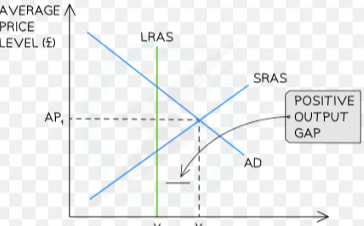
Define a negative output gap or recessionary gap.
A negative output gap or recessionary gap is a period of economic slowdown or recession where real national output is below the full employment level
True or false?
The Keynesian view believes an economy will always self-correct.
False.
The Keynesian view believes an economy may not always self-correct and return to the full employment level of output
What role does the Keynesian view suggest for the government?
The Keynesian view suggests the government should increase its expenditure to shift aggregate demand and change negative 'animal spirits' in the economy
What are three factors that can influence long-run AS?
technological advances
changes in relative productivity
changes in education and skills.
How do technological advances affect LRAS?
Technological advances shift the entire LRAS curve outwards, increasing the potential output of the economy
What is the impact of improved education and skills on LRAS?
Improved education and skills shift the entire LRAS curve outwards, increasing the potential output of the economy by enhancing the quality of labour
How does competition policy affect LRAS?
Competition policy can shift the entire LRAS curve outwards by preventing monopoly power and increasing the number of firms supplying goods/services in an economy