Pre bio s2 finals
 Call Kai
 Learn
Learn Practice Test
 Spaced Repetition
 Match
Match Flashcards
 Knowt Play
1/20

Earn XP
Description and Tags
goodluck bruh unit 4
Name | Mastery | Learn | Test | Matching | Spaced | Call with Kai |
|---|
No analytics yet
Send a link to your students to track their progress
21 Terms
32%
In 1950, Erwin Chargaff published a scientific paper showing the percentages of the nitrogen bases adenine (A), thymine (T), cytosine (C), and guanine (G) in the DNA of different types of organisms. His analysis of the data revealed key understandings about the structure of DNA
An analysis of an octopus’s DNA determines that the nitrogen base thymine makes up 18 percent of the genome. Which of the following best represents the percent of guanine Chargaff would have found in the octopus’s genome
(A) 18% (B) 32% (C) 36% (D) 64%
Chargaff’s data helped Watson and Crick determine the specific bonding rules between the four nitrogen bases that make up the genetic code in organisms
In 1953, Watson and Crick discovered the structure of DNA by examining data from many different experiments. How did using Chargaff’s data help Watson and Crick determine the structure of DNA?
(A) Chargaff’s data helped Watson and Crick determine the specific bonding rules between the four nitrogen bases that make up the genetic code in organisms.
(B) Chargaff’s data helped Watson and Crick determine that all organisms have the same percentage of adenine.
(C) Chargaff’s data helped Watson and Crick identify the sequences of bases that code for the amino acid in a protein.
(D) Chargaff’s data helped Watson and Crick determine that in adenine always bonds with cytosine and guanine always bonds with thymine
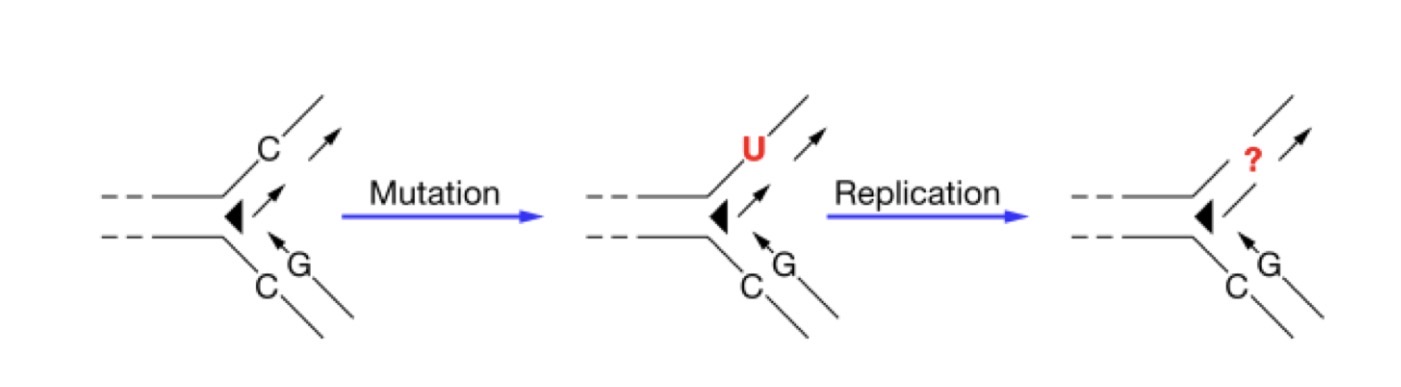
Uracil will base pair with adenine, resulting in a thymine-to-adenine base pair in the replicated DNA
A certain type of mutation converts the base cytosine into uracil. If this mutation is not repaired when the DNA replicates, as shown in the diagram, which of the following changes is most likely to result?
(A) The uracil will be replaced with cytosine in the replicated DNA because uracil is in RNA and not DNA.
(B) Uracil will base pair with adenine, resulting in a thymine-to-adenine base pair in the replicated DNA.
(C) The DNA will become single stranded because uracil cannot base pair with adenine or guanine.
(D) The DNA will no longer encode a protein because uracil is not recognized by ribosomes during protein synthesis
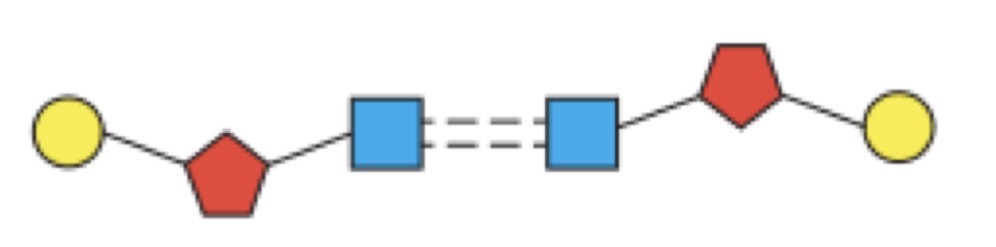
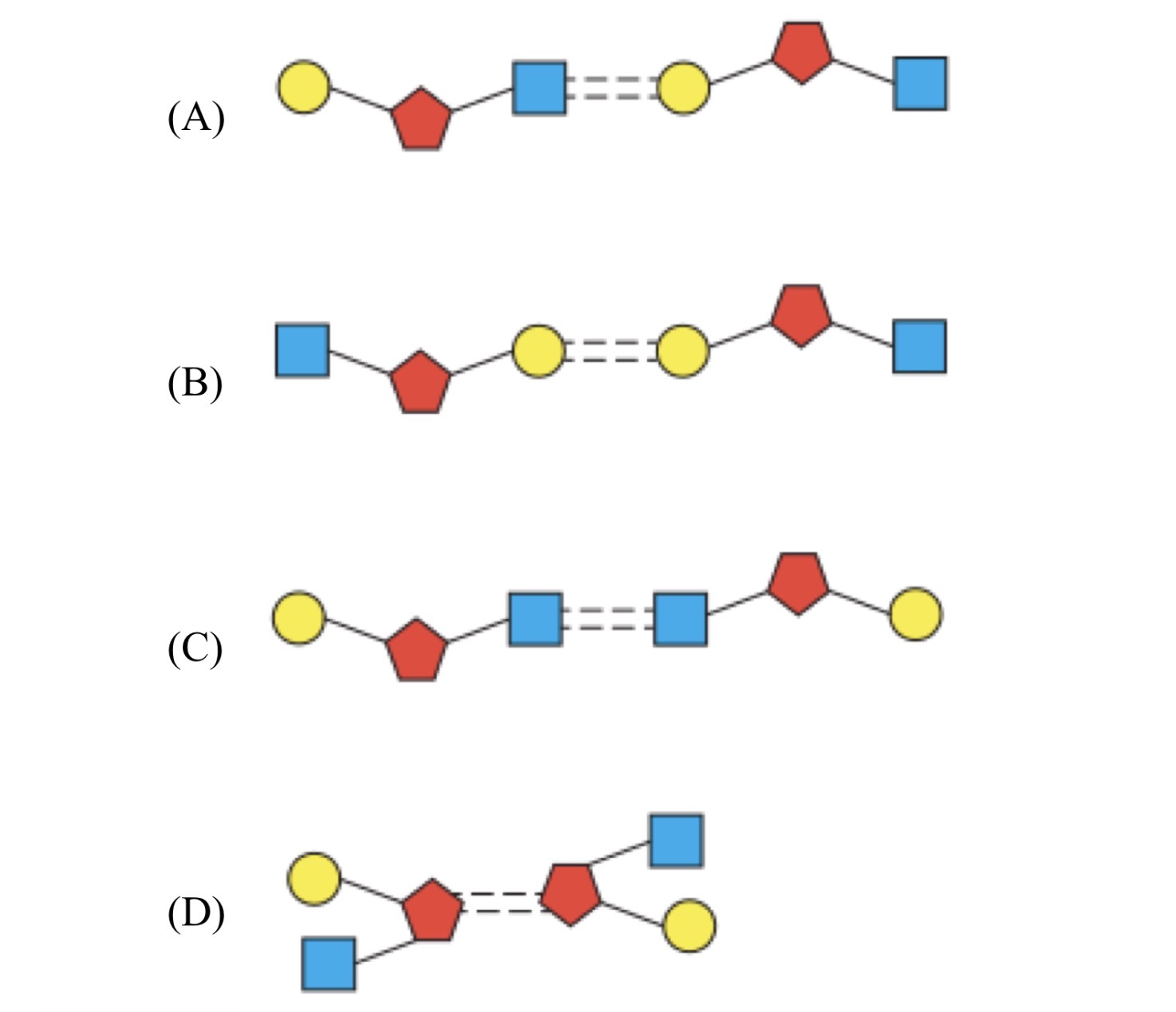
Which of the following models best represents the pairing between nucleotides located on the two complementary strands of a DNA molecule
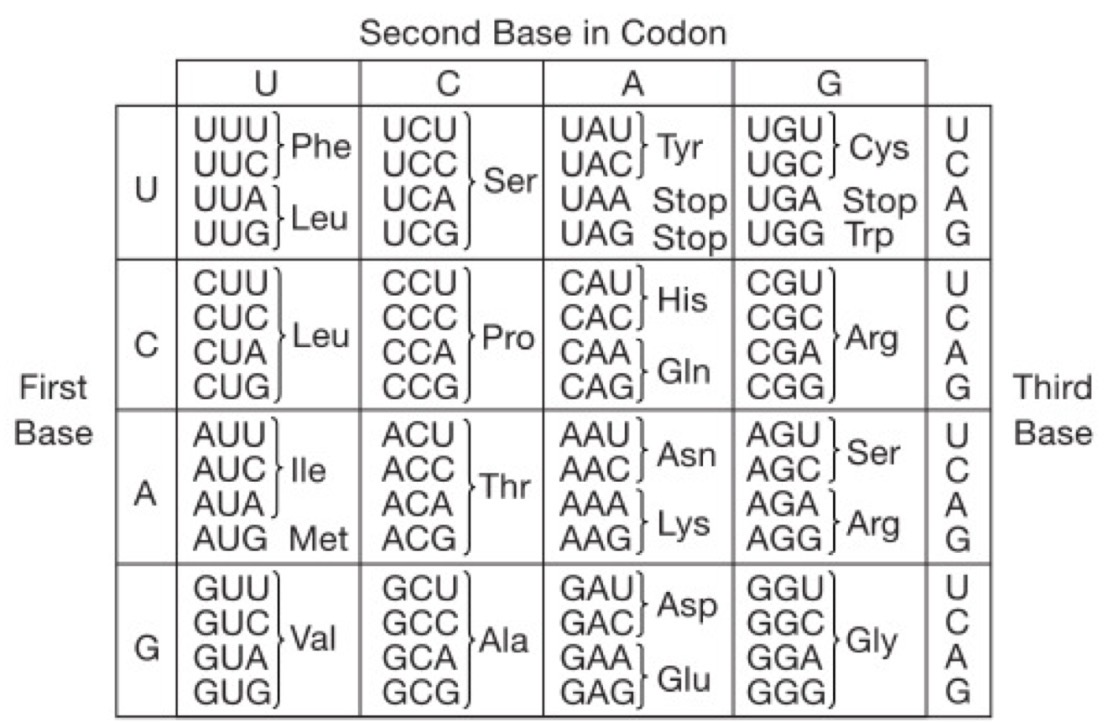
Met- Lys- Tyr- Val- Thr- STOP
A segment of a DNA strand that is used as a template for mRNA production has the following sequence: TAC TTT ATG CAT TGT ACT.
The first base shown in the segment of a DNA strand is the first base of a codon in the protein-coding sequence in the resulting mRNA. Based on the DNA sequence, which of the following is the associated amino acid sequence?
a) Ser-Lys-Tyr- Val- Phe- His
b) Tyr- Phe- Met- His- Cys- Thr
c) Met- Lys- Tyr- Val- Thr- STOP
d) Ser- Thr- Met- His- Lys- Val
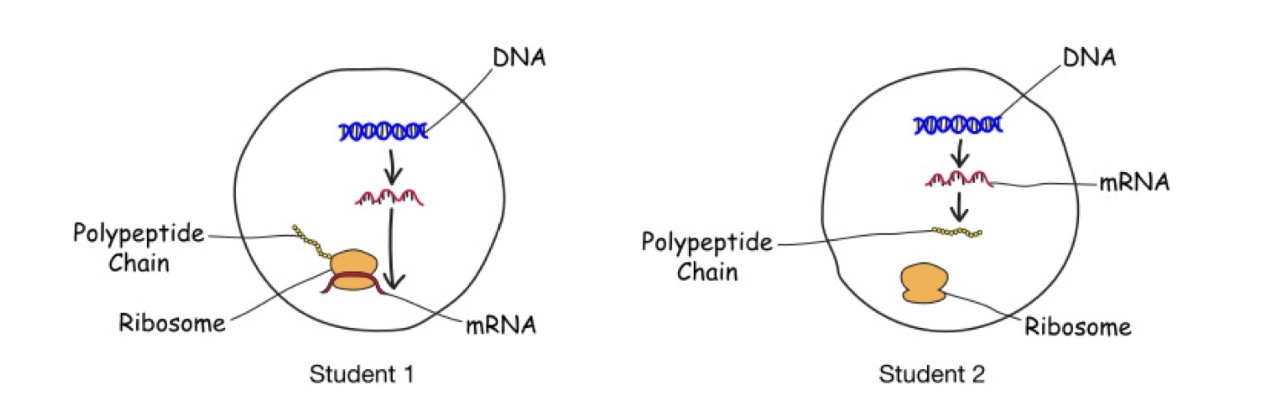
Student 1, because is translated into a polypeptide chain at the ribosome
Two students developed models to show how information in genes is expressed as proteins in prokaryotes. Which statement best explains which student created the model that is the most accurate representation of how information in genes is expressed as proteins in prokaryotes?
(A) Student 1, because is produced from the template.
(B) Student 1, because is translated into a polypeptide chain at the ribosome.
(C) Student 2, because is produced from the polypeptide chain.
(D) Student 2, because is translated into a polypeptide chain without ribosomes
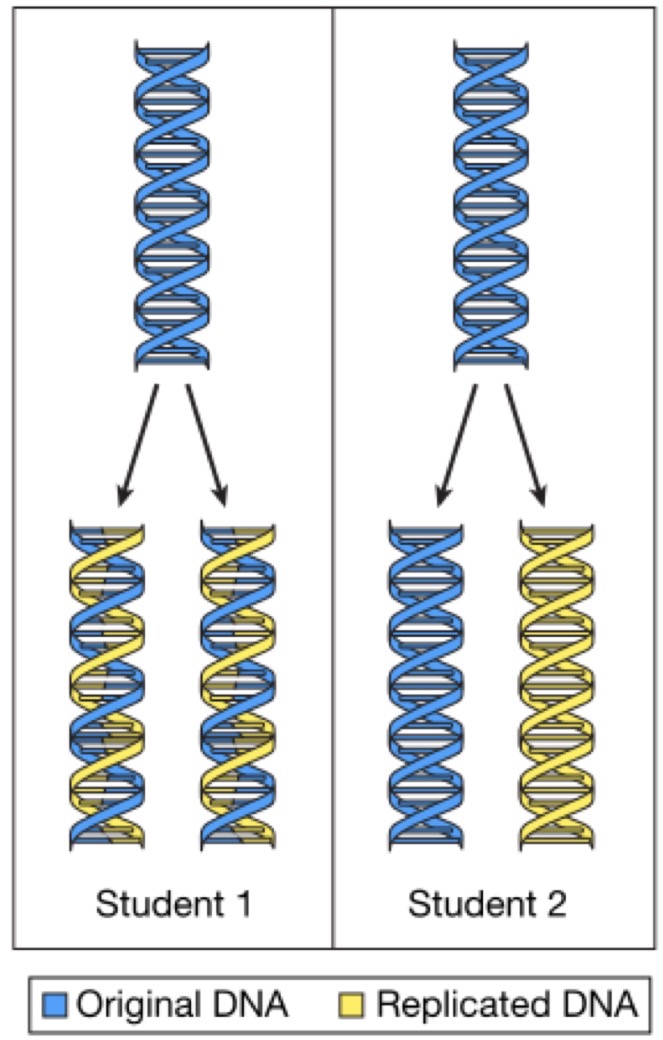
Student 1’s model is correct. replication produces two copies that each contain one of the original strands and one new strand.
Two students are having a debate in class about how is replicated in the cell. They each draw a model to show how they think is replicated. The figure shows the models created by Student 1 and Student 2. Which of the following statements indicates the correct model and provides the appropriate reasoning?
(A) Student 1’s model is correct. replication produces two copies that each contain one of the original strands and one new strand.
(B) Student 1’s model is correct. replication leaves the two original strands together in a double helix and produces a copy composed of two strands.
(C) Student 2’s model is correct. replication produces two copies that each contain one of the original strands and one new strand.
(D) Student 2’s model is correct. replication leaves the two original strands together in a double helix and produces a copy composed of two new strands
Student 1’s claim is correct because enzymes unzip the helix so that nucleotides can build a new strand of DNA
After the students identified the correct model, they did additional research on how is replicated. The students then returned to the models that they drew and made the following claims. Student 1: The model does not need to be changed because replication can occur without proteins. Student 2: Proteins need to be added to the model. Without proteins, replication would not be possible. Which of the following statements indicates the correct student claim and provides the appropriate reasoning?
(A) Student 1’s claim is correct because replicates when nucleotides mix together in the cytoplasm to build a new strand of DNA .
(B) Student 1’s claim is correct because enzymes unzip the helix so that nucleotides can build a new strand of DNA .
(C) Student 2’s claim is correct because proteins separate the two strands and build a new strand of DNA.
(D) Student 2’s claim is correct because enzymes break down the nuclear envelope so that chromosomes can condense into chromatids
A U A C C G C U A G G
A DNA strand with the sequence T A T G G C G A T C C is the template for the production of mRNA in a bacterial cell. Which of the following is the sequence of the mRNA that is produced?
50%
A scientist studying a species of algae, Gracilaria domingensis, discovered that its color is controlled by a single gene with two alleles. The individuals with a red or green phenotype are homozygous for the red or green alleles and the individuals with a brown phenotype are heterozygous. The scientist crosses two brown individuals. What percent of the offspring from this cross is predicted to be brown?
(A) 25%
(B)
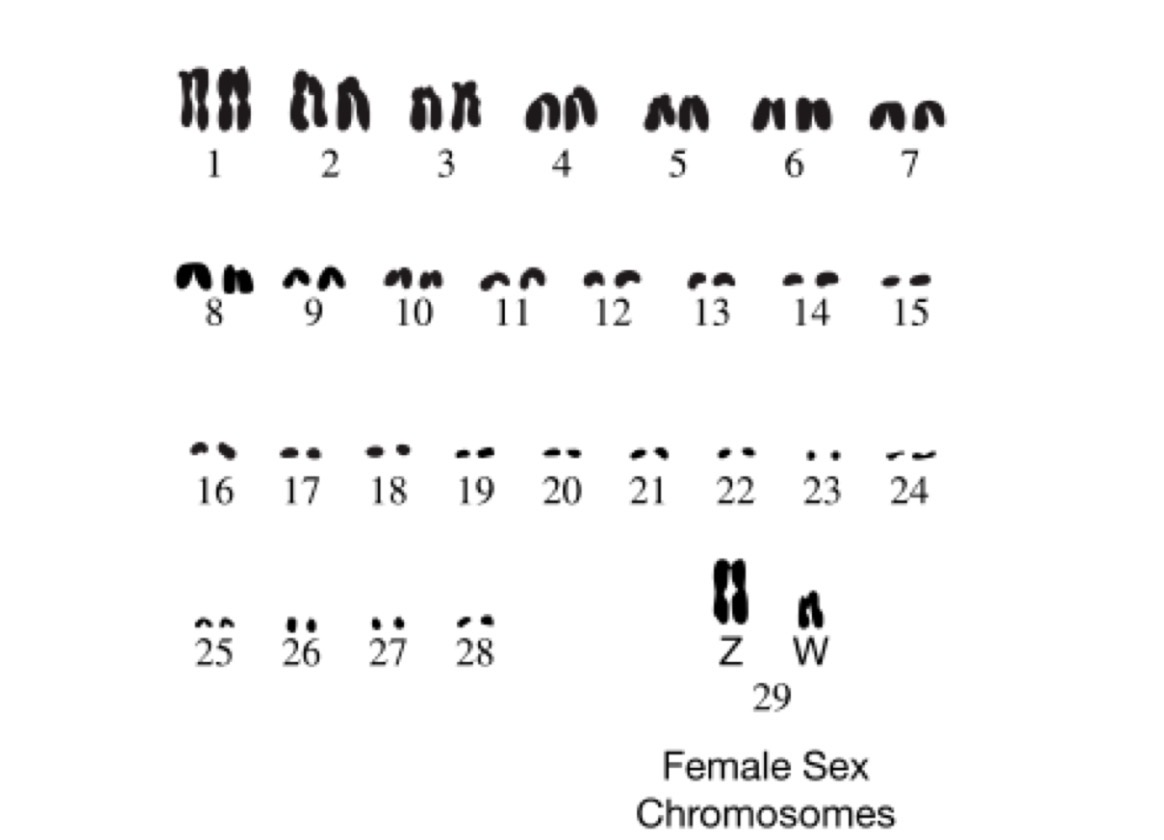
29
Cape parrots are found in forests in South Africa. In a study of Cape parrot genetics, biologists produced the karyotype shown from somatic cells of a female Cape parrot. Based on the karyotype, how many chromosomes are present in the gametes of a Cape parrot
There is a 50% chance that the child will inherit the Huntington’s disease allele, because the father has one copy of the allele.
Huntington’s disease is an inherited condition in which the neurons in the brain break down over time. An individual who inherits one allele for Huntington’s disease will most likely express the symptoms. A man who is heterozygous for the Huntington’s disease allele has a child with a woman with no family history of Huntington’s disease. Which of the following best explains the percent chance that the child will inherit an allele for Huntington’s disease?
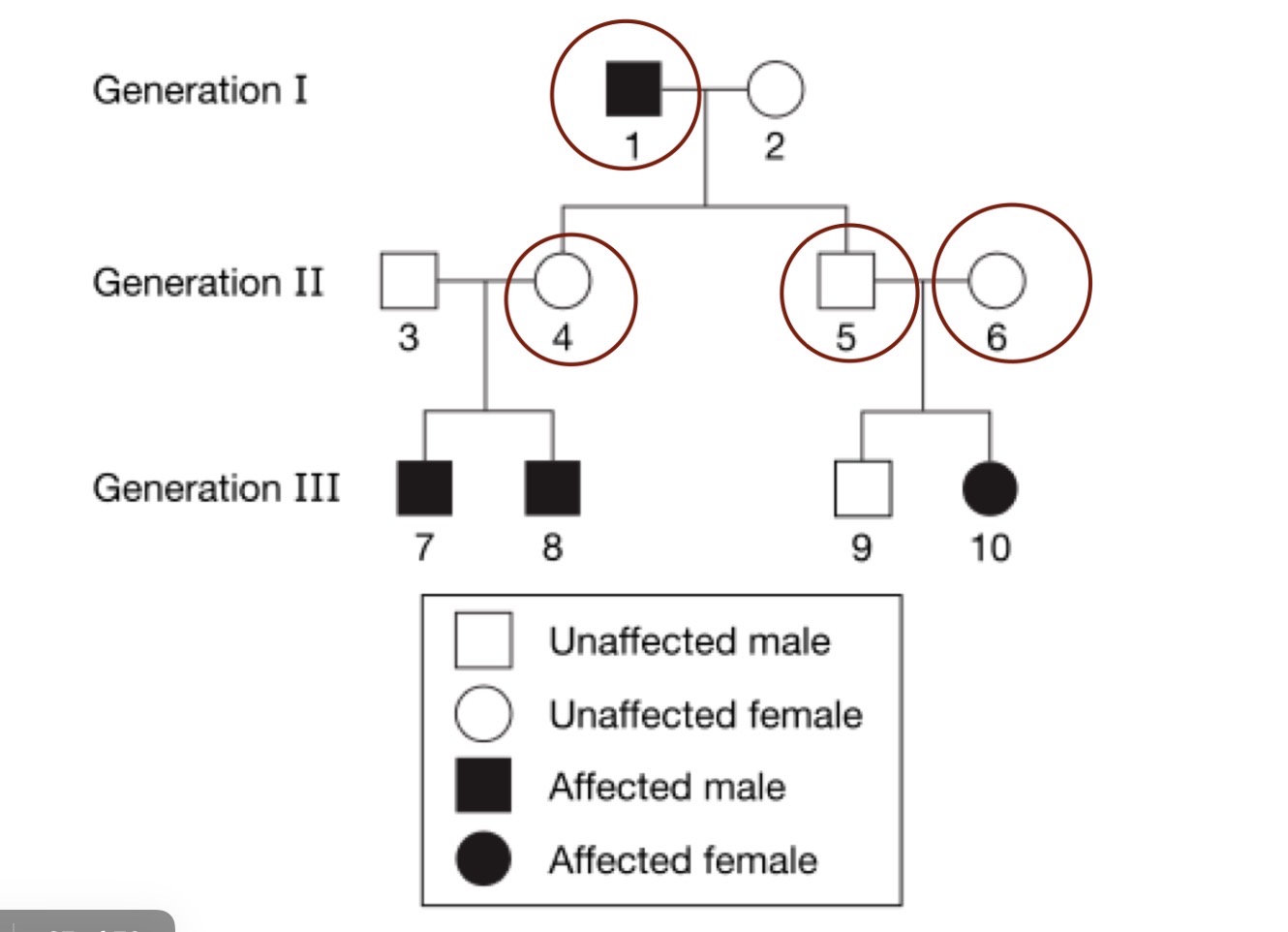
Sickle cell anemia is inherited as an autosomal recessive trait given that individual 10 has the condition but neither of her parents do
As a research project, a group of students created a pedigree showing the incidence of sickle cell anemia in a family over three generations. Which of the following claims about the inheritance pattern of sickle cell anemia is best supported using evidence from the pedigree
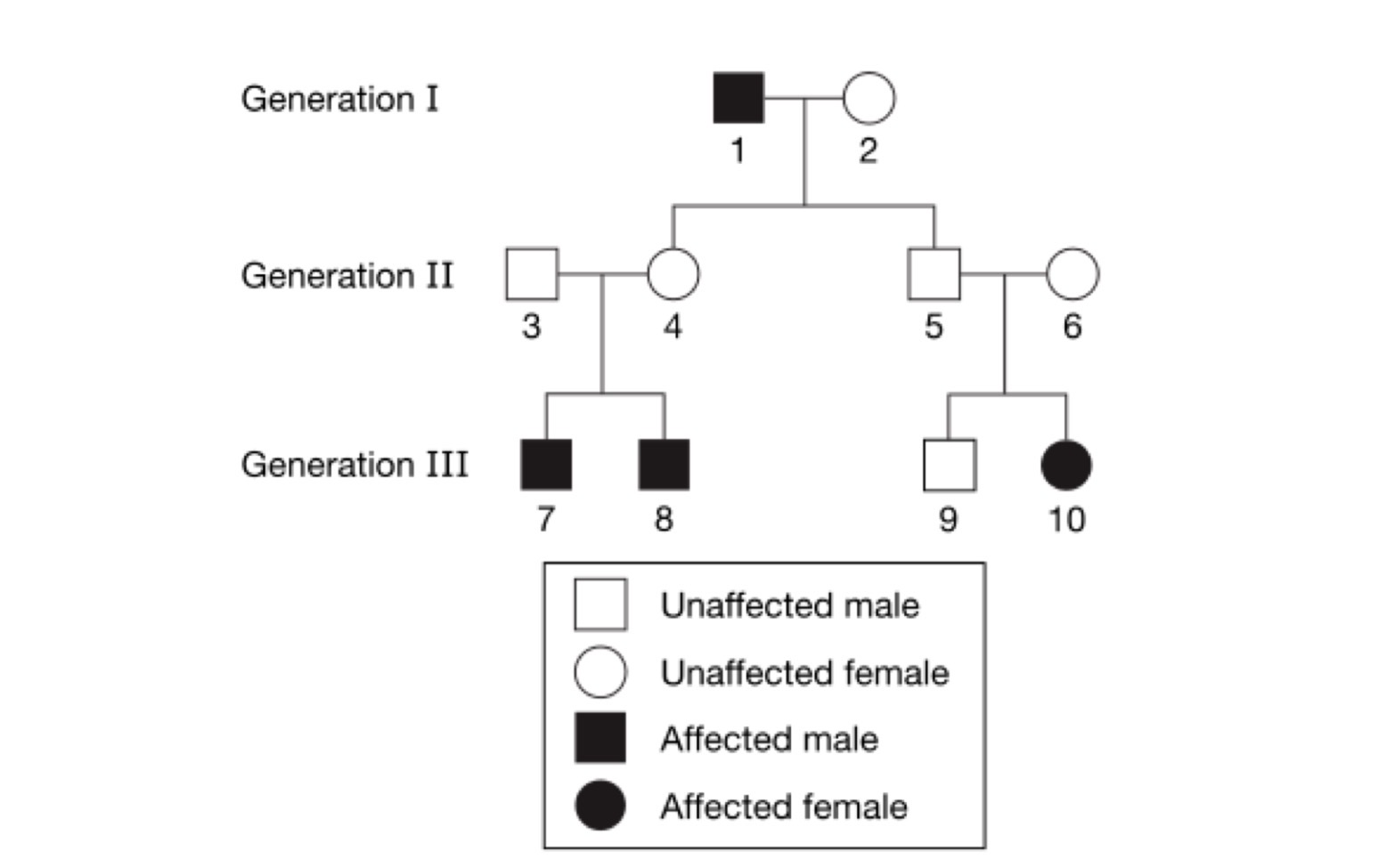
3, 4, 5, 6
The teacher suggested that the students revise their model to represent individuals who have a heterozygous genotype and are therefore carriers for the disease. Circle the FOUR individuals in the following pedigree that the students know for certain are heterozygous
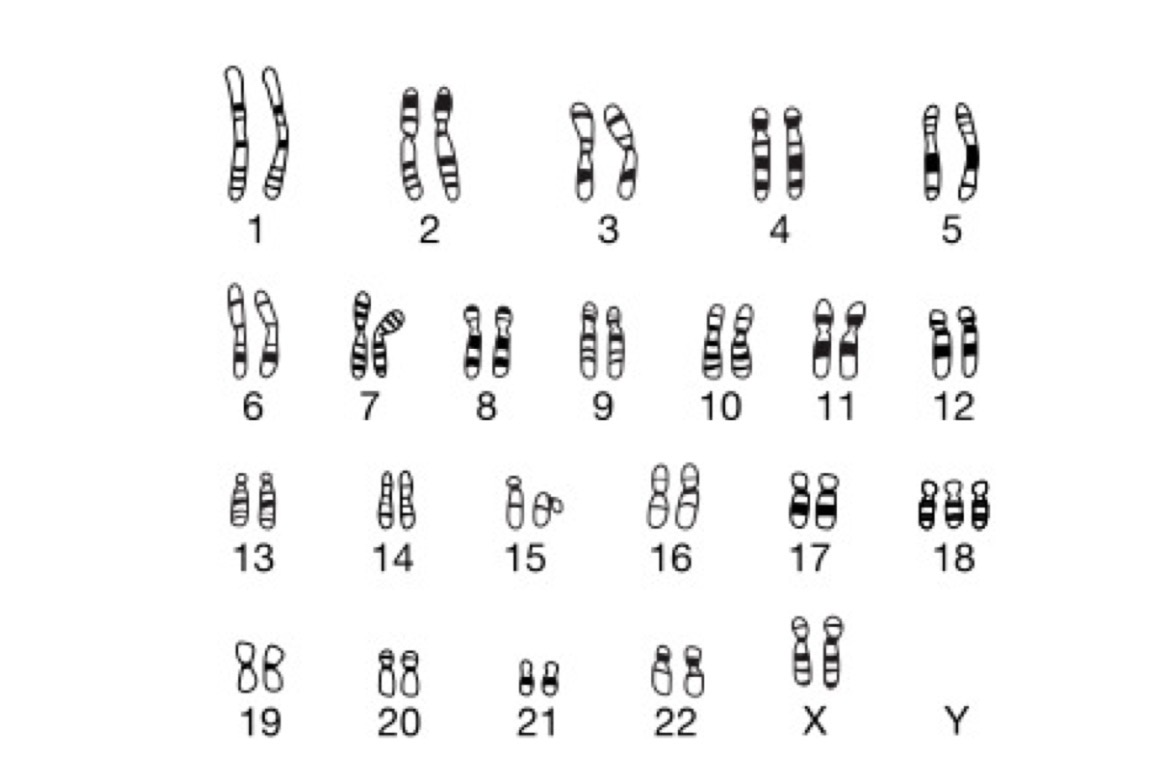
A failure of homologous chromosomes to separate in meiosis I
The karyotype of an individual with trisomy 18 is represented in the figure. Which of the following errors would have occurred in one of the individual’s parents to have resulted in trisomy 18
Non-Dwarf, Homozygous recessive
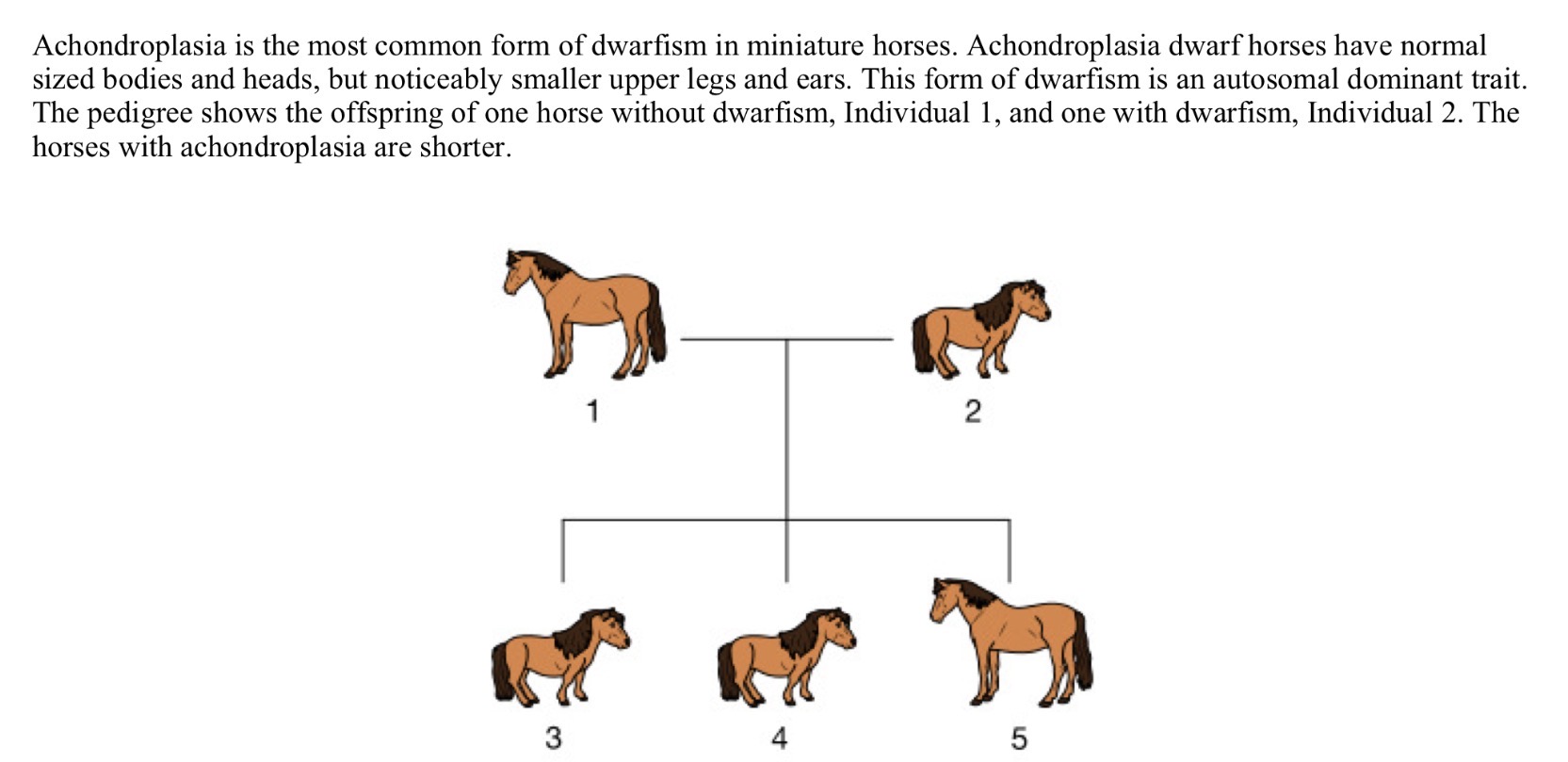
Achondroplasia is the most common form of dwarfism in miniature horses. Achondroplasia dwarf horses have normal-sized bodies and heads, but noticeably smaller upper legs and ears. This form of dwarfism is an autosomal dominant trait. The pedigree shows the offspring of one horse without dwarfism, Individual 1, and one with dwarfism, Individual 2. The horses with achondroplasia are shorter. Which of the following is the correct pairing of phenotype and genotype of Individual 5 in the pedigree
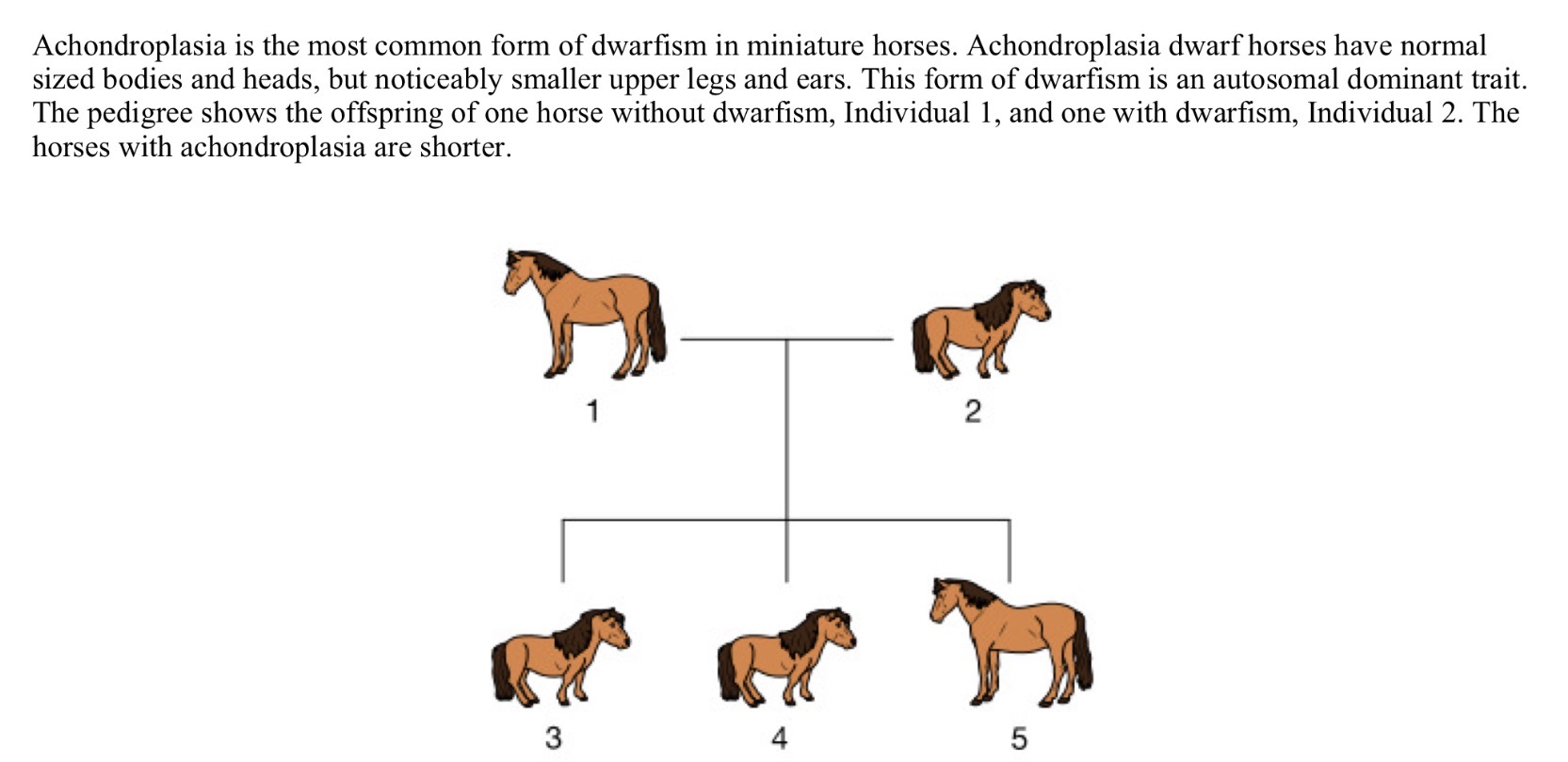
The horse is heterozygous because it was able to produce a non-dwarf offspring
Based on the pedigree, which of the following is an accurate claim about the genotype of Individual 2?
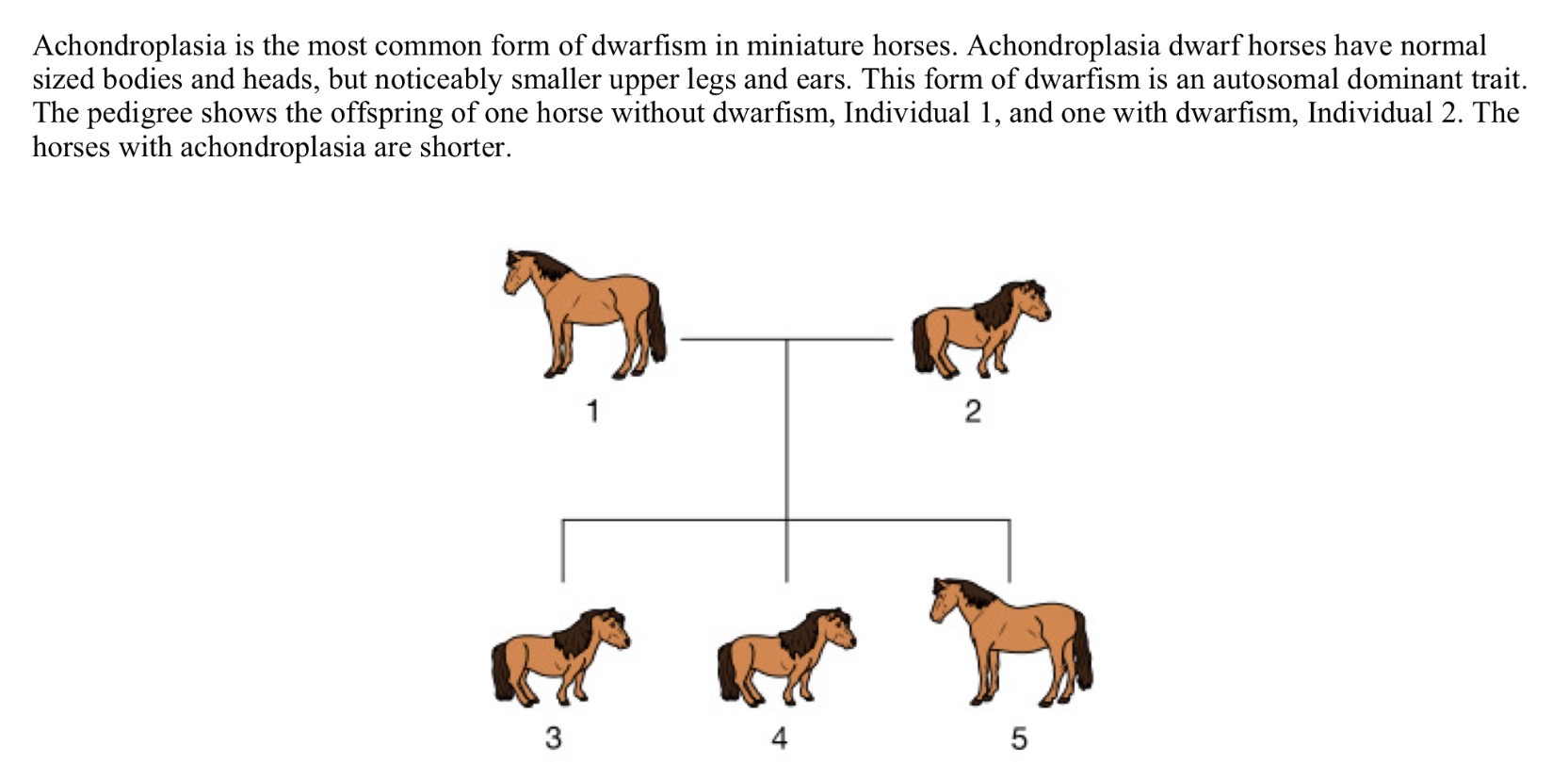
All of their offspring will be homozygous non-dwarf horses.
If Individual 5 mates with a homozygous recessive horse, which of the following is a valid prediction about the offspring?
The phenotype for long hair is inherited as an autosomal dominant trait because one copy of the mutant allele is sufficient to produce long hair.
Dogs in a certain breed have either long hair or short hair. Scientists sequenced the genomes of a sample of the dogs and found that the long-haired individuals have a 2-base pair insertion mutation in a gene that affects hair length. Individuals with short hair do not have an insertion mutation in that gene. The phenotypes of a pair of dogs and their offspring are represented in the pedigree.
Which of the following claims is best supported using the information provided?
(A) The phenotype for long hair is inherited as an autosomal recessive trait because there were fewer offspring with short hair than with long hair.
(B) The phenotype for long hair is inherited as an autosomal dominant trait because individuals must have two copies of the mutant allele to produce long hair.
(C) The phenotype for long hair is inherited as an autosomal dominant trait because one copy of the mutant allele is sufficient to produce long hair.
(D) The phenotype for long hair is inherited as an-linked recessive trait because only female offspring have long hair
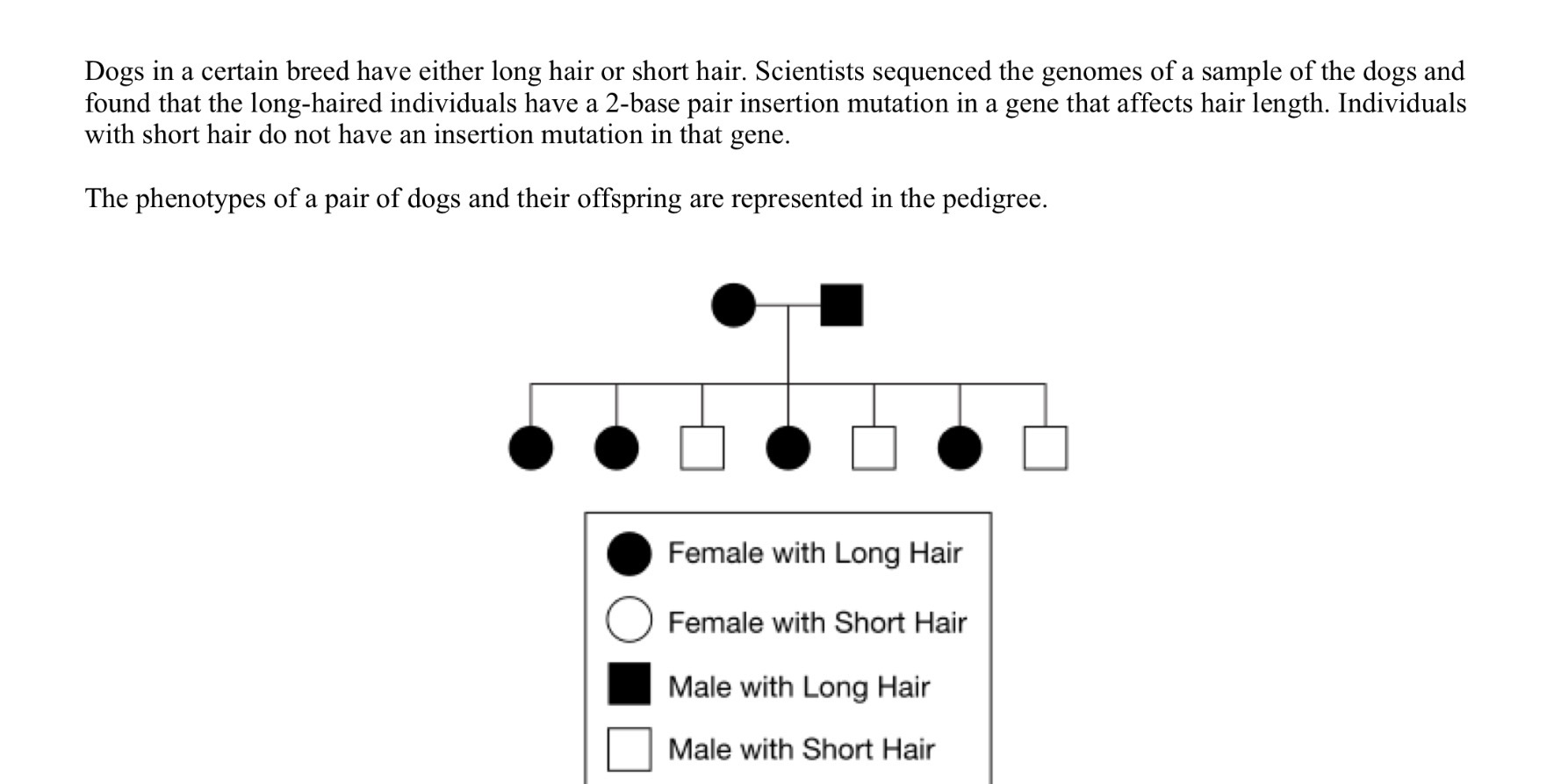
The mother is heterozygous for the long-hair allele, and the father is heterozygous for the long-hair allele.
hich of the following best describes the genotype of parents in the pedigree?
(A) The mother is heterozygous for the long-hair allele, and the father is homozygous for the long-hair allele.
(B) The mother is heterozygous for the long-hair allele, and the father is heterozygous for the long-hair allele.
(C) The mother is homozygous for the long-hair allele, and the father is homozygous for the long-hair allele.
(D) The mother is homozygous for the long-hair allele, and the father is heterozygous for the long-hair allele
Feather color in chickens is an example of incomplete dominance in which the alleles for black or white feathers are expressed in the homozygous genotypes and the heterozygous genotype and produces a blue phenotype
When a blue-feathered hen (female chicken) and blue-feathered rooster (male chicken) mate, the feather colors of their offspring have a ratio of black: blue: white. Which of the following best explains the appearance of the ratio of phenotypes in the offspring of this cross?
(A) Feather color in chickens is an example of codominance in which crossing-over between the alleles for black or white feathers during fertilization produces a blue phenotype.
(B) Feather color in chickens is an example of incomplete dominance in which the alleles for black or white feathers are expressed in the homozygous genotypes and the heterozygous genotype produces a blue phenotype.
(C) Feather color in chickens is sex-linked, so only hens can pass on the allele for blue feathers, and only roosters can pass on the allele for white feathers.
(D) Feather color in chickens is controlled by multiple genes in which one gene encodes the blue phenotype, one gene encodes the black phenotype, and one gene encodes the white phenotype