Fish Sensory Systems
 Call Kai
 Learn
Learn Practice Test
 Spaced Repetition
 Match
Match Flashcards
 Knowt Play
1/13

Earn XP
Description and Tags
Chapters 14 & 15
Name | Mastery | Learn | Test | Matching | Spaced | Call with Kai |
|---|
No analytics yet
Send a link to your students to track their progress
14 Terms
Basic Eye Components
light enters through cornea & pupil
most fish can’t control the amount of light entering by constricting the pupil
spherical lens is highly refractive
retractor lentis contracts/relaxes to focus by moving the lens toward/away from the retina
Mudskippers
can blink
have flatter lens
curved cornea adapted to lower light refraction in air
Rod and Cone Cells in Fish Eyes
found in the retina
photoreceptor, light-sensitive cells of the eye containing opsins
rod cells detect light intensity
cone cells provide color vision
Silver Spinyfish
2 cone opsins
38 rod opsins (the most of any vertebrate)
Rhodopsin-1 absorbs maximally at the most blue-shifted wavelength of any vertebrate (444 nm)
Monochromatic Vision
single type of cone cell with single type of pigment
perceive light intensity but not color
Trichromatic Vision
three different cones that detect certain wavelengths
Tetrachromatic Vision
Four different cone types
Damselfish
can see UV patterns
UV-reflective facial patterns in some species
Hagfish
eyespot (cannot form images)
Anableps
four-eyed fish
single lens divided into two regions (dorsal and ventral)
helpful for feeding on flying insect & aquatic prey
Barreleye
unique tubular eyes point directly upwards
can see faint outline of prey items sinking from above
secondary lens & retina produce unfocused images
Chemoreception
chemoreceptors located in the mouth, barbels, or surface of the body
gills have chemoreceptor for detecting O2 , CO2 , and NH4+
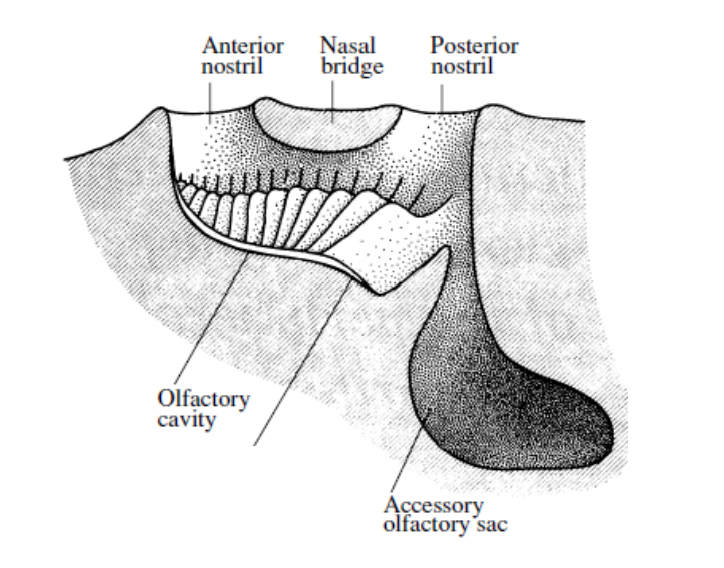
Olfactory System
water enters nasal cavity through the anterior nares
leaves out the posterior nares
forward motion, hydraulic pumping, or beating cilia bring water into nasal cavity
Olfactory Epithelium (OE) is arranged into a series of folded, petal-like lamallae called a nasal rosette