3.3 — Addressing Income and Wealth Inequality
 Call Kai
 Learn
Learn Practice Test
 Spaced Repetition
 Match
Match Flashcards
 Knowt Play
1/35

There's no tags or description
Looks like no tags are added yet.
Name | Mastery | Learn | Test | Matching | Spaced | Call with Kai |
|---|
No analytics yet
Send a link to your students to track their progress
36 Terms
What is income + examples
A flow of money earned over a period of time, e.g., wages, salaries, interest, or dividends.
- It is a flow concept as returns to the various factors of production are variable over any given period of time
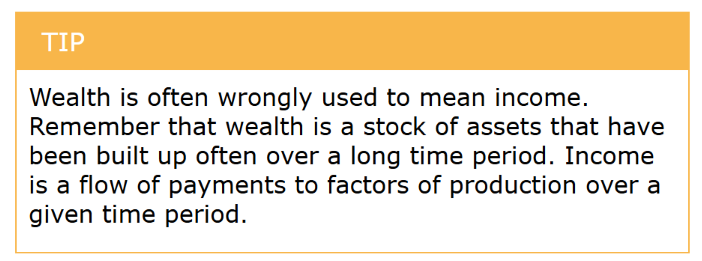
What is wealth + examples
A stock of valuable assets owned at a point in time, e.g., property, savings, shares, or inheritance.
- A stock of assets that has been built up overtime
- There to provide security and, in some cases, an income stream for the future
What is the key difference between income and wealth
Income is a flow that is earned regularly, whereas wealth is a stock that accumulates over time.
Give an example where income and wealth differ.
A young professional may have high income but low wealth, while a retiree may have low income but high wealth from property or savings.
Where can wealth come from
Inherited from past generations of families or from firms.
How is income and wealth inequality measured (AS & A-level)
Using the Gini coefficient and Lorenz curve.
What is the Gini coefficient
A numerical measure of income inequality ranging from 0 (perfect equality) to 1 (perfect inequality).
- Measures the extent of income inequality in an economy
What is a Lorenz curve (not in AS-level)
A graph showing cumulative % of income vs cumulative % of population; the further from the line of equality, the greater the inequality.
What do economists agree that inequality of income and wealth acts as a barrier to
Economists agree that inequality of income and wealth acts as a barrier to economic growth and development.
- Reasons can be economic, social, cultural or political
What are economic reasons for income and wealth inequality (6)
a lack of formal employment opportunities, particularly for young people, but also for those with professional skills
poor vocational training, which means that local industries cannot obtain the labour needed to maintain a viable operation in national and international markets
a lack of investment in the education and health sectors, which holds back human capital needed to promote economic growth
poor infrastructure such as roads, railways, power and water supplies
a low rate of savings, which holds back private and public sector investment
the inability of many people to obtain credit to fund small businesses and improved personal education.
Governments may use a range of policies to reduce inequality in the distribution of income and wealth. What are the main 4 (for AS)
Minimum wage
2. Transfer payments
3. Taxes - progressive income taxes, inheritance/capital taxes
4. State provision of essential goods and services
Many of the policies depend on the funds generated from tax revenue for their implementation and regulation
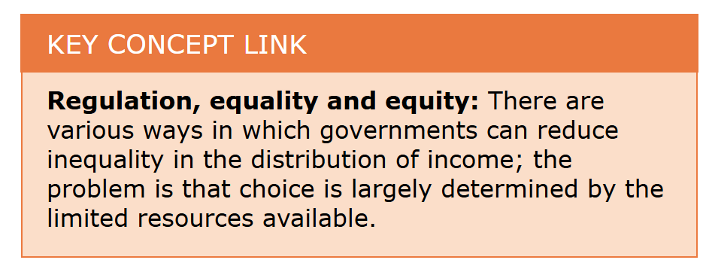
Key concept link - regulation, equality and equity
What is the informal economy
The part of the economy that is not regulated, protected or taxed by the government
What is a minimum wage
A legal lower limit on wages to protect low-income workers.
- The least amount an employer can legally pay one of its workers: usually expressed as a wage rate per hour
- It is a rate before tax and any social security deductions are made.
How does a minimum wage reduce inequality
By raising the earnings of the lowest-paid workers, reducing income disparity.
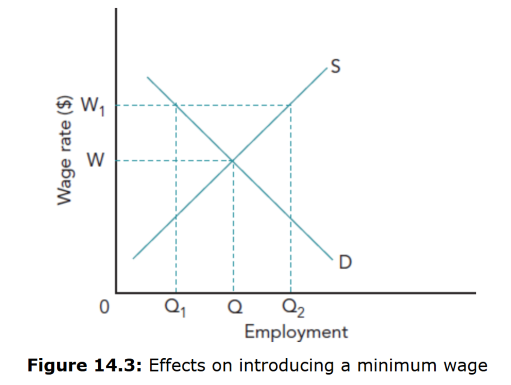
What the effect / potential drawback of introducing a minimum wage + diagram & explanation (5)
If/when set above equilibrium, it may create unemployment among low-skilled workers.
- The equilibrium wage rate is w.
- Introducing a minimum wage rate increases the wage rate to w1.
- At this higher wage rate, employers will only employ Q1 workers yet Q2 workers are willing to work.
- Those who are employed will get more pay but at the cost of fewer jobs being available.
- This unemployment is shown by Q1 to Q2.
What is the problem of minimum wage in most low-income and lower middle-income countries
The legislation might only apply to a minority of poorly paid workers. This is because the legislation would not have any impact in the large informal economies that are prevalent in these economies.
- Also, a minimum wage has no relevance where workers are self-employed or in small businesses staffed by family members.
What are transfer payments
Government payments to individuals without exchange of goods/services, e.g., pensions, unemployment benefits, child allowances.
- A payment made by the government to certain members of the community who may be unable to work or are in need of assistance
- Their aim is to provide a more equitable distribution of income
What are some examples of transfer payments (5)
Old age pensions
2. Unemployment benefits
3. Housing allowances
4. Food coupons
5. Child benefits
How do transfer payments reduce inequality (provide a more equitable distribution of income)
They provide resources to low-income households, increasing consumption and social welfare.
What does the extent to which transfer payments can be paid depend on + example country
Dependent on how much tax is collected and how many people have paid tax
- This is sometimes a problem for lowed and lower middle income countries
- E.g. Pakistan: A growing elderly population combined with a low tax base means limited pension and social security coverage, with only formal sector workers benefiting while informal workers are excluded.
○ India: Similar to Pakistan, but a larger proportion of the population is eligible for assistance.
○ Bangladesh: There is very limited or no transfer payment support, even for government workers.
Why is the effect of transfer payments controversial (the two opposing sides for/against)
In most cases it is clear they are necessary to protect vulnerable groups in the community, reduce poverty and provide a more equitable distribution of income but unemployment benefits and benefits to those low on income can act as a disincentive to work, increasing unemployment rate (therefore could be a form of inefficiency)
What is progressive taxation
A tax system where higher income earners pay a higher percentage of their income in tax.
- One where the rate of taxation rises more proportionately to the rise of income
What is the best example of a progressive tax
Progressive income tax - those earning higher incomes are taxed at a higher rate than those on lower incomes.
How does progressive taxation redistribute income
It reduces disposable income for the wealthy and funds services or transfers for the poor, reducing income inequality.
What can be the problem with progressive income tax
For some people where the income tax is too high, the result is a disincentive to work and possibly even live in a high taxation regime e.g. for tax reasons they may seek to move to a country with a more favourable tax regime.
What two taxes can be imposed to reduce wealth inequalities
Inheritance and capital tax
- Although the overall impact of such measures is very small
What is inheritance tax
Taxes on wealth transferred between generations (inheritance) or on assets (capital).
- A progressive tax on an inheritance of gift
What is capital tax
A progressive tax paid annually on the difference between the buying and selling price of an asset
What is state provision of essential goods and service
Governments provide certain important goods and services, often free of charge to the user, funded through the tax system
- If the goods are and services are used equally by all citizens, then those on lowest incomes gain most as a percentage of their income -> inequality lowered
How does state provision of essential goods reduce inequality
By providing free or subsidised healthcare, education, or housing, it ensures all citizens have access regardless of income.
- If the goods are and services are used equally by all citizens, then those on lowest incomes gain most as a percentage of their income -> inequality lowered
What are the two main examples of state provision provided universally free + explanation of justification
Health care
2. Junior & secondary education
- Justification is on the ground of equity that everyone should have access to a certain level of health care and education regardless of income and wealth.
Give examples of redistribution policies (5).
Minimum wage, transfer payments, progressive income taxes, inheritance/capital taxes, state provision of goods/services.
What is the main trade-off when redistributing income
Policies can improve equity but may reduce efficiency or create unintended consequences like unemployment or reduced incentives.
Why is understanding income vs wealth important for policy design
Because some policies target income (taxes, minimum wage) while others target wealth (inheritance tax, asset provision).
What is government failure in the context of redistribution
When policies to reduce inequality create negative side effects, e.g., unemployment from high minimum wages or disincentives from heavy taxation.