Algebra - Math 117 - ASU questions and answers + rationales
 Call Kai
 Learn
Learn Practice Test
 Spaced Repetition
 Match
Match Flashcards
1/154

There's no tags or description
Looks like no tags are added yet.
Name | Mastery | Learn | Test | Matching | Spaced | Call with Kai |
|---|
No analytics yet
Send a link to your students to track their progress
155 Terms
The number of bacteria in a certain population increases according to a continuous exponential growth model, with a growth rate parameter of 7.9% per hour. How many hours does it take for the size of the sample to double?
Note: This is a continuous exponential growth model.
Do not round any intermediate computations, and round your answer to the nearest hundredth.
A = Peʳᵗ
2P = Pe⁰·⁰⁷⁹* ᵗ
2 = e⁰·⁰⁷⁹* ᵗ
ln 2 = ln (e⁰·⁰⁷⁹* ᵗ)
ln 2 = 0.079t
t = ln 2/ 0.079
t = 8.77 hours
Give an explanation of how the following logarithms work and solve them.
log₂8
log₄4
log₄1
log₂8
2 to which power equals 8?
log₂8 = 3
log₄4
4 to which power equals 4?
log₄4 = 1
log₄1
4 to which power equals 1?
log₄1 = 0
What is the greatest common factor of 13a³ and 7a⁴?
a³
13, 7 == 1
aaa, aaaa == aaa
If an equation ends up:
2y-2y = 4-4
0 = 0
What is the value of y?
All real numbers are solutions.
How would one go about solving the following system of equations:
5x + 7y = 17
-8x + 3y = -13
One must elimate one of the variables. You could eliminate the x by multiplying both sides of the top equation by 8 and the bottom by 5, resulting in:
40x + 56y = 136
-40x + 15y = -65
------------------
71y = 71
y = 1
5x + 7(1) = 17
5x = 10
x = 2
A delivery truck is transporting boxes of two sizes: large and small. The combined weight of a large box and a small box is 90 pounds. The truck is transporting 50 large boxes and 70 small boxes. If the truck is carrying a total of 5100 pounds in boxes, how much does each type of box weigh?
How would one go about solving this with the ALEKS graphing calculator?
Create two equations that solve for y and find the intersection.
y = 90 - x
50x + 70x = 5100
y = (5100 - 50x) / 70
Plot these in "y=". Set the window size and auto calculate. Click intersection and then find intersection.
x = 60 (large)
y = 30 (small)
Two trains leave towns 542 kilometers apart at the same time and travel toward each other. One train travels 21 kmh faster than the other. If they meet in 2 hours, what is the rate of each train?
x = rate of faster train
y = rate of slower train
x - y = 21
y = x - 21
distance = rate x time
2(x) + 2(x - 21) = 542
4x = 584
x = 146
y = 146 - 21
y = 125
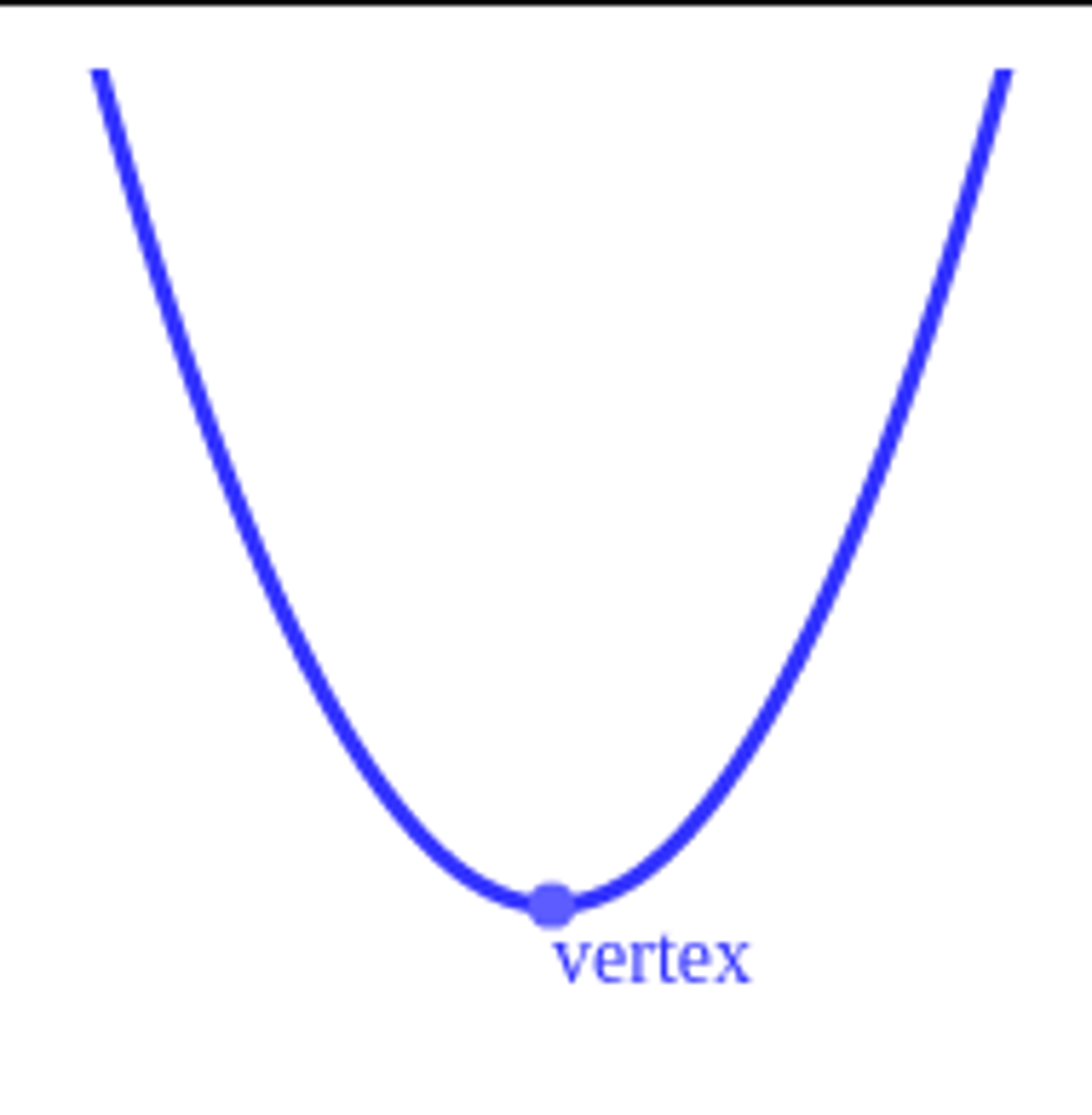
What is a parabola? What is its vertex?
vertex = point at which parabola turns around
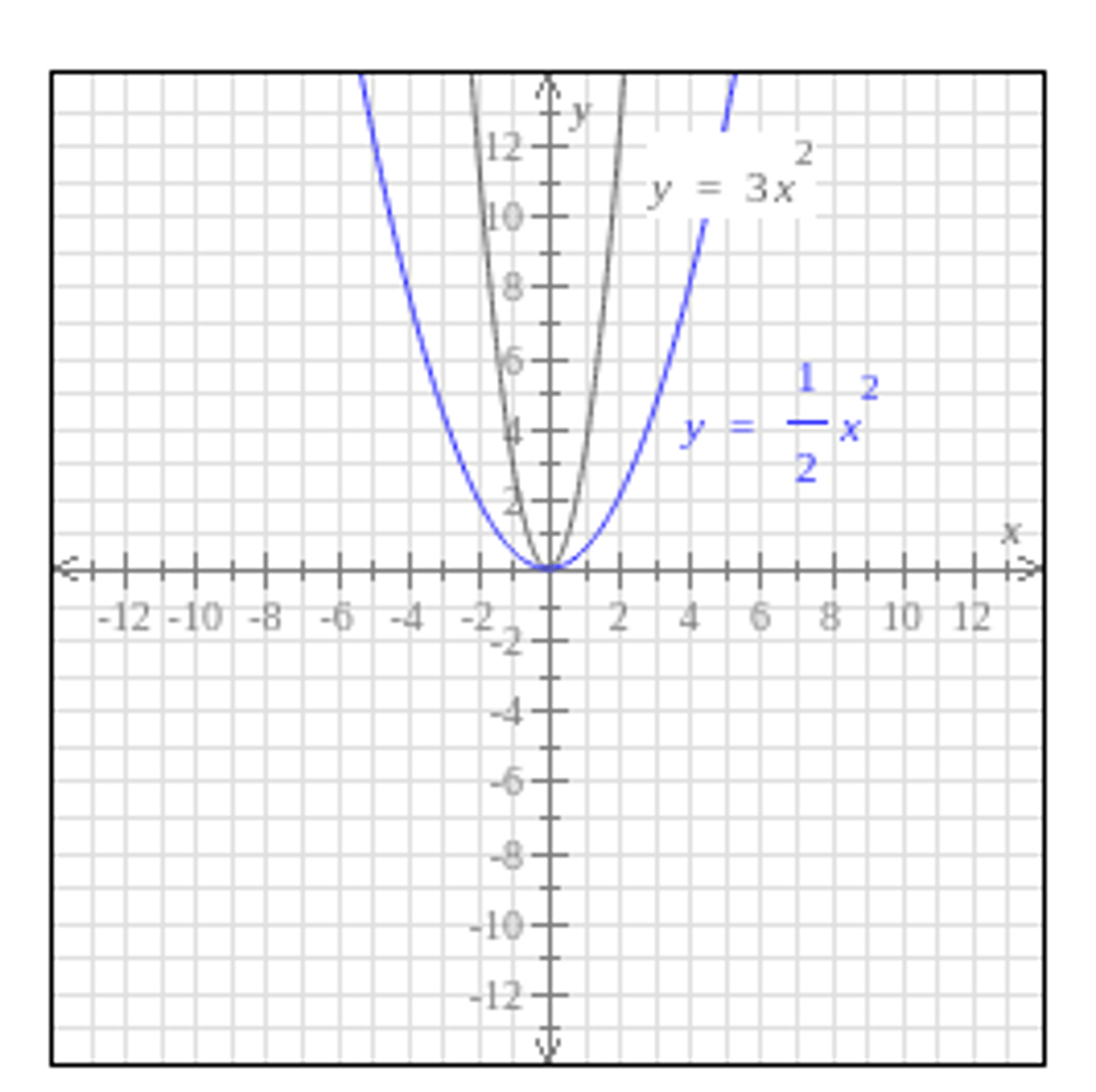
In a parabola, what happens to the lines as the coefficient gets closer to 0?
The graph lines become wider
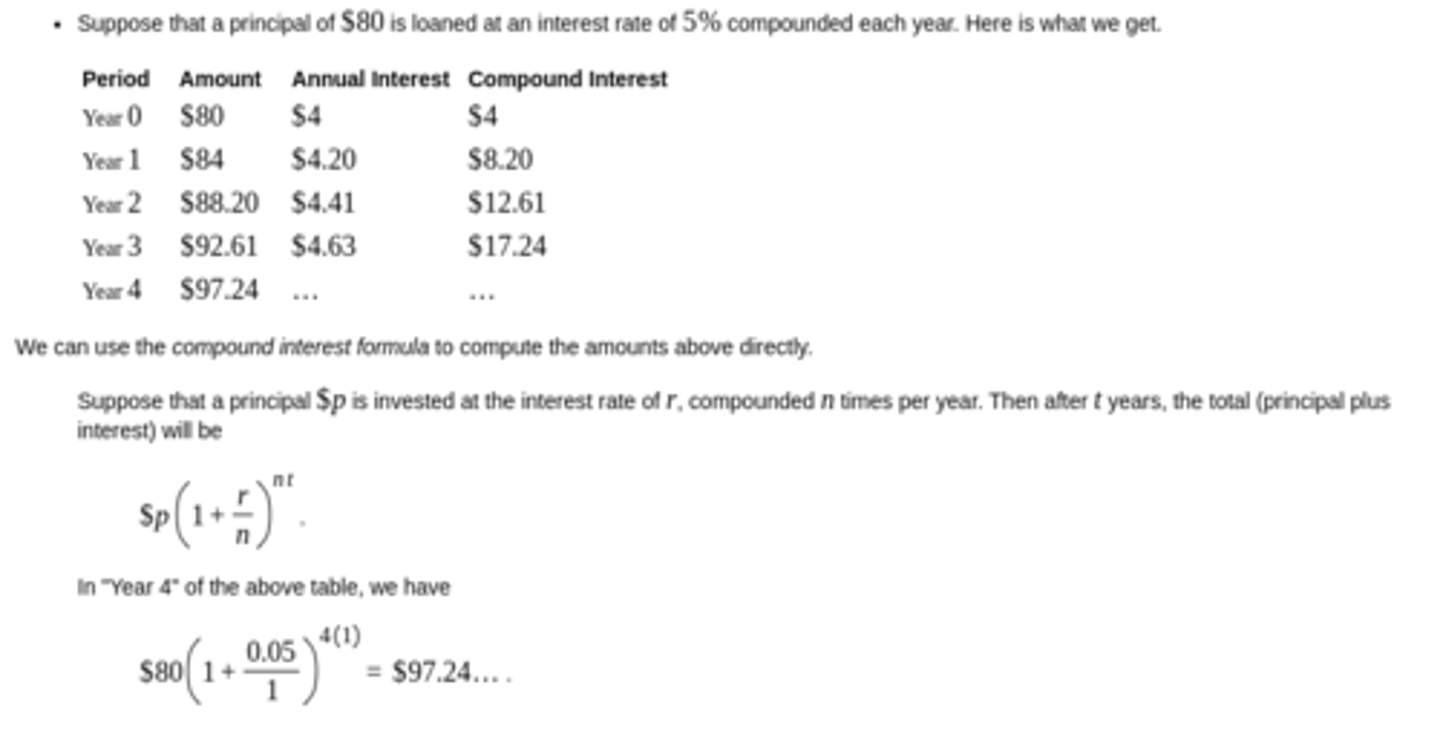
How to you compute simple interest?
interest = rate x time period x principal
e.g.
Interest on 20,000 loan, 5% per year, 5 years:
interest = .05 x 5 x 20,000
How to you compute compound interest?
How do you simplify:
(-3b³a²)⁴
81b¹²a⁸
-3 x -3 x -3 x -3 = 81
3 x 4 = 12
2 x 4 = 8
Convert the following to positive exponents:
v³ v⁻⁸ v
1 / v⁴
3 - 8 + 1 = -4
What is the solution to the following equations:
x - 3y = -6
-x + 3y = -6
This system has no solution.
0 = -6
What is the solution to the following equations:
x - 2y = -4
-x + 2y - 4 = 0
There are infinite solutions.
-4 = -4
y = (x + 4)/2
What is the solution to the following equations:
-x + 4y = -4
x - 4y = 4
There are infinite solutions
0 = 0
y = (x-4)/4
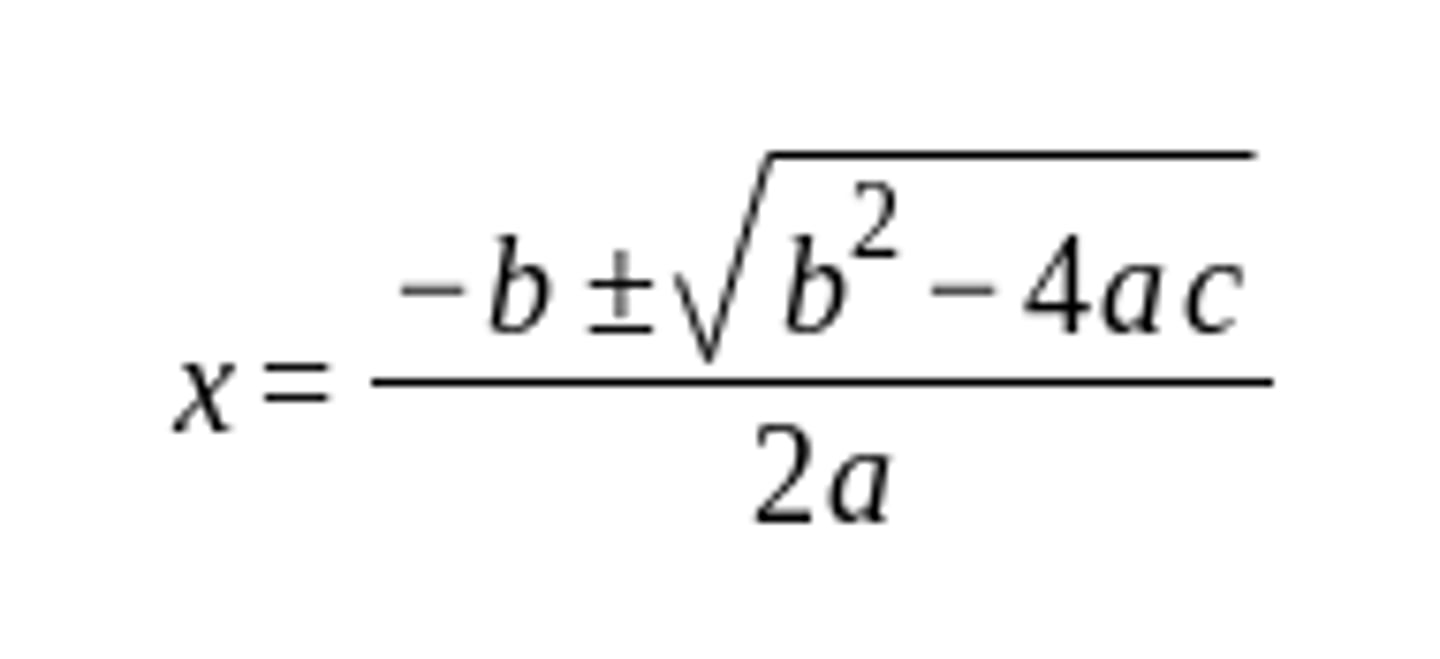
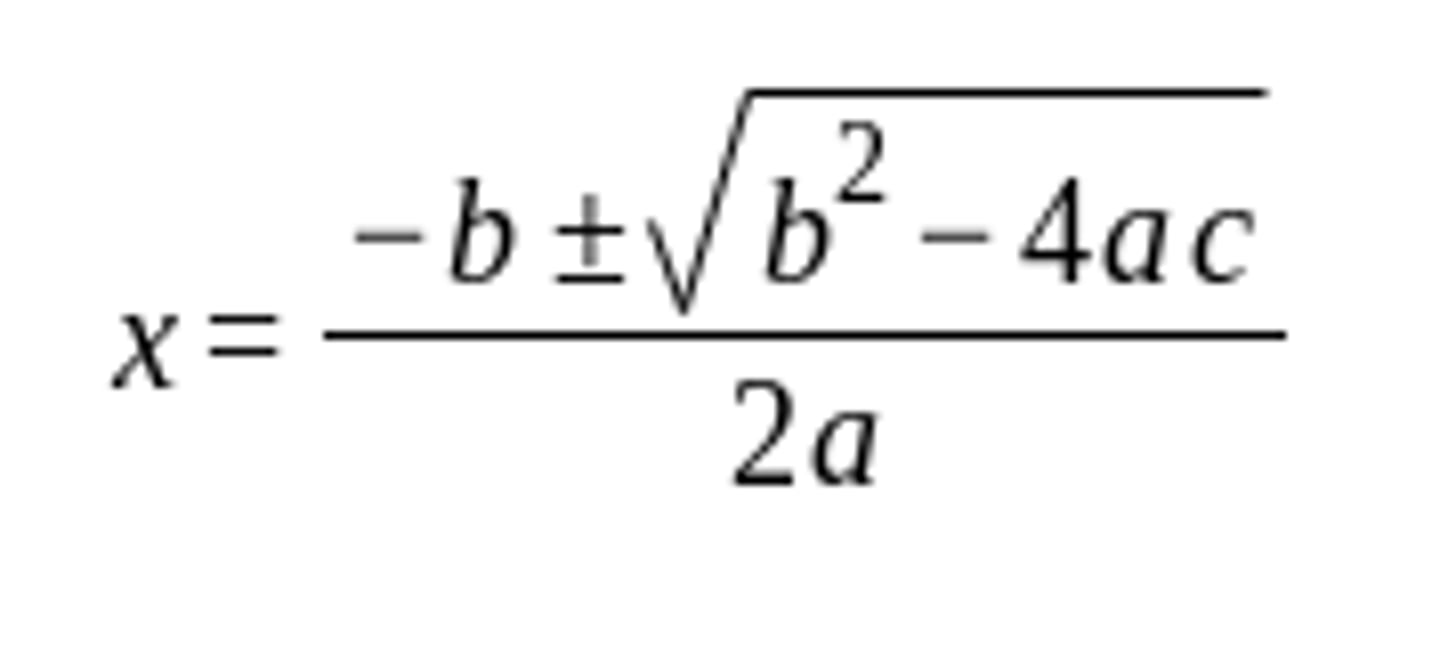
What is the quadratic formula and what is it used for?
Allows one to solve for x from:
ax² + bx + c = 0
What are the leading term, degree, and leading coefficient of:
23v⁶ + v⁴ + 7v⁹ - 4v
leading term = 7v⁹
degree = 9
leading coefficient = 7
Find all excluded values for:
(v-4) / (v+2)
v = -2
All values where expression becomes undefined, i.e. can't divide by 0
How do you find the vertexes of these parabolas?
y = -2x² + 4x + 10
y = (y - 3)² + 2
y = -2x² + 4x + 10
vertex = (1, 12)
First solve for the axis of symmetry (the vertical line that divides the parabola in half):
For: y = ax² + bx + c
Axis of symmetry = - b/2a
- (4/((2)-2) = - (4/-4) = 1
The axis of symmetry is the x coordinate of the vertex, so then just solve for y.
-2(1)² + 4(1) + 10
(1, 12)
------------
y = (y - 3)² + 2
vertex = (3, 2)
For: y = (x - h)² + k
Vertex = (h, k)
Note the sign switch of h.
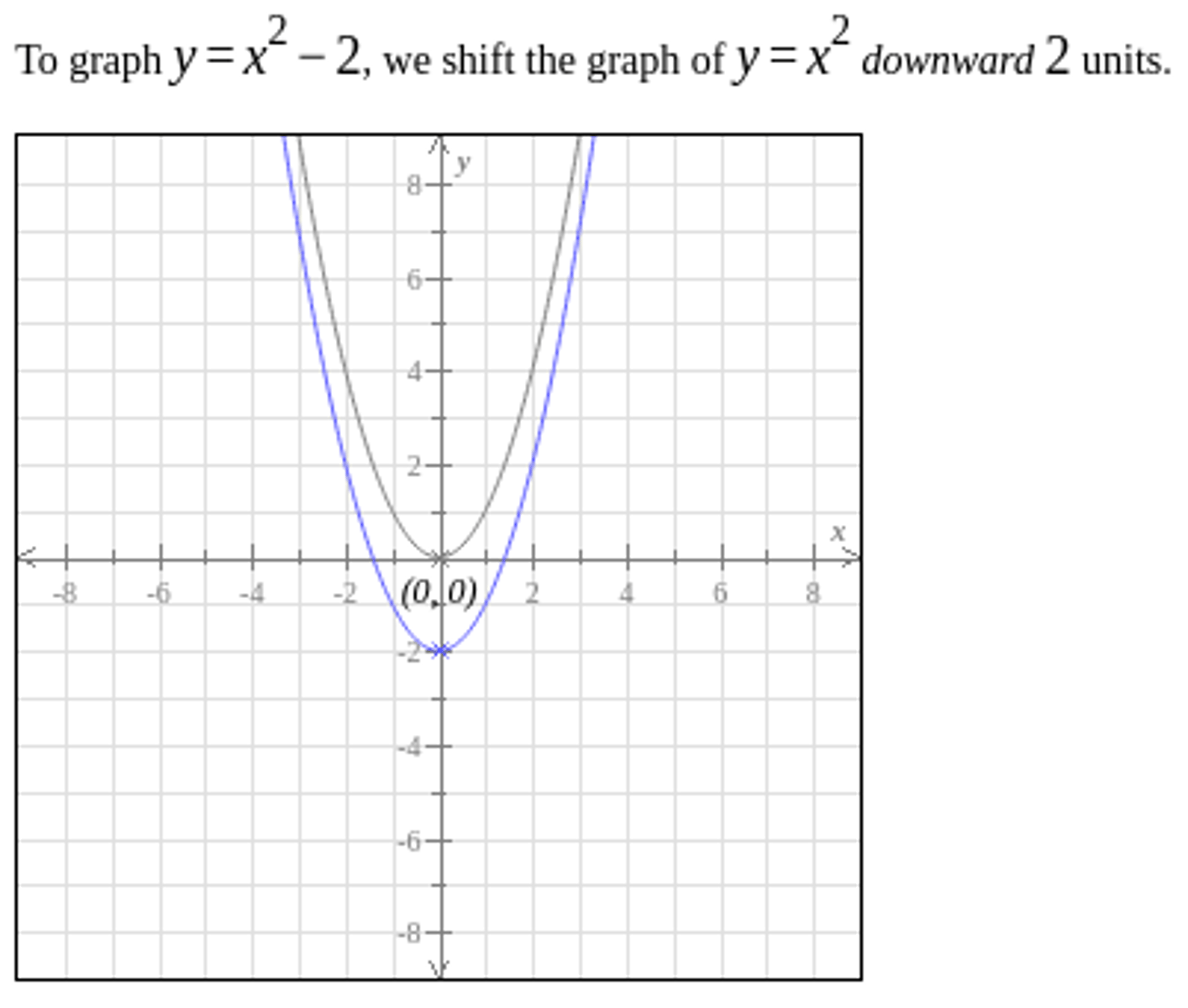
Translate y = x² to:
y = x² - 2
y = (x - 3)²
on a graph.
See the attached photo for y = x² - 2. It is shifted down two units. If it were x² + 2 it would shift up.
When the format is (x - 3)² the graph is shifted to the right three units.
If it were (x + 3)² it would shift to the left.
i.e. The opposite of what you would intuitively guess based on the vertical shifting rule stated above
Simplify:
8(3v + 5)(v - 7)
----------------
48(v - 7)(2v + 5)
3v + 5
-------
12v + 30
Simplify:
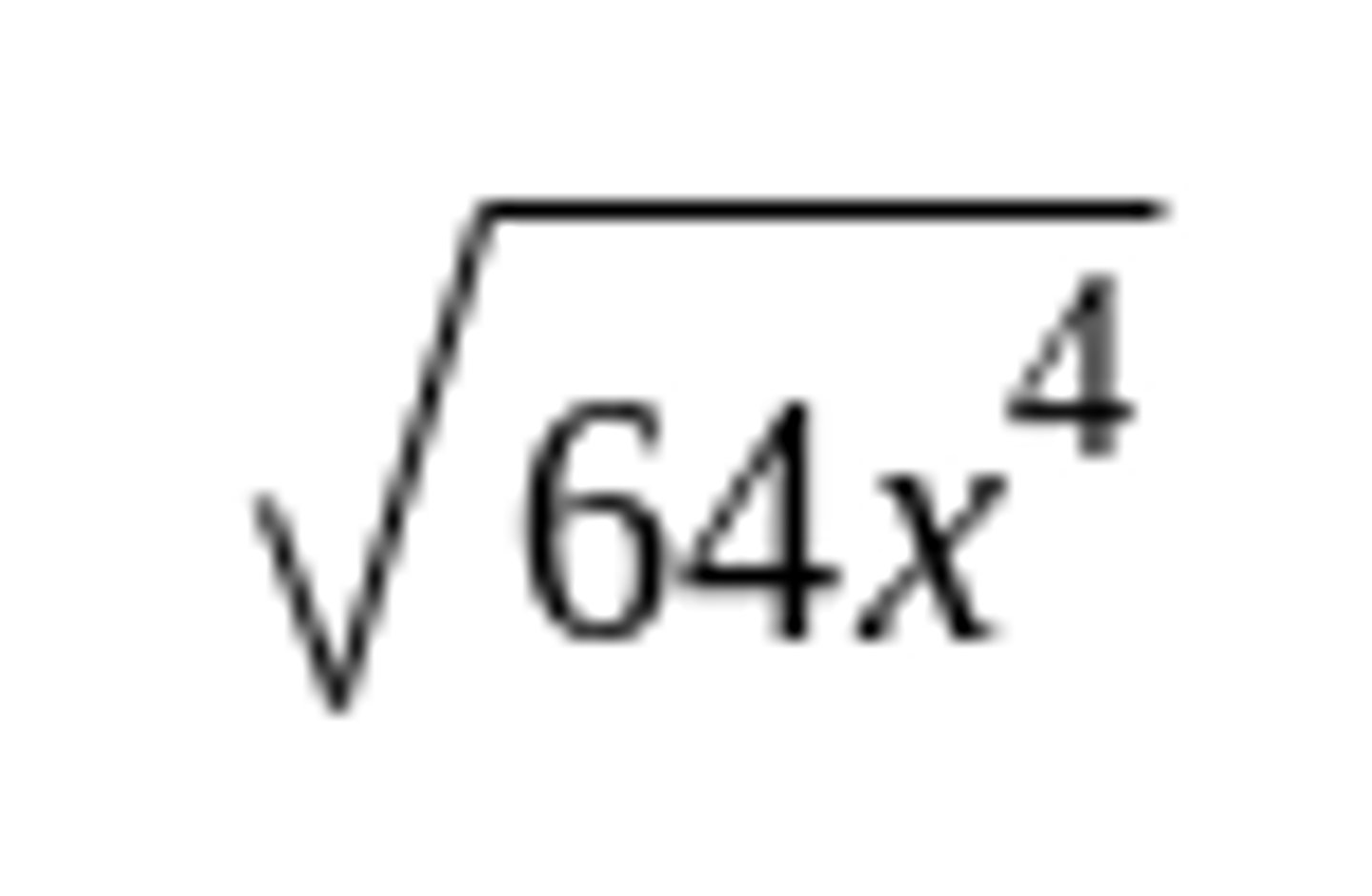
sqrt{64x^4} (see photo)
8x²
Rewrite 5² = 25 as a logarithmic equation.
log₅25 = 2
aᵇ = c -> logₐc = b
abc -> acb
Rewrite log₂16 = 4 as an exponential equation.
2⁴ = 16
logₐc = b -> aᵇ = c
acb -> abc
Solve the inequality for w:
-22 - 5w < 3
-22 - 5w < 3
-22 + 22 - 5w < 3 + 22
-5w < 25
w > -5
* When dividing both sides by a positive number the inequality sign stays the same. When dividing both sides by a negative number, the sign is reversed.
Find the greatest common factor of these two expressions:
30x⁸w⁴
18x³u⁷w⁶
6x³w⁴
Start with GCF of coefficients 30 and 18, which is 6.
Then find the lowest powers of the common variables.
Simplify the following fraction taken to the 4th power.
( a⁴ ) ⁴
( --- )
( -3b² )
a¹⁶
-----
81 b⁸
Evaluate each expression:
1) log ₅ 1/25 = x
2) log ₂ 32 = x
1) logₐc = b
aᵇ = c
5ˣ = 1/25
5ˣ = 5⁻²
x = -2
2) log ₂ 32 = x
2ˣ = 32
x = 5
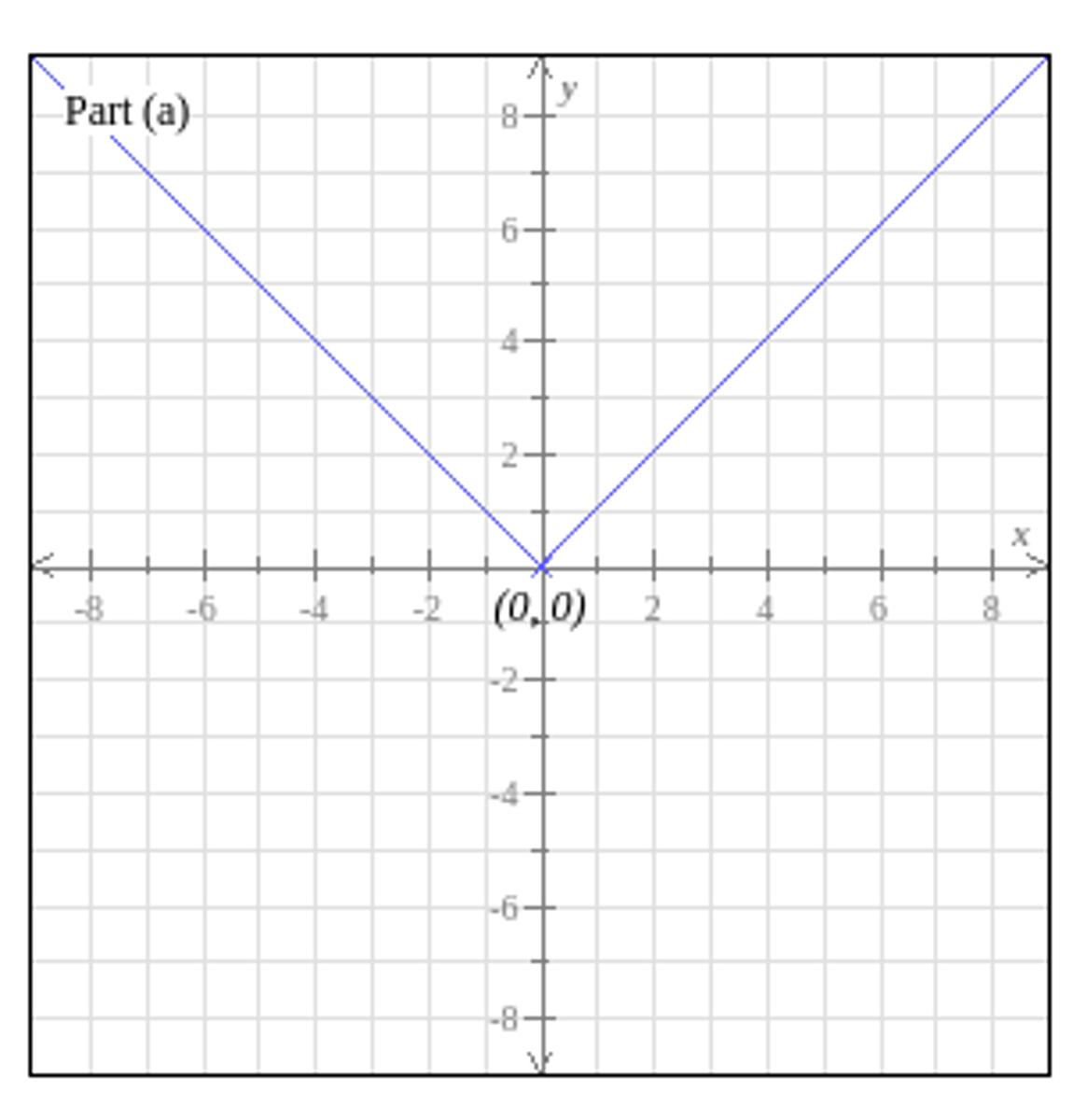
How would you translate the following graphs?
1) y = |x| -5
2) y = |x - 2|
1) y = |x| -5
- down 5 units
2) y = |x - 2|
- right 2 units
How would you translate the following graphs?
1) y = f(x) -2
2) y = g(x - 5)
1) y = f(x) -2
- down 2 units
2) y = g(x - 5)
- right 5 units
Solve for g:
f = (1/7)(g + h - k)
f = (1/7)(g + h - k)
7f = g + h - k
g = 7f - h + k
Solve for y:
30y - 25 = 9y²
9y² - 30y + 25 = 0
9(25) = 225 ->
-15 x -15 = 225 and
-15 - 15 = -30
9y² - 15y - 15y +25
3y(3y - 5) - 5(3y - 5)
(3y - 5)(3y - 5) = 0
(3y - 5) = 0 ->
y = 1 2/3
What is a relation? Domain? Range? Function?
relation = set of ordered pairs consisting of a first and second component
domain = set of first components (e.g. "x")
range = set of second components (e.g. "y")
function = special type of relation where no two ordered pairs have the same first component (i.e. domains must all be unique)
Are the following sets of ordered pairs functions?
1) { (z, w), (j, c), (j, m), (k, r) }
2) { (b, c), (a, d), (c, c), (d, a) }
1) no, two "j"s as domains (i.e. "x") -> (j, c) and (j, m)
2) yes, all domains unique (b, a, c, d)
Find all excluded values of:
x² + 3x - 18
------------
x² - 49
excluded values = where denominator equals 0
x = -7, 7
Factor by grouping:
5y³ + 7y² + 25y + 35
5y(y² + 5) + 7(y² + 5)
(5y + 7)(y² + 5)
Convert the following radical expression to exponential:
⁵√13³
x ᵐ⁄ⁿ = ⁿ√xᵐ
13³⁄⁵
Two trains leave the station at the same time heading west and east. The westbound train travels 95 mph. The eastbound train travels 85 mph. How long will it take them to travel 396 miles apart?
95x + 85x = 396
2.2 hours
A principal of $4,200 is invested at 7.75% interest compounded annually. How much will the investment be worth after 12 years?
4200(1.0775)¹² = $10,286
A forest covers 4100 km². It's area will decrease by 8.75% every year. How large will it be after 15 years?
4100(1 - .0875)¹⁵
If the graph g(x) = 5x² - 1 is translated vertically downward by 9 units, it becomes the graph of function h. Find h(x).
h(x) = g(x) - 9
= (5x² - 1) -9
= 5x² - 10
Find the x- and y-intercepts:
-5x + 2y = 6
x-intercept -> y = 0
-5x + 2(0) = 6
-5x = 6
x = -6/5
y-intercept -> x = 0
-5(0) + 2y = 6
2y = 6
y = 3
Simplify the following:
1) 125⁻²ᐟ³
2) (1 / 8)⁻²ᐟ³
1) 125⁻²ᐟ³
1 / 125²ᐟ³
1 / (125¹ᐟ³)²
1 / (³√125)²
1 / 5²
1 / 25
2) (1 / 8)⁻²ᐟ³
8 ²ᐟ³
(8¹ᐟ³)²
(³√8)²
2²
4
Find all the values of x that are not in the domain of h.
h(x) = x² + 2x - 24
------------
x² + 8x + 12
h(x) = x² - 4x -45
------------
x² - 81
x² + 8x + 12
(x + 6)(x + 2) = 0
x = -6, -2
x² - 81
x = 9, -9
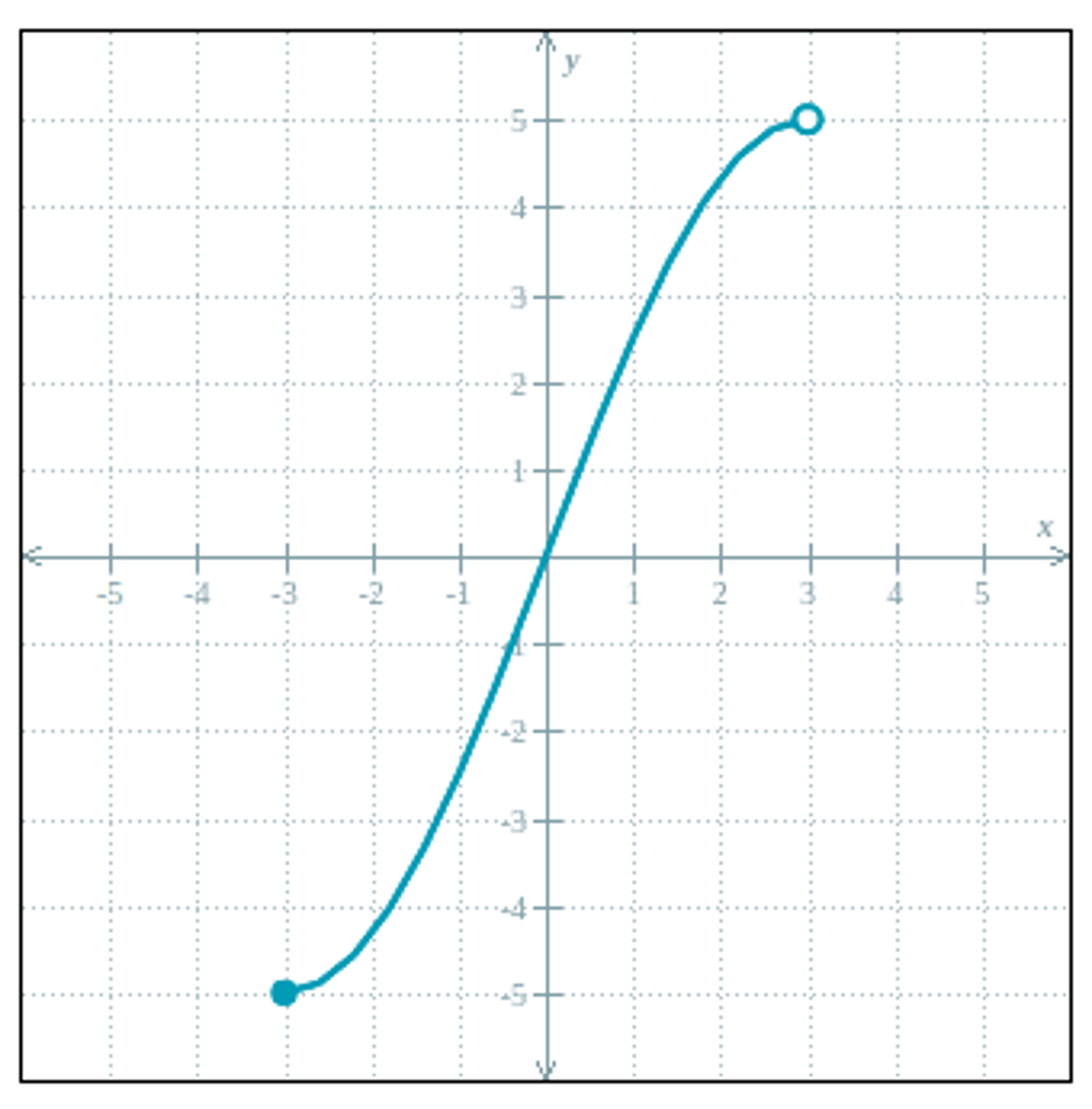
Write the domain and range of this graph using interval notation.
domain = all x coordinates
-3 <= x < 3
domain = [ -3, 3)
range = all y coordinates
-5 <= y < 5
range = [ -5, 5)
* bracket -> includes point
parenthesis -> point not included
Write the domain and range of the following graph using interval notation.
domain = all x coordinates
domain = [-2, 3)
range = all y coordinates
range = [-5, 4]
* bracket -> includes point
parenthesis -> point not included
![<p>domain = all x coordinates</p><p>domain = [-2, 3)</p><p>range = all y coordinates</p><p>range = [-5, 4]</p><p>* bracket -> includes point</p><p>parenthesis -> point not included</p>](https://knowt-user-attachments.s3.amazonaws.com/1a9d5f5c-81d6-476d-b0ec-503cd2d9b886.png)
For f(x) = (1/6)ˣ find:
x = -3, -2, -1, 0, 1
-3 -> 216
-2 -> 36
-1 -> 6
0 -> 1
1 -> 1/6
Fill in the missing ( __ ) values:
1) log₈3 - log₈5 = log₈__
2) log₉__ + log₉5 = log₉35
3) -4log₈3 = log₈__
1) logₐ(M/N) = logₐM - logₐN
log₈(3/5)
2) logₐ(M*N) = logₐM + logₐN
log₉7
3) logₐMᵖ = p logₐM
log₈(1/81)
Rewrite the following as an exponential equation:
ln6 = y
logₐc = b -> aᵇ = c
When the base is 'e', we don't write logₑ.
We write 'ln' (aka natural log).
'e' is a special irrational number that equals 2.718281...
ln c = b -> eᵇ = c
eʸ = 6
Rewrite the following as a logarithmic equation:
e⁵ = x
logₐc = b -> aᵇ = c
When the base is 'e', we don't write logₑ.
We write 'ln' (aka natural log).
'e' is a special irrational number that equals 2.718281...
ln c = b -> eᵇ = c
ln x = 5
Solve for w:
5w² - 15w = 0
5w² - 15w = 0
5w(w - 3) = 0
w = 3, 0
Solve for x:
(x - 5)² = 2x² - 7x -3
(x - 5)² = 2x² - 7x -3
= 2x² - 7x -3 - (x - 5)²
----------
- (x - 5)²
-( (x - 5)(x - 5) )
- (x² - 10x + 25)
----------
= 2x² - 7x -3 - x² + 10x - 25
= x² + 3x - 28
= (x + 7)(x - 4)
x = -7, 4
Find the domain of the function and write in interval notation:
g(x) = √(x - 9)
Find the set of all values that make √(x - 9) a real number (i.e. when x - 9 is greater than or equal to zero).
x - 9 >= 0
x >= 9
[ 9, ∞)
* bracket -> includes point
parenthesis -> point not included (can't include infinity)
Find the domain of the function and write in interval notation:
f(x) = √(x) + 3
Find the set of all values that make √(x) a real number (i.e. when x is greater than or equal to zero).
x >= 0
[0, ∞)
* bracket -> includes point
parenthesis -> point not included (can't include infinity)
What is the different between semiannual, biannual, and biennial?
Biannual means twice per year, and semiannual means every six months (i.e. every half year) -- the same in the end but with a slight technical difference.
Biennial means every two years (i.e. every other year).
Hong deposited $4000 into an account with 3% interest, compounded semiannually. Assuming that no withdrawals are made, how much will he have in the account after 8 years?
Do not round any intermediate computations, and round your answer to the nearest cent.
Semiannual means every six months (i.e. twice per year). The annual rate is 3%, so half the rate gets compounded every six months.
Rate per compound period = 1 + (0.03 / 2)
Number of periods = 8 * 2 = 16
Amount = 4000 * (1 + (0.03/2) )¹⁶
= $5075.94
Write a⁵ * a² without exponents.
aaaaaaa
Fill in the blank:
x * x⁷ = x-
y⁵ * y² = y-
x⁸
y⁷
Expand:
y⁷
log ----
x
7logy - logx
Expand:
log(yz⁸)
logy + 8logz
A laptop computer is purchased for $1700 . Each year, its value is 75% of its value the year before. After how many years will the laptop computer be worth $600 or less?
1700 * 0.75ˣ <= 600
0.75ˣ <= 600/1700
0.75ˣ <= 0.3529
Try out values until you get the smallest number that results in less than or equal to 0.3529.
x = 4
A loan of $34,000 is made at 7% interest, compounded annually. After how many years will the amount due reach $77,000 or more?
Write the smallest possible whole number answer.
34,000 (1.07)ˣ >= 77,000
1.07ˣ >= 2.26
Try out x values until you get the smallest value that is greater than or equal to 2.26.
x = 13
Factor:
3x² + 27x -45
3(x² + 9x - 15)
Cannot be factored
Solve for x with the quadratic formula:
2x² - 4x = 3
2x² - 4x - 3 = 0
-(-4) +- √(-4² - 4(-6))
----------------------
2(2)
4 +- √40
----------
4
x = 2.58, -0.58
Solve for x:
81 = 27⁻ˣ⁺⁴
81 = 27⁻ˣ⁺⁴
3⁴ = 3³⁽⁻ˣ⁺⁴⁾
3⁴ = 3⁻³ˣ⁺¹²
4 = -3x + 12
3x = 8
x = 8/3
Use the change of base formula to compute:
log ₁⸝₇ 4
Round to the thousandth decimal place.
log 4
------
log 1/7
-0.712
Solve for x:
log ₓ 1/36 = 2
logₐb = c
aᶜ = b
log ₓ 1/36 = 2
x² = 1/36
x = 1/6
Find the domain of:
f(x) = √(-8x + 48)
Write the answer in interval notation.
-8x + 48 >= 0
-8x >= -48
x = 6
x = 7 -> not a real number √(-56 + 48)
x = 5 -> ok, so domain must decrease from 6
(-∞, 6]
Find the domain of:
v(x) = √(-x) - 7
Use interval notation.
v(x) = √(-x) - 7
√(-x) >= 0
x = 0
(-∞, 0]
Solve for x:
log₄(-3x + 8) = 1
logₐb = c -> aᶜ = b
4¹ = -3x + 8
3x = 4
x = 4/3
Solve for x:
-6log₄(5x) = -12
-6log₄(5x) = -12
log₄(5x) = -12/-6
log₄(5x) = 2
logₐb = c -> aᶜ = b
4² = 5x
16 = 5x
x = 16/5
Suppose that $2700 is borrowed for three years at an interest rate of 8% per year, compounded continuously. Find the amount owed, assuming no payments are made until the end. Do not round any intermediate computations, and round your answer to the nearest cent.
A = Peʳᵗ
A = 2700e⁽⁰·⁰⁸⁾⁽³⁾
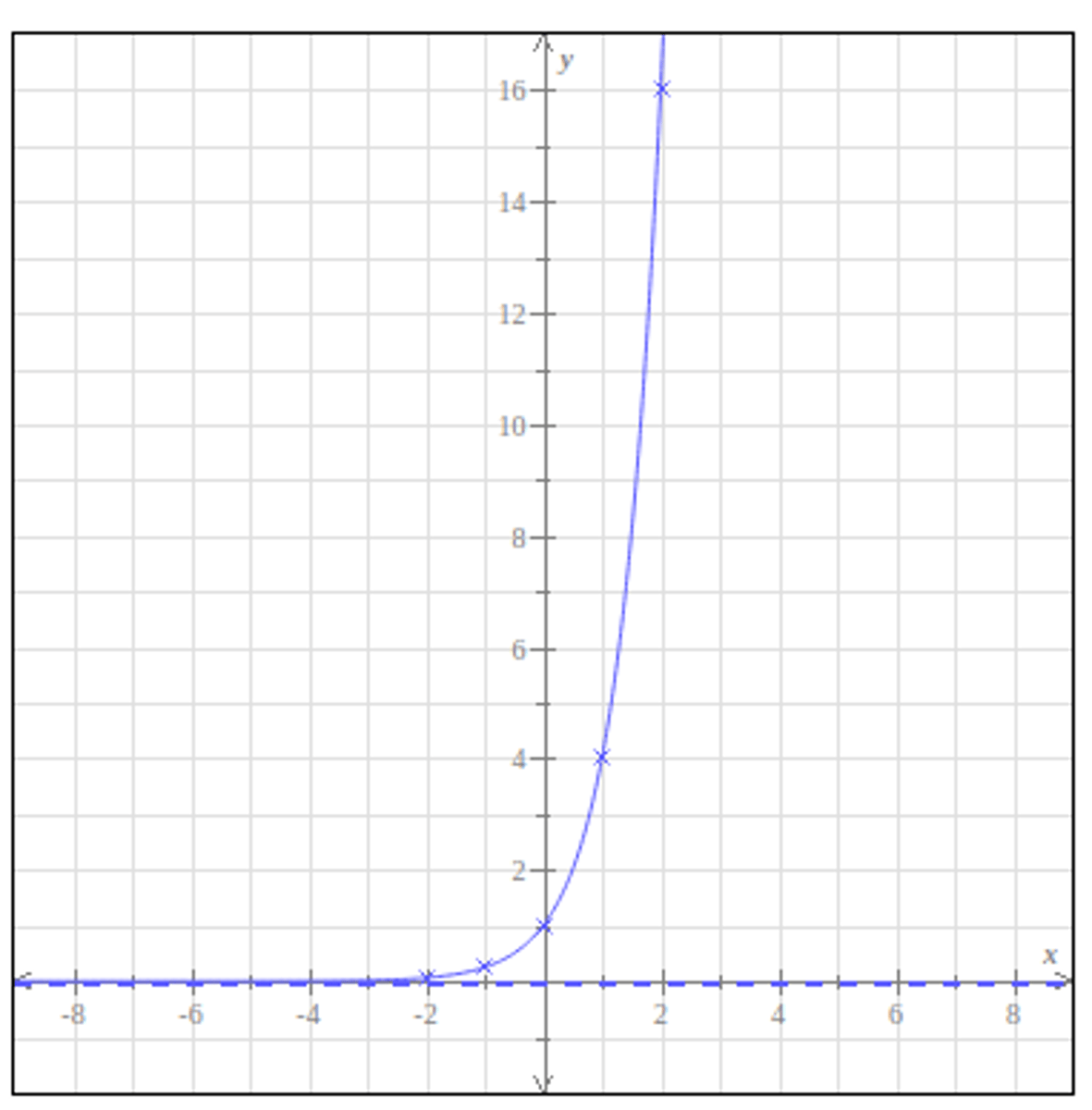
Graph five points of the exponential function of f(x) = 4ˣ and include the asymptote.
(-2, 1/16)
(-1, 1/4)
(0, 1)
(1, 4)
(2, 16)
Plot the asymptote as a horizontal line along the x-axis.
Then graph-a-function.
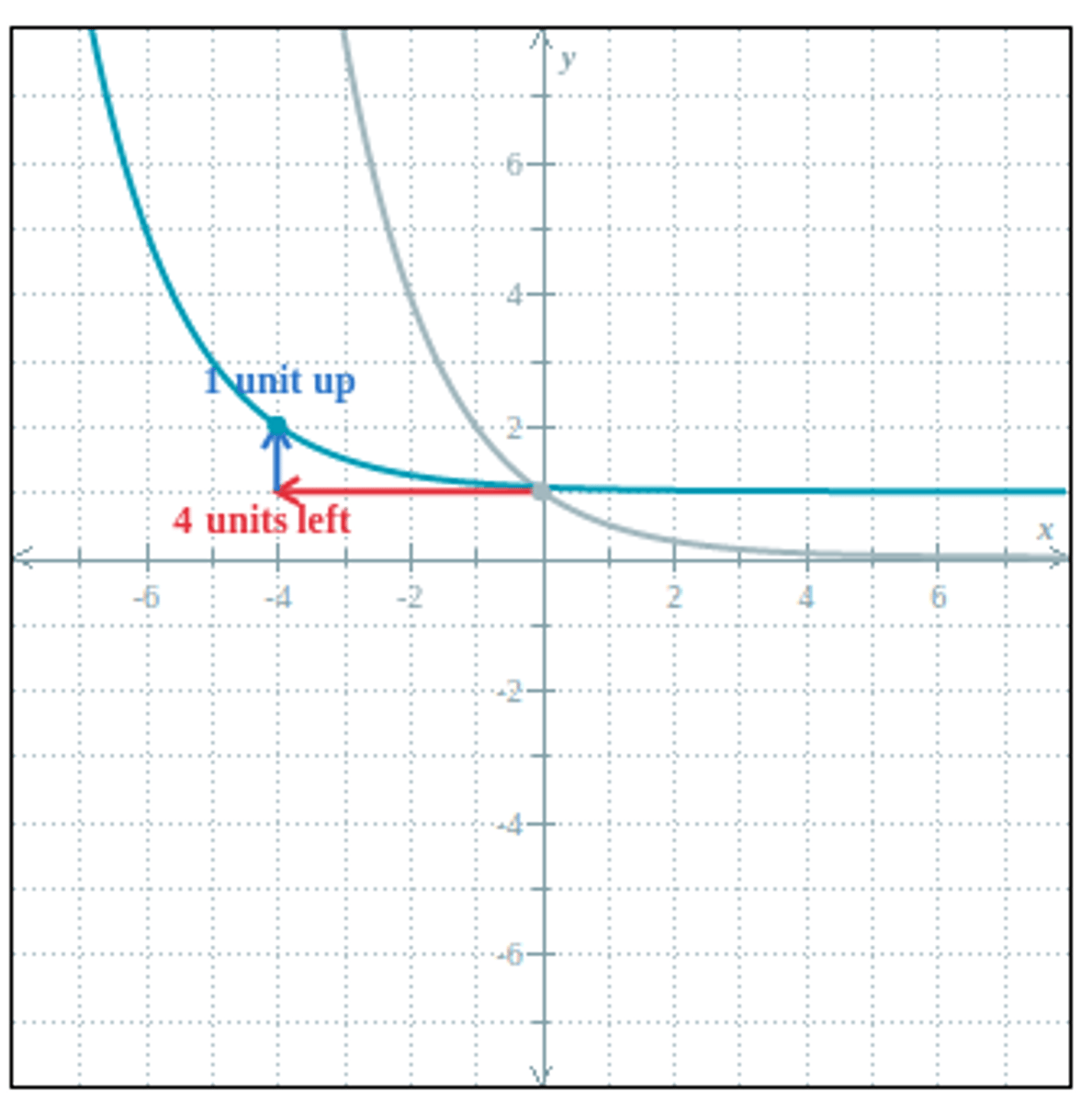
Translate y = (1/2)ˣ into:
y = (1/2)ˣ⁺⁴ + 1
Shift the line 4 units left and 1 unit up.
Use the properties of logarithms to evaluate the following expression:
ln e⁸ + ln e⁴ = __
ln c = b -> eᵇ = c
so...
ln eᵇ = b
ln e⁸ + ln e⁴ =
8 + 4 = 12
Use the properties of logarithms to evaluate the following expression:
2log₂3 - log₂36 = __
2log₂3 - log₂36 = __
logₐMᵖ = p logₐM
2log₂3 - log₂36 = log₂3² - log₂36
= log₂9 - log₂36
logₐ(M/N) = logₐM - logₐN
logₐ(M*N) = logₐM + logₐN
= log₂(9/36)
= log₂(1/4)
logₐb = c -> aᶜ = b
so...
logₐaᶜ = c
= log₂2⁻²
= -2
Use the properties of logarithms to evaluate the following expression:
log₁₄7 - log₁₄2 = __
log₁₄7 - log₁₄36 = __
logₐ(M/N) = logₐM - logₐNterm-75
logₐ(M*N) = logₐM + logₐN
= log₁₄14
logₐb = c -> aᶜ = b
so...
logₐaᶜ = c
= log₁₄14¹
= 1
Use the properties of logarithms to evaluate the following expression:
2log₁₂4 + log₁₂9 = __
2log₁₂4 + log₁₂9 = __
logₐMᵖ = p logₐM
log₁₂16 + log₁₂9
logₐ(M/N) = logₐM - logₐN
logₐ(M*N) = logₐM + logₐN
log₁₂(16 * 9)
log₁₂(144)
logₐb = c -> aᶜ = b
so...
logₐaᶜ = c
log₁₂12¹² = 12
Simplify:
√5(√3 - 8)
√5(√3 - 8)
√15 - 8√5
* Check for actual square roots
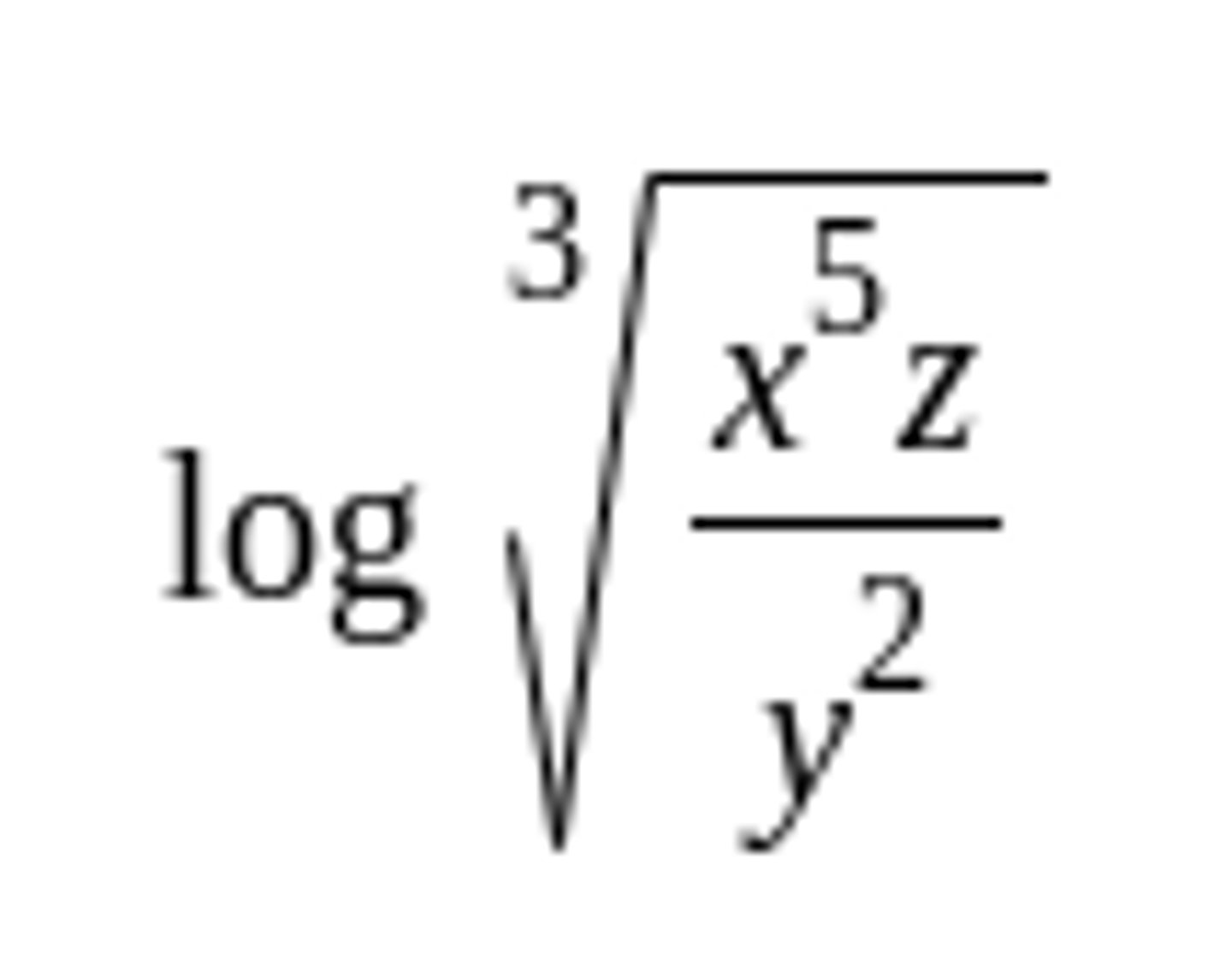
Expand the following equation. Only one variable per log and no radicals or exponents.
³ √ x⁵z
log √ ------
√ y² * see image
x⁵z ¹ᐟ³
log ----
y²
x⁵z
(1/3)log ----
y²
(1/3) (logx⁵z - logy²)
(1/3) (5logx + logz - 2logy)
(5/3)logx + (1/3)logz - (2/3)logy
Expand the following equation. Each log should only have one variable and no radicals or exponents.
log√(x³yz⁵)
log√(x³yz⁵)
log x³ᐟ² y¹ᐟ² z⁵ᐟ²
1/3logx + 1/2logy +5/2logz
Solve for y. Round to the nearest hundredth.
e⁶ʸ = 4
ln(e) = 1
e⁶ʸ = 4
lne⁶ʸ = ln4
6y(lne) = ln4
6y = ln4
y = ln4/6
y = 0.23
Solve for x. Round to the nearest hundredth.
5³ˣ = 4
5³ˣ = 4
log5³ˣ = log4
3xlog5 = log4
3x = log5 / log4
x = log5 / 3log4
x = 0.29
Write this expression as a single logarithm.
3log₄z + 4(log₄x - 5log₄y)
3log₄z + 4(log₄x - 5log₄y)
log₄z³ + log₄x⁴ - log₄y²⁰
log₄z³ + log₄(x⁴ / y²⁰)
log₄ (z³x⁴ / y²⁰)
Write the expression as a single logarithm.
7logₘ(5z + 1) + (1/4)logₘ(z + 3)
7logₘ(5z + 1) + (1/4)logₘ(z + 3)
logₘ(5z + 1)⁷ + logₘ(z + 3)¹ᐟ⁴
logₘ((5z + 1)⁷(z + 3)¹ᐟ⁴)
Write the expression as a single logarithm.
(1/4)log꜀w + 4log꜀x - log꜀y
(1/4)log꜀w + 4log꜀x - log꜀y
log꜀w¹ᐟ⁴ + log꜀x⁴ - log꜀y
log꜀ (w¹ᐟ⁴x⁴ / y)
The mass of a radioactive substance follows a continuous exponential decay model. A sample of this radioactive substance has an initial mass of 4335 kg and decreases continuously at a relative rate of 12% per day. Find the mass of the sample after three days. Do not round any intermediate computations, and round your answer to the nearest tenth.
Peʳᵗ
4335 e ⁻⁰·¹² * ³ = 3024.4 kg
Henry deposited $5000 into an account with a 7.2% annual interest rate, compounded monthly. Assuming that no withdrawals are made, how long will it take for the investment to grow to
$7645 ? Do not round any intermediate computations, and round your answer to the nearest hundredth.
5000 (1 + 0.072/12)¹²ᵗ = 7645
1.006¹²ᵗ = 7645/5000
12t log 1.006 = log 1.529
12t = log 1.529 / log 1.006
t = log 1.529 / 12 log 1.006
t = 5.92 years
* Don't multiply 5000 and 1.006 first
i.e. 5030¹²ᵗ = 7645
Latoya places a bottle of water inside a cooler. As the water cools, its temperature Ct in degrees Celsius is given by the following function, where t is the number of minutes since the bottle was placed in the cooler.
C(t) = 3 + 21e⁻⁰·⁰⁵ᵗ
Latoya wants to drink the water when it reaches a temperature of
20 degrees Celsius. How many minutes should she leave it in the cooler? Round your answer to the nearest tenth, and do not round any intermediate computations.
C(t) = 3 + 21e⁻⁰·⁰⁵ᵗ
20 = 3 + 21e⁻⁰·⁰⁵ᵗ
17 = 21e⁻⁰·⁰⁵ᵗ
17/21 = e⁻⁰·⁰⁵ᵗ
ln 17/21 = -0.05t ln e
ln 17/21 / -0.05 = t (1)
t = 4.2 min
Find:
g(5x) = x² -3
g(5x) = x² -3
= (5x)² - 3
= 25x² - 3
Solve for x:
ln(x - 5) - ln14 = ln18
ln(x - 5) - ln14 = ln18
ln (x-5)/14 = ln 18
(x - 5)/14 = 18
x = 252 + 5
x = 257
Solve for x:
log(x + 4) = log(5x + 5)
log(x + 4) = log(5x + 5)
x + 4 = 5x + 5
-1 = 4x
x = -1/4
Solve for x:
log₄(x - 8) - log₄2 = log₄x
log₄(x - 8) - log₄2 = log₄x
(x - 8)/2 = x
x - 8 = 2x
x = -8
Check:
log₄(-8 - 8)
log₄(-16) = undefined
-> No solution
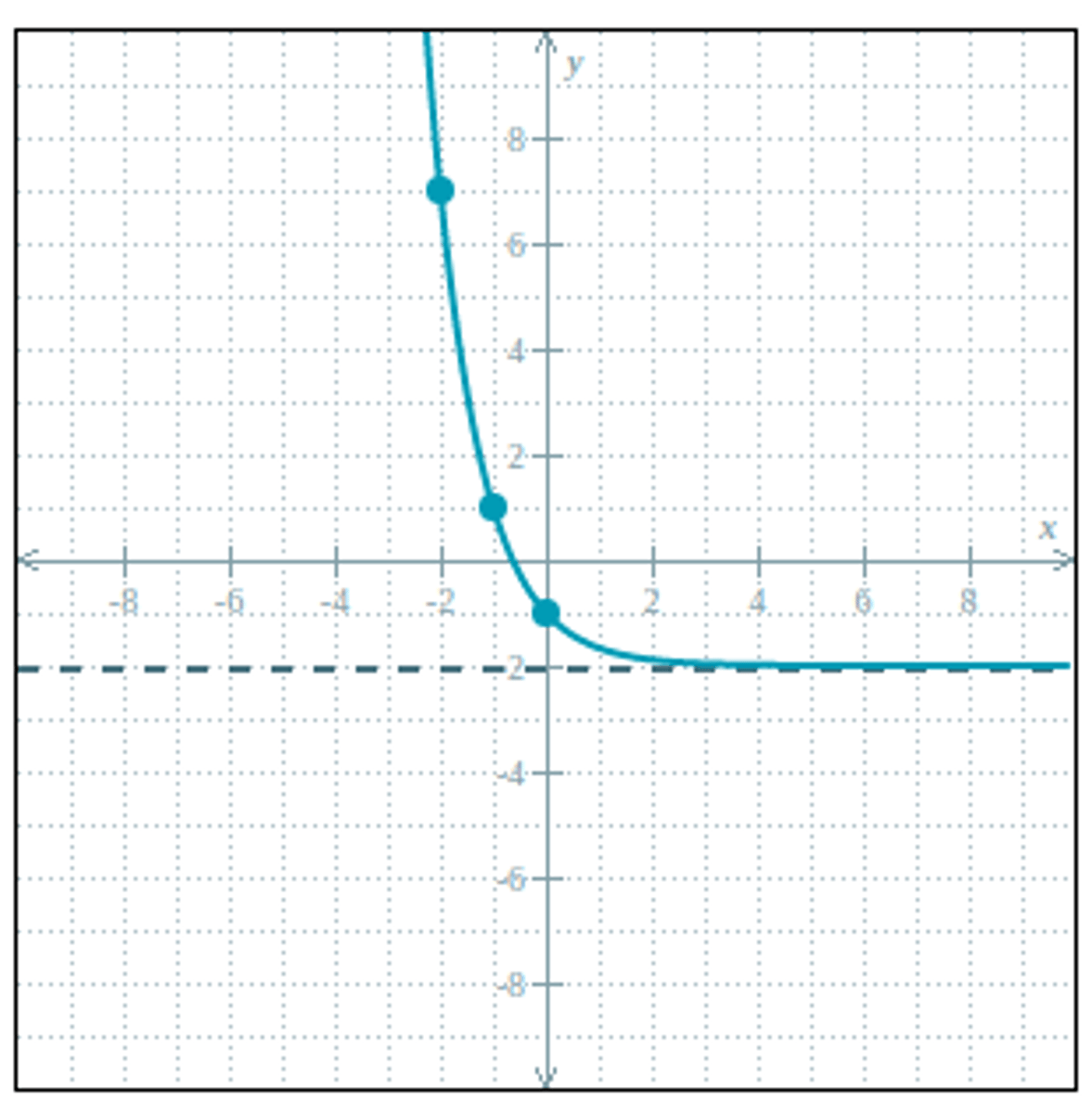
Plot 2 points and the asymptote of:
g(x) = (1/3)ˣ - 2
Give the domain and range in interval notation.
(0, -1)
(-1, 1)
(-2, 7)
(1, -1.67)
(2, -1.89) * approaching -2
domain = (-∞, ∞)
range = (-2, ∞)
Solve for x. Round to the nearest hundredth.
5 - 2 ln x = 2
5 - 2 ln x = 2
-2 ln x = -3
ln x = 3/2
x = e³ᐟ²
x = 4.48
Solve for x.
ln(x - 2) - ln 4 = -3
ln(x - 2) - ln 4 = -3
ln (x - 2)/4 = -3
(x - 2)/4 = e⁻³
x = 4e⁻³ + 2
x = 2.20
The amount of money invested in a certain account increases according to the following function, where y₀ is the initial amount of the investment, and y is the amount present at time t (in years).
y = y₀(e⁰·⁰³⁵ᵗ)
After how many years will the initial investment be doubled? Do not round any intermediate computations, and round your answer to the nearest tenth.
y = y₀e⁰·⁰³⁵ᵗ
2y₀ = y₀e⁰·⁰³⁵ᵗ
2 = e⁰·⁰³⁵ᵗ
ln 2 = ln (e⁰·⁰³⁵ᵗ)
ln 2 = 0.035t
t = ln 2 / 0.035
t = 19.8 years
Suppose that $2300 is invested at an interest rate of 4.25% per year, compounded continuously. After how many years will the initial investment be doubled?
Do not round any intermediate computations, and round your answer to the nearest hundredth.
2300 e ⁰·⁰⁴²⁵ᵗ = 4600
e ⁰·⁰⁴²⁵ᵗ = 2
0.0425t = ln 2
t = ln 2 / 0.0425
t = 16.31 years
Suppose that the number of bacteria in a certain population increases according to a continuous exponential growth model. A sample of 2000 bacteria selected from this population reached the size of 2140 bacteria in three hours. Find the hourly growth rate parameter.
Note: This is a continuous exponential growth model.
Write your answer as a percentage. Do not round any intermediate computations, and round your percentage to the nearest hundredth.
2000 e³ʳ = 2140
e³ʳ = 1.07
3r = ln 1.07
r = ln 1.07 / 3
r = 0.0226
* Write as a PERCENTAGE
2.26 %