FP Practice Quizzes
 Call Kai
 Learn
Learn Practice Test
 Spaced Repetition
 Match
Match Flashcards
 Knowt Play
1/54

There's no tags or description
Looks like no tags are added yet.
Name | Mastery | Learn | Test | Matching | Spaced | Call with Kai |
|---|
No analytics yet
Send a link to your students to track their progress
55 Terms
B) Mechanical Bond
There are multiple forces that hold porcelain to Zirconia substructure for a PFZ crown. Which type of bonding force has the greatest strength?
A) Chemical Bond
B) Mechanical Bond
C) Flexural Strength
B) It is a solid single-layer with same type of ceramic
Ceramic can be classified into many categories. When you hear the term monolithic ceramic, what does it mean to you?
A) It is multi-layered with different types of ceramic
B) It is a solid single-layer with same type of ceramic
True
T/F: All ceramic restorations can be categorized into 3 main types: (1) predominantly glass such as feldspathic porcelain, (2) Particle-Filled
Glass, i.e. E-max, and (3) Polycrystalline ceramic such as Zirconia.
C) 5Y-TZP
Among the three types of Zirconia, 3Y-TZP, 4Y-TZP and 5Y-TZP, which one has the most translucency?
A) 3Y-TZP
B) 4Y-TZP
C) 5Y-TZP
B) Chemical > Compressive strength > Mechanical Entrapment
Which one is correct regarding the amount of bond strength between metal alloy to porcelain in PFM crown?
A) Chemical >Mechanical>Compressive strength
B) Chemical > Compressive strength > Mechanical Entrapment
C) Mechanical Bond > Chemical Bond > Compressive Force
B) Lightness or darkness of color
Value is _____________
(Besides its definition, be sure to know its application in dentistry)
A) Intensity of color
B) Lightness or darkness of color
C) Variety of color
True
T/F: How we see color depends on 3 factors: light source, object and an observer. If you cannot use natural light source for shade matching, you can use a fluorescent lamp and be sure that the lamp has color temperature at least 5500 Kelvin and Color Rendering Index at least 90 or above
C) Value
One of the textbooks recommends to initiate shade matching by assessing the lightness or darkness of the color of the affected tooth first.
This means we should first assess__________
A) Hue
B) Chroma
C) Value
True
T/F: Metamerism is when two colors appear to match under one lighting condition, but not when the light changes.
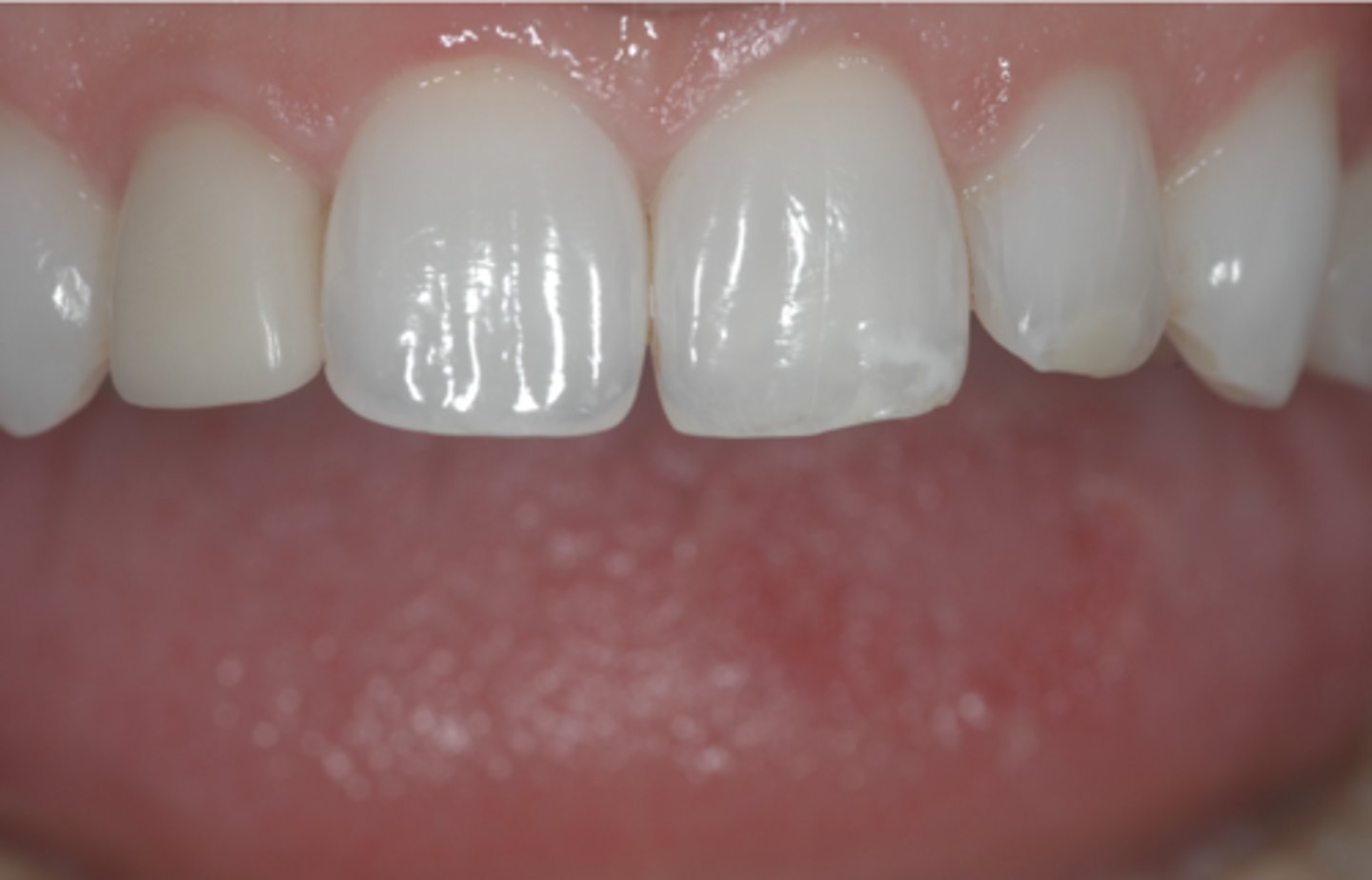
B) You realize that you are unable to increase value of Crown #7. You decide to return this crown to the lab and request to change not only the shade but also translucency and surface characters.
Compare Crown #7 during a try-in visit and Natural Tooth #10. Which one is correct?
Hint: The lighter the color, the higher the value. No color has higher value than white and no color has lower value than black.
A) You should consider stain Crown #7 to increase its value.
B) You realize that you are unable to increase value of Crown #7. You decide to return this crown to the lab and request to change not only the shade but also translucency and surface characters.
D) 4
A master cast or a working cast is generally formed by using Type ______ dental stone.
A) 1
B) 2
C) 3
D) 4
True
A Pindex system allows an operator to remove an individual prepared tooth from a working cast to examine its surface and finish line in 360 degrees so that the final crown can be made from this die with high accuracy. Is this statement true or false?
A) I will have difficulty inserting my crown since interproximal contacts may be off
Most pindex systems use a mechanical interlock such as dowel and sleeve so that an individual die is stable on the platform and is not rotated. If you find out that your individual die is slightly rotated and is not stable on the platform, what could happen to your final crown?
A) I will have difficulty inserting my crown since interproximal contacts may be off
B) I should not be worried since the rotation is slight and tooth has PDL that will compensate for it
C) I should suspect my crown to be hypo-occluded
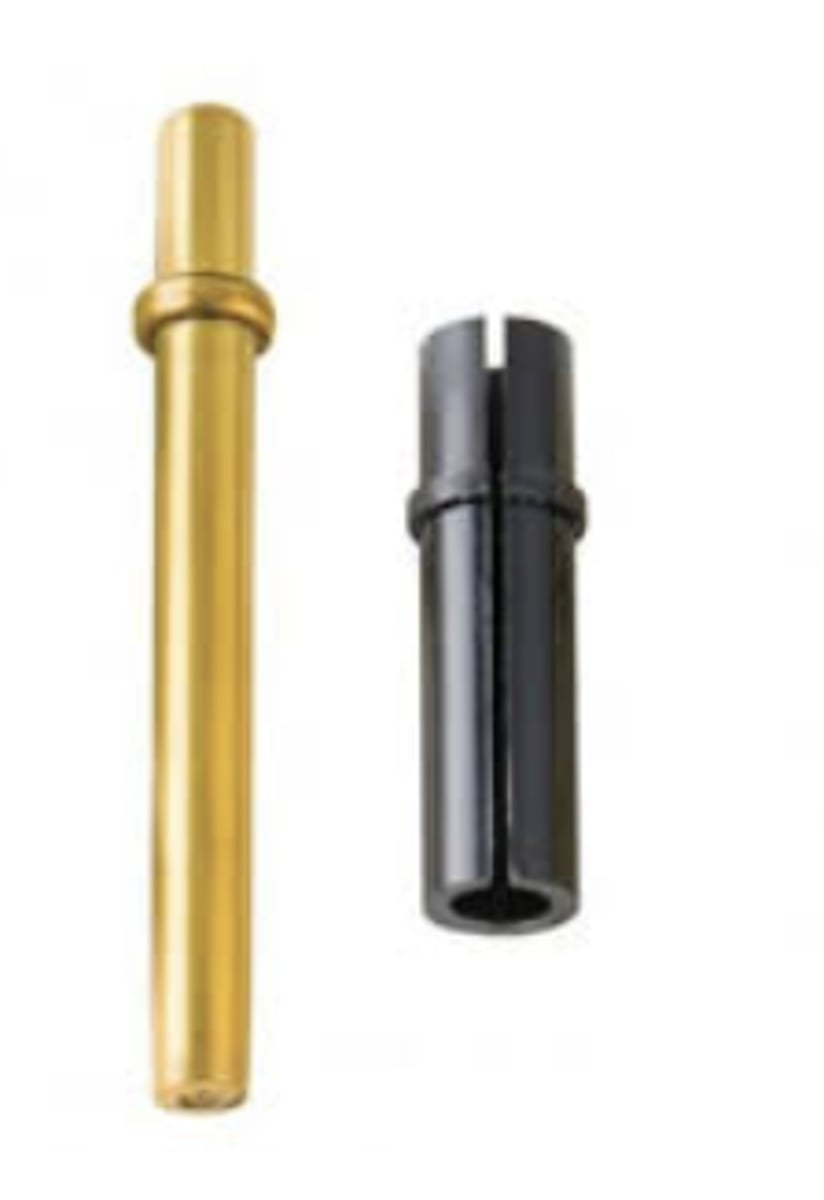
B) Because it exposes the finish line clearly so that there is no confusion between the laboratory technician and clinician
Why is die trimming important?
A) Because it is the only way to make a working cast looks neat
B) Because it exposes the finish line clearly so that there is no confusion between the laboratory technician and clinician
C) Because it is the only way to communicate the soft tissue level with the laboratory technician
A) You will likely have a problem with interproximal contacts and occlusion
What would happen if your working cast was pindexed poorly, i.e., the die segment is very loose and rotated?
A) You will likely have a problem with interproximal contacts and occlusion
B) Your crown color will be inaccurate
A) High Noble, Titanium, Noble and Base metal alloys
Which one is correct based on ADA's metal alloy classification?
A) High Noble, Titanium, Noble and Base metal alloys
B) Precious, Semi-precious and Non precious alloy
C) High Precious and base metal alloys
B) No, it depends solely on the content of the alloy
Can you identify precious vs semi-precious metal by the look of the crown?
A) Yes, if you see a yellow gold crown it must contain more than 40% of Au
B) No, it depends solely on the content of the alloy
A) Too soft for oral function
What is the main reason not to use pure 90% Au to fabricate a Gold Crown?
A) Too soft for oral function
B) Too rigid for oral function
C) Too corrosive to be used in oral cavity
B) Chemical properties, including resistance to corrosion and oxidation
On what basis are noble metals classified?
A) Physical properties such as color and weight
B) Chemical properties, including resistance to corrosion and oxidation
C) Cost and rarity
D) Magnetic properties
A) Amount of Au or Pd is used to distinguish precious metal to base metal alloys
Which one of the following is correct?
A) Amount of Au or Pd is used to distinguish precious metal to base metal alloys
B) Amount of Silver and Zirconia are used to distinguish precious metal to base metal alloys
A) True
Surveyed crown is a full coverage restoration that was planned to aid in retaining and supporting a removable partial denture (RPD).
A) True
B) False because a surveyed crown is called when there is a removable partial denture in the patient's month disregard whether it helps or does not help with the retention or support of the RPD.
A) Yes, because the abutment tooth requires to have a rest seat, more tooth reduction should be accounted for. If we do not know this information in advance, the lab technician will not know and the final crown will need to be discarded at the end.
Dr. Smith is a clinical faculty on the floor and she expresses her disappointment with her student who does not have an RPD design in advance when the tooth that student plans to prepare today is one of the abutment of the RPD. Should Dr. Smith be upset with this student?
A) Yes, because the abutment tooth requires to have a rest seat, more tooth reduction should be accounted for. If we do not know this information in advance, the lab technician will not know and the final crown will need to be discarded at the end.
B) No, it was unnecessary for her to be disappointed since we can always cut the opposing tooth to make more room or we can skip to the other tooth.
A) Yes
Tooth #30 has a small Class I amalgam restoration. In general, this tooth would not need to be a crown but Monika, a senior dental student, has planned to use it for a surveyed crown because she cannot find any desirable undercut at Disto-Buccal aspect where she wanted it. Dr. Smith, a clinical faculty member, did review a treatment plan and RPD design and corrected her that this tooth should not be prepared for a full coverage restoration because Tooth #30 has intact amalgam with no further damage, which considers to be sound. Is Dr. Smith right?
A) Yes
B) No
True
T/F: Before you send a case out to the lab, you should always surveyed your working cast of your prepared tooth and mark tripods so that the lab technician can create desirable undercut based on your RPD design for your surveyed crown.
A) Place a working cast with a surveyed crown on a surveyor, follow tripods and verify whether you have good survey lines and desirable undercut
After you have received a surveyed crown from the lab technician, besides assessing fit, contacts, contour and appearance, what else should you do?
A) Place a working cast with a surveyed crown on a surveyor, follow tripods and verify whether you have good survey lines and desirable undercut
B) Wait for clinical try-in, cement the crown and make an alginate impression to pour cast and put that cast on a surveyor
A) 3 layers: opaque, body and enamel
How many porcelain layers do we have in a PFM crown and what are they?
A) 3 layers: opaque, body and enamel
B) 2 layers: metal, porcelain
C) 3 layers: metal, porcelain and incial
True
T/F: If you plan to do a PFM Crown, porcelain does require metal framework to provide structural support. It is absolutely necessary to have adequate thickness of metal to support the amount of porcelain. For instance, you cannot allow to have 5 mm thickness of porcelain that is supported by 0.5 mm thickness of metal coping.
E) Patient's systemic conditions
Which FACTOR has no impact to your PFM metal framework design?
A) Tooth Preparation itself
B) Patient's grinding habit i.e. bruxism
C) Finish Line Location
D) Patient's esthetic demand
E) Patient's systemic conditions
True
T/F: For PFM crown or retainer, occlusal contact should be at least 1.0 mm away from the metal-ceramic interface. This is the reason why you should have a proper bite registration so that a lab technician can properly articulate your working and opposing casts properly and is able to design your metal framework prior to apply porcelain.
A) True
There are many pontic designs available to be used, a modified ridge lap design appears to be widely used since it does fulfill the requirement of both esthetics and cleansibility.
A) True
B) False. Full Ridge Lap is the most desirable since food debris cannot leak under the pontic both buccal and lingual aspects
B) No
Would you consider doing a ceramic veneer on a tooth that has most of the tooth structure in dentin?
A) Yes
B) No
True
T/F: To achieve proper tooth shade matching for ceramic veneer you should not only have a shade of the patient's desired outcome but also matching the underlying tooth structure shade to communicate with the lab technician
A) A stump shade
To achieve proper tooth shade matching for ceramic veneer you should not only have a shade of the patient's desired outcome but also matching the underlying tooth structure shade to communicate with the lab technician. Which vehicle do you use to match the underlying tooth structure?
A) A stump shade
B) Dentsply Denture Tooth shade matching
C) Vita Shade Guide
C) Bruxism
Contraindications of ceramic veneers are:
A) When patient has significant thickness of enamel more than 3.5 mm
B) When patient is happy with her own smile and tooth shade/form
C) Bruxism
C) Margin of the restoration should not be at the centric contact
Which one is correct for onlay preparation guidelines?
A) You should follow amalgam preparation guidelines
B) Cavo surface angle should be convergent from the gingival floor to the occlusal surface
C) Margin of the restoration should not be at the centric contact
B) Retain the core
The main purpose of having a post is to______
A) Strengthen the root
B) Retain the core
C) Provide fracture root resistance
A) You should determine the 3 following factors: (1) determine the amount of coronal tooth structure, (2) determine the strategic value of this tooth, and (3) determine what is the patient's preference
Statement: When you encounter structurally compromised dentition with a very questionable prognosis, but you believe it may still be treatable, which of the following determining factors is correct?
A) You should determine the 3 following factors: (1) determine the amount of coronal tooth structure, (2) determine the strategic value of this tooth, and (3) determine what is the patient's preference
B) You should ONLY determine (1) the amount of coronal remaining tooth structure and (2) the patient's preference
C) You should only use the Patient's preference ONLY
A) Yes, I would and will plan to choose a prefabricated post since there are some tooth structure left.
Would you consider place a post on this tooth? If so, which type of post should you choose?
A) Yes, I would and will plan to choose a prefabricated post since there are some tooth structure left.
B) Yes, I would remove all of the undermined tooth structure and place a cast post/core.
C) No, I would not since there are substantial amount of tooth structure left more than 75%.
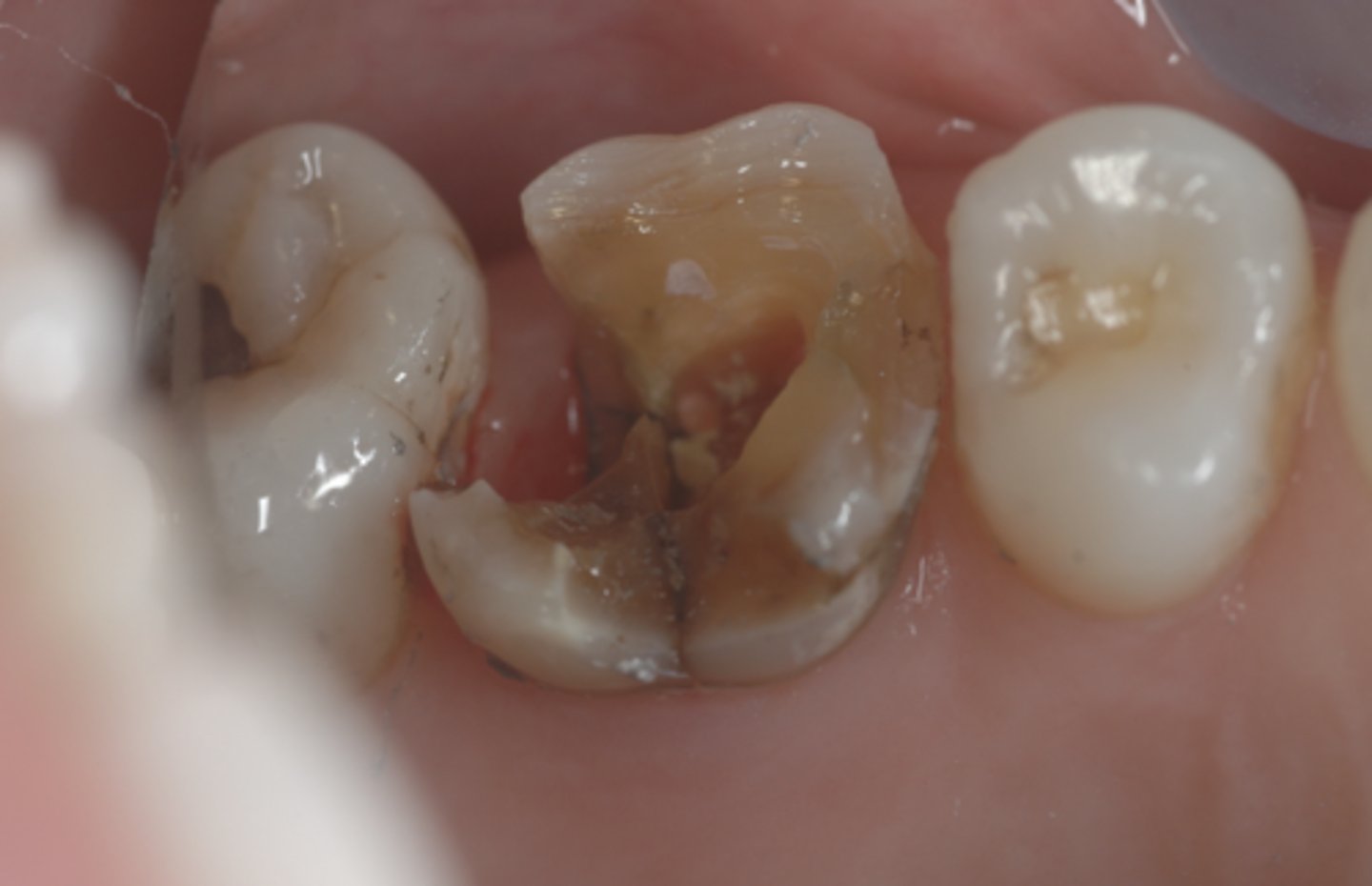
2.0mm
A minimum ferrule height is ____mm.
B) You will place a provisional crown back and inform the patient that an alternative restorative material such as a PFM crown will be utilized. She will have 2 crowns to choose from at her next visit.
Tooth #7 suffers from trauma and had a root canal treatment along with a cast yellow gold post and core. Pt is 24 years old and is very much concerned with her appearance. You did an all ceramic crown for her and the crown turned out to look greyish since the yellow gold shows through your all ceramic crown. The patient is very unhappy with the outcome. Which one would be a possible next step for you?
A) You will tell the patient that nothing can be done.
B) You will place a provisional crown back and inform the patient that an alternative restorative material such as a PFM crown will be utilized. She will have 2 crowns to choose from at her next visit.
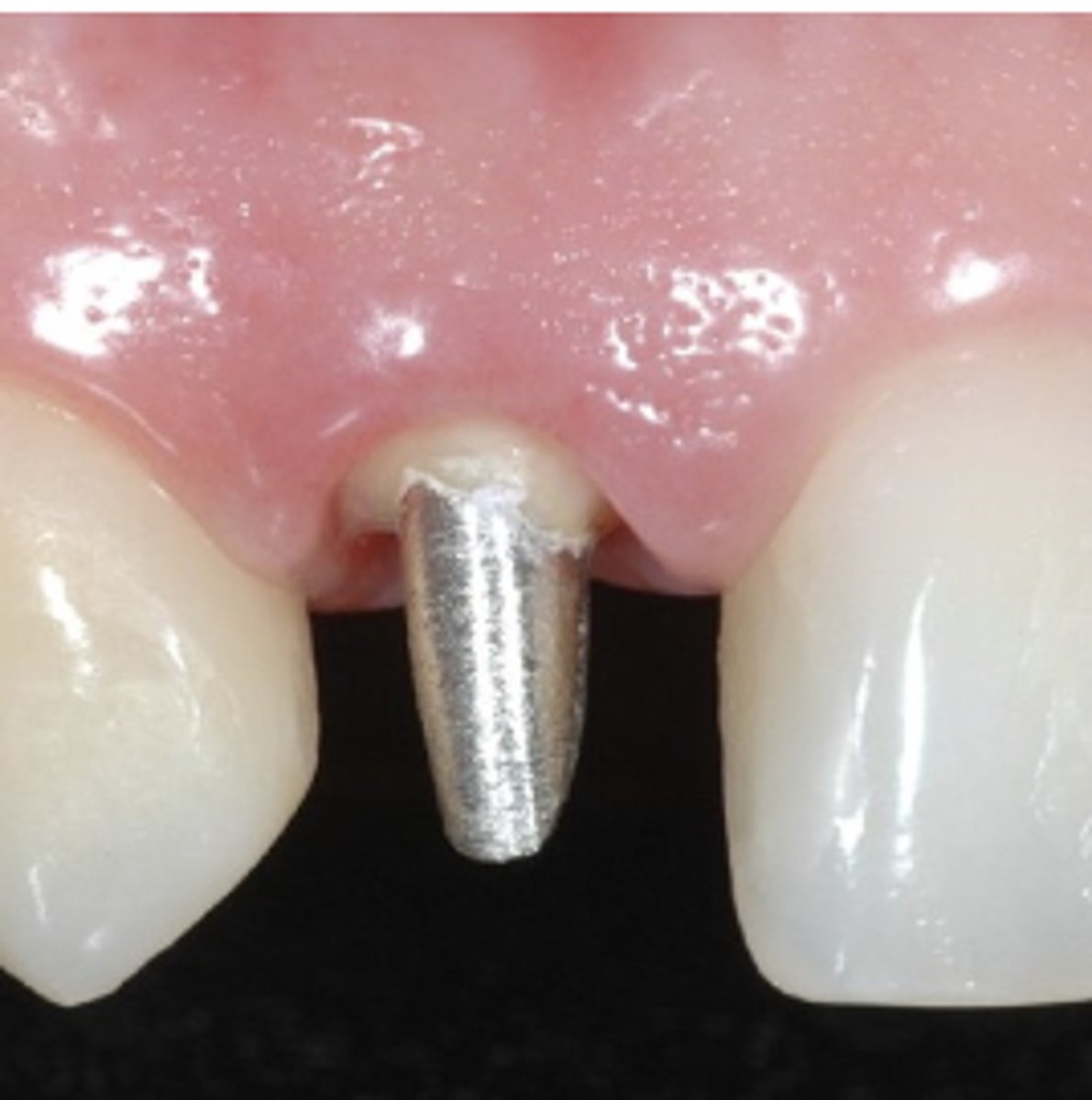
C) Image 3: Root canal treated tooth with limited occlusal access
Following are the reasons that dictate your first treatment option for a crown. Which one is not always true?
A) Image 1: Significant amount of tooth structure loss due to dental caries
B) Image 2: Existing Defective large amalgam restoration
C) Image 3: Root canal treated tooth with limited occlusal access
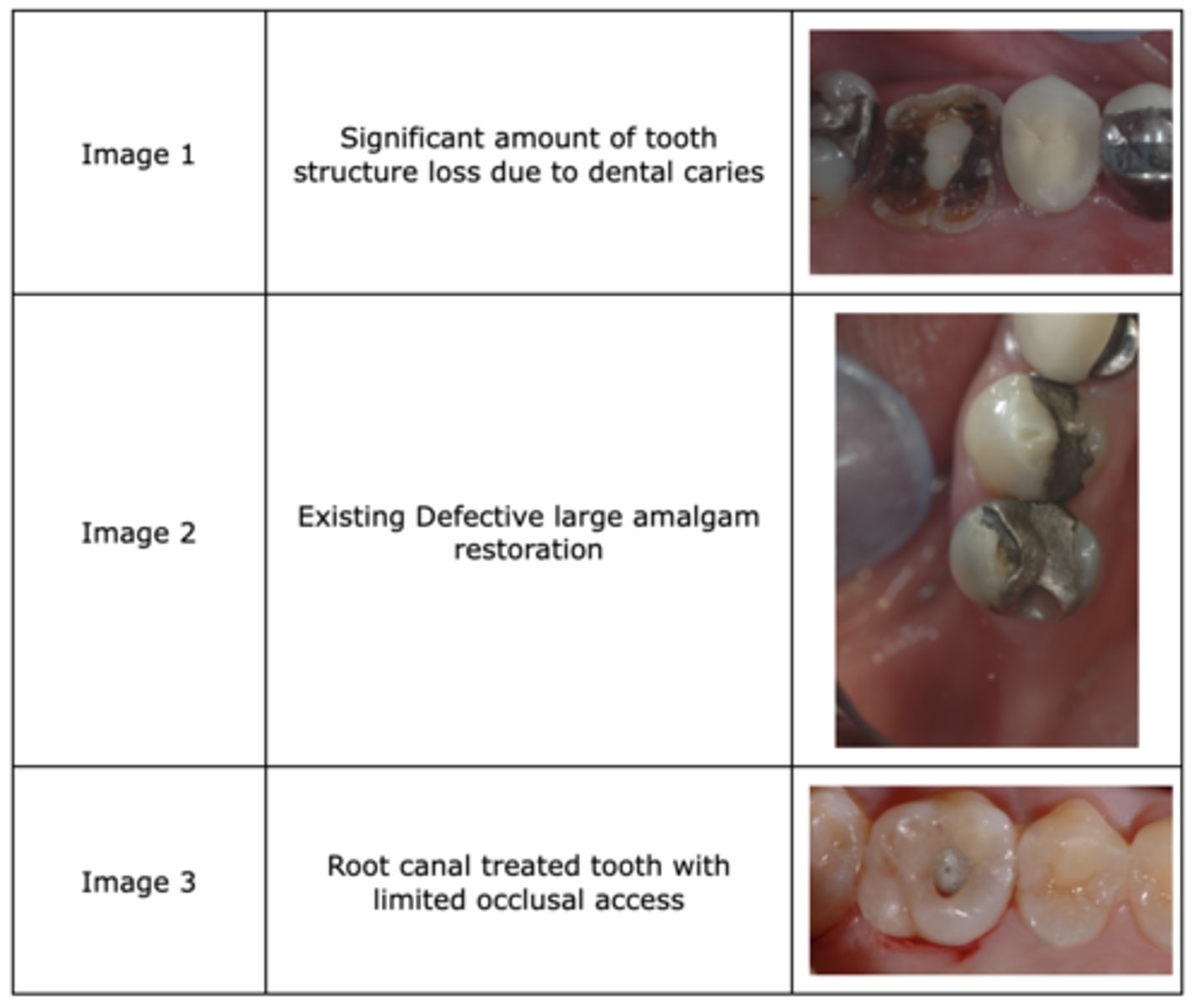
True
T/F: Diagnosis of the problem based on patient's chief complaint should come first before providing a treatment plan.
True
T/F: Diagnosis in Prosthodontics is not only limited to the tooth in question but also to the existing prosthesis.
C) To assess Crown to Root ratio
Tooth #5 suffers from functional cusp fracture. Patient is willing to do a crown. After you examine patient clinically, you go on to view the Periapical radiograph of Tooth #5. What are you looking for?
A) To see the floor of the sinus above apex of Root #5
B) To calculate a working length for a post
C) To assess Crown to Root ratio
B) No, because a maximum acceptable Crown:Root is 1:1
Tooth #5 presents with palatal cusp fracture with Crown:Root = 3:1. Would you plan to make a crown for this tooth?
A) Yes, as long as patient makes a payment
B) No, because a maximum acceptable Crown:Root is 1:1
B) Resin Modified Glass Ionomer Cement
Which cement has hygroscopic expansion that you should be aware when you are using it to cement all ceramic restoration?
A) Resin Cement
B) Resin Modified Glass Ionomer Cement
C) Zinc Oxide Non-Eugenol Cement
D) Self-Adhesive Resin cement
A) Resin and Resin Modified Glass Ionomer Cements
What are the most commonly used definitive contemporary cements?
A) Resin and Resin Modified Glass Ionomer Cements
B) Zinc Phosphate and Zinc Oxide Eugenol Cements
C) Phosphate and Zinc Oxide Eugenol Cements Glass Ionomer and Resin Cements
C) Proximal Contact
The most difficult aspect to remove excess cement from is __________:
A) Buccal aspect
B) Palatal aspect
C) Proximal Contact
C) Rapid working time
Definitive cement should possess these requirements. Which one is INCORRECT?
A) Low solubility
B) Biocompatible
C) Rapid working time
D) High bond strength
True
T/F: Rely X universal is a dual-cured cement and can be used as a stand alone self-adhesive cement for a gold crown or a PFM crown or an all Zir crown, and as an adhesive cement when using with Scotch bond bonding agent for an E-Max crown or porcelain veneer . The dual-cured capability means that it can be set via autopolymerization or light activation.
B) Examine the crown internal surface and place it on the cast to assess fit, contacts, contour and appearance
Your dental assistant informed you that a crown for your patient has returned from the lab, what should you do next?
A) Do nothing just document in your electronic health record that the crown was received.
B) Examine the crown internal surface and place it on the cast to assess fit, contacts, contour and appearance
C) Examine the shade that is correct, if this is the anterior crown. Anything else will be done clinically.
D) Assess the bite only since everything has to be done clinically
A) This is a good idea.
You try-in a crown on Tooth #5 that is a root canal treated tooth. You decide not to anesthetize the affected tooth to allow your patient to provide feedback during occlusal adjustment.
A) This is a good idea.
B) You should always anesthetize every dentition when you are working on it.
A) Do not panic, check interproximal contact using dental floss
When you try-in crown #5 clinically and you found that a PFM Crown #5 is not completely seated on the prepared tooth, what should you
A) Do not panic, check interproximal contact using dental floss
B) Discard the crown and make a new impression
C) Attempt to put more figure pressure to the crown or let the patient bit really hard so that the crown will be seated properly
D) Start adjusting occlusion so that marginal ridges are conformed to the adjacent dentition
A) Adjust the cusp tip of Crown #5 to not have any contact with the opposing tooth#20 during eccentric movement in order to prevent porcelain chipping and not altering the patient's existing occlusal scheme
When you try-in Crown #5, during lateral movement you found that Buccal cusp tip of PFM crown #5 touch distal cusp-arm of an opposing Tooth #20. Patient has a pre-existing canine guidance occlusal scheme. What should you do?
A) Adjust the cusp tip of Crown #5 to not have any contact with the opposing tooth#20 during eccentric movement in order to prevent porcelain chipping and not altering the patient's existing occlusal scheme
B) Do nothing since it will impact appearance of the crown
D) Continue to check Mesial-proximal contact with dental floss and verify proximal fit (marginal integrity) using a Bite wing radiograph. Go through a regular process of crown try-in. If crown #5 fits well and meets the patient's expectation, you will inform the patient that you will have to add porcelain to establish proper distal proximal contact in either the in-house lab or send it back to the original lab prior to do a final cementation.
When you try in an all ceramic crown #5 clinically you found that the distal aspect of this crown has no proximal contact to the adjacent tooth #4. Which one of the following would be your plan of action?
A) Continue to check Mesial proximal contact with dental floss and verify proximal fit (marginal integrity) using Bite wing radiograph. If this crown fits well, you can proceed to do a final cementation and ignore the open distal contact.
B) Stop and send this crown to an in-house lab to add porcelain on the distal aspect before you are doing anything
C) Cancel this appointment and return this crown to the original lab to add porcelain to establish proper distal proximal contact
D) Continue to check Mesial-proximal contact with dental floss and verify proximal fit (marginal integrity) using a Bite wing radiograph. Go through a regular process of crown try-in. If crown #5 fits well and meets the patient's expectation, you will inform the patient that you will have to add porcelain to establish proper distal proximal contact in either the in-house lab or send it back to the original lab prior to do a final cementation.