Ecology Ch.12
 Call Kai
 Learn
Learn Practice Test
 Spaced Repetition
 Match
Match Flashcards
 Knowt Play
1/30

There's no tags or description
Looks like no tags are added yet.
Name | Mastery | Learn | Test | Matching | Spaced | Call with Kai |
|---|
No analytics yet
Send a link to your students to track their progress
31 Terms
What are the types of “predators”?
Herbivores-feed on plants
Carnivores feed on animals
Omnivores- feed on both plants and animals
What are panda's and koalas examples of?
Low competition animals
Pandas can only eat bamboo, but cannot digest the celluose to get a high amount of energy. Therefore, they need to eat a lot of bamboo just to survive. They also have no interest in mating.
Koalas are similar in that they can only eat eucalyptus leaves, but get very little energy out of it.
Describe Carnivores
Carnivores are generalist (polyphagous) - view any meat as edible
Typically higher N than plants
Carnivores adapt to hunt certain prey and bypass certain prey defenses.
Examples of adaptations: Jaws/ teeth, venom, poison, group feeding, persistence hunting (humans)
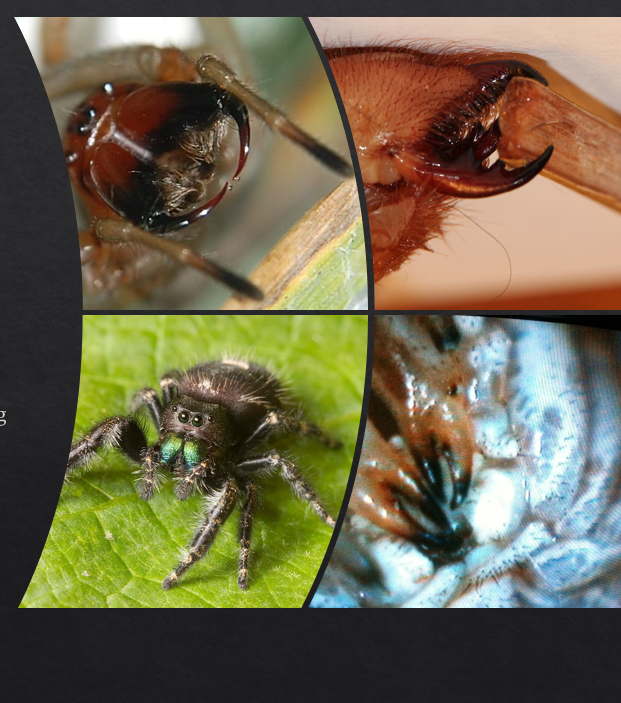
How are Chelicerata adapted for carnivore lifestyle?
Chelicerata is a group that includes horseshoe crabs, sea scorpions, and arachnids
They have legs modified for feeding
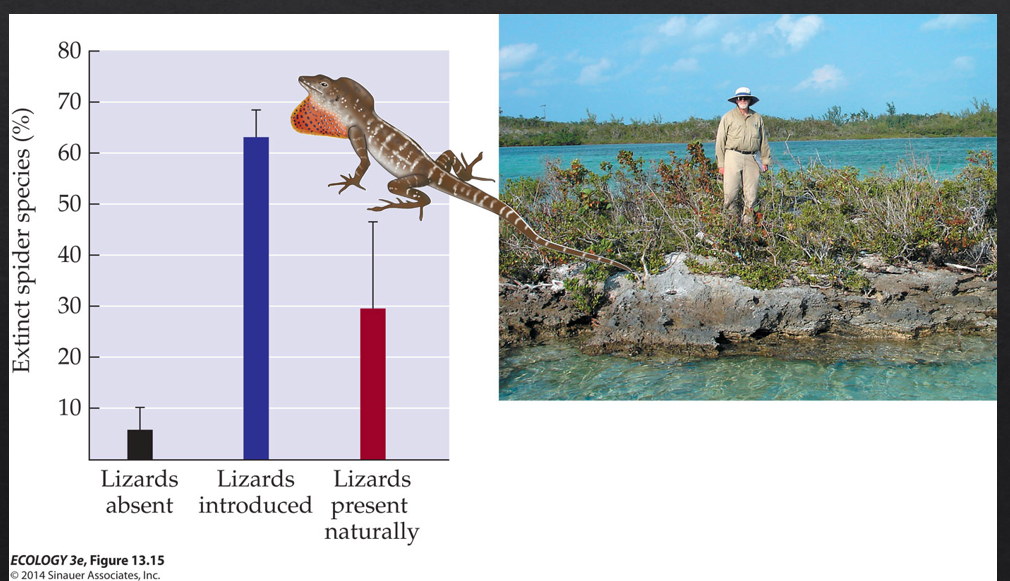
How can lizards preying on spiders alter community structure?
Lizards that are introduced artificially can be strong enough predators to wipe out the spiders that they feed on completely.
Anything that the spiders would have controlled is now released.
This is an example of top down control.
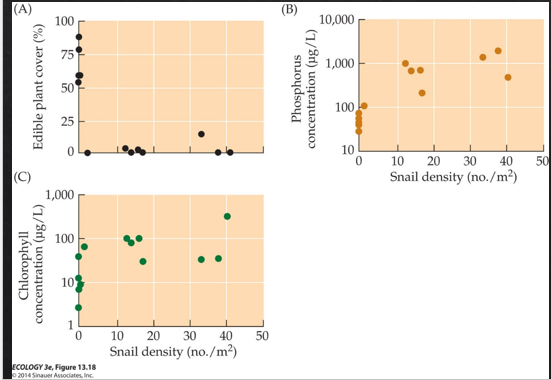
How do snail herbivores structure an aquatic community?
The snail is a grazer that feeds heavily on macrophytes (rooted/large aquatic plants).
When the snail is abundant enough, it eliminates macrophytes, which shifts the whole food web from a macrophyte-based system to a plankton-based system. Phytoplankton fills the autotroph role instead.
This is another example of top down control
How do we know that predation is a strong force?
The answer is that predation shapes morphology, behavior, and physiology across millions of years of evolution.
Prey have evolved specific adaptations to avoid being eaten and reproduce.
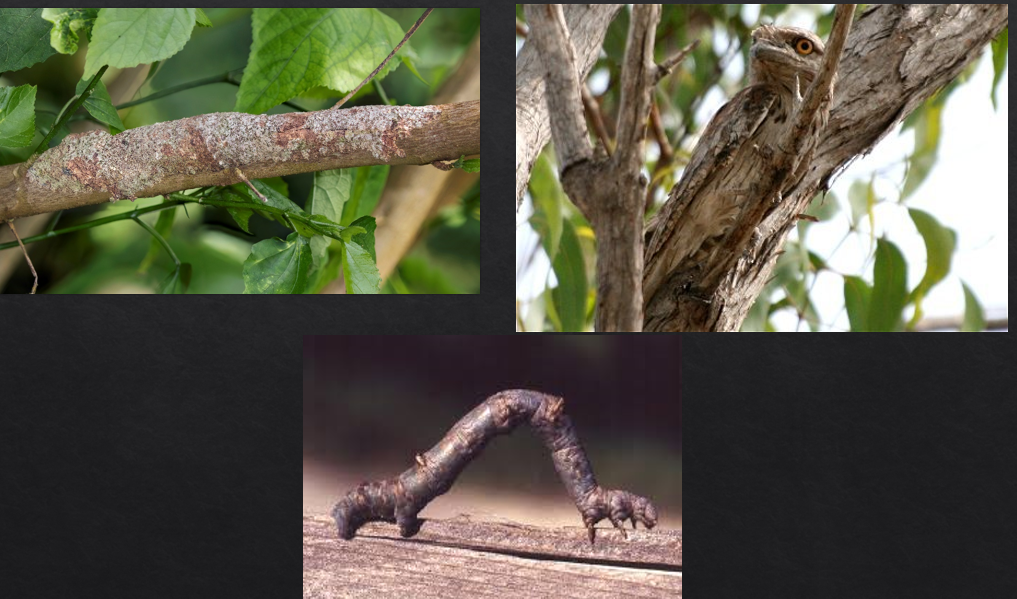
What is Crypsis?
A types of camouflauge.
Crypsis is concealment through resemblance to the background
Used by stick bugs, moths, and owls
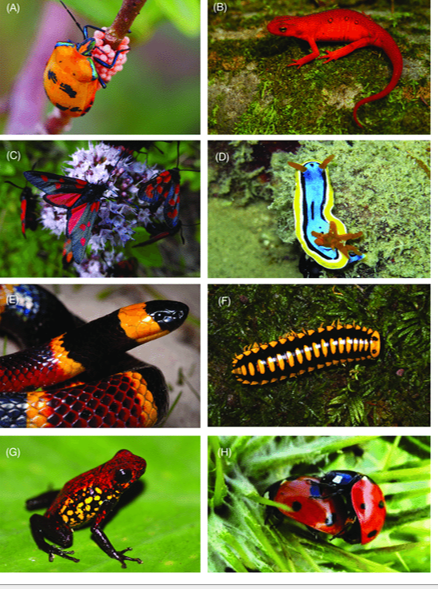
What is Aposematic coloring?
The prey advertises itself with bright warning colors (red, orange, yellow, black) that signal toxicity or distastefulness.
Used by poison dart frogs and monarch butterflies.
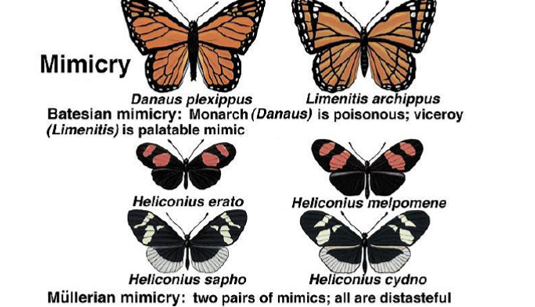
What is mimicry?
the act performed by organisms to resemble other organisms or inanimate objects to gain an advantage in their surroundings
Batesian mimicry: a palatable species (the mimic) copies the warning coloration of a toxic species (the model). The mimic free-rides on the model's predator conditioning. Works best when mimics are rare relative to models — if mimics become too common, predators encounter enough palatable individuals to stop avoiding the pattern.
Müllerian mimicry: two or more toxic species converge on the same warning pattern. Both benefit because predators only need to learn one signal — the cost of "education" is shared across species
What are the types of herbivores and what is the relevance of the Red Queen hypothesis here?
Herbivores are characterized by their degree of dietary specialization:
Monophagous — feeds on one species
Oligophagous — feeds on a few related species
Polyphagous — feeds on many species
The key point is that herbivores have been co-evolving with plants for ~400 million years, so they've had enormous time to evolve around plant defenses.
The Red Queen Hypothesis is central here: plants evolve new defenses, herbivores evolve to overcome them, plants evolve again — a constant evolutionary arms race where both sides must keep "running" just to stay in place. Neither side ever "wins" permanently
What are some defense mechanisms that plants have against herbivores?
Physical: spines and thorns slow feeding rates; leaf hairs (trichomes) interfere with small invertebrate movement
Chemical barriers: saps and resins gum up mouthparts; increased fiber content reduces digestibility and nutritional value
Mutualistic defense: ant-plant mutualisms where plants provide food/shelter and ants physically attack herbivores (e.g., Acacia and Pseudomyrmex ants)
Secondary compounds: alkaloids, tannins, glucosinolates, etc. — chemicals with no primary metabolic role that deter or poison herbivores
Semiochemicals: signaling chemicals, including volatile compounds that attract predators/parasitoids of the herbivore (indirect defense)
What is an induced defense?
A defense that is only present when a threat is present.
Example 1:Mussels use byssal threads to anchor themselves to substrate. When exposed to chemical cues (effluent) from blue crabs, mussels increase byssal thread production — making themselves harder to pry off and eat.
Mussels don’t produce many byssal threats all the time because defense has energetic costs.
Examples 2: when one leaf or plant is damaged, it releases volatiles that prime neighboring leaves (or even neighboring plants) to upregulate their own defenses before being attacked
In what environments would you expect no defense and induced defense over heterogenous defense?
No defense - If predation/herbivory pressure is very low, the cost of maintaining defenses exceeds the benefit — selection won't favor them. Also, if the prey has no natural predators (isolated populations, island species), defenses often erode over evolutionary time.
Induced defense- Heterogeneous or unpredictable environments where predation risk varies — it's better to pay for defense only when the signal says predators are actually present.
What two methods do scientists use to measure the effects of predation?
Predator exclusion: physically remove or block predators using cages, netting, or fencing, then compare prey populations inside vs. outside the exclusion. If prey thrive inside the cage, that's evidence predation was suppressing them. The limitation is that cages themselves can alter microhabitat (shade, airflow, prey behavior) — called a cage artifact.
Tethering: attach prey to a fixed point so they can't flee, then measure survival rates. This isolates the predation rate from prey escape behavior. Limitation: tethered prey can't use normal escape behaviors, so predation rates may be overestimated.
What is the prey equation?
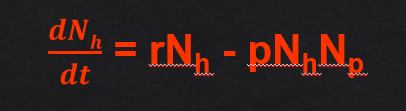
Nh= prey density
Np= predator density
p= predation efficiency p=1 means predator always kills p<1 means that prey sometimes escapes
Nh x Np = predator encounter rate
r = rate of population increase
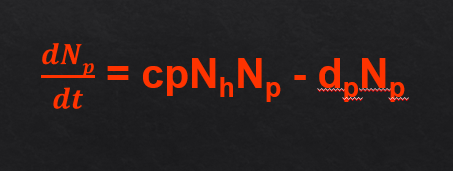
What is the predator equation?
rate of prey capture = pNhNP
c = conversation efficiency( how efficiently capture prey are converted into predator offspring)
Therefore, predator births = cpNhNp
Predator deaths = dNp
What is the Lotka Volterra predator prey model?
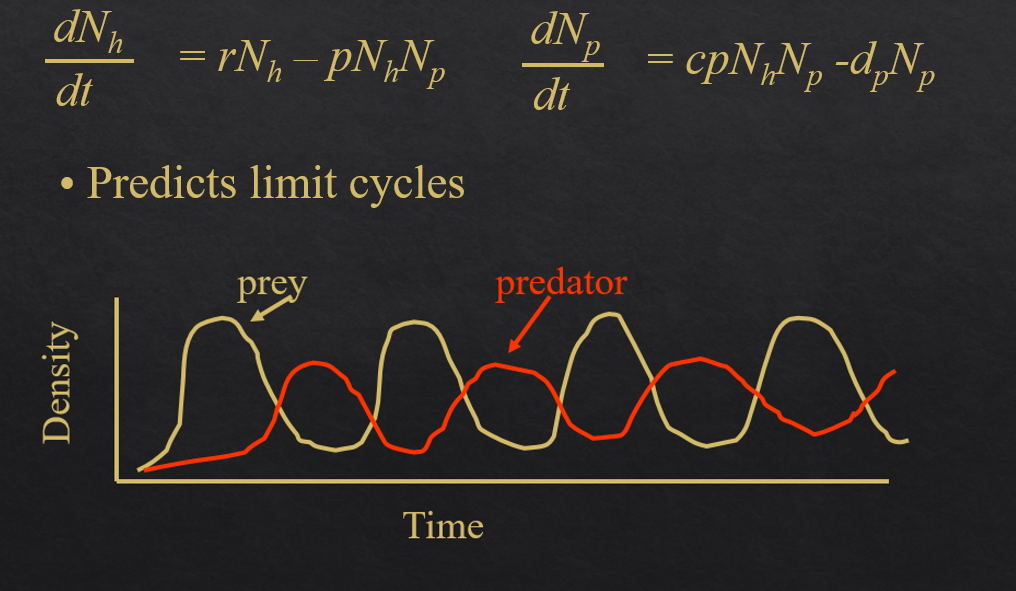
Combines the predator and the prey equations together
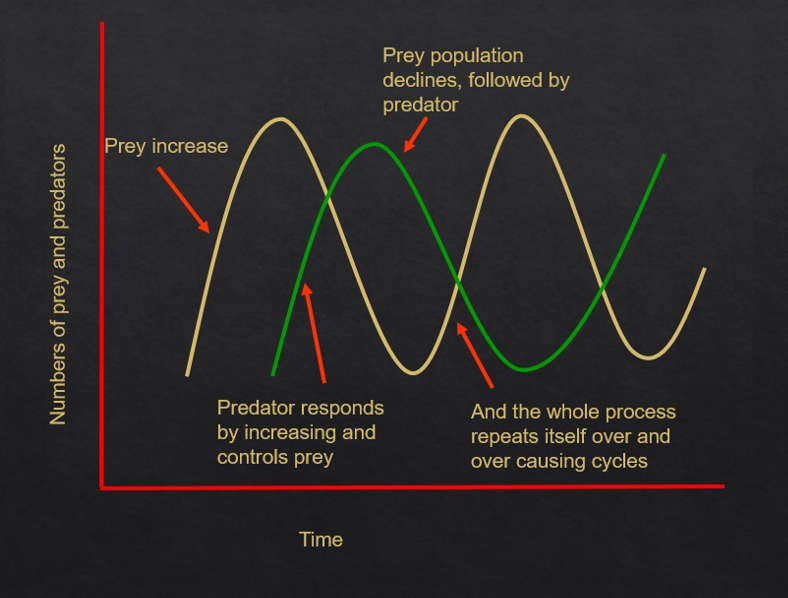
What the model predicts: coupled oscillations. Prey rise → predators rise (more food) → prey fall (overhunted) → predators fall (starving) → prey rise again. The two populations cycle perpetually out of phase with each other
What is the stable limit cycle?
The repeated oscillations between predator and prey populations.
What was the Gause Lab test with paramecium?
Gause used Paramecium as prey in controlled lab cultures to test the model's predictions.
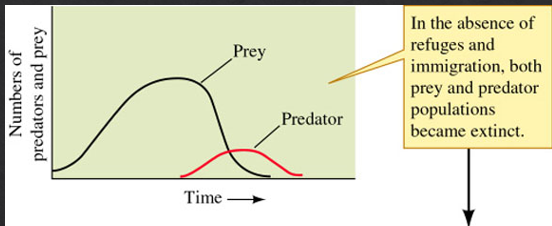
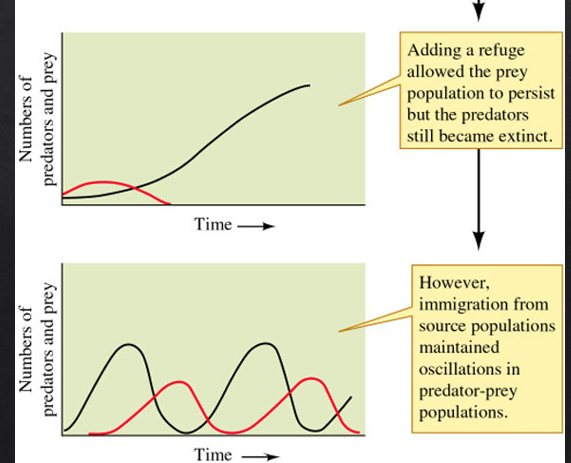
The result in simple lab environments: predators drove prey to extinction, then went extinct themselves — no sustained oscillations. This contradicts the model's prediction of perpetual coexistence.
The lab was too simple; it lacked the spatial structure and refuges that real ecosystems have.
What happened when Gausse added a refuge and immigration?
Oscillations were maintained. However, refuge alone is not enough to sustain oscillations. It merely maintained it.
What is the lynx and the hare?
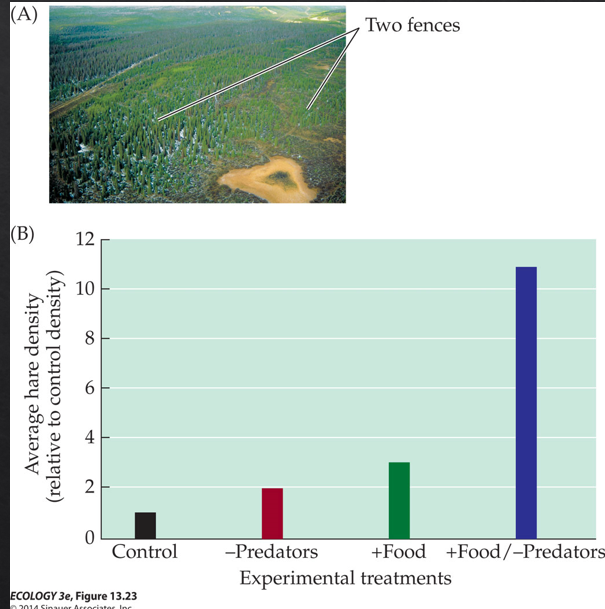
The most famous real-world example of predator-prey oscillations, drawn from Hudson's Bay Company fur trade records spanning and an example of the limitations of the Lotka Voltera predator prey model.
Hare populations cycle with a ~10-year period, and lynx populations lag behind by about 1–2 years — exactly what the L-V model predicts in terms of phase offset.
However, the hare cycle is not purely driven by lynx predation. hares overgraze their food supply at peak densities, and this food depletion contributes to the crash independently of lynx.
he L-V model only includes predation as the driver of prey decline, but the snowshoe hare data shows that food supply from below (bottom-up) interacts with predation from above (top-down)
What are the two stabilizing mechanism?
Prey refuges
habitat heterogeneity - the number of habitats
predator functional response
predator aggregation response
predator interference
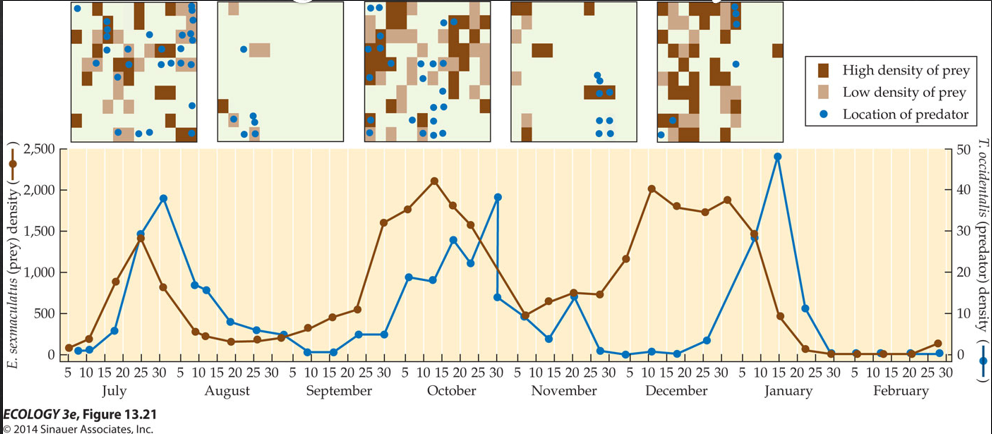
What happened Huffaker’s 1958 experiment
Phytophagous mite- the prey feed on citrus)
Predatory mite- the predator
With just a few oranges, the prey mice would expand quickly, then quickly be driven to extinction by the predator mites
Then the predator mites would die off as well
When Huffaker increased the environment to 252 oranges and balls( more heterogeneity)
increased barriers to predator dispersal
increased prey dispersal ability (breeze)
The results were sustained oscillations and coexistence of predators and prey.
What is a predator’s functional response?
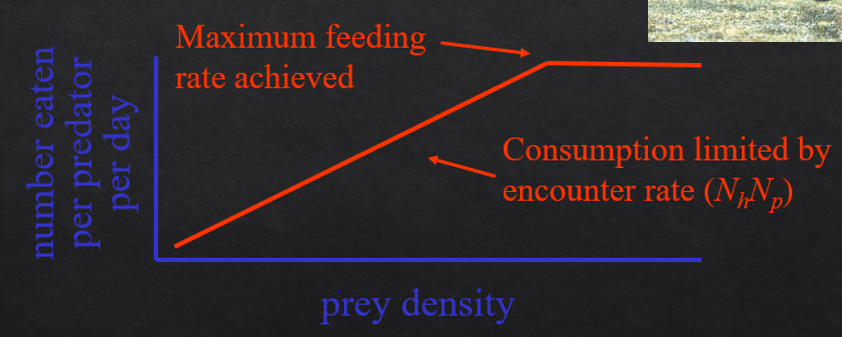
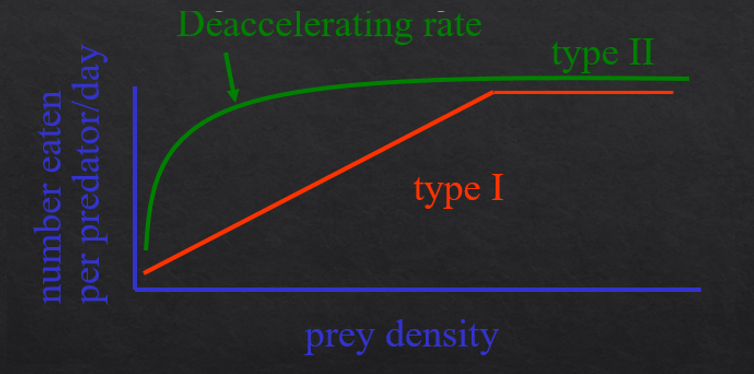
describes how the number of prey consumed per predator changes as prey density increases
What is a type one functional response?
Consumption increases linearly with density
Based on random encounters used in the Lotka Voltera model
Consumption is limited by the prey encounter rate
Not really representative of nature ( ignores biological constraints like sleep, satiation, time constraints)
What is a type two functional response?
Consumption increases with prey density, but plateaus because of satiation or handling time
hyperbolic curve
Does not stabilize prey
Observed in many animals
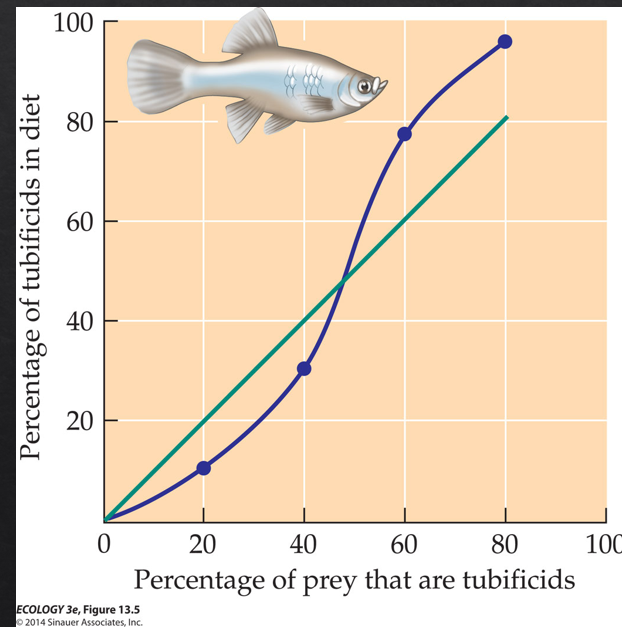
What is a type three functional response?
driven by search image formation — a learning process where predators become more efficient at detecting and capturing a prey type the more frequently they encounter it.
most effective at hunting the most common prey
stabilizing
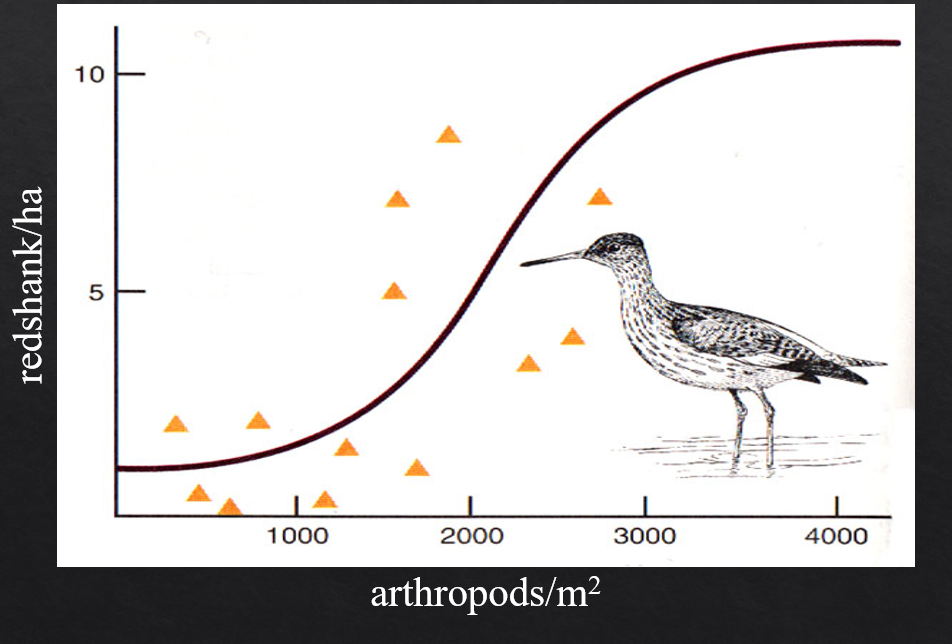
What is predator aggregative response?
when predators physically move to and concentrate in areas with the highest prey density.
Density dependent selection by letting less dense patches survive
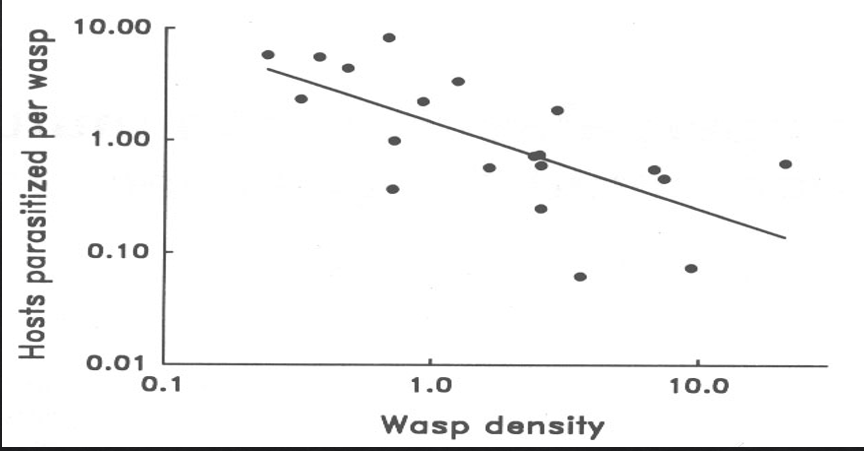
What is predator interference?
When predator density gets high, predators start interfering with each other — competing for the same prey, defending territories, or simply getting in each other's way.
density dependent
Summarize how predator and prey coexist
Low prey density → predators are inefficient (no search image, no aggregation) → prey population grows and recovers
High prey density → predators become more efficient (search image, aggregation) → prey population is suppressed
High predator density → predator interference kicks in → each predator is less effective → prey aren't driven to extinction