2.1-2.2 AP Calc AB
0.0(0)
Studied by 23 people Call Kai
 Learn
Learn Practice Test
 Spaced Repetition
 Match
Match Flashcards
 Knowt Play
Card Sorting
1/25

Earn XP
Description and Tags
Last updated 9:34 AM on 9/21/22
Name | Mastery | Learn | Test | Matching | Spaced | Call with Kai |
|---|
No analytics yet
Send a link to your students to track their progress
26 Terms
1
New cards
1
How many points of a function does a tangent touch?
(2.1)
(2.1)
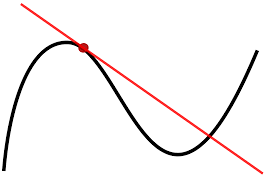
2
New cards
Perpendicular
A normal line is ______ to the tangent line.
(2.1)
(2.1)
3
New cards
f prime of c
How to read f'(c)
(2.1)
(2.1)
4
New cards
Instantaneous
The tangent looks at the _____ rate of change, which requires the limit. So, it becomes lim(x→c) f(x)-f(c)/x-c.
(2.1)
(2.1)
5
New cards
Y-Y1 = m(X-X1)
Point slope format
(2.1)
(2.1)
6
New cards
y-f(c) = f'(c)(x-c)
Tangent equation. f'(c) is the slope, a.k.a the derivative.
(2.1)
(2.1)
7
New cards
y-f(c) = -1/f'(c)(x-c)
Normal line equation. Make sure that when you are simplifying a normal line, you simplify it beginning from this format. DO NOT take the simplified version of the tangent line and just opposite-reciprocate the slope.
(2.1)
(2.1)
8
New cards
opposite, reciprocal
Perpendicular lines have ____ and _____ slopes.
(2.1)
(2.1)
9
New cards
Orthogonal line
Another name for a normal line.
(2.1)
(2.1)
10
New cards
Physical
Average velocity is a _____ example of rate of change.
(2.1)
(2.1)
11
New cards
Average Velocity
Change in distance/change in time (often portrayed as△s/△t). You hardly ever use this.
(2.1)
(2.1)
12
New cards
Instantaneous Velocity
You take the limit of the rate of change at specific time. So, lim (t→t0)△s/△t or lim (t→t0) f(t)-f(to)/t-t0.
(2.1)
(2.1)
13
New cards
Lower-bound approximation
In a table, in order to approximate the slope/derivative, you can take the rate of exchange (rise/run) of the coordinate you are looking for and the one above (the next big one).
(2.1)
(2.1)
14
New cards
Upper-bound approximation
In a table, in order to approximate the slope/derivative, you can take the rate of exchange (rise/run) of the coordinate you are looking for and the one below (the one before it).
(2.1)
(2.1)
15
New cards
Average approximation
In a table, in order to approximate the slope/derivative, you can take the slopes you found for both the upper and lower bound and average them by summing the slopes and dividing them by two. This is the best of all approximations.
(2.1)
(2.1)
16
New cards
lim(x→c) f(x)-f(c)/x-c
Form 1 of a derivative. Used whenever you have a known x-value.
(2.2)
(2.2)
17
New cards
lim(h→0) f(x+h)-f(x)/h
Form 2 of a derivative. Used whenever you don't have any known values other than the function.
(2.2)
(2.2)
18
New cards
0
Horizontal lines have a slope of ___. So, in f(x) a horizontal line means that the derivative of those points is 0, so f'(c) has a root at these points.
(2.2)
(2.2)
19
New cards
estimating
In order to construct the rest of a f'(c) graph using f(c) only is by _____ the slope between points, you can do this through rise/run. Remember, the x-coordinates of f'(c) and f(c) are the same, but for f'(c) the y-coordinate means the derivative of f(c) at that x-point.
(2.2)
(2.2)
20
New cards
Continuity
Differentiability implies ____. So, if a function is differentiable it MUST BE continuous.
(2.2)
(2.2)
21
New cards
Differentiability
Continuity does not imply_______. So, if a function is continuous IT MAY be differentiable or IT MAY NOT.
(2.2)
(2.2)
22
New cards
Domain
The _____ of f(c) is the same as the domain of f'(c), but you must exclude the values that cause the limit of f(c) not to exist.
(2.2)
(2.2)
23
New cards
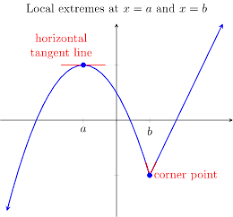
Corner
One of the three ways for lim(x→c) f(x)-f(c)/x-c not to exist. Happens when the lim approaching from the left does not equal the limit approaching from the right, which creates a ____ at (c, f(c)).
(2.2)
(2.2)
24
New cards
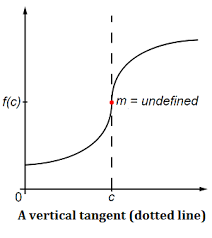
Vertical
One of the three ways for lim(x→c) f(x)-f(c)/x-c not to exist. Happens when the limits both equal to ∞ or -∞. This creates a _____ tangent line, which is undefined.
(2.2)
(2.2)
25
New cards
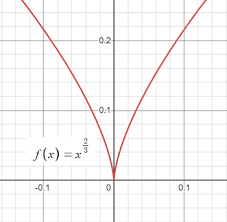
Cusp
One of the three ways for lim(x→c) f(x)-f(c)/x-c not to exist. Happens when one side of the limit is going to ∞ while the other is going to -∞. This creates a ___ and a vertical tangent line at (c, f(c)). Usually happens when an exponent is a fraction.
(2.2)
(2.2)
26
New cards
Non-differentiable
When given a piecewise function,
1. Determine what f(c) is.
2. Check that both sides of the limit exist.
If these apply and are correct, then the function is continuous. However, if they do not, then the function is not only discontinuous but also _____.
(2.2)
1. Determine what f(c) is.
2. Check that both sides of the limit exist.
If these apply and are correct, then the function is continuous. However, if they do not, then the function is not only discontinuous but also _____.
(2.2)