Bio1110 Community Structure + Species Diversity + Trophic structure and community dynamics + Disturbance
 Call Kai
 Learn
Learn Practice Test
 Spaced Repetition
 Match
Match Flashcards
 Knowt Play
1/86

There's no tags or description
Looks like no tags are added yet.
Name | Mastery | Learn | Test | Matching | Spaced | Call with Kai |
|---|
No analytics yet
Send a link to your students to track their progress
87 Terms
What is a community?
an assemblage of all the populations of organisms living close enough together for potential interactions, here different species affect each other’s abundance and distribution
What are interspecific interactions?
the relationships and "dealings" between individuals of different species within a community
What are the main types of interspecific interactions?
Competition, Predation, Herbivory, Parasitism, Mutualism, and Commensalism
Which organisms benefit from the Competition interspecific interactions?
both are harmed, both species take resources from the other, ex. a grass and a wildflower loses water, nutrients, and access to sunlight that the other takes
What is an ecological niche?
all biotic and abiotic resources used by a species in its environment, like food, habitat, nesting materials, climate, etc., ex. each anole species uses a different part of a forest canopy for feeding, results in organisms that have adaptations to specific niches even those that are technically living in the same tree
What is a fundamental vs a realized niche?
fundamental = the entire set of conditions (temperature, food sources, habitat) under which a population can theoretically survive and reproduce in the absence of interference from other species
Realized = the actual set of conditions and resources a species uses after accounting for biotic interactions, such as competition and predation (so it includes abiotic and biotic factors)
What is the competitive exclusion principle in ecology?
states that two species competing for the exact same limited resources cannot coexist at constant population values (because competition leads to exclusion, one species will have some sort of advantage over the other and will dominate)
What is interspecific competition?
an ecological interaction where individuals of different species compete for the same limited resources in an ecosystem, is either a win-lose or lose-lose situation
How does interspecific competition lower carrying capacity?
because it reduces the total amount of available resources that a single species can claim, when a competitor enters the mix, that environment effectively "shrinks" for the original species
How does interspecific competition work as a selective pressure?
by favoring individuals that are best equipped to survive the presence of the competitor, When resources are limited, individuals with traits that minimize direct competition or maximize resource extraction are more likely to survive and pass those genes to the next generation
What is resource partitioning?
evolutionary strategy where species living in the same habitat "divide" limited resources to avoid direct competition
What is character displacement?
evolutionary process where two similar species develop distinct physical or behavioral differences to reduce competition when they live in the same geographic area
What are allopatric populations?
groups of the same species (or closely related species) that live in different, non-overlapping geographic areas. Because they are physically separated, there is no gene flow between them, and they do not compete for the same local resources
What are sympatric populations?
groups of different species (or different populations of the same species) that occupy the same geographic area. Unlike allopatric populations, which are separated by physical barriers, sympatric populations frequently encounter one another and must share the same environment and resources
Which organisms benefit from the Predation interspecific interactions?
one animal is harmed while the other benefits, the predator benefits, usually ends with the prey dying, ex. arctic foxes benefit from eating lemmings while the lemmings lose the opportunity to reproduce
Which organisms benefit from the Herbivory interspecific interactions?
one harmed and one benefitted, the herbivore benefits while the plant loses biomass, ex. bison benefits from eating grass while the grass loses biomass that is eaten
Which organisms benefit from the Parasitism interspecific interactions?
One harmed and one benefits, ex. tapeworms benefit from absorbing nutrients in human intestines while the human loses nutrients
Which organisms benefit from the Mutualism interspecific interactions?
Both benefit, ex. flowers gain pollination while the bees gain nectar and some pollen
Which organisms benefit from the Commensalism interspecific interactions?
One gains while the other is unaffected (rarest), ex. egrets benefit from insects stirred up by cattle when they walk through grass, while the cow is unaffected
Fundamental niches are limited by only …
abiotic factors like climate or the species own physiological tolerance, the fundamental niche is usually the “dream” scenario that represents the full range of resources a species is capable of using
Just Competition =
an overlap in niches between organisms, includes inter and intraspecific, results in usually a negative interaction for both species, lowers carrying capacity
Current niches are the …
ghosts of competition past
There are often more similarities in population of …
closely related species that are allopatric then sympatric because they did not need to adapt in consideration of more competitors
Organisms have both a fundamental and …
realized niche
What is species richness?
number of different types of species
What is species abundance?
proportional representation of each species in a community
Is an organism more vulnerable to extinction in a community with high diversity or low diversity?
They are more vulnerable in low diversity environments, because if there is more diversity then there will be more resistant to invasion and harm
What is a monoculture? What are the benefits to monoculture? What are the drawbacks?
a giant field where we plant one species, intensive and needs a lot of care, drawbacks = if disease enters the population they are likely to all get wiped out, benefits = efficient and high output for farms, requires a lot of intensive care, monocultures have high parasite, pathogen, and herbivore loads
richness and relative abundance affect …
pathogen spread
Disease spreads more easily when there is …
dominantly one species, there are less chances that one will be immune to the disease when there is low diversity
What is a foundation species?
good competitors, contribute to habitat and food, are often in large size, high abundance, things like dominant trees or algal species or dominant desert shrub
Examples of foundation species
coral reef, red mangroves, pine forest, or kelp forest
How can a foundation species impact its community?
by forming the habitat itself like coral or moderating environmental stress like in marsh grasses regulating temperature, providing resources, can add to biodiversity
What is an ecosystem engineer?
creates or dramatically alters their biotic and abiotic environment
How can an ecosystem engineer impact its community?
through allogenic engineering (changes non-living or living materials to physically change the environment) ex. Beavers cutting down trees and building dams
Or through autogenic engineering (change the environment with their own physical structures) ex. coral
A dominant species is …
the most abundant
How does energy and chemicals move through an ecosystem?
primary producers harness energy from the sun and fix inorganic carbon into organic molecules, and then animals eat the primary producers, taking energy and carbon, photosynthesis provides food for photoautotrophs and the rest of the ecosystem
What is a photoautotroph?
an organism that uses light as its energy source and carbon dioxide (CO2) as its primary carbon source to "self-feed"
What is a chemoautotroph?
an organism that produces its own organic molecules using energy derived from inorganic chemical reactions rather than sunlight
What is a chemoheterotroph?
an organism that must consume organic molecules for both its energy and its carbon source
What is a primary producer?
an organism that captures energy from the sun or chemical sources to create organic molecules from inorganic ones, Plants! - usually
What is a primary consumer?
an organism that occupies the second trophic level in a food chain. These organisms obtain their energy and nutrients by eating primary producers
What is a herbivore?
type of chemoheterotroph that specializes in eating living plant tissues or algae, includes a lot of secondary consumers
What is a carnivore?
In the BIOL 1110 curriculum, a carnivore is a chemoheterotroph that derives its energy and nutrient requirements from a diet consisting mainly or exclusively of animal tissue - commonly a secondary consumer as well - can definitely be others
What is an omnivore?
a chemoheterotroph that has a flexible diet, obtaining energy and nutrients from a variety of sources, including both primary producers (plants/algae) and consumers (animal tissue) - jumps around what trophic level it sits at (Humans do this!!)
What is a detritivore?
a chemoheterotroph that obtains its nutrients by consuming detritus—non-living organic matter such as leaf litter, animal remains, and feces, the recyclers
What is a decomposer?
(also known as a saprotroph) is an organism that breaks down dead or decaying organic matter. Unlike consumers that eat their food, decomposers perform external digestion
What does Trophic structure describe?
the transfer of energy and organic molecules through the community
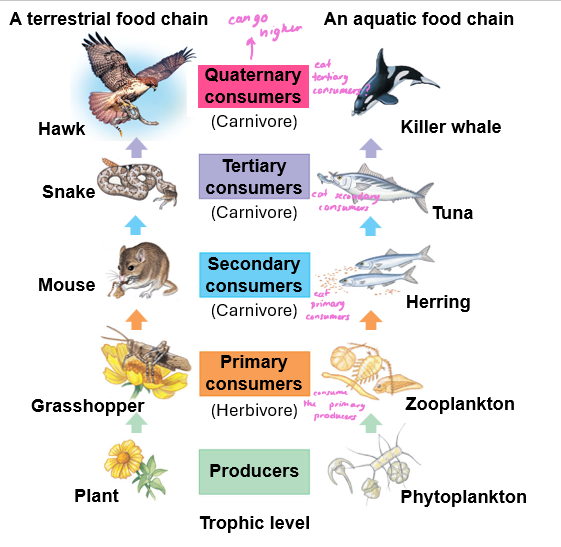
What is the food chain?
the path of chemical energy through all trophic levels
What is the primary source of energy for most ecosystems?
sunlight
What type of autotroph is the producer in most aquatic ecosystems?
photoautotrophs specifically phytoplankton (algae)
What type of autotroph is the producer in most terrestrial ecosystems?
Plants like trees
What is a trophic level?
a specific position an organism occupies in a food chain or food web, determined by its primary source of energy
What is a food chain vs a food web?
A food chain is a simplified, linear sequence that shows a single path of energy flow. It tracks energy from a primary producer up to a final apex predator
A food web consists of many interconnected food chains. It is a more realistic representation of an ecological community because most organisms are generalists or omnivores that eat at multiple trophic levels
What limits the length of a food chain?
the energy supply
What does an energy pyramid show?
(also called a trophic pyramid) is a graphical representation designed to show the flow of energy between trophic levels in an ecosystem
What is the percentage of energy in available visible light that is actually captured by producers?
1% say we get 1,000,000 kcal of sunlight then primary producers get 10,000 kcal
What percentage of energy is generally passed from one trophic level to another throughout all other transfers?
10% - the ten percent rule
Where does the rest of the energy that’s lost during the 10 percent rule go?
lost as heat during cellular respiration or spent on life processes (happens because of cellular respiration, indigestible material or the material is not eaten)
What is usually the highest level of a food chain?
the Apex Predator (also known as the Top Carnivore or Quaternary/Quinary Consumer)
At what trophic level would you expect to find the most biomass?
the primary producers
Where would you expect to see the least amount of biomass?
the top predator/the apex/Quaternary depending on how many levels there are
Explain the inverted biomass pyramid of some aquatic ecosystems
occurs when the biomass of the primary consumers (the herbivores) is actually greater than the biomass of the primary producers, there are higher turnover rates
What is a keystone species?
species whose impact on community structure is larger than its biomass or abundance, one of which being Pisaster (sea stars) from an intertidal community, if a keystone species is removed, the ecosystem often undergoes a dramatic shift, frequently leading to a collapse in biodiversity
Many keystone species are what type of predators?
apex, they maintain the community structure by keeping the populations of lower-level consumers in check, ex. sea otters keeping sea urchin populations under control, grey wolves in Yellowstone
Bottom up control is …
when the community is mainly affected by the biomass at lower trophic levels, the nutrient supply or the availability of food at lower trophic levels limits the abundance of organisms at higher trophic levels
In the bottom up control community, producers are limited by …
inorganic nutrients in the soil, if inorganic nutrients was added, there would be an increase in everything else and if predator abundance changers it shouldn’t extend down the to lower trophic levels
Top down control is …
when the abundance of organisms at higher trophic levels control the abundance of organisms at lower trophic levels, ex. predation
A trophic cascade occurs when predators …
indirectly affect the abundance of organisms more than two trophic levels down, creates an every-other effect of ± outcomes, changes abundance of predators DOES impact producers
What three things could happen when transferring energy
the biomass can’t be absorbed (cannot be moved to the next trophic level - lost as feces), growth (new biomass in secondary production - can be passed to the next level), or the biomass is burned through in cellular respiration to maintain the status quo, ultimately leaves as heat and cannot be passed to the next trophic level - endotherms use even more!)
What systems are sometimes exception to the each trophic level has less biomass then the one before it rule?
aquatic ecosystems
In a food web, the arrows point towards who …
eats you, some species can fall at different trophic levels like omnivores who are “nonexclusive” consumers
What is a disturbance in a community?
events that change communities by removing organisms from it or altering resource availability, loss of old communities and results in new opportunities
What are the consequences of a disturbance?
The consequences are rarely "all or nothing"; instead, they trigger a series of predictable ecological shifts, 1. changes in species richness 2. alteration of selection strategies (environment favors r-strategists) 3. Transition to ecological succession (primary or secondary) 4. Biomass and nutrient shifts (most immediate consequence is the reduction of standing biomass)
Define ecological succession
change in the composition of a community over time
What is primary succession?
colonization of a lifeless area (no soil), pioneer species make this possible/easier
What is secondary succession?
colonization of an area that previously had life following a disturbance
What kind of disturbances would result in primary succession?
cataclysmic or geological in nature, as they must completely remove or cover any pre-existing biological legacy (seeds, roots, and organic soil), strips the environment down to nothing, like volcanic eruptions, glacial retreats, etc.
What kind of disturbances would result in secondary succession?
the disturbance destroys the existing vegetation but leaves the soil and seed bank intact, ex. forest fires, abandoned farmland, flooding, etc.
What is a pioneer species?
the first type of organism to colonize a bare or disturbed area, initiating the process of ecological succession, ex. lichens, mosses, cyanobacteria
What is an invasive species?
introduced to a new environment, they colonize and dominate the community, they lack predators and pathogens and/or can be strong competitors, ex. Burmese python, Kudzu in southeastern US, zebra mussels, chestnut blight
Why are invasive species a threat to biodiversity?
because they can disrupt trophic levels and/or ecosystem roles of the natives, become a problem when they are not mitigated by a predator/pathogen
How can pathogens affect community structure?
if a pathogen wipes out a dominant competitor, it "releases" resources, if a pathogen attacks a species that provides habitat (a foundation species), the physical structure of the community changes, when a pathogen targets a keystone species or a foundation species, the effects ripple through every trophic level, pathogens can stall or accelerate ecological succession
Why are pathogens a problem when they enter a new population?
when a pathogen enters a new population—often called a novel pathogen or an "emerging infectious disease"—it is a major ecological problem because the natural "checks and balances" that keep ecosystems stable are missing
What happens when pathogens attack K-strategists?
pathogens often favor organisms with high reproductive rates, meaning they are less effective against r-strategists because they produce more offspring so they have a higher chance of resulting in genetic mutations that help them survive an outbreak, because K-strategists have long lifespans and low reproductive rates, a major disease outbreak can be devastating to their population
Primary and secondary succession is typically colonized by who first?
r-strategists, K-strategists colonize later once the habitat becomes more stable
As r-strategists recolonize during succession, K-strategists like pines may colonize soon creating an understory, then K-strategists like oaks may eventually outcompete the pines and dominate until another disturbance, in that way, each community facilitates …
the next community, each collection of primary producers has corresponding consumers associated with them