Class 12: Groups and Teams
 Call Kai
 Learn
Learn Practice Test
 Spaced Repetition
 Match
Match Flashcards
 Knowt Play
1/39

There's no tags or description
Looks like no tags are added yet.
Name | Mastery | Learn | Test | Matching | Spaced | Call with Kai |
|---|
No analytics yet
Send a link to your students to track their progress
40 Terms
Organizational Behavior is a field of study
individuals: personality, values, motivation, creativity, perception…
Groups: teams, decision-making, conflict, negotiation
Organizations: power, structure, design, complementaries, and links to strategy
Why study teams
work today is increasingly interdependent — few tasks can be done alone
Complex problems need diverse expertise and collaboration
Teams bridge divisions and roles, combining skills and perspectives
Studying team helps us understand how to coordinate effectively
What do teams do
solve coordination and communication challenges formal structures can not
Act as linking mechanisms for knowledge, resources, and problem-solving
Enable boundary-crossing collaboration and innovation
But effective teams are only as god as their group dynamics
Team effectiveness: is a function of quality of inputs, team design, and most important, team dynamics
task performance
Viability (member learning)
Member satisfaction
Team dynamics drive whether a group thrives or struggles
We love teams because of synergy
they bring together strengths and ideas
They help solve problems that individuals can’t alone
Working together can achieve Moore Han working separately
We hate teams because of friction
they can be slow or frustrating to coordinate
Conflicts or unequal effort can drain motivation
Decisions can take longer or feel less satisfying
The goal of organizational behavior
Is to promote synergy and counteract issues with thoughtful team design and team dynamics
Team Development Stages (Tuckman 1965)
Forming
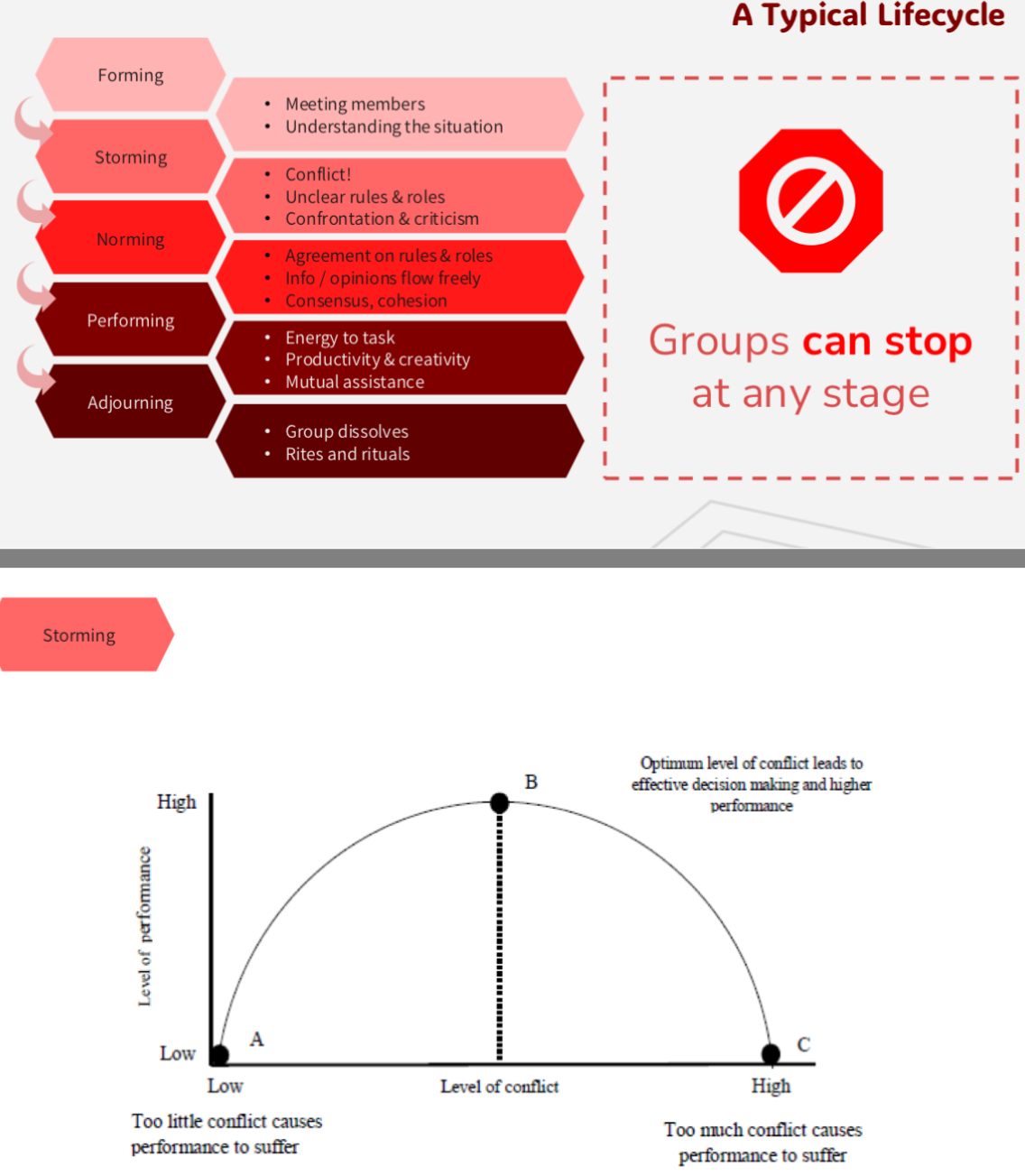
Storming
Norming
Performing
Adjourning
Team design: size, composition, purpose, roles, join design
Team dynamics: synergy, social loafing, groupthink, cohesion, decision making, communication, conflict
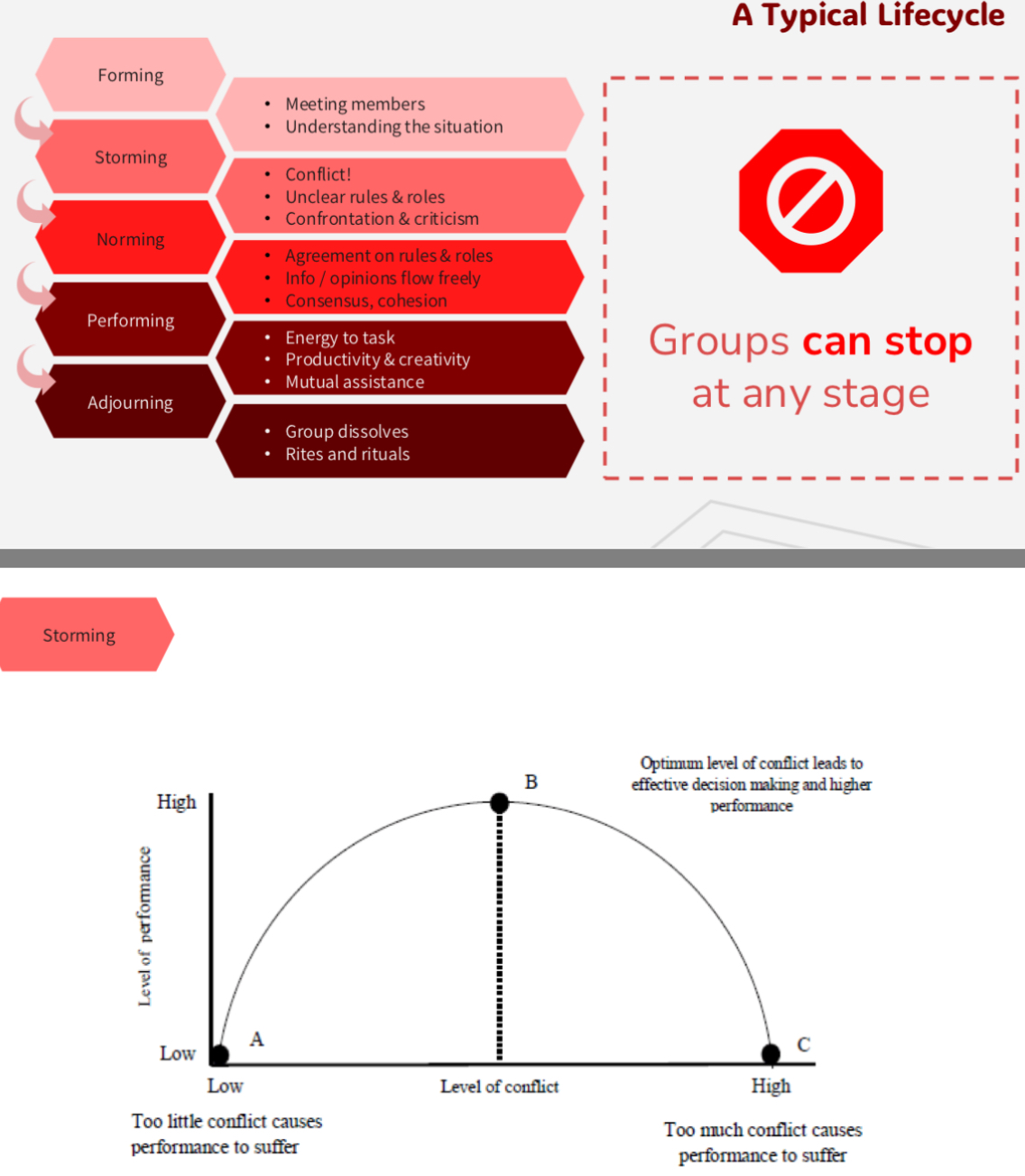
Forming
meeting members
Understanding the situation
Storming
conflicts
Unclear rules and roles
Confrontation and criticism
Norming
agreement on rules and roles
Info/opinions flow freely
Consensus, cohesion
Performing
energy to task
Productivity and creativity
Mutual assistance
Adjourning
group dissolves
Rites and rituals
A typical lifecycle
Groups can stop at any stage
Conflict starts with perception
Conflict is a process that begins when one party perceives that another party has or is about to negatively affect something important to them
Types of conflicts
relationships
Task
Process
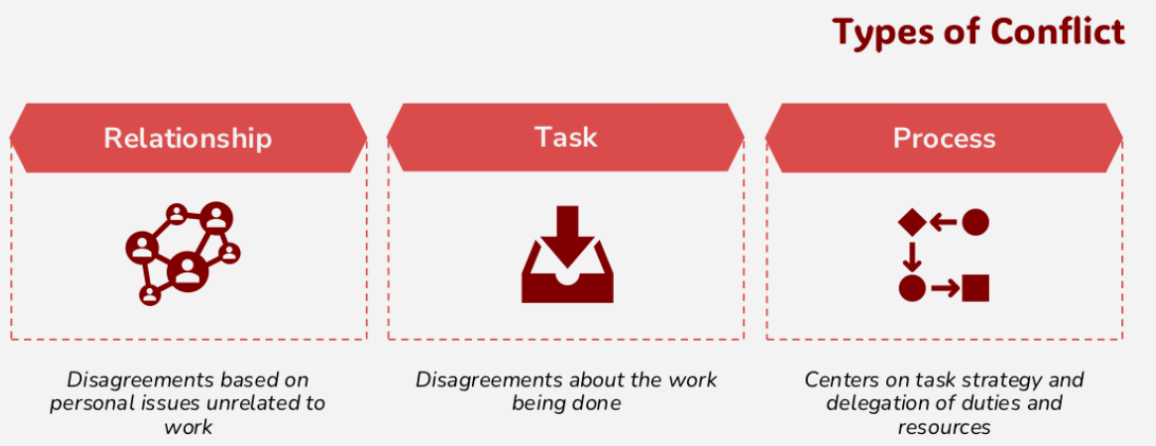
Relationship
Disagreements based on personal issues unrelated to work
Task
Disagreements about the work being done
Process
Centers on task strategy and delegation of duties and resources
Group Norms and Cohesion: How Teams Really Work
what are norms?
What is cohesion?
How they work together
Real talk
What are norms?
The unspoken rules in a group — like “don’t ghost the group chat” or “show up prepared”
What is cohesion?
How connected and committed people feel to the group
when you feel the vibe, you’re more likely to follow the rules
How norms and cohesion work together
Strong cohesion makes it easier to call out slackers or celebrate effort
but..it can also make it harder to speak up if you disagree
Real talk
Ever stayed quiet in a group because you didn’t want to mess with the vibe? That’s cohesion in action
When cohesion goes too far?
groupthink
When everyone just goes along with the group — even if they disagree
People stay quiet to avoid conflict
It feels like “everyone agrees” (even if they don’t)
Creative ideas and honest feedback get lost
Some symptoms of groupthink
Belief inherent morality
Stereotyped views of out-groups
Direct pressure on dissenters
Self-censorship
Illusion of unanimity
Group cohesion: What Makes a Group Feel Like a Team?
It’s how attracted people feel to being part of the group. Like when a group project actually feels fun
what builds it?
What happens when cohesion is strong?
The watch-outs
What builds group cohesion?
winning together (success)
Feeling similar (shared values or vibe)
Small size (easier to bond)
Facing challenges together (tight deadline , tough feedback)
Going through something hard (like a tough onboarding or initiation)
What happens when cohesion is strong?
The good stuff
people show up, speak up, and stick around
Feels like “we’re in this together”
The watch-outs
cohesion can lead to groupthink
People might stay quiet to avoid rocking the boat
Can become an echo chamber when new ideas get shut down
“Strong teams feel great — but only if they leave room for different voices”
Social loafing
When people in a group don’t try as hard because they think others will pick up the slack
free-rider effect: “why bother? Others will do it”
Sucker effect: “why should i work hard if no one else is?”
Too many people? It’s easy to hide and check out
Free-rider effect
Why bother? Others will do it
Sucker effect
Why should i work hard if no one else is?
So, how might we counteract team loafing?
keep group size small: more visible individual performance and lower communication costs
Intrinsic motivation should counteract social loafing (i.e., job design — interesting work and quality feedback
Group members with unique inputs (indispensability) and understand kind of task
Why group size matters
The best group size depends on what you’re trying to do and how you want people to feel
Small groups = more connection
easier to build real friendships
Less conflict, more trust
People feel safer to speak up
Stronger sense of belonging and shared success
Large Groups = more power (sometimes)
great for task where more hands or ideas help
Additive task: everyone contributes (e.g. building a house)
Disjunctive tasks: one great idea can win the day
Teams
a team is just a group of people trying to get something done — together
Teams change over time
They go through phases (forming, storming, etc)
Things like group size and roles shape how they evolve
Norms can help or hurt
Clear roles = less stress, more success
When everyone knows what they’re doing, the group work better
And people feel more included, respected, and motivated