Module 6 - Bond Valuation: Prices and Yields
 Call Kai
 Learn
Learn Practice Test
 Spaced Repetition
 Match
Match Flashcards
 Knowt Play
1/13

Earn XP
Description and Tags
Name | Mastery | Learn | Test | Matching | Spaced | Call with Kai |
|---|
No analytics yet
Send a link to your students to track their progress
14 Terms
A non-callable, fixed-coupon bond has a price of 106.0625 and a YTM of 2.8%. If the YTM were to increase instantaneously by 80 bps, the price of the bond would decrease by 11%. If the YTM were to decrease instantaneously by 80 bps, the price of the bond would increase by:
A. less than 11%.
B. exactly 11%.
C. more than 11%.
C. more than 11%.
Exceptions to the maturity effect exist for bonds that have:
A. long maturities, make small coupon payments, and trade at a discount.
B. short maturities, have high coupon rates, and trade at a discount.
C. long maturities, have high coupon rates, and trade at a premium.
A. long maturities, make small coupon payments, and trade at a discount.
With a constant market discount rate, as a non-callable, fixed-coupon bond approaches maturity:
A. the price–yield relationship will become more convex.
B. a low-coupon bond trading at a discount will increase in price.
C. a high-coupon bond trading at a premium will increase in price.
B. a low-coupon bond trading at a discount will increase in price.
A fixed-income analyst is pricing a bond using the following equation.
The bond’s price, relative to par, is most likely:
A. greater than 100.
B. exactly 100.
C. less than 100.
A. greater than 100.

A four-year, 2.0% semiannual coupon bond that pays coupons semiannually is trading at a price of 102.581. The bond’s annualized yield-to-maturity is closest to:
A. 0.67%.
B. 1.34%.
C. 2.22%.
B. 1.34%.
A bond is traded in between its coupon payment dates. Which of the following is true?
A. The buyer must pay the full price plus the accrued interest.
B. The bond’s quoted price is greater than its flat price.
C. Accrued interest is not included in the flat price.
C. Accrued interest is not included in the flat price.
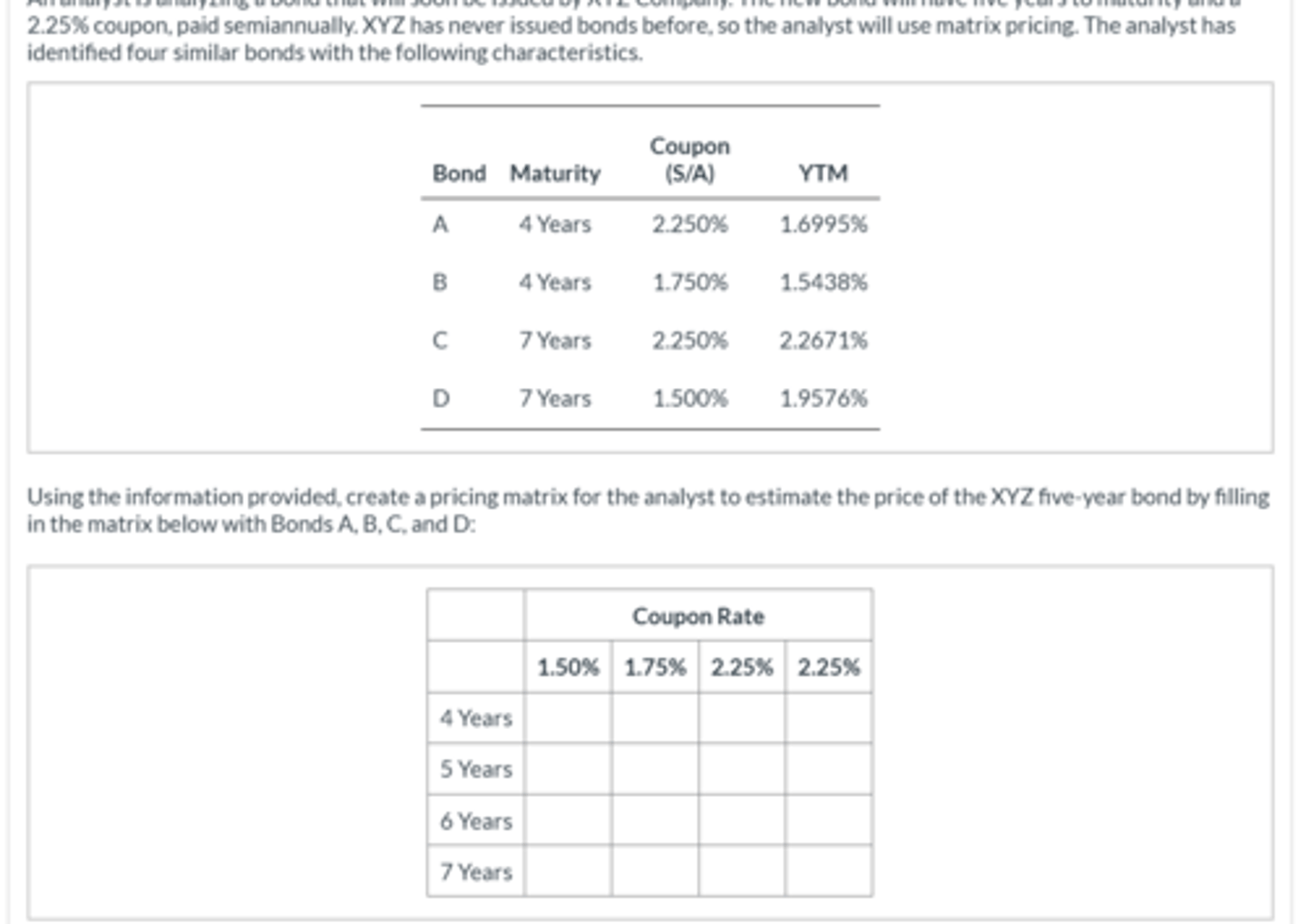
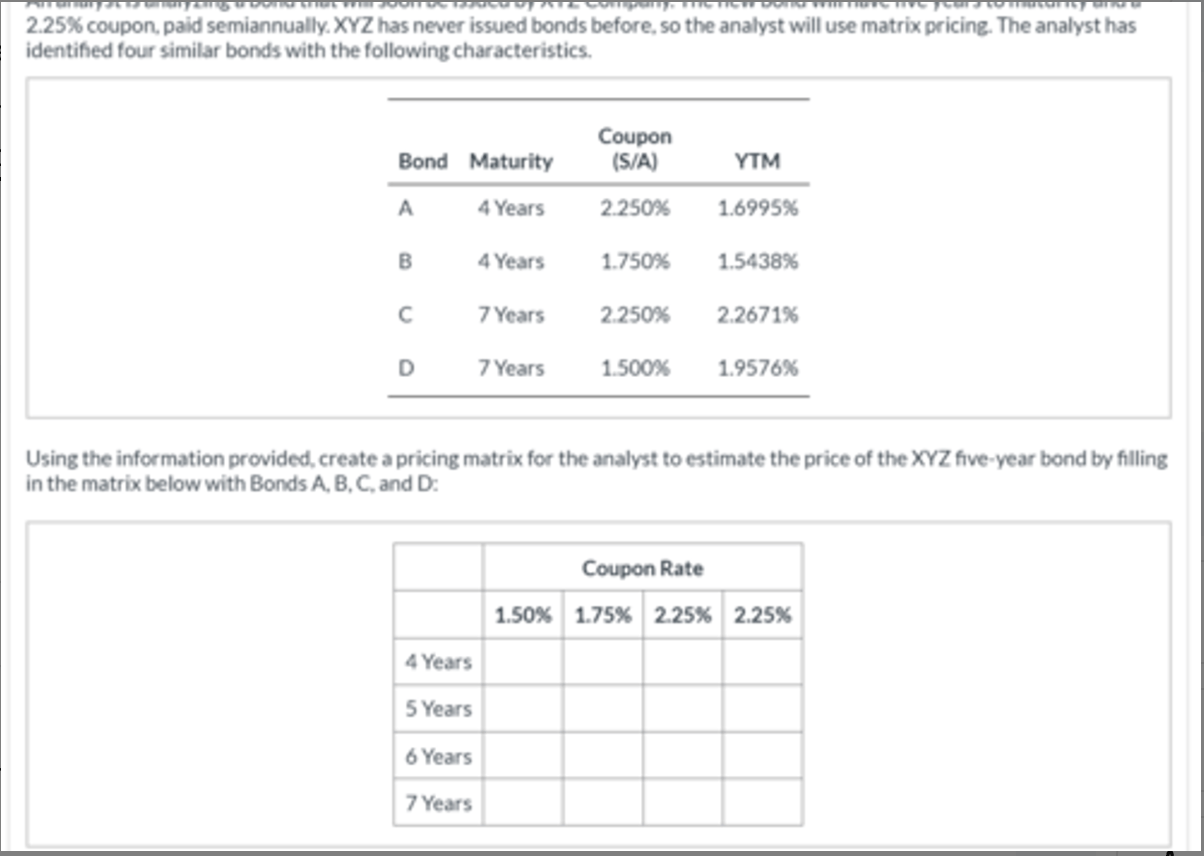
An analyst is analyzing a bond that will soon be issued by XYZ Company. The new bond will have five years to maturity and a 2.25% coupon, paid semiannually. XYZ has never issued bonds before, so the analyst will use matrix pricing. The analyst has identified four similar bonds with the following characteristics.
Using the information provided, create a pricing matrix for the analyst to estimate the price of the XYZ five-year bond by filling in the matrix below with Bonds A, B, C, and D:
(Look at the picture on the right side)
To price the new XYZ bond, the analyst should group yields for comparable bonds in a matrix with maturities and coupon rates.
Coupon Rate
1.50%
4 Years =
5 Years =
6 Years =
7 Years = D
1.75%
4 Years = B
5 Years =
6 Years =
7 Years =
2.25%
4 Years =
5 Years =
6 Years =
7 Years = C
2.25%
4 Years = A
5 Years =
6 Years =
7 Years =
Consider two bonds that are identical except for their coupon rates. The bond that will have the highest interest rate risk most likely has the:
A. lowest coupon rate.
B. coupon rate closest to its market yield.
C. highest coupon rate.
A. lowest coupon rate.
Correct Answer Feedback:
Correct. A lower coupon rate means that more of the bond’s value comes from repayment of face value, which occurs at the end of the bond’s life.
The market value of an 18-year zero-coupon bond with a maturity value of $1,000 discounted at a 12% annual interest rate with semi-annual compounding is closest to:
A. $122.74.
B. $130.04.
C. $192.86.
A. $122.74.
Correct Answer Feedback:
Correct. The value of a zero-coupon bond is
where r is the market discount rate per period, and N is the number of evenly spaced periods to maturity. The value of the zero-coupon bond is
An investor purchases the bonds of JLD Corp., which pay an annual coupon of 10% and mature in 10 years, at an annual yield to maturity of 12%. The bonds will most likely be selling at:
A. par.
B. a premium.
C. a discount.
C. a discount.
Correct Answer Feedback:
Correct. The coupon rate on the bonds is lower than the yield to maturity, implying that the bonds should be selling at a price lower than their par value—that is, at a discount.
An investor sells a bond at the quoted price of $98.00. In addition, she receives accrued interest of $4.40. The flat price of the bond is equal to the:
A. par value plus accrued interest.
B. accrued interest plus the agreed-on bond price.
C. agreed-on bond price excluding accrued interest.
C. agreed-on bond price excluding accrued interest.
Correct Answer Feedback:
Correct. The agreed-on bond price excluding accrued interest is referred to as the flat price.
A credit analyst is least likely to use matrix pricing to estimate the required yield and price of a(n):
A credit analyst is least likely to use matrix pricing to estimate the required yield and price of a(n):
A. newly underwritten bond.
B. actively traded speculative grade bond.
C. inactively traded investment grade bond.
B. actively traded speculative grade bond.
Correct Answer Feedback:
Correct. Matrix pricing is most suited to pricing inactively traded bonds and newly underwritten bonds. A credit analyst is least likely to use matrix pricing to price an actively traded bond.
The maturity effect is least likely to hold for a:
A. zero-coupon bond.
B. low-coupon, long-term bond trading at a discount.
C. low-coupon, long-term bond trading at a premium.
B. low-coupon, long-term bond trading at a discount.
Correct Answer Feedback:
Correct. In some situations, the maturity effect may not hold for a low-coupon bond that is trading below par.
Bonds are quoted using the:
A. full price and settled using the flat price.
B. flat price and settled using the full price.
C. "dirty" price and settled using the invoice price.
B. flat price and settled using the full price.
Correct Answer Feedback:
Correct because the flat price usually is quoted by bond dealers. If a trade takes place, the accrued interest is added to the flat price to obtain the full price paid by the buyer and received by the seller on the settlement date.