La Voz Pasiva y Activa
 Call Kai
 Learn
Learn Practice Test
 Spaced Repetition
 Match
Match Flashcards
 Knowt Play
1/18

There's no tags or description
Looks like no tags are added yet.
Name | Mastery | Learn | Test | Matching | Spaced | Call with Kai |
|---|
No analytics yet
Send a link to your students to track their progress
19 Terms
La Voz Pasiva y Activa
prefers the active voice in most contexts
the passive voice is less used in English
most of the times “se” is a better alternative when the “doer” is not mentioned
the passive voice is restricted to more formal contexts.
It is less natural than the active voice.
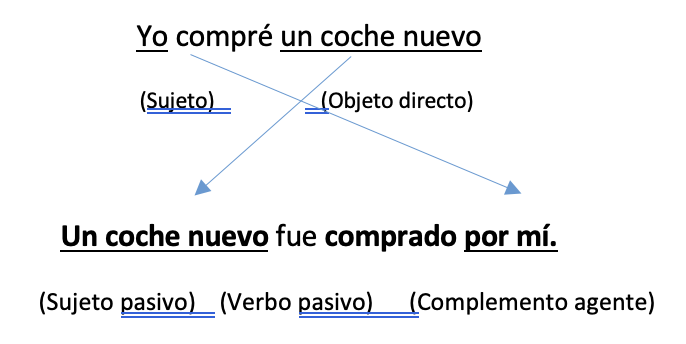
Transformación: activa > pasiva
Activa:
→ Yo compré un coche nuevo
yo = (active) subject
un coche nuevo = direct object
Pasiva:
Un coche nuevo fue comprado por mí
un coche nuevo = passive subject
comprado = passive verb
por mí = the “doer”
1. needs to be in the same tense as the active subject (indefinite article of to be = was)
2. participle that agrees in gender and number with the passive subject (masculine singular participle of to buy: bought)
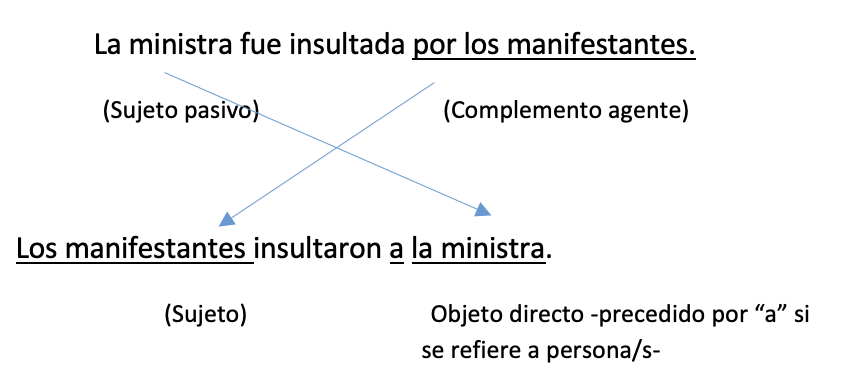
Transformación: pasiva > activa
Pasiva:
La ministra fue insultada por los manifestantes
La ministra = passive subject
Por los manifestantes = the “doer”
Activa:
Los manifestantes insultaron a la ministra
Los manifestantes = (active) subject
A la ministra = direct object → “a” comes before if it refer to a person/people
¿Cómo EVITAR la pasiva? - Transformation to the active
Ideal for when there is a “doer”
España fue invadida por los musulmanes (passive) → Los musulmanes invadieron España (active)
¿Cómo EVITAR la pasiva? - Verb in 3rd person plural
There is not a “doer”, but WE KNOW that people did it, understood it was a human action
Fue asesinado en Las Vegas (passive) → Lo asesinaron en Las Vegas (active)
¿Cómo EVITAR la pasiva? - Duplication of direct object
Instead of using the passive, Spanish often prefers a more colloquial active structure:
Put the direct object at the beginning (this was the passive subject)
Add “a” if it’s a person
Repeat it with a direct object pronoun (lo, la, los, las)
Place the real subject (agent) at the end
Formula:
(A + objeto directo) + pronombre + verbo + sujeto
Examples
Passive:
Pedro y Luis fueron empujados por la muchedumbre
→ Active alternative:
A Pedro y a Luis los empujó la muchedumbre
Passive:
El edificio será devorado por las llamas
Active alternative:
El edificio lo devorarán las llamas
Notes
This structure is more natural and common in spoken Spanish
It may feel unusual because the subject comes at the end
The pronoun duplication (los, lo, etc.) is essential
¿Cómo EVITAR la pasiva? - Use “se”
Often used to avoid the passive voice when there is no agent.
More impersonal and formal
The agent is unimportant, unknown, or absent
Se usa mucho picante en México
Aquí se cena a las 21:00
Active: Subject + verb (present) + object → I write the letter
Passive: Object + am/is/are + past participle → The letter is written (by me)
Active: Subject + am/is/are + verb-ing + object → I am writing the letter
Passive: Object + am/is/are + being + past participle → The letter is being written (by me)
Active: Subject + verb (past) + object → I wrote the letter
Passive: Object + was/were + past participle → The letter was written (by me)
Active: Subject + was/were + verb-ing + object → I was writing the letter
Passive: Object + was/were + being + past participle → The letter was being written (by me)
Active: Subject + have/has + past participle + object → I have written the letter
Passive: Object + have/has + been + past participle → The letter has been written (by me)
Active: Subject + had + past participle + object → I had written the letter
Passive: Object + had + been + past participle → The letter had been written (by me)
Active: Subject + am/is/are + going to + verb + object → I am going to write the letter
Passive: Object + am/is/are + going to be + past participle → The letter is going to be written (by me)
Active: Subject + was/were + going to + verb + object → I was going to write the letter
Passive: Object + was/were + going to be + past participle → The letter was going to be written (by me)
Active: Subject + would + verb + object → I would write the letter
Passive: Object + would + be + past participle → The letter would be written (by me)
Active: Subject + would have + past participle + object → I would have written the letter
Passive: Object + would have + been + past participle → The letter would have been written (by me)
Modals = could/should/must
Active: Subject + modal + verb + object → I could write the letter
Passive: Object + modal + be + past participle → The letter could be written (by me)
Modals = could/should/must
Active: Subject + modal + have + past participle + object → I could have written the letter
Passive: Object + modal + have been + past participle → The letter could have been written (by me)