The central nervous system
 Call Kai
 Learn
Learn Practice Test
 Spaced Repetition
 Match
Match Flashcards
 Knowt Play
1/27

There's no tags or description
Looks like no tags are added yet.
Name | Mastery | Learn | Test | Matching | Spaced | Call with Kai |
|---|
No analytics yet
Send a link to your students to track their progress
28 Terms
grey matter
contains cell bodies, dendrites and unmyelinated axons
white matter
conrains myelinated axons
cerebellum
unconscious coordination of posture reflexes, and body movements and motor skills (hitting baseball)
medulla oblongata
controls automatic, involuntary responses, such as heart rate, constriction or dilation of blood vessels, breathing rate, swallowing and coughing
pons
relay centre between neurons of the right and left halves of the cerebrum, the cerebellum and the rest of the brain
hindbrain
cerebellum, medulla oblongata, pons
midbrain
relays visual and auditory information between areas of hind and forevrain. plays a role in eye movement and skeletal muscles
forebrain
thalamus, hypothalamus, cerebrum
forebrain
thalamus, hypothalamus, cerebrum
hypothalamus
regulates the pituitary gland, heart rate, blood pressure and temperature. controls drives such as hunger, thirst and sex drive
cerebrum
largest part of brain and divided into hemispheres: cerebral cortex, corpus callosum and the 4 lobes
blood brain barrier
meninges protect CNS by preventing direct circulation of blood through cells of brain and spinal cord
cerebrospinal fluid
clear colourless liquid that surrounds and cushions brain and spinal cord
cerebral cortex
language, memory, personality, vision and conscious thought
corpus callosum
connects left and right cerebral hemispheres through nerve tracts
frontal lobe
conscious thought, intelligence, memory snd personality. controls voluntary muscle movements
temporal lobe
process SOME visual and ALL auditory information
parietal lobes
receives sensory information from skin and processed information aboud body POSITION
occipital lobe
process visual info
broca’s area
coordinates muscles for speaking and translates thought into speech
wernickes area
stores information involved in language comprehension
somatic system
controls voluntary actions under conscious control
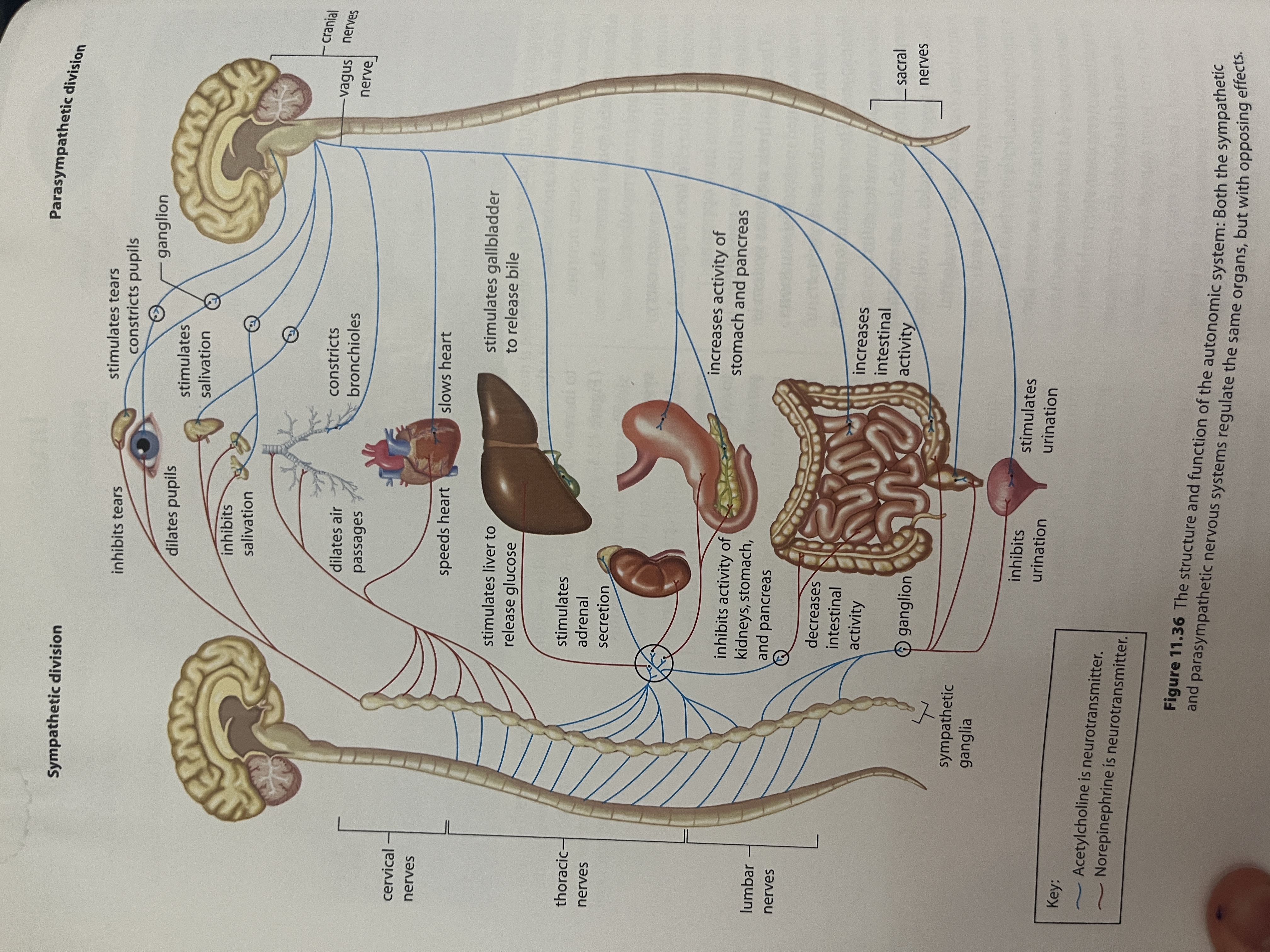
autonomic nervous system
controls involuntary actions such as heartbeat, digestion, swearing, dilation
sympathetic nervous systsm
fight or flight response;
increase heart rate and blood pressure
dilates pupils
increases breathing rate
redirects bloodflow to skeletal muscles
decrease digestion
releases adrenaline from adrenal glands
parasympathetic nervous system
rest and digest;
decreases heart rate
constricts pupils
slows breathing rate
stimulates digestion
increases saliva
promotes energy storage
norepinephrine
sympathetic neurotransmitter released by sympathetic nerves
memorize