AP Bio: Unit 7- Evolution
 Call Kai
 Learn
Learn Practice Test
 Spaced Repetition
 Match
Match Flashcards
 Knowt Play
1/55

Earn XP
Description and Tags
not done
Name | Mastery | Learn | Test | Matching | Spaced | Call with Kai |
|---|
No analytics yet
Send a link to your students to track their progress
56 Terms
Species
Population whose members can interbreed & produce viable, fertile offspring. They are reproductively compatible
how/why do new species originate
a series of evolutionary process, populations become isolated (geographically & reproductively).
Isolated populations evolve…
independently
Allopatric speciation
Speciation by isolation, geographic seperation
sympatric speciation
Speciation that happens at the same area. Can happen because of habitat isolation, behavioral isolation, sexual selection, polyloidy
Ecological isolation
Species occur in the same area, but occupy different habitats so rarely encounter each other.
Geographic isolation
Species occur because of a geographic barrier
Temporal isolation
species that breed during different times of day, different seasons, or different years. So cannot mix gametes.
What speciation is temporal isolation?
sympatric speciation
behavioral isolation
unique behavioral patterns & rituals isolate species (like bird dances)
What speciation is behavioral isolation?
sympatric (? from powerpoint uhh)
Mechanical isolation
Morphological differences can prevent successful breeding/mating.
ex. different shaped reproductive organs for insects
What speciation is mechanical isolation?
sympatric
Gametic isolation
sperm of one species may not be able to fertilize eggs of another species. Can be biochemical barrier or chemical incompatibility
ex. sea urchin release sperm & eggs, but different species gametes do not fuse.
what speciation is Gametic isolation
sympatric
prezygotic barriers
reproductive isolation mechanisms that prevent species from mating or fertilizing
postzygotic barriers
Prevent hybrid offspring from developing into a viable fertile adult.
reduced hybrid viability (hybrid unhealthy)
reduced hybrid fertiliity
hybrid breakdown
Reduced hybrid viability
genes of different parent species may interact & impair the hybrid’s development
What speciation is reduced hybrid viability
sympatric
reduced hybrid fertility
even if hybrids are vigorous, but may be sterile. Chromosomes of parents differ in number/structure. Meiosis in hybrids may fail to produce normal gametes.
Hybrid breakdown
Hybrids may be fertile & viable in first generation, but when they mate offspring are feeble or sterile
Gradualism
Belief that speciation happens in small changes over time. Rate of speciation is constant
Punctuated equilibrium
belief, that with a massive environmental change there will be big change fast. Rapid bursts of change and long periods of little/no change.
Directional selection
a type of natural selection where individuals with traits that are either higher or lower than the average value for the population have a better chance of survival and reproduction. This leads to a shift in the average value of the trait over time.
Graphically, entire bell curve shifts
selection for one extreme phenotype
selection against the other phenotypes
Disruptive selection
a type of natural selection that simultaneously favors individuals at both extremes of the distribution.
Graphically, shift from the mean- 2 bell curves emerge
selection for 2 extreme phenotypes
selection against the intermediate phenotype
Stabilizing selection
a type of natural selection that favors intermediate phenotypes over extreme variations, promoting the stability of a population by reducing variation. This process helps maintain the status quo in traits that are advantageous for survival and reproduction, leading to a decrease in the extremes of a trait spectrum. In this way, stabilizing selection can enhance the overall fitness of a population, ensuring that successful traits are preserved through generations.
Graphically, shift towards the mean
selection for intermediate phenotype
selection against the 2 extreme phenotypes
Natural selection
a process where individuals with certain inherited traits (phenotypes) are more likely to survive and reproduce at higher rates than other individuals because of those traits, leading to an increase in the frequency of those favorable traits in the population over generation
Evolutionary fitness is measured by ….
reproductive success
reproductive success
an individual's ability to produce viable, fertile offspring that survive to reproduce themselves, thereby passing their genes to the next generation
Lamarckian statements
UNTRUE: ideas that evolution is driven by the inheritance of acquired characteristics and the principle of use and disuse. These ideas suggest that individuals change within their lifetime to meet environmental needs and pass those changes to their offspring, rather than populations evolving over generations via natural selection
do not use
Artificial selection
organisms with certain traits are bred until the population has that trait
the 5 fingers of evolution
(pinky) Small population → genetic drift
(ring) Non-random mating → sexual selection
(middle) Mutation
(index) Movement → gene flow
(thumb) Natural selection → better trait = thumbs up
Gene flow
the addition/removal of alleles from population
the transfer of genetic variation from one population to another. If the rate of gene flow is high enough, then two populations are considered to have equivalent allele frequencies and therefore effectively be a single population. Basically migration can change allele frequencies for a population
Mutations do what in evolution
provides new genetic variation
Genetic drift
nonselective process in small populations changes allele frequencies
Bottleneck effect
population size reduced
ex. natural disaster killed most of the population (does not have to because of a trait)
Founder effect
Population separated from other members of a population
ex. In the 18th century, a small group of around 200 German immigrants founded the Amish community in Pennsylvania → The community remained largely isolated, marrying only within their own group
Drivers of evolution
mutations
migration (gene flow)
genetic drift
Advantage of variation in populations (genetic variation)
genetically diverse populations are more resilient to environmental perturbation because they are more likely to have individuals that can withstand the environmental pressure
alleles that are adaptive in one environmental conditions may be deleterious in the other because of different selective pressures
If the 5 fingers of evolution are not met, than…
they provide a valaubale null hypothesis and evolution does not happen
Hardy-Weinberg equilibrium
a approximation that
the frequency of the dominant allele + frequency of recessive allele is equal to one (100% of the population)
the frequency of the dominant allele² + 2(heterozygous allele) + recessive allele² is equal to one (100% of the population)
serves as a null model or baseline in population genetics to determine if a population is evolving. It predicts that allele and genotype frequencies remain constant across generations in the absence of evolutionary influences like mutation, natural selection, migration, and genetic drift
deviations from the equations suggest that evolution is happening
formula to use if hardy-weinberg question only gives number and not frequencies 7 ALL GENOTYPE NUMBERS ARE GIVEN
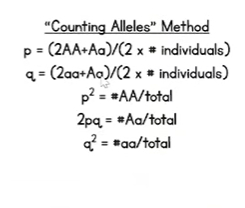
Always start with… in hardy-weinberg equations
finding q²
Evidences of evolution
fossils
biogeography
biochemical data
morphological (similar characteristics)
ancestral/derived traits
common ancestry
biogeography
distribution of species and ecosystems in geographic space & through geological time
Analagous structures
Due to convergent evolution. Traits that have similar functions but different evolutionary origins. They are not derived from a common ancestor.
Homologous structures
traits of different organisms that have similar structure but not necessarily the same function, indicating a common ancestry.
Phylogeny
the study of evolutionary relationships among species, represented by branching trees showing divergence from common ancestors
Phylogenic tree
visual hypotheses representing evolutionary relationships among species based on shared ancestry, molecular data (DNA/amino acids), or morphological traits
shows the amount of change over time calibrated by fossils or a molecular clock
Cladogram
visual hypotheses representing evolutionary relationships among species based on shared ancestry, molecular data (DNA/amino acids), or morphological traits
Does not show time scale or evolutionary difference between groups
morphological traits
the physical characteristics and structures of organisms, including their shape, size, and overall form.
outgroup
species or group of organisms that is used as a reference point when constructing a phylogenetic tree. It is chosen because it is believed to be less closely related to the other organisms being studied.
Speciation
2 populations become reproductively isolated from each other
reproductive isolation
when different species are unable to interbreed and produce viable offspring due to physical, behavioral, or genetic barriers.
behavioral
temporal (mate at different times)
geographic
habitat/ecological
mechanical
gametic
hybrid breakdown
phenomenon where the hybrid offspring of two different species are viable and fertile in the first generation but produce offspring that are inviable or sterile in subsequent generations. This concept highlights the complexities of reproductive isolation and the mechanisms through which new species can emerge, emphasizing how genetic incompatibility can manifest over generations.
… could be the earliest genetic material
RNA