Lecture 8 - Sound
 Call Kai
 Learn
Learn Practice Test
 Spaced Repetition
 Match
Match Flashcards
 Knowt Play
1/68

There's no tags or description
Looks like no tags are added yet.
Name | Mastery | Learn | Test | Matching | Spaced | Call with Kai |
|---|
No analytics yet
Send a link to your students to track their progress
69 Terms
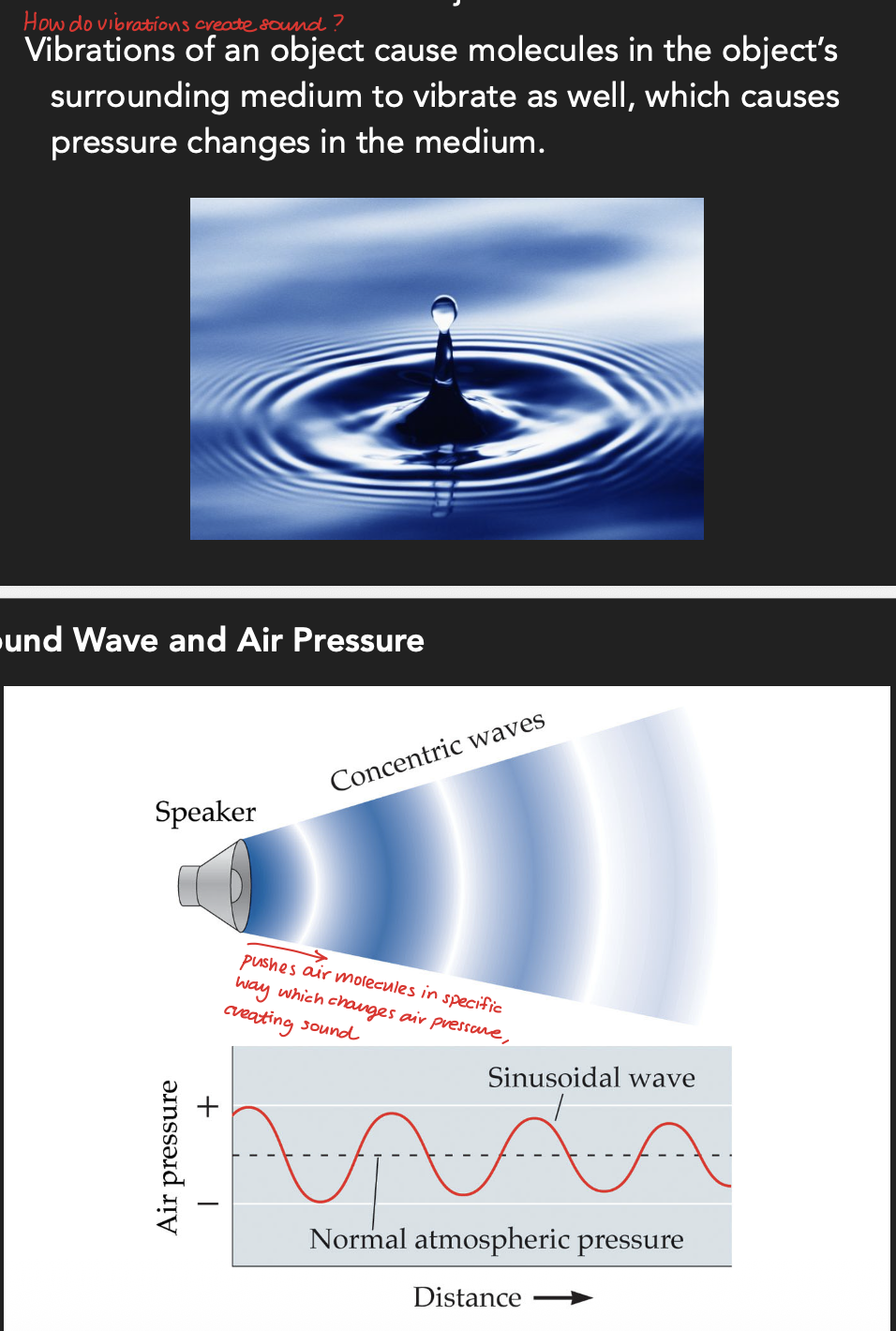
How are sounds created?

How do vibrations create sound?
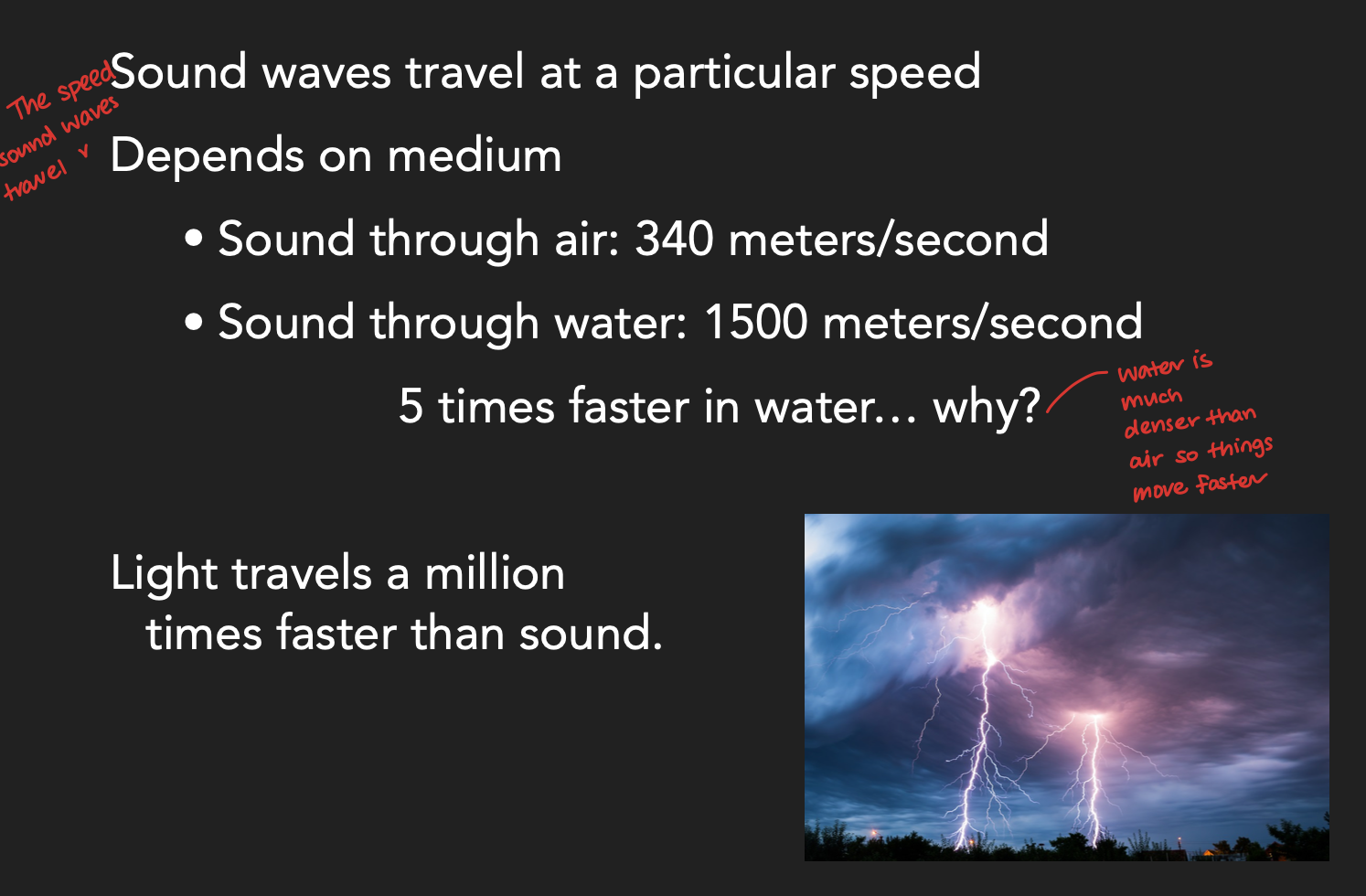
What determines how fast sound travels? Provide some examples of the speed of sound.
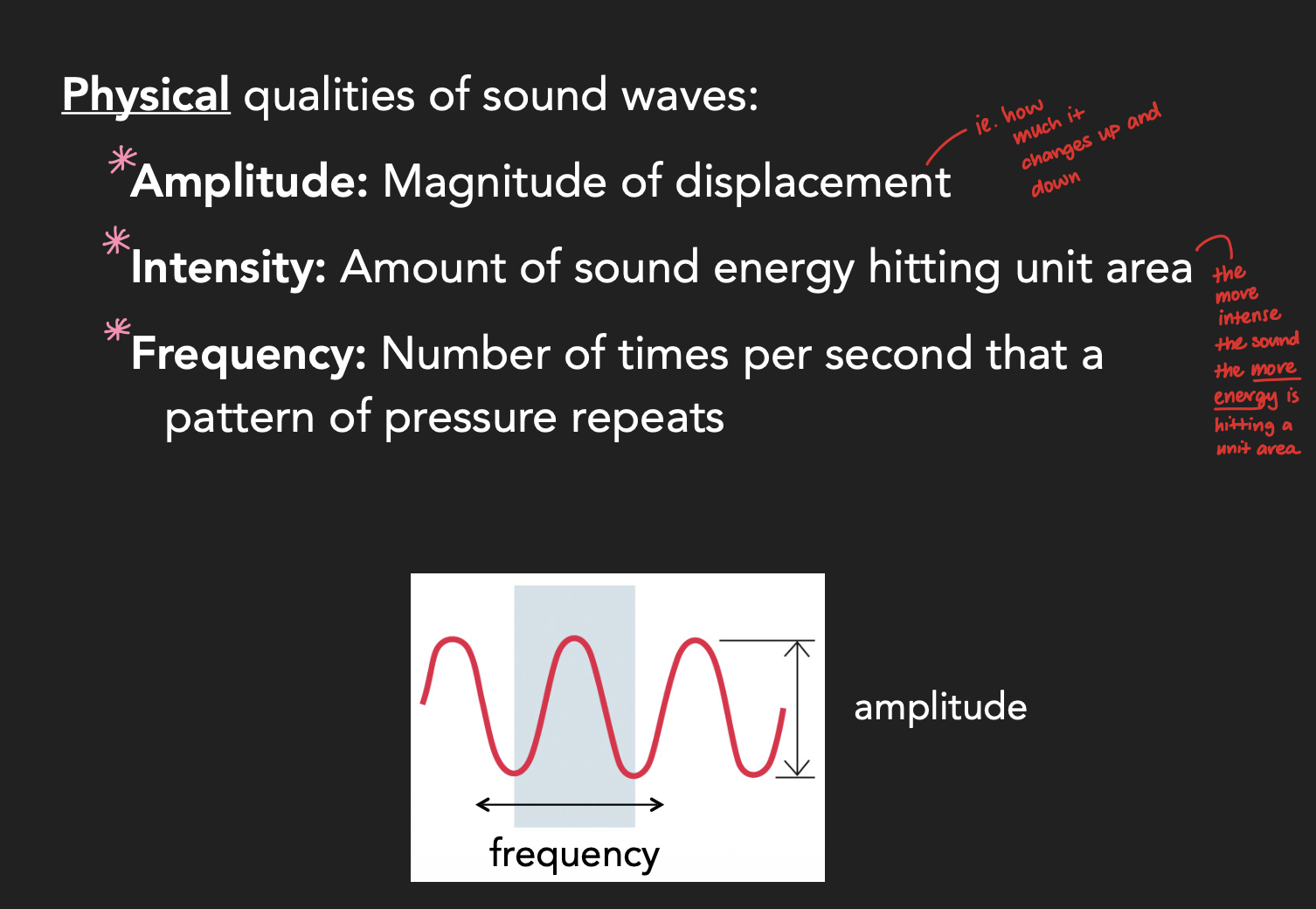
What are the 3 physical qualities of sound waves?
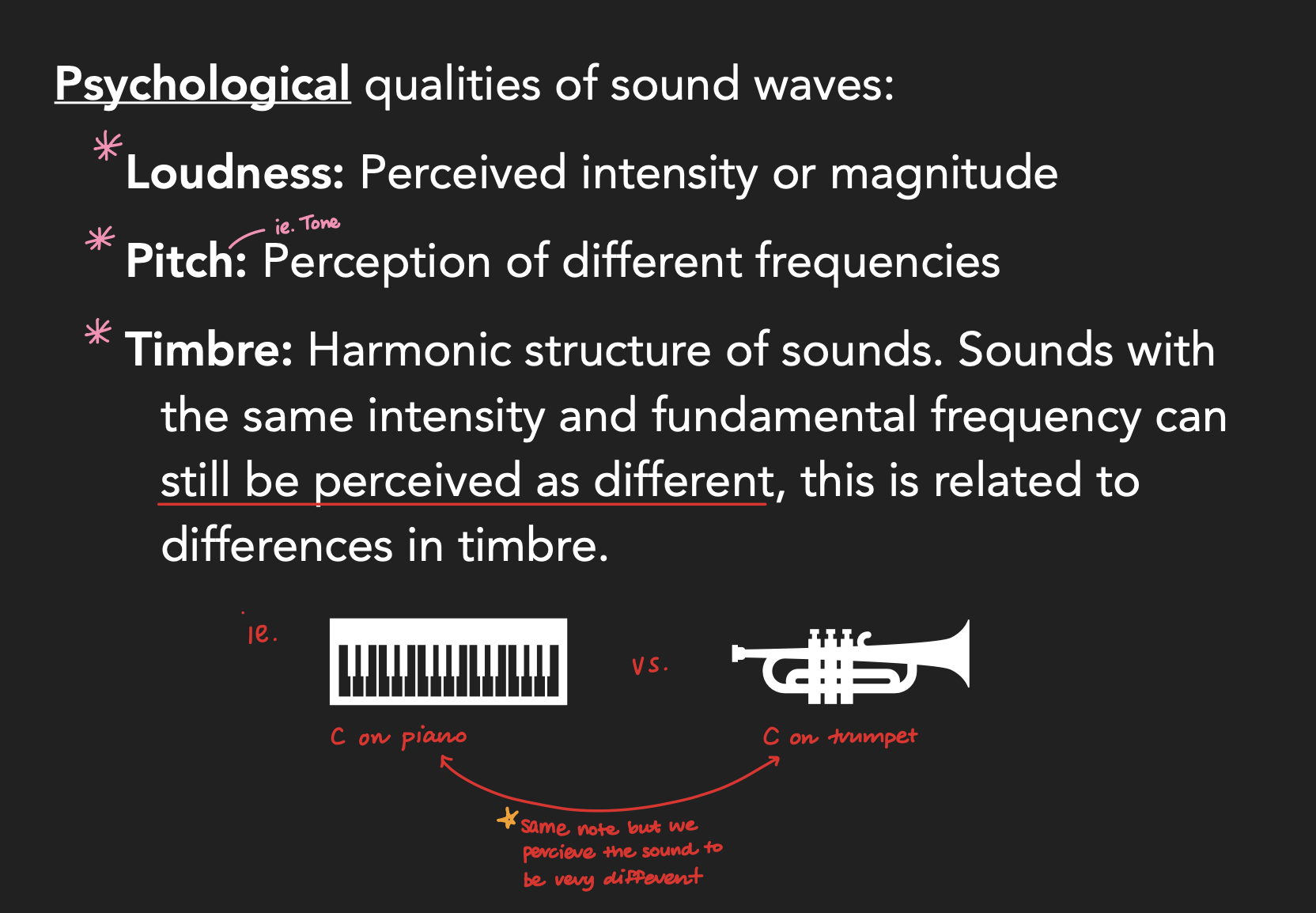
What are the 3 psychological qualities of sound waves?
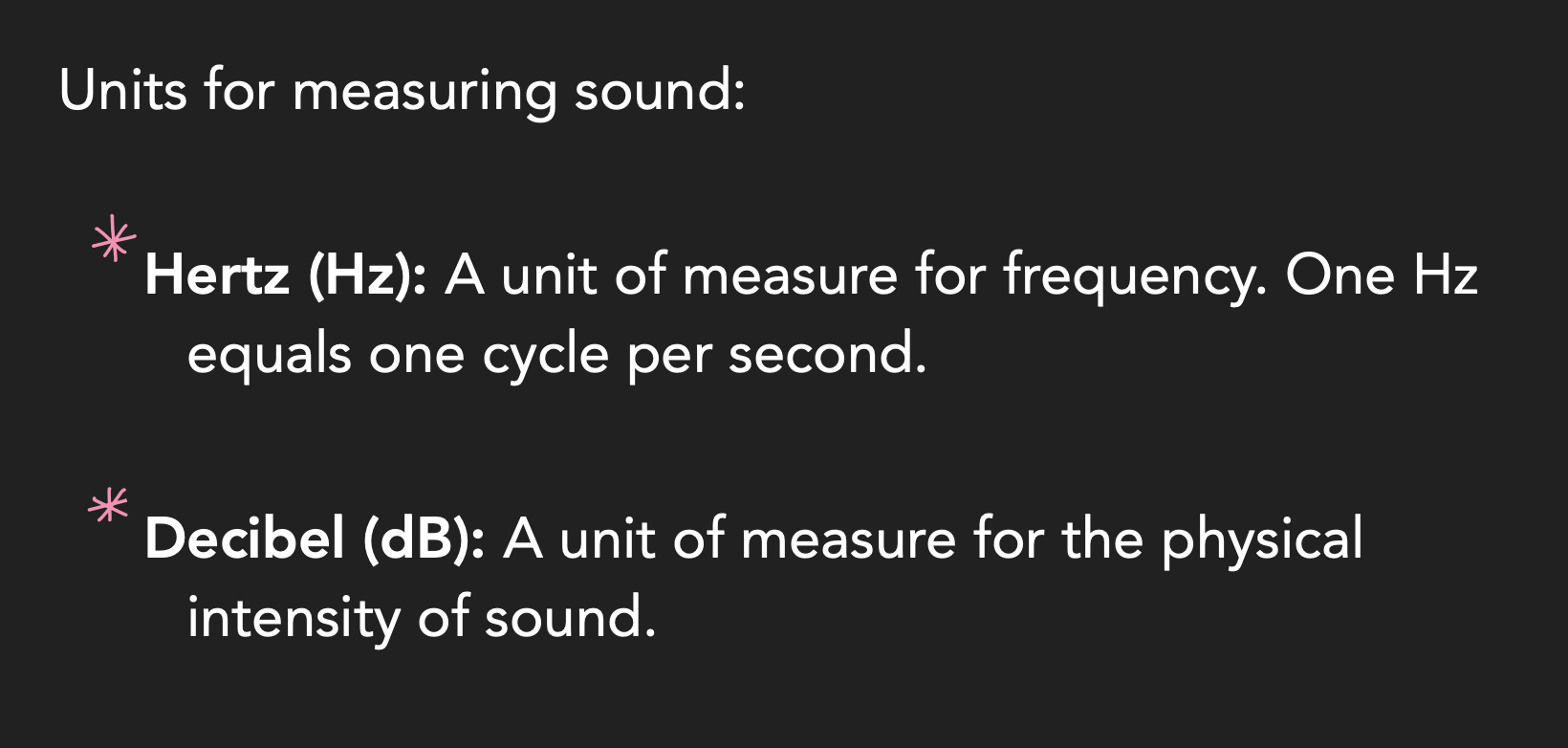
What are the 2 units for measuring sound. Define both terms.
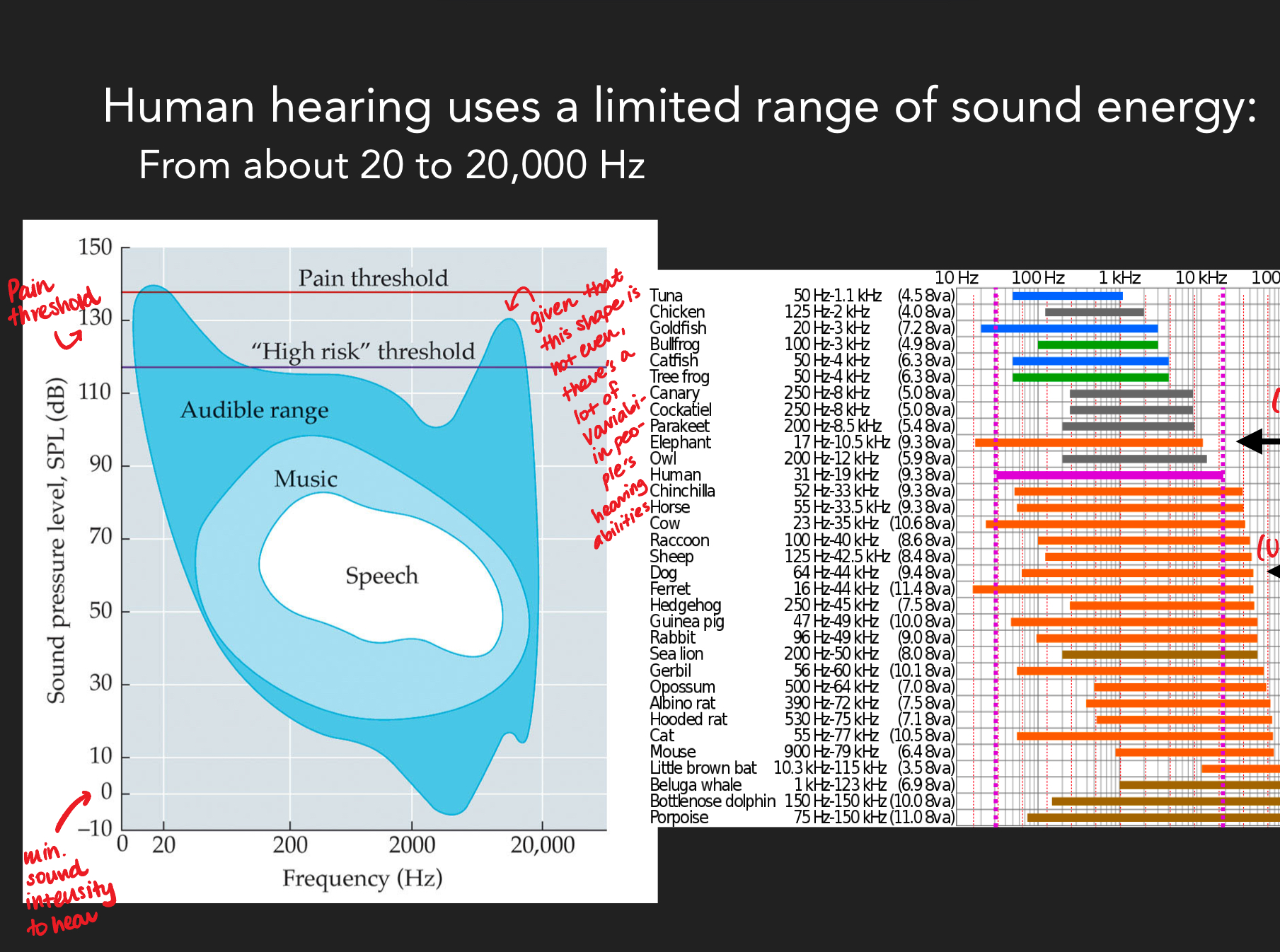
What is the range of humans ability to detect sound energy?
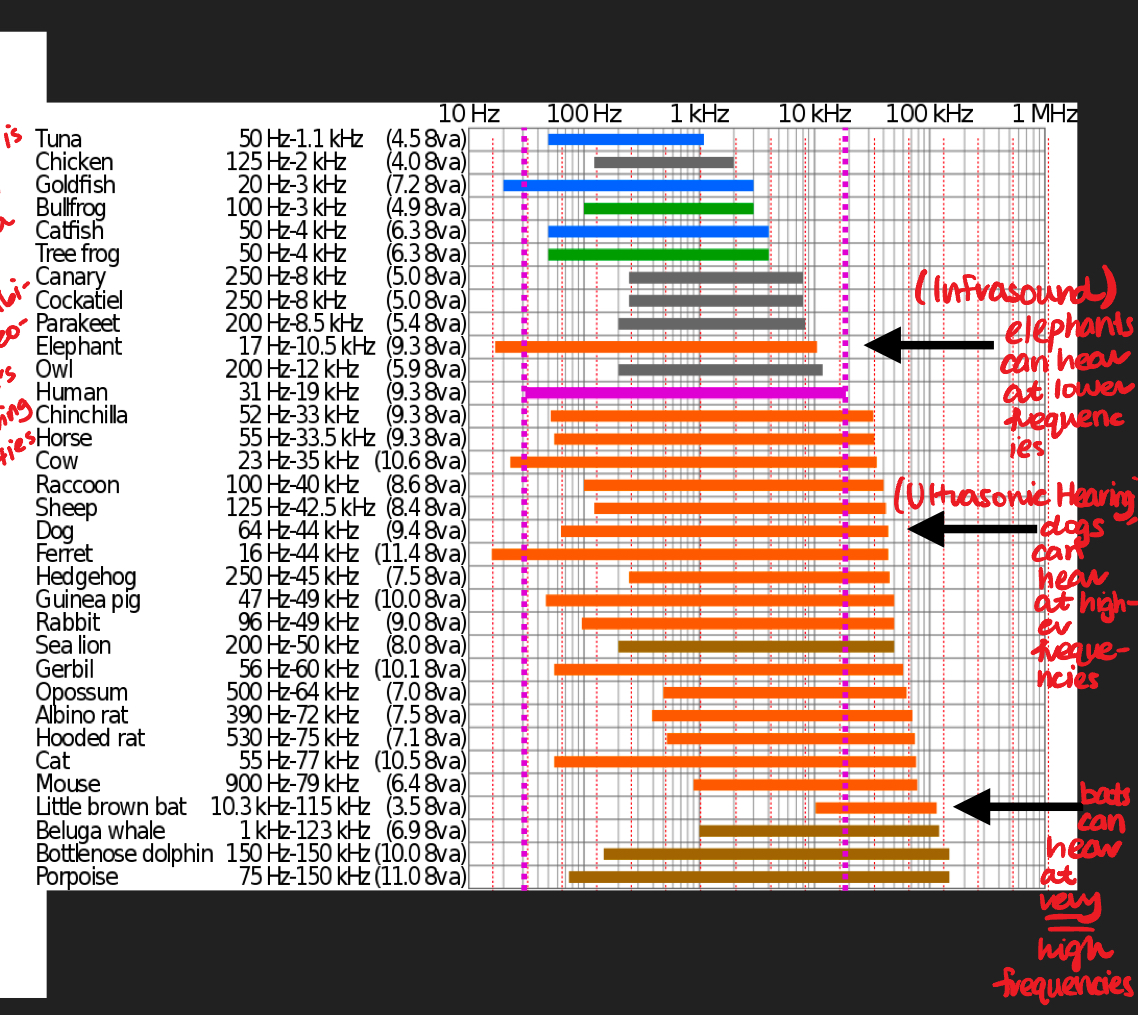
What type of hearing do elephants, dogs and bats have?
What is the simplest kind of sound wave?
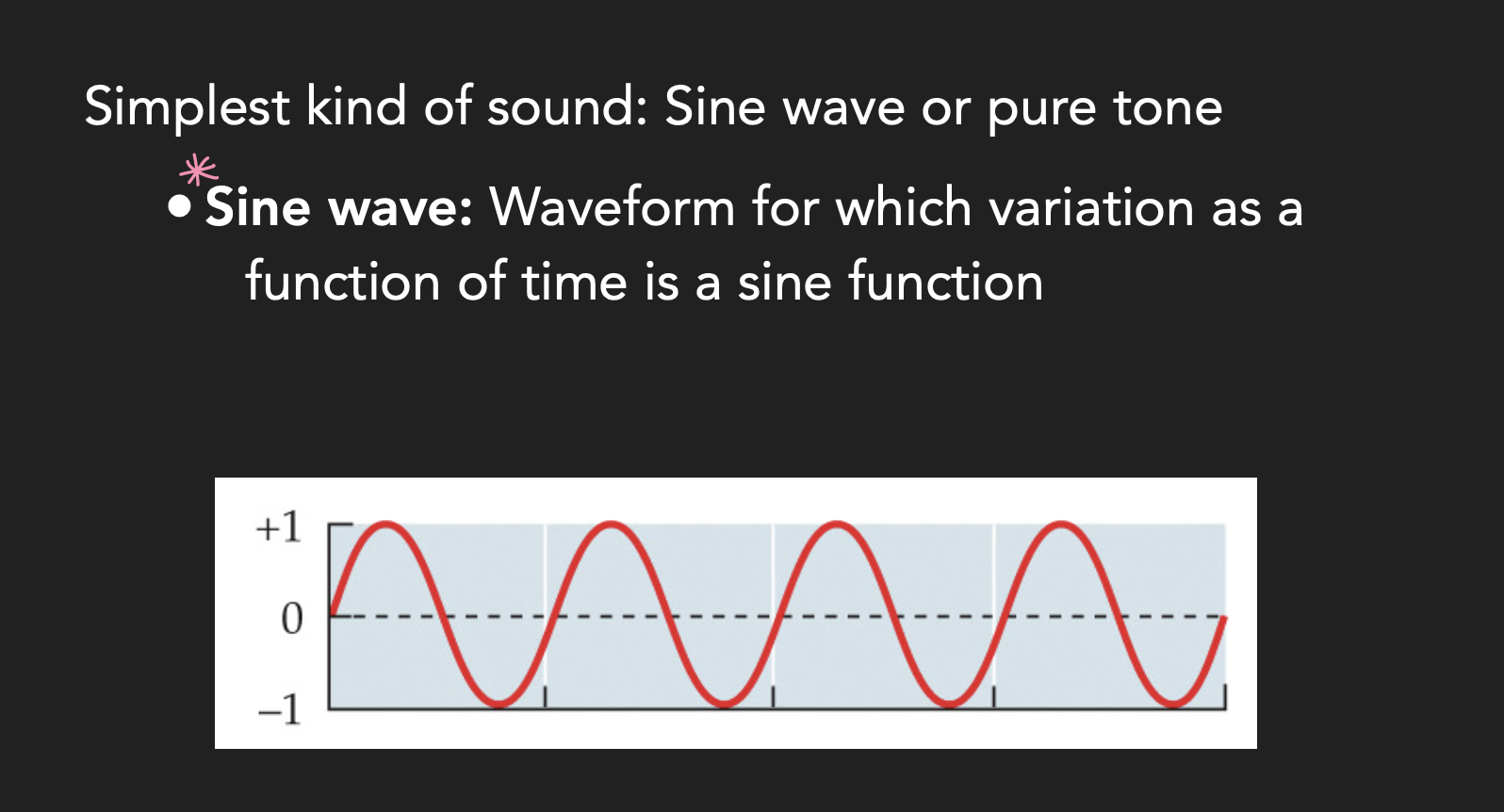
What are everyday sounds made of?
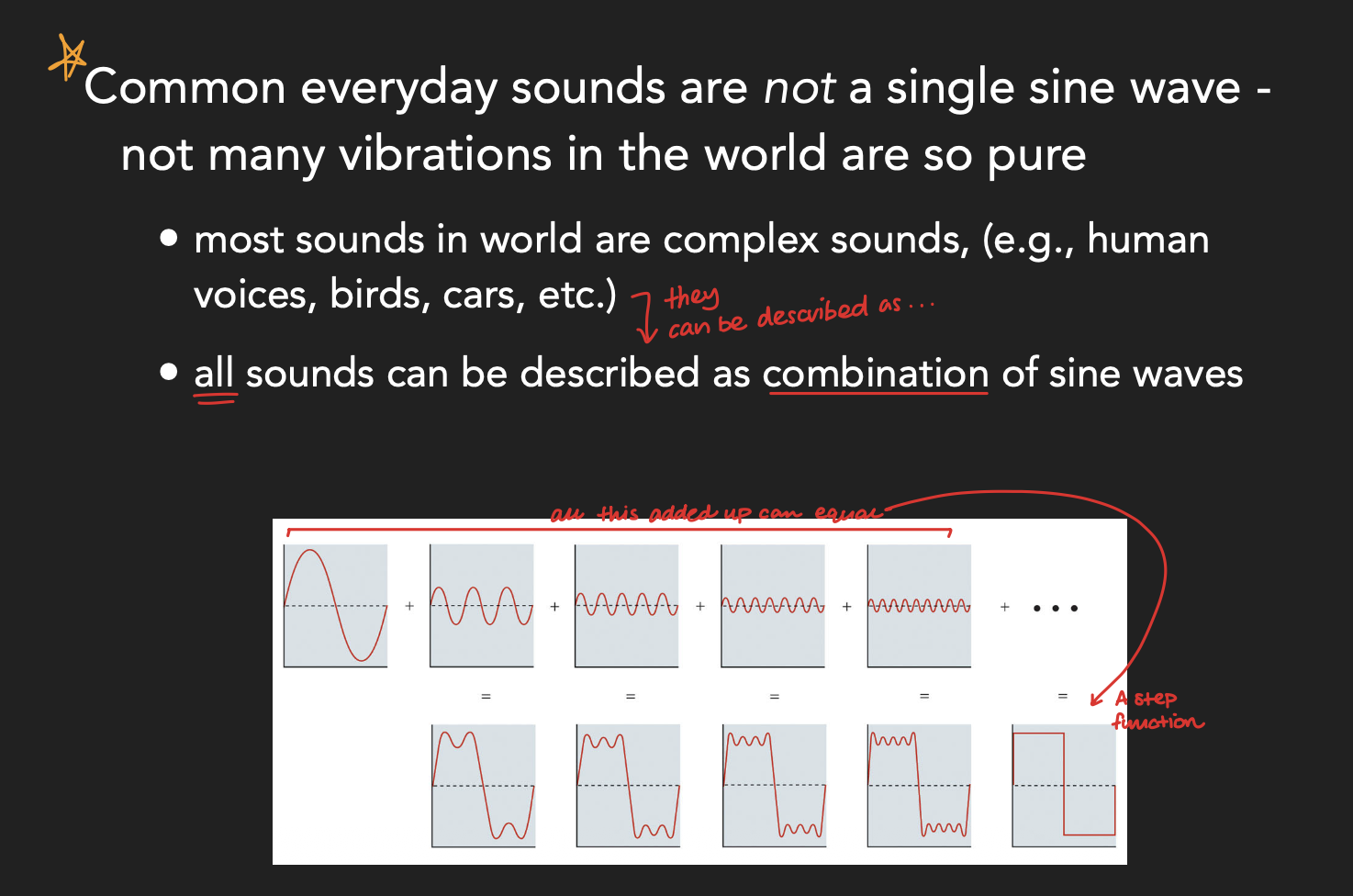
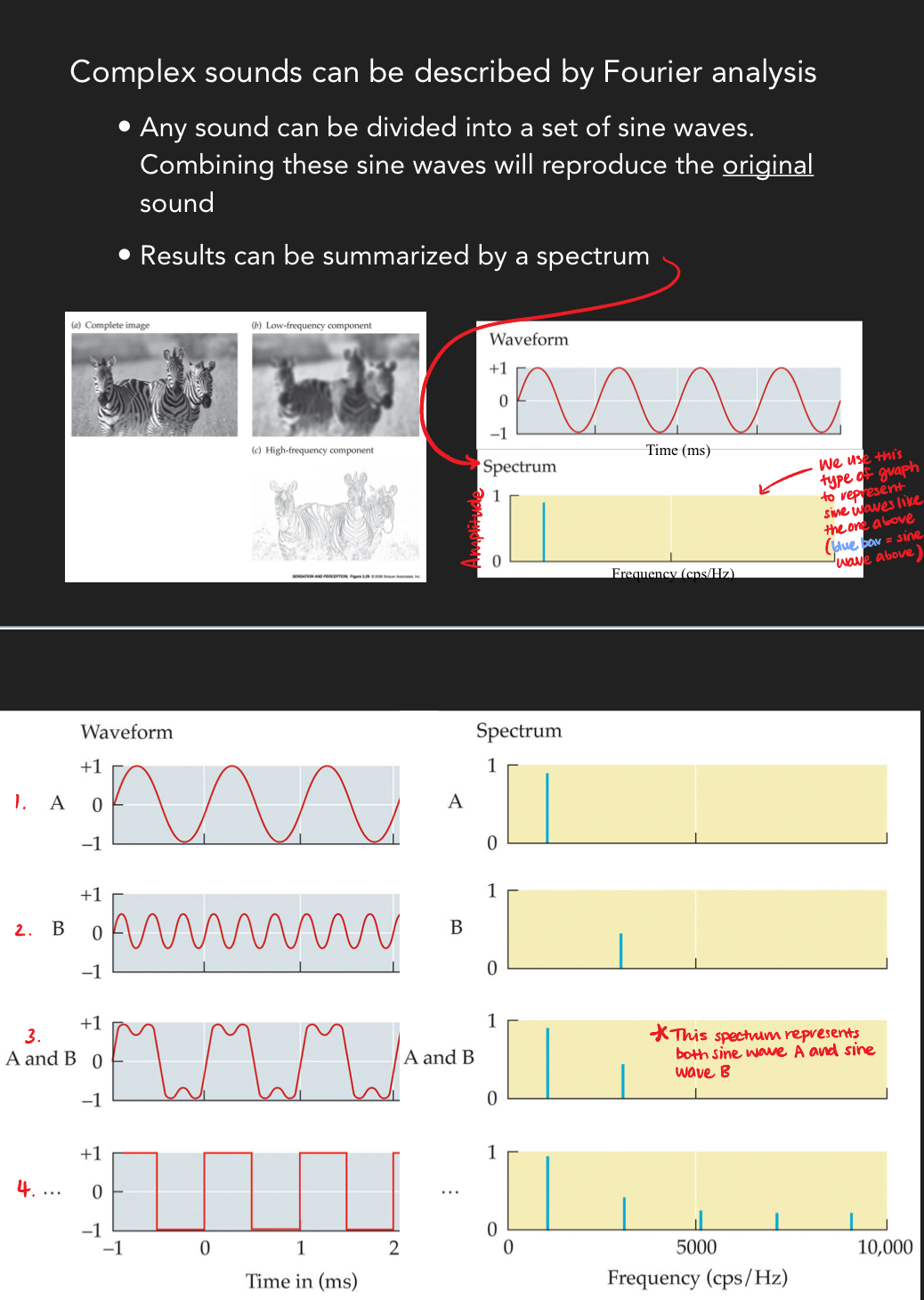
What method do we use to describe complex sounds?
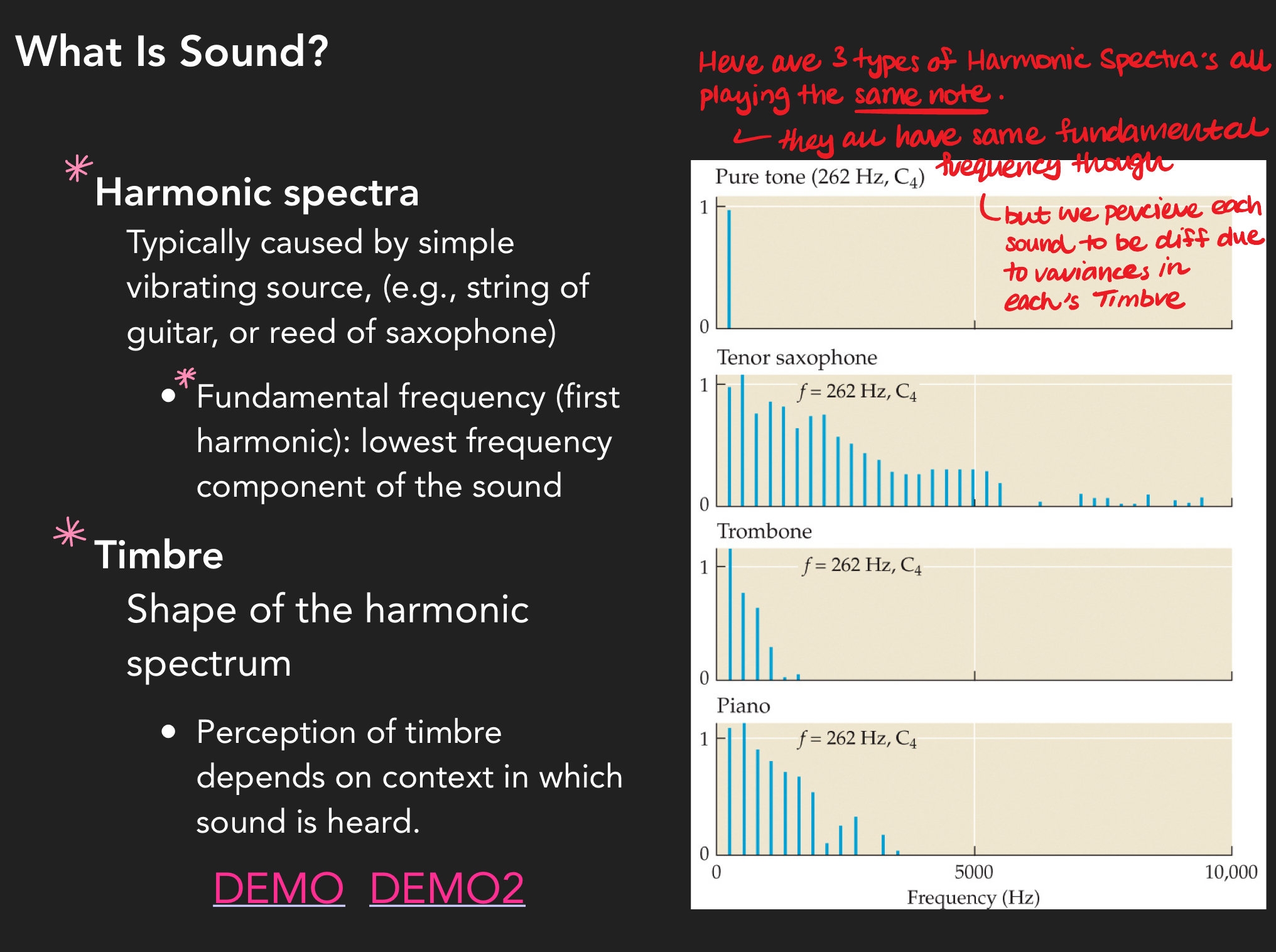
Define harmonic spectra and timbre, how do they work together to influence our perception of sound?
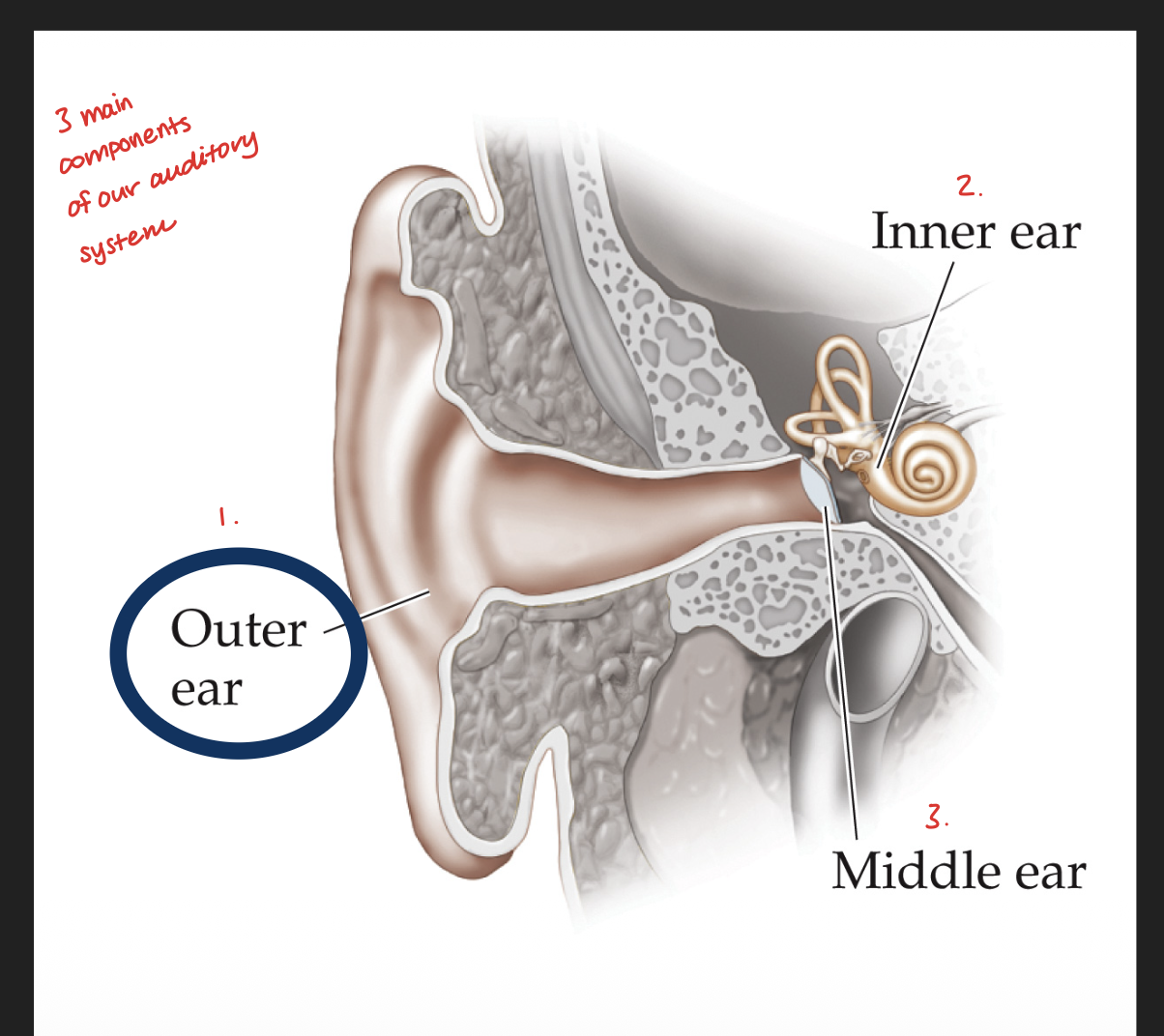
What are the 3 main components of our auditory system?
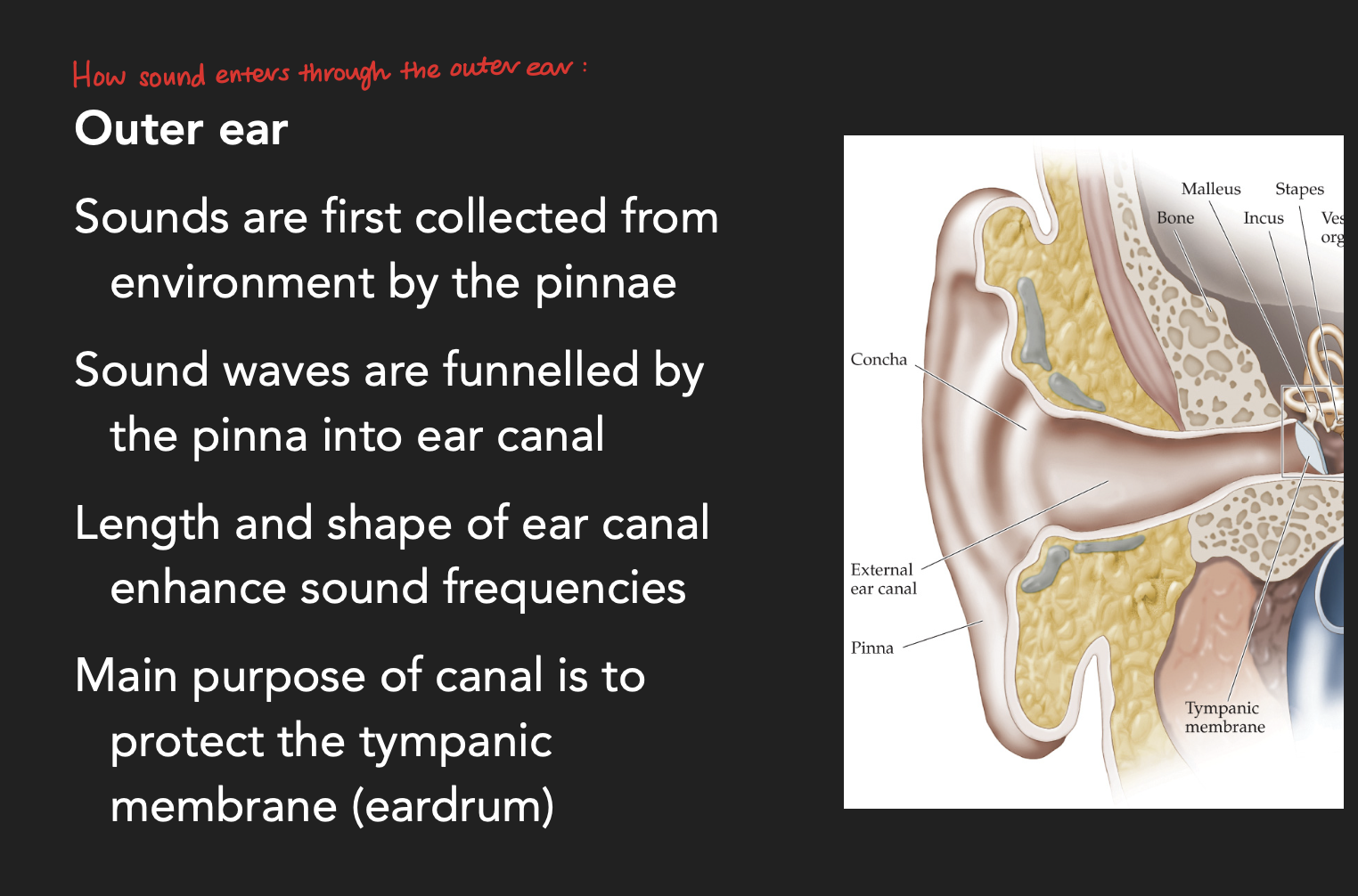
How does sound enter through our outer ear?
Define tympanic membrane.

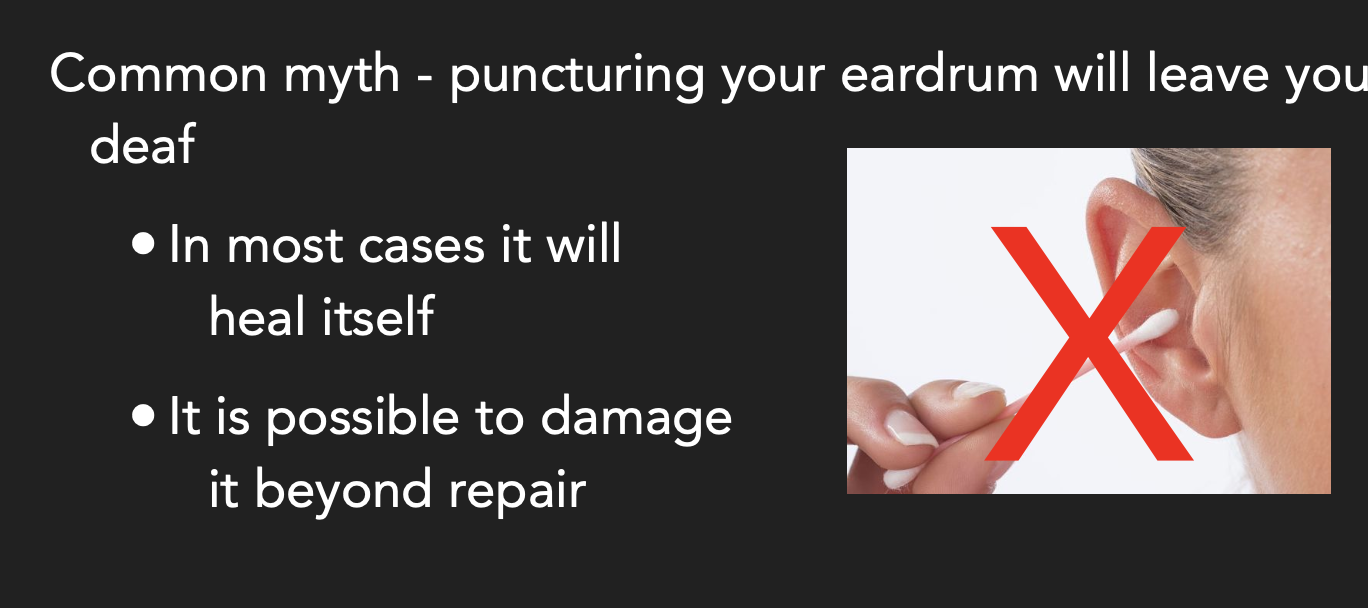
Will puncturing your ear drum leave you deaf?
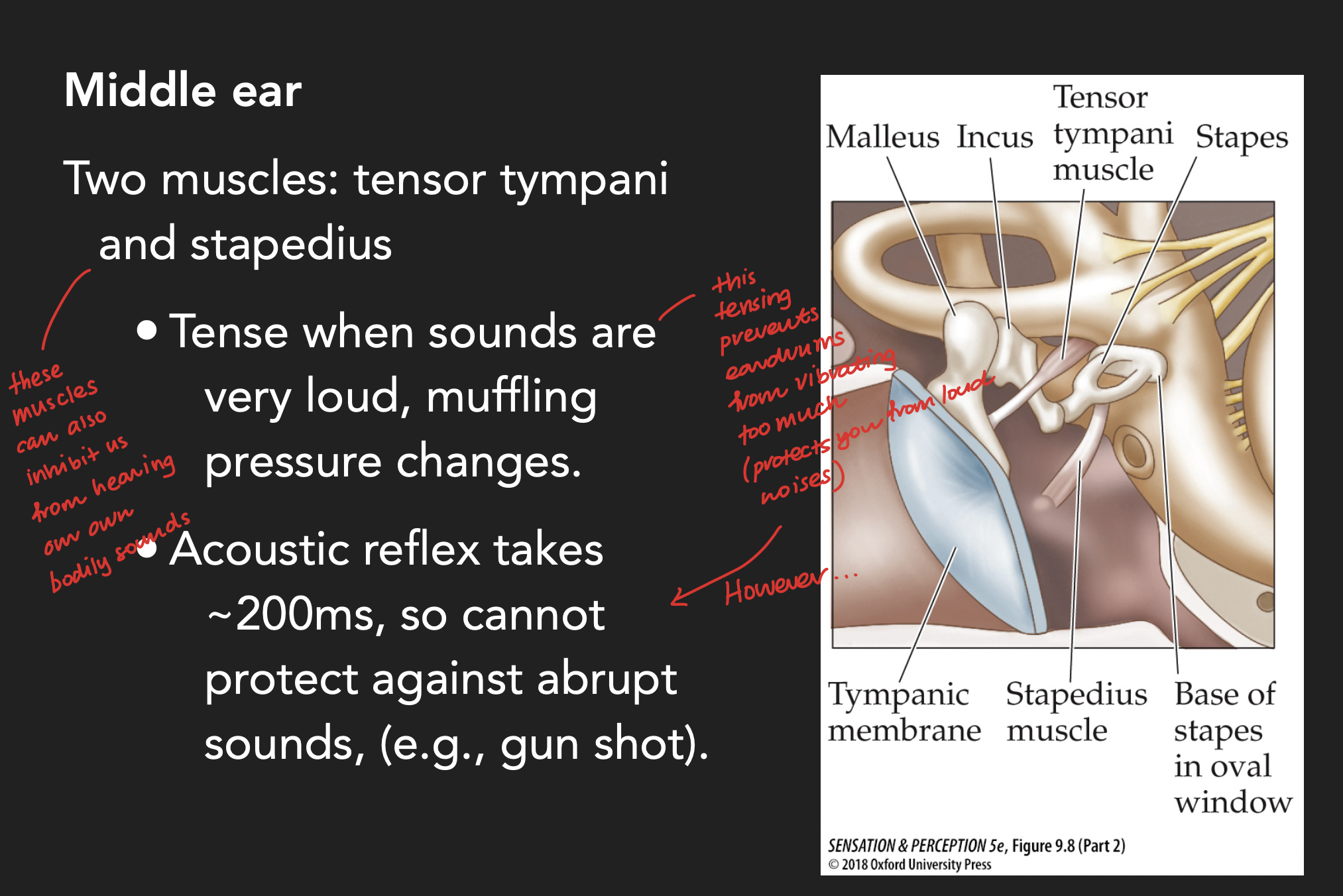
What bones are found in the middle ear and what do they do?
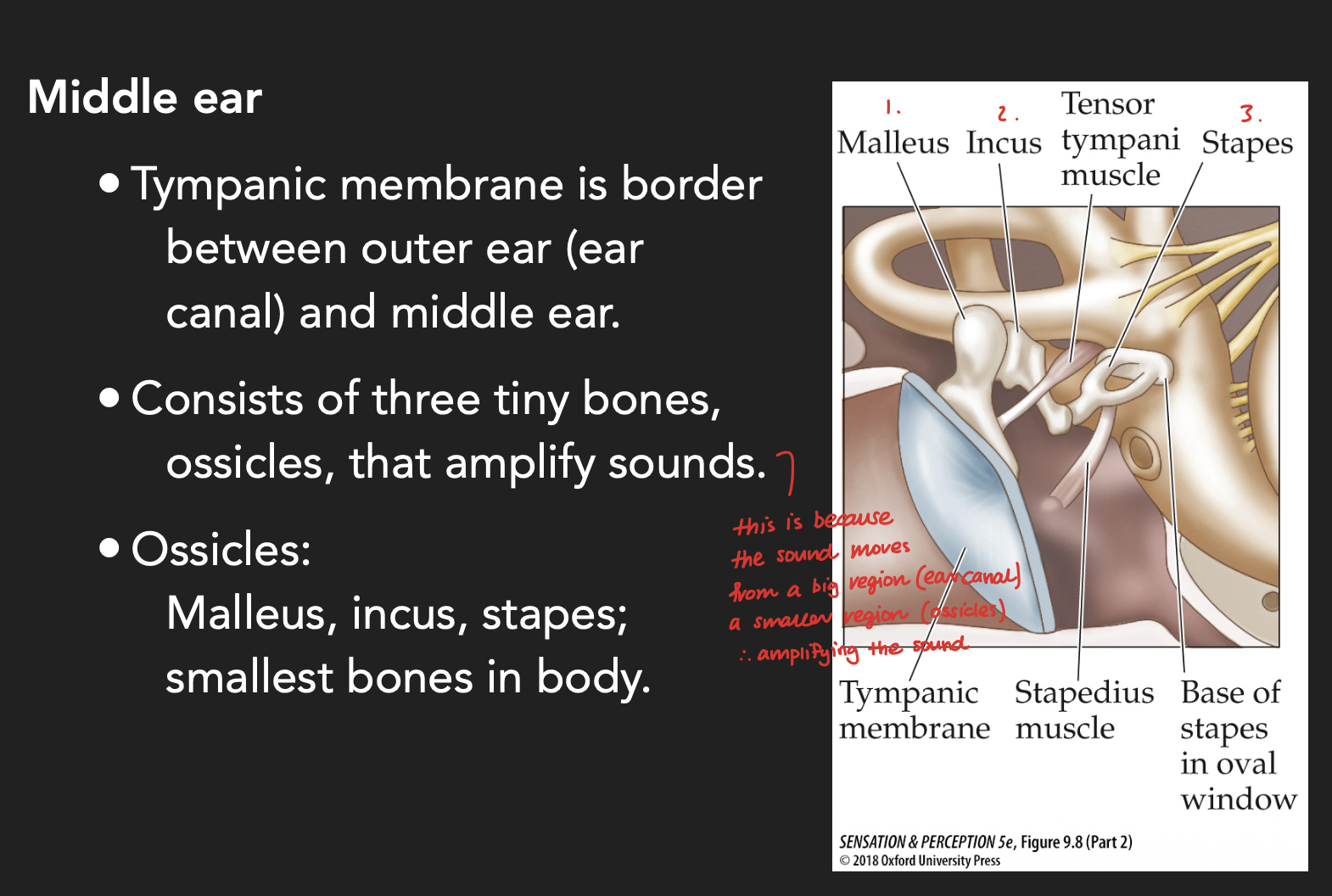
How do the ossicles amplify sound?
They take the large surface area of the eardrum and reduce the sound energy to a much smaller area (i.e., the end of the stapes).
*the eardrum is 18x larger than the stapes fyi
What 2 muscles are found in our middle ear? What are their characteristics?
Explain what occurs in the inner ear.
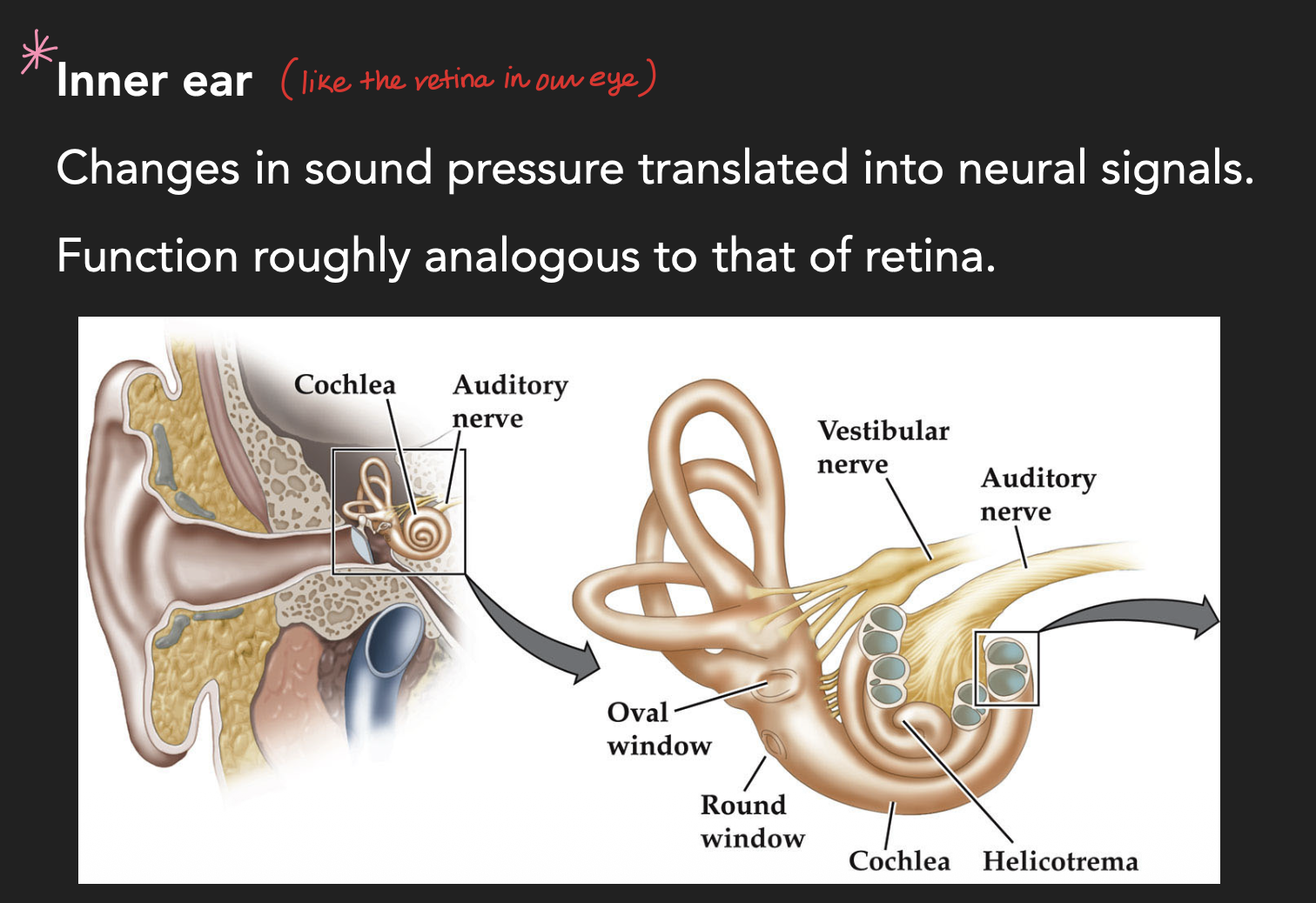
Define cochlea.

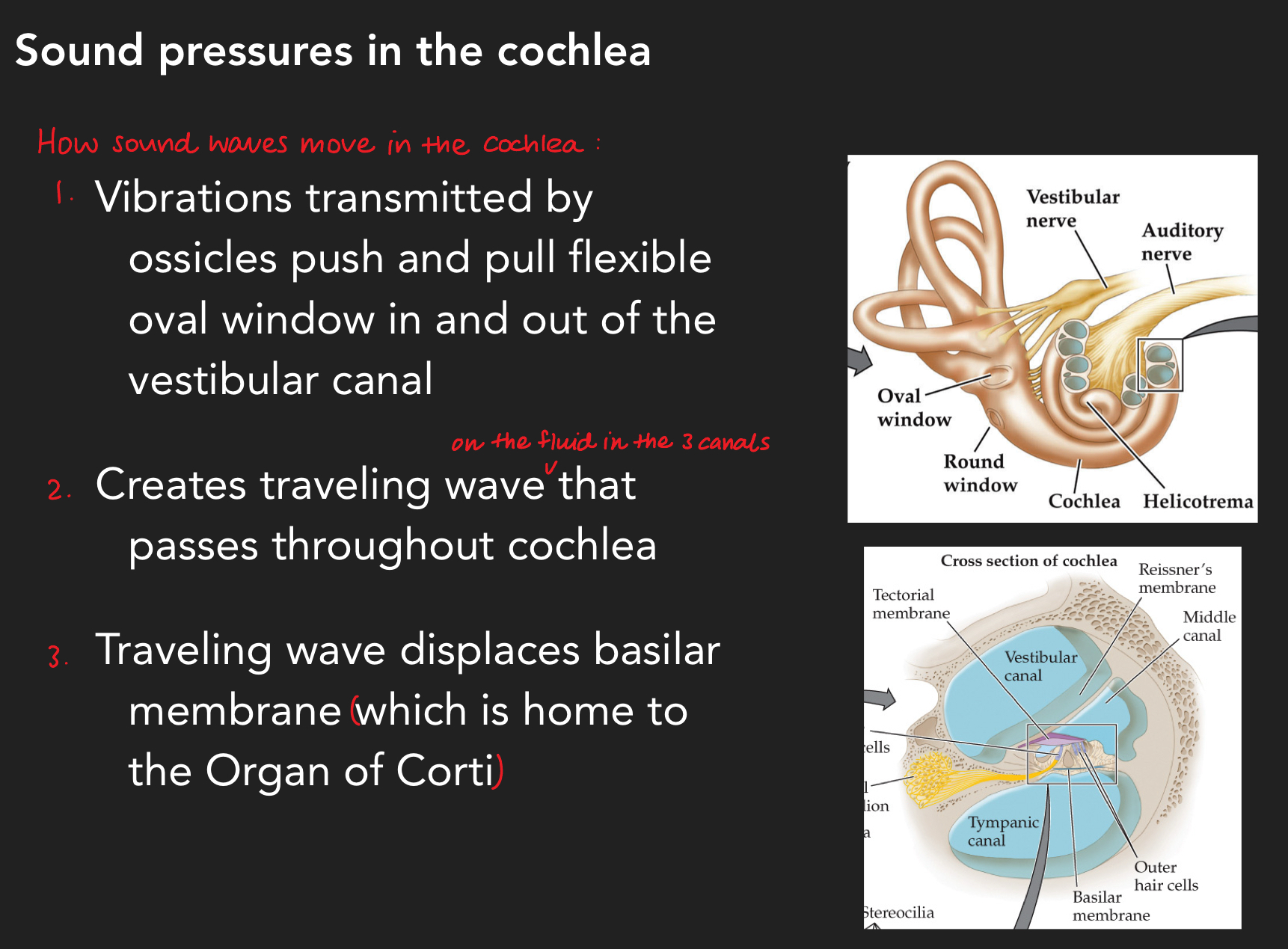
Explain the structure of the cochlea.
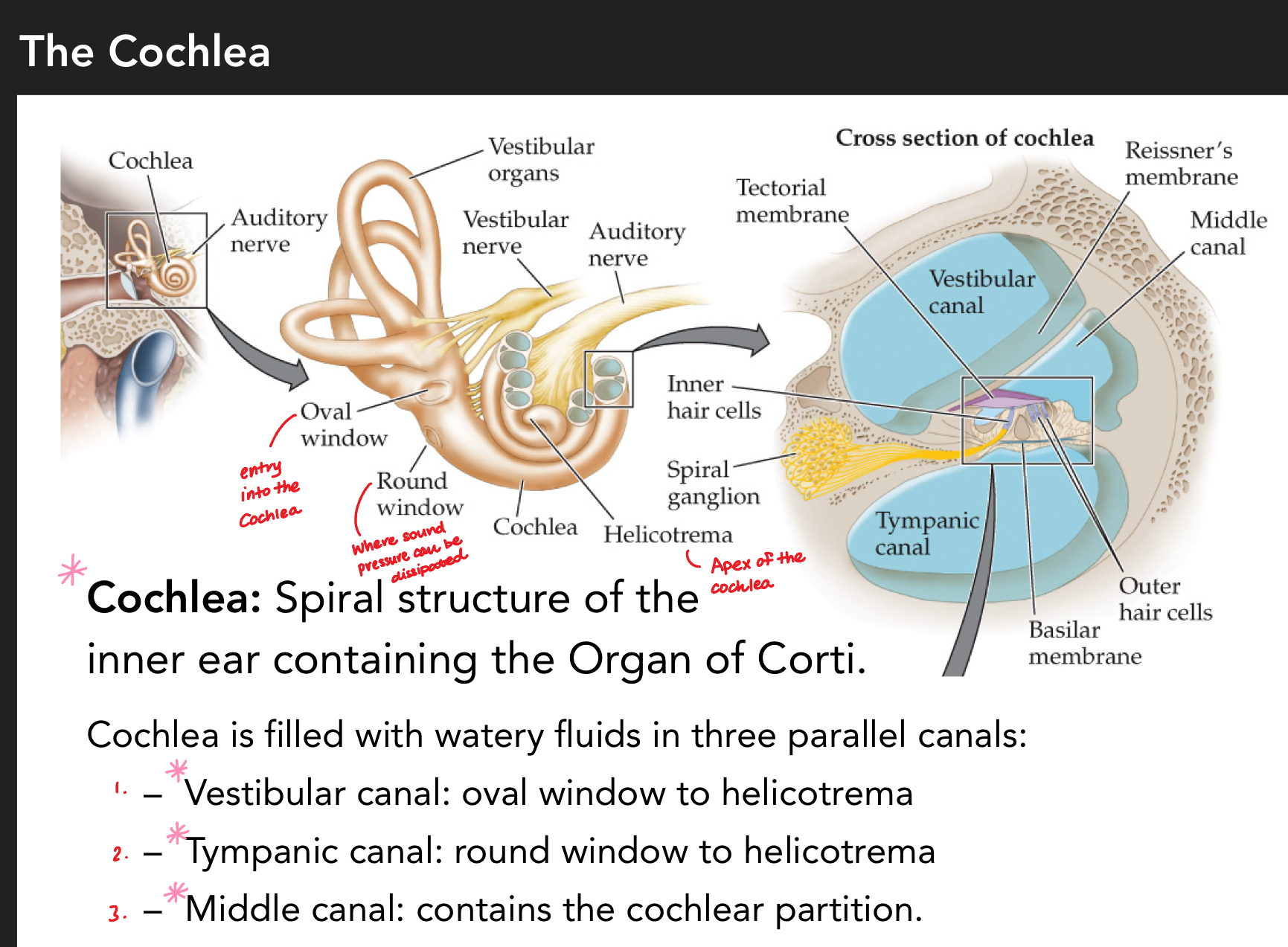
What 2 membranes separate the three cochlear canals?
Reissner’s Membrane
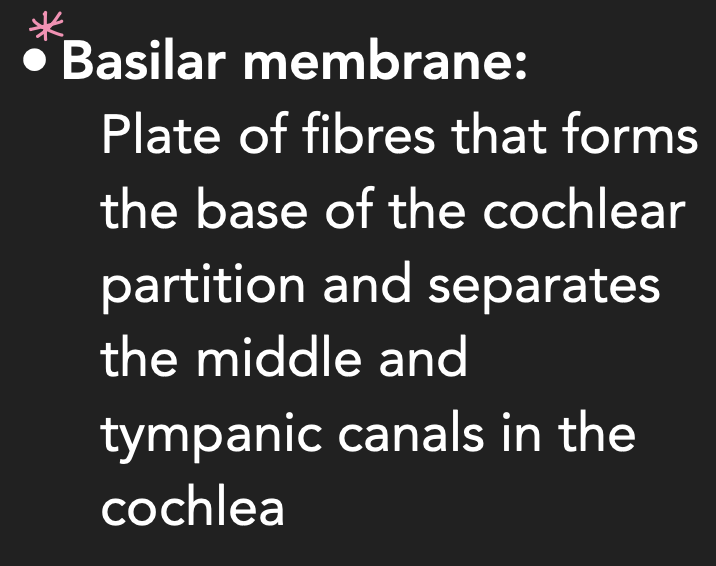
Basilar Membrane
Define Reissner’s Membrane.

Define Basilar Membrane.
*also holds the organ of corti
How do sound waves move through the cochlea?
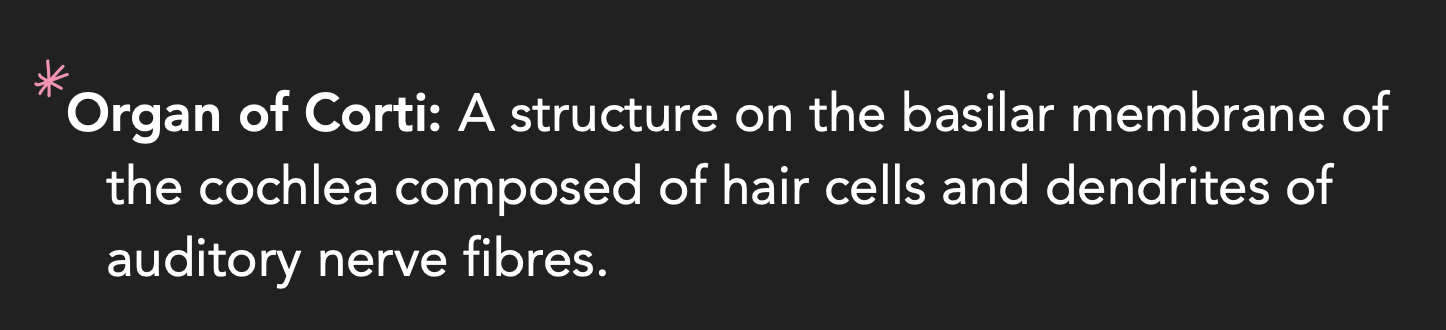
Define organ of corti.
*where transduction of sound energy to a neural signal occurs
Define stereocilia.
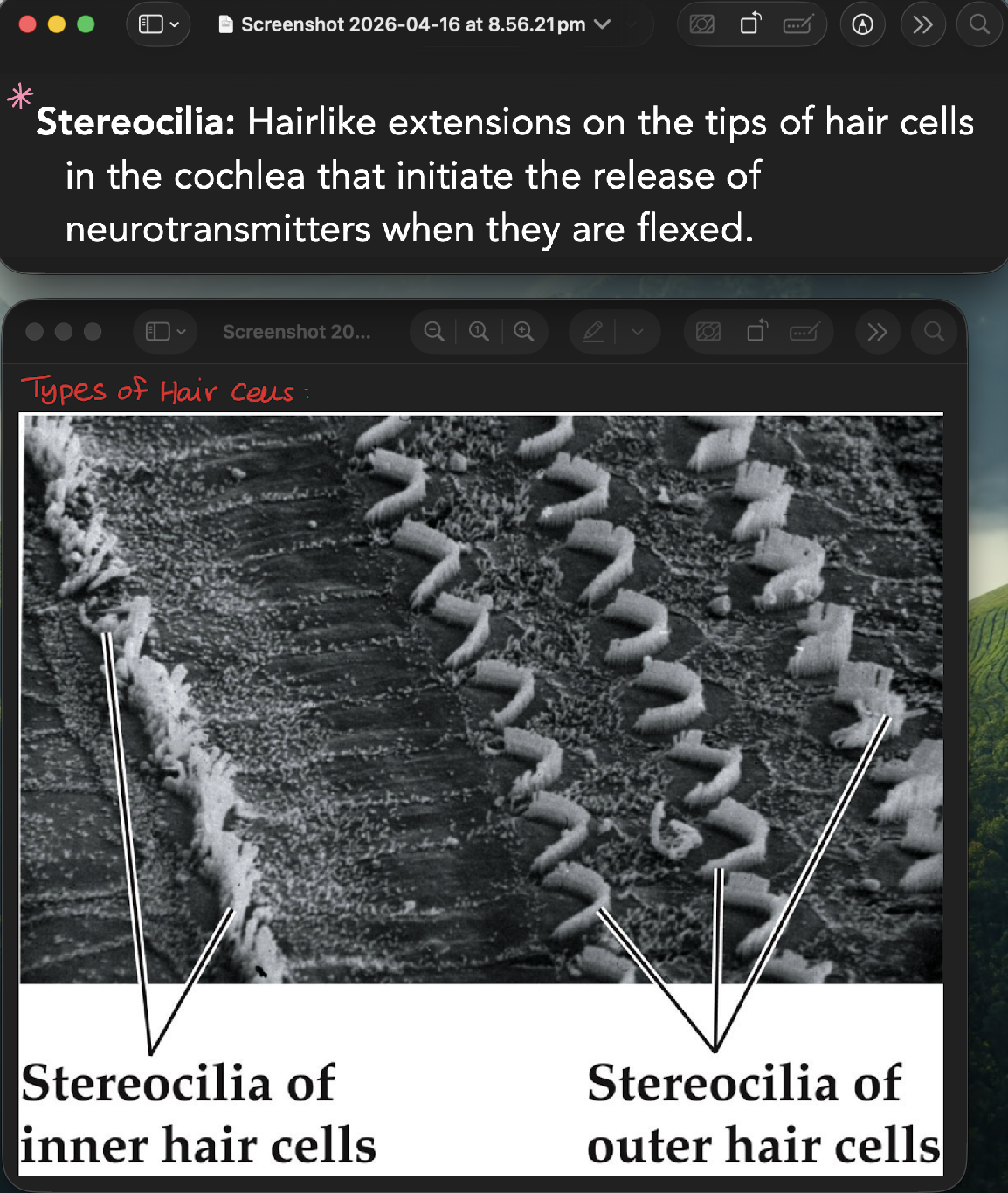
How do the hair cells move?
*the travelling wave moves the basilar membrane (which the hair cells are attached to) and the tectorial membrane brushes against the hair cells—making them move.
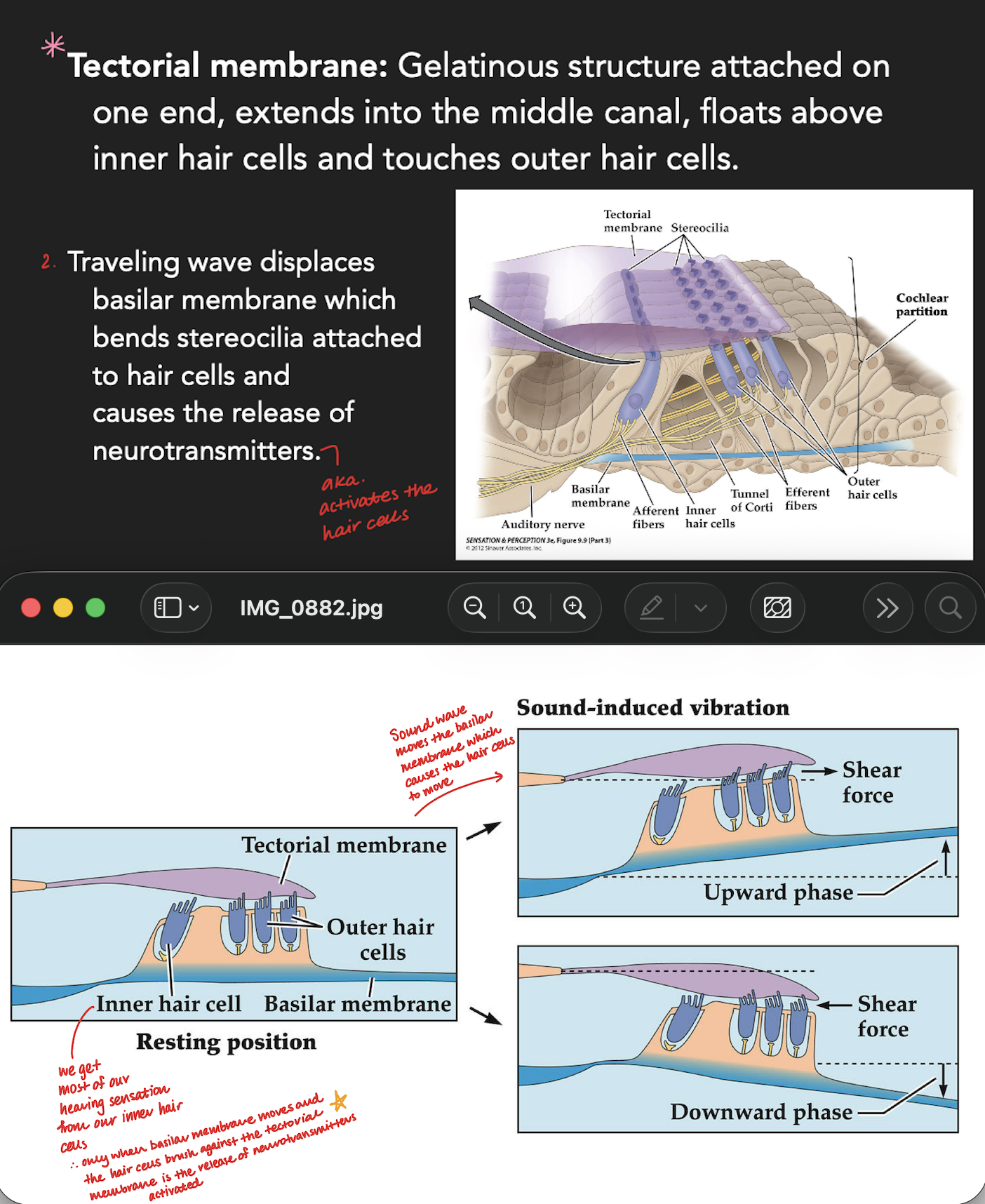
How are neurotransmitters released when stereocilia are moved?
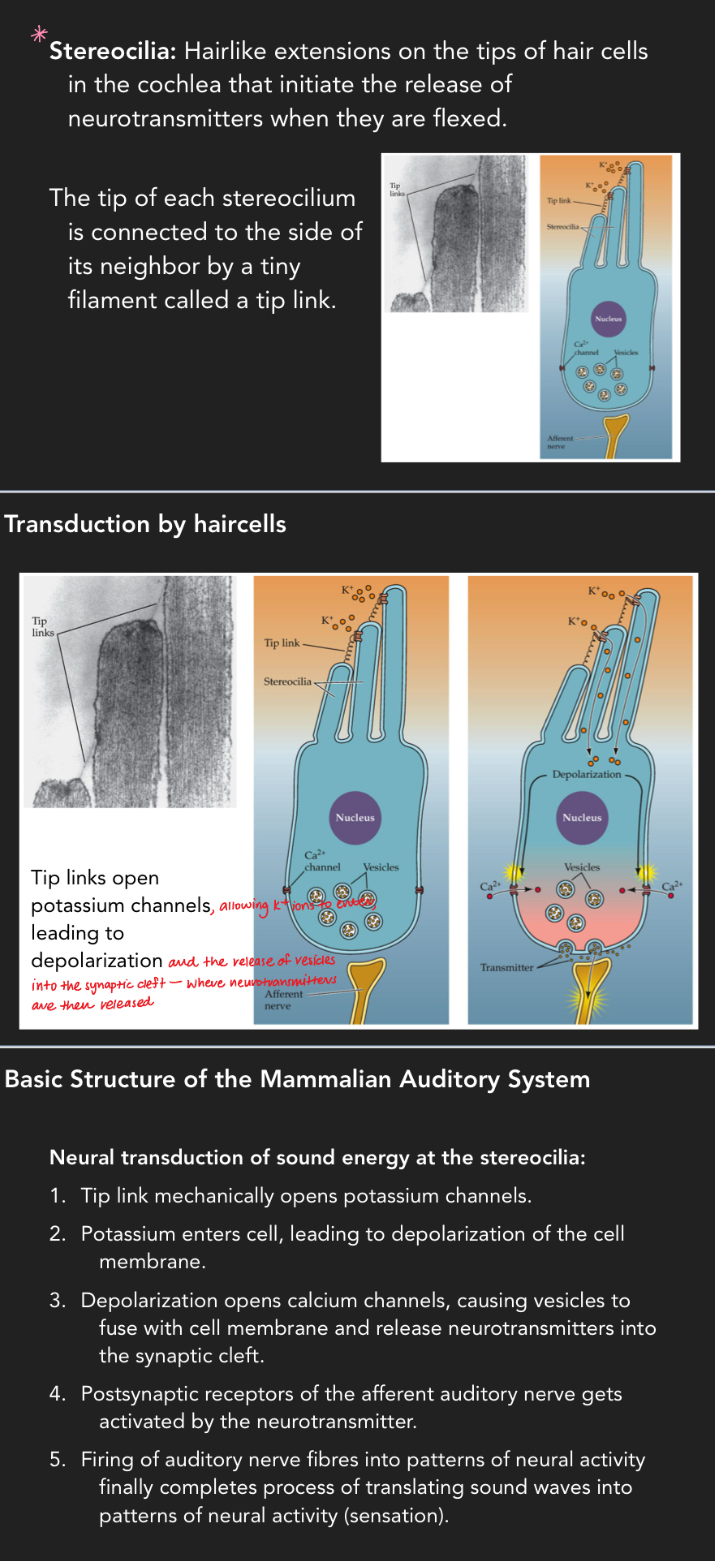
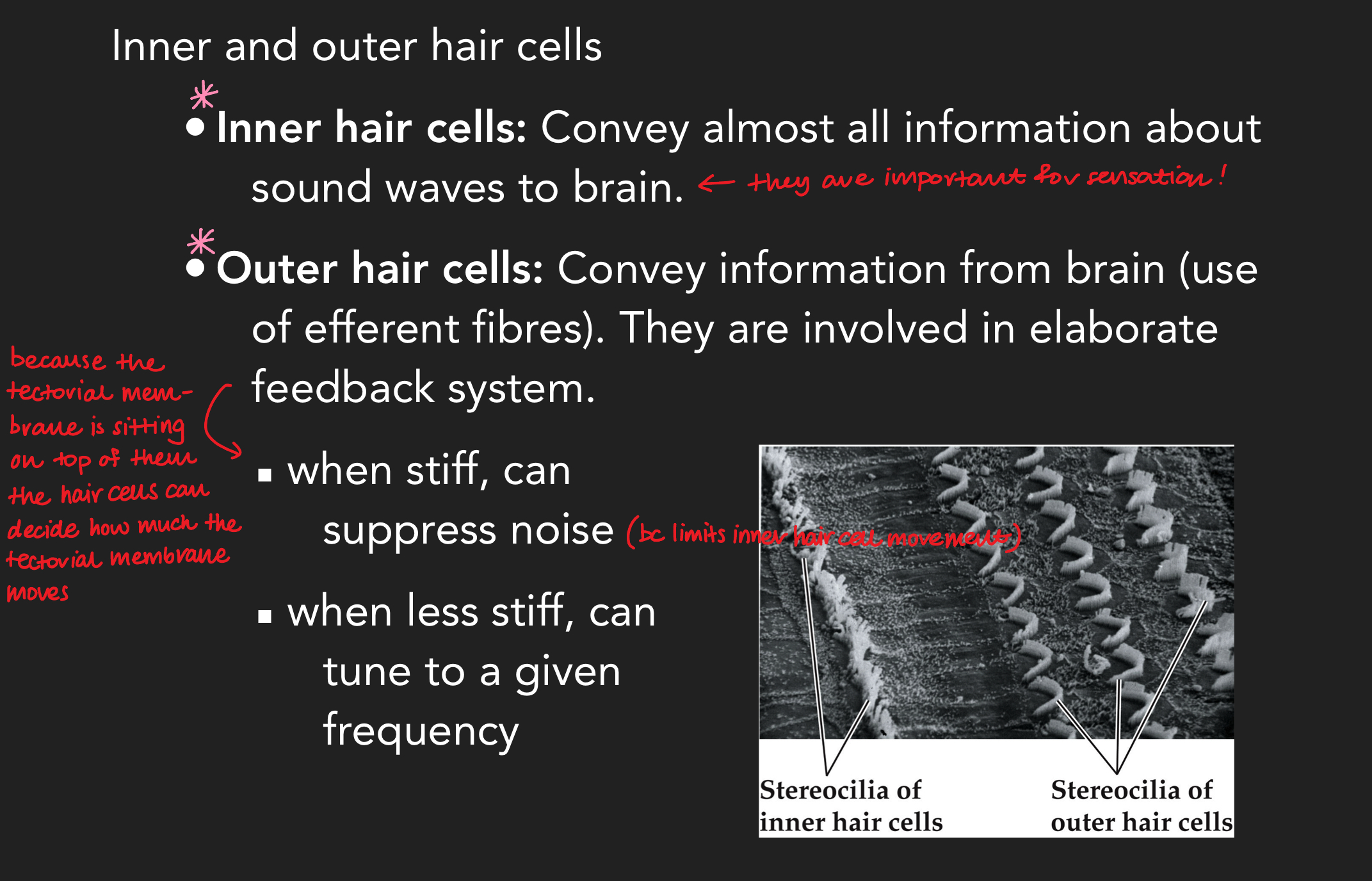
What do the inner and outer hair cells do?
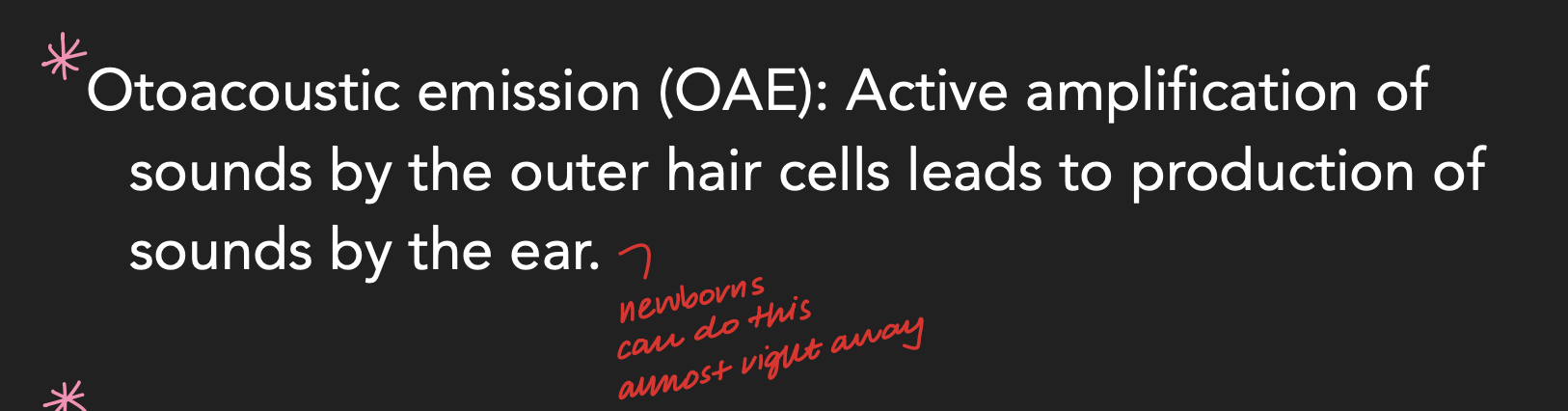
Define otoacoustic emission (OAE).
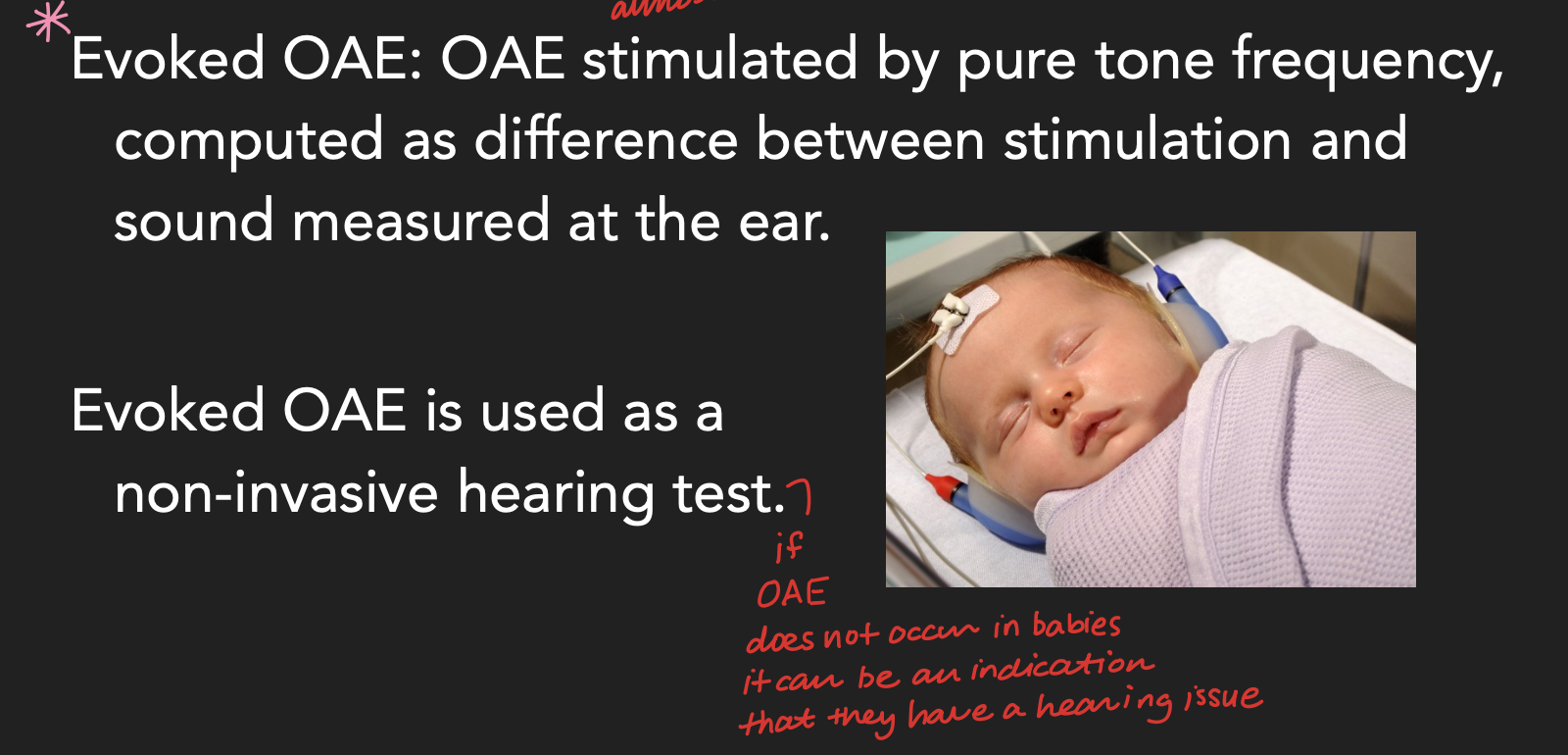
Define evoked OAE
How do we code for the different aspects of sound?
Amplitude:
This is coded in the cochlea by the amount of displacement of the hair cells (the higher the amplitude of the sound waves, the larger the movement of the tectorial membrane)
Frequency:
This is coded via place coding where different parts of the cochlea are tuned to different frequencies because of the shape of the basilar membrane (high frequencies bend the stiffer regions of the membrane of the cochlea, and lower frequencies bend the more flexible regions near the apex of the cochlea)
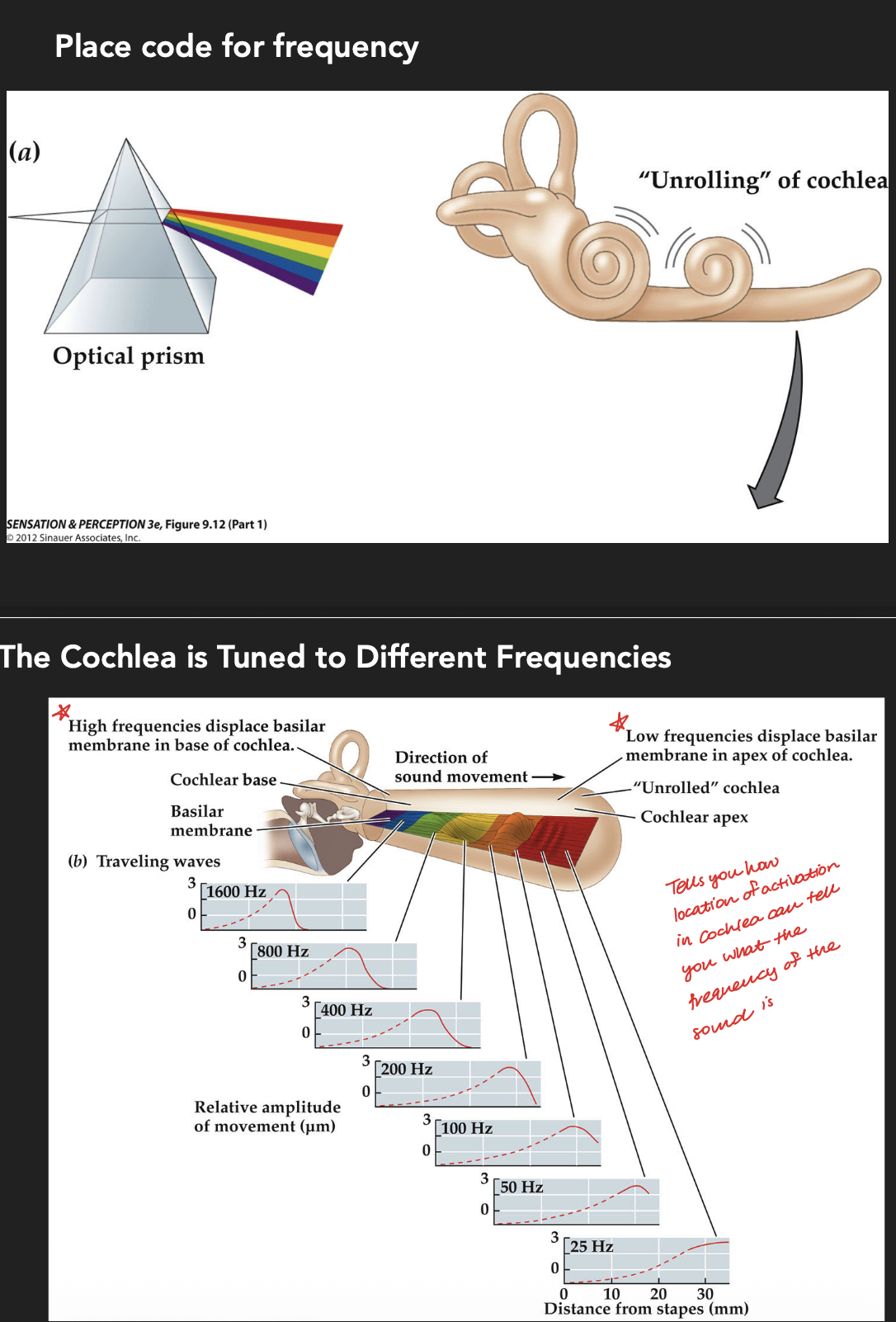
Are auditory nerve fibres tuned to specific frequencies?
Yes!
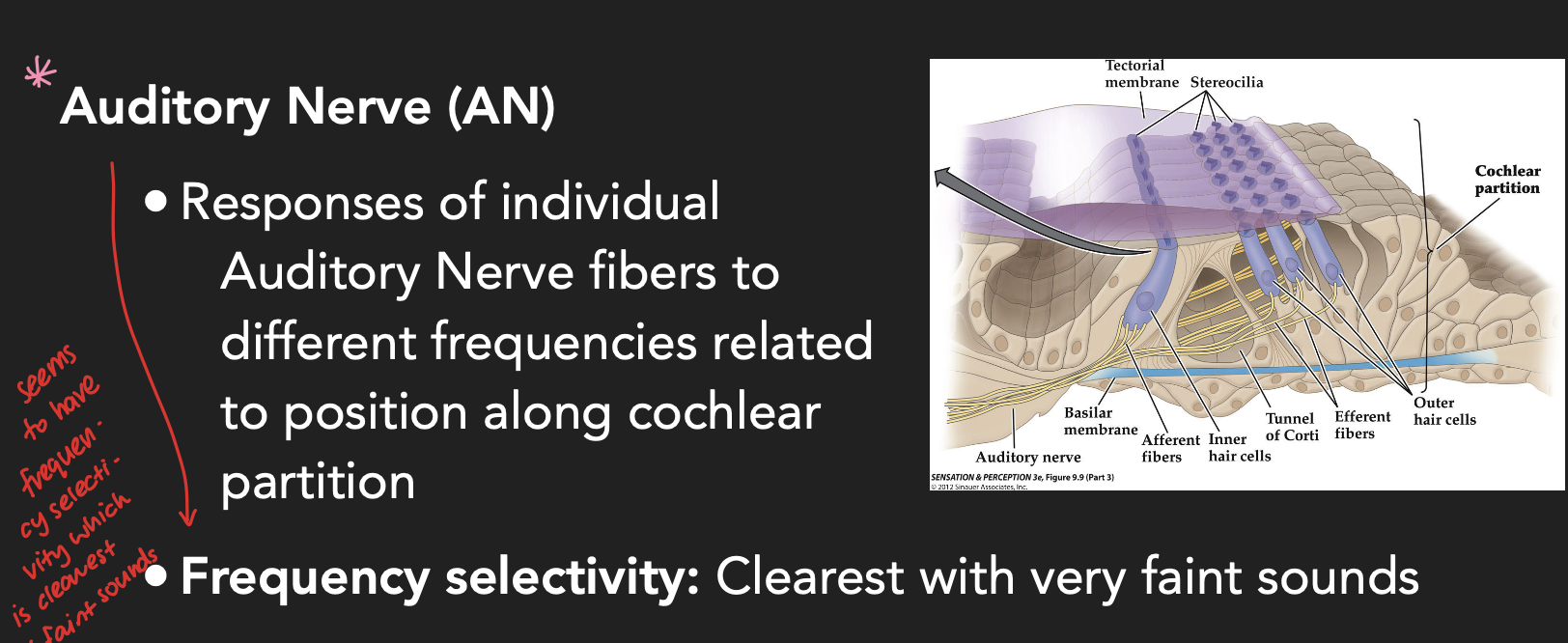
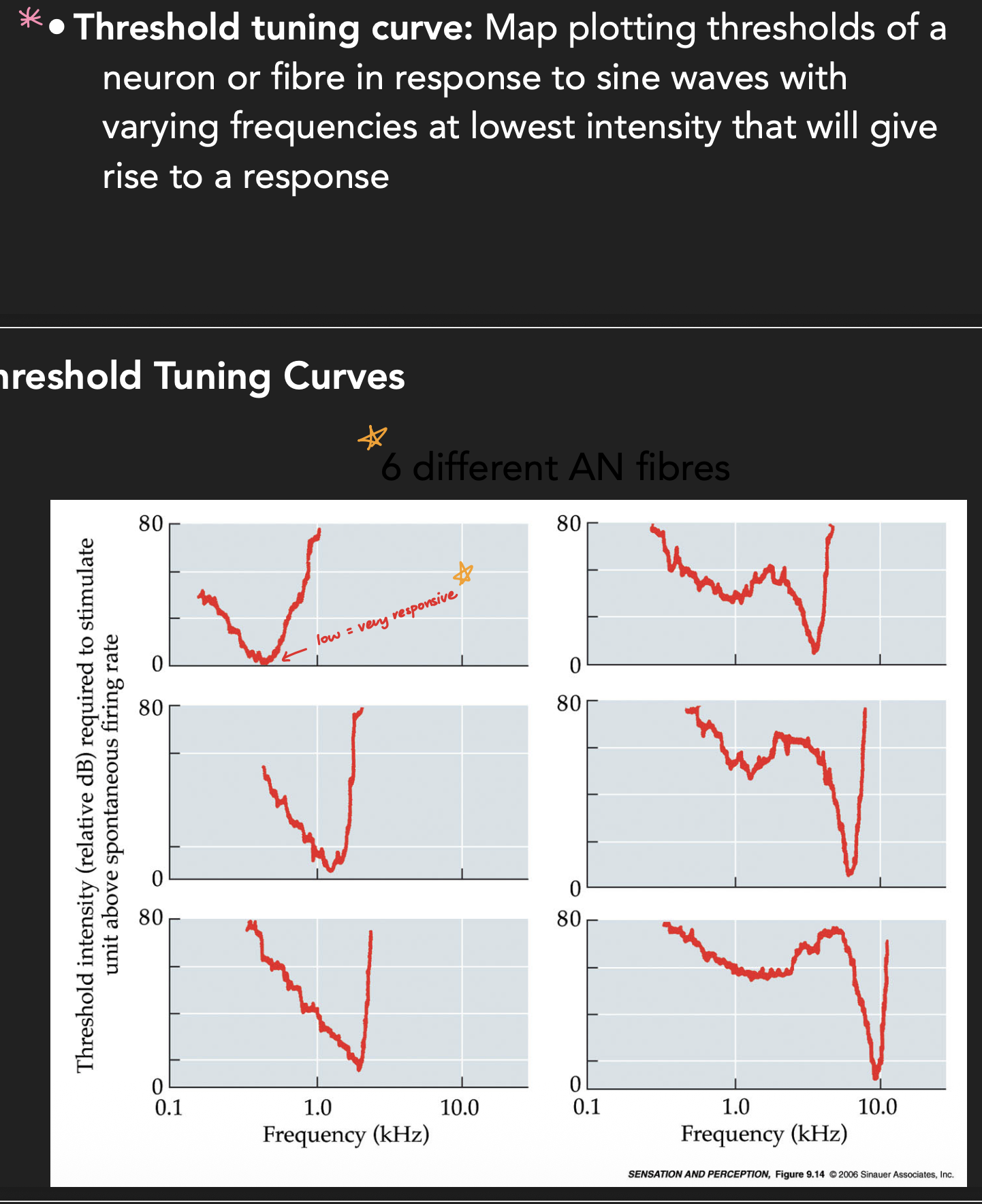
What’s the best way to see how different auditory nerves are tuned to different frequencies?
*low = responds to that frequency the easiest (aka likes that frequency the most)
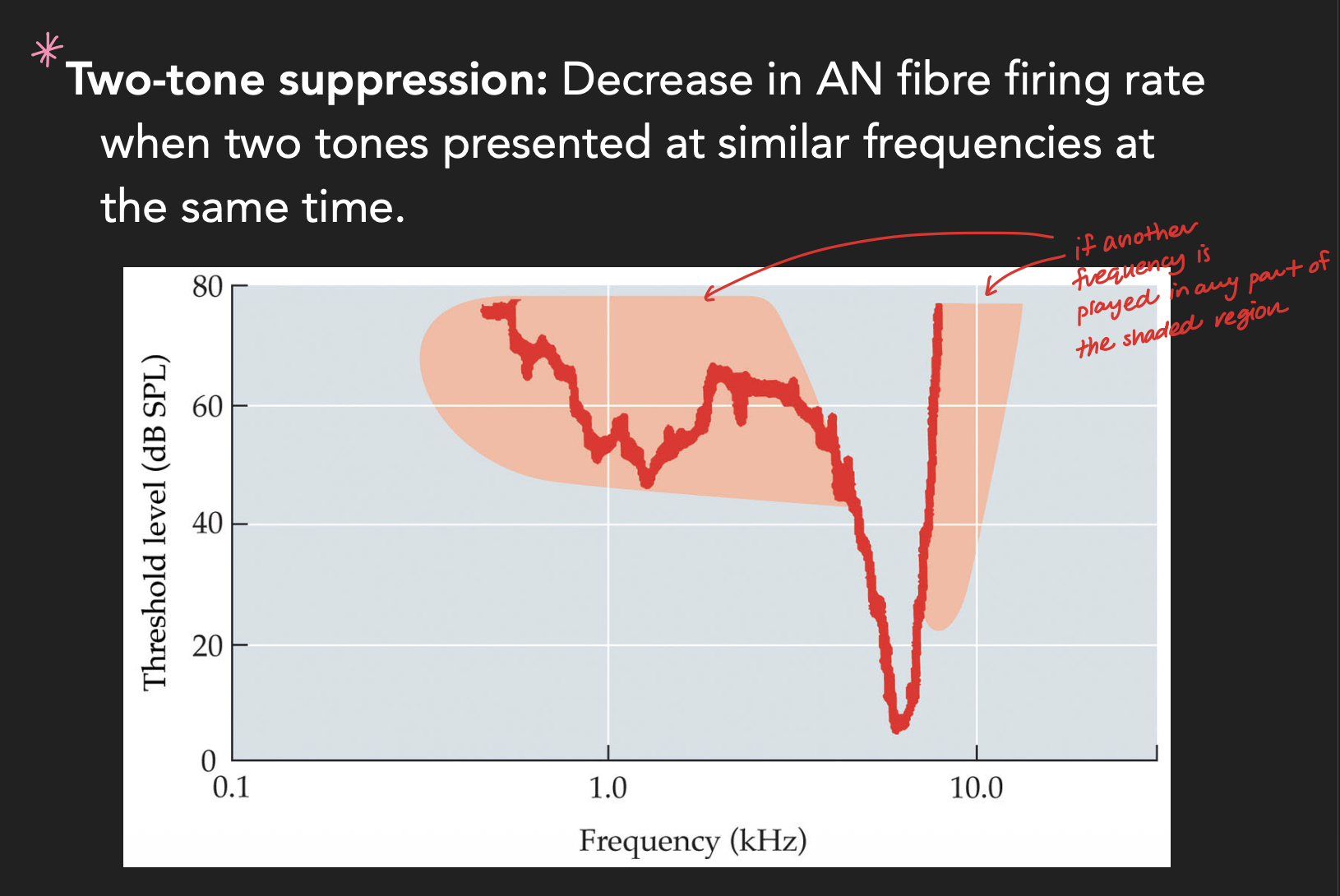
Define two-tone suppression.
Define isointensity curves.
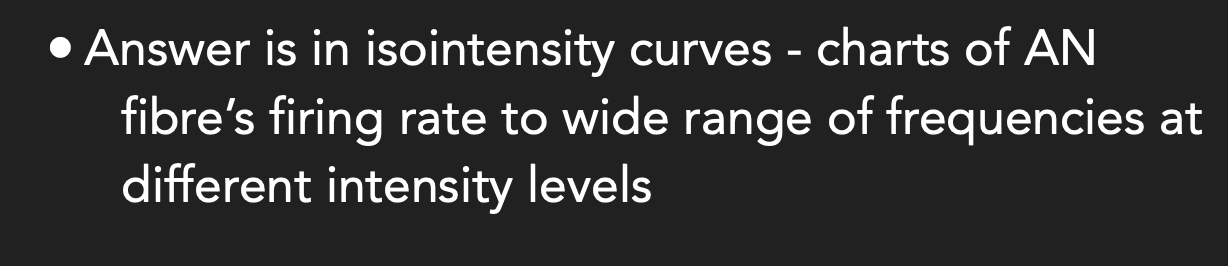
How come we do not have a clear explanation of when auditory nerves are stimulated at specific frequencies?
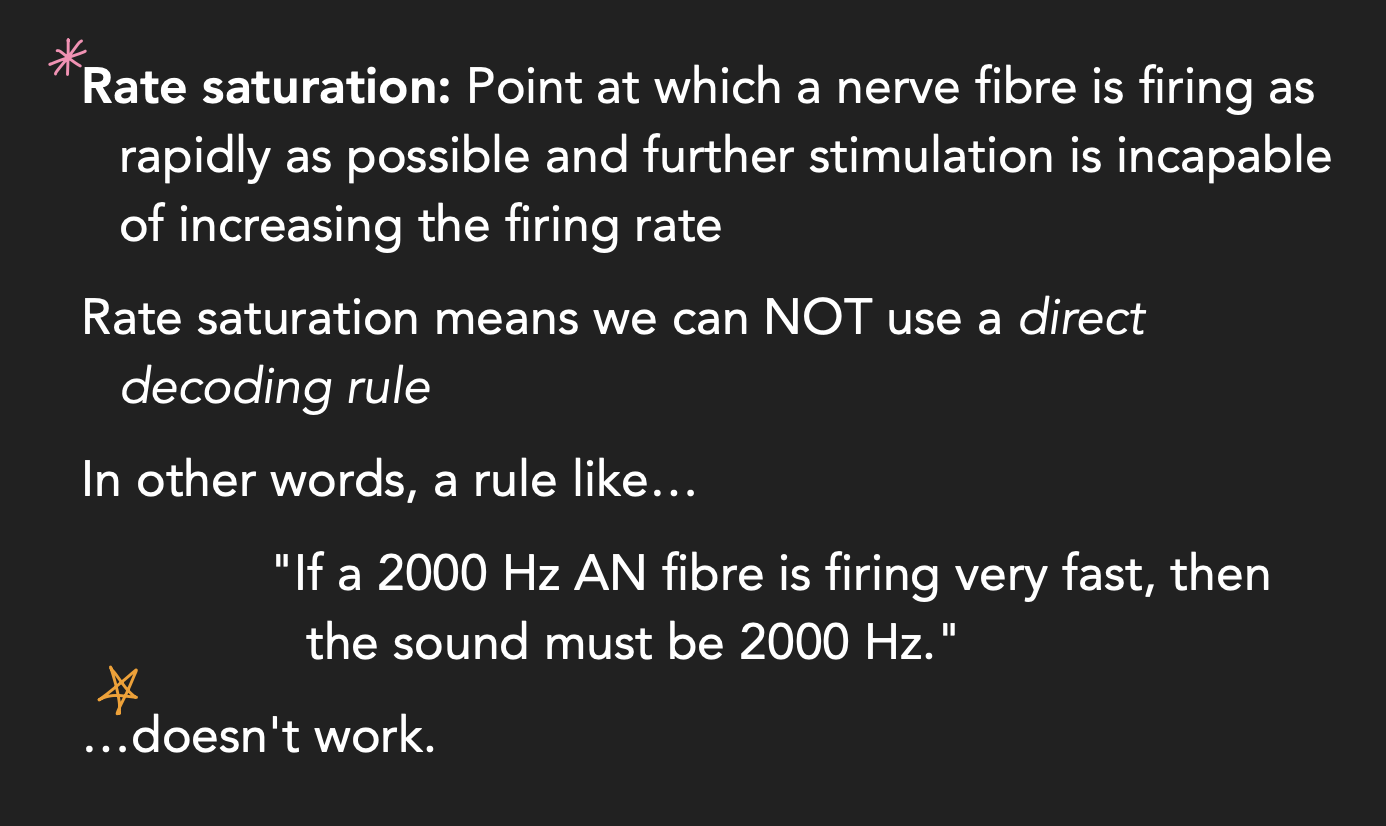
Rate saturation
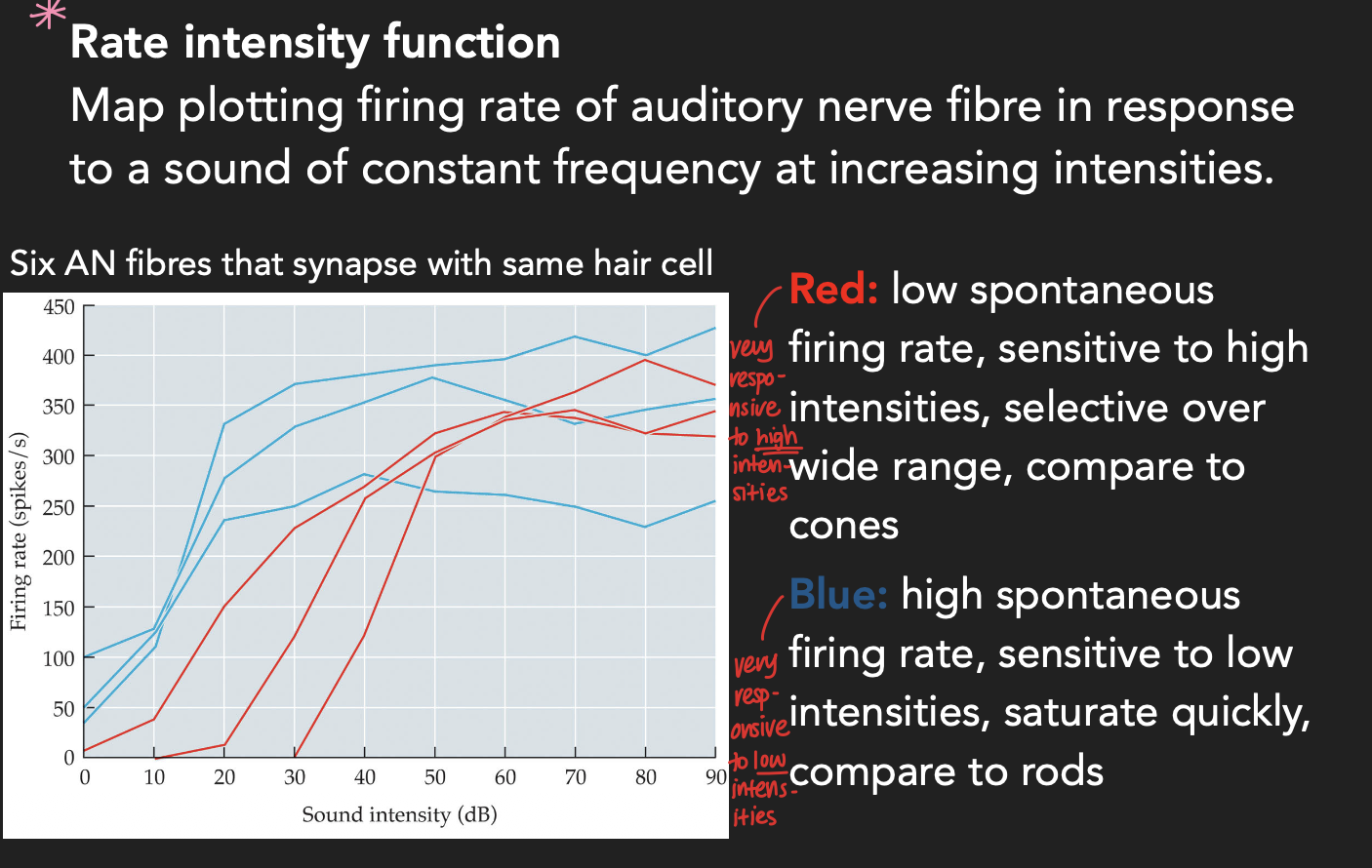
Spontaneity of firing rate
Why does rate saturation make it hard to explain when specific auditory nerves are stimulated at specific frequencies?
Auditory nerve (AN) fibres can only bend so much and so when the sound gets really loud (i.e., high decibel), they start bending at the same rate for a lot of different frequencies—the AN fibres get saturated. Hence, the AN fibres become less selective at higher volumes.
Therefore, even if an AN is selective at 2000Hz at one volume, its selectivity may change when the volume changes.
Define rate saturation. What are the implications of rate saturation?
Explain how differences in the spontaneity of firing responses makes it hard to explain when specific auditory nerves are stimulated at specific frequencies?
How do our ears make sense of the sound we are hearing?
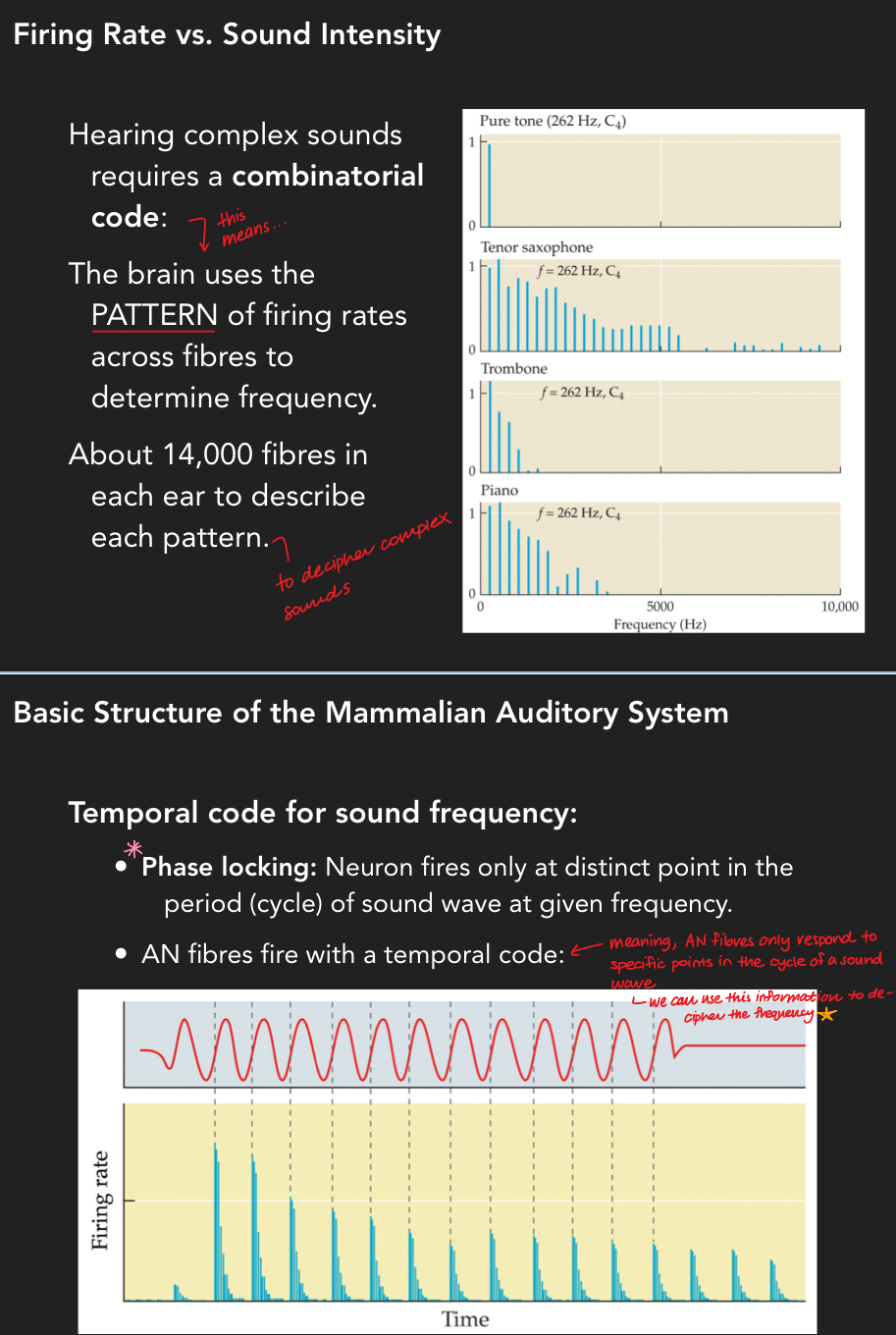
How do we transform temporal code to frequency?
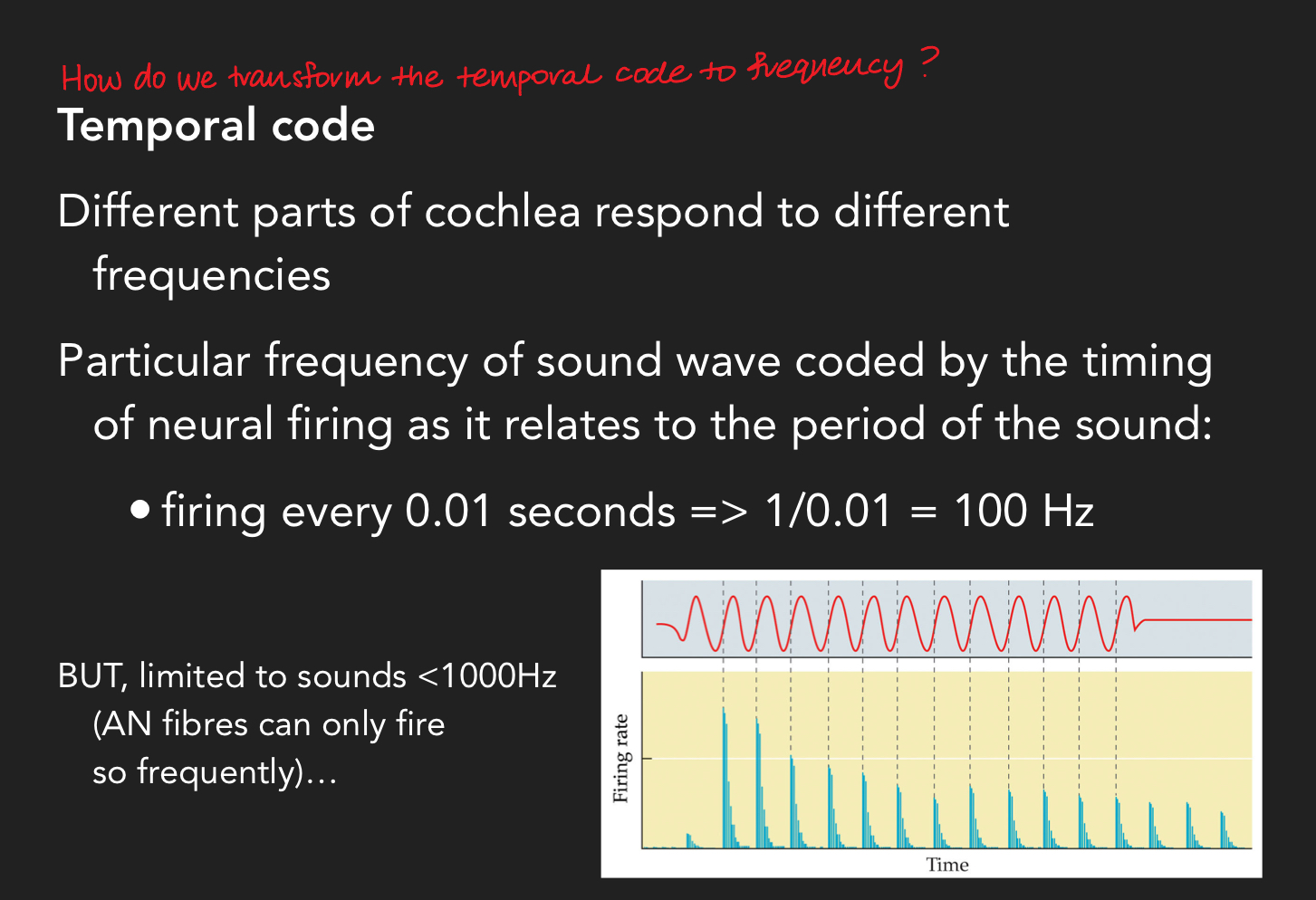
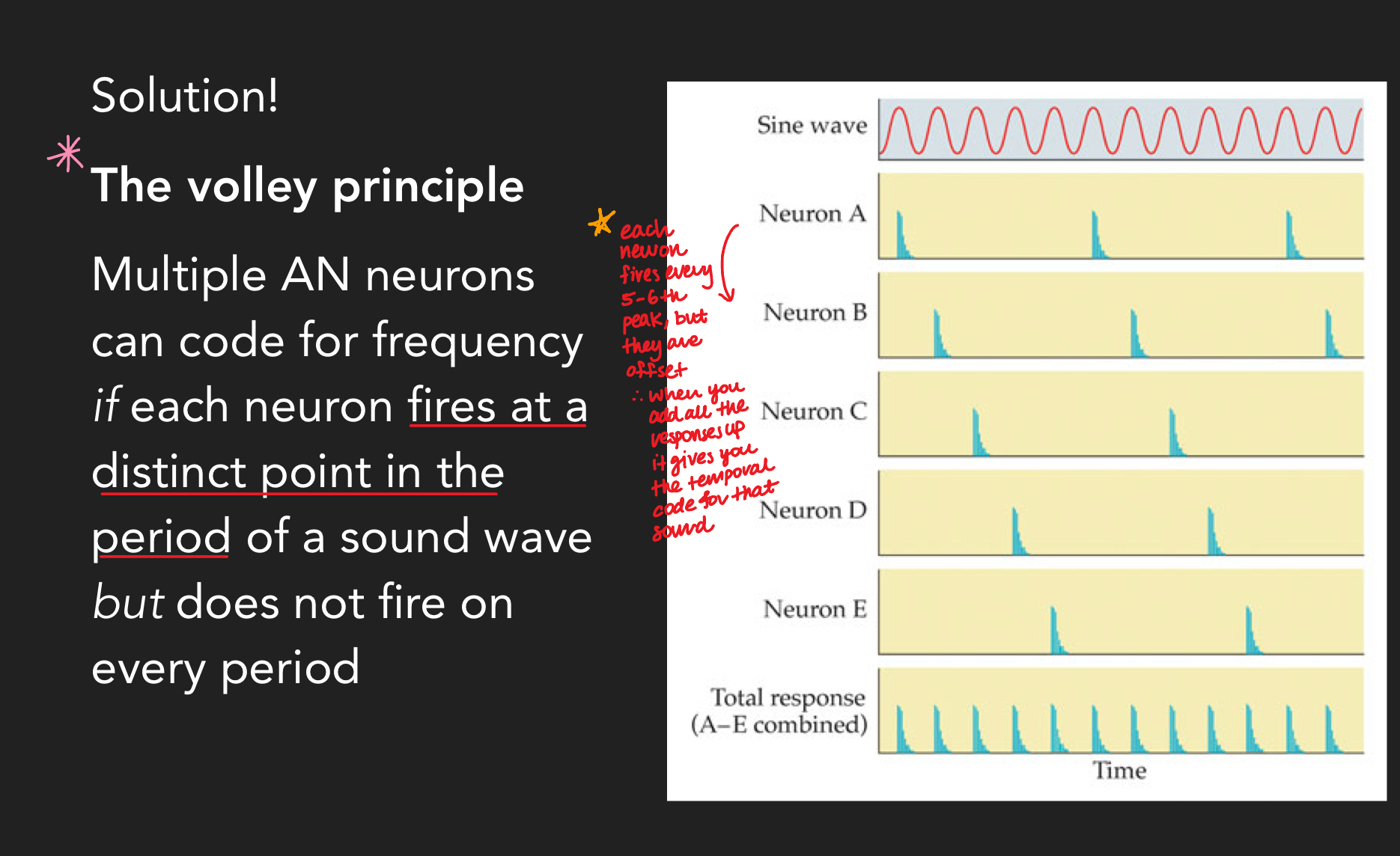
How do we get a temporal code if phase locking only works for sounds <1000Hz?
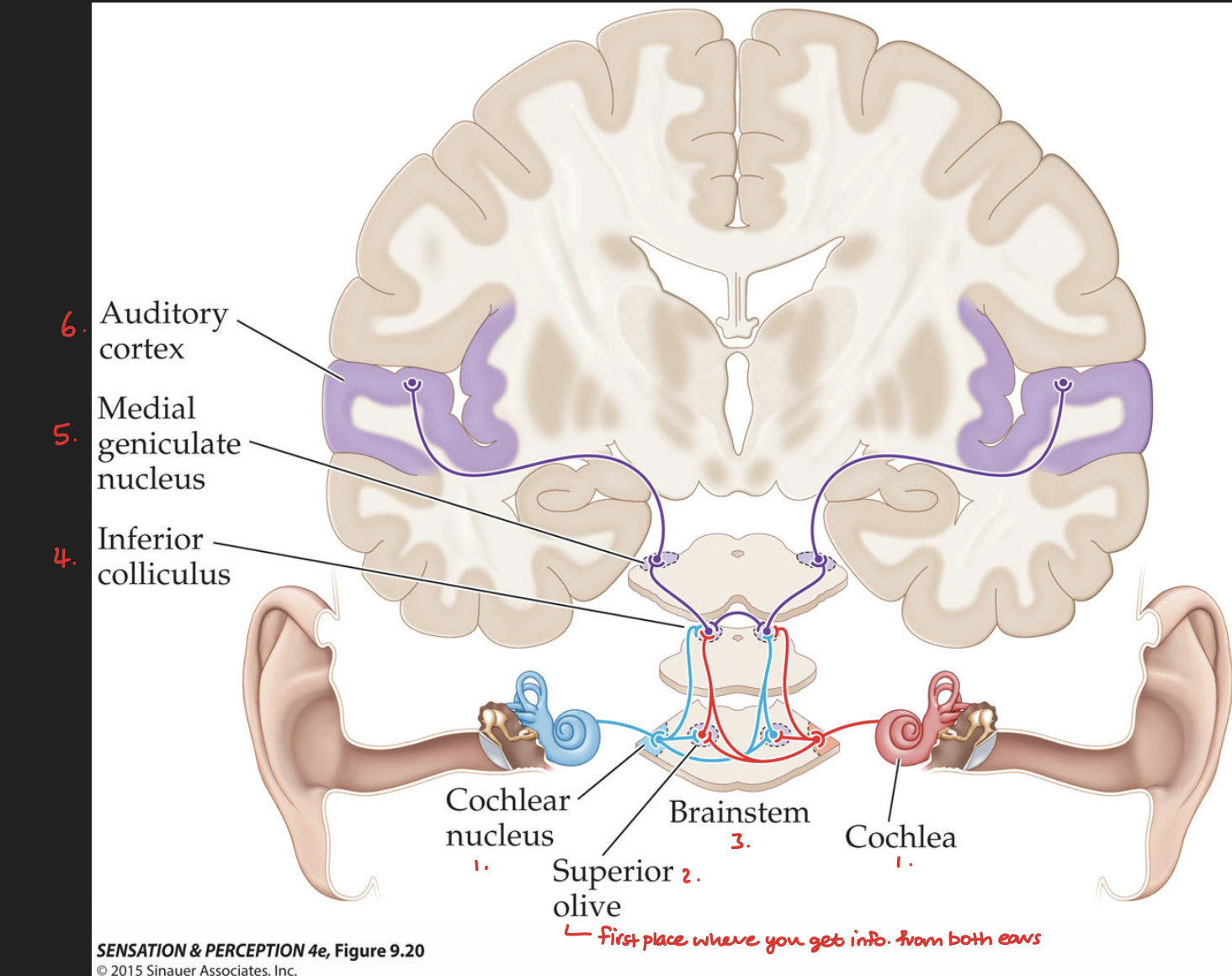
How does sound energy progress through the brain?
Cochlear Nucleus
Superior olive
Inferior colliculus
Medical geniculate nucleus
Define the cochlear nucleus.

Define the superior olive.

Define the inferior colliculus.

Define the medial geniculate nucleus.

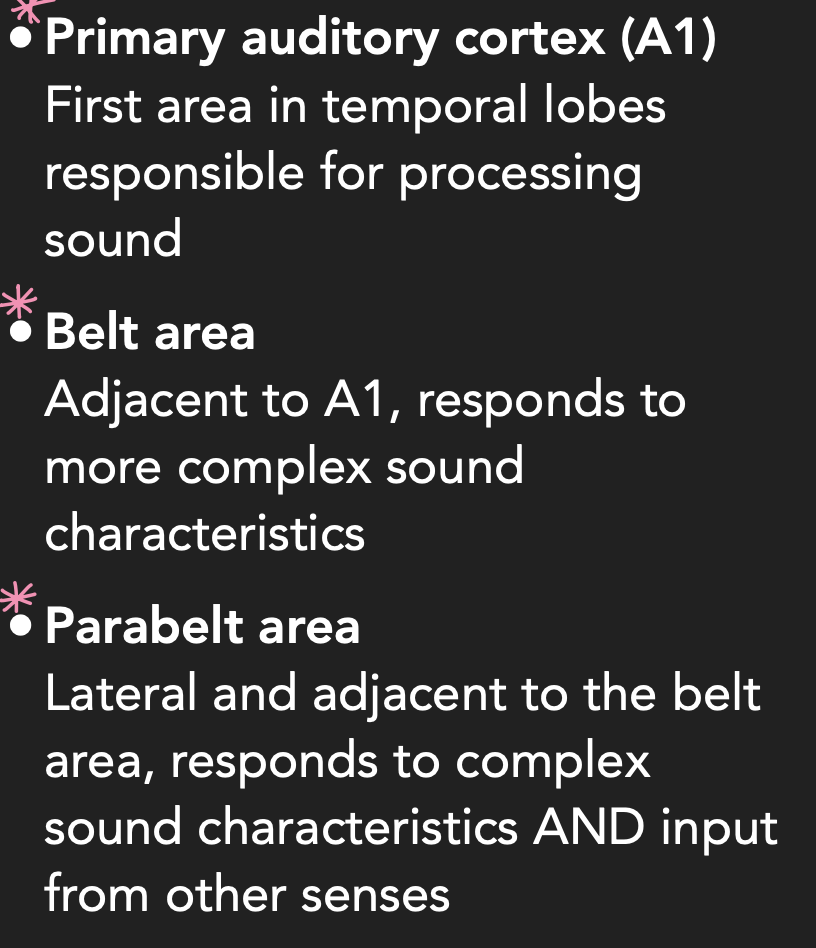
What are the 3 main regions of the brain important for auditory processing? Define each region.
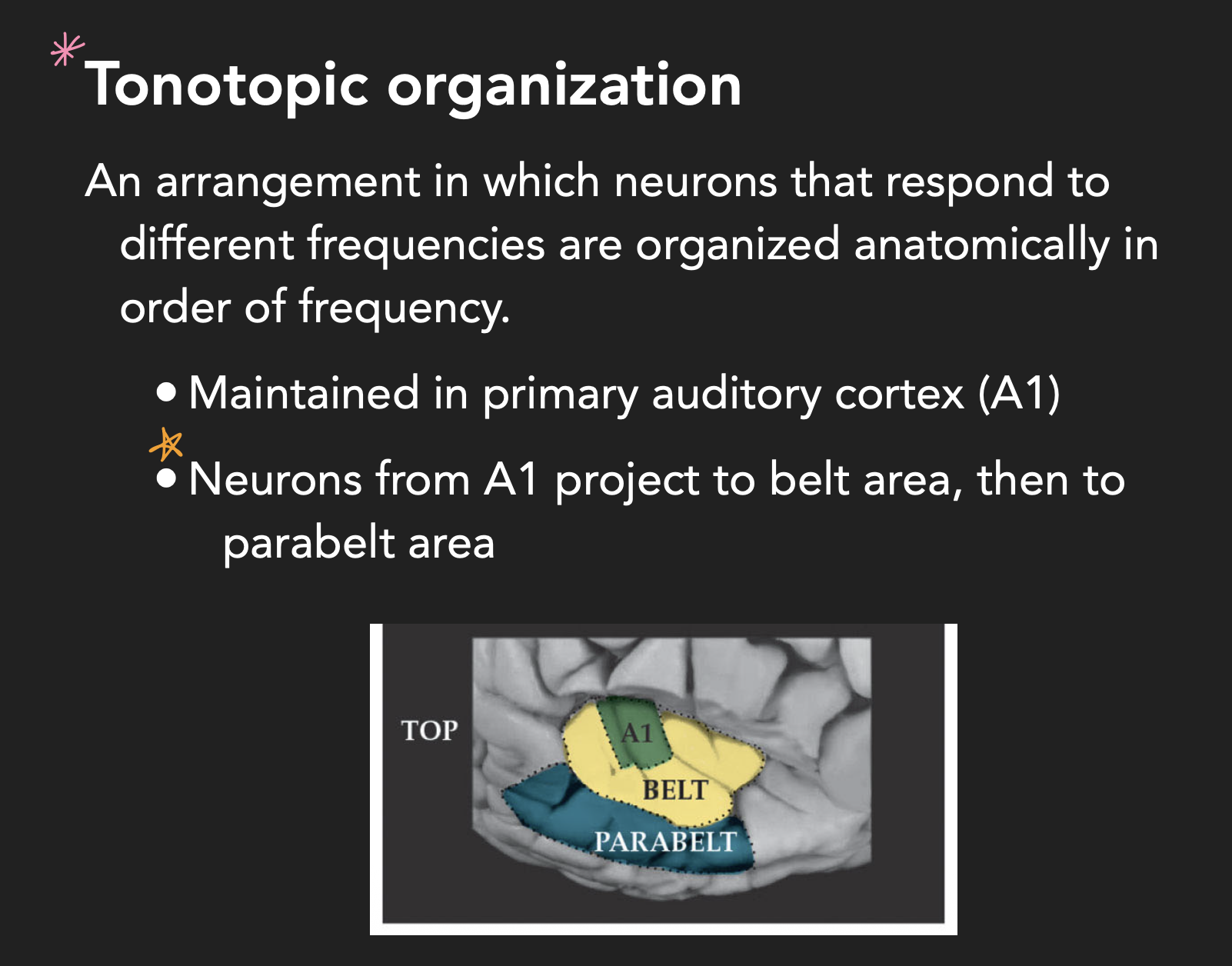
Define tonotopic organisation.
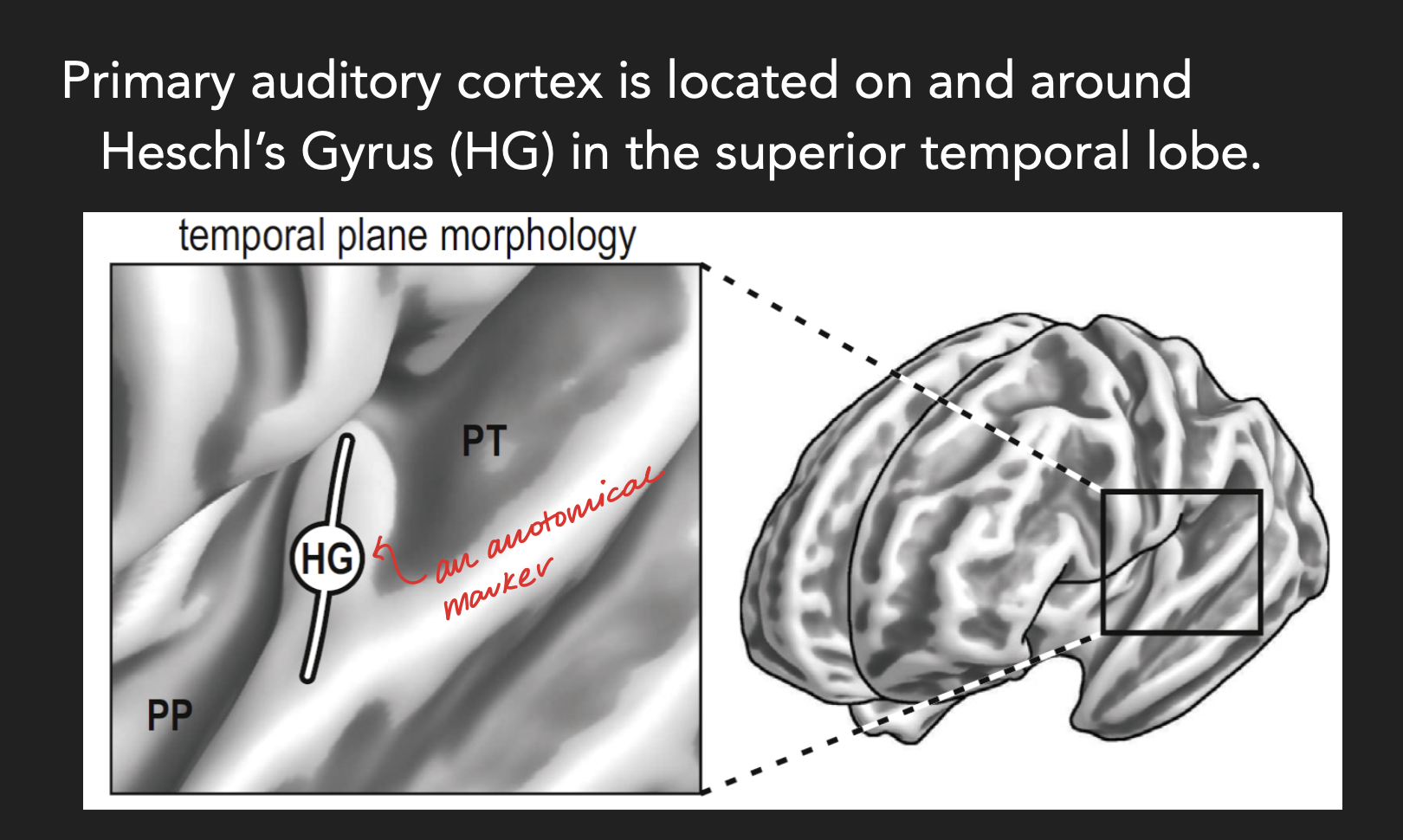
Where is Heschl’s Gyrus located?
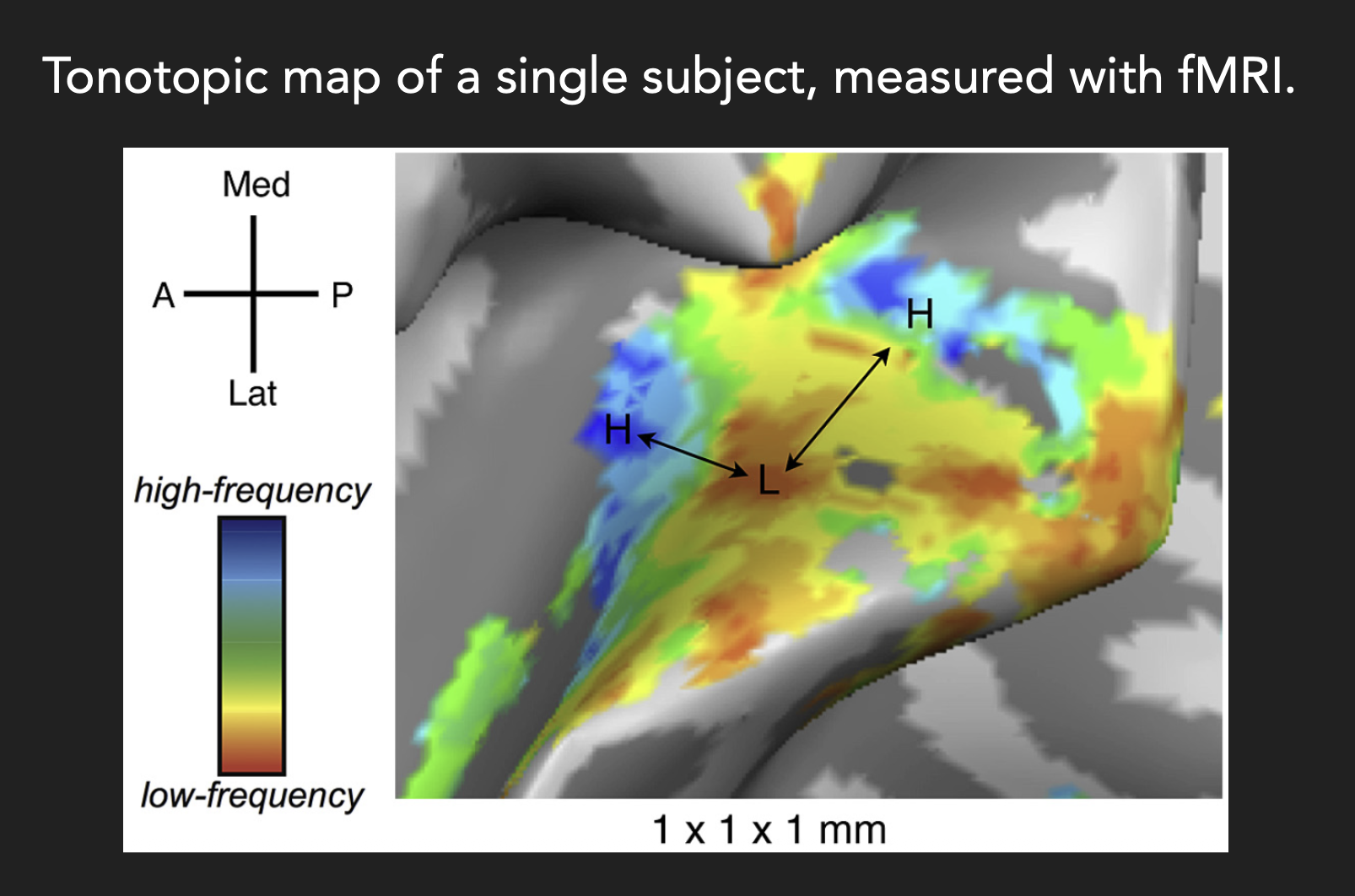
How does frequency selectivity change around Heschl’s Gyrus?
*more selective to higher frequencies as you move away from Heschl’s Gyrus, and more selective to lower frequencies as you get to the centre of Heschl’s Gyrus
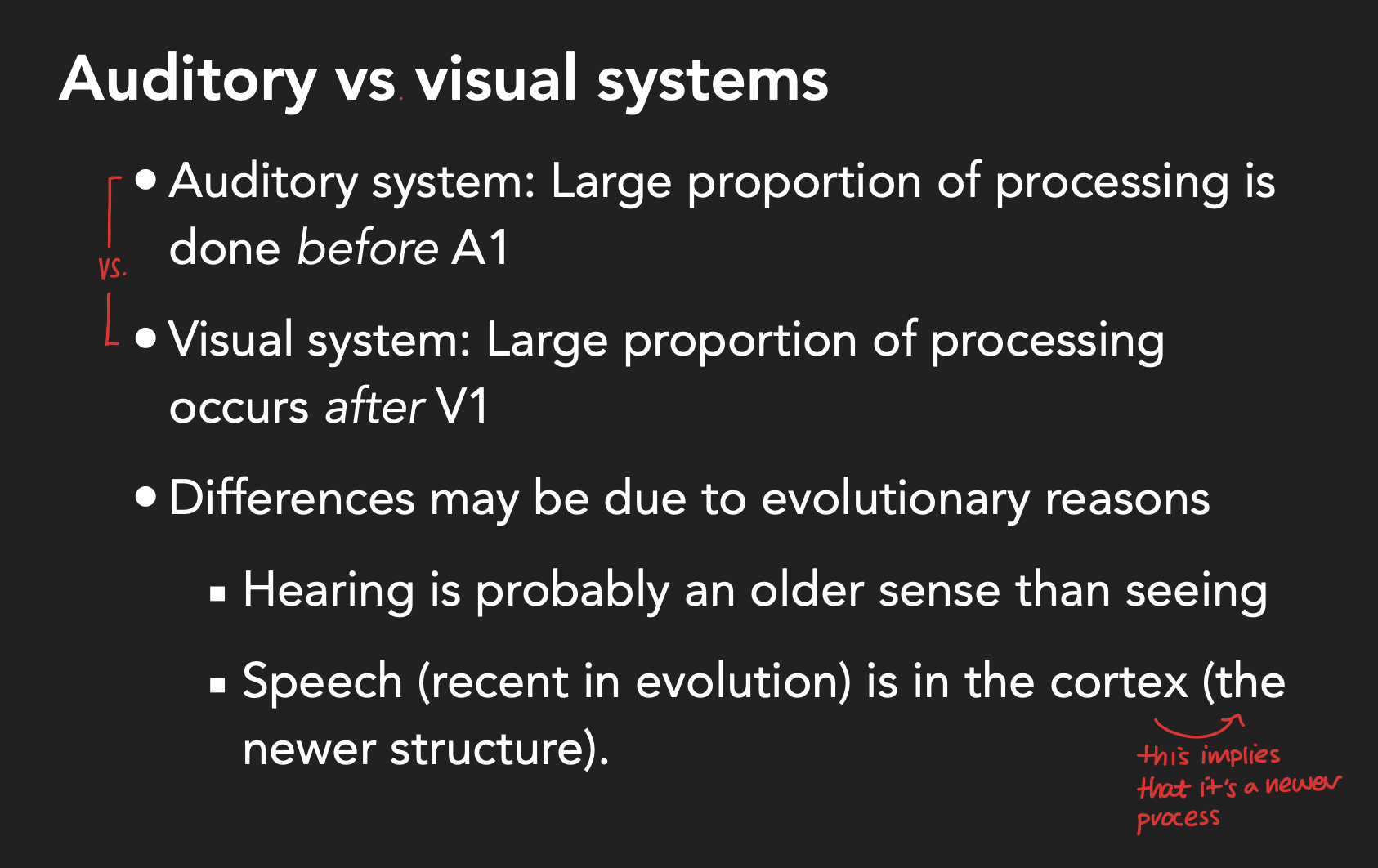
Compare auditory vs. visual processing. Expain why we see those differences.
Define psychoacoustics.
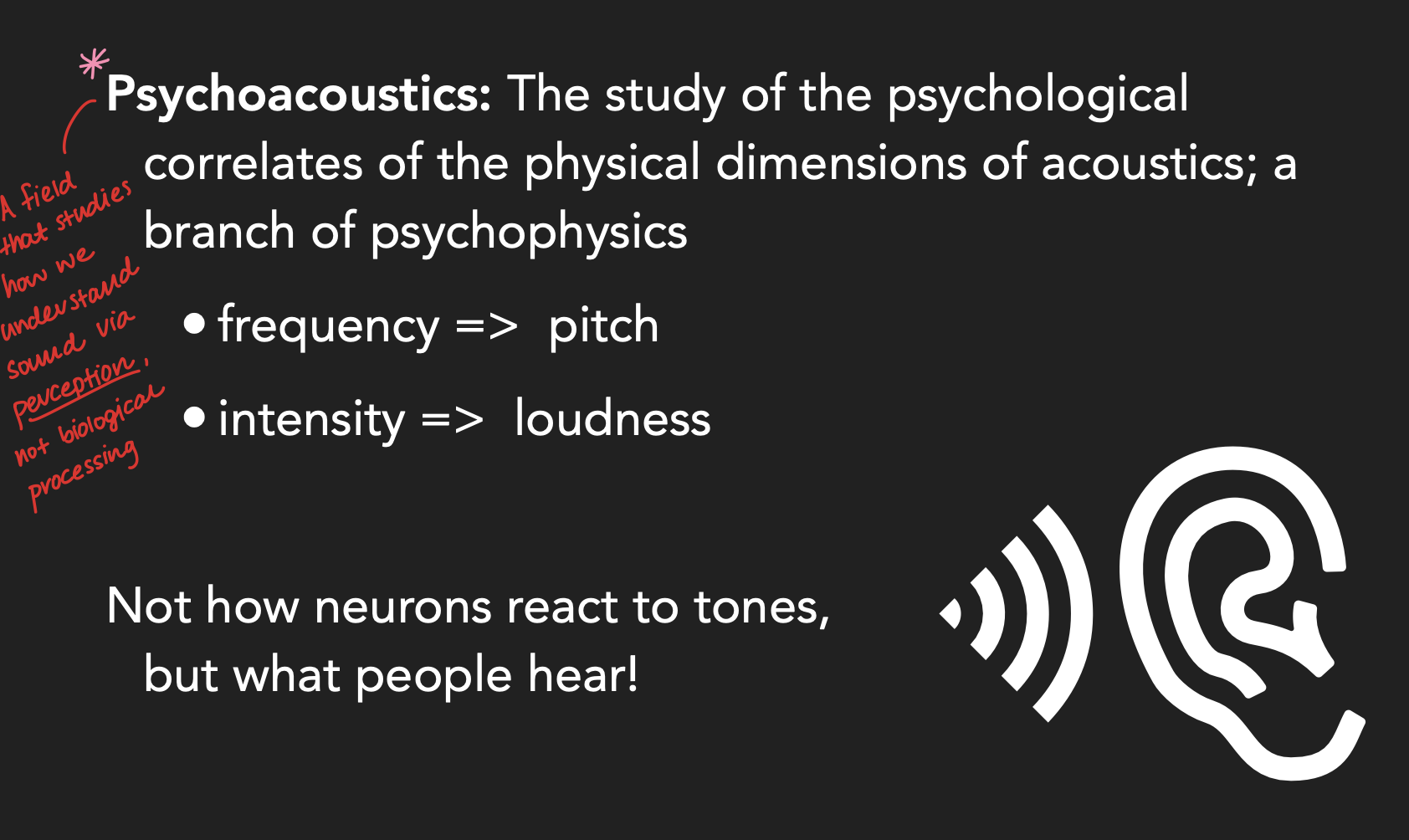
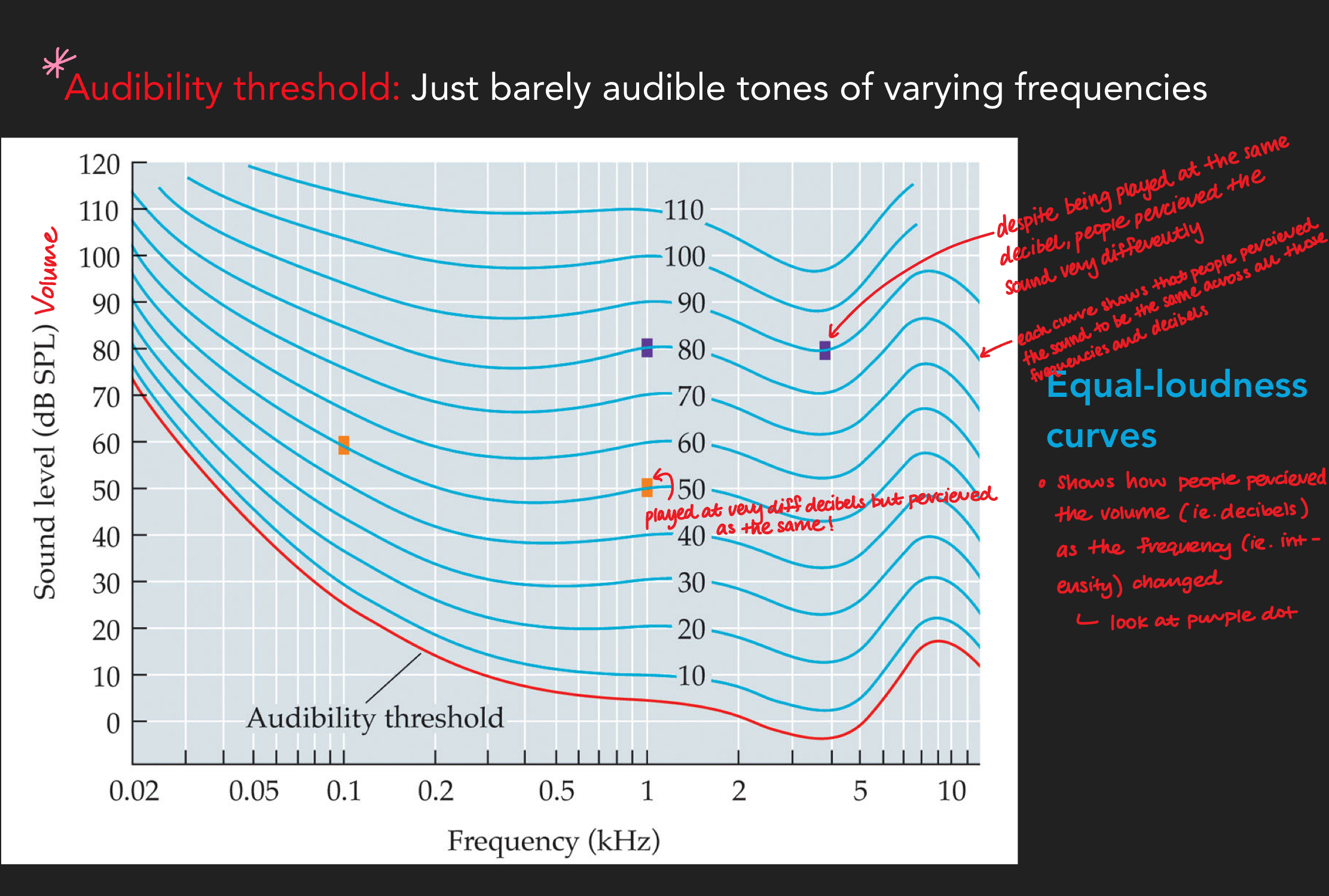
Can we just look at the decibels of sounds to know how people are going to hear the sound? Explain why or why not.
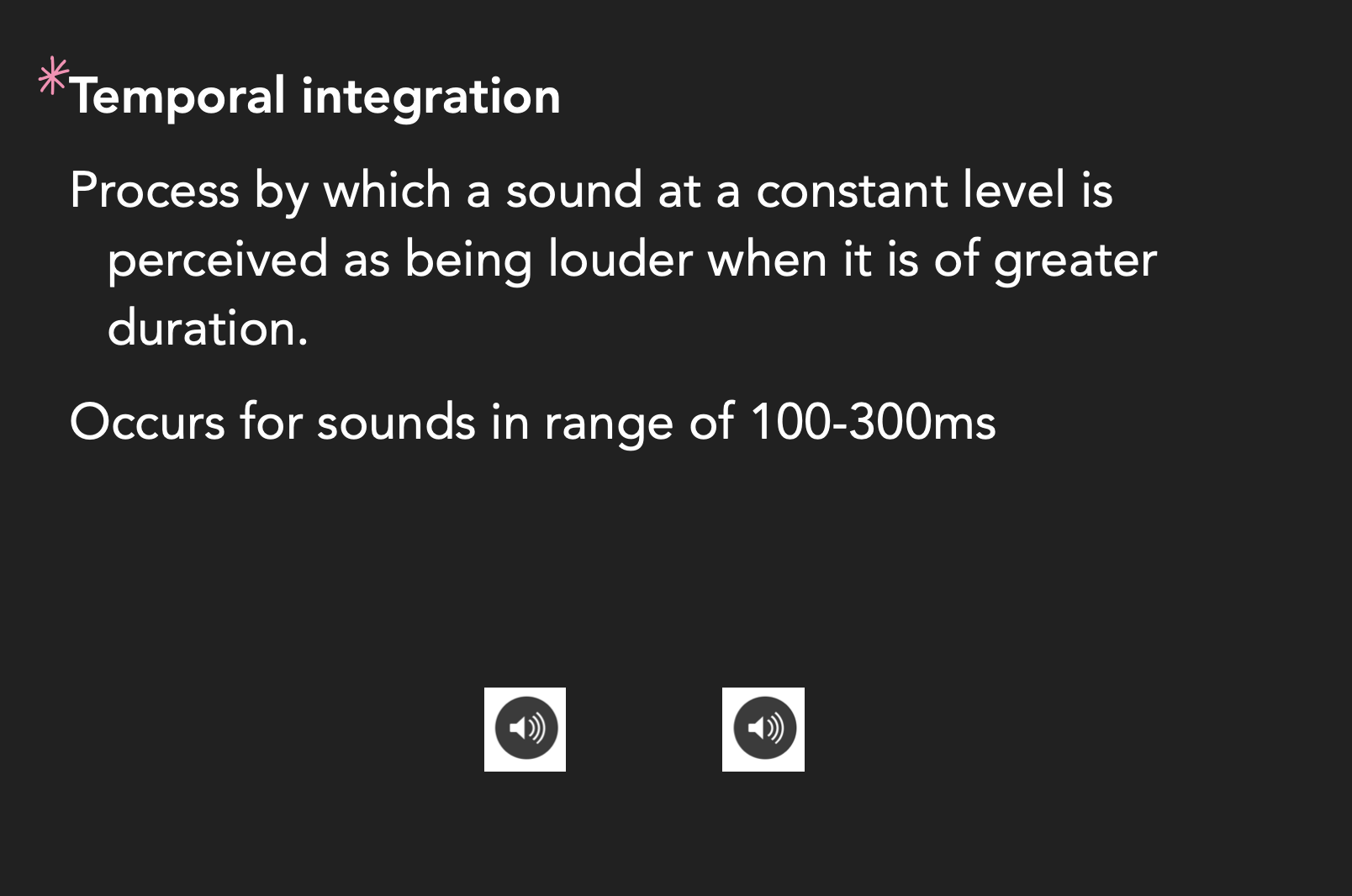
Define temporal integration.
What do psychoacoustacians study and how do they study it?
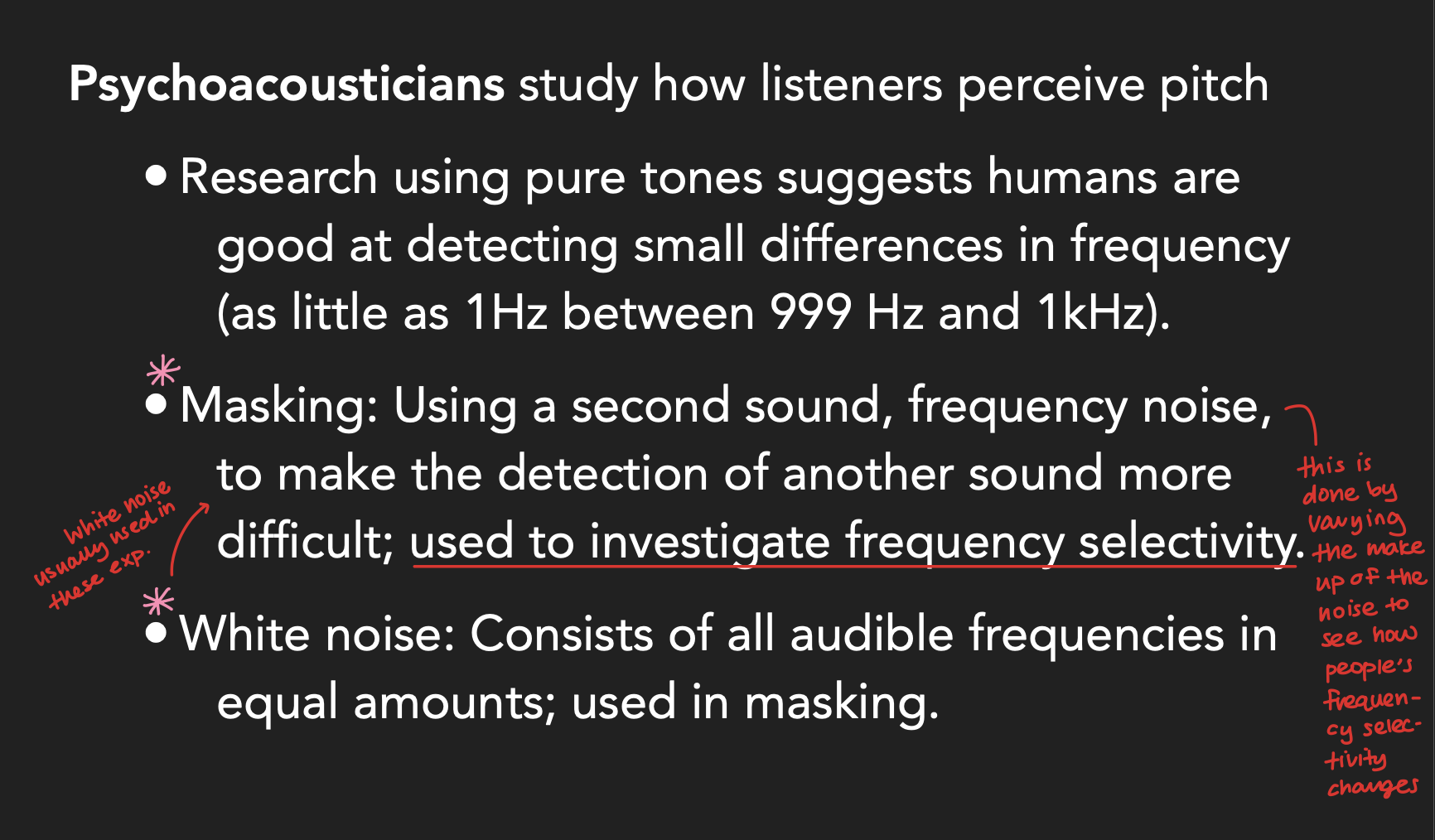
How is sound masking measured?
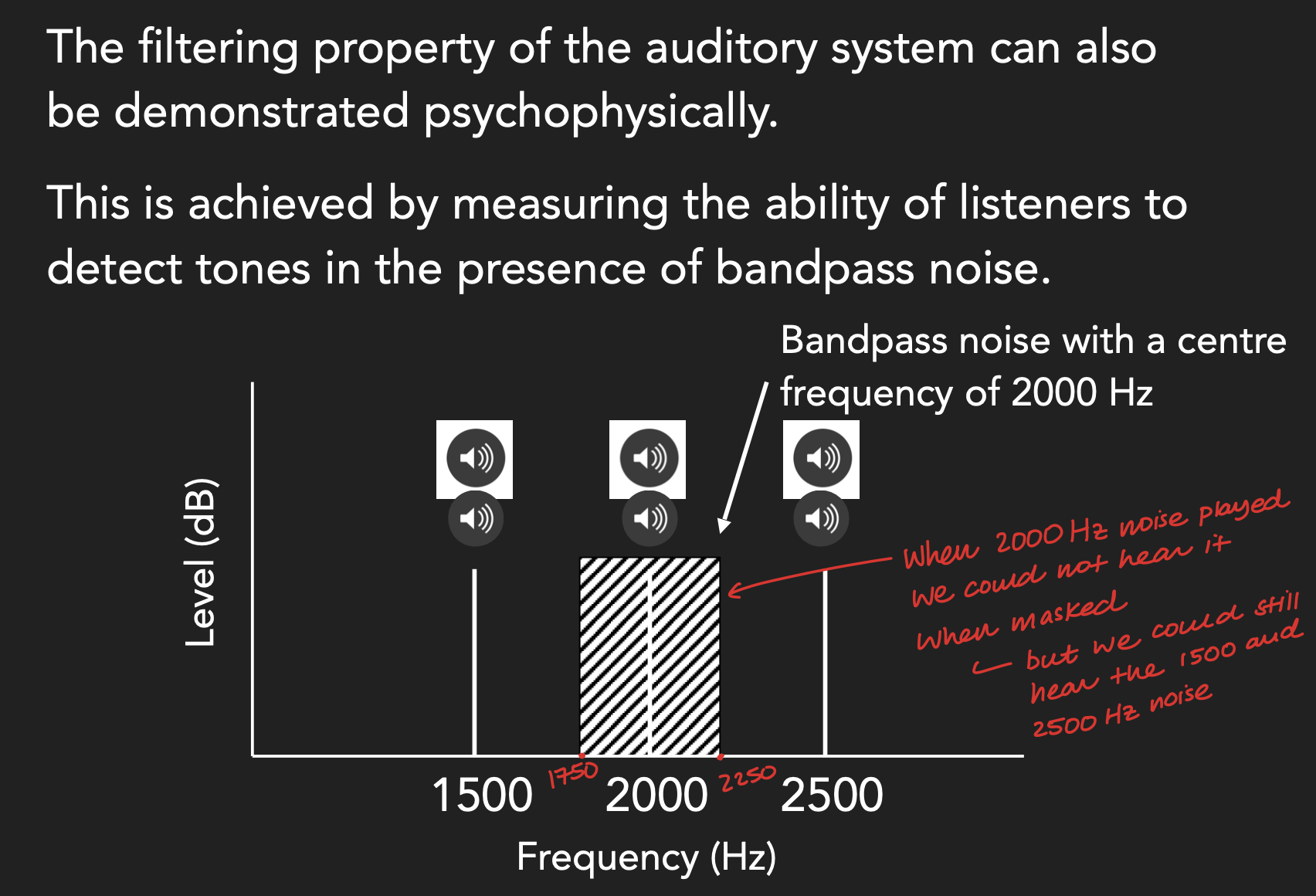
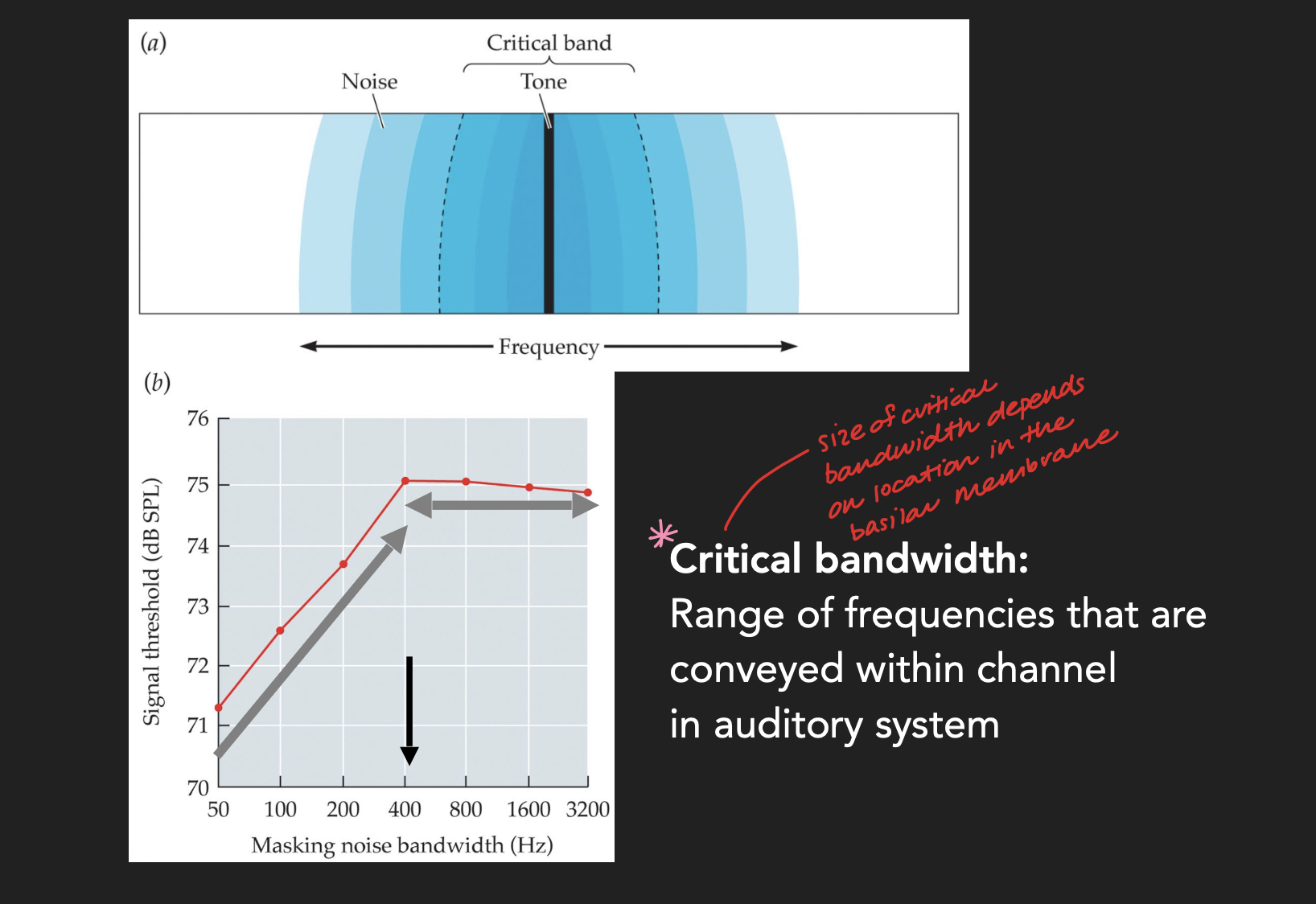
How do psychoacoustacians use critical bandwidth when studying the effect of masking? What were the results?
They changed the critical bandwidth of the mask (i.e., when the range of frequencies included in the sound changes) to see how it affected the volume people needed in order to distinguish pure tones.
They found that the larger the mask, the louder the pure tone needs to be for participants to be able to pick up on it. That is because the mask is now hitting more of those auditory nerves that can fure to those frequencies. But then it eventually plateaus.
This tells us that there is a channel in which auditory nerves respond to the pure tone and also to a range of frequencies of about 400Hz. However, anything beyond that is governed by a different channel of auditory nerves.
*the width of these critical bandwidths correspond to the physical spacing of frequencies that you find on the cochlea on the basilar membrane
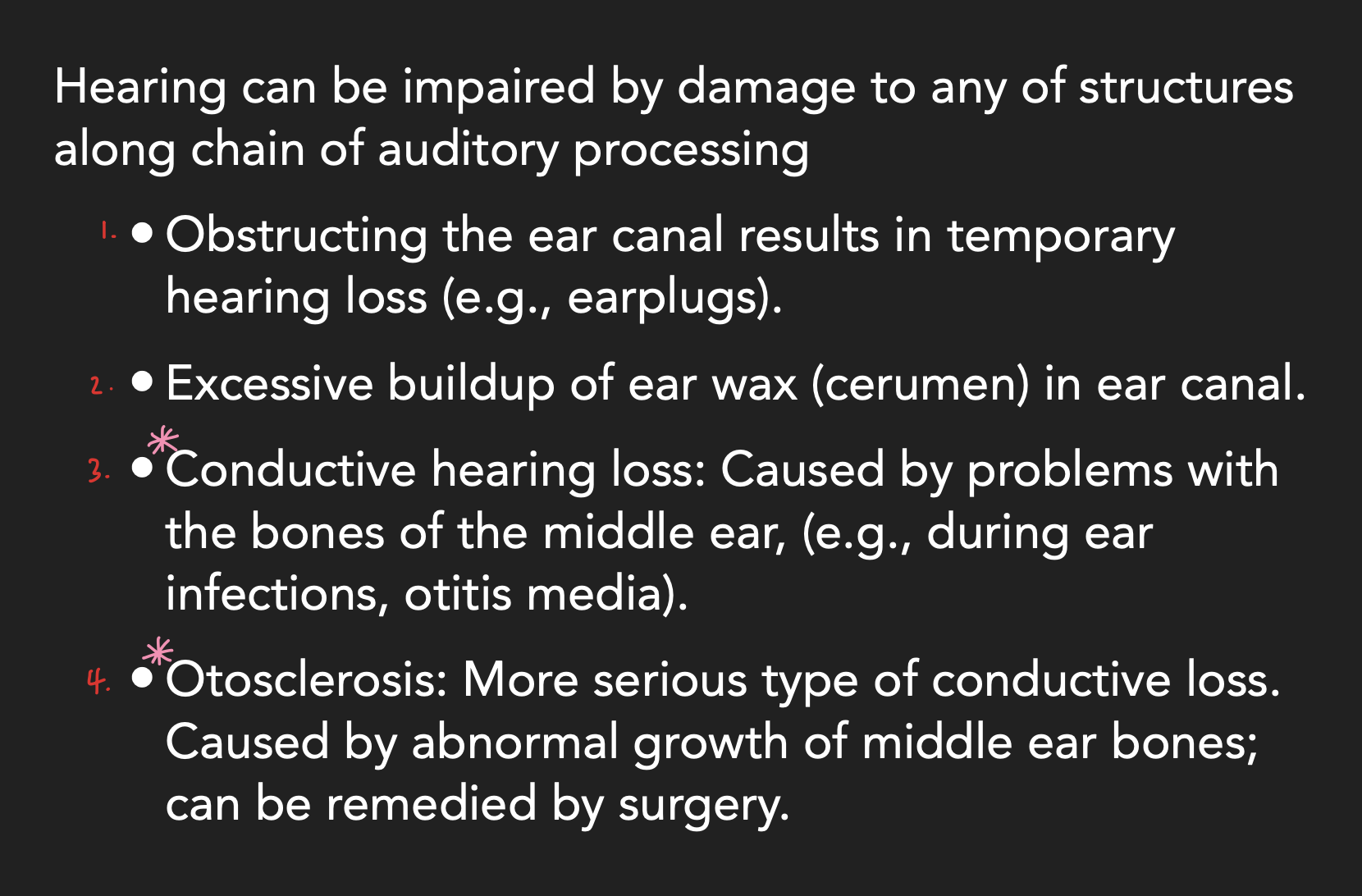
What are some causes for hearing loss?
Define Sensorineural hearing loss.

Define common hearing loss.

Explain how the hearing of people living on Easter Island (a very quiet island) is different from those living in more urban areas.
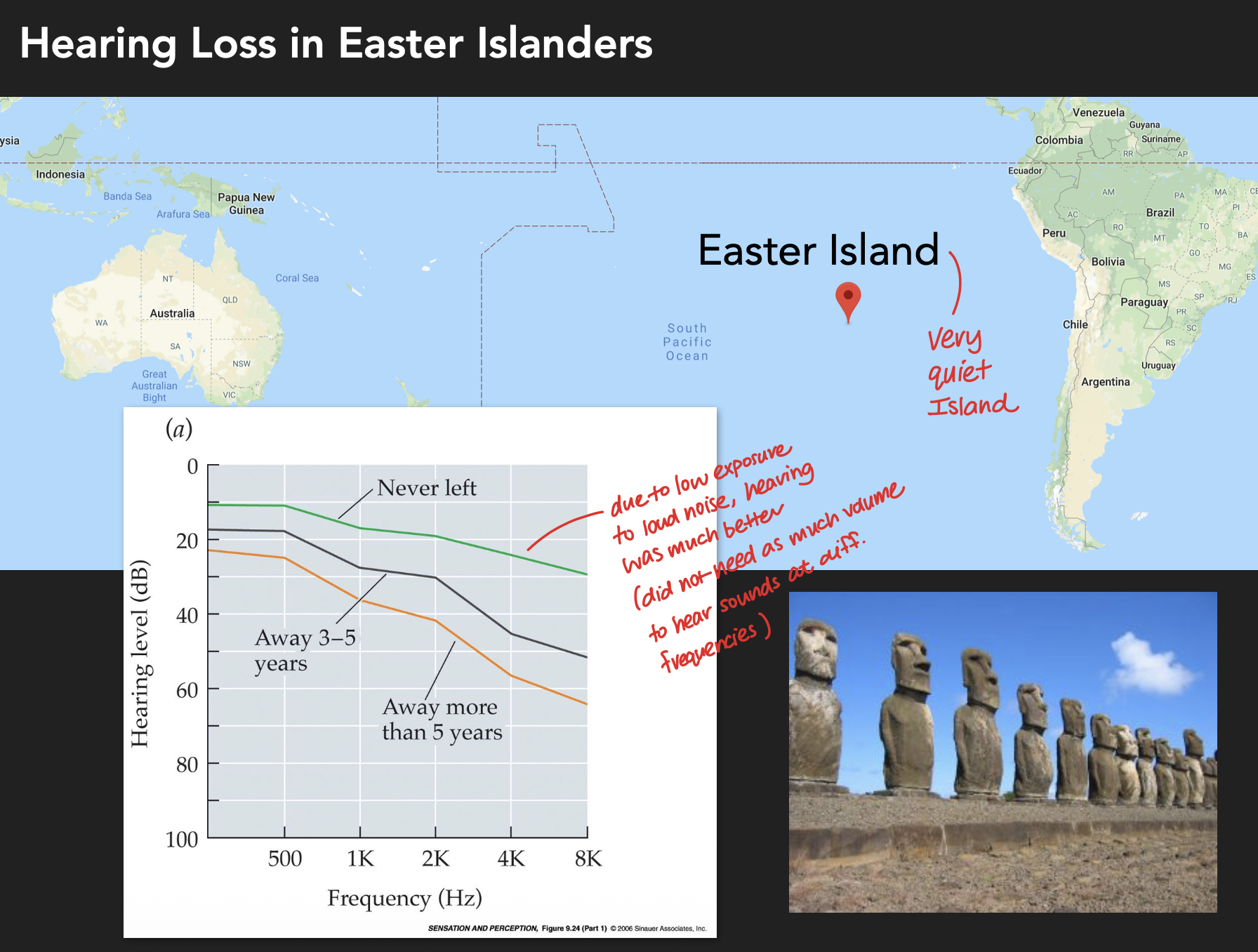
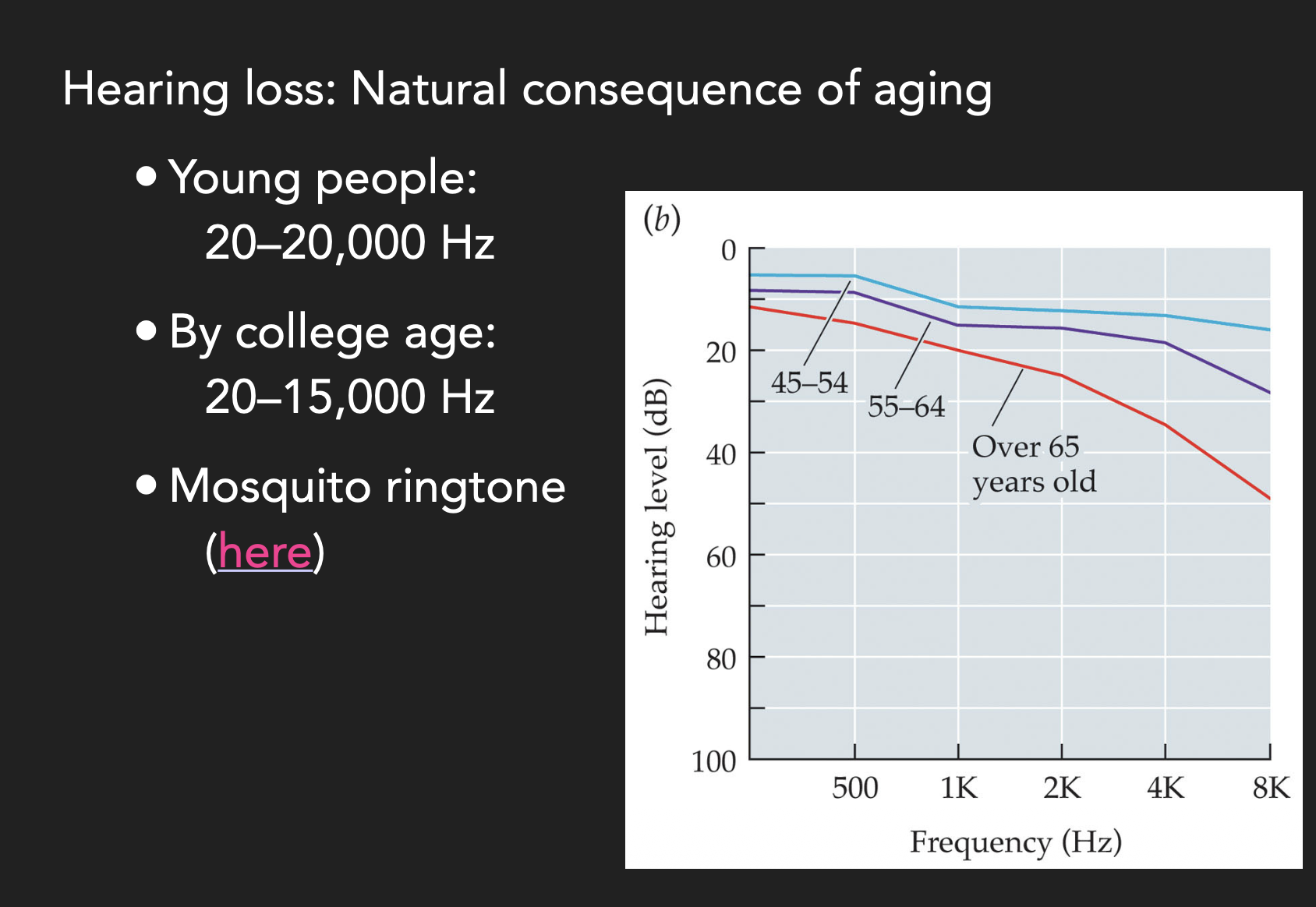
How does hearing ability change as people age?
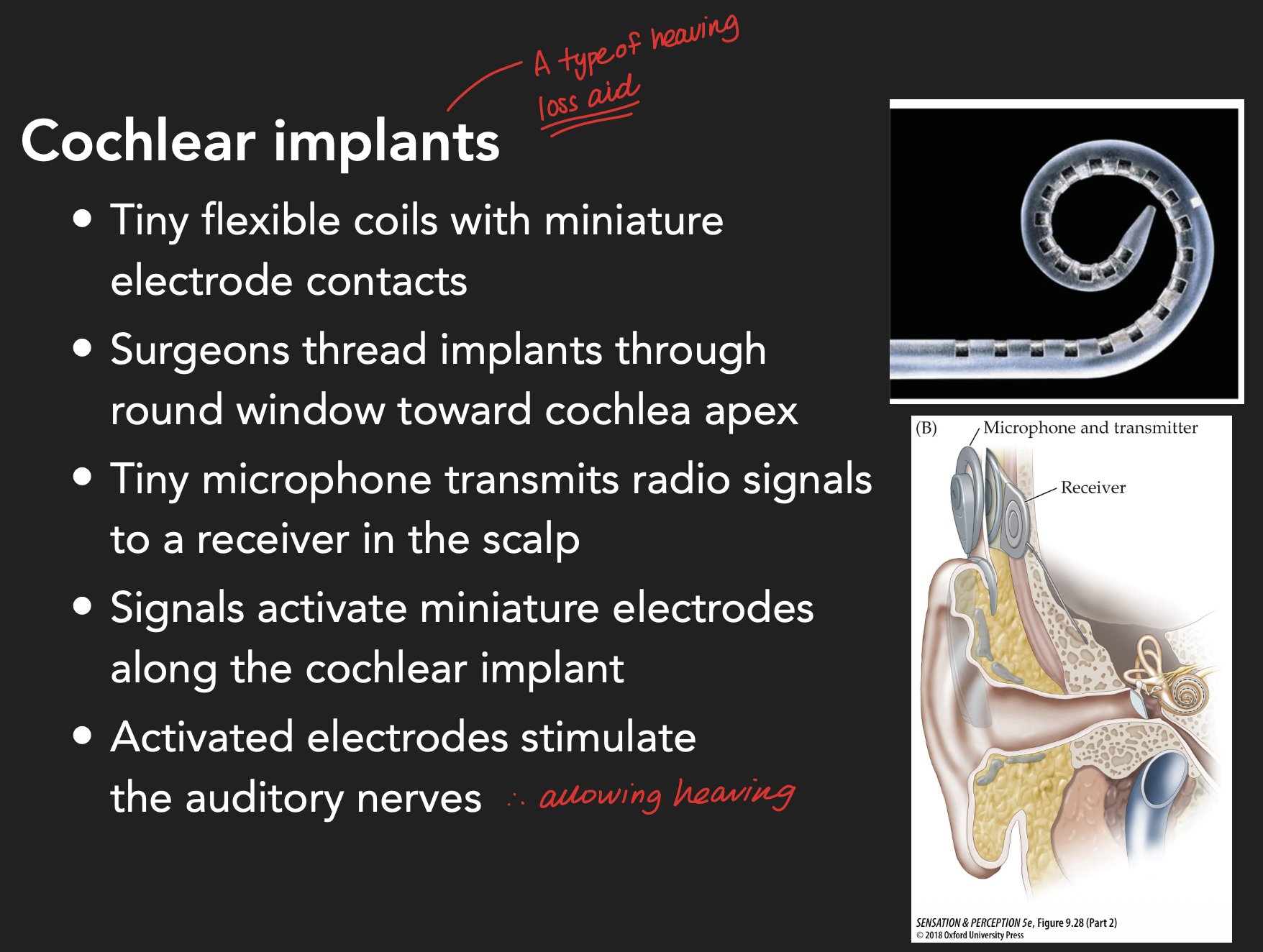
What are types of aids for hearing loss?
Hearing aids
Cochlear implants
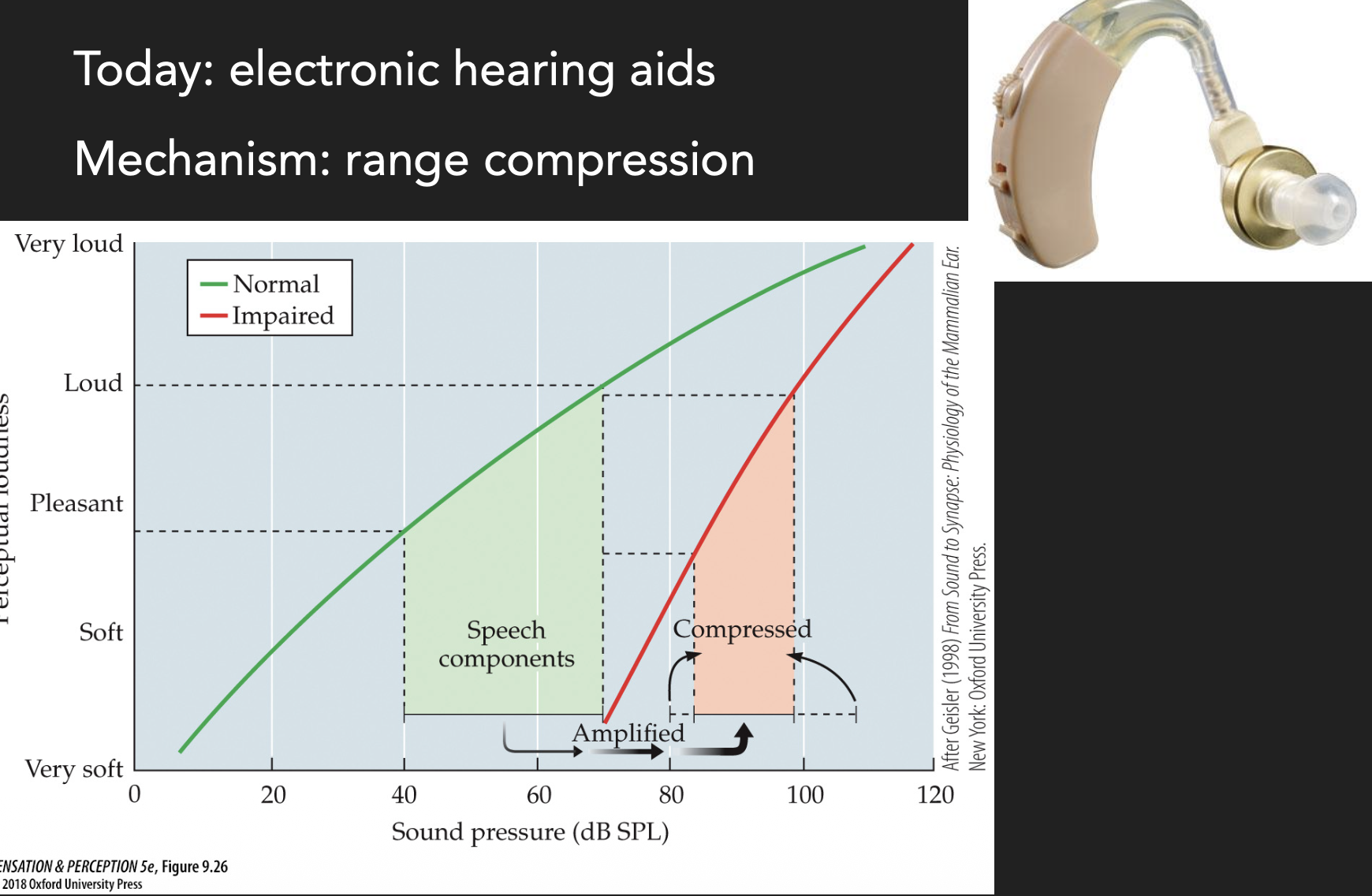
How do hearing aids work?
Hearing aids take important bits of frequencies in quieter sounds that people with hearing loss can’t pick up on, compress the sound and shifts it to frequencies that the person can hear.
How do cochlear implants work?