Carriage of oxygen
 Call Kai
 Learn
Learn Practice Test
 Spaced Repetition
 Match
Match Flashcards
 Knowt Play
1/9

There's no tags or description
Looks like no tags are added yet.
Name | Mastery | Learn | Test | Matching | Spaced | Call with Kai |
|---|
No analytics yet
Send a link to your students to track their progress
10 Terms
Must know facts about erythrocytes (RBC)
Biconcave for greater surface area
Made in bone marrow
Mature erythrocytes have no nucleus
Only live for about 120 days
1mm3 of blood contains 5 million erythrocytes
Haemoglobin red pigment contains iron
300 million haemoglobin molecules in one erythrocyte
Haemoglobin carries oxygen
Describe the transport of oxygen
Oxygen binds to haemoglobin in RBC to form oxyhaemoglobin. One molecule of haemoglobin can carry four oxygen molecules.
At lungs O2 concentrations are high so it diffuses into erythrocytes and binds to haemoglobin. At tissues, O2 concentrations are low so diffuses from erythrocytes into body cells down conc. gradient
Note:
When all of haemoglobins oxygen binding sites are all taken up with oxygen it is saturated
What is meant by the term dissociation
Release of oxygen from haemoglobin
What is meant by the term of affinity
Attraction for (oxygen)
What is meant by the term partial pressure
The pressure that oxygen exerts within a mixture of gases
Oxygen dissociation curve
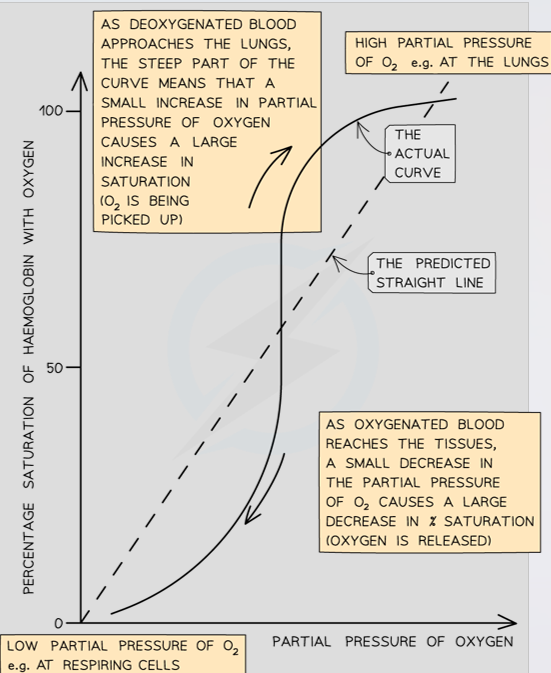
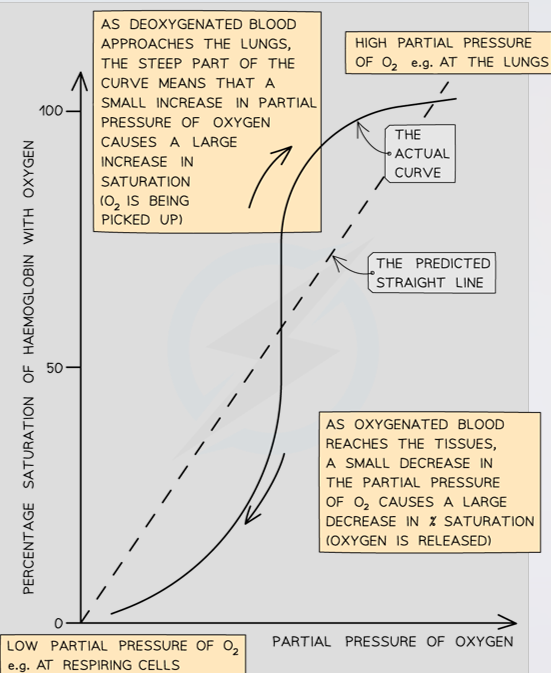
At high partial pressures of oxygen, haemoglobin will have a higher affinity for oxygen so it binds more easily but dissociates slowly and if partial pressures of oxygen is low haemoglobin has low affinity it binds slowly and dissociates easily.
Why is the oxygen dissociation curve sigmodial shaped
This is due to haemoglobins affinity at different partial pressures of oxygen and the ease of binding.
The first O2 molecule is difficult to bind due to the shape of haemoglobin which is why curve shallow at start
Second and third O2 bind easier ,explaining the steeper part of curve in the middle, as haemoglobin undergoes confrontational change once first O2 is bound. This is called positive co-operation
Fourth O2 molecule difficult to bind due to crowding and the tendency for O2 to dissociate, explaining the levelling of the curve at the top
What is foetal haemoglobin
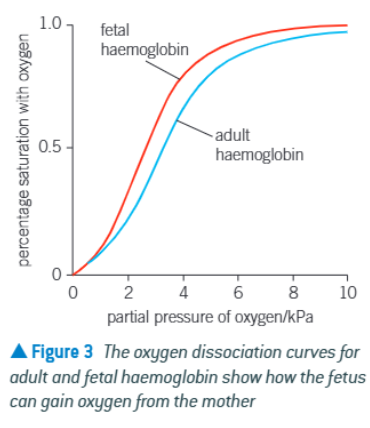
Foetal haemoglobin has a higher affinity for oxygen at the same partial pressures of oxygen this means that as maternal blood passes foetus it diffuses from blood to bind with foetal haemoglobin. At lower pO2 higher saturation of foetal haemoglobin.
How is fetal haemoglobin different on a dissociation curve
The foetal haemoglobin curve shifts to the left
What is myoglobin
Similar structure to haemoglobin but is just one polypeptide chain. Stores oxygen in muscles. Has a higher affinity for oxygen meaning it can hold oxygen until muscles really need it.