global migration CASE STUDY- LAOS
 Call Kai
 Learn
Learn Practice Test
 Spaced Repetition
 Match
Match Flashcards
 Knowt Play
1/6

There's no tags or description
Looks like no tags are added yet.
Name | Mastery | Learn | Test | Matching | Spaced | Call with Kai |
|---|
No analytics yet
Send a link to your students to track their progress
7 Terms
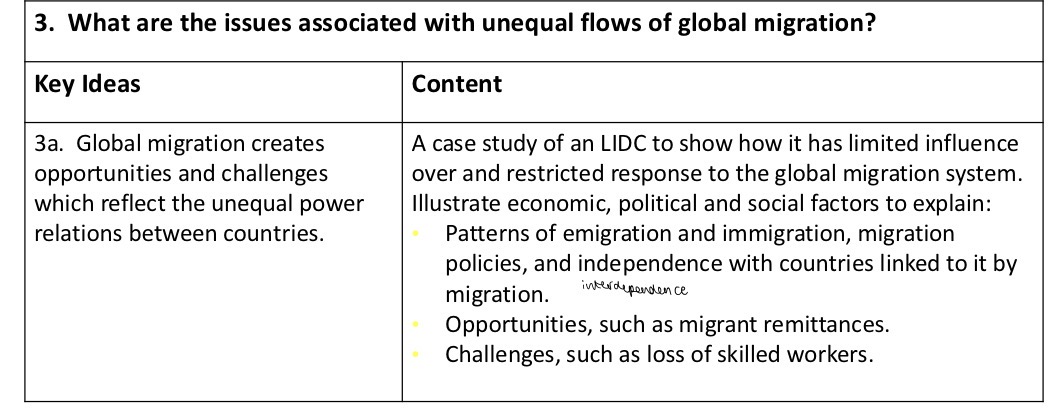
How has Laos got limited influence over and restricted response to the global migration system?
Background facts
limited influence and restricted ability to respond to change within global migration system
Landlocked country, LIDC, 6.8mil people, located in SE Asia
73% of Laos employed in agriculture
Member of ASEAN (association of south East Asian nations since 1997)
Remittances bring income
Historical migration in Laos
country of emigration + internal displacement due to conflict, weak economy
Laos civil war (1953-1975) caused internal displacement
End of Vietnam war in 1975, indigenous people in remote areas struck by war resettles, more than 300,000 people fled to Thailand- escape communist regime that took over
Many people ultimately resettled in the US, France, Canada, Australia
Laos government carried out resettlement programmes 1980s-90s, to relocate ethnic minority groups to development areas in lowlands to alleviate poverty, make more services available, control rebel groups.
However for many resettlement lead to loss of livelihoods, exacerbated poverty, food insecurity
Mid 90s, migration to urban centers- capital Vientiane to pursue better jobs in growing manufacturing and services became main type of relocation
Thailand main international migration destination for Laotians- more job opportunities, better pay. Destination countries 3 most popular- Thailand (930,000 resident Laos- born emigrants), USA (200,000), Bangladesh (90,000)
Patterns of emigration and immigration
Reasons for emigration (leaving a country) to Thailand
Many workers are subsistence farmers, no promise of financial gain. Lack of alternative occupations in rural areas, periodic droughts, food insecurity
Daily minimum wage in Thailand is 300 baht, compared to 80 baht in Laos
Low levels of education in Laos- low skilled jobs, Thailand have a demand for this in rapidly growing economy
Improved access to Thailand across Mekong river
Thailand is SE Asias second largest economy. Newly industrialised country (NIC), natural resources, strong electronics, tourism industries. % of people below national poverty line decreased from 65.26% in 1988 to 13.15% in 2011.
Thailand magnet for migration, people move there- strong tourism sector, diversifying economy
Remittances so important in Laos
Thai- Laos friendship bridge
first major bridge across lower Mekong river links Nong Khai in Thailand with Vientiane in Laos.
Brought benefits to two countries in terms of trade, tourism, economies, transportation, investment
Encourages immigration and emigration
Brings together Thai + Lao people
Just over 1km, has two 3.5m wide road lanes, two 1.5m wide footpaths, single metre gauge railway line running down the centre
ASEAN
member of ASEAN, ASEAN economic community allowed freer movement of skilled labour from 2015.
Mutual recognition agreements allow professionals employed in nursing, dentistry, medicine, architecture and tourism, after 5 years of working in their country of origin, to have greater freedom of movement between ASEAN countries
Migration policies
Laos= source country for human trafficking.
In 2013, 36% of the population were under 15, therefore there are an increasing number of entrants into the work force in a country where opportunities are limited. The vulnerability of young migrants to forced labour and sex exploitation in Thailand is of major concern to the government and international organisations. One development was the trafficking of under age footballers from Liberia to Laos to play for Champassak United.
Government policies are ineffective; many young migrants don't obtain the required passport, risk fines on return. However, Laos Ministry of Labour and Social Welfare and Ministry of Public Security now work in cooperation with the IOM, UN agencies such as ILO, Unicef, and International NGOs such as CARE International, Save the Children to implement a more stringent anti-trafficking policy.
National plan of action for human trafficking led by Laos government: three main strands. Prevention- awareness, campaigns, education, alleviation of poverty reducing need to migrate. Protection- reintegration of returning migrants, shelters for women who may need counselling. Prosecution- investigation of trafficking networks, training border officials, strengthening legal framework.
Trying to improve protections for workers through updated laws, bilateral agreements with countries like Thailand
Interdependence between countries linked to Laos by migration
ASEAN countries increasingly interdependent
Laos- Thailand migration corridor dominated by outward flow of unskilled Laotians to work in Thailand. Contribution to Thai economy is in construction, agriculture, fisheries, factory work; remittances assist development in Laos
Laos Thailand Cooperation Committee established- completion of friendship bridge strengthened communication + trade. Thailand funded large health service development and drugs centre in Laos
Laos + Thailand work together as members of Mekong River Commission- manage flooding, economic activities in basin
Laos signed agreements to build rail links between Thailand and Vietnam in 2012, including high speed rail link to China. All open up Laos to development
Laos and Thailand members of coordinated Mekong Ministerial Initiative against Trafficking (COMMIT)
Opportunities
Migration corridor between Laos + Thailand is one of the largest within ASEAN. Helped to stimulate political and economic co-operation in terms of trade, investment, development projects and security
There is economic co-operation, with Vietnam involved in over 400 investment projects in Laos.
Migrant remittances very important to the life of returnees and their families. In Laos, 22% of families live below the poverty line, economic impact of this money on local and national development ranges from purchase of simple domestic appliances to agricultural machinery.
Political stability improving between Laos, Thailand and Vietnam.
Challenges
Most economic migrants from Laos are low skilled, have limited education and under 18 at their first migration. Many travel illegally, vulnerable to human trafficking, forced labour, exploitation. Laos government policy difficult to implement, depends on transnational governance by organisations such as NGOs, IOM for its success
There is loss of skilled labour such as carpenters and mechanics to Thailand. This is set to increase differences in wage remain high and there is freer movement in the ASEAN Economic Community.
The Laos garment industry is the largest sector of manufacturing employment, its growth depends on improved working conditions in factories of the Laos capital, Vientiane, and retention of the many young female workers who may leave, seeking higher wages in Thailand.