General Principles of Perception
 Call Kai
 Learn
Learn Practice Test
 Spaced Repetition
 Match
Match Flashcards
 Knowt Play
1/29

There's no tags or description
Looks like no tags are added yet.
Name | Mastery | Learn | Test | Matching | Spaced | Call with Kai |
|---|
No analytics yet
Send a link to your students to track their progress
30 Terms
What did von Helmholtz argue about sensation and perception?
Sensation + perception are different → additional processing is undertaken by the brain after signals are registered by CNS
What is sensation (according to von Helmholtz)?
Simple awareness due to the stimulation of a sense organ (encodes different shapes, patterns etc)
What are senses? Give some examples of things they detect
Levels of signals in the environment
Light
Chemicals
Mechanical forces (e.g. sound)
Temperature
What do senses depend on?
Transduction → occurs when many sensors in the body convert physical signals from the environment into neural signals sent to the CNS
What does vision involve?
Light reflected from surfaces gives eyes info about shape, colour + position of objects
What does audition involve?
Vibrations from vocal cords, guitar strings etc cause changes in air pressure → propagate through space to ears
What does touch involve?
Pressure of a surface against the skin signals its shape, texture + temp
What do taste and smell involve?
Molecules dispersed in the air/dissolved in saliva reveal identity of substances
What is perception (according to von Helmholtz)?
Organisation, identification + interpretation of a sensation in order to form a (coherent) mental rep
Damage to visual processing centres in the brain can interfere with the interpretation of info coming from eyes -> senses can be intact with perceptual abilities being compromised
What is perception?
Construct that represents behaviourally relevant aspects of our environment
Info is repped/transformed to extract object attributes so they can be effectively acted upon
Illusions/systematic errors reveal heuristics used by the system to achieve this
What does perception concern?
Seeing objects + their attributes so they can be acted upon (rather than the attributes per se)
What is colour?
Construct of the nervous system
Colour constancy provides a degree of invariance to our recognition of visually presented objects – similarly to other constancies
Effects of context emerge as the system has to be robust to variations to detect a ‘true’ object attribute
How do levels of explanation relate to perception?
What is the visual information that is being extracted from the environment to drive behaviour?
What representations does the brain form + how (i.e. by which processes)?
What are the biological mechanisms that implement this (e.g. inhibitory + excitatory areas in receptive fields)?
What is the study of perception connected with?
Neuroscience + cog psych → BUT mains a separate interdisciplinary area of research V1
Categorical knowledge connected to perceptual knowledge
What is psychophysics?
Scientific method for investigation of relationships between physical stimuli + psych experience
E.g. increasing light intensity (thresholds of perception)
Introspection can't be used to measure perceptual experiences → can't know directly what is perceived (e.g. evoked memories + emotions affect perceptions)
How did Gustav Fechner develop psychophysics?
Was a physicist interested in perception → temporarily blinded himself + led to life-long eye problems
Developed psychophysics = methods that measure the strength of a stimulus + the observer's sensitivity to that stimulus
Ask PPTs to make a judgement + relates the measured stimulus to each observer's no/yes response
Begin measurement process with single sensory signal → determine how much physical energy is required to evoke a sensation
What is the point of subjective equality?
When it isn’t possible to tell 2 stimuli apart (when do they appear to be the same)
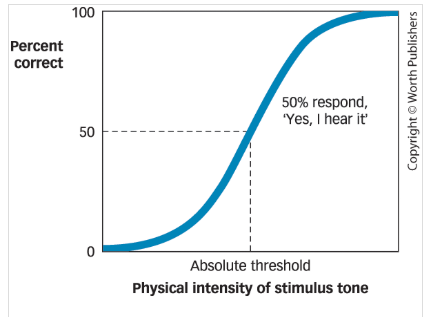
What is an absolute threshold?
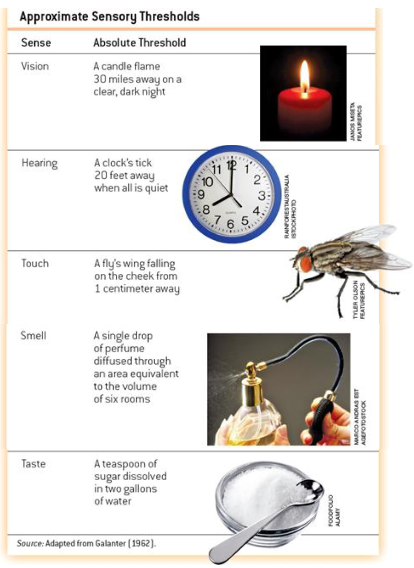
Minimal intensity needed to just barely detect a stimulus
Transition from not sensing to sensing is gradual
People are most sensitive to the range of tones corresponding to human conversation
Low tone → can't hear but can feel
High tone → can't hear but animals can
Is operationalised as perceiving the stimulus 50% of the time
What is just noticeable difference?
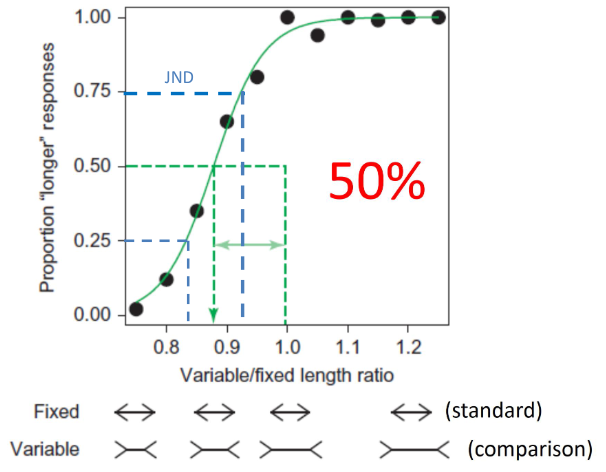
When it becomes possible to reliably tell the difference between stimuli → minimal change in a stimulus that can be just barely detected
Not a fixed quantity → depends on how intense the stimuli being measured are + what the sense being measured is
E.g. shown standard light (fixed intensity) + then a brighter/dimmer light to compare → when S is very dim, observers can see even a very small difference in brightness between the two lights: the JND is small BUT if S is bright, a much larger increment is needed to detect the difference: the JND is larger
What is JND roughly proportional to? Who discovered this principle and what is it called?
The magnitude of the standard stimulus
Discovered by Ernst Weber
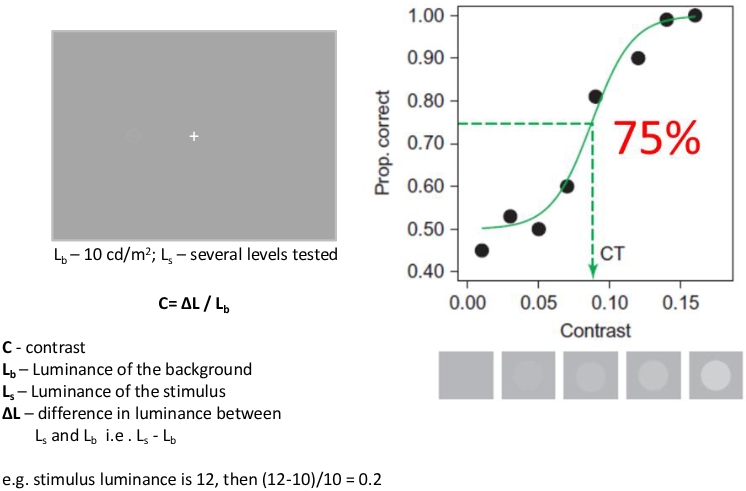
Weber's law = JND of a stimulus is a constant proportion despite variations in intensity (the measured size of difference is irrelevant)
JND table
What is Weber-Fechner law?
The difference in intensity divided by the intensity of the background is constant
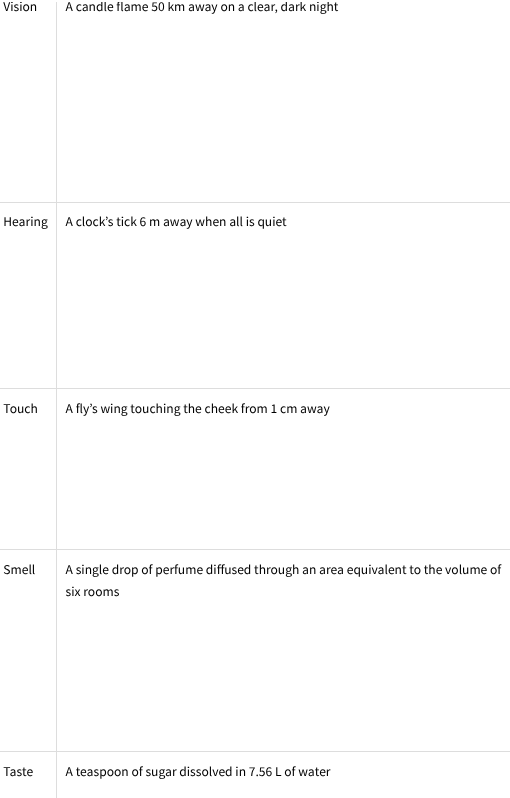
Approximate sensory thresholds (table)
Where do sensory signals face noise from? What does this lead to and suggest?
Internal + external environment → competes with ability to detect a stimulus with perfect, focused attention
Sensory systems are noisy; when the signals are very small, dim or quiet, the senses provide only a ‘fuzzy’ indicator of the state of the world
Spontaneous action potential → neuron fires even if no sense/object is presented
Explains the gradual nature of perception → on some presentations, the neurons' responses will be a bit greater than average → more likely to detect sense
What is signal detection theory?
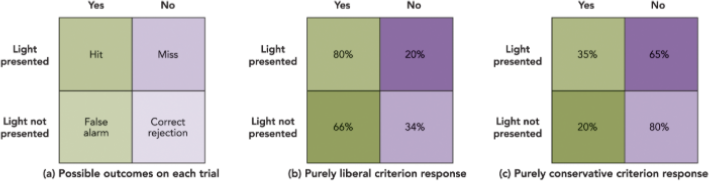
The response to a stimulus depends on a person’s sensitivity to the stimulus in the presence of noise and on a person’s response criterion
Observers consider the sensory evidence evoked by the stimulus + compare it to an internal decision criterion (Green + Swets, 1966; Macmillan + Creelman, 2005)
Sensory evidence exceeds the criterion → observer says they detected the stimulus
Falls short of the criterion → observer says they didn’t detect the stimulus
Allows researchers to quantify an observer's response in the presence of noise (hit vs miss vs false alarm vs correct rejection)
What is d’ (d-prime)?
Stat that gives a relatively pure measure of the observer’s sensitivity or ability to detect signals
Based on the relative proportion of hits to misses + group variability in detecting the phenomenon under consideration
High = more certain when it is present or absent
What is a perceptual sensitivity?
How effectively the perceptual system represents sensory events
What does signal propose (strength)?
A way to measure perceptual sensitivity separately from the observer’s decision-making strategy
E.g. a radiologist deciding whether a mammogram shows cancer → may decide on a strictly liberal criterion + check every possible case of cancer with a biopsy (minimises the possibility of missing a true cancer but leads to many false alarms) BUT a strictly conservative criterion will cut down on false alarms but will miss some treatable cancers
Offers a practical way to choose among criteria that permit decision makers to take into account the consequences of hits, misses, false alarms + correct rejections (McFall + Treat, 1999; Swets, 2000)
What do our perceptual systems emphasise?
Change in responding to sensory events (signals a need for action → e.g. noises of a car) than to constant stimulation
CNS has evolved to respond to the environment → significant events in the world that are probably going to require some response involve something changing
It makes sense to have our senses looking for changes rather than trying to estimate absolute levels BUT have to be able to adapt to changes (would otherwise be in a continual state of alert)
What is sensory adaptation?
Sensitivity to prolonged stimulation tends to decline over time as an organism adapts to current conditions
E.g. would have constant awareness of how your tongue feels while it is resting in your mouth