SMM4 - Interactivity, Personalization & Social Entertainment (keyterms, MP + scenario questions)
 Call Kai
 Learn
Learn Practice Test
 Spaced Repetition
 Match
Match Flashcards
 Knowt Play
1/70

There's no tags or description
Looks like no tags are added yet.
Name | Mastery | Learn | Test | Matching | Spaced | Call with Kai | Chat |
|---|
No analytics yet
Send a link to your students to track their progress
71 Terms
Interactivity — three definitions
Features: what technical interactive options exist 2. Process: how communication flows back and forth 3. Perception: how interactive the user feels it is — perception is the most important
Interactivity definition (Wu, 2000)
The extent to which a person perceives they control the interaction process, their communication counterpart personalizes content, and responds to their communicative behavior
Four components of interactivity (Lee, 2005)
User control 2. Responsiveness 3. Personalization 4. Connectedness
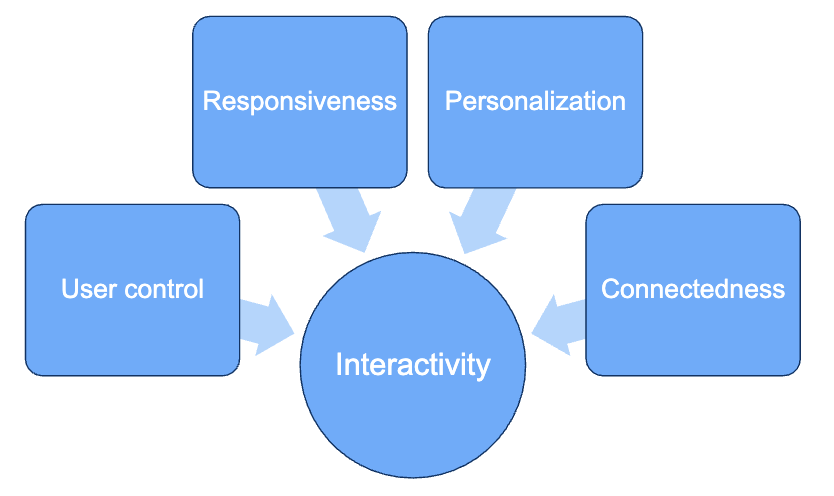
User control (interactivity)
The degree of control the user has over the timing and sequence of the interaction; example: a clickable button in a campaign that gives the user a sense of agency
Responsiveness (interactivity)
The ability to respond to previous messages and the speed at which responses occur; keeping users engaged through fast, reactive communication
Personalization (interactivity)
The degree to which content is tailored to the individual; leads to more attention and engagement; made possible through large user databases
Connectedness (interactivity)
The extent to which users can share information with others through online communities and chat groups; creates a feeling of belonging
How to apply the four interactivity components to a campaign
Identify which elements give users control (timing/sequence), which enable response, which tailor content to the individual, and which allow sharing with others
The interactivity paradox
Highly interactive ads score lower on message attention, recall, and recognition because users focus on the interaction itself rather than the brand message; prevented with vividness and anthropomorphism
Vividness (interactivity)
Rich, multi-sensory elements in an ad that maintain attention on the message even within a highly interactive format
Anthropomorphism (interactivity)
Attributing human-like qualities to elements in an ad to maintain attention and emotional connection during interactive experiences
Personalization (definition)
The use of personal data to make a campaign unique to the individual recipient, using their name, friends, or photos; the most extreme form of audience tailoring
Targeting (definition)
Directing marketing campaigns at a specific group based on characteristics such as age, gender, or socioeconomic status; less extreme than personalization
Segmentation (definition)
Dividing the market into groups with similar needs or characteristics to promote products differently to each group; precedes targeting
Order: segmentation → targeting → personalization
Segmentation divides the market into groups, targeting directs campaigns at specific groups, personalization tailors content to individual recipients — from least to most specific
Two advantages of personalization
- Gives consumers a sense of control over the content they see 2. Mitigates information overload by making only relevant content visible
Why personalization is easier in SMM than traditional media
Social platforms hold large databases of user behavior, preferences, and demographics that enable precise individual-level tailoring impossible in broadcast media
Five types of segmentation
- Geographical 2. Demographic 3. Psychographic 4. Benefit segmentation 5. Behavioral segmentation
Geographical segmentation
Dividing the market based on region, country, climate, or location; GPS enables hyper-local targeting based on physical presence
Demographic segmentation
Dividing the market based on age, gender, education, socioeconomic status, or occupation
Psychographic segmentation
Dividing the market based on personality, motives, lifestyles, attitudes, and opinions; the richest segmentation type — allows truly understanding the individual
Benefit segmentation
Dividing the market based on the specific benefits people seek from a product (e.g. trail runners vs recreational runners vs professional runners)
Behavioral segmentation
Dividing the market based on actual behaviors with a brand or product category
Social footprint
All social media activities of a user — what they do, when, where, and on which device; functions as a digital identity that enables precise psychographic and behavioral segmentation
Social entertainment (definition)
Escaping or being diverted from problems, emotional release, relaxation, cultural enjoyment, and passing the time; social media users engage with brands for these hedonic motivations
Key finding on entertainment and engagement (Bazi et al. 2023)
The effectiveness of social media content in generating customer brand engagement depends on its ability to be entertaining; entertainment leads to engagement which leads to brand loyalty and brand love
Three types of social entertainment
- Social games 2. Social music 3. Social TV
Social game (definition — Tuten & Solomon, 2017)
A multi-player, competitive, goal-oriented activity with defined rules of engagement and online connectivity among a community of players
Three characteristics that make a game social
- Interactivity 2. Participation 3. Network sharing
Network sharing in social games (3 examples)
Public scoreboards/leaderboards, achievement badges shareable with your social network, ability to interact with friends while playing (friend list with chat)
Social music marketing formats
Display ads in the app, audio/video ads (for free users), sponsored sessions, host-read or produced podcast ads, sponsored playlists created by brands
Social TV (definition)
Technology that supports communication and social interaction during or around TV viewing; includes second-screen behavior, media multitasking, and social TV apps
Second screen / media multitasking
Watching TV while simultaneously following social media reactions; also called multi-screening; example of social TV behavior
Social entertainment in paid vs owned media
Paid: advertising space, product placement, sponsored entertainment. Owned: branded entertainment and advergames created by the brand itself
Game-based marketing (definition)
Integrating advertising or brand content into social games to leverage the entertainment environment for persuasive purposes
Three formats of game-based marketing
- In-game advertising (paid) 2. Product placement (paid) 3. Advergames (owned)
In-game advertising
Placing brand elements such as logos or virtual billboards within an existing game developed by another company; can be around-game or display ads
Product placement (in games)
Featuring branded products within entertainment content; two types: screen placement (visually present) and script placement (referenced by characters)
Advergames
Games specifically developed by or for a brand as interactive advertisements; almost always online; the game itself primarily serves as the advertisement; owned media
Advantages of game-based marketing (6)
- Transference effect — positive game emotions transfer to brand 2. Gamers are open to in-game advertising 3. Narrative transportation keeps players immersed 4. Media multitasking is difficult during gaming 5. Targeting is possible 6. Not subject to ad blockers
Transference effect / affect transfer
Positive or negative emotions experienced during gameplay transfer directly to the brand advertised within that game; the emotional state of the game shapes brand perception
Advantages of advergames over in-game advertising (4)
- Exclusivity — brand owns the entire game environment 2. Control — full creative control 3. Information — detailed user data collection 4. Contact — extended uninterrupted brand exposure
Advergames vs in-game ads: which works better for children?
Advergames — simpler format fits their cognitive abilities, lower persuasion knowledge means they do not detect the persuasion attempt, familiar brands recognized more easily
Advergames vs in-game ads: which works better for adults?
In-game advertising — complexity matches adult cognitive skills producing optimal engagement; adults quickly detect advergame commercial intent, triggering persuasion resistance
Why adults resist advergames
Adults have higher persuasion knowledge and recognize the commercial intent of advergames faster, leading to cognitive resistance; in-game ads in complex games feel less like advertising
Why brand familiarity matters differently for children vs adults in advergames
Children in advergames prefer familiar brands (easier to recognize); adults show no difference for familiar vs unfamiliar brands in advergames because they dislike the format regardless
Game engagement as mediator (Ghosh et al. 2022)
Higher game engagement directly increases purchase intention toward the advertised brand; it mediates the relationship between game format and brand outcomes
AI in SMM (definition)
Integration of AI technologies including machine learning, natural language processing, and data analytics into marketing strategies to analyze data, automate processes, personalize experiences, and optimize campaigns
Four applications of AI in SMM
- Chatbots — automated customer service 2. Predictive analytics — anticipating behavior 3. Content generation — creating copy and images 4. Optimization — improving campaign performance in real time
Pros of AI in SMM
Enhanced personalization, automation and efficiency, data-driven decision-making, improved 24/7 customer support
Cons of AI in SMM
Data needs double-checking, may lack human element, privacy concerns, potential for misinformation, algorithm aversion, brand authenticity risk
Algorithm aversion
The psychological tendency of people to distrust and reject algorithmic output even when it objectively outperforms human work; consumers ascribe lower creativity to AI-generated art
Uncanny valley
The phenomenon where AI-generated content becomes so realistic that it triggers discomfort or unease in the audience rather than connection
GenAI content creation (definition)
The use of statistical models to generate novel content based on input data; example: using ChatGPT for captions and Midjourney for images
Brüns & Meißner 2024 — main conclusion
Brands that fully automate content creation with GenAI are perceived as less authentic; if GenAI assists rather than replaces humans, follower reactions are significantly less negative; social media users value human involvement
Brand authenticity as mediator (Brüns & Meißner 2024)
Consumer resistance to GenAI-generated content is almost entirely explained by a decline in perceived brand authenticity; people associate creativity and passion with human action, and delegation to AI violates this expectation
Automation vs assistance in GenAI
Full automation (AI replaces humans) → strongly negative reactions due to authenticity damage. Assistance (AI supports humans) → significantly less negative reactions; human remains in creative control
GenAI disclosure paradox
Consumers cannot visually detect the difference between human-made and AI-generated content; the negative reactions only activate once AI origin is disclosed; creates an ethical dilemma about transparency
Four negative effects of full GenAI automation on followers
- Lower post credibility 2. More negative brand attitudes 3. Reduced eWOM intentions 4. Lower brand loyalty — all mediated by perceived brand authenticity
Content aesthetic quality (Bazi et al. 2023)
The perceived aesthetic appeal and visual beauty of social media posts; positively affects all three engagement dimensions — cognitive processing, affection, and activation — partly mediated by entertainment
Three dimensions of customer engagement (Bazi et al. 2023)
- Cognitive processing — thinking about the brand 2. Affection — positive emotional feelings 3. Activation — behavioral engagement such as liking, sharing, commenting
Why cognitive processing alone does not build brand loyalty
Pure cognitive engagement (thinking about a brand) has no direct effect on brand loyalty or brand love; only affection and activation — emotional and behavioral engagement — produce these deep brand relationships
Celebrity endorser attractiveness in social media
Attractive celebrities have a direct effect only on affection; their effect on cognitive processing and behavioral activation is fully indirect — it only occurs when the celebrity content is experienced as entertaining
Entertainment as mediator (Bazi et al. 2023)
Entertainment mediates the relationship between content inputs (aesthetic quality, celebrity attractiveness) and all three engagement dimensions; content must be experienced as entertaining to generate full engagement
Statement 1: Highly interactive ads always improve brand message recall. Statement 2: Highly interactive ads can lower message attention and recall unless the message is constructed with vividness and anthropomorphism. Which is correct?
Statement 1 is incorrect, statement 2 is correct — the interactivity itself distracts from the brand message unless counteracted
Statement 1: Segmentation comes after targeting in the marketing process. Statement 2: Segmentation precedes targeting — you first divide the market, then direct campaigns at specific segments. Which is correct?
Statement 1 is incorrect, statement 2 is correct — segmentation divides the market first, targeting directs campaigns at those segments
A children's toy brand wants to advertise on social media. Should they use advergames or in-game advertising and why?
Advergames — children respond more positively to simpler game formats that match their cognitive skills; they also have lower persuasion knowledge so they do not detect the commercial intent, resulting in better brand attitudes and higher purchase intention
A sportswear brand creates an Instagram campaign where users can upload their own photo to a branded filter and share the result. Identify which interactivity components are present
User control (users choose their own photo and timing), personalization (the filter is applied to their individual image), responsiveness (others can respond to shared images), connectedness (sharing the result spreads the message through their network)
A fashion brand discloses on Instagram that their latest campaign images were generated by AI. According to Brüns & Meißner 2024, what happens to brand outcomes?
Disclosure triggers negative reactions: perceived brand authenticity drops sharply, leading to lower post credibility, more negative brand attitudes, reduced eWOM intentions, and lower brand loyalty — even though consumers could not visually detect the AI origin before disclosure
Why is psychographic segmentation considered the richest segmentation type?
It goes beyond surface-level demographics to capture what people actually do, think, and value — personality, motives, lifestyles, and opinions — allowing marketers to truly understand the individual within the target audience
A brand is deciding between using AI to fully automate their Instagram content vs using AI as a creative assistant for their human content team. What does the research recommend and why?
Use AI as assistance not automation — Brüns & Meißner show that full automation collapses perceived brand authenticity, which cascades into negative brand attitudes and lower loyalty; when AI assists humans, reactions are significantly less negative because the human creative element is preserved