Coasts - Updated
 Call Kai
 Learn
Learn Practice Test
 Spaced Repetition
 Match
Match Flashcards
 Knowt Play
1/244

There's no tags or description
Looks like no tags are added yet.
Name | Mastery | Learn | Test | Matching | Spaced | Call with Kai |
|---|
No analytics yet
Send a link to your students to track their progress
245 Terms
What are the key components of a coastal system?
Inputs, outputs, energy, stores/components, flows/transfers, and feedback loops.
What are the primary sources of energy in coastal environments?
Winds, waves (constructive and destructive), currents, and tides.
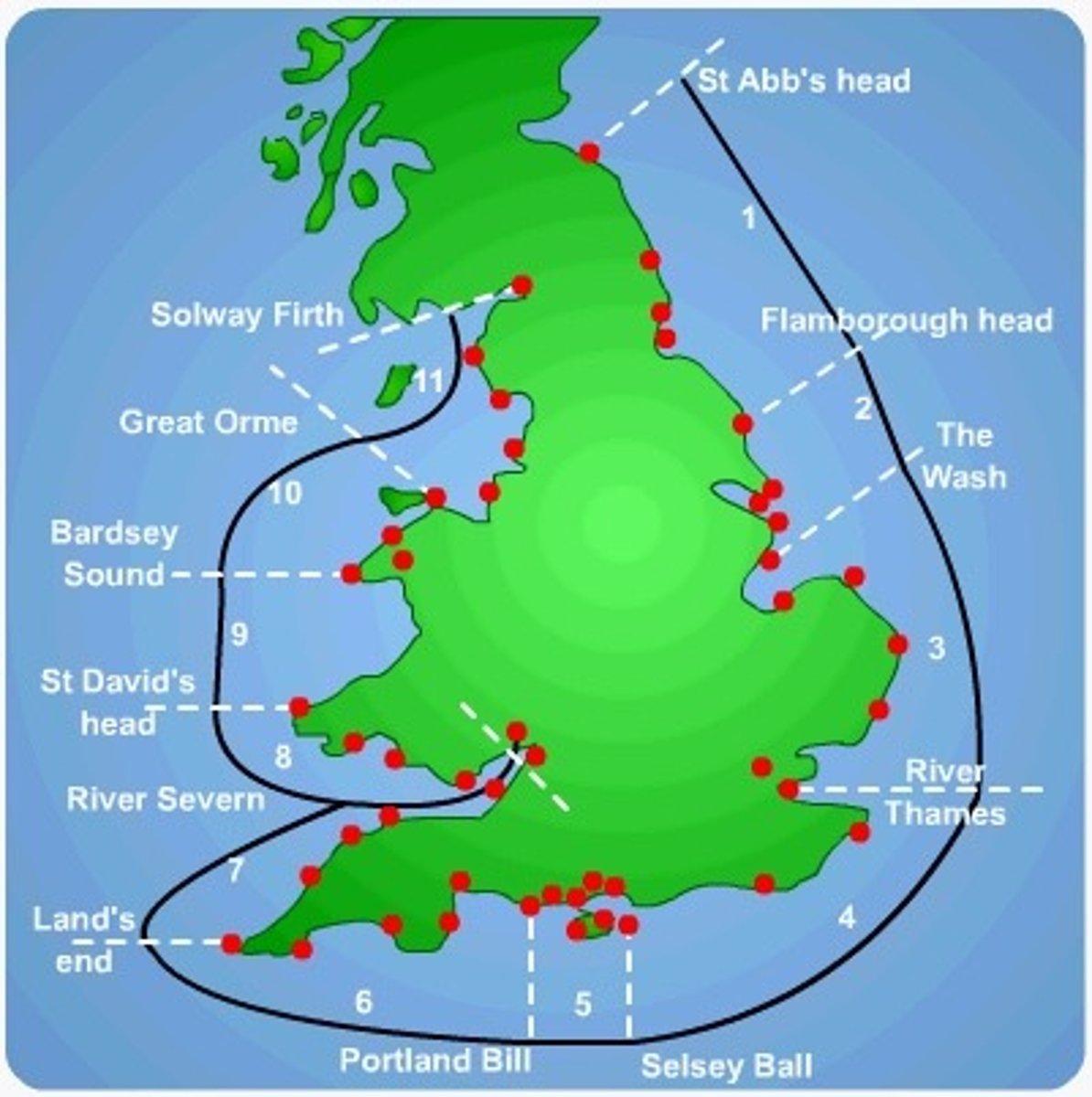
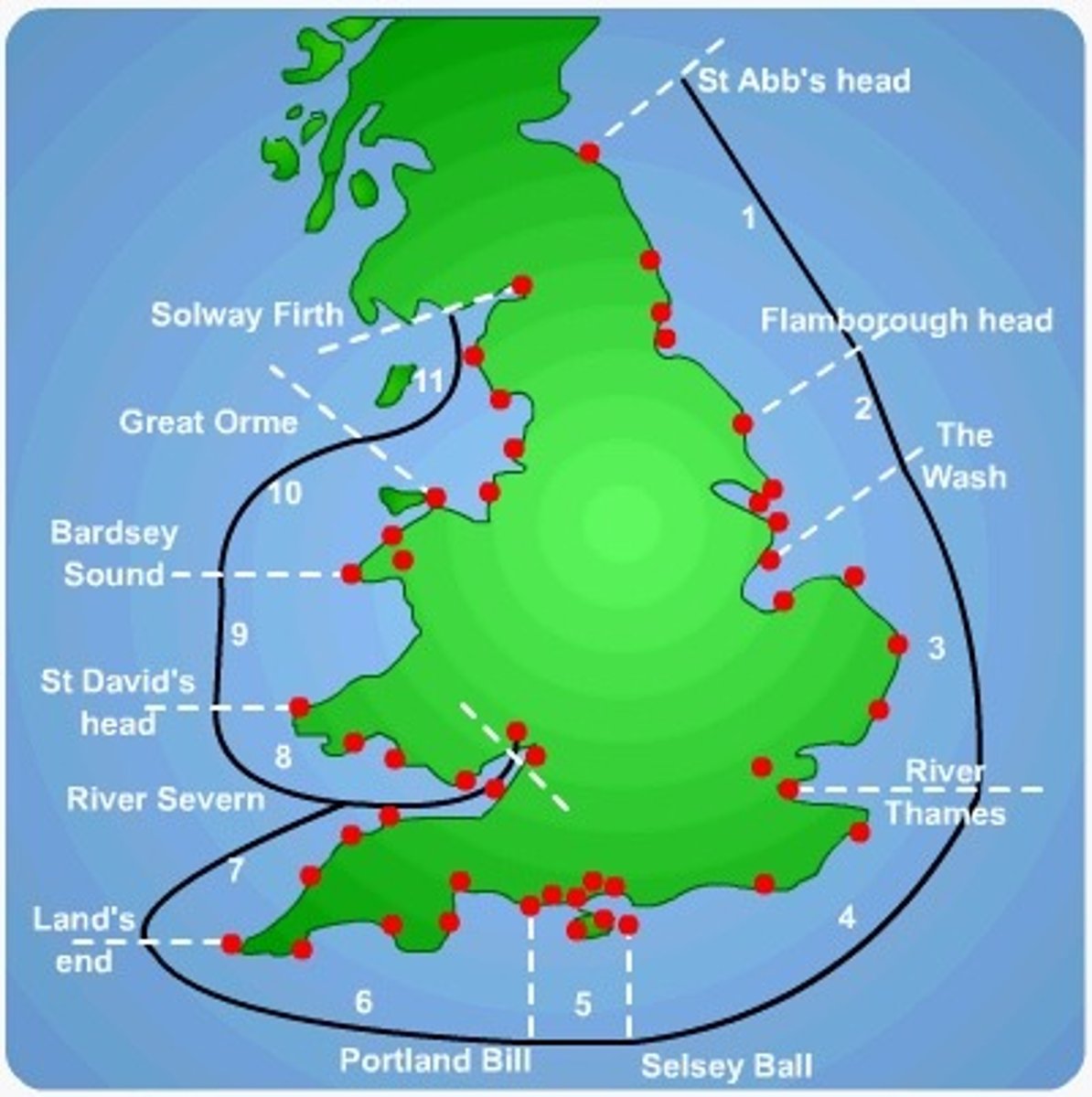
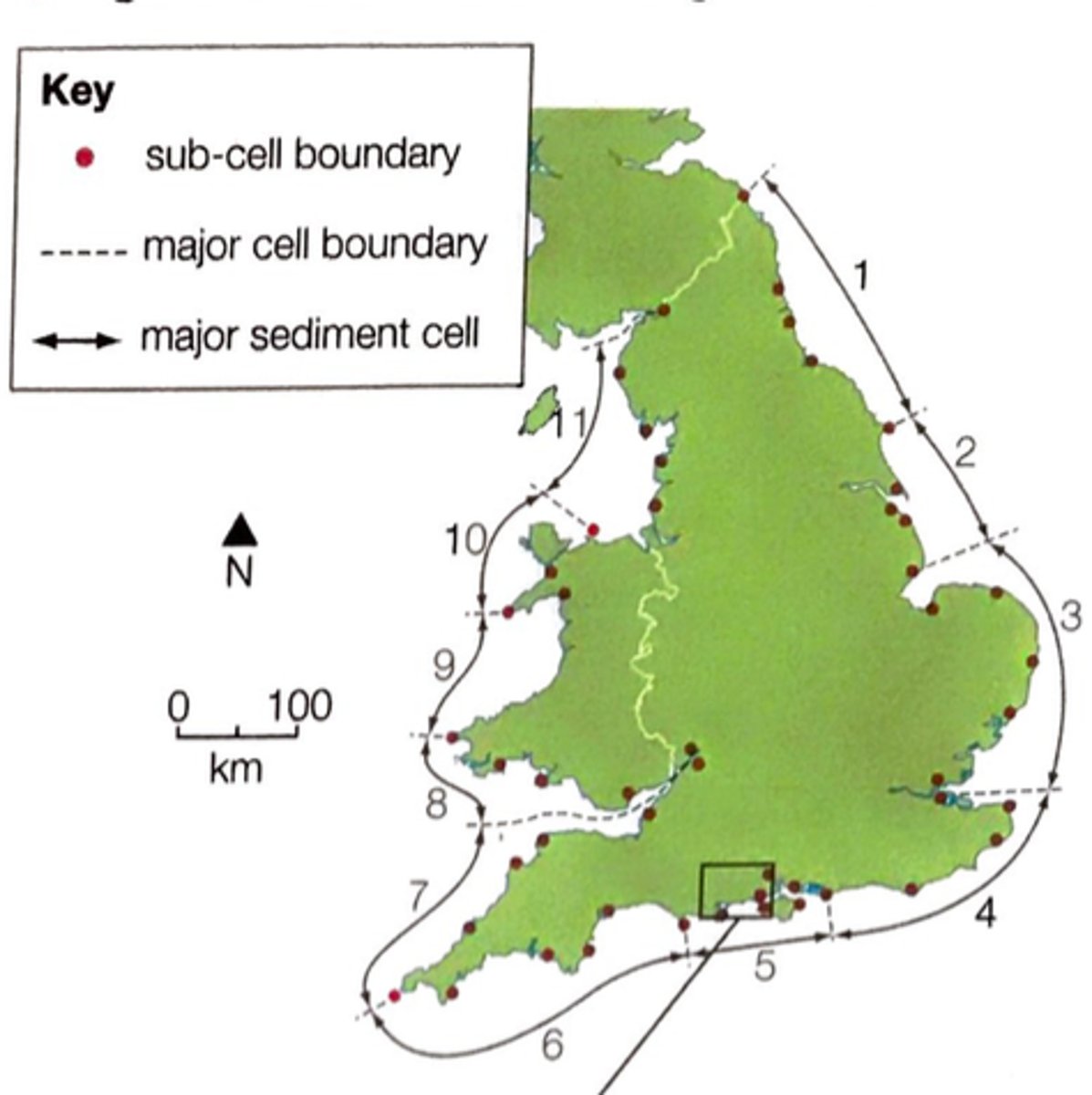
What is a sediment cell?
A self-contained stretch of coastline where sediment is sourced, transported, and deposited with minimal movement between cells.
Name four marine erosion processes.
Hydraulic action, wave quarrying, corrasion/abrasion, and attrition.
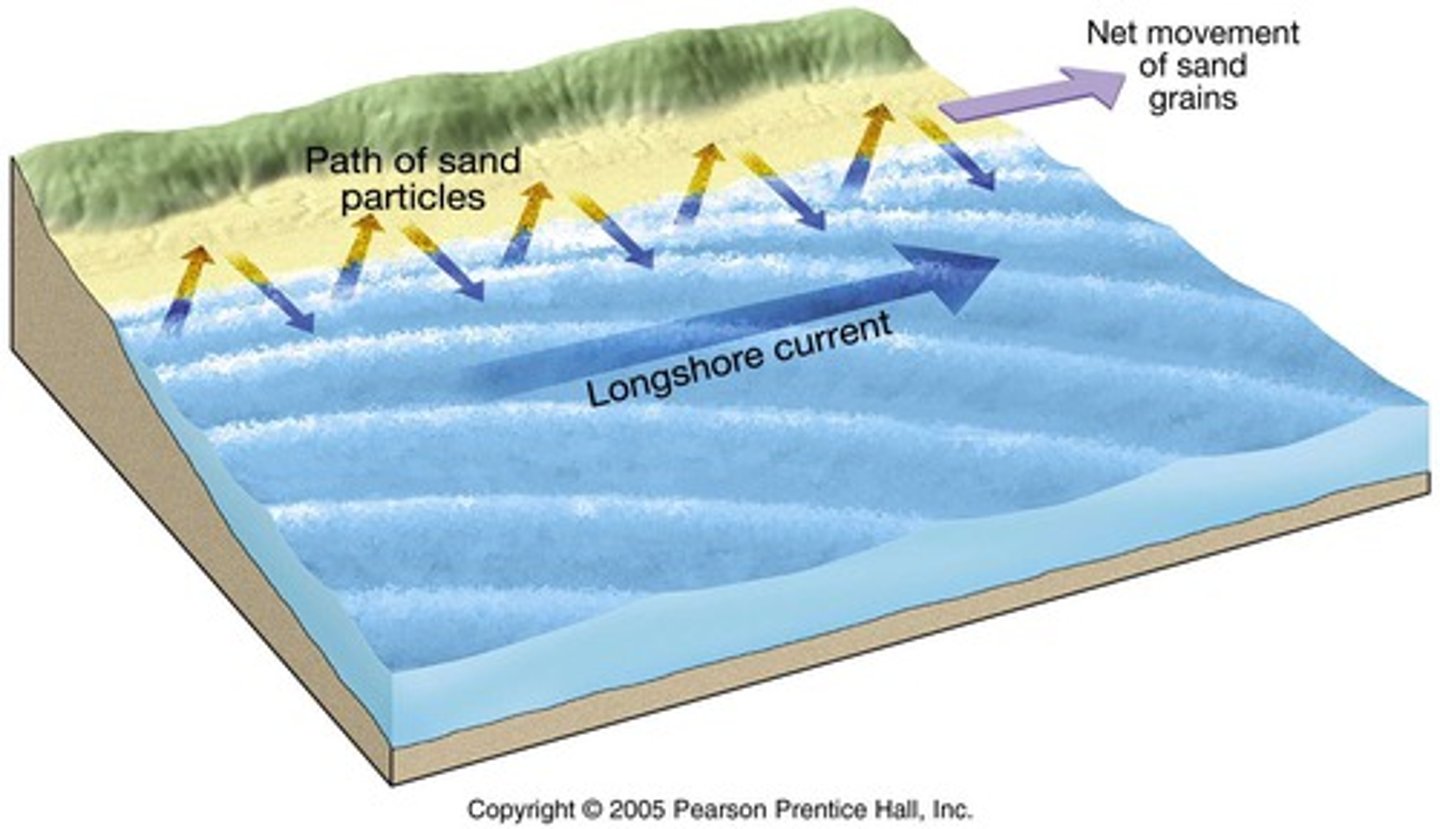
What is longshore drift?
The process of sediment transportation along a coastline caused by waves approaching the shore at an angle, moving material in a zigzag pattern.
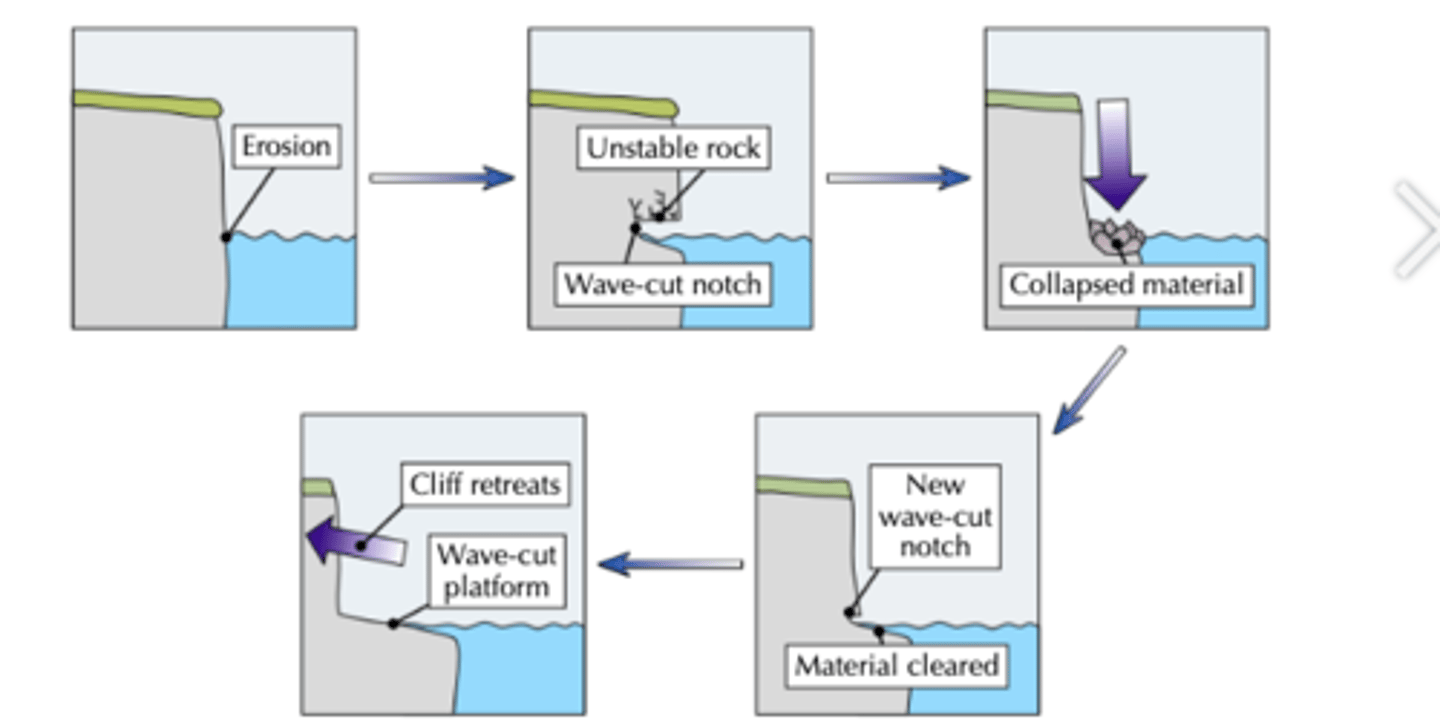
How do wave-cut platforms form?
Through the erosion of a cliff base by hydraulic action and abrasion, creating a wave-cut notch that eventually causes the cliff to collapse and retreat.
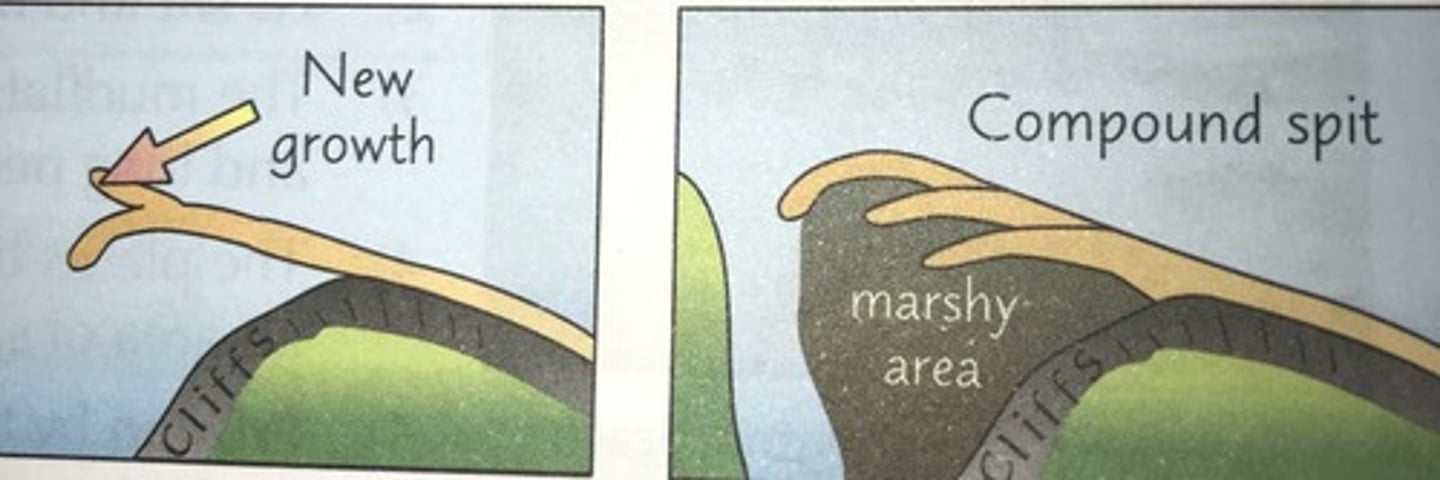
What is the difference between a simple and a compound spit?
A simple spit is a straight or hooked ridge of sediment, while a compound spit has multiple recurved ridges or minor spits along its landward edge.
What is a tombolo?
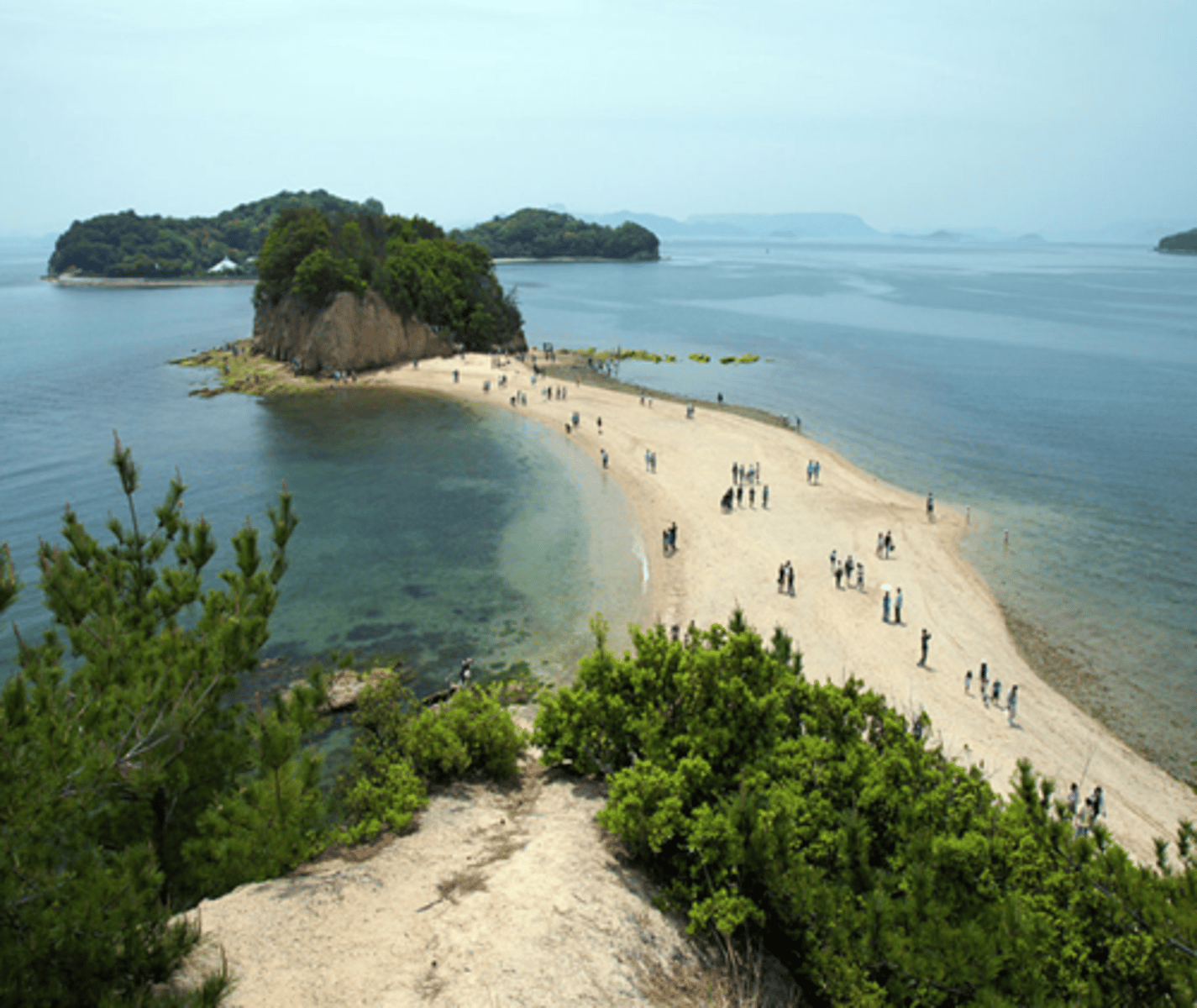
A ridge of sand or shingle that connects the mainland to an offshore island.
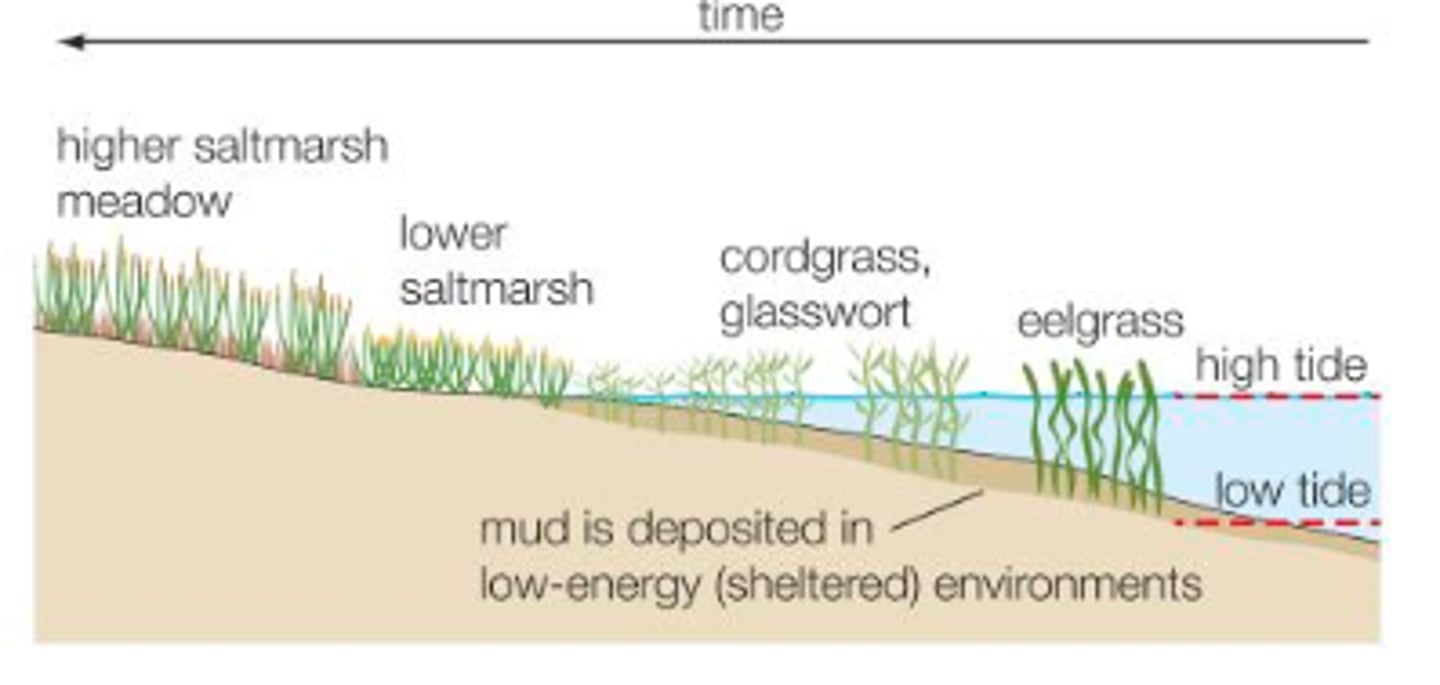
How do estuarine mudflats and saltmarshes develop?
They form in low-energy environments where fine sediment is deposited by tides, eventually being colonized by salt-tolerant vegetation.
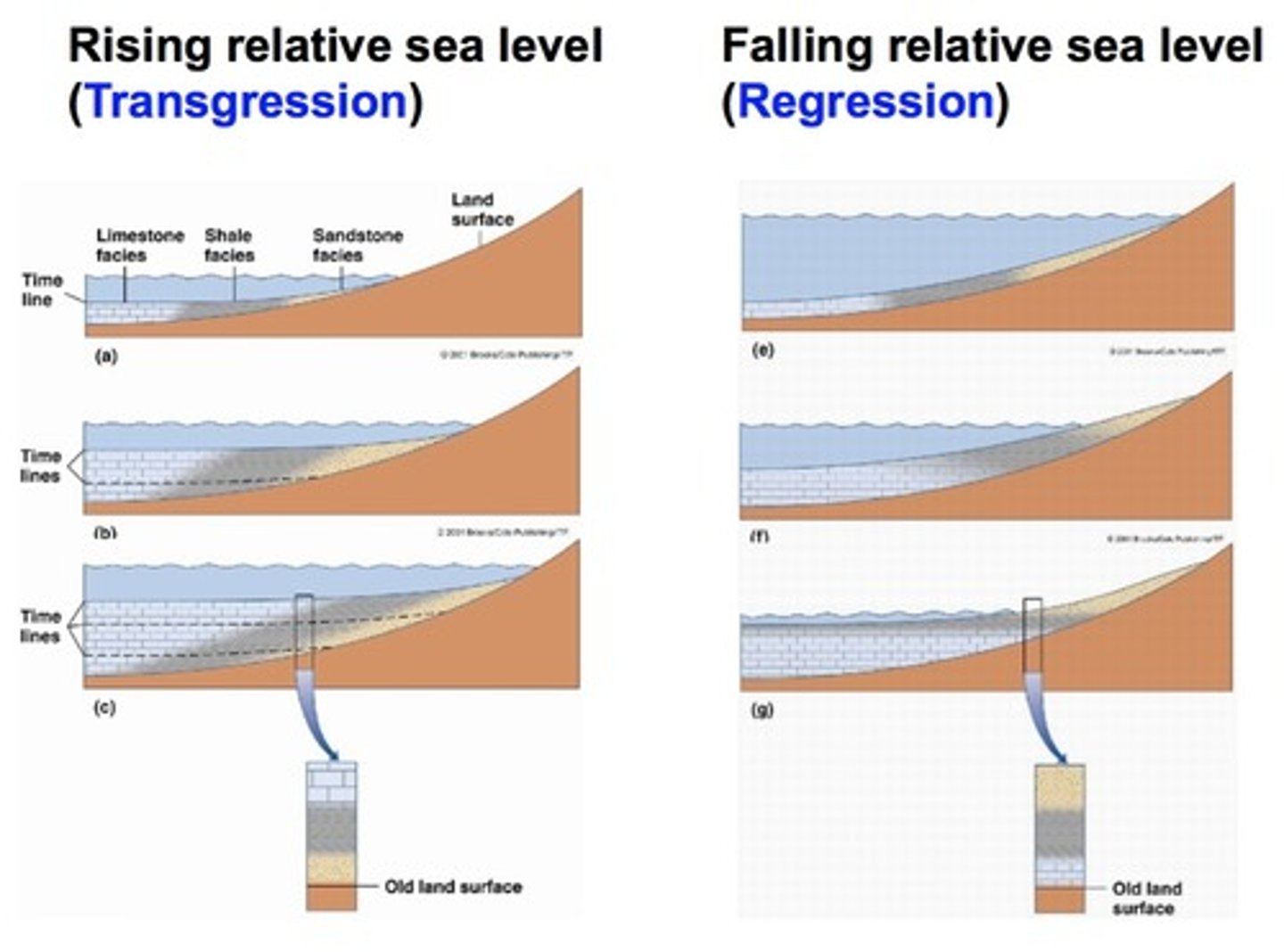
Define eustatic sea level change.
A global change in sea level resulting from an actual rise or fall in the volume of water in the oceans, often due to ice melt or thermal expansion.
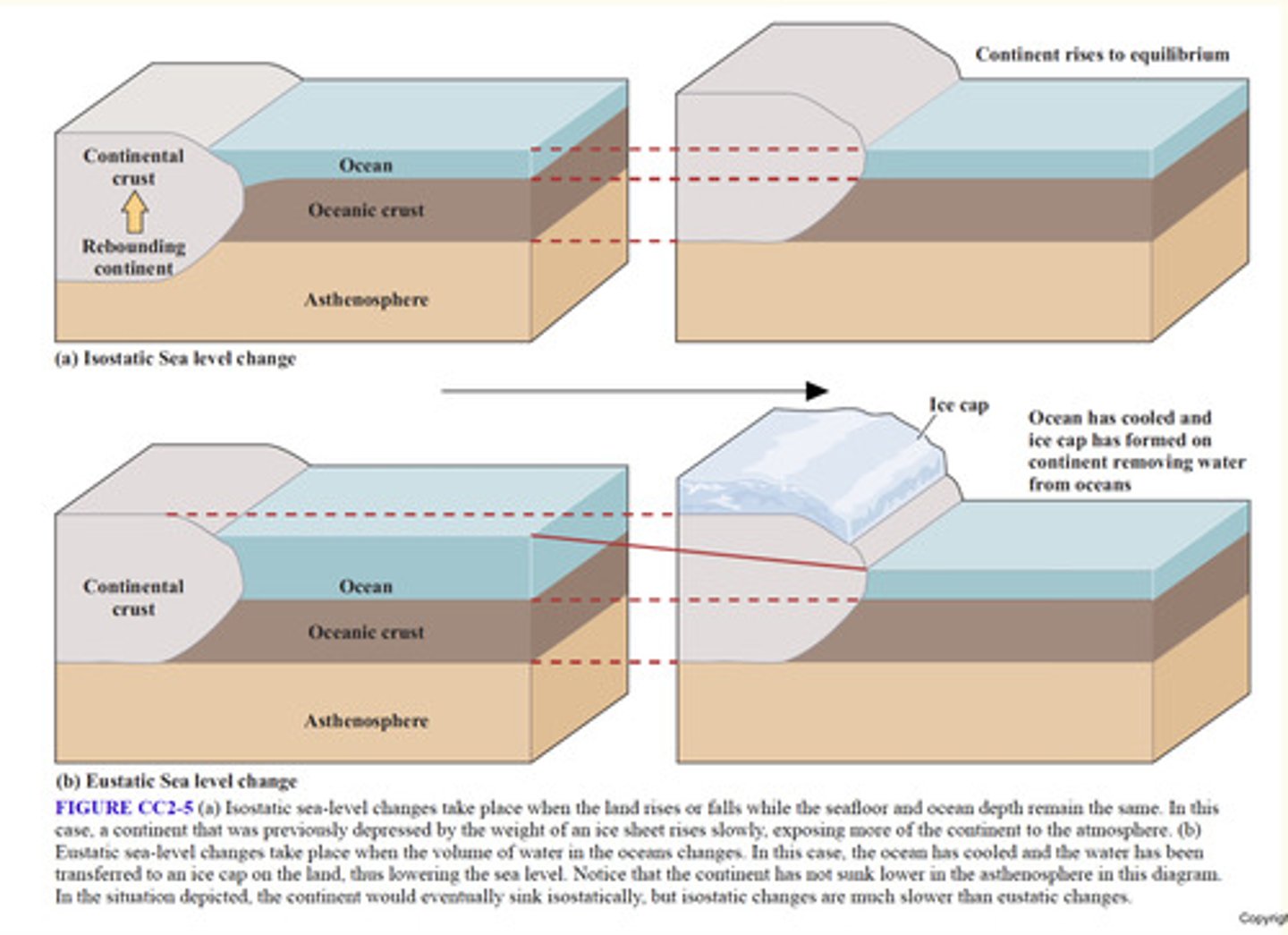
What is isostatic sea level change?
A local change in sea level caused by the vertical movement of the land, often due to post-glacial rebound.
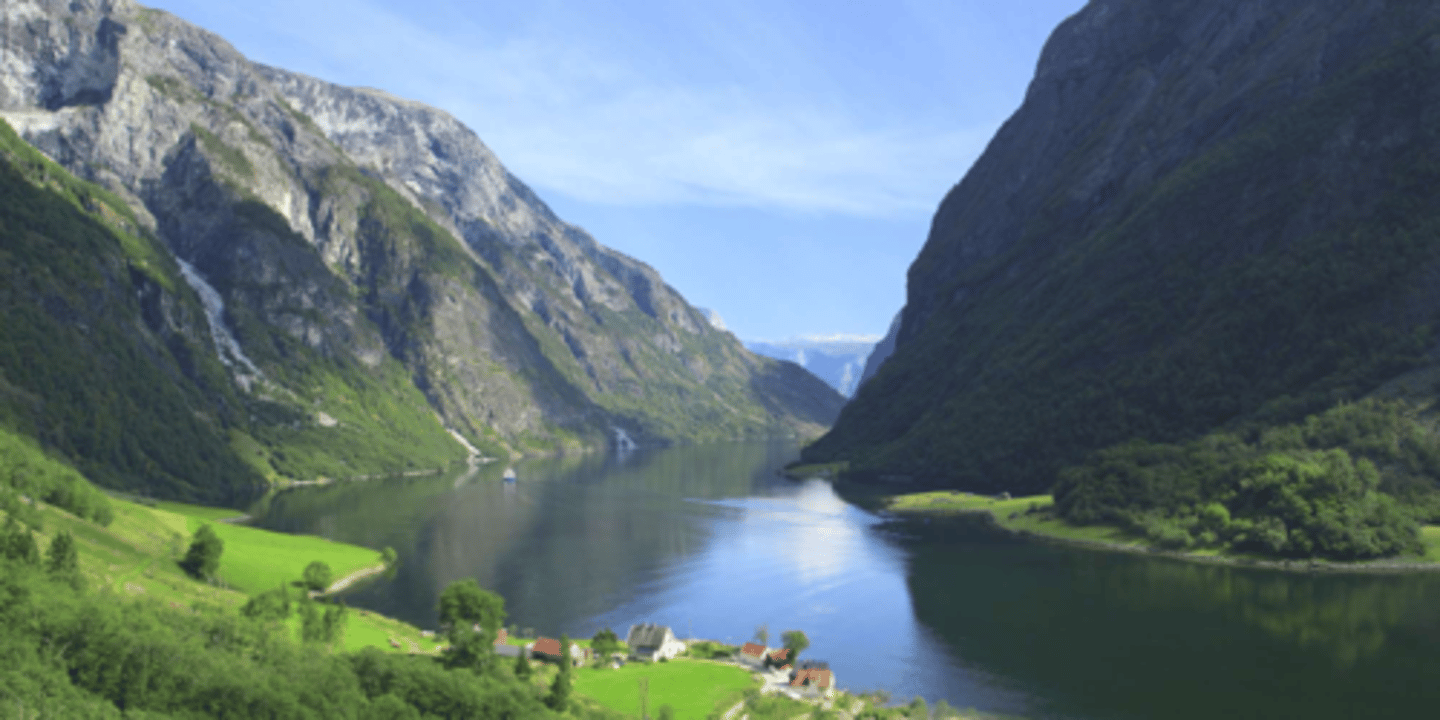
What is a fjord?
A submerged glacial valley with steep, cliff-like sides, formed when sea levels rose after the last glacial period.
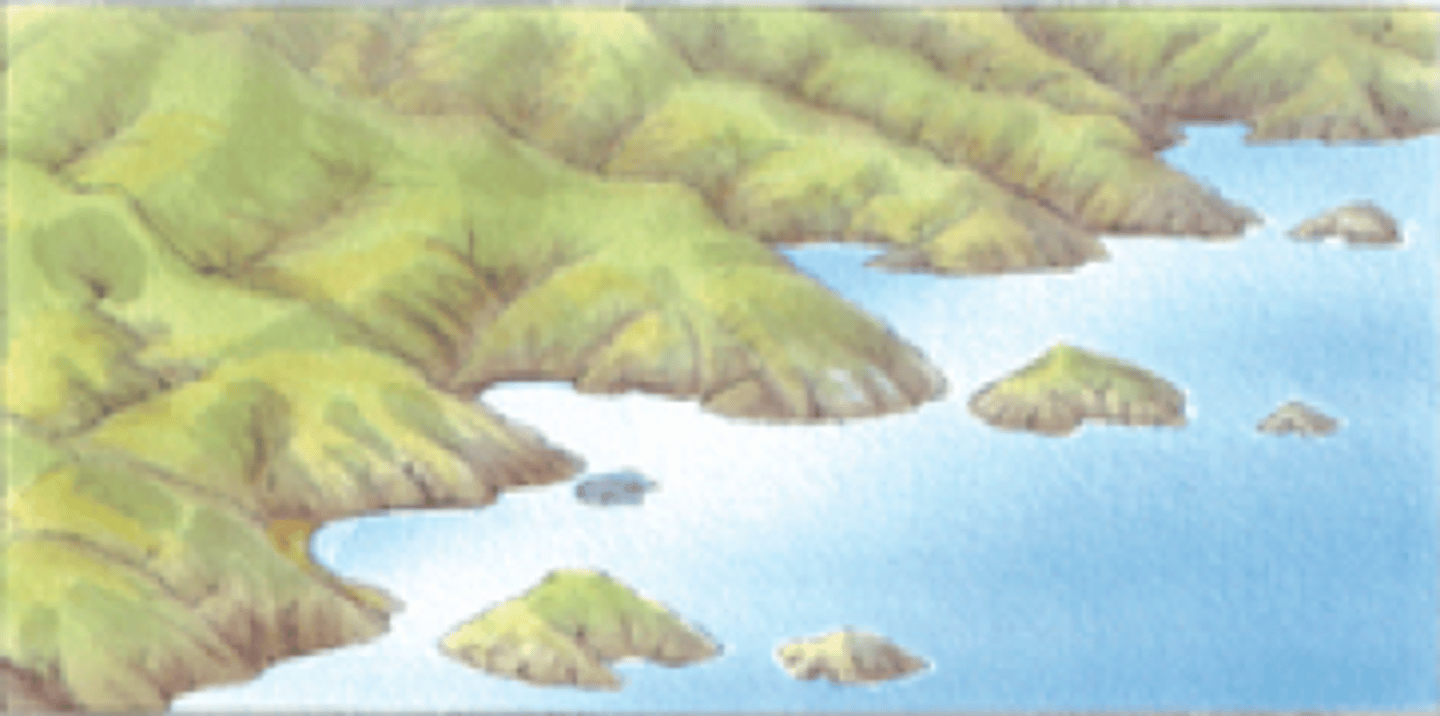
What is a ria?
A submerged river valley, typically V-shaped, formed by a rise in sea level.
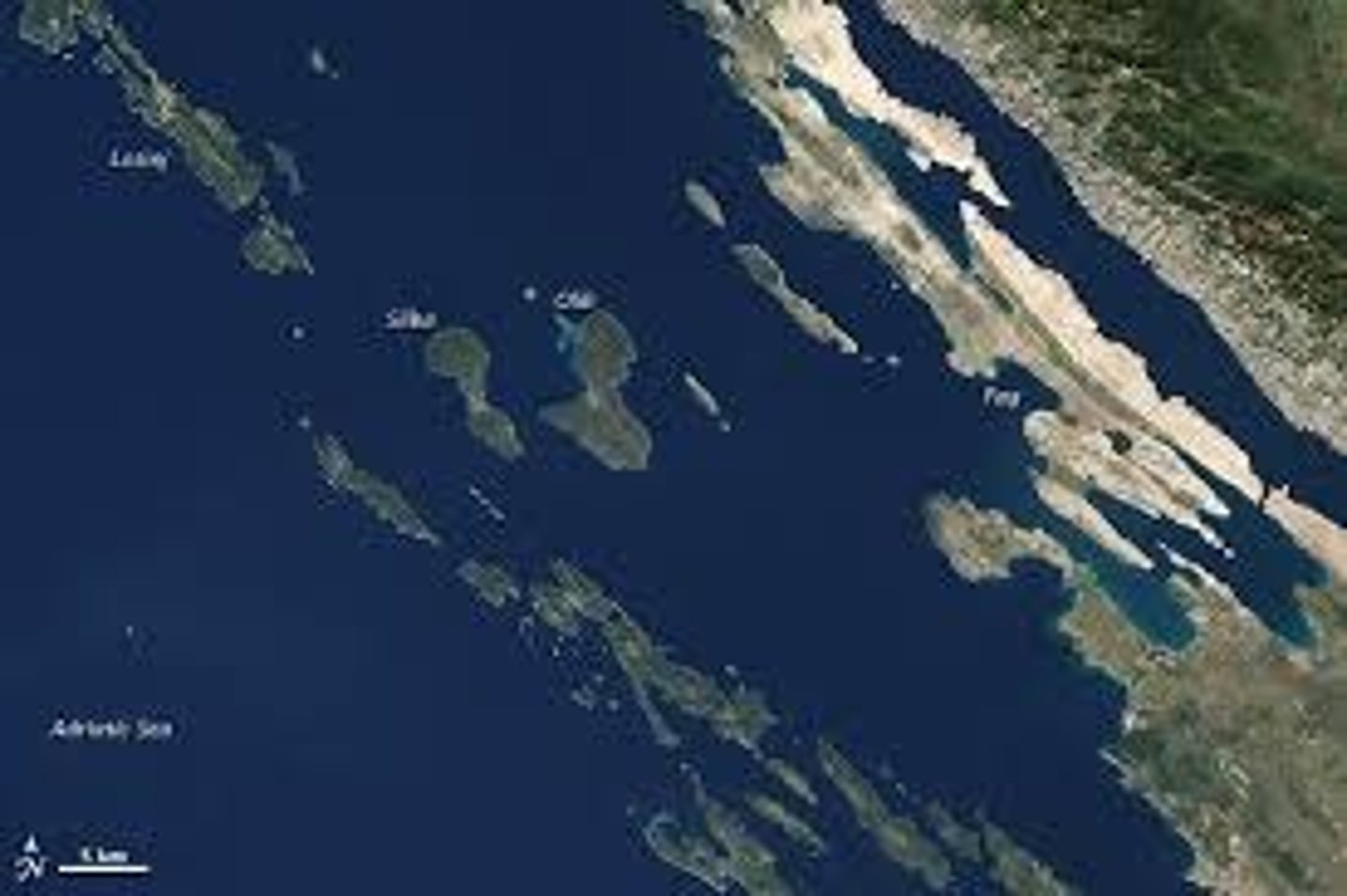
What characterizes a Dalmatian coastline?
A coastline where mountain ranges run parallel to the coast and become submerged, creating a series of elongated islands and inlets.
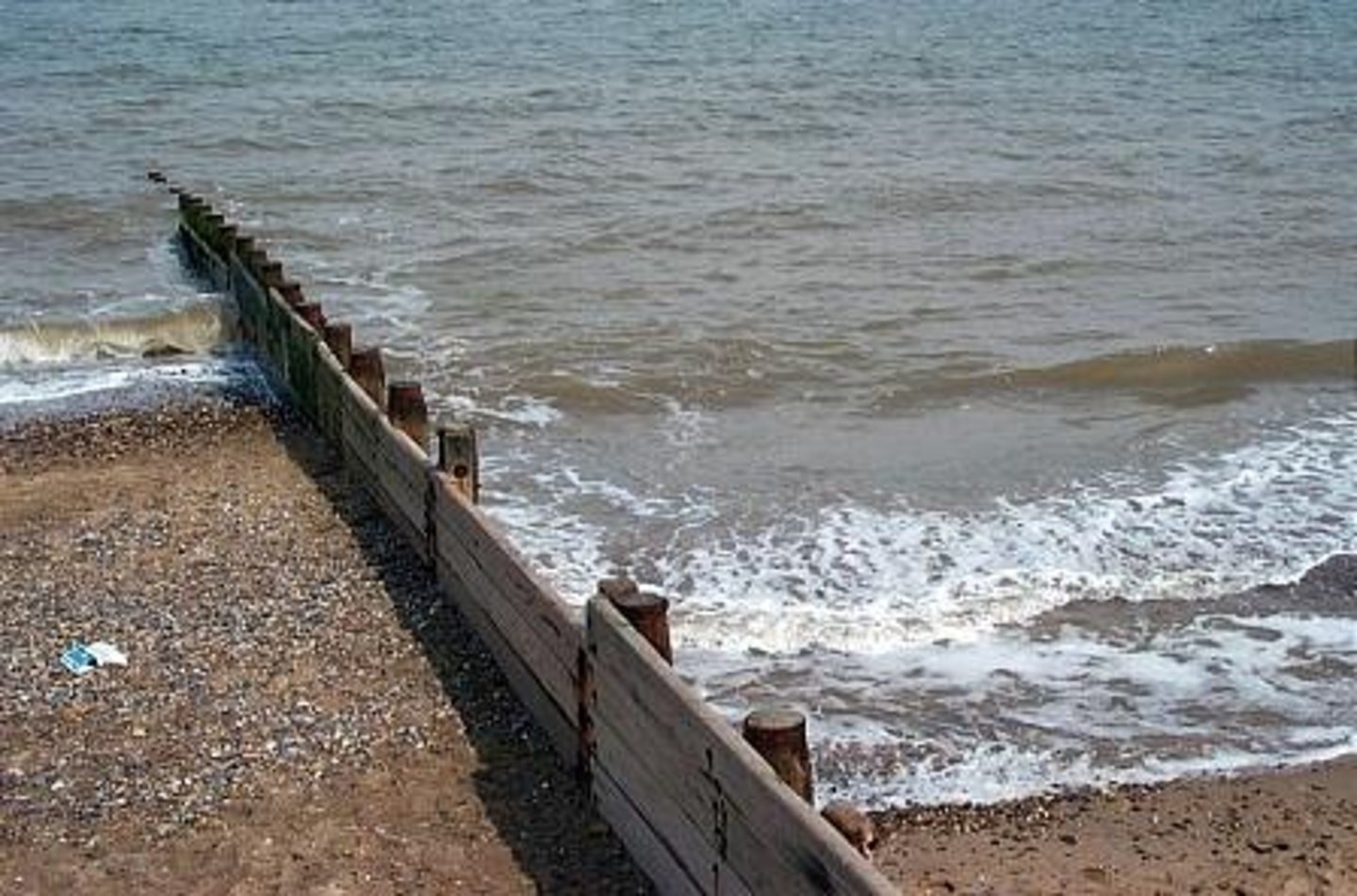
What is the difference between hard and soft engineering in coastal management?
Hard engineering involves artificial structures (e.g., sea walls) to resist coastal processes; soft engineering works with natural processes (e.g., beach nourishment).
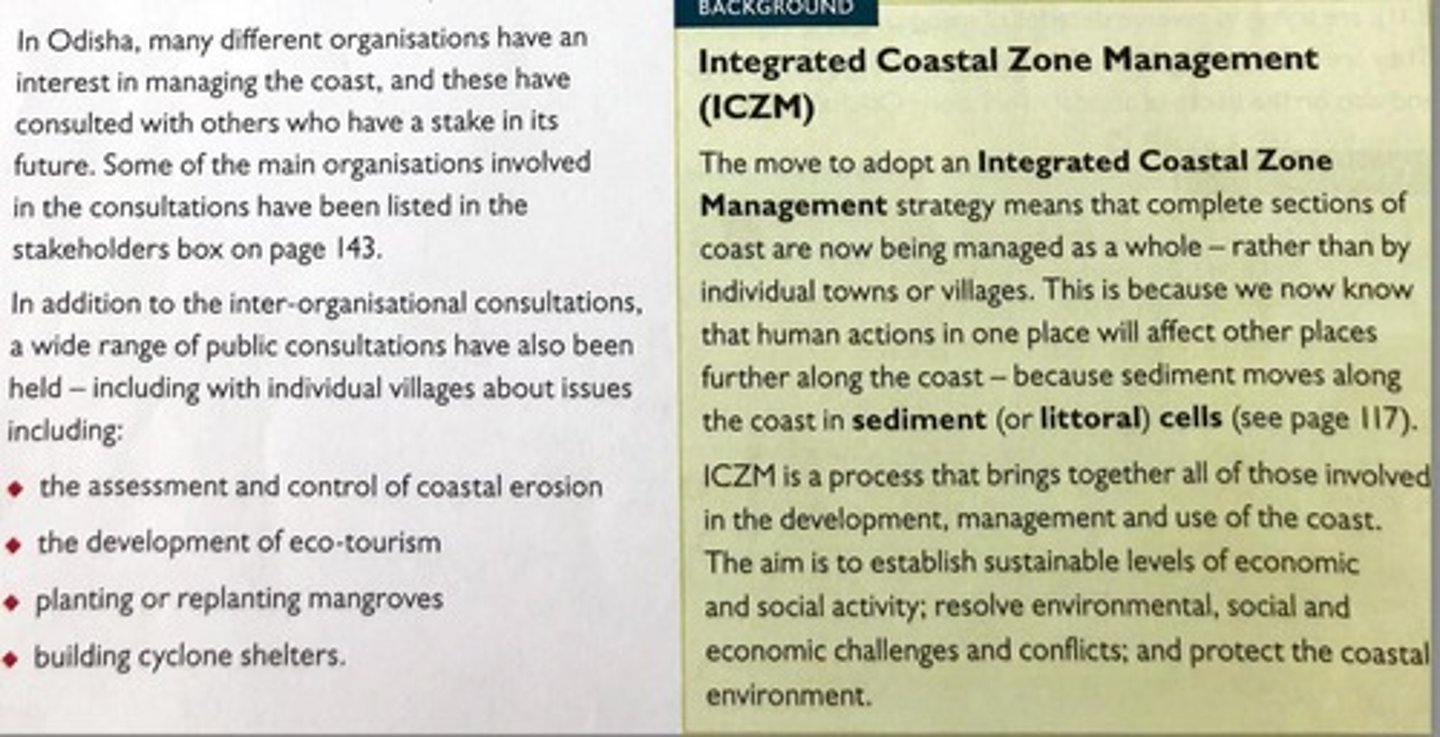
What is Integrated Coastal Zone Management (ICZM)?
A sustainable approach that manages the entire coastal zone as a whole, considering all stakeholders and natural processes rather than just individual sites.
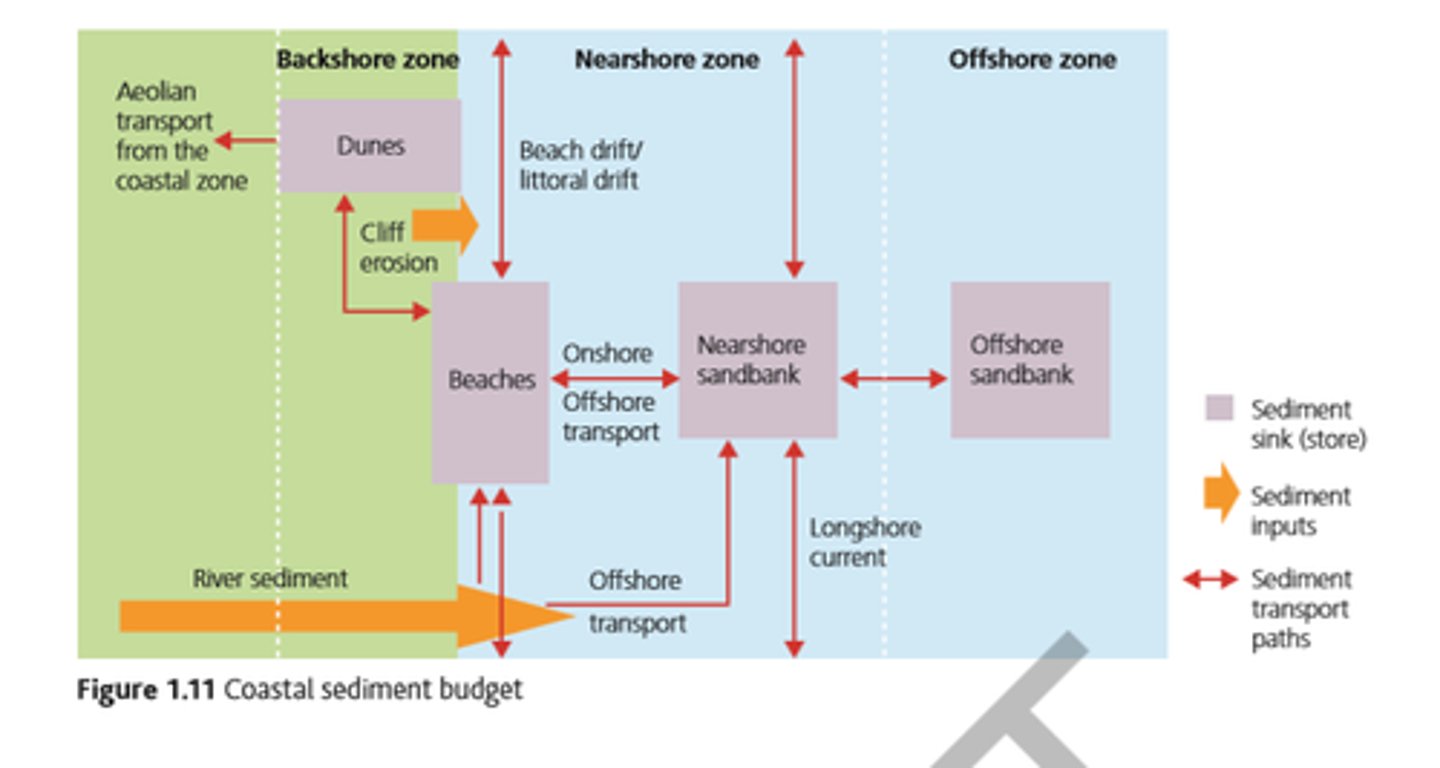
What is a sediment budget?
The balance between the amount of sediment entering a system (sources) and the amount leaving it (sinks).
How does sub-aerial weathering affect coastal landscapes?
It weakens the cliff face through processes like freeze-thaw, salt crystallization, and biological weathering, making the rock more susceptible to marine erosion.
Why is the coast considered an open system?
It receives inputs from outside the system and transfers outputs away into other systems like the atmosphere, terrestrial, or oceanic environments.
In what contexts might a coast be viewed as a closed system?
During scientific research and coastal management planning.
Define dynamic equilibrium in the context of a sediment cell.
A state where inputs and outputs of sediment are in a constant state of change but remain in balance.
What is the difference between long-term and short-term interruptions to dynamic equilibrium?
Long-term interruptions are typically caused by human interventions, while short-term interruptions are caused by natural variations.
What are the three main categories of coastal inputs?
Marine (waves, tides, salt spray), Atmosphere (sun, air pressure, wind), and Humans (pollution, recreation, settlement, defences).
Provide four examples of coastal outputs.
Ocean currents, rip tides, sediment transfer, and evaporation.
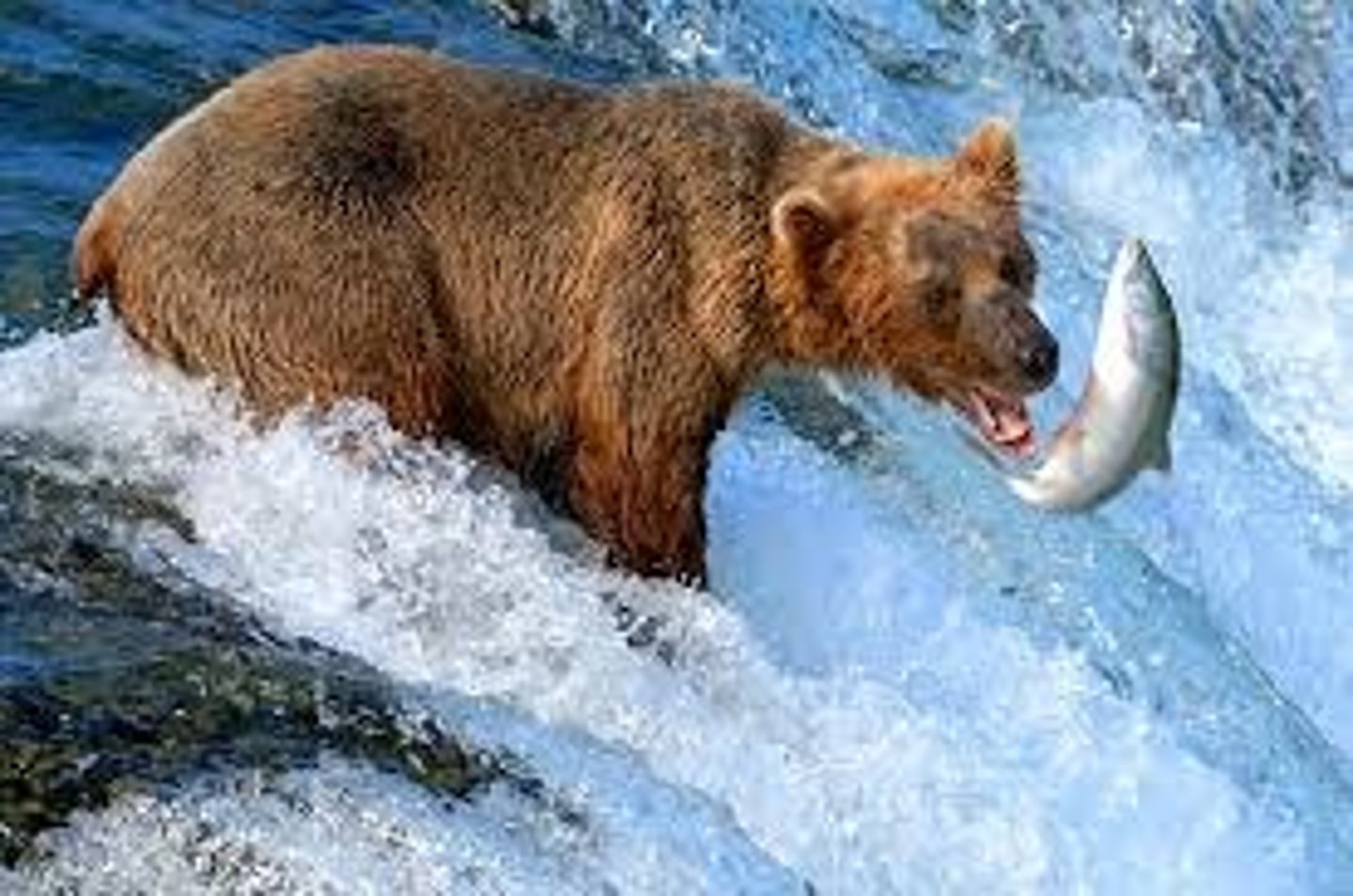
What are stores or sinks in a coastal system?
Locations where sediment and material accumulate, such as beaches, sand dunes, spits, bars, and cliffs.
What are transfers or flows in the coastal system?
The processes that link inputs, outputs, and stores, including longshore drift, erosion, transportation, and deposition.
What are the primary sources of energy in the coastal system?
Wind, gravitational force, and flowing water.
What is the function of a negative feedback loop in a coastal system?
It lessens the impact of a change, helping the system return to dynamic equilibrium.
Describe the negative feedback loop involving an offshore bar during a storm.
Excess sediment from beach erosion is deposited as an offshore bar, which then dissipates wave energy, protecting the beach from further erosion until conditions normalize.
What is the function of a positive feedback loop in a coastal system?
It exaggerates a change, making the system more unstable and pushing it further away from dynamic equilibrium.
Give an example of a positive feedback loop involving sand dunes.
Human foot traffic destroys dune vegetation, which leads to increased erosion, further destabilizing the dunes and leaving the beach more exposed.
What is the primary source of sediment in the coastal zone?
Rivers, especially in high-rainfall environments where significant river erosion occurs.
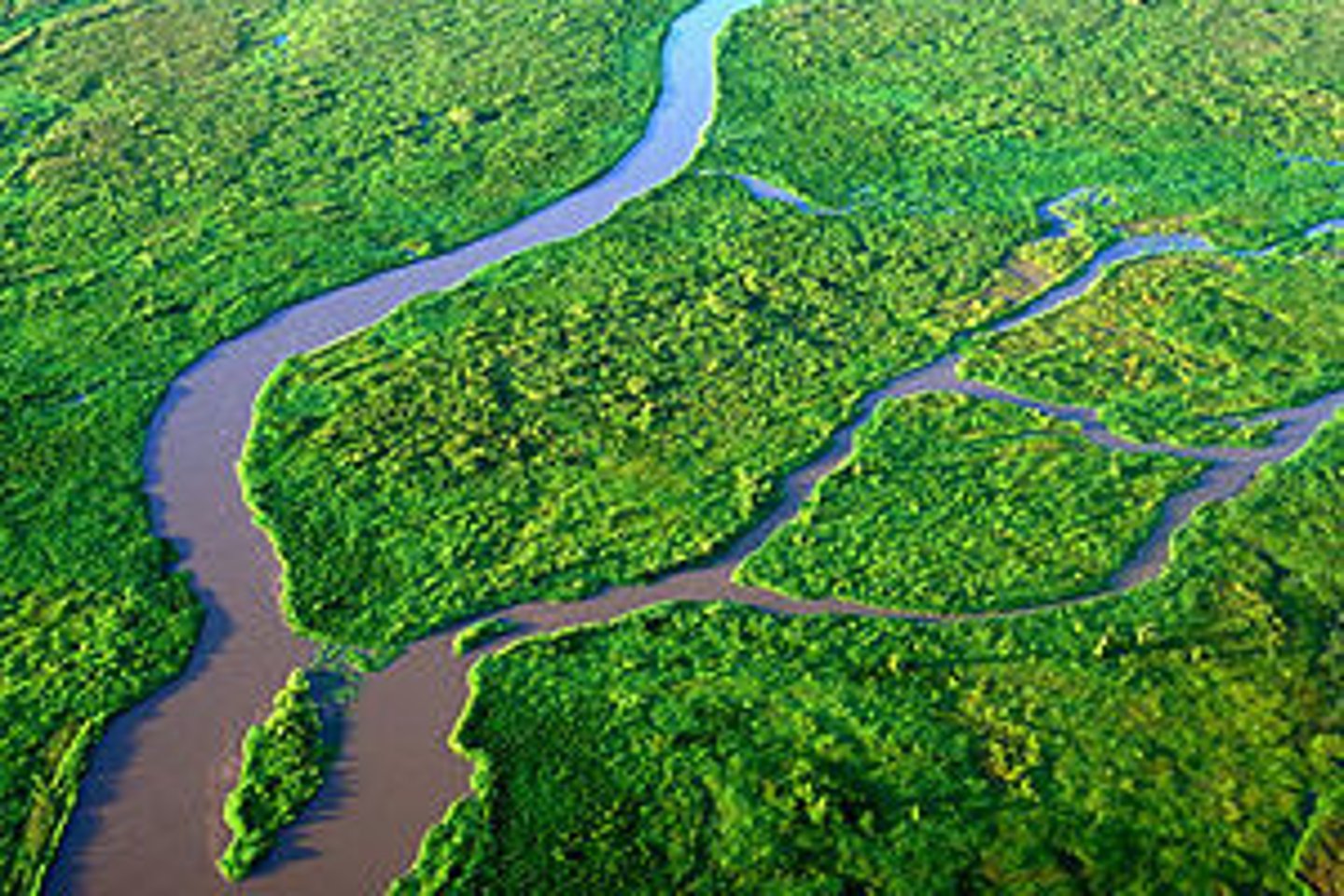
What are estuaries and why are they significant?
Brackish areas where rivers meet the sea; they are important wildlife habitats and sites for sediment deposition.
Why is cliff erosion a significant sediment input?
In areas with unconsolidated cliffs, rapid retreat (up to 10m per year) provides large volumes of sediment, particularly during winter storms.
How do glaciers contribute to coastal sediment?
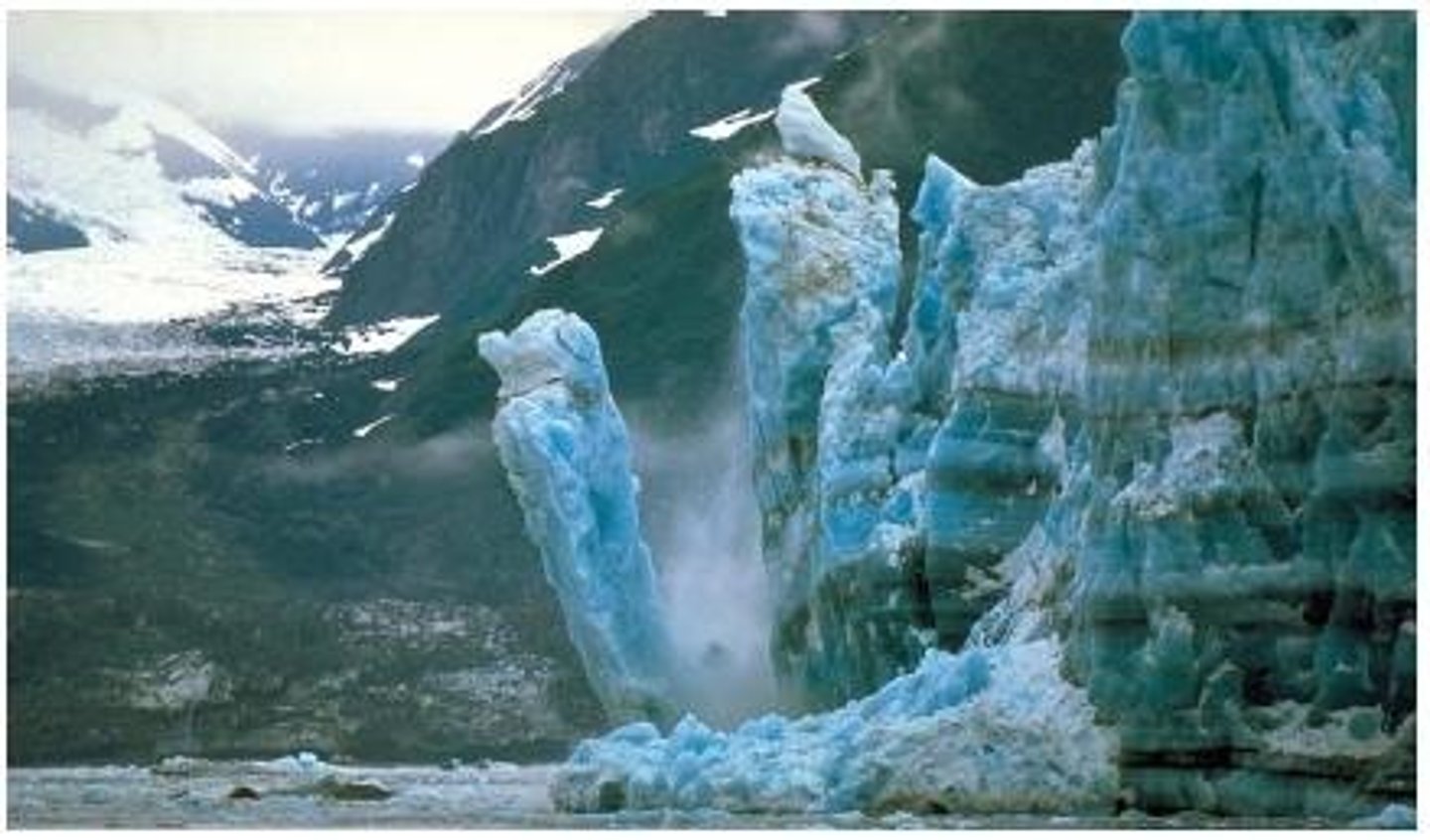
Glaciers flowing directly into the ocean deposit stored sediment when they calve (break off into the sea).
How does offshore sediment reach the beach?
Waves, tides, and currents erode offshore sinks like bars and transport the material onto the beach.
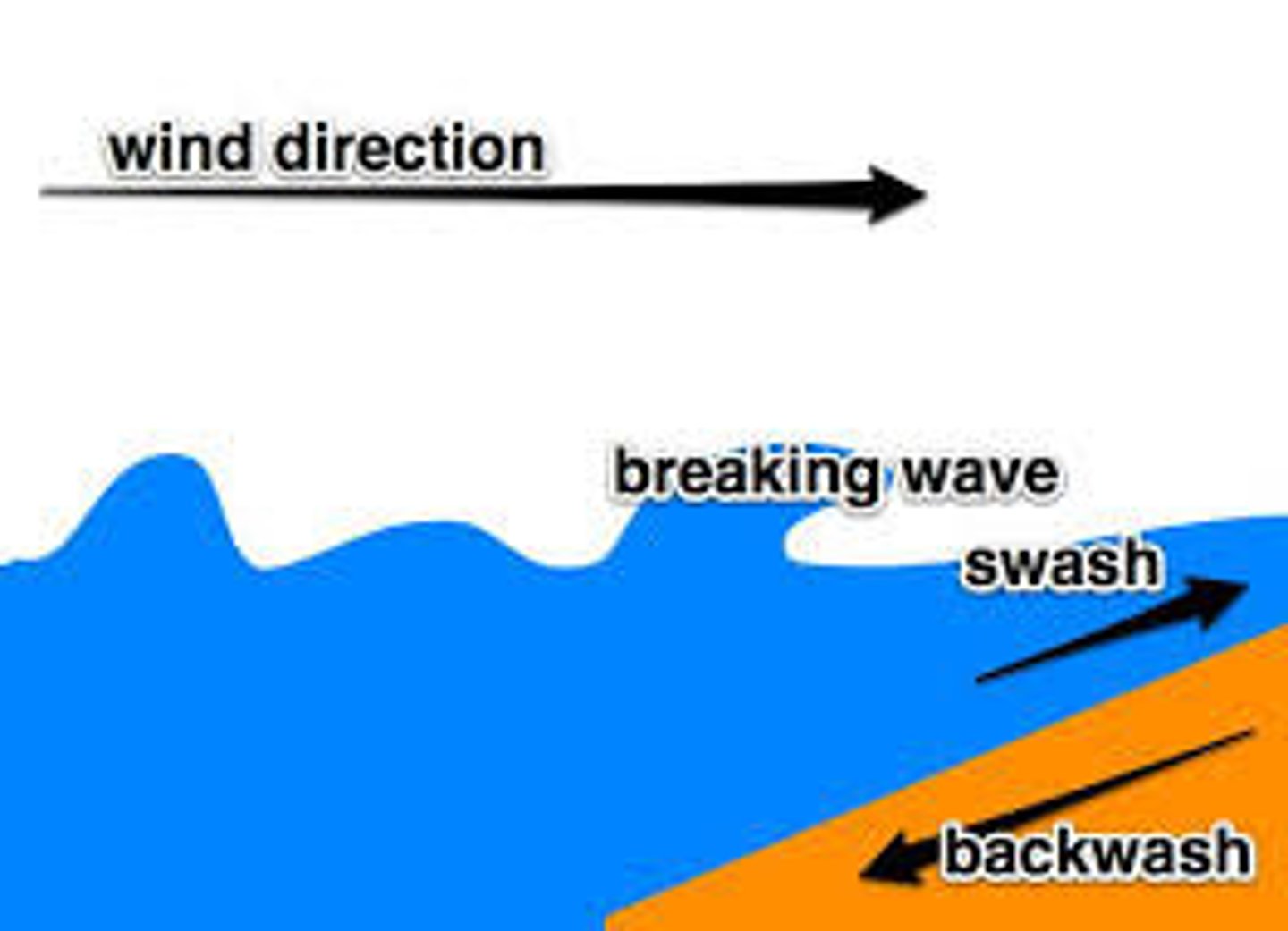
In longshore drift, what is the role of the swash and backwash?
The swash approaches the coast at an angle due to prevailing winds, moving sediment along the beach, while the backwash pulls sediment directly back down the beach.
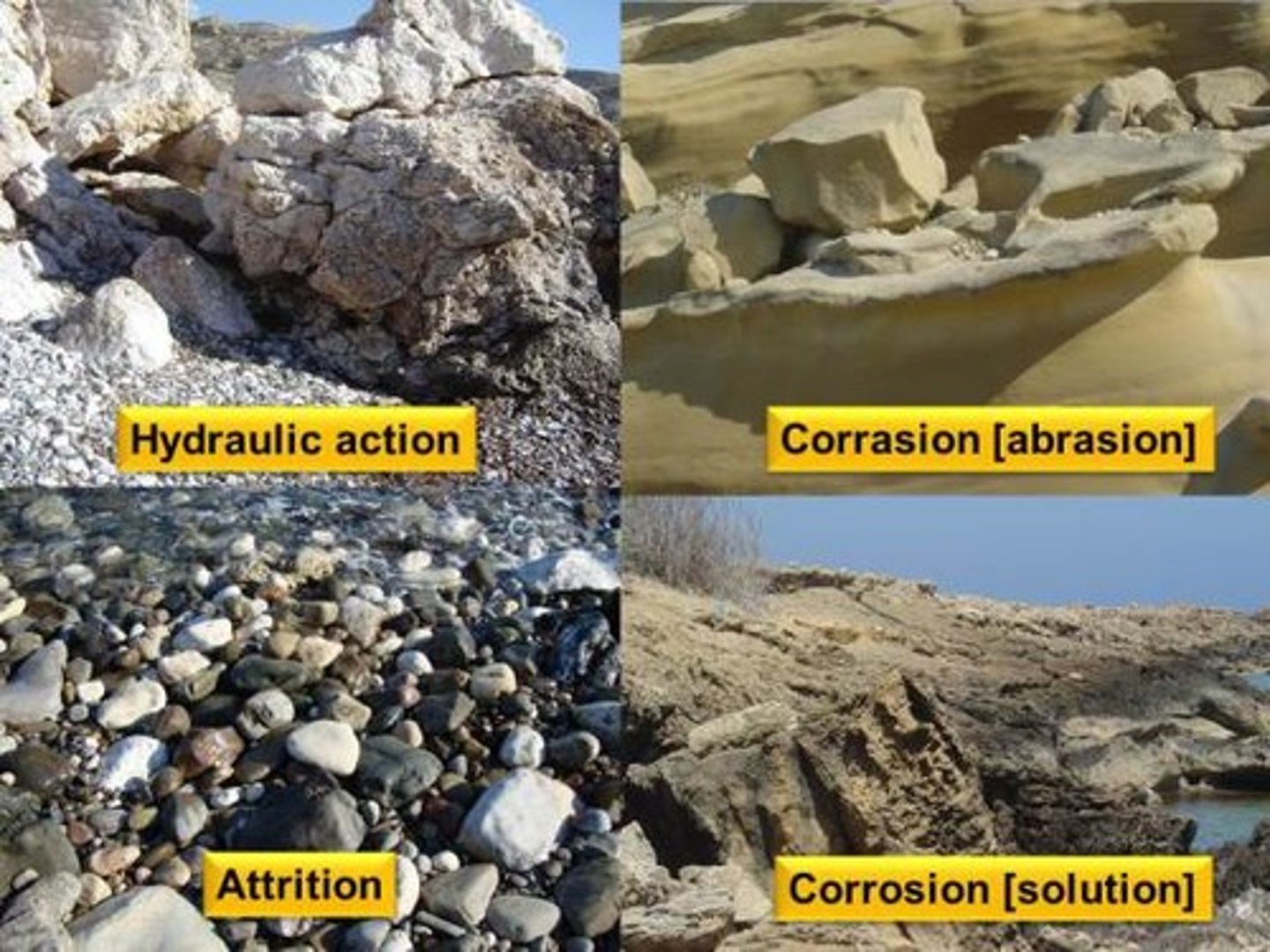
List four types of erosion mentioned in the notes.
Hydraulic action, corrosion, attrition, and abrasion.
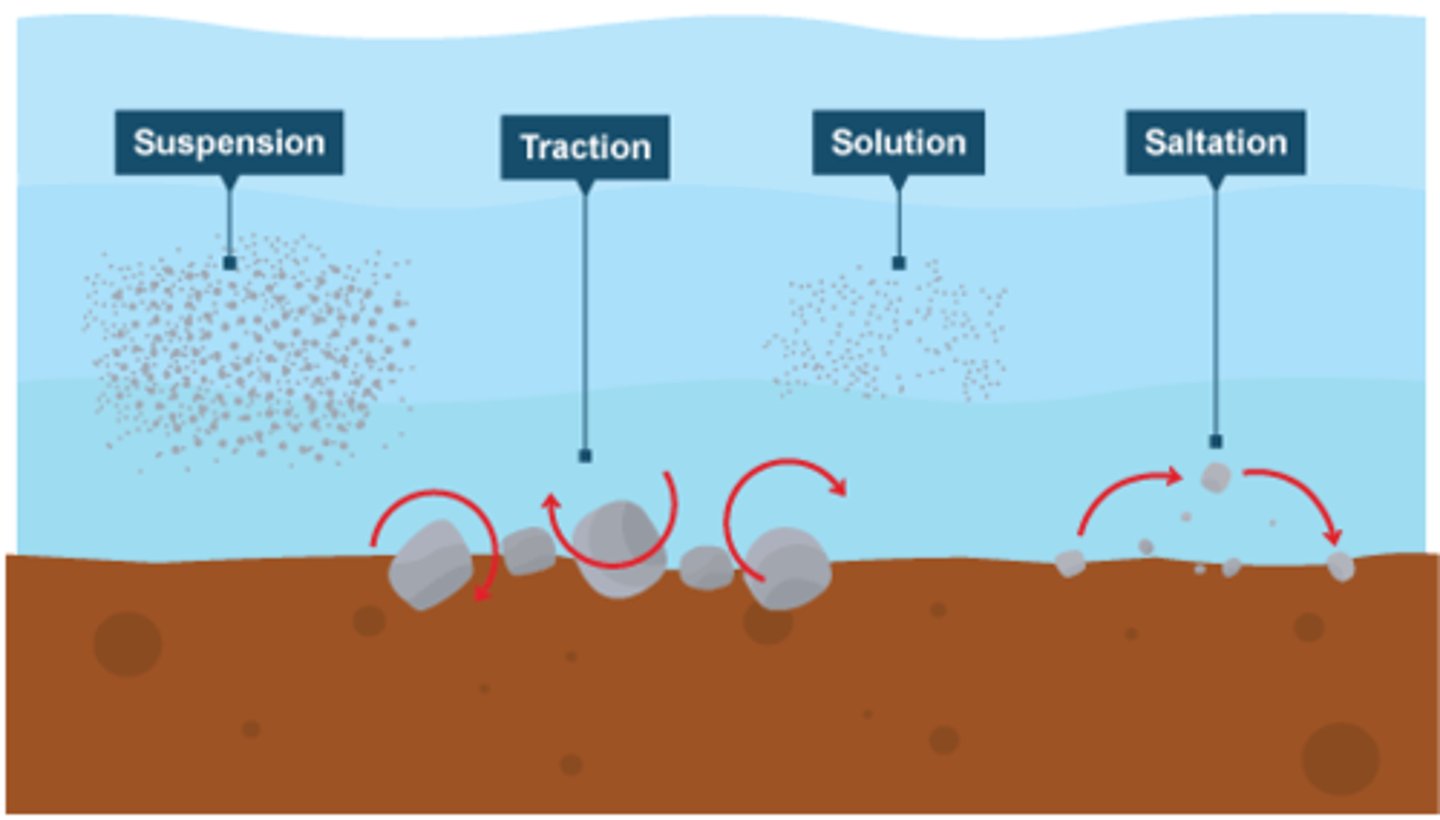
List four types of transportation mentioned in the notes.
Bedload, in suspension, traction, and in solution.
What are the two processes of deposition mentioned?
Gravity settling and flocculation.
Why are subcells important in coastal management?
They are smaller, distinct sections within a sediment cell that are often used as the specific focus for planning coastal management projects.
What is the main driving force behind the movement of sand in dune or desert environments?
Wind energy.
What is the primary mechanism that transports sediment along the coastline?
Longshore drift.
What is the state of dynamic equilibrium in a sediment budget?
A state where the inputs and outputs of sediment are equal.
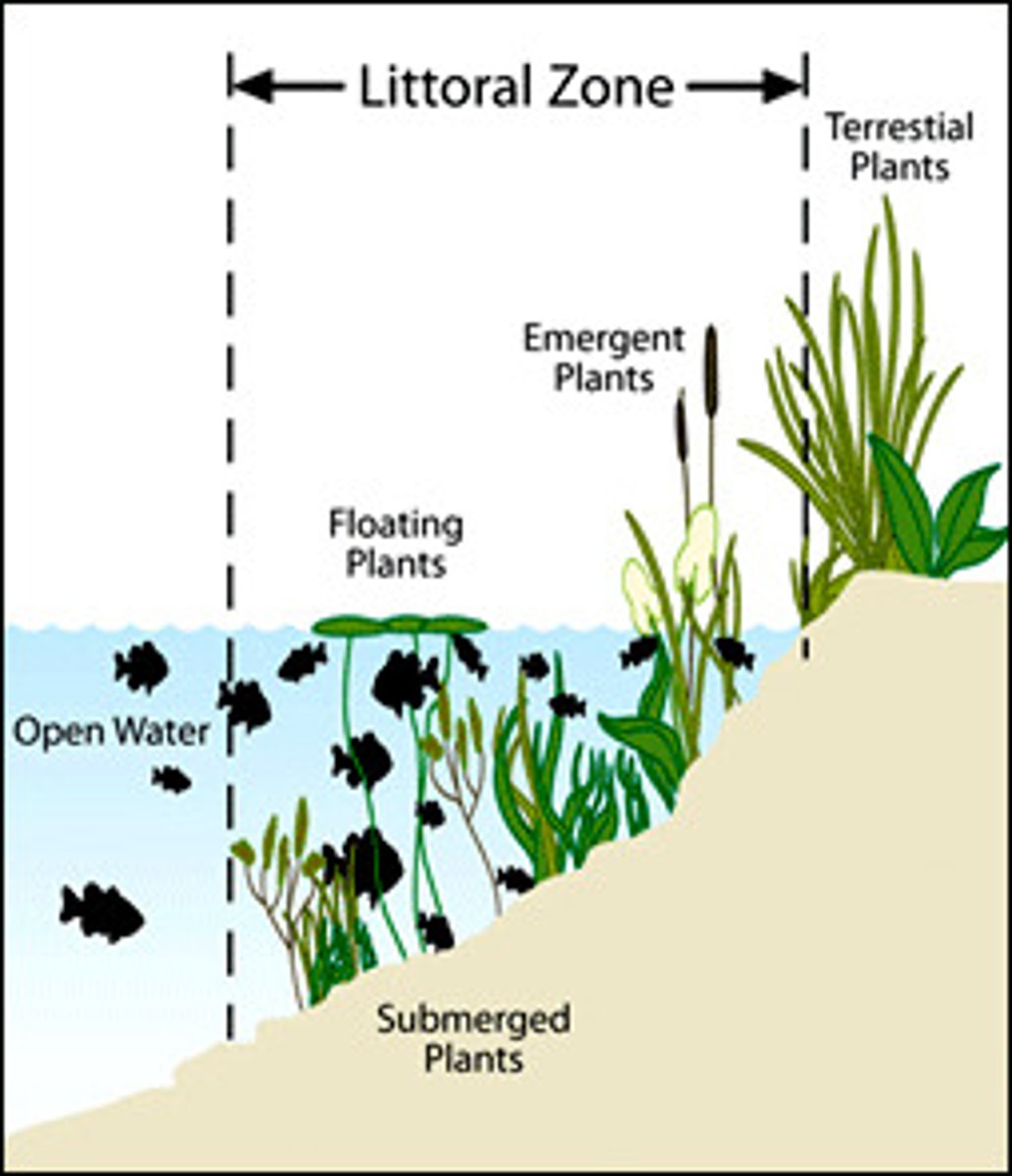
How is the littoral zone defined?
The area of land between the cliffs or dunes on the coast and the offshore area beyond the influence of waves.
What are two short-term factors that cause the littoral zone to change?
Tides and storm surges.
What are two long-term factors that cause the littoral zone to change?
Changes in sea level and human intervention.
What is the primary energy source for all natural systems?
The sun.
What is the main source of energy at the coast?
Waves, which are primarily generated by wind.
What happens to water particle orbits as waves approach a shallower seabed?
The orbits become more elliptical, leading to more horizontal movement.
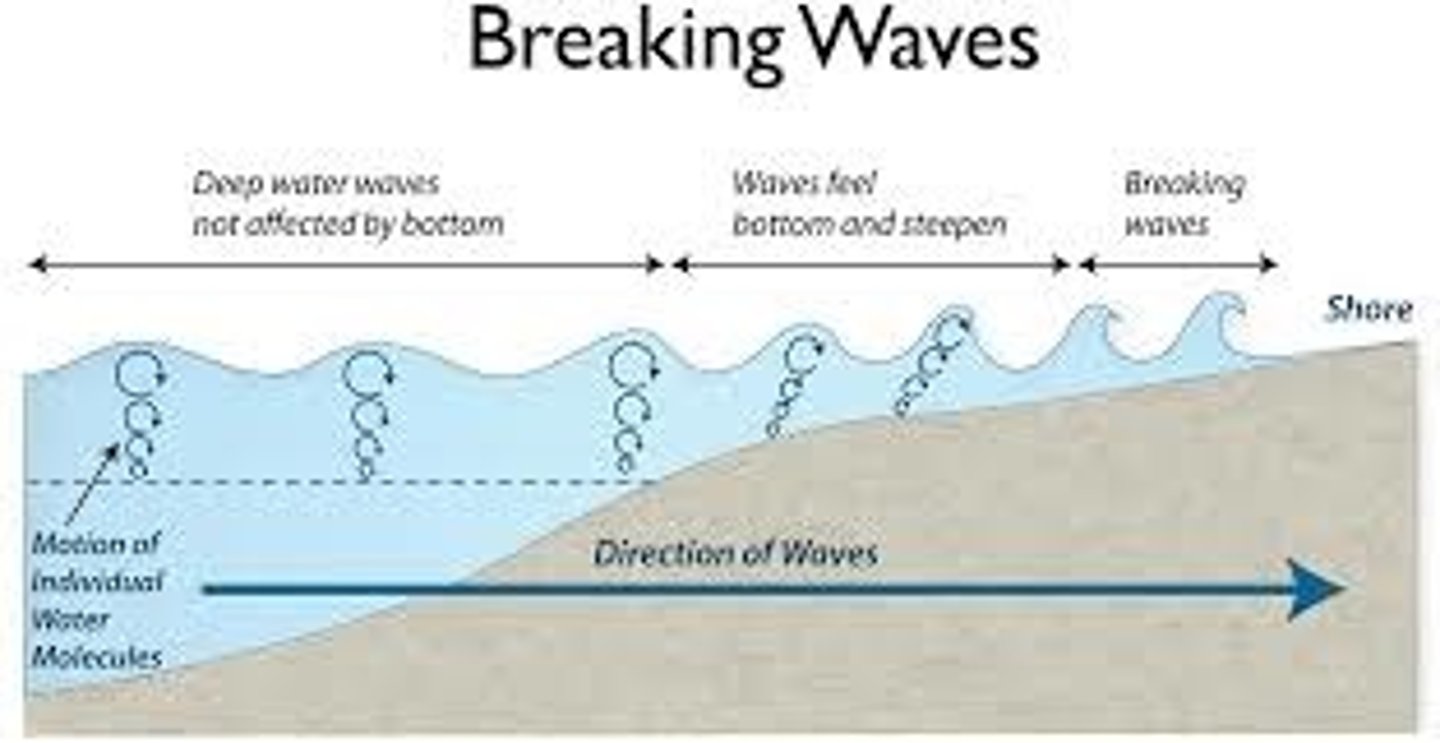
What occurs to a wave as it approaches the coastline?
Wave height increases, while wavelength and wave velocity decrease, eventually causing the wave to break.
What is the difference between swash and backwash?
Swash is the water moving up the beach, while backwash is the water moving back down the beach into the sea.
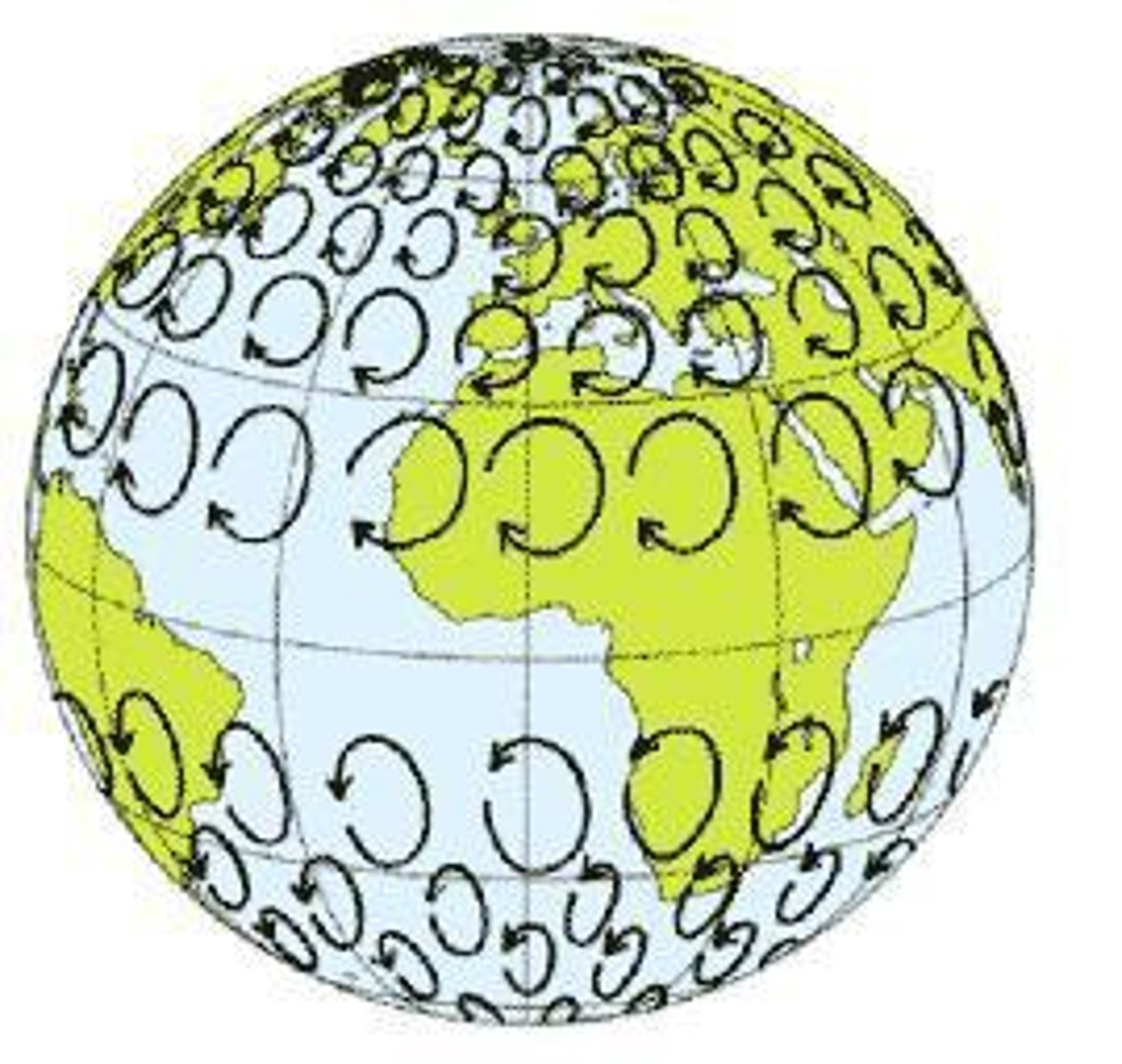
What is a pressure gradient in the context of wind?
The difference in pressure between two areas; a larger difference results in stronger winds.
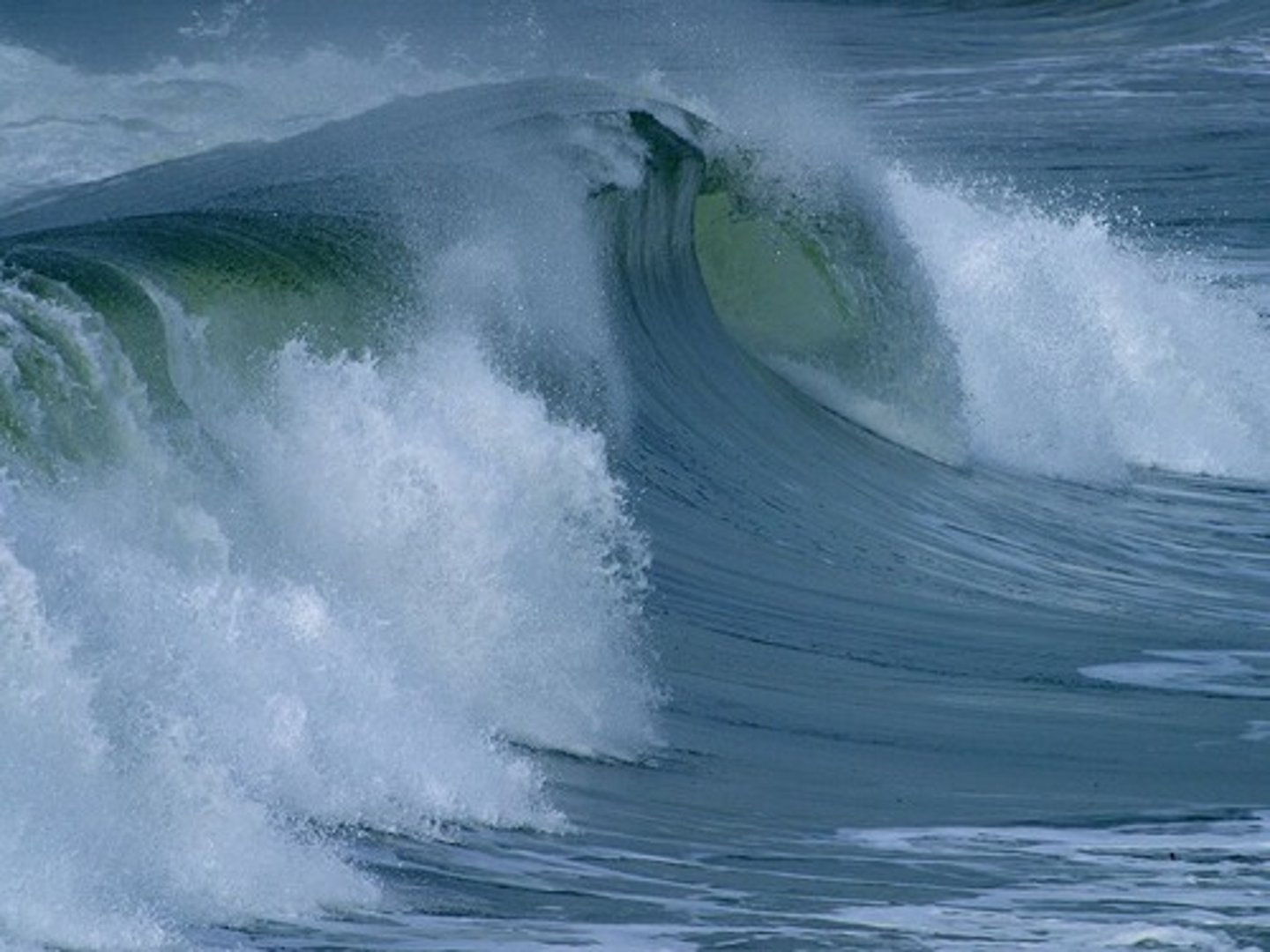
What is 'fetch' in relation to wave energy?
The distance over which the wind blows; a larger fetch results in more powerful waves.
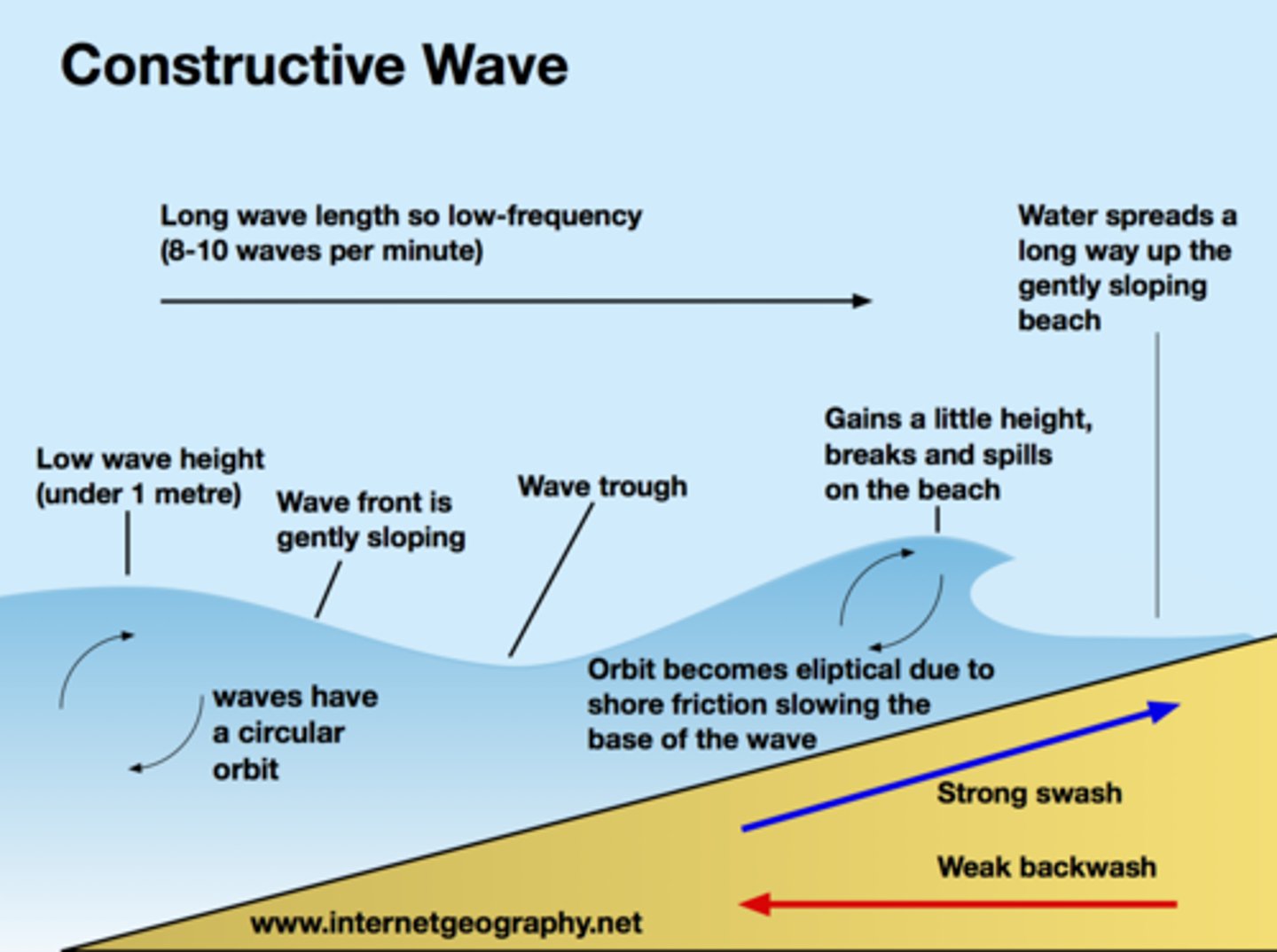
What is the primary effect of constructive waves on a beach?
They deposit material, creating depositional landforms and increasing beach size.
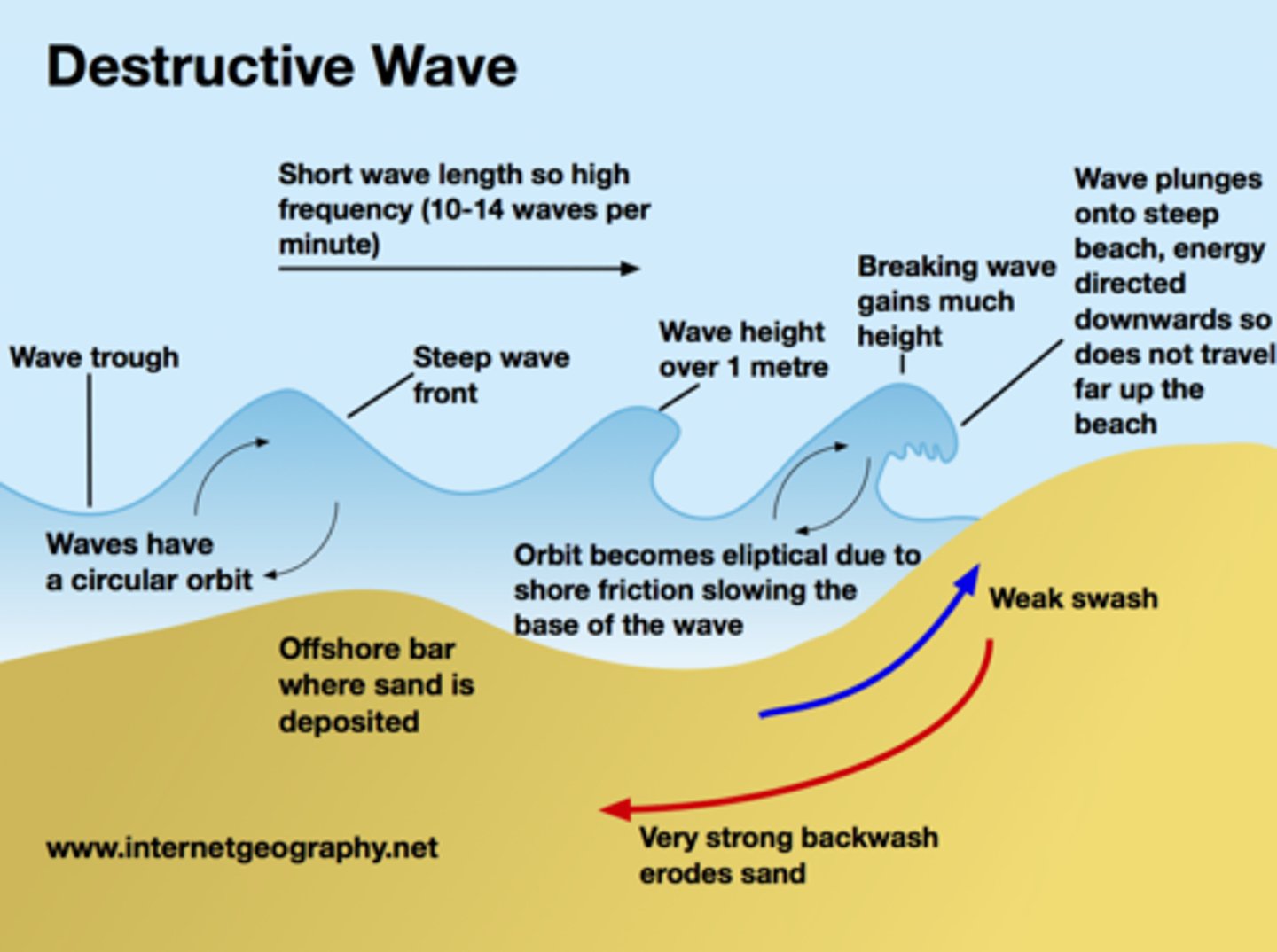
What is the primary effect of destructive waves on a beach?
They remove material through erosion, decreasing beach size.
What are the typical characteristics of constructive waves?
Long wavelength, low frequency (6-9 per minute), and strong swash with weak backwash.
What are the typical characteristics of destructive waves?
Short wavelength, high frequency (11-16 per minute), and weak swash with strong backwash.
How does a negative feedback loop operate between beach profile and wave type?
Constructive waves build a steeper beach, which favors destructive waves; destructive waves then erode the beach, creating a gentler profile that favors constructive waves.
What is the primary cause of tides?
The gravitational pull of the sun and the moon on the Earth's oceans.
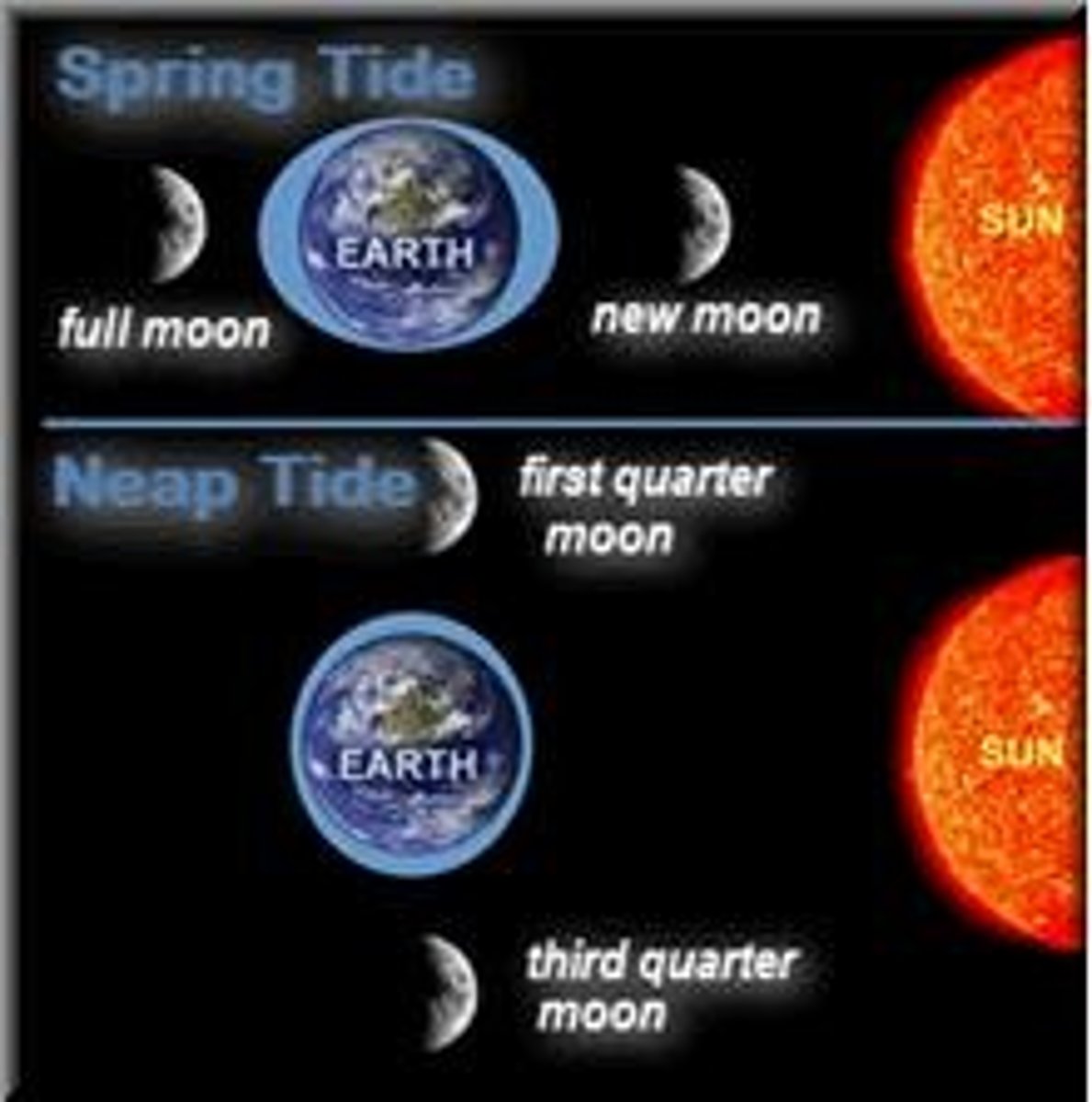
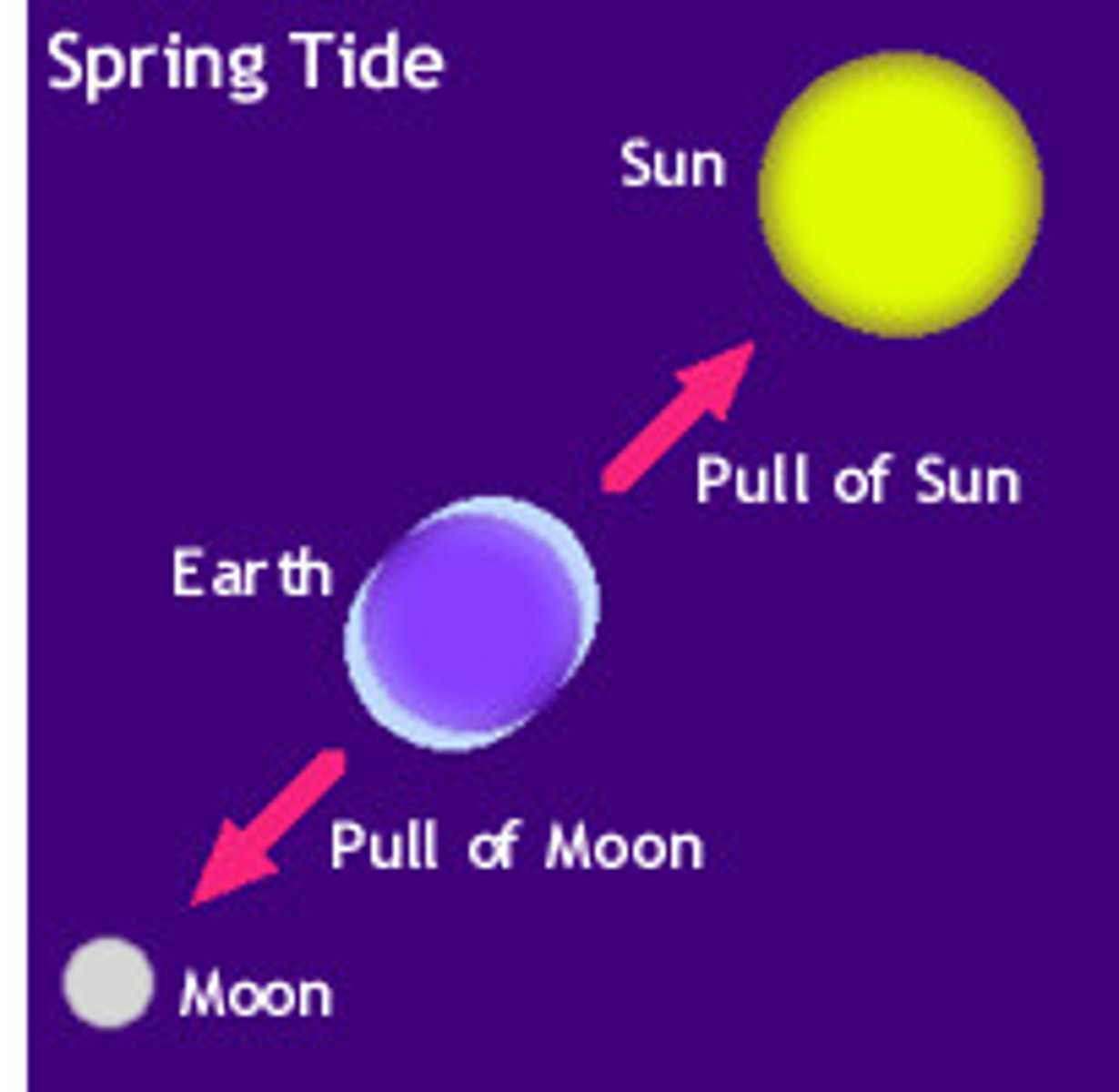
What is a spring tide?
A tide occurring when the sun and moon are in alignment, combining their gravitational forces to create the largest possible tidal range.
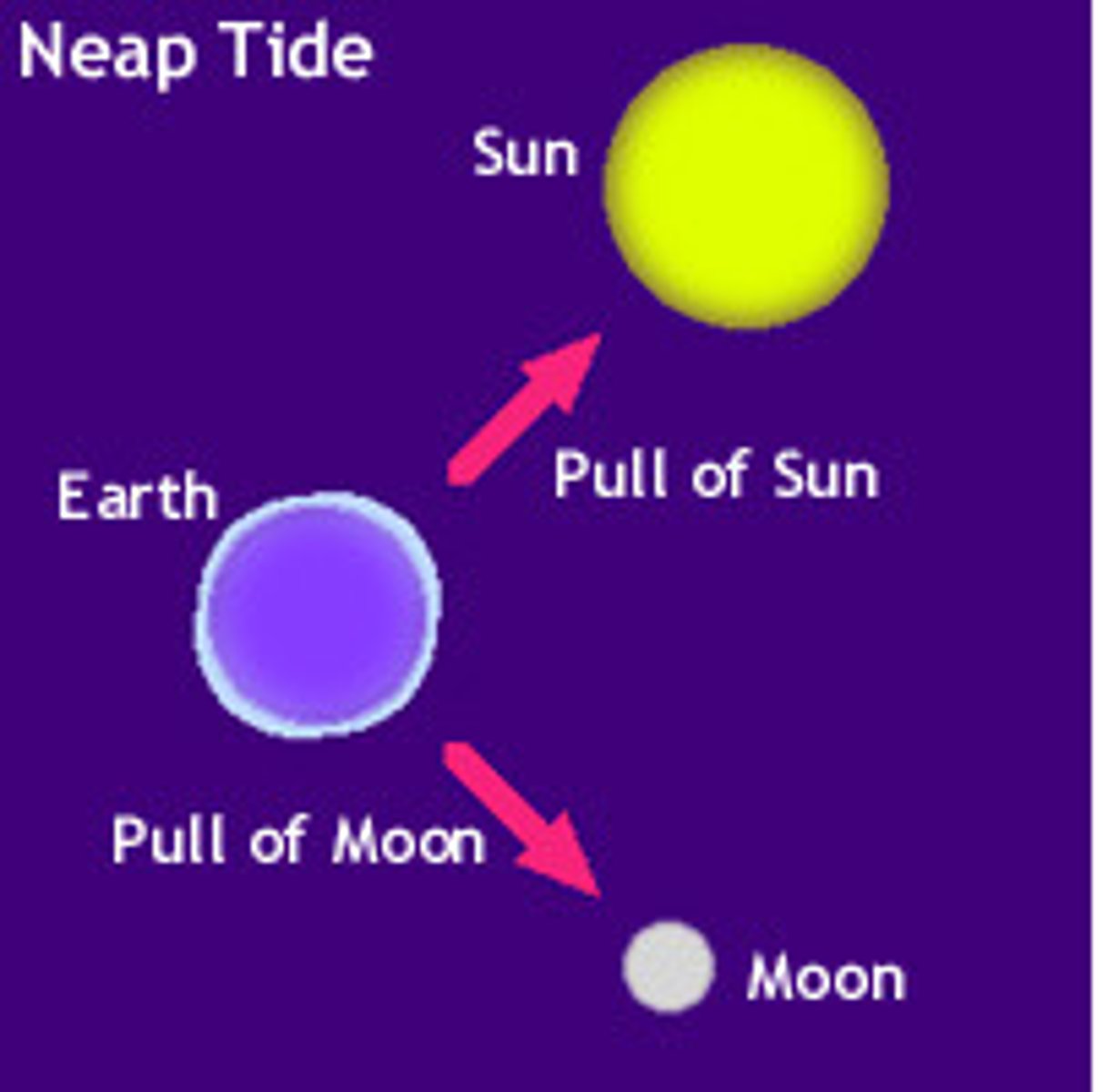
What is a neap tide?
A tide occurring when the sun and moon are perpendicular, causing their gravitational forces to act against each other and creating the smallest possible tidal range.
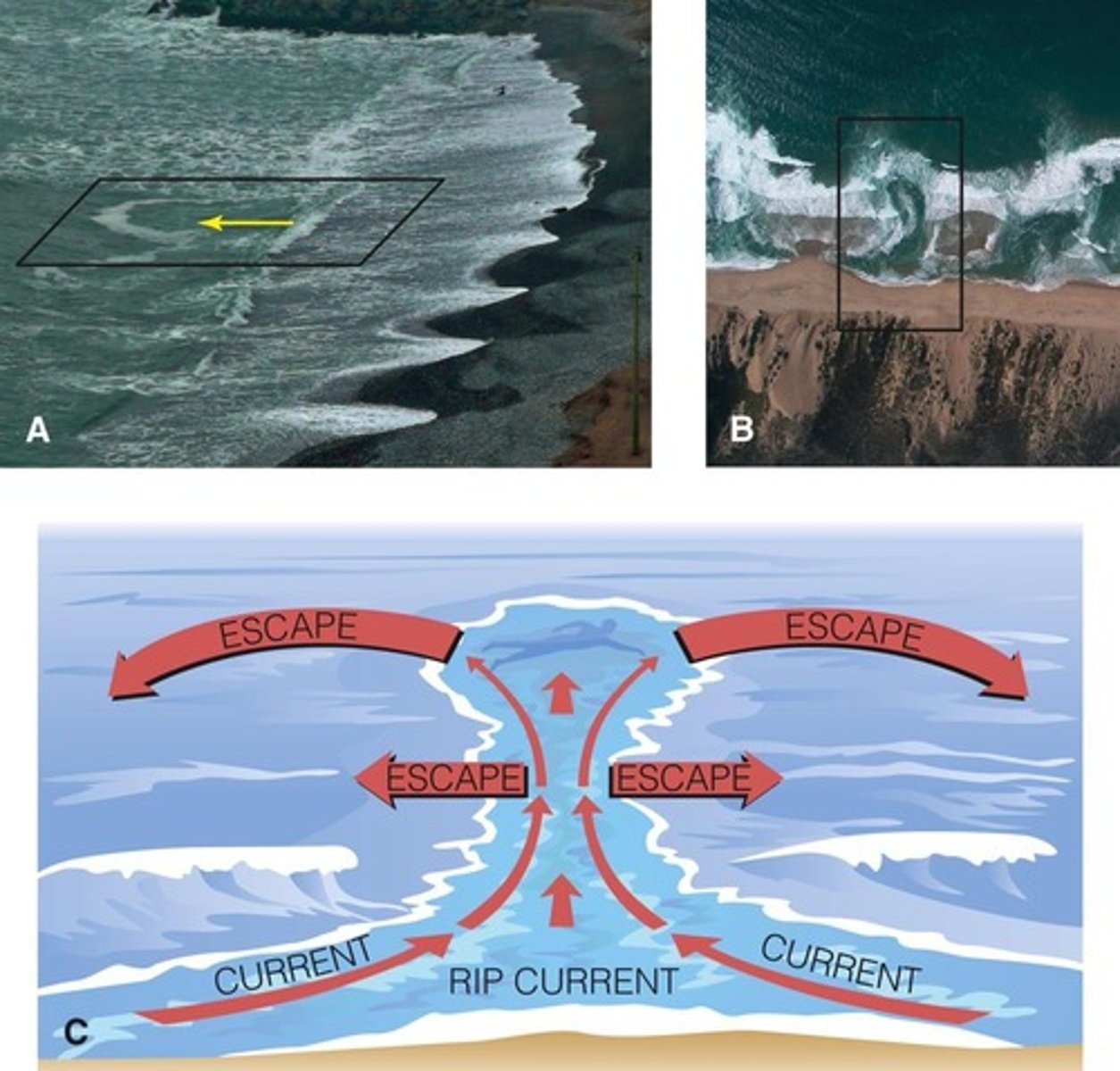
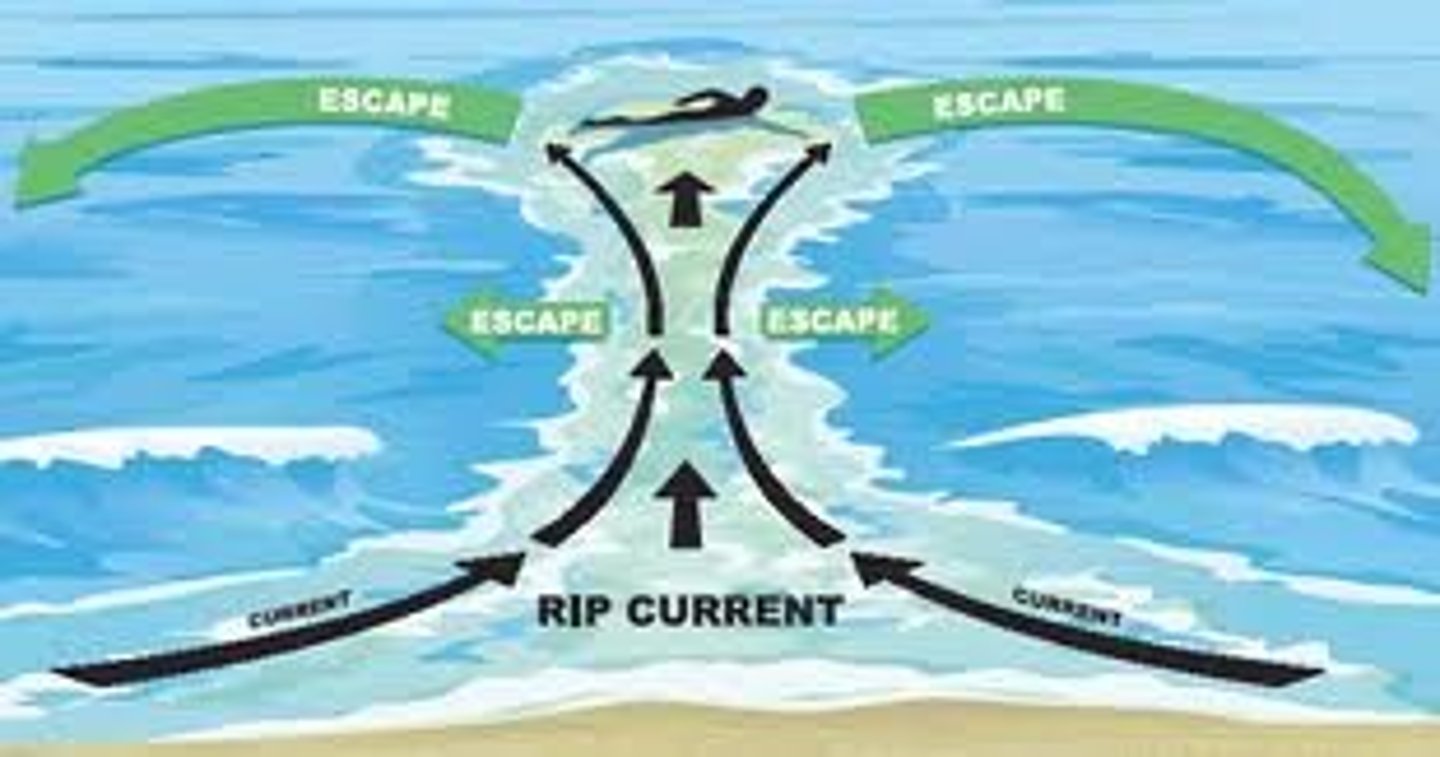
What is a rip current?
A powerful underwater current occurring near the shoreline caused by a buildup of water from plunging waves.
Define 'shoreline'.
The boundary between the sea and the land.
Define 'offshore'.
The area beyond the influence of waves.
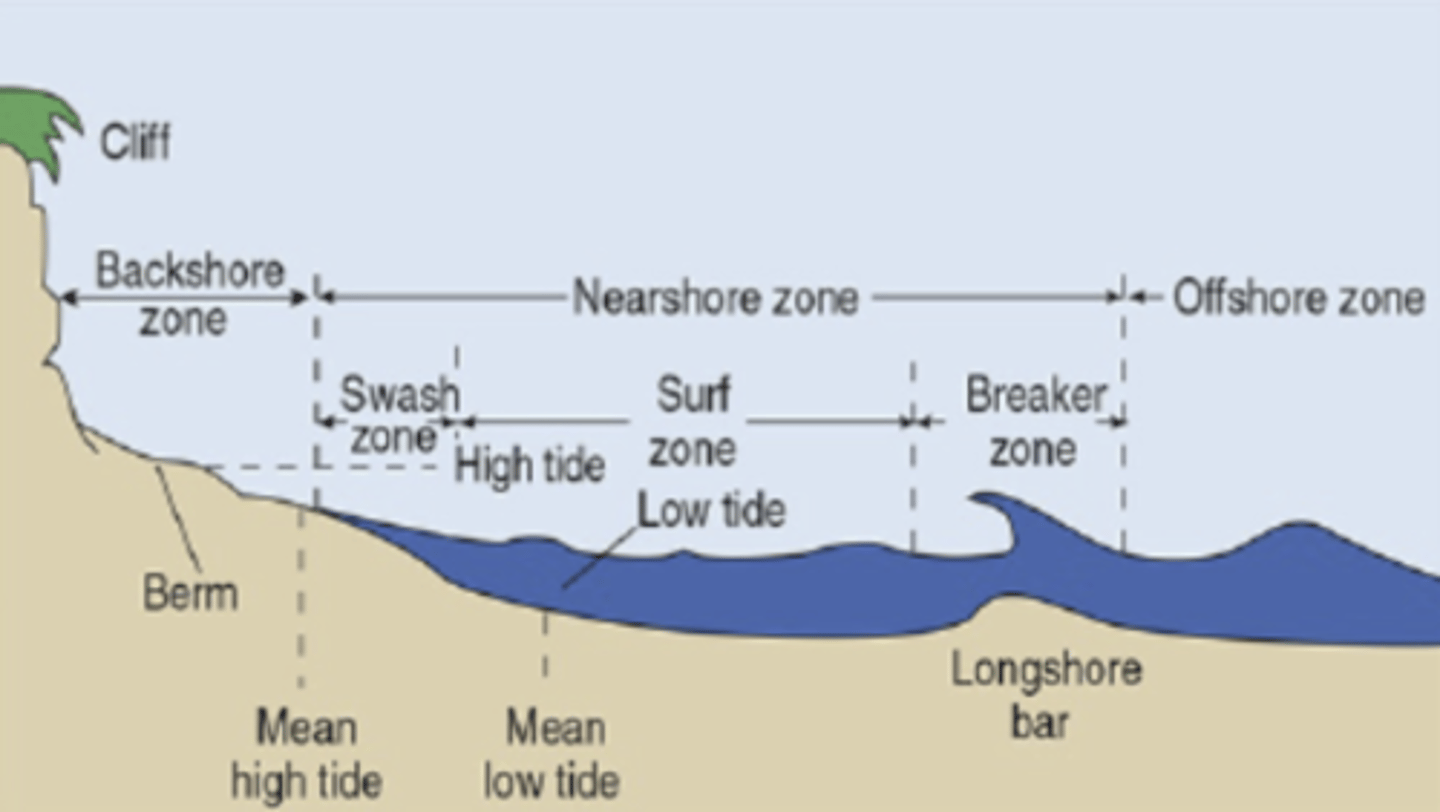
Define 'onshore'.
The area of land not covered by the sea, but very close to it.
How is a rip current formed?
Backwash is forced under the surface by breaking wave resistance, creating an underwater current that flows away from the shore, often accelerated by gaps in sandbars.
How can a swimmer escape a rip current?
By swimming parallel to the beach.
What is the key difference between a rip current and a riptide?
Rip currents are caused by breaking waves and beach features, whereas riptides occur when the ocean tide pulls water through a small area like a bay or lagoon.
What characterizes a high-energy coastline?
Large fetch, powerful waves, rocky headlands, frequent destructive waves, and a rate of erosion that exceeds the rate of deposition.
What characterizes a low-energy coastline?
Sheltered areas, constructive waves, sandy beaches, and a rate of deposition that exceeds the rate of erosion.
What is wave refraction?
The process where waves turn and lose energy around a headland on uneven coastlines, focusing energy on headlands and dissipating it in bays.
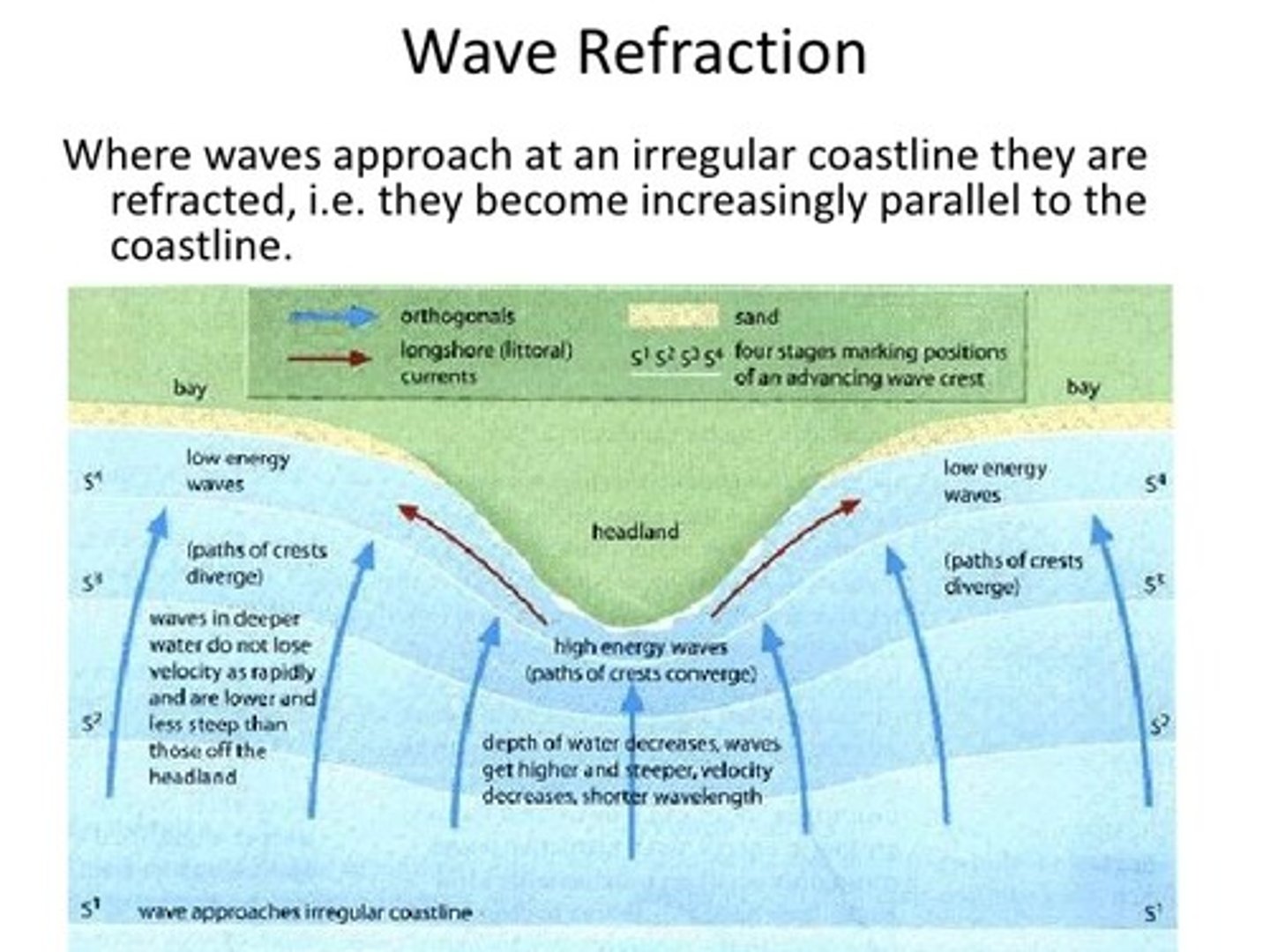
How does negative feedback maintain coastal equilibrium?
Erosion creates headlands and bays; wave refraction then dissipates energy in bays while focusing it on headlands, eventually wearing headlands down and balancing the coastline.
What is corrasion?
The process of picking up sediment from an offshore sink and hurling it against cliffs at high tide to erode them.
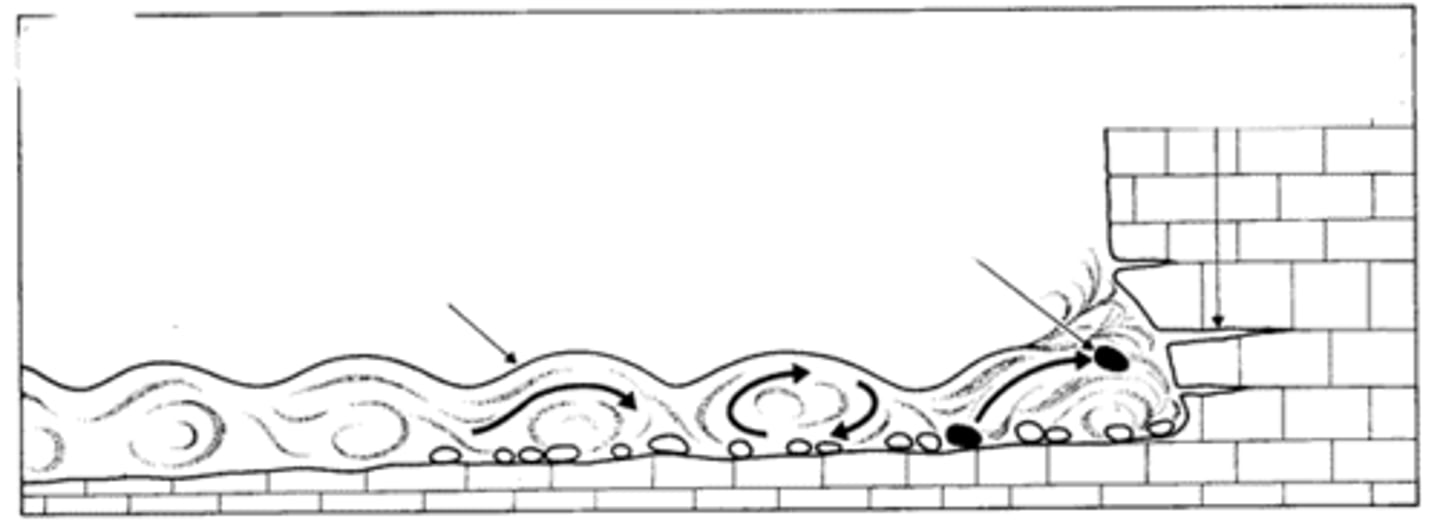
How does abrasion differ from corrasion?
Corrasion is the hurling of sediment at a surface, while abrasion is the wearing down of sediment as it is moved along the shoreline.
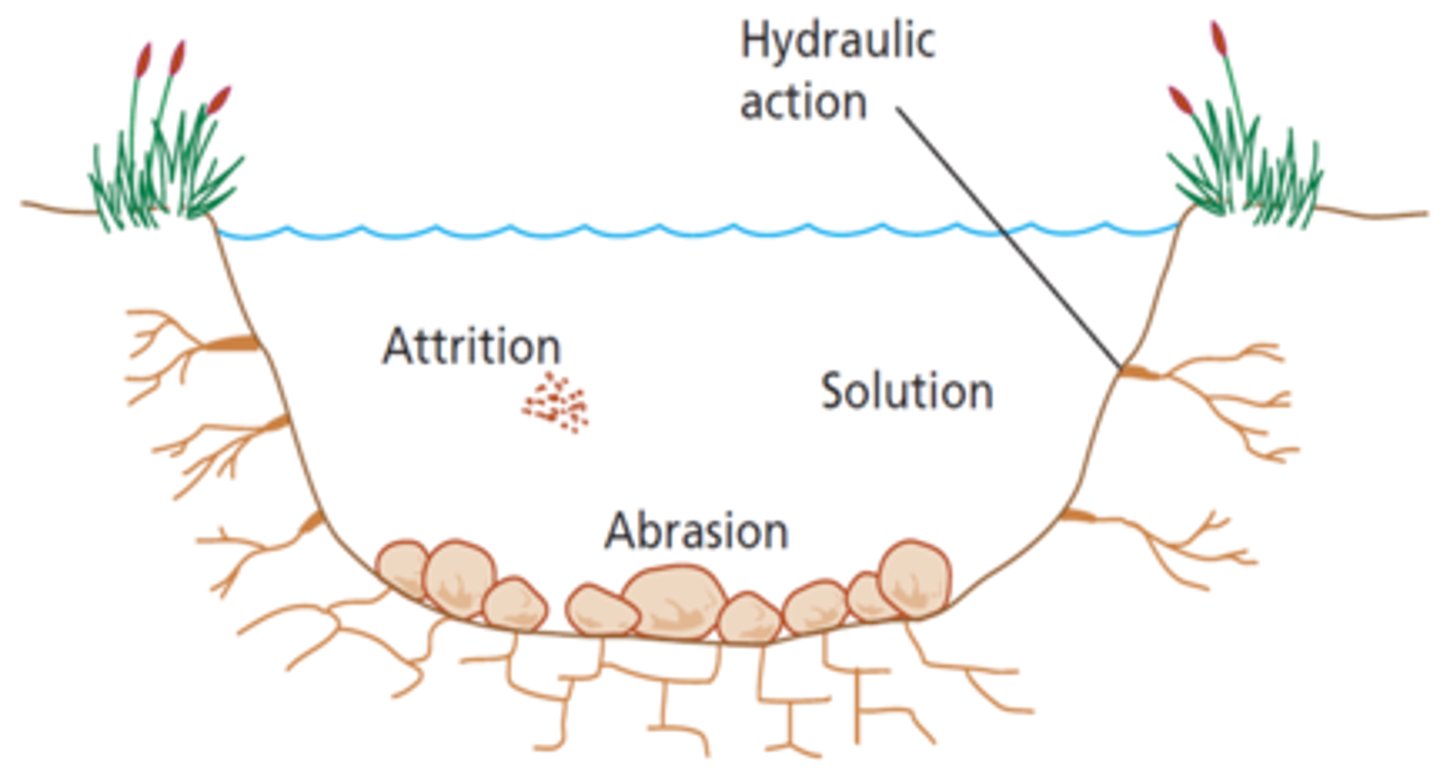
What is attrition?
Rocks and pebbles hitting against each other, becoming rounder and smaller, though it has little effect on the erosion of the coastline itself.
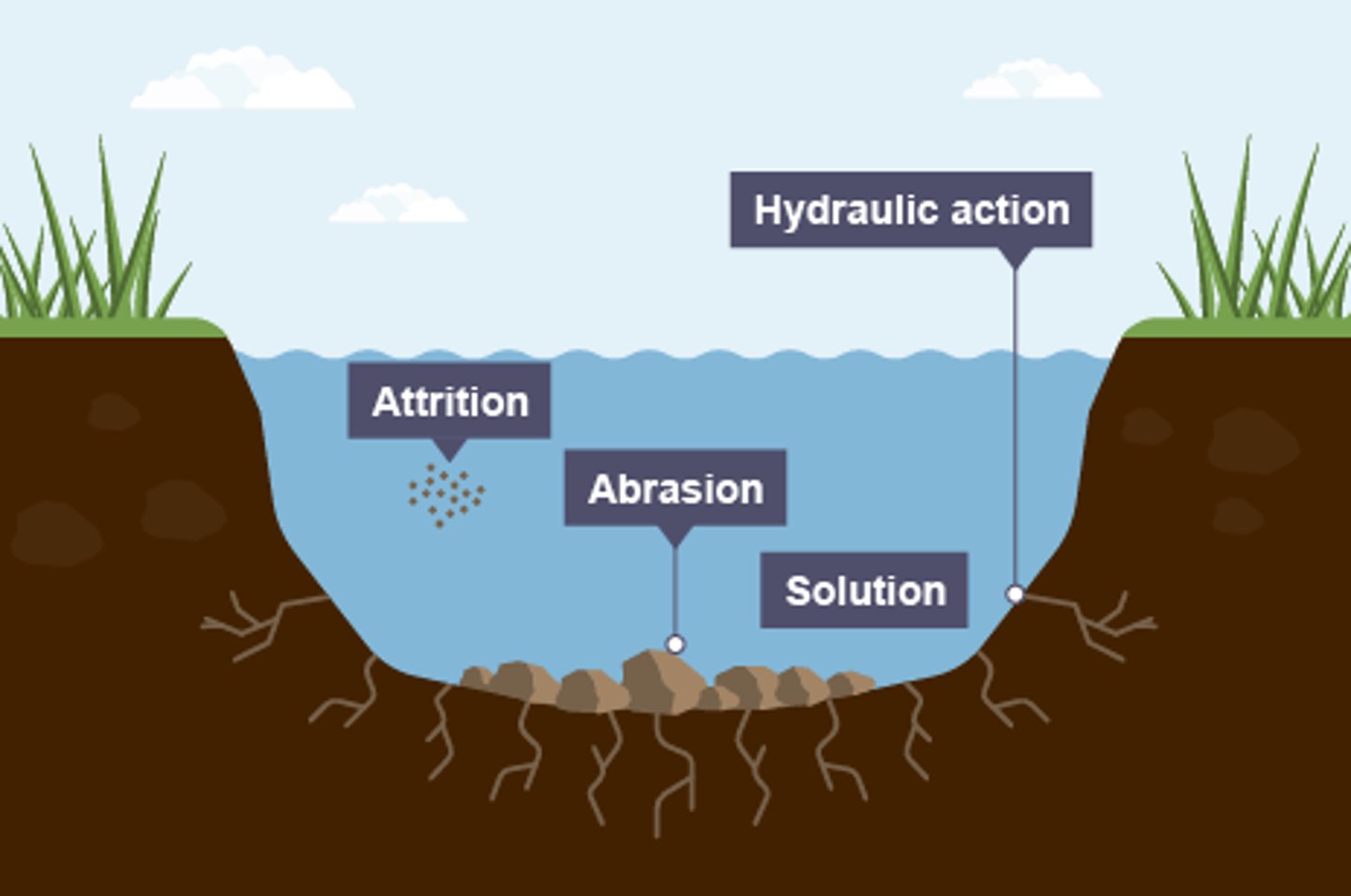
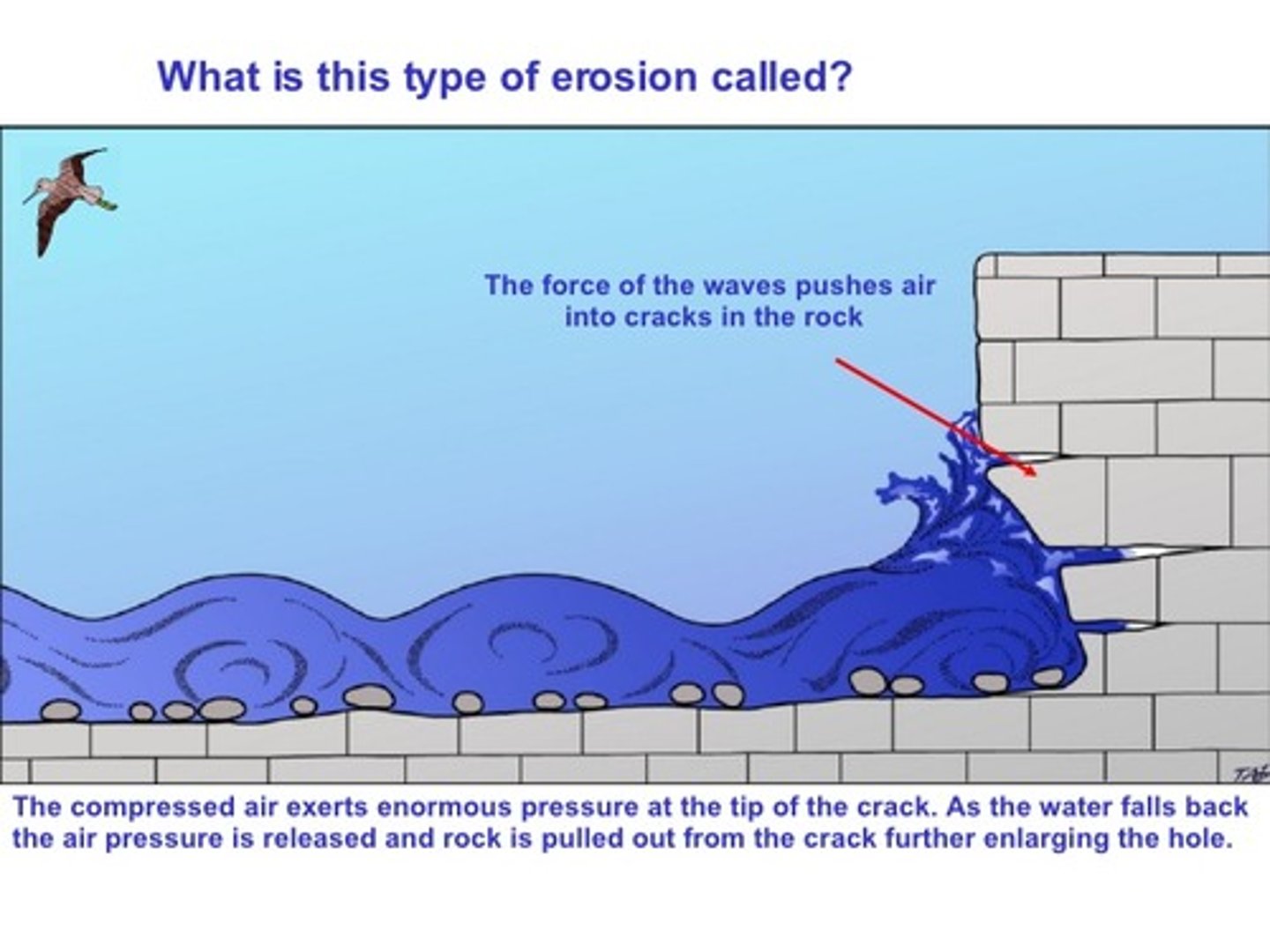
What is hydraulic action?
The process where waves force air into cracks in a cliff, widening them as the wave retreats and the air expands.
What is cavitation?
A form of erosion where air bubbles in water implode under high pressure, creating tiny jets of water that weaken the rock.
What is corrosion (solution) in a coastal context?
The process where mildly acidic seawater dissolves alkaline rocks like limestone.
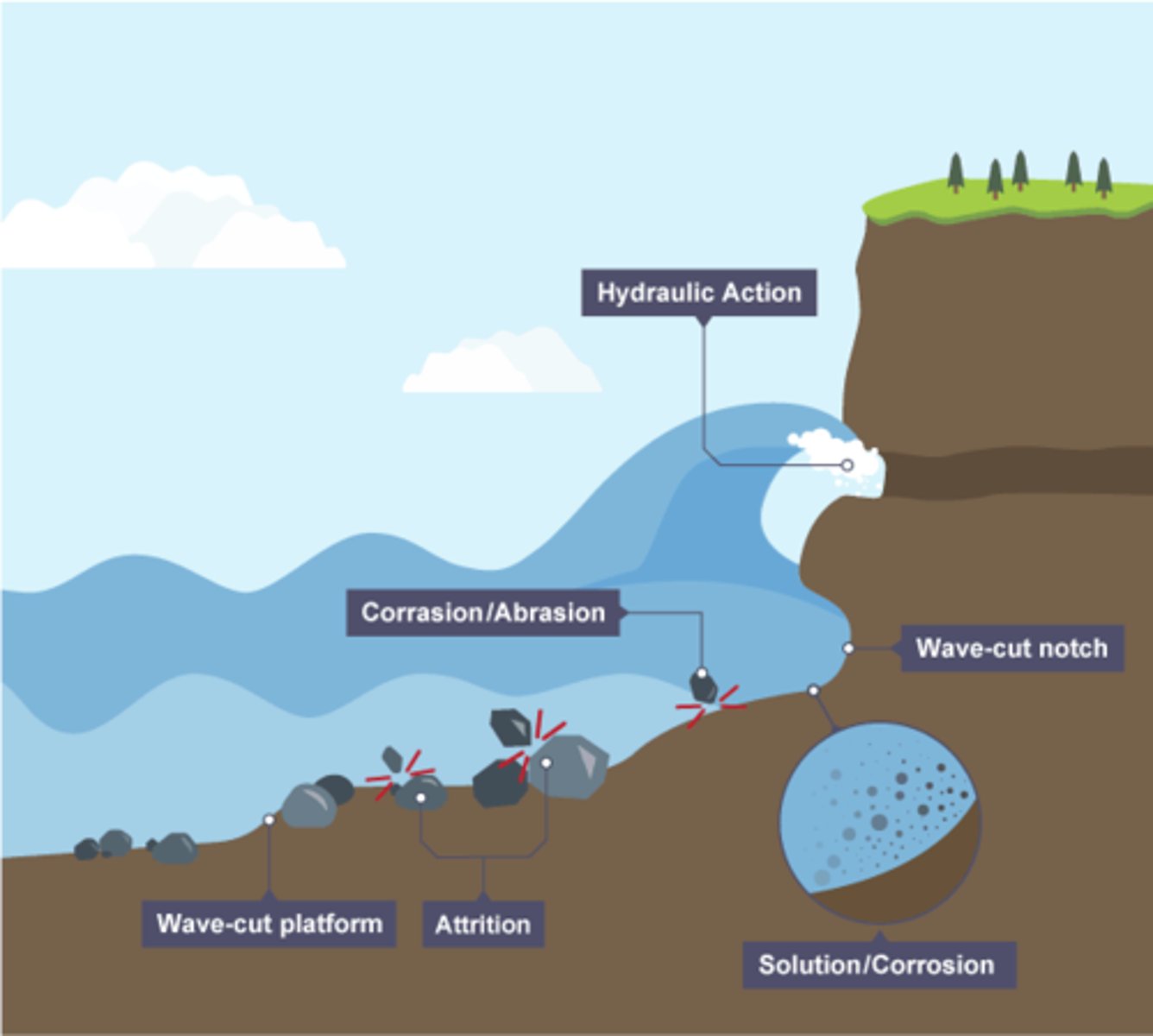
What is wave quarrying?
The process where breaking waves exert massive pressure (up to 30 tonnes per m²) to directly pull rocks from a cliff face.
Why is erosion more common during winter months?
Winter brings more frequent storms, leading to more powerful and destructive waves.
How do beaches act as a natural defense?
They absorb wave energy, which reduces the erosive impact on the cliffs behind them.
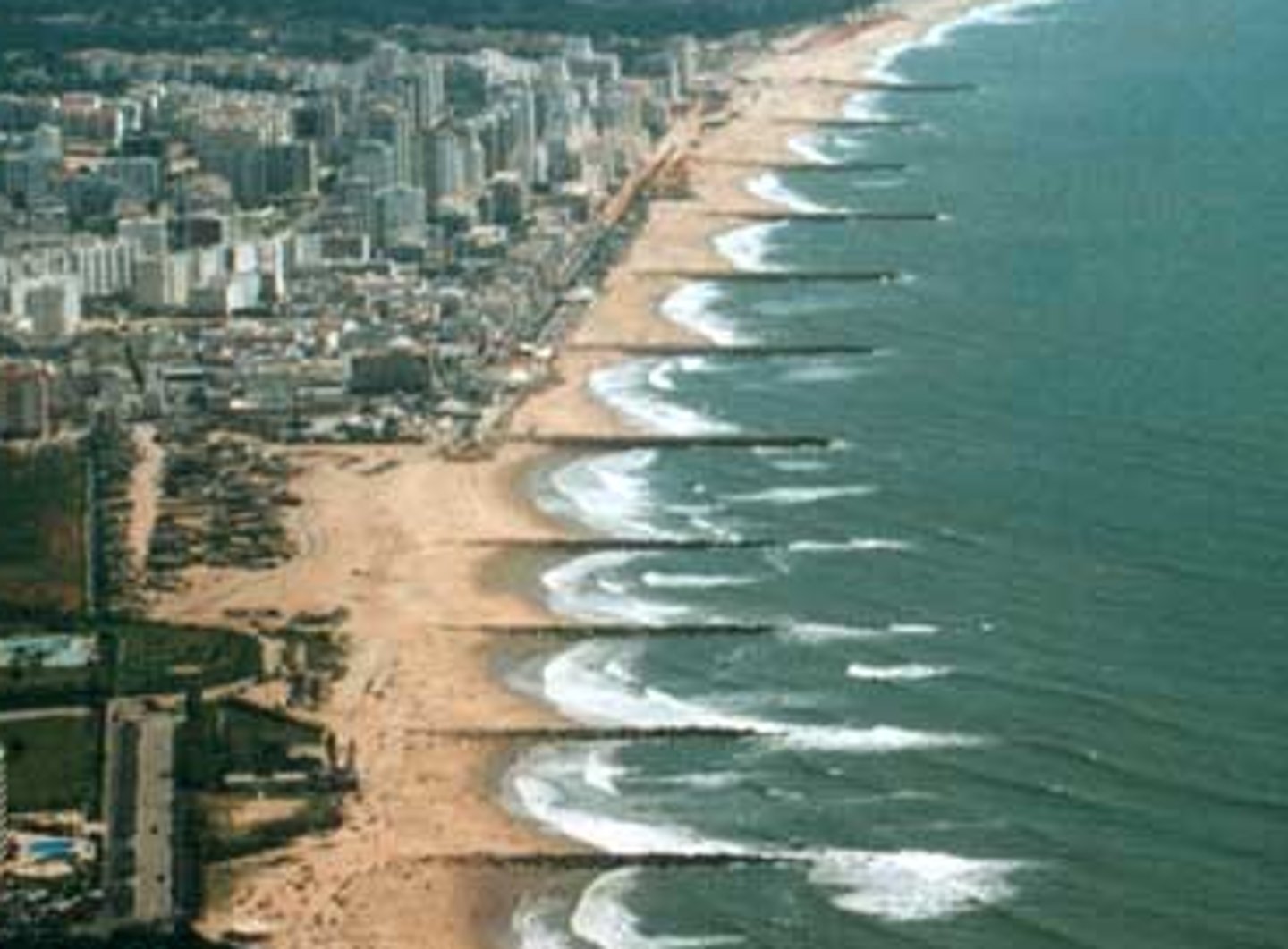
What is a potential negative consequence of using groynes?
They trap sediment, which may prevent beaches from building up in other areas, potentially increasing the rate of erosion there.
How do subaerial processes affect coastal erosion?
Weathering and mass movement (like landslides) weaken cliffs and provide rock fragments that increase corrasion and abrasion.
Why are igneous and metamorphic rocks more resistant to erosion than sedimentary rocks?
They are composed of interlocking crystals, whereas sedimentary rocks are made of cemented particles.
How do rock faults and fissures affect erosion?
They act as structural weaknesses and increase the surface area of the rock face, allowing erosion to occur more rapidly.
What are the two main types of coastal environments?
High-energy and low-energy coastlines.
What happens to wave energy in a bay?
It is dissipated, leading to the formation of depositional features like beaches.
What is the relationship between the carbon cycle and coastal erosion?
Increased ocean acidity (linked to the carbon cycle) may accelerate the corrosion of alkaline rocks.
What is the primary role of destructive waves?
They are associated with high-energy coastlines and contribute to a net loss of sediment through erosion.
What is the primary role of constructive waves?
They are associated with low-energy coastlines and contribute to the build-up of sediment through deposition.
How do large faults in rock contribute to coastal landforms?
They create favorable conditions for erosion, leading to the formation of headlands and bays.
Why do igneous rocks like granite and basalt have a very slow rate of erosion?
They possess interlocking crystals that provide high resistance to erosion.
What is the primary structural reason for the fast erosion rate of sedimentary rocks like limestone?
They contain many faults, making them weak and vulnerable to erosion.
Define the transportation process of 'Traction'.
Large, heavy sediment rolls along the seabed, pushed by currents.
How does 'Saltation' differ from 'Traction' in coastal transportation?
In saltation, smaller sediment bounces along the seabed because it is too heavy to be fully picked up by the water flow.
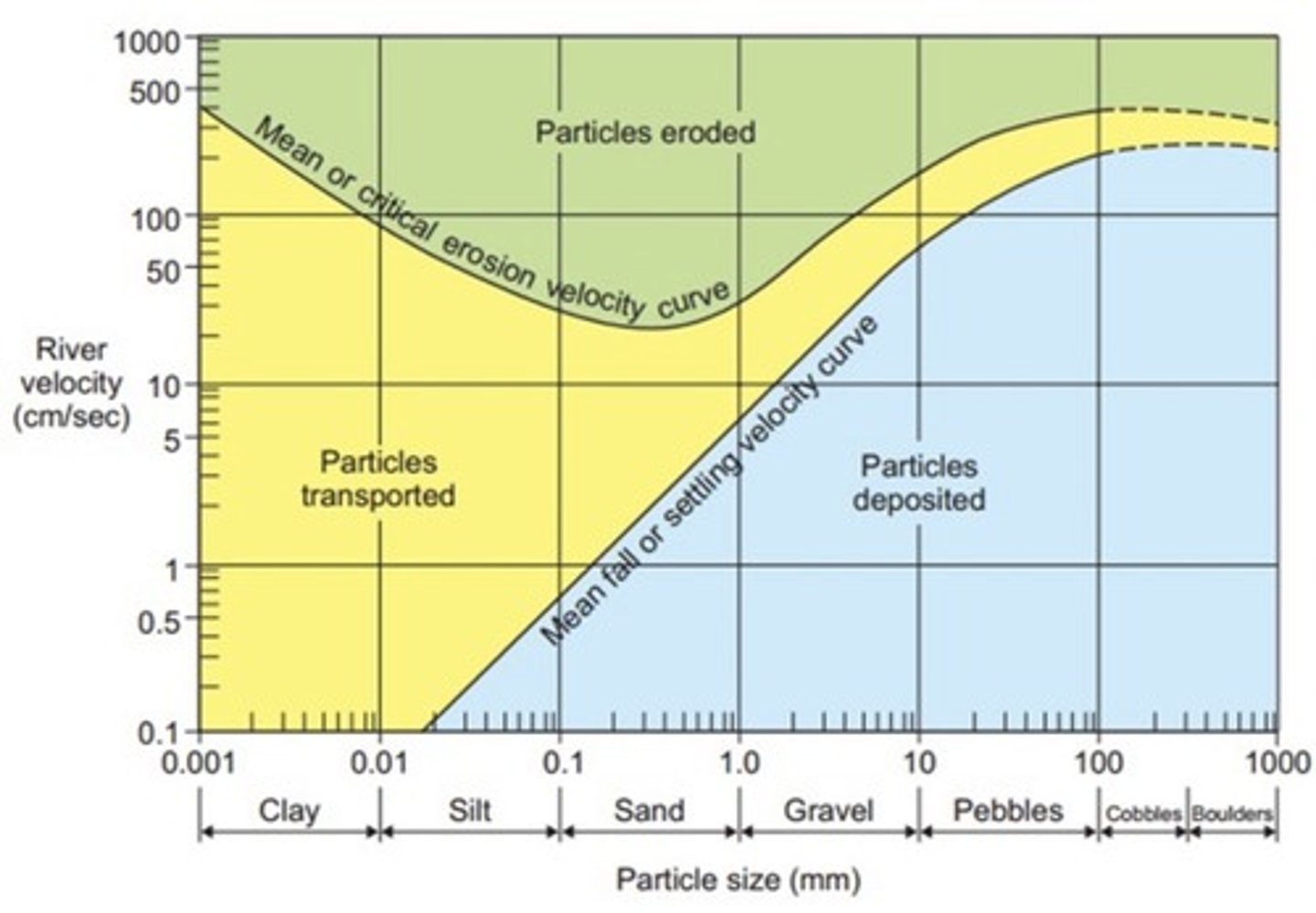
What does the Hjulström curve demonstrate regarding sediment transport?
It shows that higher water velocities are capable of suspending larger and heavier pieces of sediment.
What two components determine the angle at which waves hit the beach during Longshore Drift?
The direction of the prevailing wind and the wave's approach.
In Longshore Drift, what is the difference between swash and backwash?
Swash pushes sediment up the beach at an angle, while gravity pulls the backwash (and sediment) back down the beach.
What are the two main conditions that trigger sediment deposition?
When sediment becomes too heavy for the water to carry, or when the wave loses energy.