4.2 Factors Affecting Enzyme Activity
 Call Kai
 Learn
Learn Practice Test
 Spaced Repetition
 Match
Match Flashcards
 Knowt Play
1/88

There's no tags or description
Looks like no tags are added yet.
Name | Mastery | Learn | Test | Matching | Spaced | Call with Kai |
|---|
No analytics yet
Send a link to your students to track their progress
89 Terms
What has to happen in order for enzymes to catalyse reactions?
come into contact with the substrate and the enzyme needs to be the right shape (complementary) for the substrate
What type of protein are enzymes?
complex proteins
What factors can enzyme structures be affected by examples (2)?
temperature, pH
When are enzymes more likely to come into contact with the substrate?
when temperature and substrate concentration increases
What increases the kinetic energy of the particles?
increasing the temperature of a reaction
What happens to the particles as the temperature increases (causing their kinetic energy to increase)?
Particles move faster and collide more frequently
In enzyme-controlled reactions what does an increase in temperature result in?
more frequent successful collisions between enzyme and substrate - Increasing the reaction rate
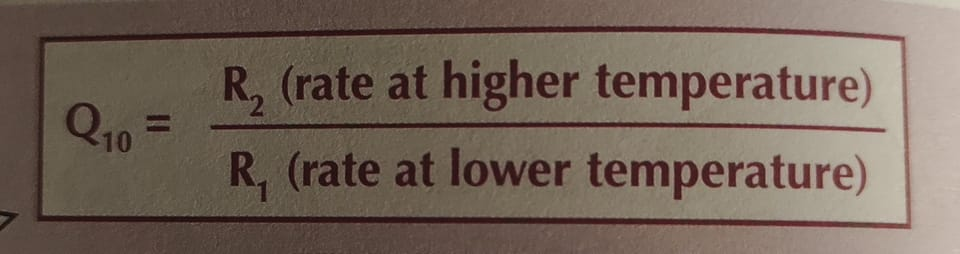
What is the temperature coefficient of a reaction?
a measure of how much the rate of reaction when the temperature increases by 10'C
temperature coefficient symbol?
Q₁₀
What is the enzyme coefficient of most enzyme-controlled reactions?
2
A temperatures before the optimum what does a temperature coefficient value of 2 mean?
that the rate doubles when the temperature is raised by 10'C
A temperatures before the optimum what does a temperature coefficient value of 3 mean?
that the rate trebles when the temperature is raised by 10'C
Equation for the temperature coefficient?
…
Why are enzymes structure's affected by temperature?
they are proteins
What vibrates more at higher temperatures in the enzyme?
the bonds holding the protein together
As the temperature increases so do the vibrations leading them to?
leading the bonds to strain and and break
What do the breaking of these bonds result in a change in?
in the precise tertiary structure of the protein
What is it called when the enzyme changes shape like this?
the enzyme denatures
What happens to the active site when the enzyme denatures?
The active site changes its shape and is no longer complementary to the substrate
What happens to the enzyme once it denatures?
will no longer function as a catalyst
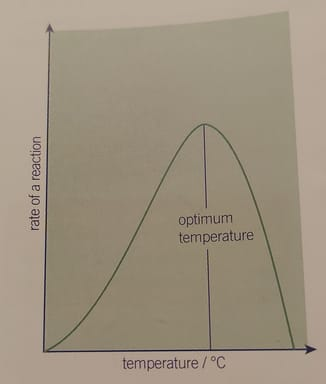
Optimum temperature?
the temperature at which the enzyme has the highest rate of activity
Optimum temperature of enzymes in the human body?
around 40'C
Optimum temperature of enzymes in thermophile bacteria?
70'C
Where is thermophile bacteria found?
Hot springs
Optimum temperature of enzymes in psychrophilic organisms?
below 5'C
Where do psychrophilic organisms live?
areas that are cold - e.g. the Antarctic and Artic
How fast does the rate of reaction decrease once the enzymes have denatured above the optimum temperature?
decrease in rate of reaction is rapid
How large does the change have to be in order for the enzyme's active site to no longer be complementary to the substrate?
a slight change
Why is the loss of enzyme activity relatively abrupt?
all enzyme molecule's active sites slightly change shape at about the same activity
When does the temperature coefficient not apply anymore (in an enzyme-controlled environment)?
once the enzymes have denatures
How fast does the rate of reaction decrease once the enzymes have denatured below the optimum temperature?
less rapidly
Why is the decrease in enzyme activity happen less rapidly when the enzymes have denatured below the optimum temperature (rather than above it)?
the enzymes have not actually denatured - they are just less active
What have the majority of living organisms evolved to cope with?
living within a certain temperature range
What can some organisms cope with?
extreme temperatures
Examples of extremely cold environments (3)?
deep oceans, high altitudes and polar regions
What needs to be adapted to the cold in organisms living in extremely cold conditions?
the enzymes controlling the metabolic activities of these organisms
What are enzymes that are adapted to the cold structure's like?
more flexible (particularly the active site)
What does these enzymes being flexible make them less stable than?
less stable than enzymes that work at higher temperatures
Why are enzymes that work at lower temperatures less stable than enzymes that work at higher temperatures?
smaller temperature changes will denature them
What are thermophiles?
(bacteria) organisms adapted to living in very hot environments
Examples of very hot environments - where thermophiles can be found (2)?
hot springs and deep sea hydrothermal vents
Where are the enzymes present in thermophiles more stable than other enzymes?
increased number bonds (particularly hydrogen bonds and sulfur bridges) in their tertiary structures
What are the shapes of these enzymes and their active sites more resistant to?
change as the temperature rises
What holds proteins in their precise three-dimensional shape (tertiary structure)?
hydrogen bonds and ionic bonds between amino acid R-groups
What do these bonds cause interactions between on the amino acids?
interactions between the polar/charged R-groups on the amino acids
What is a change in pH?
a change in hydrogen ion concentration
How many hydrogen ions present in a low pH environments?
higher number of hydrogen ions present
Low pH?
acid
How many hydrogen ions present in a high pH environments?
fewer hydrogen ions present
High pH?
alkaline
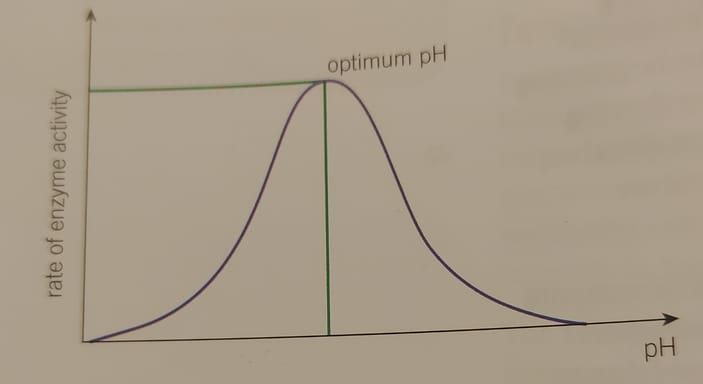
Optimum pH?
the active site for an enzyme will only be in the right shape at a certain hydrogen ion concentration
When does the pH cause the shape of the active site to alter (alter the enzyme's structure)?
when the pH changes from the optimum - becoming more acidic or alkaline
Renaturation?
if the pH returns to the optimum then the enzyme/active site will resume its normal shape and catalyse the reaction again
What happens to the enzyme when the pH changes more significantly from the pH?
Denaturation
Denatured?
the structure is irreversibly altered and the active site will no longer be complementary to the substrate
Why does denaturisation reduce the rate of reaction?
substrates can no longer bind to the enzymes active sites as they are no longer complementary in shape
What do hydrogen ions interact with?
the polar/charged R-groups
What changes the degree of the interaction between the polar and charged R-groups/hydrogen ions?
changing the concentration of hydrogen ions
What also effects the interactions of R-groups with each other?
hydrogen ions
How does the enzyme's active site change through a high or low pH (in denaturisation)?
by disrupting the ionic and hydrogen bonds that maintain the enzymes' specific three-dimensional shape , leading to a change in the shape of its active site
When are R-groups less able to interact with each other?
when there are lots of hydrogen ions present (low pH) or when there are very few hydrogen ions present (high pH)
What does the R-groups being less able to interact with each other in these conditions lead to happening to the enzyme?
bonds breaking and the shape of the enzyme changing
Due to this what is the pH range that the enzyme functions in like?
narrow pH range
Enzymes in the digestive system: what enzyme is found in saliva?
Amylase
Enzymes in the digestive system: where does the enzyme action happen in those that are found in saliva?
Mouth/throat
Enzymes in the digestive system: pH of saliva?
7-8 (neutral)
Enzymes in the digestive system: what does amylase breakdown?
starch into maltose
Enzymes in the digestive system: where is gastric juice found?
Stomach
Enzymes in the digestive system: the pH of gastric juice?
1-2 (acidic)
Enzymes in the digestive system: enzyme found in gastric juice in the stomach?
Pepsin
Enzymes in the digestive system: what does pepsin breakdown?
Proteins into polypeptides
Enzymes in the digestive system: where is pancreatic juice found?
Small intestine/duodenum
Enzymes in the digestive system: pH of pancreatic juice in the small intestine/duodenum?
8 (slightly alkaline)
Enzymes in the digestive system: enzymes found in pancreatic juice (4)?
trypsin, lipase, amylase and maltase
Enzymes in the digestive system: what does trypsin breakdown?
proteins into polypeptides
Enzymes in the digestive system: what does lipase breakdown?
triglycerides into glycerol and fatty acids
Enzymes in the digestive system: what does amylase breakdown?
Enzymes in the digestive system: what does maltase breakdown?
maltose into glucose
When does the number of substrate molecules/ion/atoms increase?
when the concentration of substrate molecules increases
How does the increased number of substrate particles lead to a faster rate of reaction?
a higher collision rate of of the substrate particles and the active sites of the enzymes
What does these higher collision rate increase the number of?
enzyme-substrate complexes (faster rate of reaction)
How does the increase in the concentration of enzymes increase the rate of reaction?
increases the number of available active sites in a volume leading to the formation of enzyme-substrate complexes at a faster rate
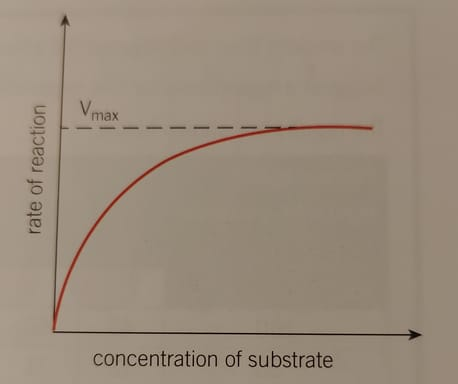
What does the rate of reaction increase up to?
its maximum (Vmax)
What are all occupied at the Vmax?
all of the active sites are occupied by substrate particles - no more enzyme-substrate complexes can be formed until products are released from active sites
How to get the reaction rate to rise towards a higher Vmax?
increase the concentration of the enzyme - more active sites are available
After increasing the concentration of enzymes in a reaction, what becomes the limiting factor?
the substrate concentration (increase it to allow the reaction rate to rise until the new Vmax is reached)
The effect of pH on the rate of reaction graph?
…
The effect of temperature on the rate of reaction graph?
…
The effect of the concentration of substrate on the rate of reaction graph?
…