Intro to cognitive methods
 Call Kai
 Learn
Learn Practice Test
 Spaced Repetition
 Match
Match Flashcards
 Knowt Play
1/28

There's no tags or description
Looks like no tags are added yet.
Name | Mastery | Learn | Test | Matching | Spaced | Call with Kai |
|---|
No analytics yet
Send a link to your students to track their progress
29 Terms
What is neuropsychological testing?
‘Evaluating cognition by studying people with cognitive impairments in that domain’ - looking at the effects of something going wrong to understand how the brain should work when it is right
What are the three tiers of cognitive/neuropsychological tests?
Cognitive screening, cognitive testing, and neuropsychological assessments
What is the lesion approach to neuropsychological testing?
This approach involves studying cognition by observing function after brain damage, which can be caused by strokes, tumours, traumatic brain injuries, neurodegenerative diseases etc. If damage to a brain region disrupts a function, that region is necessary for that function.
What are the four assumptions of neuropsychology?
FUMT - Fractionation, Universality, Modularity, Transparency
What is the fractionation assumption of neuropsychology?
The belief that brain damage can result in the selective impairment of components of cognitive processing
What is the universality assumption of neuropsychology?
That models of the brain can be used to generalise across people
What is the modularity assumption of neuropsychology?
cognition consists of the functioning of a number of independent processing units
What is the transparency assumption of neuropsychology?
the cognitive system of a brain damaged patient is fundamentally the same as that of a normal subject, except for a ‘local’ modification of the system
When does a single dissociation occur?
When a patient shows impairment in one function, but preserved performance in another function - suggesting that these two functions are separable. One clear example of this is speech production/comprehension.
What is a limitation of relying on single dissociation?
It could simply show reflect task difficulty rather than truly displaying functional independence.
What is a double dissociation?
When patient 1 has impaired function A and working function B, while patient 2 has impaired function B and working function A.
What is a strength of double dissociation?
It provides strong evidence that the functions are independent, and not simply just different levels of difficulty.
What is the most direct way to measure cognitive function?
By measuring performance on cognitive tasks
What are some examples of indirect ways to measure cognitive function?
Self report, EEG, MRI, Behavioural observations
What are some ways to take behavioural measurements?
Verbal/nonverbal responses (e.g a button press), reaction time, accuracy
What is a neuropsychological test?
A systematic administration of clearly defined procedures, designed to test cognitive function.
What is a limitation of many neuropsychological tests?
Many procedures are not designed for repeated use, as well as the fact that training effects were not considered in test design
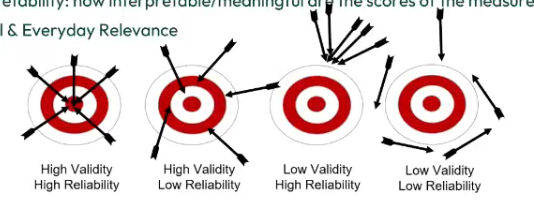
What are the five key psychometric properties of a neuropsychological test?
RRRIV - reliability, relevance, responsiveness (sensitivity to important changes over time), interpretability (meaningfulness of measure scores), validity
What are practice effects?
Improvements in cognitive test scores, which are caused by repeated exposure to the test
What are the two key approaches to measuring the brains abilities?
The manipulation approach, and the measurement approach.
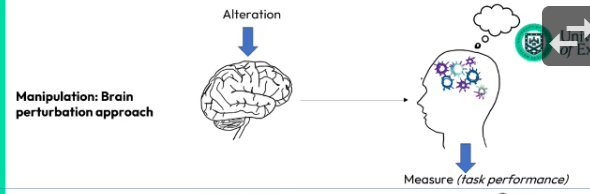
How does the manipulation approach to measuring brain ability work?
There is an alteration to brain function (e.g someone with a lesion), and task performance is tested to test for differences compared to a typical brain.
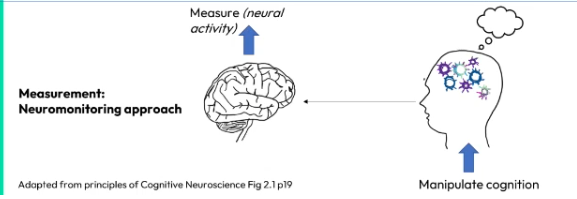
How does the measurement approach to measuring brain ability work?
Cognition is manipulated (e.g by inducing a fear state), and then neural activity is measured and compared to a typical set of measurements.
What are the three main components of a structural MRI?
A massive magnet, gradient coils and receiving coils.
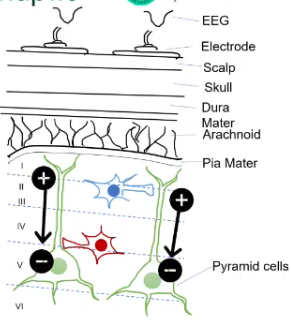
Where does the signal that an EEG records originate from?
From postsynaptic dendrites - not action potentials
How is a signal achieved using an EEG?
With synchronised activity of a population of neurons, where the neurons are aligned in parallel - and then the voltage is compared between multiple sites, e.g using bone as a reference site
What is the issue of noise when using an EEG?
When there are artifacts in the recording of signals during the EEG recording procedure. These can come from mechanical and instrumental sources, as well as biological faults
What is the range of activity types with a set of EEG frequency bands?
From deep sleep to hyperactivity
What does ERP stand for?
Event related potential - repeated peaks in EEG signals during a task
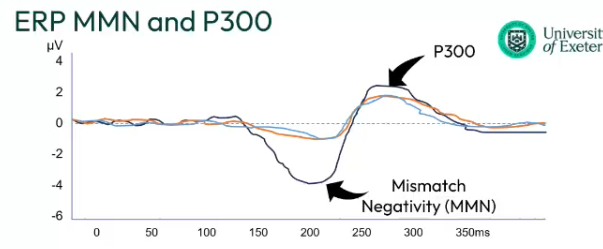
What is the key issue of ERPs?
There is no way to know the exact source of the electrical potential - so functions cannot certainly be linked to areas.