Chap 22: Lymphoid System and Immunity
 Call Kai
 Learn
Learn Practice Test
 Spaced Repetition
 Match
Match Flashcards
 Knowt Play
1/92

There's no tags or description
Looks like no tags are added yet.
Name | Mastery | Learn | Test | Matching | Spaced | Call with Kai |
|---|
No analytics yet
Send a link to your students to track their progress
93 Terms
What is the lymphoid system?
a network of tissues, organs, and vessels that help to maintain the body’s fluid balance, cleanse the body of foreign matter, and provide immune cells for defense
What are lymphoid system components?
lymph, lymphatic vessels, lymphoid tissue, and lymphoid organs
What is lymph?
fluid from interstitial fluid spaces
What reabsorbs lymph?
Capillaries reabsorb 85% of it, lymph system reabsorbs the 15%
What happens if the lymphatic system has an issue with drainage?
If the lymphatic system has an issue with its drainage this can cause the tissue to swell
Tissue swelling as a result of failure to drain is called?
lymphedema
What do lymphatic vessels do?
transport the lymph
What do lymphoid tissue and lymphoid organs have?
lymphocytes and other cells are concentrated
What are functions of the lymphoid system?
fluid recovery, immune surveillance, lipid absorption
What is fluid recovery?
reabsorb 15% of fluid filtered (H2O & protein) at capillary beds into interstitial spaces. 85% of fluid is absorbed by the capillaries.
What happens if the 15% is not returned to the blood?
One can die of circulatory failure within hrs
What are pathogens?
microorganisms with the potential to cause disease
What is immune surveillance?
immune cells monitor lymph for foreign agents and pathogens (microorganisms with the potential to cause disease). On the way back to the blood, the fluid passes through lymph nodes, which act as filters where immune cells guard against pathogens & activate immune responses.
What are lacteals?
special lymphatic vessels
What is lipid absorption?
lacteals (special lymphatic vessels) in small intestine absorb dietary lipids that cannot be absorbed by the intestinal blood capillaries.
What is lymphedema?
excess fluid accumulation due to interference of lymphatic drainage.
What is edema?
accumulation of excess fluid in loose connective tissue.
What are larger lymphatic similar too in structure?
veins
Describe larger lymphatics
Larger lymphatics similar to veins in their structure, though their walls are thinner and valves are closer together
What do larger lymphatic have specifically?
a tunica interna with an endothelium and valves. a tunica media with elastic fibers and smooth muscle, and a thing outer tunica externa. Their walls are thinner and their valves are closer together than those of veins.
Although larger lymphatics are similar to veins in structure, what do they have that veins do not?
valves that are closer together
What is the flow of lymph?
Lymphatic capillaries → collecting vessels → lymphatic trunks → collecting ducts (largest lymphatic vessels) → subclavian veins (blood)
What are lymphatic trunks named by?
location
Provide examples of lymphatic trunks
jugular, subclavian, bronchomediastinal, intercostal, intestinal, and lumbar
What do lymphatic trunks converge to form?
collecting ducts
What are the two collecting ducts of the lymphatic trunk
right lymphatic duct and thoracic duct
What is the right lymphatic duct?
convergence of trunks in right thoracic cavity; drains right upper limb, right side of head, right side of thorax.
where does the right lymphatic duct drain
Drains into the right subclavian vein.
What is the thoracic duct?
(collects the fatty lymph from the small intestine called chyle) of abdomen. Drains all of the body below the diaphragm, and the left upper limb and left side of the head, neck and thorax.
Where does the throacic duct drain?
Drains into the left subclavian vein.
Collecting vessels converge to form what?
larger lymphatic trunks
Lymphatic trunks drain ?
major potions of the body
How many lymphatic trunks are there
11, whose names indicate their locations and parts of the body they drain
What does the lumbar trunk drain?
not only the lumbar region, but also the lower limbs
What are the lymphoid cells
T lymphocytes, B lymphocytes, Natural killer cells, dendritic cells
What are t lymphocytes ( t cells )
mature in thymus; have many subtypes with different functions
What are two exmaples of t lymphocytes
helper T cells and cytotoxic T cells
What do helper T cells do
activate other immune cells (signal B cells to transform into plasma cells that produce antibodies)
what do cytotoxic T cells do
destroy infected and abnormal cells (cancer cells)
What are B lymphocytes ( b cells )
mature in bone marrow; after activation they differentiate into plasma cells that secrete antibodies (defensive proteins)
What are natural killer cells ( NK )
destroy infected and abnormal (malignancy) cells
What two cells are involved in defense against cancer
cytotoxic T cells and NK cells
What cells are natural killer cells similar too?
cytotoxic cells, but broder, more generalized defense
What are dendritic cells ( DCs )
phagocytic cells. 10 role is to activate T cells and controlling responses of other cells
Where are dendritic cells found?
Found in lymphoid organs, mucous membranes & skin.
Provide the circulating lymphocyte percentage
80% T cells, 15% B cells and 5% NK & stem cells.
What are macrophages ( big eaters )
widespread phagocytes that develop from monocytes
Where do macrophages develop from?
monocytes
What is the function of macrophages
Engulf and break down debris, dead cells, microbes, and foreign matter; secrete growth factors & other signaling molecules to stimulate wound healing and tissue regeneration
What do macrophages serve as?
antigen-presenting cells (APCs) to alert the immune system to invaders & activate immune responses
What is the macrophage system?
all the body’s phagocytic cells (except leukocytes)
Describe the body’s phagocytic cells
Some are wandering cells, Others are fixed in place like lymph nodes, blood sinusoids of liver & spleen
Give examples of cells of macrophages
microglia (brain), alveolar macrophages (lungs), stellate macrophages (liver), interstitial macrophages (intestinal mucosa)...
Describe the flow of afferent and effernt lymphatic vessels
Several afferent lymphatic vessels lead to node, but few efferent lymphatic vessels leave its hilum
What is the lymph node?
a bottleneck that slows down lymph flow an allows time for cleansing it of foreign matter
What do macrophages and reticular cells of the sinuses do before the lymph leaves the node?
removes about 99% of the impurities before the lymph leaves the node
On the way to the bloodstream, where does the lymph go?
lymph flows through one lymph node after another and thus becomes quite thoroughly cleansed
Why are the axillary lymph nodes often biopsied in cases of suspected breast cancer
cancer cells breaking free of a breast tumor enter the lymphatic and often lodge and seed the growth of secondary tumors in these nearby lymph nodes
What are the largest and most infected tonsils
the palatine tonsils
What is tonsillitis?
acute inflammation of the palatie tonsils, usually caused by a viral or bacterial infection
What is tosillectomy?
surgical removal of palatine tonsils
Tonsillectomy used to be ?
the most common surigical procedure performed on children, however, it is less often done today due to tonsillities being treated w/ antibiotics
Which tonsils are most likely to be affected by an inhaled pathogen
pharyngeal tonsil is th emost vulnerable to inhaled pathogens
What is the spleen
argest lymphoid organ measuring up to 12 cm long; has two types of tissue, red pulp and white pulp
Where is the spleen located?
Located in LUQ, specifically left hypochondriac region.
What are the two types of tissue in the spleen?
red pulp and white pulp
What is red pulp?
sinusoids full of concentrated erythrocytes
What happens to old, fragile RBCs
Old, fragile RBCs recognized and phagocytized by macrophages, removing them from bloodstream (erythrocyte graveyard)
What is white pulp?
lymphocytes and macrophages aggregated along branches of the splenic artery
What do cells of the white pulp do?
monitor the blood for foreign agents and
what is the function of white pulp
Reservoir for monocytes to be released when needed
What is the spleen called
“erythrocyte graveyard”
Why is the spleen called the erythrocyte graveyard
old, fragile RBCs exhibit oxidative stress to their plasma membrane, enabling macrophages to recongize and phagocytize them, removing them from circulation just as they dispose of blood-borne bacteria and other cellular deris.
What does the spleen produce
erythrocytes in the fetus and may rsume this role in adults w/ extreme anemia
What is the spleen a reservoir for
large “standing army” of monocytes, waiting in emergency preparedness.
when monocytes disperse and colonie organs, what happens after?
monocytes become macrophages and help to combat pathogens and repair damageed tissues
What does the spleen stabilize
blood volume by transferring excess plasma from the bloodstream into the lymphoid system
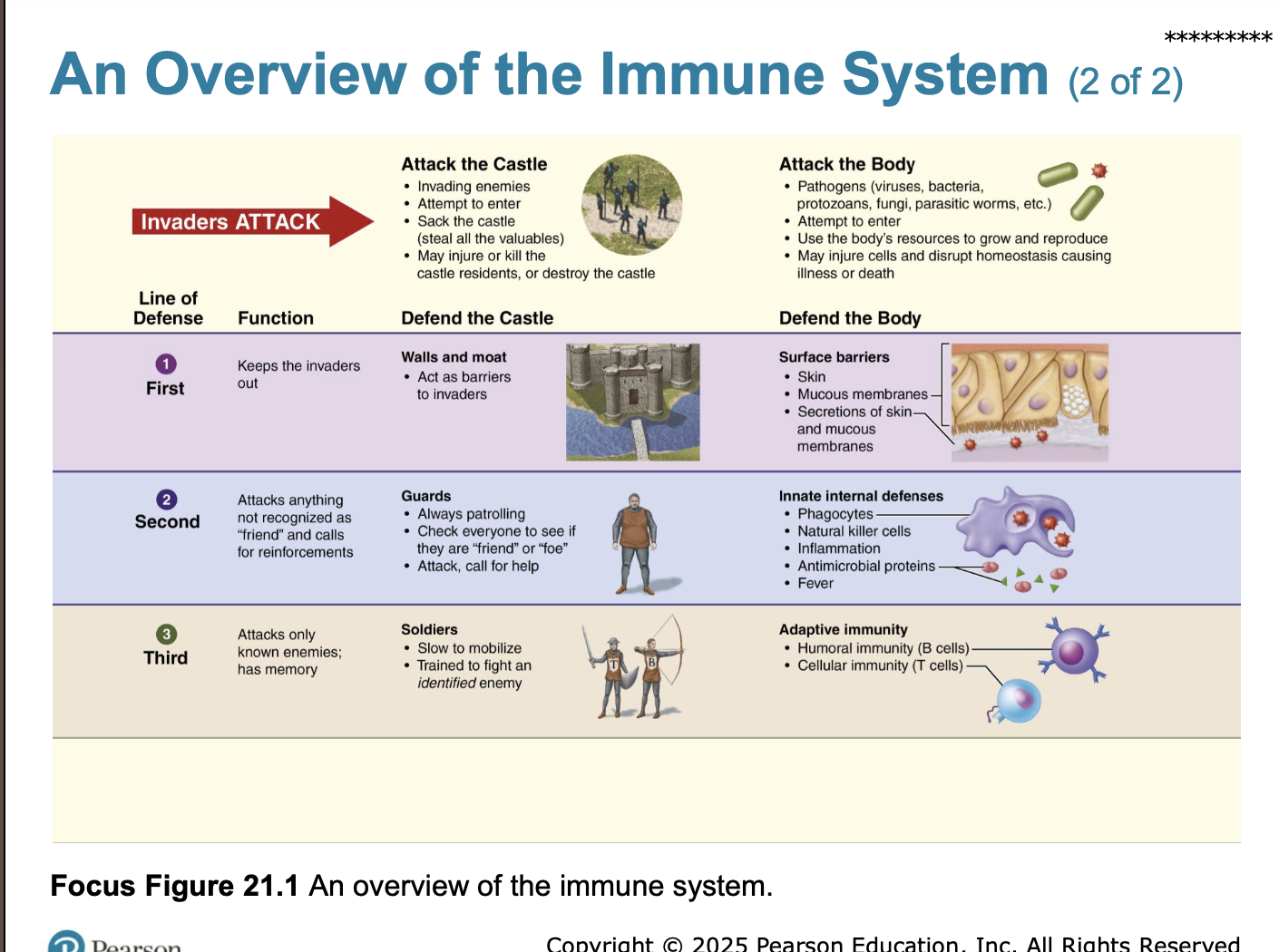
review an overwie of the immune system
Describe the first step of Lymphocyte Activation
B cells bind and engulf antigens, and present fragments to helper T cells
Describe the second step of Lymphocyte Activation
Helper T cells may activate the B cell
Describe the third step of Lymphocyte Activation
Activated B cells multiply and transform into plasma cells that produce antibodies
Describe the fourth step of Lymphocyte Activation
Some activated B cells become memory B cells to resist future encounters. Provide lasting protection.
What are the three categories immune disorders are classified into?
autoimune diseases, hypersensitivity, immunodeficiency diseases
What are autoimmune diseases
immune attack of own tissues
What is an example of an autoimmune disease
insulin-dependent diabetes, rheumatoid arthritis
where are autoimmune diseases more common
in women than men
What is hypersensitivity
exaggerated immune responses to antigen
what does hypersensitivity include?
Includes allergies: excessive reactions to environmental antigens (allergens) such as insect venoms, plant products (poison oak, poison ivy), dust, pollen, nuts, milk, eggs, and others
In many cases, what does an allergen stimulate and what does it cause?
An allergen stimulates basophils and mast cells to release histamine and other chemicals that cause a broad range of symptoms, edema, congestion, watery eyes, runny nose, hives, cramps, diarrhea, vomitting, and sometimes catastrophic circulatory failure (anaphylactic shock)
What is Immunodeficiency diseases
failure of immune responses
What is a congenital example of an Immunodeficiency diseases
Congenital example: severe combined immunodeficiency disease (SCID)-
born without a functional immune system
What is a acquired example of an Immunodeficiency diseases
acquired immunodeficiency syndrome (AIDS), caused by HIV virus infection. Targets helper T cells (CD4)
Provide the lymphatic trunks
paired jugular, subclavian, bronchomediastinal, inercostal, and lumbar trunks