Biology Unit 5 Test
 Call Kai
 Learn
Learn Practice Test
 Spaced Repetition
 Match
Match Flashcards
 Knowt Play
1/25

There's no tags or description
Looks like no tags are added yet.
Name | Mastery | Learn | Test | Matching | Spaced | Call with Kai |
|---|
No analytics yet
Send a link to your students to track their progress
26 Terms
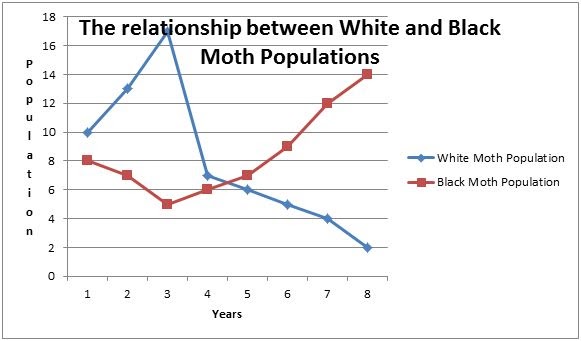
Using the graph below, infer what could have happened to the environment around year 4 that caused a shift in the populations of moths. (4-2F, 4.0)
The tree trunks became darker due to unchecked air pollution, thus increasing the number of black moths.
Under natural selection, why must more offspring be produced than can survive?
There must be competition so that some individuals survive and reproduce more than others.
What is evolution?
A change in allele frequencies in a population over time
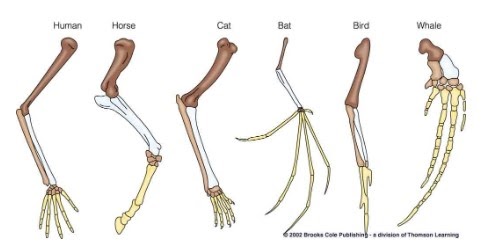
Structures that have a similar embryological origin and structure but are adapted for different purposes and environments, such as a bat wing and a human arm are called ___________. (4-2C, 3.0)
homologous structures
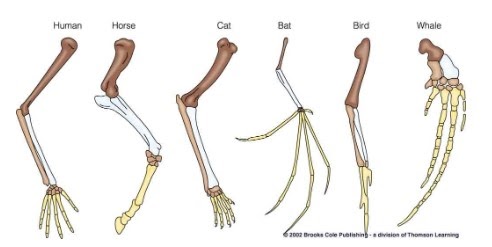
The similarity of the bones shown in question 5 support that the organisms: (4-2C, 3.0)
have a common ancestor
Evolution occurs in ___, but natural selection acts on ___.
populations; individuals
Why is artificial selection evidence for natural selection?
Humans selected for traits that they found desirable, and those traits became more common.
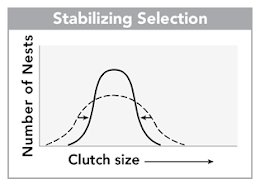
Robins typically lay four eggs. Four eggs allow the offspring to be well fed, whereas larger clutches may result in malnourished chicks that have a lower chance of survival. Fewer than four eggs per clutch may result in no surviving offspring if the eggs are preyed upon. Which type of pattern of natural selection MOST LIKELY acts to keep four eggs the most common clutch size?
Robins typically lay four eggs. Four eggs allow the offspring to be well fed, whereas larger clutches may result in malnourished chicks that have a lower chance of survival. Fewer than four eggs per clutch may result in no surviving offspring if the eggs are preyed upon. Which type of pattern of natural selection MOST LIKELY acts to keep four eggs the most common clutch size?
Genetic drift is when _____.
a random change in allele frequency is caused by a large population shrinking
Based on radiometric dating, the Earth is approximately 4.6 billion years old. Why is this important in biology?
4.6 billion years are enough time for evolution by natural selection to occur.
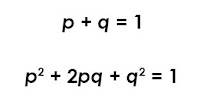
In a population of anteaters, allele frequencies for the trait of tongue length are determined to be L = 0.7 and l = 0.3 in the summer of 2015. Calculate the expected genotype frequencies for anteater tongue length in the next generation if the population remains in Hardy-Weinberg equilibrium.
LL 0.49 Li 0.42 ii 0.09
As Darwin explained, a small population of finches settled on the Galapagos Islands. Darwin called these finches the founders, or founding population. The founders became the ancestors of all the finch species that Darwin observed on the islands.
How did the founders compare with other finches of the same species that remained in South America?
They were similar, but might have had different allele frequencies due to the small size of the founding population.
In Great Smoky Mountains National Park, about 13 species of fireflies each use light flashes for males and females to recognize each other. The timing and pattern of these flashes is unique for each species. Another group of fireflies does not flash at all and actively mates during the day rather than at night. This group includes six species.
Select two modes of isolation observed in related firefly species.
Temporal isolation: The species remain separate because the period of most active mating differs. Behavioral isolation: Each species exhibits a unique flash pattern that allows males and females to recognize each other.
There are 10 "B" and 30 "b" alleles in a population. What is the frequency of the "b" allele?
0.75
Which of the following species are most closely related: Sylvilagus floridanus, Camponotus floridanus, Sylvilagus audubonii?
Sylvilagus floridanus and Sylvilagus audubonii
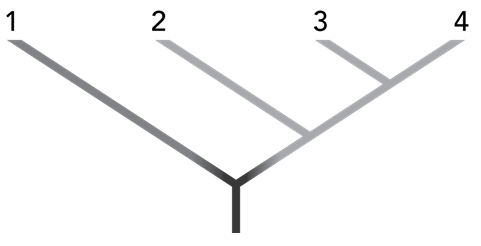
In this outline of a phylogenetic tree, the numbers 1 to 4 each represent a species.
Which pair of species have the most recent common ancestor?
Species 3 and 4
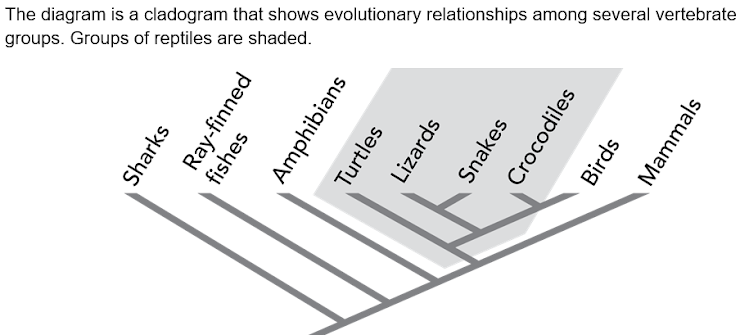
Which two animal groups represented in the phylogenetic tree have the most recent common ancestor?
lizards and crocodiles
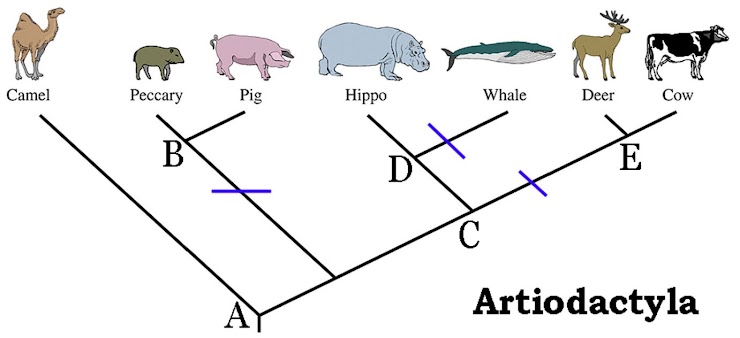
Of the organisms listed below, hippos are most closely related to ___.
deer
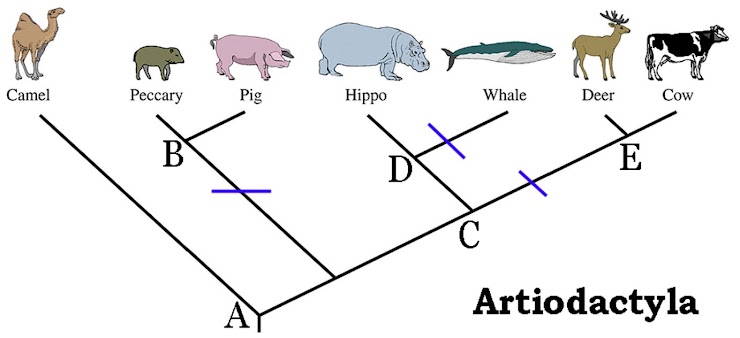
Cows and whales share a most recent common ancestor at branch ___.
C
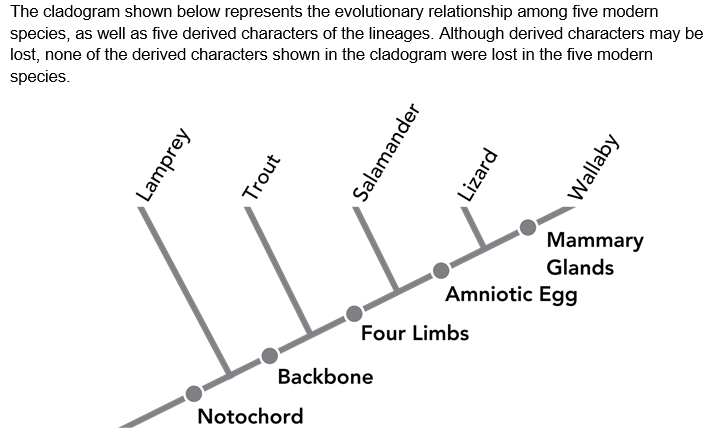
Which statement describes the evolution of the trait of an amniotic egg?
The trait evolved in an ancient ancestor of lizards and wallabies, and was passed to all of the ancestor’s descendants.
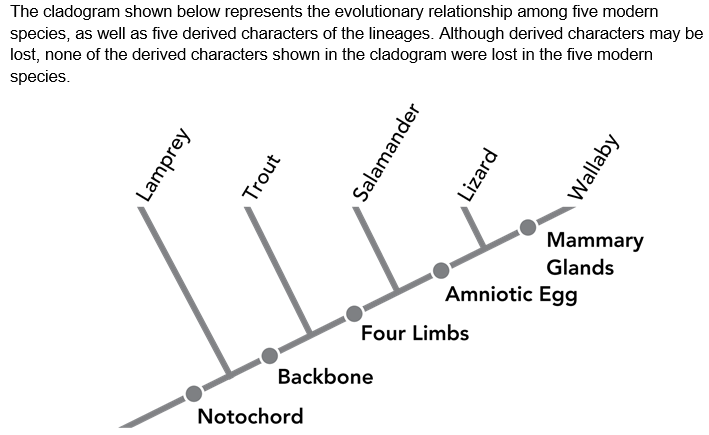
Which property can be determined from the information in the cladogram?
the order in which the five derived characters evolved
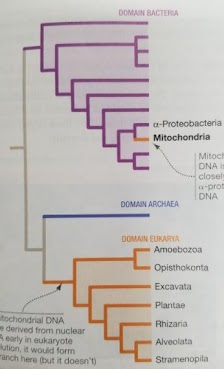
If mitochondria were independent organisms, they would be most closely related to ___.
𝛼-Proteobacteria
A chemoheterotroph gains energy from ___ (sunlight or high-energy molecules) and carbon from ___ (CO2 or food).
___________ Energy from Carbon From
Sunlight
breaking down high-energy molecules
CO2 in the atmosphere
eating and digesting food
Sunlight- no, breaking down high-energy molecules - energy from O2 in the atmosphere-no
eating and digesting food- carbon from
Match the structures that each group of organisms uses to absorb nutrients
villi/microvilli = animal hyphae= fungi Roots=plants
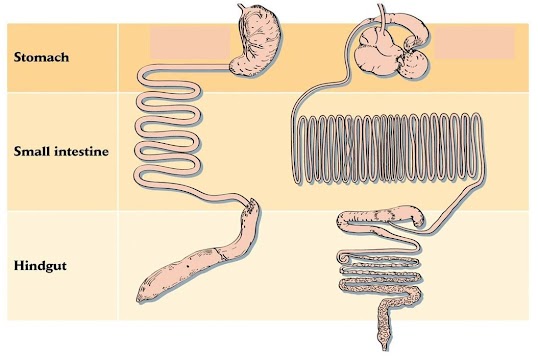
The digestive system on the left is most likely from a/an ___.
carnivore
The skull and teeth below are most likely from a/an ___.
herbivore