Friction and soil mechanics (wk 6)
 Call Kai
 Learn
Learn Practice Test
 Spaced Repetition
 Match
Match Flashcards
 Knowt Play
1/28

There's no tags or description
Looks like no tags are added yet.
Name | Mastery | Learn | Test | Matching | Spaced | Call with Kai |
|---|
No analytics yet
Send a link to your students to track their progress
29 Terms
What is the basic friction equation?
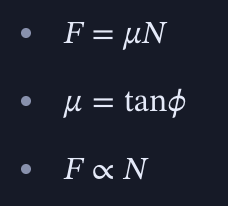
What is the friction angle?
Maximum slope before soil slides
Related to interparticle friction
μ=tanϕ
What are two key properties of friction?
Independent of apparent area → surface area
Independent of velocity (magnitude)
Why is friction independent of apparent contact area?
According to bowden and tabor model
True contact area is microscopic
in most materials σc is very high
E.g. in steel σc = 4000 Mpa
This means Atrue contact ÷ A surface area <<<< 1
i.e. out of total surface area, minimal is actually in contact
Surfaces touch only at asperities
Friction arises from adhesion at true contact points
HOWEVER:
Soft material friction depends on apparent contact area
Bowden and Tabor model assumes hard surfaces
What did Bowden & Tabor discover?
Normal force is directly proportional to true contact area
Argued that the initial contact area is EXTREMELY small and there is a limiting normal stress (σc) at any asperity
As the normal load is applied, ridges will be flattened until the load is spread over an area Ac such that N= σcAc
As you increase the normal, more surface from each object comes into contact
Eventually each asperity is in contact with each other
What is the shear force needed to overcome friction?
F=τA
τ = shear strength of microscopic bonds
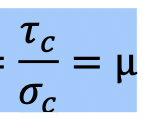
What is the physical meaning of the coefficient of friction?
a ratio of the shear strength of the bond to the limiting normal stress
Why do F1 cars have large tyres if friction is area‑independent?
Bowden–Tabor applies to hard surfaces
Tyres are soft materials
Load spreads over full apparent area
Friction depends on deformation, not µN
Surfers put wax on the top of the surfboard to enable them to stand up (to increase µ). Why do skiers put wax on the underside of their skis?
Friction produces heat
Melts snow directly under the ski, hence lubrication -> allows them to ski faster
Ability of ski material to conduct heat is also critical. Metal skis would not work.
How does lubrication reduce friction?
Adds fluid layer → hydrodynamic lubrication
Reduces shear strength τc
Prevents metal‑to‑metal contact
Avoids generation of excessive heat due to friction
What determines soil composition?
Particle size (sand → clay)
Finest 25% of particles determines soil properties
Uniform distribution of fine particles in soil
Controls frictional properties
Affects strength and stiffness
Control pore size
Affects how easily soil drains
If more than 25% of soil are fine = less big particles in contact -> finer particles impact soil strength more than bigger particles
Movement of water moves through spaces between particles -> determined by finer particles
Particle shape & mineral type
Represented by grading curve
Why do fine particles control soil behaviour?
Determine frictional strength
Control pore size → drainage
If >25% fines → fines dominate behaviour
note: we assume soil has no tensile capacity
How do different soils drain?
Clay: very slow (≈1×)
Construction in clay requires regular spaced drains to minimise time draining overall
Is fine and densely packed particles holds onto water -> can lead to waterlogging
Sand & gravel: very fast
Drainage time also depends on distance to free‑draining layer
Why use clay cores in earth dams?
High friction → stability
Low permeability → water barrier
point of a dam i
Rockfill provides strength but cannot contain water
Sand filter prevents mixing of clay & rockfill
What is effective stress?
the difference between total stress and water pressure
σ′=σ−u
the actual stress carried by the soil skeleton (grain-to-grain contact)
Controls strength & settlement
Why is effective stress zero at the seafloor (4000 m depth)?
Total stress = water pressure
Water supports the load
No grain‑to‑grain contact stress
grain are actually hovering above each other
Why can sandcastles have slopes > friction angle?
Suction (negative water pressure) increases effective stress
instead of particles being pulled away, they are pressed together
Surface tension → negative pore pressure
Stronger in finer soils (clay >> sand)
What is the angle of repose?
Same as angle of friction
Maximum stable slope angle for soil
Slopes steeper than this are unstable
How does water affect the angle of repose?
Water reduces effective stress
Fills pore spaces → lowers friction
Removes suction between grains
Saturated soil has lower friction angle
What happens to friction angle when water flows out of a slope?
Stable angle ≈ ½ of friction angle
Why are landslides associated with heavy rain?
Rain increases pore water pressure
Reduces effective stress
Decreases frictional resistance
lubricates soil particles
What are rock discontinuities?
Weakness planes separating rock blocks
Examples: faults, joints, bedding planes, shear zones
Control rock behaviour at shallow depth
What forces act on a rock block on a slope?
Weight (W)
Normal force (N)
Frictional resistance (F = N tanθ)
Water pressure force (F_water) → a distributed load (so need to calculate point load + the point from the base where it acts)
we draw water pressure as a right angle triangle since
Water pressure increases linearly with depth (height)
Water pressure = zero at the surface
calculate unknowns using equilibrium
When does sliding occur?
When Fwater=friction=Ntanθ
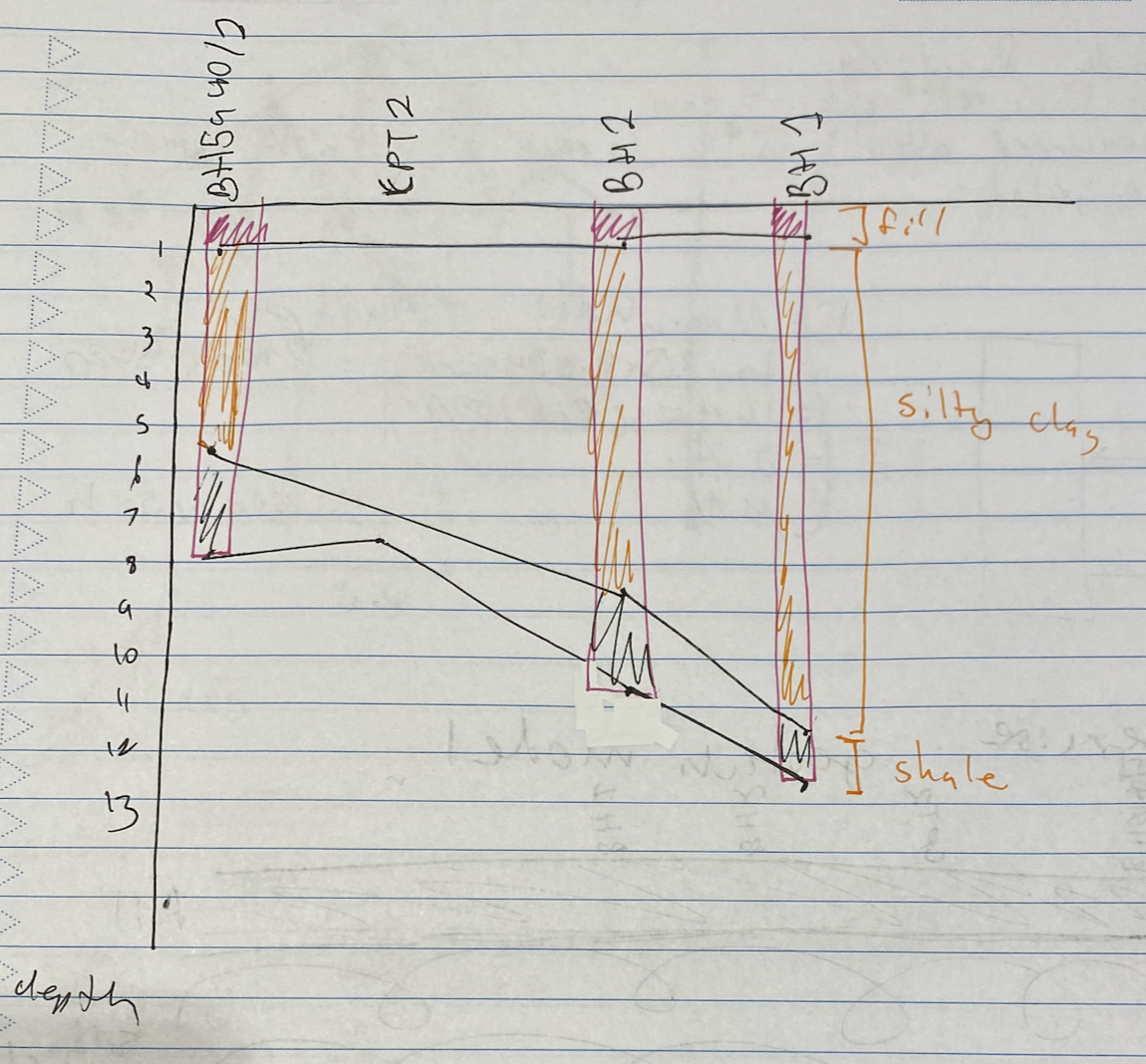
Why do we create ground models?
Identify soil types & depths
Predict ground behaviour
Each layer is tested to identify its properties
Typical values of strength
Friction angle
Young's modulus (stiffness)
Foundation design must consider
Stability -> is ground support enough?
Serviceability -> how acceptable are deformations
Inform foundation design
Columns transmit load to foundation -> foundation transmit load to ground
column → (point load)→foundation pad → (pressure)→ ground
how to draw a geotechnical model
Distance from point on x-axis
Depth under ground on y-axis
What is the ground bearing requirement?
Ground bearing strength ≥ applied pressure
i.e. Strength of ground (kN) ≥ applied load (kN)
What is Poisson’s ratio?
Ratio of lateral strain to axial strain
When compressed vertically, soil expands laterally
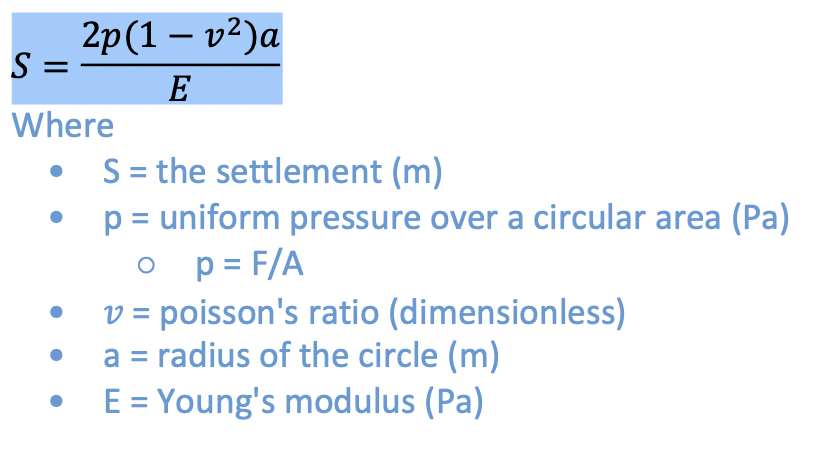
What is the settlement formula for a circular loaded area?