BI108 - Quiz 5
 Call Kai
 Learn
Learn Practice Test
 Spaced Repetition
 Match
Match Flashcards
 Knowt Play
1/52

There's no tags or description
Looks like no tags are added yet.
Name | Mastery | Learn | Test | Matching | Spaced | Call with Kai | Chat |
|---|
No analytics yet
Send a link to your students to track their progress
53 Terms
What are hormones?
long-distance chemical signals used for communication
What is a ligand?
a molecule that binds to a receptor
What are the types of signals and what are examples?
amines: derived from tryptophan or tyrosine, might be lipid-soluble (i.e. epinephrine)
peptides: small proteins, not lipid-soluble (i.e. insulin and oxytocin)
steroids: have 4 ring structures, lipid-soluble (i.e. estrogen)
What is signal transduction?
one type of signal is converted to another, and in peptides and some amines, extracellular signals are converted to intracellular signals
What is a kinase?
an enzyme that catalyzes the addition of a phosphate group from ATP to another molecule
How does signal amplification work in lipid-soluble signals?
the signal binds to the receptor, and it activates transcription (producing many mRNAs), which in turn produce many protein products
How does signal amplification work in a phosphorylation cascade?
signal transduction occurs and a series of phosphorylation events occur
How does signal amplification work in terms of messengers?
the signal acts as the first messenger, and then it is converted to a second messenger (usually an ion or small molecule) that activates the production of many protein products
What is a set point when it comes to homeostasis?
a reference point for control
What is an error signal when it comes to homeostasis?
the difference between the set point and feedback info
What is an effector when it comes to homeostasis?
tissues/organs that can alter the internal environment
What is negative feedback? Give an example
info that returns the system to the set point
ex: blood glucose levels are monitored by the pancreas, which, when it detects an issue, it releases glucagon (effector), which is stored and broken down in the liver, which releases glucose
What is positive feedback? Give an example
amplifies response and increases the deviation from the set point
ex: in childbirth, uterine contractions increase, stimulated by stretching of the cervix
What are the 3 modes of delivery for signals?
Juxtacrine: physical contact between cells
Autocrine: nearby signaling between cells
Endocrine: distant signaling between cells
What happens when an electrical potential gradient is established?
ions move toward areas of opposite charge driven by repulsion and attraction
What is membrane voltage?
separation of charge across a membrane
What is an electrochemical gradient?
the combination of concentration gradient and electrical gradient
What is co-transport?
one ion (usually H+) is used to transfer other molecules across the membrane by establishing their own gradient
What is action potential?
temporary swings in membrane voltage (consistent)
What is resting potential?
action potentials that have a normal membrane voltage (usually -70mV)
What is the voluntary nervous system?
voluntary signals or commands to/from muscles or other body cells (i.e. telling yourself to run)
What is the autonomic nervous system?
physiological controls or signals that detect a change in internal environment (i.e. body temp, blood pressure)
What are the two parts of the autonomic nervous system?
Parasympathetic nervous system: rest and digest
Sympathetic nervous system: fight or flight
What do sensory/afferent neurons do?
Carry signals from sensor to CNS
What do interneurons do?
only in CNS, integrate and coordinate signals to find the appropriate response
What do efferent neurons do?
process response and send signals to PNS
When is a membrane hyperpolarized?
when the membrane voltage becomes more negative than resting potential
When is the membrane depolarized?
when the membrane voltage gets less negative than resting potential
How do voltage-gated channels work? What are the two types?
they open or close depending on membrane potential, at rest they are closed
Na+ channels: quickly allow Na+ ions to rush from the outer membrane to the inner membrane, depolarizing it. Membrane potential swings positive
K+ channels: don’t open until depolarization has been happening since there is now a strong gradient favoring the movement of K+ ions from the inner membrane to the outer membrane. This repolarizes the membrane and then hyerpolarizes it. K+ leak channels open to restore resting potential
How does charge spread work in a neuron?
Positive charges from the Na+ channels are repulsed by the other positive charges in the cell, so they spread throughout the axon
What is myelination and why is it necessary?
specialized glial cells (Schwann cells) wrap around sections of an axon to prevent the movement of ions across membrane, ensuring efficient charge spread
What are the components of a synapse?
presynaptic cell: terminus where action potential arrives
synapse: neurons’ cell membranes meet, forming a gap
postsynaptic neuron/cell: subsequent cell
What happens in a synapse when an action potential arrives?
voltage-gated Ca+ channels at the end of presynaptic cell open and Ca+ rush in
Some Ca+ fuse with the membrane at the synapse and release their contents into the cleft
neurotransmitters (signaling molecules) bind to channels in post-synaptic membrane, causing ligand-gated channels to open
neurotransmitter uses KE to detach from ligand-gated channels and channel closes
What are the steps of an action potential?
starts at resting potential
stimulation and rising (depolarization)
peak → all Na+ channels are open (max potential)
falling (repolarization) _> Na+ channels close, K+ channels open, K+ leaves cell (down the gradient), positive charge leaves repolarizing the membrane
refractory period _> K+ channels remain open, causing hyperpolarization than all channels close, takes 2ms to restore resting potential
What is the difference between an open and closed circulatory system?
Open: fluid (hemolymph) is contained in vessels in some regions, but leaves vessels and circulates directly
Closed: fluid is always in vessels, and circulation occurs in a loop
What do the 4 chambers of the heart do (in order)?
Right atrium: deoxygenated blood from body is received
Right ventricle: deoxygenated blood is pumped up the pulmonary artery into the lungs
Left atrium: oxygenated blood from the lungs is received
Left ventricle: oxygenated blood is pumped into the aorta to the rest of the body
What are the 3 vessels that carry blood?
arteries: carry oxygen-rich blood away from the heart
veins: carry oxygen-poor blood toward the heart
capillaries: where oxygen and nutrients diffuse from blood to tissues and CO2 waste diffuses from tissues to blood
What do alveoli do?
they are covered with capillaries with RBCs that exchange CO2 and oxygen
What is the structure and function of hemoglobin?
Structure: 4 subunits, each with a heme group (Fe at the center) that can bind O2
Function: a protein that binds oxygen molecules that have diffused into RBCs and carry it to tissues in need. It can also bind CO2 and carry it to the lungs to be expelled
What are the two modes in which gas flows?
bulk flow: mass movement like breathing
diffusion: small movement in lungs and tissues
What properties cause for more efficient diffusion in the body?
higher surface area
thinner membrane
capillaries closer to the skin surface
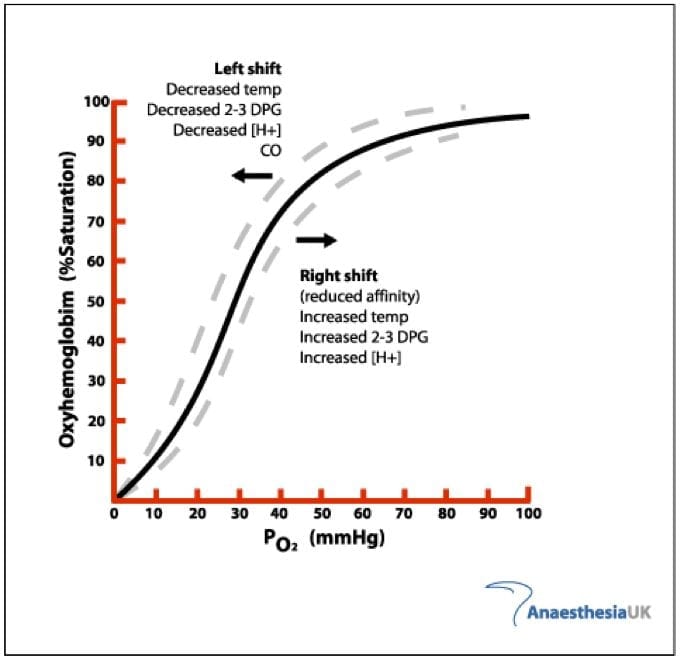
What is the oxygen-hemoglobin dissociation curve ?
A curve that represents the amount of oxygen (%) available in hemoglobin compared to the partial pressure of oxygen.
What are pathogens?
disease-causing agents that are adapted to exploit your cells for their own gain
Why are pathogens so difficult to defend against?
short lifespans
evolve quickly (immune system must defend against entirely new pathogens)
must be distinguished from normal body cells
What are the two parts of the innate immune system?
barriers to entry: cilia, antibiotic-containing liquids (tears/mucus), wax, and saliva that protect openings of the body by trapping or killing pathogens
inflammatory response: when blood-clotting proteins are released, leukocytes (WBCs) fight against the infection
What are the cells that play a role in the innate immune system?
macrophages: patrol tissues throughout the body (crawl by extending cell membrane), and secrete signaling molecules from site of the wound to other cells.
mast cells (wound site): secrete compounds that constrict blood vessels to reduce blood loss
mast cells (blood vessels): secrete compounds that make blood vessels expnd to be more permeable
neutrophils: crawl to wound site in response to singnals and changes in blood flow, they engulf and destroy bacterial cells
What happens when a pathogen breaks through the innate immune system?
the acquired immune system recognizes the invader and secretes proteins to mark the invader for destruction and recognizes cells that have been infected to destroy them before they can reproduce
What is the difference between antigens and antibodies?
antigens: any non self molecule that elicits a response from the immune system
antibodies: proteins reproduced by B cells that bind to antigens
What are epitopes?
specific locations on an antigen where antibodies bind
How do B-cells work?
Function: they are antibody-producing cells that are responsible for recognizing pathogens
BCRs: reside in B-cell membranes, they are antibodies with stalk-like transmembrane domains
How do T-cells work?
Function: they are antigen-presenting cells that engulf antigens, attach them to an MHC protein, and transport them to the cells surface
TCRs: have a transmembrane domain that anchors them to the cell, if one binds to a T cell, the T-cell is transformed into a helper T cell (activate B cells) or cytotoxic T cell (responds to the antigens)
What do cytotoxic T cells do?
kill infected cells if their TCR binds to an antigen being presented
What happens when B and T cells activate?
they lose most of their mitochondria, get larger, and gain RER
undergo lots of mitosis to clone themselves into memory cells that remain after the infection is cleared