Research Methods
 Call Kai
 Learn
Learn Practice Test
 Spaced Repetition
 Match
Match Flashcards
 Knowt Play
 Podcast
1/123

There's no tags or description
Looks like no tags are added yet.
Name | Mastery | Learn | Test | Matching | Spaced | Call with Kai |
|---|
No analytics yet
Send a link to your students to track their progress
124 Terms
Experimental Method AO1 - Aims
Narrowed focus of research, developed from theories. General statements describing investigation purpose.
E.g. To investigate whether drinking energy drinks makes people more talkative
Experimental Method AO1 - Hypotheses
Statement describing relationship between variables.
Alternative - Ancticipates there will be a significant difference.
Null - Anticipates there will not be a significant difference.
Directional - Anticipated type of difference based on previous research.
E.g. People who drink x makes them more talkative.
Non Directional - Unspecified difference between variables
E.g. People who drink x makes people differ in talkativeness compared to people who do not drink x.
Experimental Method AO1 - Variables
Researcher manipulates IV, measures the change on the DV. Measure of significance requires compare to control group.
Experimental Method AO1 - Operationalisation
Clarification of the exact change that causes the difference.
E.g. After drinking 300ml x, ptcps say more words in the next 5 minutes than ptcps who drink 300ml water.
Research Issues AO1 - Extraneuous Variables
Unwanted variable interferes with IV. Must be identified, removed before study to ensure internal validity.
Research Issues AO1 - Confounding Variables
Changes systematically with IV. Can explain change in the DV as much as IV, must be controlled to ensure internal validity.
Research Issues AO1 - Demand Characteristics
Ptcps make sense of experimental situtation, use clues to interpret experiment, second guessing experimenter intention. Participant reactivity difficult to control, makes behaviour unnatural. Extraneuous variable affecing DV.
Please-U: Delib. overperform to please experimenter
Screw-U: Delib. underperform to sabotage results
Research Issues AO1 - Investigator Effects
Researcher uncounscious behaviour may proc unwanted influence, affecting DV (expectancy effects).
Could impact study design (ptcps selection, materials, instruction, leading questions).
Research Issues AO1 - Randomisation
Can minimise impact of EXTv/CFDv, reduces unconscious bias (control investigator effects).
E.g. Randomly selected stimuli, randomly selected ptcps, randomly selected conditions.
Research Issues AO1 - Standardisation
Ensuring significance of results req all ptcps should be subject to same environment, info, experience.
List of formalised, exact study details, e.g. standardised instructions.
Experimental Design AO1 - Independent Groups
2 seperate groups experience 2 different conditions. Often, 1=Experimental, 2=Control.
Performance of each group compared.
Experimental Design AO3 - Independent Groups
STR - Prevents order effects
LIM - Difference in groups reduces validity. Effect on the DV could be due to IV or ptcpV (confounding variable). Impact reduced by random allocation.
LIM - Less economical, requires double ptcps for one result each = increased time, money to recruit ptcps.
Experimental Design AO1 - Repeated Measures
All ptcps experience all conditions.
E.g., complete experimental first, control second.
Mean scores compared from both conditions to see if difference.
Experimental Design AO3 - Repeated Measures
STR - PtcpV controlled, higher validity.
STR - More economical. Fewer ptcps for greater results = less time, money.
LIM - Significant order effects (solved by counterbalancing AB BA)
LIM - More tasks = more time could create fatigue, boredom, greater skill (extV).
LIM - Repeated study = demand characteristics, lower validity.
Experimental Design AO1 - Matched Pairs
2 groups experience 2 conditions. Ptcps matched based on relevant variable (e.g. Knowledge based experiment = IQ). Attempts to control ptcpV, cfdV. Needs pre-test to be effective.
Experimental Design AO3 - Matched Pairs
STR - Single condition = less order effects, demand characteristics.
LIM - Ptcps can never be matched completely equally = ptcp variables still exist.
LIM - Less economical = More time + Money for pre-test, finding ptcps.
Types of Experiment AO1 - Lab Experiment
Experiment in highly controlled artifical environment.
Types of Experiment AO3 - Lab Experiment
STR - High control over cfdV and extV. High internal validity = able to establish cause and effect.
STR - Easier to replicate = possible to test study’s reliability
LIM - Lacks generalisability in artificial environment (unfamiliar) = low external validity. Artificial Stimuli = low mundane realism.
LIM - Awareness = demand characteristics, low validity of results.
Types of Experiment AO1 - Field Experiment
IV manipulated in natural setting. Ptcps may be unaware they are being studied.
Types of Experiment AO3 - Field Experiment
STR - Higher mundane realism, behaviour may be more valid, authentic (higher external validity).
LIM - Loss of control of cfdV and extV = harder to establish cause and effect.
LIM - Ethical issues of possibly being unable to give informed consent.
Types of Experiment AO1 - Natural Experiment
Researcher has no control over IV; naturally occuring. DV and setting can be natural or set by researcher.
Types of Experiment AO3 - Natural Experiment
STR - Provides opportunites normally impossible for practical/ethical reasons, e.g. Romanian Orphans.
STR - Study of real world issues/events as they happen = high external validity.
Types of Experiment AO1 - Quasi Experiment
IV based on existing difference bwteen people, unmanipulatable/unchangeable e.g. age.
Types of Experiment AO3 - Quasi Experiment
STR - Controlled conditions = High internal validity, replication
LIM - Unable to allocate ptcps to groups = cfdV.
LIM - Lack of control over IV = difficulty establishing cause and effect
Sampling AO1 - Random Sampling
All members of target pop have equal chance of selection. Each person on list assigned a number, chosen through lottery method.
Sampling AO3 - Random Sampling
STR - Unbiased, so likely more representative than other samples (e.g. opportunity), cfdV and extV equally divided among group, inc. internal validity.
LIM - No way to guarantee representative sample.
LIM - Difficult and time consuming (complete target pop. list somewhat innacesible).
Sampling AO1 - Systematic Sample
Every nth number of target pop. list is chosen. Formed off of sampling frame (organised list of target pop.).
Sampling AO3 - Systematic Sampling
STR - Objective method, researcher has no influence once system established.
LIM - Refusal to participate = makeshift volunteer sample.
Sampling AO1 - Stratified Sample
Researcher idenitifies different strata of population relevant to experiment. Chooses sample representative of proportions.
Sampling AO3 - Stratified Sample
STR - More representative sample = greater generalisability.
LIM - Stratification imperfect, complete representation impossible.
Sampling AO1 - Opportunity Sample
Researcher find anyone willing/available.
Sampling AO3 - Opportunity Sample
STR - Convenient, less costly.
LIM - Ungeneralisable (drawn from specific area).
LIM - Subject to researcher bias.
Sampling AO1 - Volunteer Sample
Potential ptcps come to researcher (e.g. from an ad).
Sampling AO3 - Volunteer Sample
STR - Easy and cost efficient.
LIM - Subject to volunteer bias, may attract certain profile of volunteer, limiting generalisability.
Ethical issues AO1 - Informed Consent
Ptcps should know what they are doing beforehand. Makes ptcps aware of research aims, procedures, rights (inc. right to withdraw), data usage. Ptcp should not feel coerced or obliged.
Ways of dealing with Ethical issues AO1 - Informed Consent
Ptcps should be issued consent letter detailing all relevant info (prev). Requires signature, or parental signature <16.
Other forms of consent:
Presumptive consent - Similar group to ptcps asked if study is acceptable.
Prior general consent - Ptcps give consent to participate in many studies, incl. one involving deception.
Retrospective consent - Ptcps asked for consent during debriefing.
Ethical issues AO1 - Deception
Deliberately misleading / witholding info from ptcps at any stage of the investigation. Contradicts giving informed consent. Can cause undue distress to ptcps.
Ethical issues AO1 - Protection from harm
Ptcps should not be at greater risk of harm than in daily life. Should be protected from physical/psychological harm e.g. stress, embarassment, pressure.
Ways of dealing with Ethical issues AO1 - Deception and protection from harm
Ptcps given full debrief, made aware of research true aims, details not previously given, e.g. other groups. Ptcps given right to withdrawal, right to withold data. Averse outcomes for ptcps require counselling.
Ethical issues AO1 - Privacy and Confidentiality
Ptcps have right to control info about themselves (privacy). Invasion = confidentiality then must be protected.
Ways of dealing with Ethical issues AO1 - Privacy and Confidentiality
Personal details must be protected, often by not recording them (anonymity). Ptcps reminded of their privacy and confidenitality rights during debrief.
Pilot Studies AO1 - Outline
Small scale version of study pre-investigation. Checks prodcedures, materials, scales work as intended. Allow for researcher to make neccesary changes.
Pilot Studies AO1 - Types
Single-blind proc: Details kept from ptcps. Any info could create expectations. Not revealed until end of study to prevent cfdV demand characteristics.
Double -blind proc: Details kept from ptcps and researcher (conducted by 3rd party). Important in drug trials to prevent different researcher behaviour.
Pilot Studies AO1 - Control and Conditions
In drug trials, experiemntal group = real drug, control group = placebo. Sets baseline to conclude significance of experimental group on IV. Most always IGD or RMD.
Observational Techniques AO3 - General
STR - Capture what people actually do, special insight into behaviour.
LIM - Observer bias, interpretation of events affected by expectations (reduced by multiple observers).
LIM - Cannot demonstrate causal relationships.
Observational Techniques AO1 - Naturalistic and Controlled
N: Takes place in context of where target behaviour normally occurs.
C: Takes place in artificial environment to control some extV, cfdV.
Observational Techniques AO3 - Naturalistic and Controlled
nSTR: High external validity = generalisability.
nLIM: Replication difficult, less control over cfdV extV = lower reliability, internal validity.
cSTR: Observations easier and controlled = higher internal validity, reliability
cLIM: Low external validity = ungeneralisable, less meaningful results.
Observational Techniques AO1 - Covert and Overt
C: Ptcps unaware they are focus of study, behaviour observed secretly (must be public to be ethical).
O: Ptcps aware they are focus of study, given informed consent beforehand.
Observational Techniques AO3 - Covert and Overt
cSTR: No demand characteristics, ensures natural behaviour = high internal validity.
cLIM: Questionable ethics (right to privacy)
oSTR: Ethically acceptable, more likely able to use results.
oLIM: Demand characteristics decreases internal validity.
Observational Techniques AO1 - Participant and Non-participant
P: Observer is part of the group, potentially secretly.
N: Observer is seperate, more objective study. Sometimes is the only way.
Observational Techniques AO3 - Participant and Non-participant
pSTR: Observer experiences situation as ptcps do = high external validity.
pLIM: Observer can identify too strongly with ptcps, losing objectivity = biased results.
nSTR: Greater objectivity = high internal validity of results.
nLIM: Lose valuable insight from being too far removed from ptcps.
Observational Design AO1 - Structured Observation
Observe a limited set of specific, clearly defined behaviours, ignoring all else in a large sample. Provides qtt data.
Observational Design AO3 - Structured Observation
STR: Quicker, easier method, large samples. Data provided can be displayed visually, reliable results.
LIM: Qtt data lacks explanatory power. Limits ability to include any unforseen relevant behaviours, limiting usefulness.
Observational Design AO1 - Unstructured Observation
Observe all that happens in a smaller sample. Almost always interpersonal interaction. Provides qlt data.
Observational Design AO3 - Unstructured Observation
STR: Qlt data is rich, insightful, highly subjective to those it was taken from = high ecological validity.
LIM: Personal and subjective nature = loss of objectivity (researcher bias, confirmation bias). Small sample. Makes findings unreliable.
Observational Design AO1 - Behavioural Categories
Used to record specific behaviours. Categories designed to only record observable behaviours (no ambiguity). Must be previously agreed upon by researchers. Then operationalised to seperate.
Inevitable researcher bias avoided with multiple researchers comparig results (inter-observer reliability).
Observational Design AO3 - Behavioural Categories
STR: Defined categories eliminates subjectivity. Closer to scientific method = higher internal validity.
LIM: Predetermined categories may lead to unforseen relevant behaviours being ignored, lowering validity of findings.
Observational Design AO1 - Sampling Methods
Event Sampling: Every behaviour category observed recorded as they happen.
Time Sampling: Records all behaviours during a set time frame.
Researcher decides which is appropriate for the observation.
Observational Design AO3 - Sampling Methods
eSTR: Specific behaviours not missed, greater internal validity.
eLIM: Too many specific behaviours = overly complex to record, overall behaviours could be missed, lowering validity.
tSTR: Researcher flexibility = more meaningful, true reflection = high internal validity.
tLIM: Can miss behaviours outside of time frame, limiting validity of findings (potential over/under representation).
Self Report Techniques AO1 - Questionnaries
Most common as easier. Pre-set list of written questions given for ptcps to answer.
Open questions provide qlt data, more meaningful, difficult to analysis. Can simplify into qtt data.
Closed questions provide qtt data, easier analysis, less meaningful.
Self Report Techniques AO3 - Questionnaries
STR: Cost effective, does not require researcher present. Data is easier analysed and presented visually.
LIM: Social desirability bias = untruthful answers. Response bias = similar results. Meaningless answers = unreliable.
Self Report Techniques AO1 - Interviews
Most commonly a face-face interaction.
Structured: Pre-determined set of questions in fixed order.
Unstructured: Conversational, no set questions. General topic, but free-flowing interaction. Interviewee encouraged to expand and elaborate on answers.
Semi-Structured: Set questions but with elements of unstructured.
Self Report Techniques AO3 - Interviews
sSTR: Straightforward, easy to replicate due to standardised format. Reduces differences between interviewers.
sLIM: Limits richness of info given standardised format. Potential for lying.
uSTR: More flexible = more meaningful data.
uLIM: Potential interviewer bias, harder to analyse data (sift through irrelevant info). Potential for lying.
Self Report Design AO1 - Likert Scales (Closed)
Scale of (usually) 5 points from StronglyA to StronglyD on a statement.

Self Report Design AO1 - Rating Scale (Closed)
Scale of (usually) 5 points on a descriptor to answer a question.

Self Report Design AO1 - Fixed Choice (Closed)
List of possible options that apply to a question, indicate those required of them.

Self Report Design AO1 - Overuse of Jargon (Open)
Technical terms only familiar to professionals. Unnecesarily complex, may hinder interviewee, less valid results. Must be simple, easily understood.

Self Report Design AO1 - Emotive language, Leading questions (Open)
Certain words = certain emotive connotations, may show researcher’s attitudes = possible demand characteristics.
Leading question = Directs interviewee towards a specific answer.
Questions must be neutral, use neutral language.

Self Report Design AO1 - Double Barrelled, Double Negatives (Open)
Double Barreled = 2 questions in one, difficult to answer (ptcp may agree with one and not the other).
Double Negatives = Difficult to decipher.
Questions must be straightforward.

Correlations AO1 - Types of Correlation
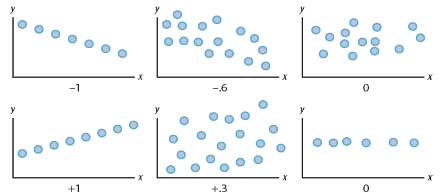
Correlation = relationship between 2 co-variables. Unable to establish cause-effect as no variables are manipulated.
Positive = Both variables increase/decrease with each other.
Negative = One variable increases while the other decreases.
Zero = No relationship between co variables.
Correlations AO1 - Correlation Coefficient
Relationships plotted on a scattergram, one variable on each axis. Correlation Coefficient tells strength and direction of co-variable relationship.
+1/-1 = perfect pos/neg correlation.
Weak correlations can still be statistically significant, depending on data set size.
Correlations AO3 - Strengths
Useful preliminary tool for research
Quick, economical. No need for controlled environment, manipulation of variables. Secondary data can be used.
Correlations AO3 - Limitations
Can tell us how variables are relates, not why (no cause-effect).
No way to tell if untested 3rd variable (intervening variable) is causing change.
Types of Data AO1 - Qualitative
Written expression, e.g. interview transcript, counselling notes. Includes yes/no answers. Concerned with interpretation from language from e.g. unstructured observations.
Types of Data AO3 - Qualitative
STR - Rich in detail, broader in scope = greater external validity. More insight into ptcp worldview.
LIM - Difficult to analyse, hard to present visually, compare to other data. Relies on subjective interpretation = subject to bias.
Types of Data AO1 - Quantitative
Numerical expression. Gathered from experiments (results from ptcps).
Types of Data AO3 - Quantitative
STR - Easier to analyse, present visually, more objective (less biased).
LIM - Less detail, insight (results have no context) = lower external validity.
Types of Data AO1 - Primary
Original data collected for investigation by researcher. First-hand from ptcps themselves e.g. from questionnaires, interviews, observations.
Types of Data AO3 - Primary
STR - More authentic, targeted for the research inquiry. Greater validity.
LIM - More time and effort, less economical (money for research).
Types of Data AO1 - Secondary
Gathered from pre-existing sources, not necessarily relevant to research aim. Has already been tested statistically for significance.
Can be gathered from journal articles, books, websites, databases.
Types of Data AO3 - Secondary
STR - Inexpensive, easily accessed.
LIM - Substantial variation in data quality/accuracy. May be outdated, incomplete, not matching researcher aims. Challenges validity of conclusions.
Descriptive Statistics AO1 - Measures of Central Tendency
Mean: Average of scores. More representative of whole data set, easily distorted by extreme values.
Median: Middle value of scores. Unaffected by extreme scores, less sensitive to lower/higher values.
Mode: Most frequent score. Easy to calculate, meanignless if several modes.
Descriptive Statistics AO1 - Measures of Dispersion
Range: Highest Value - Lowest value + 1. Easy to calculate, unrepresentative of whole data set (only accounts for extremes).
Standard Deviation: How far scores deviate from mean.
Larger SD = greater disperion, varied ptcp respone, anomalous results.
Lower SD = less dispersion, similar ptcp response.
More precise form of measure than range, but can be distorted by extreme values.
Presentation of Quantative Data AO1 - Bar Charts
Visual display for discrete data. Bars seperated to denote seperate conditions.
Presentation of Quantative Data AO1 - Histograms
Visual display for continuous data. Bars joined to denote same condition. Equal sized intervals on x axis, frequency on y axis.
Presentation of Quantative Data AO1 - Scattergrams
Visual display for correlations. Each axis is a co variable.
Presentation of Quantative Data AO1 - Normal Distribution
Symmetrical Graph, bell shaped curve. Mean/Median/Mode occupy same position in the middle. Tails never touch x axis.
Presentation of Quantative Data AO1 - Skewed Distribution
Positive Skew = Distribution concentrated towards left, long right tail.
Mode, Median, Mean.
Negative Skew = Distribution concentrated towards right, long left tail. Mean, Median, Mode.
Statistical Testing AO1 - Overview
Used to find whether there is a significant difference. Assesed on probability, level of significance = 0.05. At this level, accept AH, reject NH. More stringent for drug trials (0.01).
Statistical Testing AO1 - Levels of Measurement
Nominal - Discreet, purely qlt data.
Mode = MOCT. No MOD
Ordinal - Categorical data measured on a scale. No relative degree of difference between each scale point.
Median = MOCT. Range = MOD
Interval - Numerical (qtt) data with equal differences between each scale point.
Mean = MOCT. Standard Deviation = MOD.
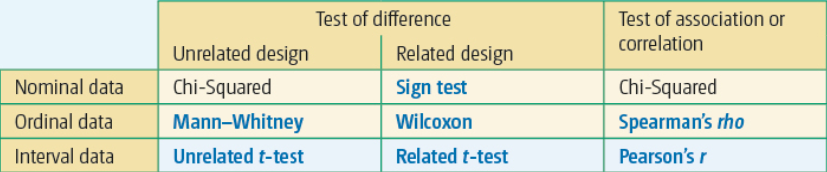
Statistical Testing AO1 - Choosing a statistical test.
Depends on
1) Data type,
2) Experimental Design,
3) Purpose of investigation.
Statistical Testing AO1 - Statistical Tables
Critical value found through 3 criteria:
1) Directional/Non-Directional
2) N (ptcps)
3) Level of significance (0.05)
Statistical Testing AO1 - Errors
Type 1 - Alternative hypothesis accepted when untrue (false positive). Caused by lenient significance level e.g. 0.1
Type 2 - Null hypothesis accepted when untrue (false negatives). Caused by stringent significance level e.g. 0.01
Statistical Testing AO1 - Sign Test
1) Find critical value on table of critical values (Match type of hypothesis with 0.05 and N).
2) Calculated value = sum of less frequent sign.
3) Text under table of critical values says whether higher/lower = significance.
Statistical Testing AO1 - Statement example
For the investigation, the calculated value of S is more than the critical value of S for a non-directional test. Therefore, the difference is not significant at the 0.05 level. The null hypothesis will be accepted, and the alternative hypothesis will be rejected.
Peer Review AO1 - Main Aims
Before research can be published, must be peer reviewed (scrutiny by 2-3 researchers in the same field). Used to:
1) Allocate Research funding
2) Validate quality and relevance of research. All elements of research assesed for quality and accuracy e.g. hypotheses, methodology, statistical tests, conclusions.
3) Suggest ammendements, minor revisions to improve report. Major revisions mean the work is innapropriate for publication.
Peer Review AO1 - Anonymity
Peer review should be anonymous to more likely produce an honest appraisal.
Anonymity may be used by rival researchers to prevent people they don’t like from getting funding (competition). Sometimes a public system works better.
Peer Review AO1 - Publication Bias
Tendency for journal editors to want to publish ‘headline grabbing’ findings, prefer to publish positive results.
Research that does not fit criteria = ignored, disregarded, ce=reates false impression of state of psychology.
Peer Review AO1 - Burying Research
May supress opposition to mainstream theories, wishing to maintain status quo. Researcher bias - Critical of opposing views, favouring similar views.
May slow down rate of change in scientific discipline.
Case Studies AO1 - Overview
In depth analysis of unusual or typical individual/event. Mostly produce qlt data. May construct case history of the subject. Can conduct tests to produce qtt data. Usually longitudinal, require info from family/friends.