GEOL 1420
 Call Kai
 Learn
Learn Practice Test
 Spaced Repetition
 Match
Match Flashcards
 Knowt Play
1/527

There's no tags or description
Looks like no tags are added yet.
Name | Mastery | Learn | Test | Matching | Spaced | Call with Kai |
|---|
No analytics yet
Send a link to your students to track their progress
528 Terms
What is the universe?
The totality of all space, time, matter, and energy.
What is astronomy?
The study of the universe.
What is planetary geology?
The application of Earth geology principles to other celestial bodies.
What is a light-year?
The distance light travels in one Earth year.
Approximately how many kilometers are in one light-year?
About 9.5 trillion kilometers.
What is the speed of light?
About 300,000 km/s.
What is the Solar System?
The Sun and all objects that orbit it, including planets, comets, asteroids, and dwarf planets.
What galaxy is our Solar System located in?
The Milky Way Galaxy.
What type of galaxy is the Milky Way?
A spiral galaxy.
About how large is the Milky Way Galaxy?
About 100,000 light-years across and 1,000 light-years thick.
In which spiral arm is our Solar System located?
The Orion Arm.
Where is the Orion Arm located in the Milky Way?
About two-thirds of the way from the center of the galaxy.
What is the first step of the scientific method?
Observation.
What happens after many successful tests of a hypothesis?
It may become a theory.
What do scientific laws describe?
Patterns in nature and what happens under certain conditions.
What do scientific theories explain?
Why and how something happens.
Give an example of a scientific law.
Newton’s Law of Gravitation.
Give an example of a scientific theory.
Theory of Evolution.
What is the Giant Impact Hypothesis?
The Moon formed from debris after Earth collided with a Mars-sized object.
Why is the Giant Impact Hypothesis favored?
Moon rocks closely match Earth’s outer layers and explain the Moon’s low density.
Why is Polaris useful?
It points almost directly north.
What causes day and night?
Earth rotating on its axis.
What is a solar day?
The 24-hour noon-to-noon cycle.
What is a sidereal day?
Earth’s true rotation period relative to distant stars (23 hr 56 min 4 sec).
Why is a sidereal day shorter than a solar day?
Because Earth moves around the Sun while rotating.
What causes seasonal changes in the night sky?
Earth’s orbit around the Sun.
What is the ecliptic?
The plane of Earth’s orbit around the Sun.
23.5°
What is the summer solstice?
The northernmost point of the Sun’s path in the sky.
What are equinoxes?
Points where the Sun crosses the celestial equator.
What causes Earth’s seasons?
Day length and sunlight angle.
What is precession?
The slow wobble of Earth’s axis.
How long does one cycle of precession take?
About 26,000 years.
What is a sidereal year?
The time Earth takes to orbit the Sun relative to fixed stars.
How many arc-minutes are in one degree? How many arc-seconds are in one arc-minute?
60 arc-minutes.
60 arc-seconds.
Why do the Sun and Moon appear the same size in the sky?
The Sun is about 400 times larger but also 400 times farther away.
What is the Moon?
Earth’s only natural satellite.
What is synchronous rotation?
The Moon rotates once in the same time it orbits Earth.
How long does the Moon take to orbit Earth?
About 27.3 days.
Why do we always see the same side of the Moon?
Tidal locking.
What is the nearside of the Moon?
The side that always faces Earth.
What causes the phases of the Moon?
Different amounts of the Moon’s sunlit side being visible from Earth.
What does waxing mean?
Illumination is increasing.
What does waning mean?
Illumination is decreasing.
What is a synodic month?
The 29.5-day cycle of Moon phases.
When do eclipses occur?
When the Earth, Moon, and Sun align in a straight line.
What is a lunar eclipse?
Earth blocks sunlight from reaching the Moon.
What is a solar eclipse?
The Moon blocks sunlight from reaching Earth.
What is an annular eclipse?
A solar eclipse where the Moon appears too small to fully cover the Sun.
Why don’t eclipses happen every month?
The Moon’s orbit is tilted relative to Earth’s orbit.
What is triangulation?
Using angles and a baseline to calculate distance.
What is parallax?
Apparent motion of an object against a distant background from different viewpoints.
Who measured Earth’s radius about 2300 years ago?
Eratosthenes.
How did Eratosthenes measure Earth’s radius?
By comparing Sun angles and distances between cities.
What was the purpose of many ancient astronomical structures?
To mark astronomical events and track calendars, seasons, and celestial motions.
What is Stonehenge believed to have been used for?
A primitive calendar aligned with the solstices.
What is special about the “heel stone” at Stonehenge?
The Sun rises directly over it on the longest day of the year.
What was the Medicine Wheel aligned with?
The rising and setting of the Sun and stars.
What was El Caracol likely used for?
Tracking seasons and astronomical events
Made by Mayan civilization.
How did the Incas use Machu Picchu?
As a mountaintop observatory.
What is a constellation?
A grouping of stars forming a perceived pattern or outline.
How many officially defined constellations exist today?
88 constellations.
Why were constellations important to ancient peoples?
Farming seasons and navigation.
Which constellation signaled winter was approaching?
Orion.
What is Polaris commonly called?
The North Star.
What does the Greek word “planetes” mean?
Wanderer.
What model of the universe did Thales propose?
A flat disk floating on an infinite ocean.
Who first introduced the celestial sphere?
Anaximander.
Who argued that Earth is spherical?
Pythagoras.
Who suggested Earth rotates on its axis once a day?
Heracleides
What are Aristotle’s three classifications of motion?
Natural - Objects moving toward their natural place without external force.
Voluntary - The movement of living things driven by their own will and consciousness
Forced motion - Any forced movement caused by an external push or pull
Who first suggested a Sun-centered universe?
Aristarchus.
How did Eratosthenes calculate Earth’s circumference?
Using geometry and shadows in two Egyptian cities.
What is geocentrism?
The belief that Earth is the center of the universe.
Supported by Aristotle.
The sky appeared to revolve around Earth and Earth seemed stationary.
What is retrograde motion?
The apparent backward motion of planets in the sky.
What actually causes retrograde motion?
Differences in planetary orbital speeds and distances from the Sun.
What is an epicycle?
A small circular orbit used in Ptolemy’s geocentric model.
What is Ockham’s Razor?
The principle that simpler explanations are preferred.
What is heliocentrism?
The Sun-centered model of the Solar System.
Who proposed the heliocentric model?
Nicolaus Copernicus.
What are superior planets?
Planets farther from the Sun than Earth.
Mars, Jupiter, and Saturn.
What are inferior planets?
Planets closer to the Sun than Earth.
Mercury and Venus.
How did the heliocentric model explain retrograde motion?
Earth overtakes slower-moving outer planets.
What was Tycho Brahe known for?
Extremely accurate astronomical observations.
What did Brahe observe in 1572?
A supernova in Cassiopeia.
What is parallax?
The apparent shift in an object’s position due to a change in viewpoint.
How does distance affect parallax?
Closer objects show larger parallax shifts.
What equation relates parallax and distance?
d=1/p
What unit is used for stellar distance in parallax measurements?
Parsecs.
How many light-years are in one parsec?
About 3.3 light-years.
Why did Brahe reject heliocentrism?
He could not detect stellar parallax with the naked eye
Who was Johannes Kepler?
Brahe’s assistant and the discoverer of the laws of planetary motion.
What is Kepler’s First Law?
Planets orbit the Sun in ellipses with the Sun at one focus.
What is Kepler’s Second Law?
Equal areas are swept in equal times.
Imply planets move faster when closer to the Sun.
What is Kepler’s Third Law?
p2=d3
p = orbital period in years
d = distance from the sun in astronomical units
Why is Galileo important?
He is considered the father of modern science and observational astronomy.
What did Galileo discover about Venus?
Venus has phases.
What did Galileo observe orbiting Jupiter?
Four large moons.
Electromagnetic radiation
Transmission of energy through space without physical connection through varying electric and magnetic fields
Provides information about the universe
Ex. light is a form of energy
7 Types of Electromagnetic radiation
From least to most energetic
Radio waves
Mircowaves
Infrared
Visible light
Ultraviolet
X-Rays
Gamma rays
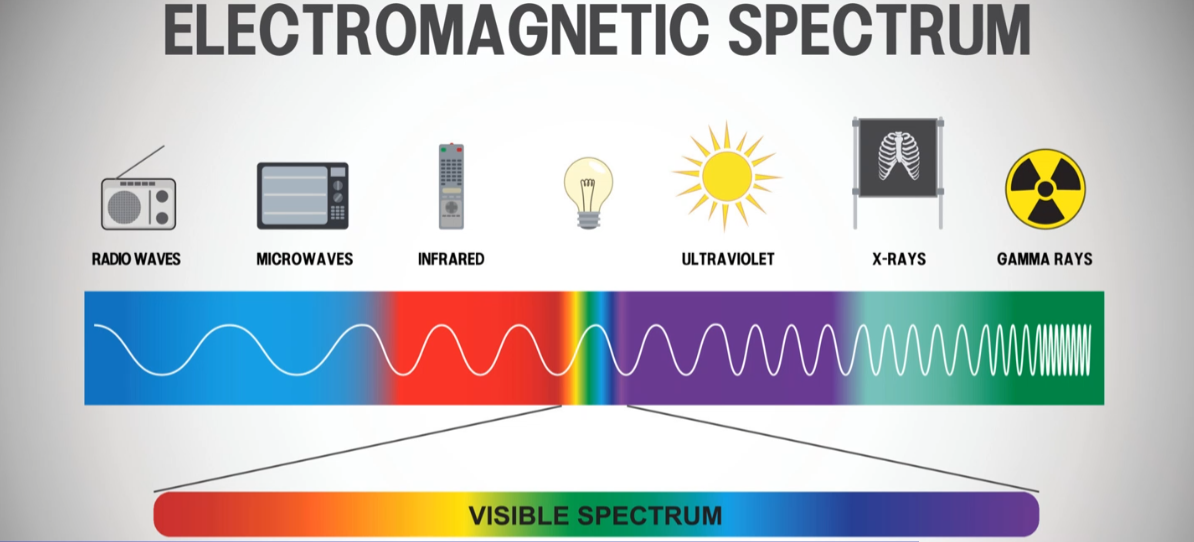
Wave
All types of electromagnetic radiation are transferred by waves
Ex. Water - up and down