9.1 Circular flow of income
 Call Kai
 Learn
Learn Practice Test
 Spaced Repetition
 Match
Match Flashcards
 Knowt Play
1/105

There's no tags or description
Looks like no tags are added yet.
Name | Mastery | Learn | Test | Matching | Spaced | Call with Kai |
|---|
No analytics yet
Send a link to your students to track their progress
106 Terms
What is the circular flow of income
The continuous movement of income, output and expenditure between households, firms, government, financial institutions and the foreign sector in an economy.
What is national income equilibrium
A situation where aggregate demand equals national income, so where aggregate expenditure equals output.
What is aggregate expenditure
The total amount of income spent in the economy at different levels of income.
In equilibrium… (NI, NO, NE)
national income = national output = national expenditure
What is meant by the equality of income, output and expenditure
In equilibrium, national income, national output and national expenditure are equal in value.
What is a two-sector economy
A simplified economy consisting only of households and firms, with no government or foreign trade.
What assumptions are made in a two-sector economy
There is no saving, no taxation, no government and no foreign trade; all income is spent on consumption. 📌 In this simple model: All income earned by households is spent → Y = C
What are leakages in the circular flow of income
Withdrawals of income from the circular flow, including saving, taxation and imports. (STM)
What are injections in the circular flow of income
Additions of spending into the circular flow, including investment, government spending and exports. (GIX)
What is the equilibrium condition in an open economy
Leakages equal injections: saving + taxation + imports = investment + government spending + exports.
What is aggregate demand (AD)
The total planned spending on goods and services in an economy at a given price level.
What is the aggregate demand formula
AD = C + I + G + (X − M).
What is consumption (C)
Spending by households on goods and services.
What is investment (I)
Spending by firms on capital goods such as machinery, equipment and buildings.
What is government spending (G)
Expenditure by the government on goods and services.
What are net exports (X − M)
The value of exports minus the value of imports.
When does National income equilibrium occur
Occurs when AD = Y
What is the multiplier
The ratio of the final change in national income to an initial change in an injection. - A numerical estimate of a change in spending in relation to the final change in spending - Also known as the national income multiplier
Why does the multiplier effect occur
Because one person’s spending becomes another person’s income, leading to repeated rounds of spending. - A rise in expenditure will create incomes, some of which will be spent and thereby create more incomes
What is the simplest way of calculating the multiplier (after the change)
Change in income / change in injection

How can the multiplier be estimated in advance of the change

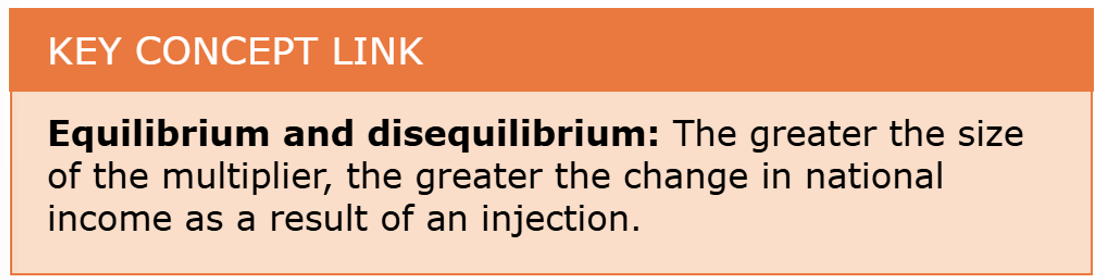
Key concept link - The greater the size of the multiplier…
What is the main influence on consumption
The level of disposable income
How does total spending change as income rises
Total spending usually rises as income rises.
How does the proportion of income spent change as income rises
The proportion of disposable income spent tends to fall.
What is the marginal propensity to consume (MPC)
The proportion of an increase in income that is spent on consumption.
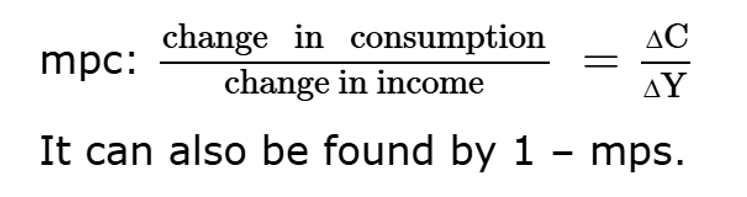
How can MPC be calculated in a closed economy
What is the average propensity to consume (APC) + how is it calculated
The proportion of income that is consumed Total consumption divided by total income. (C/Y)
How does MPC differ between rich and poor
The rich have a lower MPC, while low-income earners have a higher MPC.
What is saving
Saving is disposable income minus consumption.
What is the average propensity to save (APS) + how is it calculated
The proportion of disposable income that is saved. Total saving divided by total income. APS = S / Y
How does APS change as income rises
APS tends to increase as income rises.
Who usually has a higher APS: high-income or low-income earners
High-income earners.
What is the marginal propensity to save (MPS) + how is it calculated
The proportion of an increase in income that is saved. MPS = ΔS / ΔY (change in saving ÷ change in income)
How does MPS change as income rises
MPS tends to increase as income rises.
What is dissaving and where is it most likely to occur
Dissaving occurs when consumption is greater than income, so people use past savings or borrow. It is most likely to occur at low income levels or during periods of financial hardship.
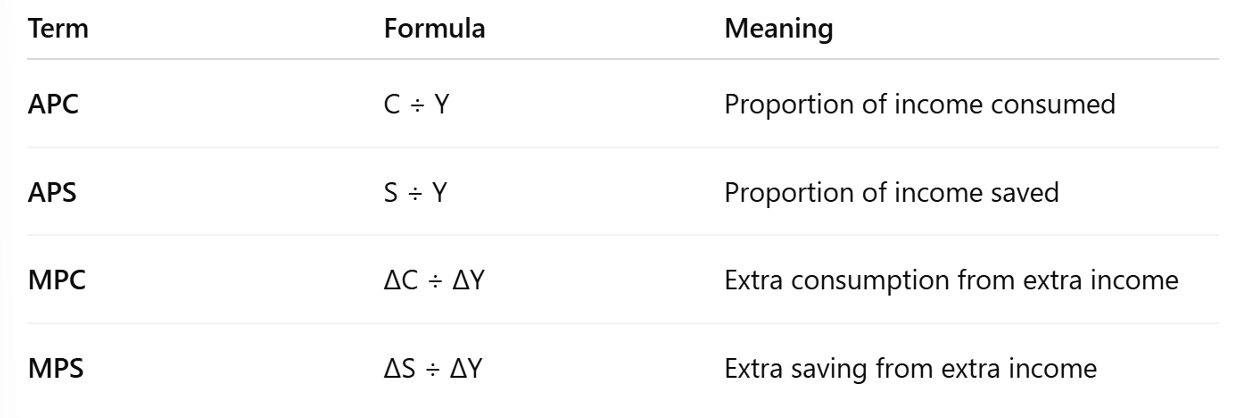
Consumption & Saving Table (Term, formula, meaning) (APC, APS, MPC, MPS)
What is the relationship between MPC and MPS
MPC + MPS = 1.
What is the relationship between APC and APS
APC + APS = 1.
What is the average rate of tax (ART) + how to calculate
The proportion of income taken in tax Total tax revenue divided by total income. T ÷ Y
What is the marginal rate of tax (MRT) + how to calculate
The proportion of an increase in income that is paid in tax. ΔT ÷ ΔY - Sometimes also called marginal PROPENSITY to tax
What is the average propensity to import (APM) + how to calculate it
The proportion of extra income spent on imports Total imports divided by total income. M ÷ Y
What is the marginal propensity to import (MPM)
The proportion of an increase in income that is spent on imports. ΔM ÷ ΔY
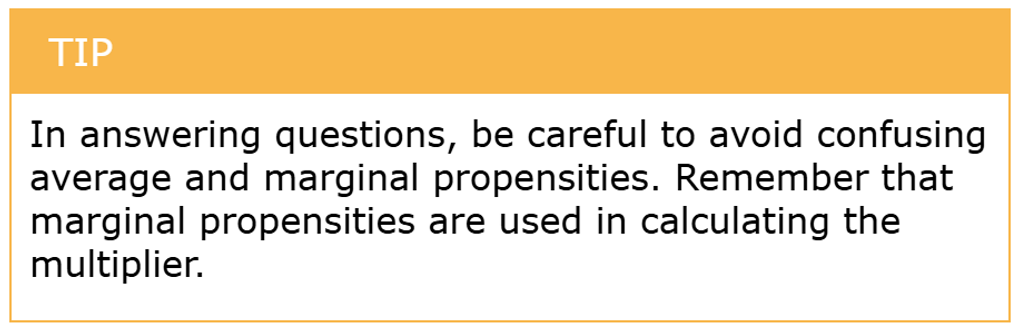
Tip: Are average propensities or marginal propensities used to calculate the multiplier
What are the three different ways of modelling the economy that changes the multiplier formula
1.Closed
2. Closed with government sector
3. Open with a government sector
What is a closed economy
An economy in which there are two-sectors - households and firms. There is only one withdrawal (saving) and one injection (investment).
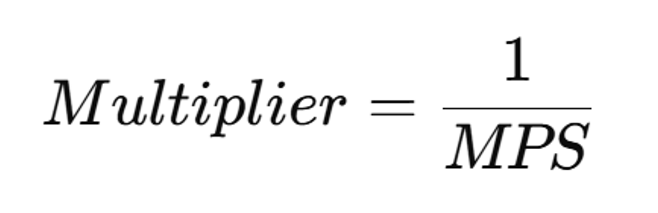
What is the multiplier formula in a closed economy with no government
Multiplier = 1 ÷ MPS.
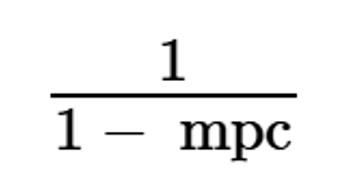
How can the multiplier formula in a closed economy with no government also be calculated without MPS
Where is equilibrium reached in a closed economy
Where aggregate expenditure = output (C + I = Y)
And injections = withdrawals (I = S)
What is a closed economy with government sector
An economy in which there are three sectors - households and firms plus the government. There is two withdrawals (saving and taxation) and two injections (investment and gov. spending).
What is the multiplier formula in a closed economy with government
Multiplier = 1 ÷ (MPS + MRT).

Where is equilibrium reached in a closed economy with government
Where aggregate expenditure = output (C + I + G = Y) And injection = withdrawals (I + G = S + T )
What is an open economy with a government sector
The most realistic model as it includes all four possible sectors (households, firms, the government and the foreign trade sector)
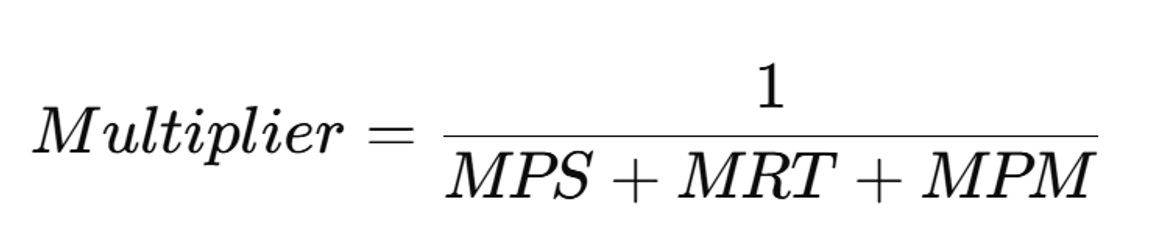
What is the multiplier formula in an open economy with a government sector
Multiplier = 1 ÷ (MPS + MRT + MPM).
Where is equilibrium income reached in an open economy with a government sector
Where aggregate expenditure = output (C + I + G + (X-M) = Y) And injection = withdrawals (I + G + X = S + T + M)
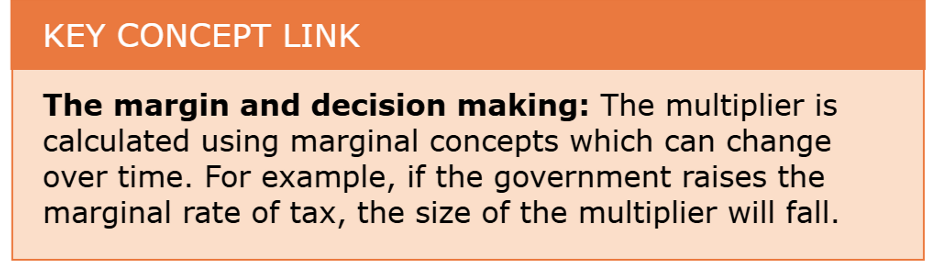
What happens to the multiplier when leakages increase
The multiplier becomes smaller.
Key concept link (the margin and decision making)
Tip - why should you keep numerical examples of the multiplier simple
What determines the level of national income
Where AS = AD - Also where aggregate expenditure = output
What happens if aggregate expenditure exceeds current output (chain of reasoning - 3)
Firms will seek to produce more
- Meaning they will employ more factors of production and GDP will rise (Vice versa is expenditure is below current output)
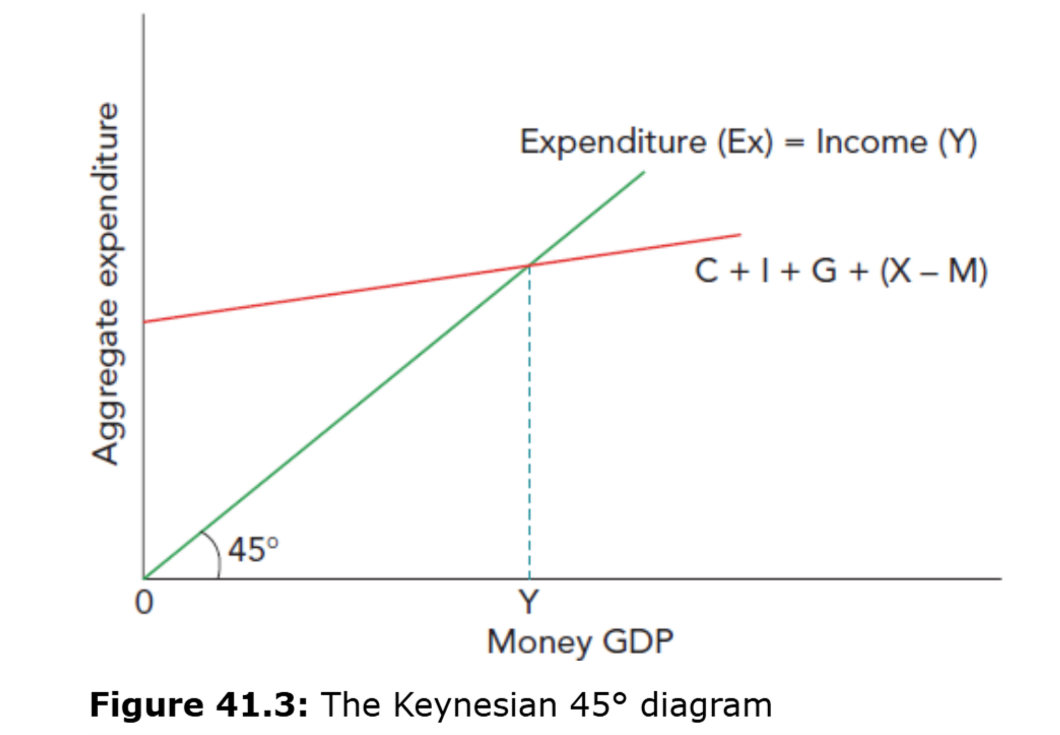
Output will change until it matches expenditure - what diagram is this shown in
The Keynesian 45 degree diagram
Draw the Keynesian 45 degree diagram and explain it (8).
• The vertical axis shows aggregate expenditure (AE).
• The horizontal axis shows national income (Y or GDP).
• The 45° line represents all points where expenditure equals income (AE = Y).
• The upward-sloping AE line shows planned spending: C + I + G + (X − M).
• Where the AE line crosses the 45° line is the equilibrium level of income.
• At equilibrium, planned spending equals actual output (no unplanned stock changes).
• If AE is above the 45° line, spending exceeds output → income will rise.
• If AE is below the 45° line, spending is less than output → income will fall.
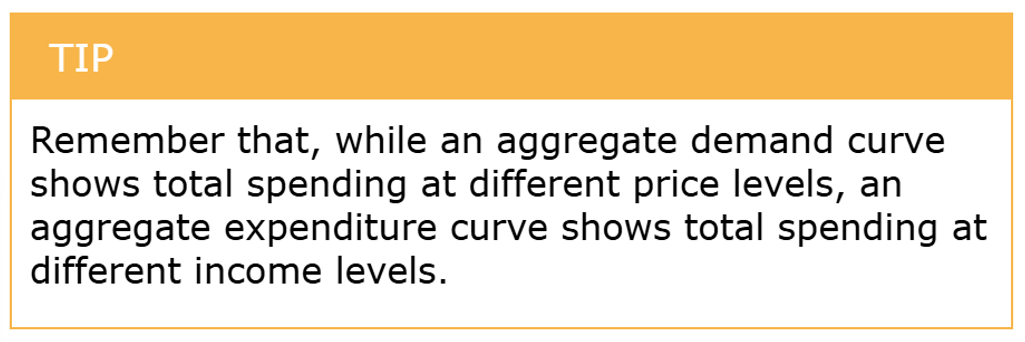
Tip: What is the difference between AD and AE
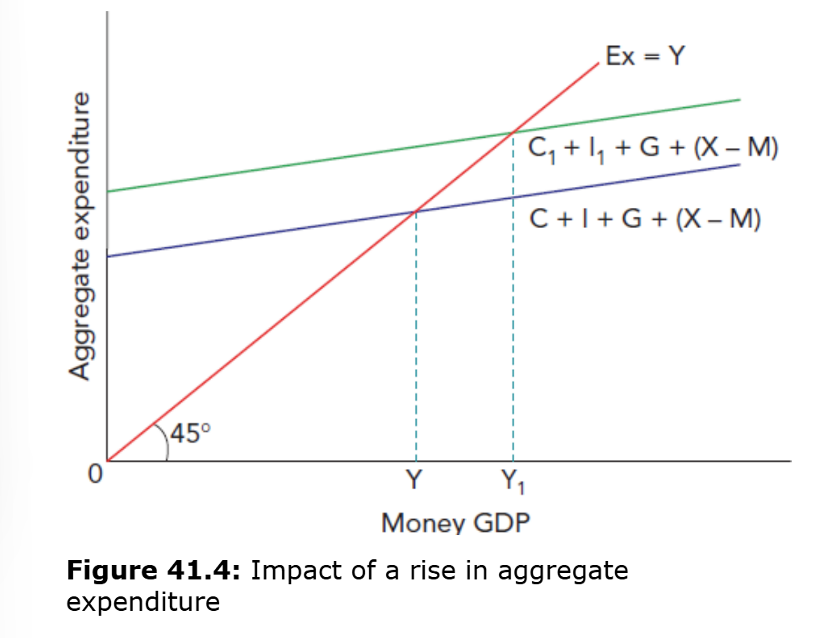
What happens if AE rises (e.g. C and I increase due to greater optimism)(show on diagram)
Output will increase (GDP increase from Y to Y1)
What will a change in the total spending on a country's goods and services result in + diagram
It will result in national income changing by the size of the injection times the multiplier. The rise occurs in stages.
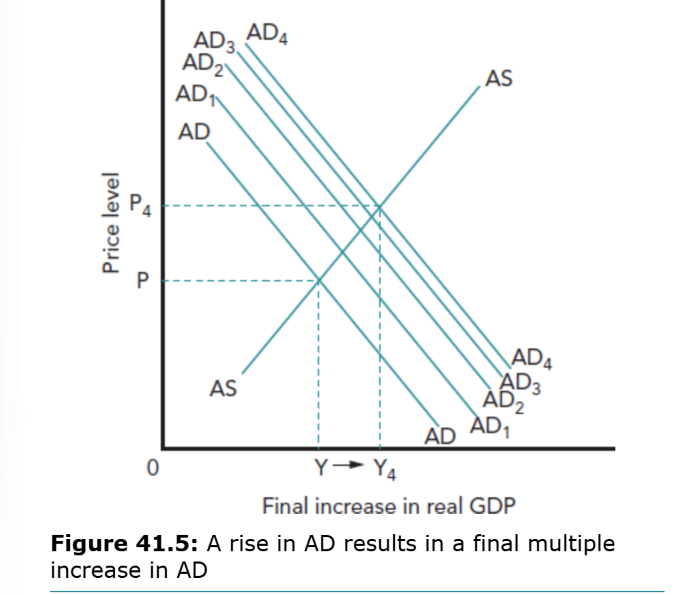
When does the multiplier effect stop
When the leakages of the circular flow equal the initial injection
What will a rise in savings cause
GDP to fall
How can a decision to save more can actually result in them saving less
Because higher saving can reduce income and hence the ability of households to save
What is the main influence on consumption + 3 others (+ how they influence)
1.Income
2. The rate of interest - rise in interest rates will increase the opportunity cost of spending as households gain more by saving
3. Expectations - If households think their income will rise in the future or interest rates will fall, they may adjust spending now
4. Distribution of income - If income becomes more unevenly distributed, consumption may fall as the rich spend a smaller proportion of their income
What does investment depend on (6 + why)
• Consumer demand/income (higher demand → firms expand, buy more capital)
• Interest rates (higher rates → borrowing costlier, saving more attractive → less investment)
• Technology (new, more productive machines encourage investment)
• Cost of capital goods (higher prices → less investment)
• Expectations (e.g. fear of recession reduces investment)
• Government policy (taxes, subsidies, interest rates affecting spending and profits)
What is the consumption function + how to calculate it
The relationship between income and consumption - indicates how much will be spent at different levels of income
C = a + bY, where a is autonomous consumption and b is the marginal propensity to consume, Y is disposable income
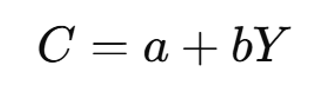
What is autonomous consumption (a)
Consumption that occurs even when income is zero - does not vary with income
What is induced consumption (bY)
Consumption that varies directly with income. - spending that is dependent on income
What is the savings function
The relationship between income and saving. S = −a + (1 − b)Y, where saving increases as income rises.
• Autonomous saving is negative when income is low • Induced saving increases with income

What is autonomous dissaving (-a)
How much of their savings people will draw on when their income is zero - does not change as income changes
What is autonomous investment
Investment that does not depend on the level of national income, instead depends on interest rates, confidence, technology
• Investment that is made independent of income.
Give two reasons why autonomous investment might increase.
Greater business confidence about the future OR a fall in the rate of interest.
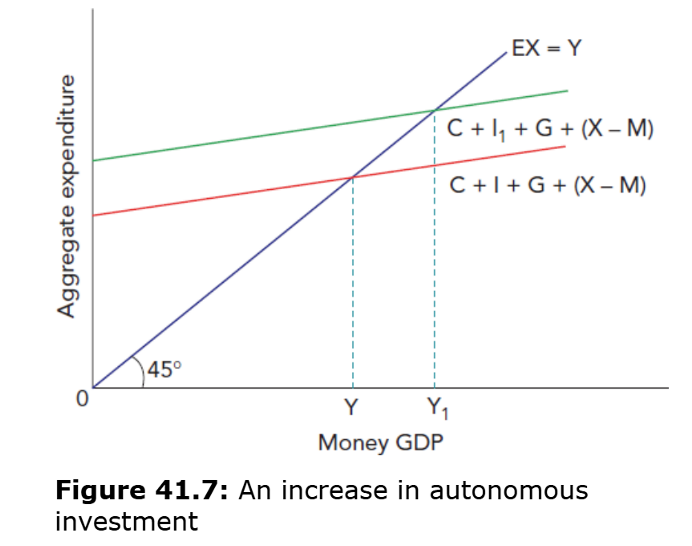
How is an increase in autonomous investment shown on the AD diagram
An upward shift of the aggregate expenditure (AD) line.
What effect does an increase in autonomous investment have on GDP + show this on graph
GDP rises by a multiplied amount (from Y to Y₁).
What is induced investment
Investment that depends on changes in income (GDP) and demand. Investment that is made in response to changes in income.
How is induced investment shown on the diagram + why
As a movement along the aggregate expenditure line because it is in response to a change in income
Why does induced investment rise when income rises
Higher income increases demand, encouraging firms to buy more capital goods.
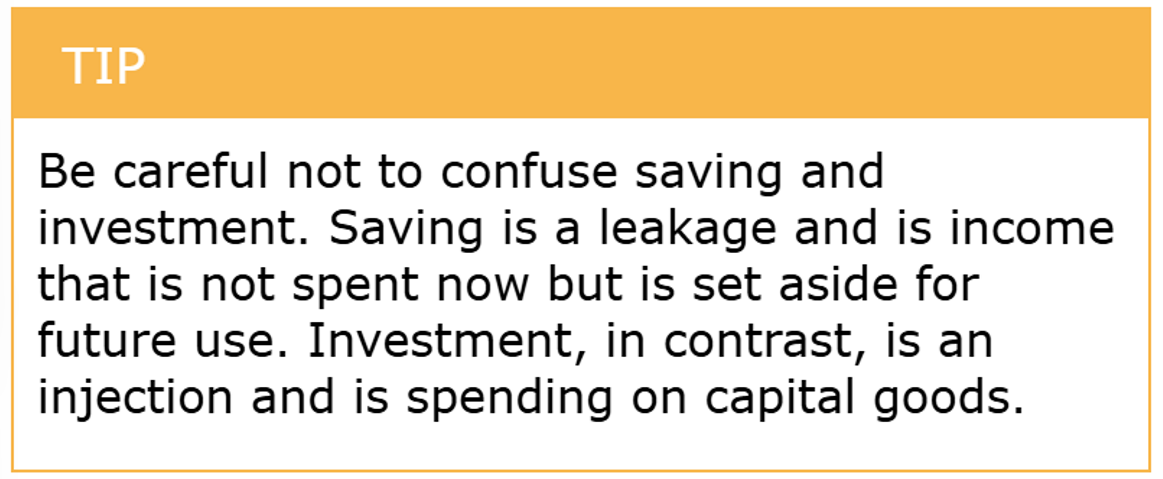
Tip - What is the difference between saving and investment
What is the accelerator effect
The idea that investment depends on the rate of change of national income (and therefore consumer demand).
Faster growth → higher investment
- A model that suggests investment depends on the rate of change in income
Focuses on induced investment and the volatility of investment
If GDP is rising but at a constant rate, how will this change induced investment + why
It will not change because firms can continue to buy the same number of machines each year to expand capacity.
What is capital-output ratio
A measure of the amount of capital used to produce a given amount, or value, of output
Tip - how do the multiplier and accelerator link
An initial rise in autonomous spending increases income via the multiplier, which then raises demand and induces further investment through the accelerator, reinforcing economic expansion.
What are 3 characteristics of Government Spending (G)
• Autonomous
• Determined by fiscal policy
• Used to stabilise the economy
Why might government spending increase during an economic downturn
To boost aggregate demand, prevent recession, and raise employment and output.
Why is government spending a higher % of GDP in countries with high risk of market failure
Because the state provides services like education and healthcare.
How can population changes increase government spending
An ageing population raises healthcare costs; immigration increases demand for housing and services.
Give two events that can cause sudden increases in government spending.
Natural disasters and military conflict.
Are Net Exports (X − M) autonomous or induced
• Exports: autonomous • Imports: induced (depend on income)
What are the key influences of net exports (2)
Relative price and quality competitiveness of the country's products (which is influenced by country's relative productivity, relative inflation rate and its exchange rate)
Incomes at home and abroad
Why will a country usually be able to sell more exports if other countries experience a rise in their GDP
Because a country's purchasing power will increase
- Particularly will benefit if its firms produce products with a high income elasticity of demand.
What is equilibrium national income using the aggregate demand approach
The level of income where aggregate demand equals national income. AD=Y
What is equilibrium national income using the income approach
The level of income where income equals consumption plus saving plus taxation.
Y=C+S+T
What is the full employment level of national income
The level of national income at which all available resources are fully employed.
What is an inflationary gap
The amount by which aggregate demand exceeds full employment output.
- The excesses of aggregate expenditure over potential output
- Equivalent to positive output gap
What causes an inflationary gap
Excess demand in the economy leading to demand-pull inflation.
- Not all demand can be met, as there are not enough resources to do so. As a result the excess demand drives up price level.