Week 6 - Mental Health Literacy
 Call Kai
 Learn
Learn Practice Test
 Spaced Repetition
 Match
Match Flashcards
 Knowt Play
1/32

There's no tags or description
Looks like no tags are added yet.
Name | Mastery | Learn | Test | Matching | Spaced | Call with Kai |
|---|
No analytics yet
Send a link to your students to track their progress
33 Terms
What is help seeking?
In the mental health context, help-seeking is an adaptive coping process that is the attempt to obtain external assistance to deal with a mental health concern.
What are help seeking barriers?
Help-seeking barriers relate to the attitudes, beliefs, and knowledge about mental health and mental health treatment as well as the instrumental and structural barriers surrounding access to care.
What are the barriers for seeking help?
Lack of trust
Lack of time
Prefrence for information support
stigma
Discomfort of talk about feelings with others
Practicle barriers
Low mental health literacy
Belief about the effectivness of treatment
Competitive campus culture
Lack of coordination of campus services
What does a lack of trust look like?
There can be a lack of trust of mental healht professionals and authority, espcialle in the Indigenous and racialized communities.
Lack of time
Not having enough time to seek help
Preference for informal supports
Some people feel more comfortable reaching out to friends or family for help instead of a health care provider.
Preference for self-reliance
Some people prefer to do thing on their own due to stigma or lack of trust in supports.
Stigma
As we have already seen, public stigma and self-stigma are considered the biggest barrier to help-seeking.
Discomfort around talking about feelings with others
This could be related to cultural or social norms about what is, and is not, acceptable to talk about.
Practical barriers
Lack of local mental health services, transportation, childcare, insurance coverage, money to pay for services, can all make it very difficult to seek help. Individuals who experience low socioeconomic status are more likely to encounter these barriers.
Long wait times for service can all dissuade a person from seeking help.
Low mental health literacy
Not recognizing the signs and symptoms of mental health conditions stands in the way of seeking help. This includes misinterpreting and dismissing symptoms as 'just stress' or 'just part of being a busy student'. Also, the belief that people should only seek help for severe problems is a barrier to seeking early and mild signs and symptoms of distress which could lead to more severe condition in the absence of treatment.
Not knowing how or where to get help and not knowing what to expect from therapy are other ways in which low mental health literacy presents barriers to seeking help.
In addition, low emotional intelligence, also referred to as 'low emotional competency' is a barrier to help-seeking because if people feel unable to identify and articulate their feelings, they may feel that there is no point to talking with a therapist.
Beliefs about effectivness of treatment
Beliefs about treatment effectiveness can stem from low mental health literacy, prior experience with therapy, or others' beliefs and biases about the effectiveness of treatment.
Competitive campus culture
For university and college students, the competitive culture and fast-paced demands of being a full-time student can hinder help-seeking.
Lack of coordination of campus services
For post-secondary students, the poor co-ordination and communication between counselling services, accessibility services, and off-campus mental health services can pose a barrier to help-seeking.
What are the steps when asking for help with your mental health?
Decide what type of mental health help you’re looking for.
Do you need someone who will listen empathetically and not give you advice (i.e., you just need to 'vent')?
Do you need a skilled, professional consultation?
Do you want to find out where to get more information?
If could be anyone, a friends, teacher, therapist ect.
Start with peopl who are nice.
What’s another step when asking for help?
Give them a heads up
- Give your listener the opportunity to tell you if they feel able to hear about your experience
It gives them the understanding that this is important and undivided attetnion is required.
What’s another tip when asking for help
Know your audience: You might want to avoid talking to people who usually make you feel worse. If you're not sure where to start or you want to talk to someone anonymously, there are phone, text, and online chat options available.
What’s another tip when askingfor help?
Find and share information
This might include completing an online symptom checker or reading an article or blog post that discusses what you're going through. Bring what you find along with you and share it when you're ready to talk. It can help you get started. Here are two online symptom checkers to consider.
What’s another step when asking for help?
Make some notes about what you want to say to help you out.
What’s another step when asking for help?
Be direct - avoid ambiguity (Texting might be easier.)
"I'm not doing okay. Can we talk?"
"I'm not doing too well. Can we talk?"
Give examples:
“Yesterday i couldn’t even leave my room”
Tell the person what they can do to help
If the conversation is hurting rather than helping, end it.
How do you prepare for a mental health appointment?
Don't just show up - plan ahead: It can be very helpful to prepare for your appointment ahead of time. Before the appointment, take time to write down what's been going on and prioritize your concerns. These prompts can be helpful as you prepare for an appointment:
For the past ______________ (specify the period of time)
I've been feeling ______________
I have been struggling with ______________
For example, ______________
I would like to ______________
I need help with ______________
My questions are __________
What is emotional Intellgence?
The ability to monitor one's own and others' feelings and emotions, to discriminate among them and to use this information to guide one's thinking and actions.
The mental proccess of emotional intellgence is
a. Appraising and expressing emotions in the self and others
This refers to the ability to identify, understand, and communicate emotions accurately.
Example: You notice that a classmate is unusually quiet and withdrawn and recognize that they may be feeling stressed or upset.
b. Regulating emotion in the self and others, and
This refers to the ability to manage emotions effectively rather than being controlled by them.
Example: Instead of yelling when frustrated, you take a few deep breaths and communicate your concerns calmly.
c. Using emotions in adaptive ways.
This refers to the ability to use emotions to enhance thinking, problem-solving, decision-making, and motivation.
Example: Feeling concerned about an upcoming assignment motivates you to start working on it early rather than procrastinating.
Goleman’s model of emotional intelligence
1) know your emotions,
2) manage your emotions,
3) motivate yourself,
4) recognize and understand other people's emotions, and
5) manage relationships (other people's emotions). These five realms are broken down into four quadrants:
What are the 4 quadrants of Goldman’s model
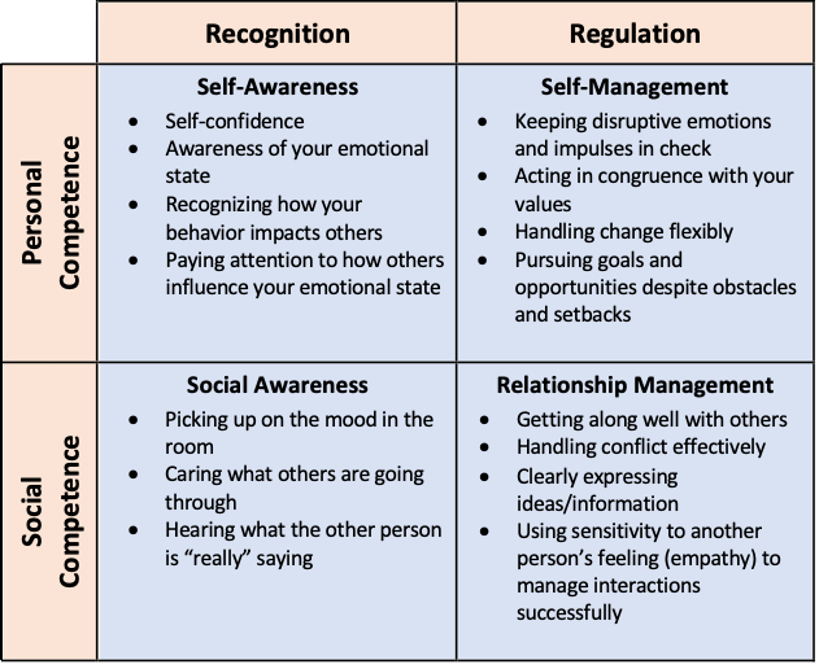
What is self awarness?
Sign of a mental health emergency
Thinking about ending your life or trying to end your life
Experiencing sensations that aren't real and/or beliefs that can't possibly be true
Making choices that put you in serious danger
Becoming unable to care for yourself, and it's putting you at risk of serious harm
Experiencing medication problems like serious side effects
Experiencing an alcohol or any other drug overdose
Taking a dangerous combination of substances (like anti-anxiety medication and alcohol)
How to can for someone with a mental health emergency
In addition to emergency services such as ambulance or a hospital emergency department, there are now several mental health crisis phone, chat, and texting helplines available 24 hours a day, 7 days a week.
What is the difference between therpay and Psycotherapy?
Therapy: An umbrella term that many people use when referring to variety of health and mental health services.
Psychotherapy is a term used to refer to talk-based therapy which aims to help people improve their mental health and well-being. Several mental health professionals use psychotherapy, including psychologists, psychotherapists, chaplains, and others.
CBT
The belief that our thoughts, emotions and behaviours are all interrelated.
Cogntive Behaviour Therapy focuses on teaching people skills for recognizing the relationship between thoughts, emotions, and behaviours.
There’s also a 5 figure model that incorperates the environment, and physiological (body sensations)
What is DBT and what are the four skills learned
Is a type of CBT.
Whereas CBT focuses on thoughts, DBT focuses on social and emotional dimensions of mental health.
Four Core Skill Development Areas of DBT
Mindfulness
Living in the present moment without judgment
Distress tolerance
Coping with a difficult situation, without accepting difficult situations that cannot be changed
Emotion regulation
Learning to accept and change emotions so that emotions do not become overwhelming or out of control
Interpersonal effectiveness
Relating to others in respectful ways
Acceptance and commitment therapy (ACT)
What are the biological effects of drugs on the body?
Pharmacokinetics (PK): What the body does to the drug
PK focuses on how the body handles a medication. It is easily remembered by the acronym ADME: [1]
Absorption: How the drug enters the bloodstream from its administration site (e.g., how a pill dissolves in the stomach).
Distribution: How the drug travels through the blood and reaches various tissues in the body.
Metabolism: How the body breaks down or alters the drug, mostly occurring in the liver.
Excretion: How the body removes the drug, primarily through the kidneys (urine) or liver (bile). [1, 2, 3, 4, 5]
Pharmacodynamics (PD): What the drug does to the body
PD focuses on the biochemical and physiological effects the drug has on the body. This involves: [1]
Receptor Binding: How a drug acts like a "key" that fits into a cellular "lock" (receptor) to trigger or block an action.
Mechanism of Action: The exact cellular or molecular process the drug uses to produce its effect.
Dose-Response: The relationship between the amount of drug in the body and the magnitude of the clinical effect (or potential side effects)