QA: Gold Standard
 Call Kai
 Learn
Learn Practice Test
 Spaced Repetition
 Match
Match Flashcards
 Knowt Play
1/16

There's no tags or description
Looks like no tags are added yet.
Name | Mastery | Learn | Test | Matching | Spaced | Call with Kai |
|---|
No analytics yet
Send a link to your students to track their progress
17 Terms
the main purpose of quality assurance is…
to assess how accurate is the diagnostic exam
allow for ultrasound results to be compared to a “gold standard” test
what are examples of Gold Standard tests?
digitals subtraction angiography
computed tomogrpahy angiography with contrast (CTA)
magnetic resonance angiography (MRA)
surgical findings
clinical outcome
what are the methods to assess efficacy?
sensitivity and specificity
how good is a test for detecting disease or how good is the test for ruling out disease?
the ability of a test to find a disease when it is present, is called?
sensitivity
the ability of a test to show there is no disease when there is no disease present, is called?
specificity
methods to assess reliability are?
true positive
false positives
positive predictive value
true negative
false negative
negative predictive values
portion of individuals with a positive test result that truly have the condition or disease is called?
PPV (positive predictive value)
portion of individuals with a negative test result that truly do not have the condition or disease, is called?
negative predictive value (NPV)
the portion of all individuals whose test results align with their condition.
the percentage of time the ultrasound results was correct
this indicates?
accuracy
the portion or percentage of patients in the entire group, being assessed, to have the disease or condition
prevalence
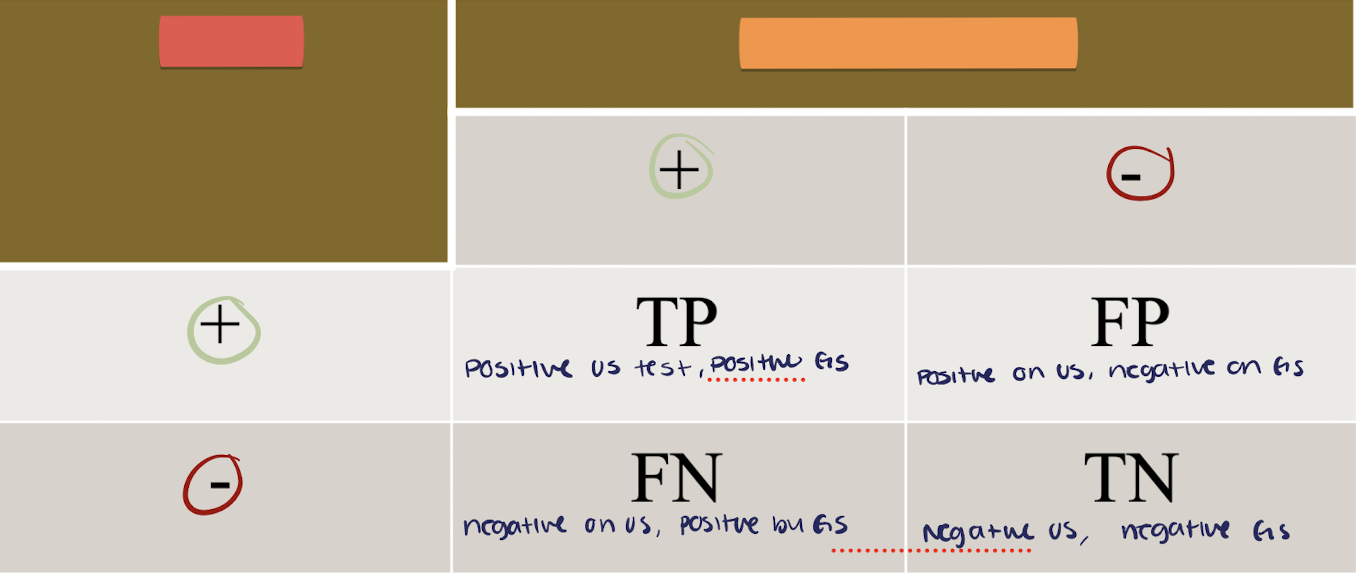
label the red and orange
test and Gold standard
how to calculate for sensitivity?
sensitivity = TP/ (TP + FN)
ability of a test to find a disease when it is present
How to calculate for specificity?
Specificity = TN / (FP +TN)
ability of a test to show there is no disease when there is no disease present
how to calculate for PPV?
PPV = TP / (TP + FP)
how to calculate for NPV?
NPV = TN / (FN + TN)
how to calculate for accuracy?
accuracy = TP + TN / (TP + FN + FP+ TN)
how to calculate for prevalence?
prevalence = TP + FN (TP + FN + FP + TN)