Chapter 13 - Neuronal Communication
 Call Kai
 Learn
Learn Practice Test
 Spaced Repetition
 Match
Match Flashcards
 Knowt Play
1/39

There's no tags or description
Looks like no tags are added yet.
Name | Mastery | Learn | Test | Matching | Spaced | Call with Kai |
|---|
No analytics yet
Send a link to your students to track their progress
40 Terms
What are factors of the internal environment?
blood glucose concentration
internal temperature
water potential
cell pH
What are factors of the external environment?
humidity
external temperature
light intensity
new or sudden sound
What are the types of responses?
animal
electrical (neurones)
chemical (hormones)
plant
chemical (number of)
What is homeostasis?
functions of organs to maintain a constant internal environment
Cell signalling
nervous and hormonal systems
one cell releases a chemical which effects a target cell
can transfer signals locally (between neurones at synapses - neurotransmitter)
can transfer signals across large distances (hormones)
How does plants coordination work?
plants use hormones as no nervous system
What do neurones do?
transmit electrical impulses
provide responses to changes in internal & external environment
Features of sensory neurones
cell body
nucleus surrounded by cytoplasm
lots of endoplasmic reticulum and mitochondria (produce neurotransmitters)
one dendron
carries impulse to cell body
one axon
carries impulse away from cell body
Features of relay neurones
many short axons
carries impulse away from cell body
many short dendrons
carries impulse to cell body
Features of motor neurones
one long axon
away from cell body
many short dendrites
to cell body
Role of neurones
sensory
receptor —> relay/motor/brain
relay
between neurones
motor
relay/sensory —> effector
Electrical impulse pathway
receptor → sensory neurone → relay neurone → motor neurone → effector
Myelin sheath
covers axons of some neurones
many layers of plasma membrane
produced from Schwann cells
grow around the axon and lay a double layer of phospholipid bilayer
insulating layer
increases transmission of electrical impulses (from 1mps to 100mps)
Node of Ranvier
small gap between myelin sheaths
2-3μm
occur every 1-3mm
allows the impulse to be transmitted faster as the impulse will jump from one node to the next - saltatory conduction
How do sensory receptors work?
specific to a single type of stimulus
act as a transducer
detect stimuli e.g. light, heat, sound, pressure
convert a stimulus into a nervous impulse (generator potential)
Types of sensory receptor
mechanoreceptor
stimulus - pressure & movement
receptor example - pacinian corpuscle
sense organ receptor - skin
chemoreceptor
stimulus - chemicals
receptor example - olfactory receptor
sense organ receptor - nose
thermoreceptor
stimulus - heat
receptor example - end-bulbs of Krause
sense organ receptor - tongue
photoreceptor
stimulus - light
receptor example - cone cell
sense organ receptor - eye
What are the features of the Pacinian corpuscle?
detect mechanical pressure
deep in skin
most abundant in fingers and soles of feet
found within joints
end of sensory neurone in centre
surrounded by layers of connective tissue separated by layers of gel
What do sodium ion channels do in the Pacinian corpuscle?
found in the membrane of the neurone
transport sodium ions across the membrane
sensory neurone in Pacinian corpuscle has a stretch-mediated sodium channel
when they change shape, permeability to sodium changes
How does a Pacinian corpuscle convert mechanical pressure into a nervous impulse?
Stretch mediated Na+ channels are too narrow and neurone in PC has resting potential
When pressure is applied, the PC changes shape & stretches membrane around neurone
Sodium ion channels widen & sodium can diffuse in
Ions change the potential of the membrane (depolarise it) which results in a generator potential
Generator potential creates an action potential (nerve impulse)
Resting potential
-70mV
outside of membrane is more positively charged than the inside of the axon
sodium potassium pump
3 Na+ are actively transported out of the axon
2 K+ are actively transported in
more sodium ions outside the membrane and more potassium inside the cytoplasm
sodium ions diffuse back in down the electrochemical gradient
potassium ions diffuse out
gated sodium ion channels
mostly closed
prevents movement
more positive ions outside than inside
creates resting potential
Action potential
when a stimulus is detected
+40mV
known as depolarisation
negative to positive
repolarisation happens again
positive to negative
neurone has resting potential, non voltage gated potassium ions are open, sodium voltage gated ion channels are closed
energy from stimulus opens vg Na+ channels, so Na+ diffuses into the axon
causes more channels to open (positive feedback)
at 40mV, voltage gated sodium ion channels close and voltage gated potassium ions open
potassium ions diffuse out and the axon becomes more negative on the outside
initially, the inside becomes more negative as lots of potassium ions diffuse out (hyperpolarisation) before returning to resting potential
How is a nervous impulse initiated?
a stimulus causes a sudden influx of sodium ions
this causes opening of voltage gated sodium ion channels further along the axon
action potential is propagated in the same way further along
Refractory period
short period of time after an impulse when the axon cannot be excited again
Saltory Conduction
myelinated axons transfer electrical impulses faster than non-myelinated
depolarisation can only occur at nodes of ranvier
action potential jumps between nodes
What affects the speed of impulses?
axon diameter
the bigger the diameter, the faster the impulse is transmitted
less resistance to flow of ions in cytoplasm
temperature
higher the temperature, the faster the impulse
only occurs up to 40 degrees as it will cause proteins to denature
myelination
myelin sheath causes faster impulses
All or nothing principle
threshold value will trigger a response
if reached, an action potential will be created
if not reached, nothing will happen
larger the stimulus, the more frequently the action potentials are generated but the size of the action potential doesn’t change
Synapse structure
synaptic cleft
presynaptic neurone
postsynaptic neurone
vesicles
contain acetylcholine
neurotransmitter receptors
Neurotransmitters
excitatory
result in depolarisation of postsynaptic neurone
e.g. acetylcholine
inhibitory
result in hyperpolarisation of the postsynaptic membrane
prevents an action potential being triggered
e.g. GABA
Synaptic transmission
action potential reaches the end of the presynaptic neurone and causes calcium ion channels to open. calcium ions enter
this causes vesicles to fuse with the presynaptic membrane, releasing ACh into the synaptic cleft
ACh fuses with receptors on the postsynaptic membrane, causing sodium ion channels to open. sodium ions diffuse into the postsynaptic neurone
influx of sodium ions generates an action potential and the postsynaptic neurone is depolarised
AChase hydrolyses ACh into choline and ethanoic acid which diffuse across the synaptic cleft
ATP is used to turn this back into ACh
Role of synapses
ensure impulses are unidirectional
allow and impulse to be transmitted from 1 neurone to multiple neurones
or multiple neurones to 1 neurone
What is summation and how does it work?
build up of neurotransmitters if a single impulse is not enough to trigger an action potential
spatial
multiple presynaptic neurones and 1 postsynaptic neurone
builds up a high enough level of neurotransmitters to trigger an action potential
temporal
single presynaptic neurone releases a neurotransmitter several times over a short period
builds up until the quantity is sufficient to trigger an action potential
How is the nervous system organised?
central nervous system
brain and spinal cord
peripheral nervous system
neurones
somatic nervous system
under conscious control
voluntary
autonomic nervous system
under subconscious control
involuntary
sympathetic
fight or flight responses
outcome increases activity
parasympathetic
relaxing responses
outcome decreases activity
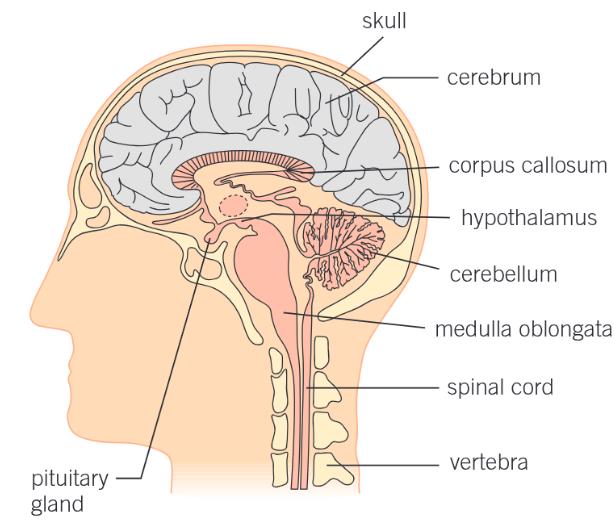
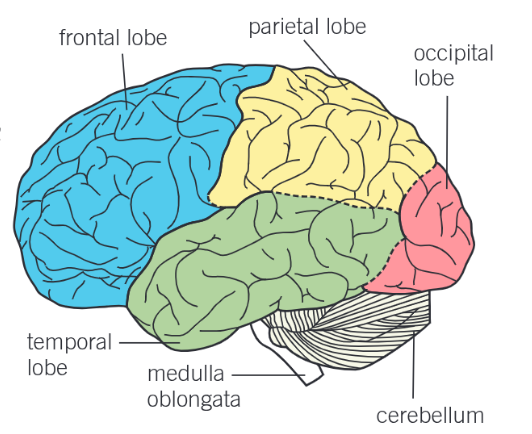
Cerebrum
controls voluntary actions
learning, memory, personality and conscious thought
highly convoluted
increases surface area
split into left and right hemispheres
each one controls half of the body
left controls right and vice versa
reasoning and decision-making take place in the frontal and prefrontal lobe of the cerebral cortex (outer layer)
Cerebellum
unconscious functions such as posture, balance and non-voluntary movement
coordinates movement
Medulla Oblongta
automatic control
heart rate and breathing rate
reflex activities
Hypothalamus
regulatory centre for temperature and water balance
controls behaviour patterns
monitors blood plasma composition
blood glucose and water concentration
produces hormones
Pituitary gland
stores and releases hormones
anterior pituitary
six hormones including FSH
posterior pituitary
stores and releases hormones produced by the hypothalamus
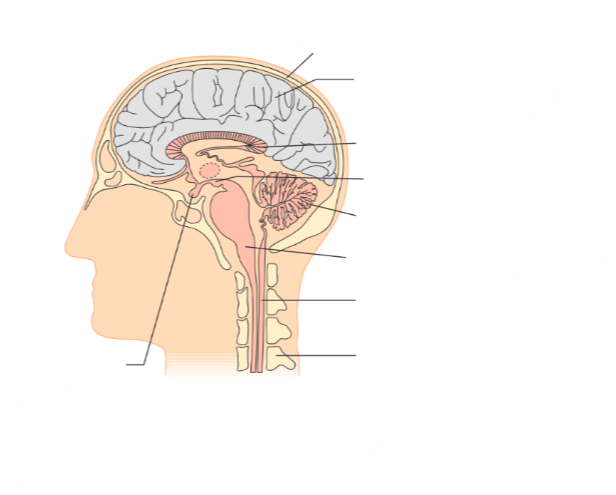
Structure of the brain
Structure of the cerebrum
Reflex arc
receptor → sensory neurone → relay neurone → motor neurone → effector