Nerves
 Call Kai
 Learn
Learn Practice Test
 Spaced Repetition
 Match
Match Flashcards
 Knowt Play
1/106

There's no tags or description
Looks like no tags are added yet.
Name | Mastery | Learn | Test | Matching | Spaced | Call with Kai |
|---|
No analytics yet
Send a link to your students to track their progress
107 Terms
The Nervous System is divided into
Peripheral Nervous System and Central Nervous System
Peripheral Nervous System consists of what?
Autonomic Nervous System + Somatic Nervous System
Autonomic Nervous System
Involuntary
Regulates homeostasis
Control smooth/cardiac muscle
Autonomic Nervous System consists of what?
Parasympathetic Nervous System + Sympathetic Nervous System
Parasympathetic Nervous System
Rest + Digest
Sympathetic Nervous System
Fight or Flight
Central Nervous System consists of what?
Spinal cord + Brain
The Brain
Grey matter
outside cell bodies
White Matter
Inside axons
Myelin
Lipid insulation = white
80% of brain used during complex tasks
What do neurons do?
Sends signals
Glial cells
Support Neurons, produce myelin
Neuron
Multipolar: Most common (1 axon, multiple dendrites)
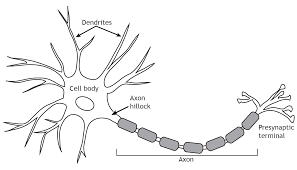
Dendrites
Recieve Signals
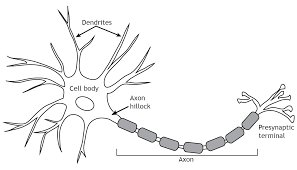
Soma (Cell Body with Nucleus)
Soma (Cell Body with Nucleus)
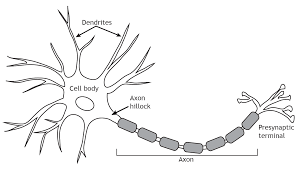
Axon Hilcock
Start of axon where action potential begins
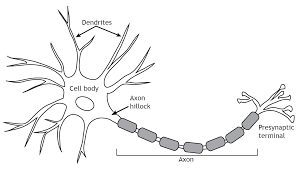
Myelin
Lipid Sheath for protection
Myelin CNS
CNS= Oligodendrocytes produce myelin
Myelin PNS
PNS= Schwann Cells produce myelin
Types of Neurons
Unipolar, pseudounipolar, bipolar
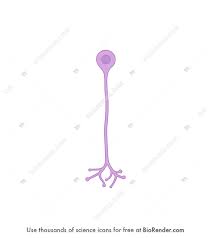
Unipolar
Single process emerging from cell body
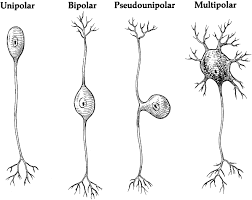
Pseudounipolar
Single Process split into two branches (*Sensory + Simple Reflexes)
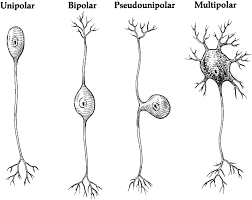
Bipolar
1 axon + 1 Dendrite (*retina + olfactory)
Glial Cells of CNS (Support)
Oligodendrocytes = produce myelin
Astrocytes: “Star Shaped”
Support Neuron
Form blood brain barrier
Microglia: Immune Cells of CNS (engulf pathogens)
Ependymal
Lining of spinal cord, produce cerebrospinal fluid
Glial Cells of PNS
Schwann Cells=produce myelin
Satellite Cells= Support neuron bodies
*Myelin = increase signal speed
Unmyelinated=slow, continuous (nocieptors=pain)
Myelinated=fast, saltatory conduction, jump at nodes
Function of Nervous System
Sensation: Detect Stimuli
Integration: Process
Response: Generate output
Example Pathway: Touching Water (Sensation)
Stimulus=sensory neurons in skin detect temperature
Signal initiation=Graded Potential triggers Action Potential in sensory neuron
Example Pathway: Touching Water (Integration)
Spinal Cord: Interneurons pass info to brain
Brain processing=Signal reaches thalamus and cerebral cortex (decision made)
Example Pathway: Touching Water (Response)
Motor Response=upper motor neurons send signal down spinal cord
Effector Activation=lower motor neurons stimulate muscle contraction via neuromuscular junction
Graded Potential Triggers Action Potential, which equals to?
All or nothing, once triggered=no going back
Graded potential
local, temporary changes in cell membrane voltage
Cells use ions specifically Na+/K+ to create change differences across the cell membrane
Ex: Na+/K+ pump: move Na+ out and K+ in to maintain concentration gradients
Ions go through ion channels
Ligand-gated=neurotransmitter stimulated (Chemical)
Mechanically gated=physical stimulus (Physical)
voltage-gated=change in voltage (Electrical)
Leakage channels=maintain resting potential
Resting Potential
Inside cell= negative
Maintained by Na+/K+ leak channels
The Action Potential
Depolarization:Na+ channels open → Na+ enters → membrane (graded potential)
Repolarization: K+ channels open → K+ leaves → Membrane returns to negative (action potential)
Hyperpolarization: Membrane briefly more negative than resting (action potential)
Refractory Period: Absolute=no new action potential possible
Relative= can fire but requires stronger stimulus (1-2 milliseconds)
Return to rest: Na+/K+ pump restores original concentrations (resting potential)
Chemical Synapse:
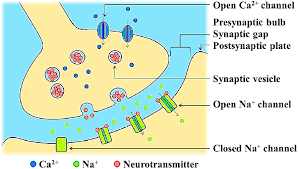
Neurotransmitters
Cholinergic (Acetylcholine), amino acids: glu, GABA, Gly, Biogenic=seratonin; norepinephrine; epinephrin; dopamine.
Two main types of Cholinergic (Acetylcholine)
Nicotinic (@ NMJ), muscarinic (ANS)
Amino Acids:
glu, GABA, Gly
Biogenic:
Seratonin, norepinephrine, epinephrin, dopamine
Sensory Receptors
Free nerve endings (pain and temp)
Interoreceptors (internal/organs)
Specialized receptor cells
^^^^ALL ARE STRUCTURE
Location of sensory receptors:
Exteroreceptors (External/skin)
Interoreceptors (Inernal/organs)
Proprioceptors (body position + movement)
Function of Sensory Receptors
Chemoreceptors = chemicals
Mechanoreceptors = presure
Thermoreceptors = temperature
nocireceptory = pain
photoreceptors = light
Sensory Modalities
General
Touch
Pain
Temperature
Proprioception
Special
Vision
Hearing
Balance
Taste
Smell
Special Senses
Taste, smell, hearing, balance
Special Senses: Taste
Taste (GUSTATION)
Receptors=taste buds on tongue
primary tastes=
sweet → sugars
salty → Na+ ions
sour → H+ ions (acids)
bitter → toxins
umami → glutamate
Signals travel through
Facial nerve VII
Glossopharyngeal IX
Vagus X
Special Senses: Smell
Receptors= olfactory epithelium in nasal canal
Direct connection to limbic system → trigger memory/emotion
Travel via olfactory nerves
Special Senses: Hearing
Sound waves converted into Neural signals in ear
External ear=collects sound
Middle ear = amplifies osund
Inner ear= transdices sound
Ossicles
Malleus
Incus
Stapes
Cochlea:
Fluid movement in basilar membrane
Hair cells bend
Ion channels open
Action potential generated
*Different regions of the cochlea detect different sound frequencies
Special Senses: Balance
Balance detected by hair cells in the inner ear
Maculae= (utricle/saccule)
Detect: head position linear
linear acceleration
gravity
Semicircular canals
Detect: rotational movement
Signals travel through vestibulocochlear nerve
Somatosensation (Touch)
Merkel cells → light touch
Meissner → fine touch
Pacinian → deep presure
Ruffini → skin stretch
Free nerve endings → pain/temp
Vision:
photoreceptors → phototransduction → photoisomerization → optic nerve (flip image)
Sensory nerve pathways:
Afferent (sensory) fibers → ventral root
(ARRIVES)
Efferent (motor) fibers → ventral root
(EXITS)
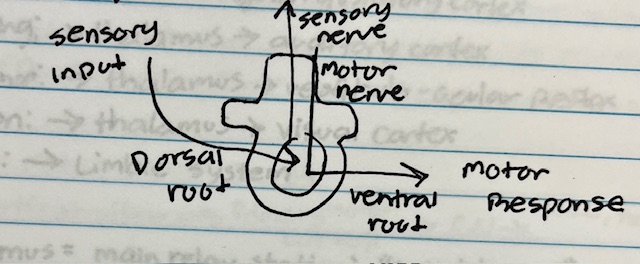
Sensory Input travels from?
PNS → (Afferent) → CNS
Sensory Inputs PNS:
Touch, pain, temp, proprioception, taste, hearing, balance, vision, smell
Sensory Inputs PNS: Touch
Encapsulated nerve ending
Sensory Inputs PNS: pain
free nerve endings
Sensory Inputs PNS: Temp
Free nerve endings
Sensory Inputs PNS: proprioception
proprioceptors in muscle + inner ear
Sensory Inputs PNS: taste
Taste buds → CN VII, IX, X → thalamus → gustatory cortex
Sensory Inputs PNS: Hearing
→ Ext., int., middle ear →; vestibulocochlear nerve → thalamus → auditory cortex
Sensory Inputs PNS: Balance
Inner ear → thalamus → vestibulo-ocular reflex
Sensory Inputs PNS: Vision
Photoreceptors → CN: II → thalamus → visual cortex
Sensory Inputs PNS: Smell
Olfactory epithelium → CN: I → limbic system
Sensory Inputs CNS (Central Processing) is split into?
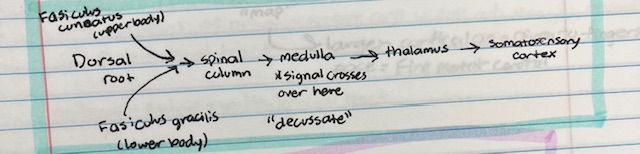
Dorsal column and spinothalamic tract
Sensory Inputs CNS: Dorsal column
fine touch
pressure
vibration
*touch → dorsal column
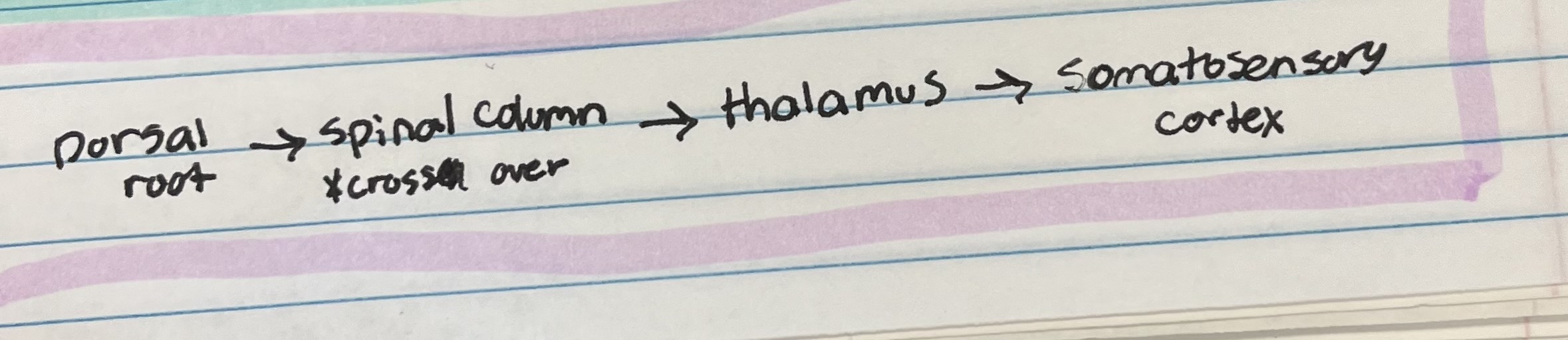
Sensory Inputs CNS: Spinothalamic tract
pain
temp
Sensory Inputs CNS: Dorsal column pathway
Sensory Inputs CNS: Spinothalamic tract pathway
Face Sensation:
Processed by trigeminothalamic tract, CN X
Face Sensation Pathway
trigeminal ganglion → pons “cross” → thalamus → somatosensory cortex
Thalamus is what?
Main relay station; “switch board”
Somatosensory cortex is what?
Homonuculus “body map”
Order of Nervous System
PNS → CNS → Brain
Brain:
Motor control initiated in frontal lobe
prefrontal cortex
executive control (decision making, planning, attention)
promotor cortex
posture + simple movement
Supplemental motor area
complex + learned movements
Broca's area
speech production
Primary motor cortex
precentral gyrus → sends to Voluntary muscle movement
Primary motor cortex = humonuculus; “map”
larger cortical area given to fingers + face = fine motor control
Motor Output ← (Efferent Exits Brains) ← descending motor pathway (brain → spinal cord → muscles)
-Upper motor neurons = primary motor cortex
Lower motor neurons = start in brainstem or spinal cord and directly stimulate muscle (reflexes) = do not require conscious brain processing
Upper motor neuron tracts
Corticobulbar → primary motor cortex → CN → face, head, neck, muscles
Corticospinal
Lateral corticospinal
cross at medulla
appendicular muscles
(fine motor movement)
Anterior corticospinal
cross at spinal cord
axial muscles
bilateral for posture + locomotion
What does cerebellum do?
Cerebellum compares motor commands from the brain with positions of proprioceptors and makes adjustments accordingly → rubrospinal tract
Balance + posture =
vestibulospinal tract
somatic pathway:
PNS → Dorsal Root → CNS (hypothalamus) → Single motor unit (ventral root) → skeletal muscle
Autonomic nervous system
PNS → Dorsal Root → CNS (hypothalamus) → preganglionic neurons → ganglion → postganglionic neuron → cell body in CNS → axon → cell body in ganglion → target organ
The Autonomic Nervous System regulates involuntary physiological processes necessary
for maintaining homeostasis
The ANS regulates smooth muscle, cardiac muscle and glands
Two main divisions:
Sympathetic = fight or flight
parasympathetic = rest + digest
Target organs of the ANS have dual innervation (sympathetic + parasympathetic)
Sympathetic Division (Thoracolumbar System) T1-L2 Pathway
CNS → Preganglionic Neurons (*lateral horn of spinal cord (short)) → sympathetic ganglion “sympathetic trunk” (paravertebral ganglion) → Postganglionic neuron (long) → target organ
*Preganglionic neurons may what?
Influence 10-20 target organs
Exception of Preganglionic neurons =
Adrenal medulla (kidneys)
Produce: epinephrine/norepinephrine
directly innervated by a preganglionic neuron
Parasympathetic Divison
Originates in brainstem + S2 - S4 (Sacrum) “Cranio-sacral outflow”
Parasympathetic Divison Pathway
Preganglionic neurons (long) → parasympathetic ganglion (located near target organ) → postganglionic neuron (short)
*parasympathetic response = more localized specific
primary neurotransmitters of ANS
Cholinergic (ACETYLCHOLINE)
nicotinic
muscarinic
Adrenergic System (epinephrine/norepinephrine)
alpha/beta receptors
Hypothalamus primary control center of ANS
Coordinates autonomic + endocrine responses
Autonomic nervous system and visceral reflexes
regulate internal homeostasis (smooth muscle, cardiac muscle + glands)
Autonomic nervous system and visceral reflexes Pathway
CNS → Preganglion → autonomic ganglion →postganglionic → organ
EX. Baroreceptors = detect blood pressure change
Embryology of Nervous System:
Ectoderm → Neural tube
Neural Tube
Anterior - brain
posterior - spinal cord
Formed around day 25
Embryology of Nervous System: Parts of Ant-Brain
forebrain → cerebrum
midbrain
hindbrain → pons/cerebellum/medulla
Embryology of Nervous System: Parts of post-spinal cord
Dorsal cells = sensory
ventral cells = motor
REVIEW OF SOMATIC NERVOUS SYSTEM RESPONSE: (Somatic Reflex) Ex. Touching a HOT stove
Sensory Input → (arrives at dorsal root)→ Integration → Motor Output
REVIEW OF SOMATIC NERVOUS SYSTEM RESPONSE;l (Somatic Reflex) Ex. Touching a HOT stove; Sensory Input: Stimulus
Heat/Pain from hot stove
REVIEW OF SOMATIC NERVOUS SYSTEM RESPONSE;l (Somatic Reflex) Ex. Touching a HOT stove; Sensory Input: Receptors
Thermoreceptors + nociceptors in skin
REVIEW OF SOMATIC NERVOUS SYSTEM RESPONSE;l (Somatic Reflex) Ex. Touching a HOT stove; Sensory Input: Neuron
sensory (Afferent) neuron (arrives at brain)
REVIEW OF SOMATIC NERVOUS SYSTEM RESPONSE;l (Somatic Reflex) Ex. Touching a HOT stove; Integration
*Occurs in spinal cord
Sensory Input: Neuron → Sensory nerve synapses with interneuron “remove hand now”
REVIEW OF SOMATIC NERVOUS SYSTEM RESPONSE;l (Somatic Reflex) Ex. Touching a HOT stove; Motor Output
Neuron = somatic motor neuron
→ effector response
target = skeletal muscle
NT= acetylcholine
Effect = NMJ muscle contracts
→ hand withdraws
REVIEW OF SOMATIC NERVOUS SYSTEM RESPONSE;l (Somatic Reflex) Ex. Stepping on a sharp tack; Sensory Input: Stimulus
Sharp tack in foot
REVIEW OF SOMATIC NERVOUS SYSTEM RESPONSE;l (Somatic Reflex) Ex. Touching a HOT stove; Sensory Input: Receptors
Nociceptors in skin
REVIEW OF SOMATIC NERVOUS SYSTEM RESPONSE;l (Somatic Reflex) Ex. Touching a HOT stove; Sensory Input: Activates
Sensory neuron
REVIEW OF SOMATIC NERVOUS SYSTEM RESPONSE;l (Somatic Reflex) Ex. Touching a HOT stove; Sensory Input → (Pain = spinothalamic tract) → Integration
Enters at dorsal horn
Crosses at spinal cord
Lateral spinothalamic tract to thalamus
Primary somatosensory cortex
Premotor cortex
REVIEW OF SOMATIC NERVOUS SYSTEM RESPONSE;l (Somatic Reflex) Ex. Touching a HOT stove; Motor Response
Leaves via ventral horn
(premotorcortex → *Corticospinal tract → leaves via ventral horn)
Somatic motor neuron triggers skeletal muscle