Week 10: Language
 Call Kai
 Learn
Learn Practice Test
 Spaced Repetition
 Match
Match Flashcards
 Knowt Play
1/47

There's no tags or description
Looks like no tags are added yet.
Name | Mastery | Learn | Test | Matching | Spaced | Call with Kai |
|---|
No analytics yet
Send a link to your students to track their progress
48 Terms
What is language lateralisation?
The tendency for language functions to be predominantly located in one hemisphere of the brain, usually the left.
In what percentage of the population is the left hemisphere dominant for language?
90% of the population.
Which hemisphere is dominant for language in most left-handed individuals?
The right hemisphere is dominant in 27% of left-handed people.
Name factors involved within language comprehension
Prosody, intonation, and emphasis help convey meaning in language.
Name some roles of the right hemisphere
Comprehension likely involves right hemisphere
Damage to the RH might affect:
Talking about spatial relations
Maps and complex geometrical forms
Organising a narrative
Understanding figurative aspects of language
What is phonagnosia?
The inability to recognise familiar voices, associated with damage to the right temporal lobe.
How is the left and right hemisphere involved in speech production?
LEFT: controls speech output (Broca’s area)
RIGHT: minimal role
How is the left and right hemisphere involved in comprehension?
LEFT: literal meaning, vocabulary, grammar
RIGHT: context, implied meaning
How is the left and right hemisphere involved in grammar and syntax?
LEFT: processes sentence structure
RIGHT: limited role
How is the left and right hemisphere involved in semantics?
LEFT: precise word meaning
RIGHT: broad, associative meaning
How is the left and right hemisphere involved in prosody (tone, rhythm)?
LEFT: basic structure of speech
RIGHT: emotional tone, intonation
How is the left and right hemisphere involved in figurative language?
LEFT: limited alone
RIGHT: metaphor, sarcasm, humour
How is the left and right hemisphere involved in error awareness?
LEFT: often aware
RIGHT: less aware
How is the left and right hemisphere involved in the effect of damage?
LEFT: aphasia
RIGHT: monotone speech, poor emotional understanding
What is the corpus callosum's function?
It connects the two hemispheres of the brain, allowing them to communicate.
What is the purpose of surgically cutting the corpus callosum?
To stop seizures in severe cases of epilepsy.
→ Corpus callosum is cut and communication between hemispheres is disrupted
What does the left hemisphere do in terms of language?
It acts as an 'interpreter' that builds explanations and verbalises thoughts.
Outline the order of language comprehension
Hear it
Recognise the words
Understand the words
Remember what happened or imagine
Put the words together
Tell your muscles to move
Answer
What is bilingualism?
The ability to use two languages in everyday life.
Which structure do bilingual babies show stronger responses to?
Prefrontal cortex
What are the potential cognitive advantages of bilingualism?
Enhanced attention, task switching, and inhibitory control (Bialystok et al, 2012)
Where is bilingualism believed to be localised? (Guissani et al, 2007)
Electrostimulation studies review (Guissani et al, 2007)
Some overlapping
Primary or secondary language-specific regions
What is aphasia?
A language disorder resulting from brain damage that affects understanding or producing language.
What are the primary causes of aphasia?
Stroke, brain tumors, and head injuries.
Name two forms of non-fluent aphasia
Broca’s
Global
What is Broca's aphasia characterised by?
Effortful, agrammatic speech with good comprehension.
What is global aphasia characterised by?
Severe impairment in all language functions.
Name three forms of fluent aphasia
Wernicke’s
Conduction
Anomic
What is Wernicke's aphasia characterized by?
Fluent but meaningless speech with poor comprehension.
What is conduction aphasia characterised by?
Poor repetition, fluent with errors
What is anomic aphasia?
A type of aphasia where individuals have difficulty finding words, especially nouns and verbs.
Name factors associated with Broca’s aphasia/non-fluent aphasia
Broca 1861-1865: case studies of aphasia
Patient 'Tan'
Cavity left frontal lobe filled with fluid
Patient can comprehend but not express speech
Speech is associated with left hemisphere
Damage to the inferior left frontal lobe and underlying subcortical white matter
Comprehension of speech is intact
Speech is slow, broken, effortful
Loss of the production of complete sentence structures is speech and writing
Name three speech deficits associated with Broca’s aphasia
Agrammatism (loss of grammar)
Broca’s anomia (accessing the word): word-finding difficulties
Articulation problems: mispronunciations, often alter the sequence of sounds
Outline 6 preserved functions in Broca’s aphasia
Language comprehension (mostly intact)
Meaning of words
Awareness of deficits
Non-verbal communication (gestures/facial expressions)
Understanding humour/sarcasm/tone
Prosody/expression of emotions
Outline factors associated with Wernicke’s aphasia
Repetitive or fluent aphasia
Main difficulty is understanding language (spoken or written)
Speech remains smooth and well-paced but might lack meaning
Linked with damage in the left temporal gyrus
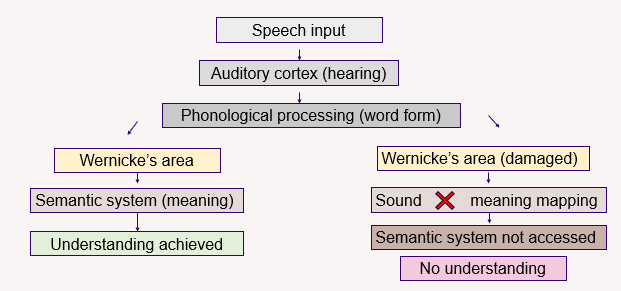
What happens if connections to Wernicke's area are disrupted?
It can lead to pure word deafness, transcortical sensory aphasia, anomic aphasia or conduction aphasia.
What is agrammatism?
Difficulty in using grammatical constructions and word order to decode sentences.
What preserved functions are typically seen in Broca's aphasia?
Intact language comprehension, meaning of words, awareness of deficits, and non-verbal communication.
What is the significance of the Boston diagnostic aphasia test?
It is used to assess language function and diagnose types of aphasia.
What does the term 'pure word deafness' refer to?
Auditory verbal agnosia
Rare disorder of the recognition of speech
Patients cannot understand spoken words despite having normal hearing, reading and writing skills
Typically caused by disconnection rather than direct destruction of Wernicke's area itself
What is meant by transcortical sensory aphasia?
Poor comprehension but preserved repetition
Speech fluent, grammatically correct but meaningless
May not be aware of difficulty
What is meant by anomic aphasia?
Problem with word findings and naming things
Difficulty retrieved certain words, especially nouns and verbs
They know what they want to say but cant get the words to come out correctly
Might use substitution words or related words
Wernicke's area and the broader left posterior temporal and parietal regions involved
Name factors associated with conduction aphasia
Meaningful fluent speech and comprehension, but poor repetition
Extreme difficulties repeating lists of words (although related words may be repeated)
May replace word they are asked to repeat with another with the same meaning
Caused by damage to pathway between Broca and Wernicke area responsible for conveying sound – arcuate fasciculus
Hearing sentence evokes imagery, which allows individual to describe the meaning but using different words
What is the difference between Broca’s and Wernicke’s anomia?
Broca’s anomia = can’t get the word out
Wernicke’s anomia = gets the wrong word out
What is the role of Wernicke's area?
Involved in language comprehension, particularly in understanding spoken and written language.
What is the impact of aphasia on mental health?
Nearly 60% of people with aphasia experience depression a year post-stroke.
What are the characteristics of global aphasia?
Severe impairment in all language functions, affecting both comprehension and production.
What is the significance of the arcuate fasciculus?
It is the pathway that connects Broca's and Wernicke's areas, crucial for language processing.