L9 Co-occurring Diagnosis and experiences
 Call Kai
 Learn
Learn Practice Test
 Spaced Repetition
 Match
Match Flashcards
 Knowt Play
1/86

There's no tags or description
Looks like no tags are added yet.
Name | Mastery | Learn | Test | Matching | Spaced | Call with Kai |
|---|
No analytics yet
Send a link to your students to track their progress
87 Terms
The O'Nions et al. (2024) Lancet study on autistic life expectancy used data from what source, and was co-produced with whom?
Anonymised GP practice records; co-produced with 4 autistic people and a National Autistic Society representative
In the O'Nions et al. (2024) study, what were the approximate life expectancies for autistic people WITHOUT a learning disability, compared to non-autistic controls?
mid-late 70s vs. controls early 80s
In the O'Nions et al. (2024) study, what were the approximate life expectancies for autistic people with a learning disability?
early 70s
Name three limitations of the O'Nions et al. (2024) life expectancy study
No cause of death data; no gender diversity information; underdiagnosis means findings cannot be generalised
Unigwe (2017) measured GP’s self-efficacy in caring for autistic patients on a scale of 1-10 – what was the overall mean score and what does this suggest
less than 5, suggesting GP’s have low confidence in caring for autistic patients
In Unigwe (2017), what 3 tasks did GPs confidence score lowest on
managing the care of children with autism, managing the care of adults with autism, and knowing which medications to prescribe
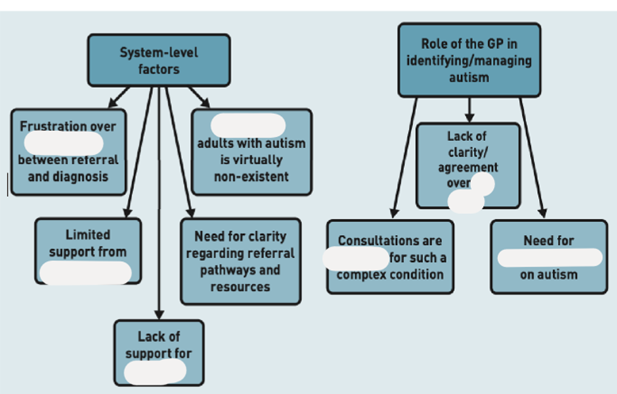
Complete these barriers to healthcare
long delays, support for, local services, families, GP remit, too short, specific training
Doherty (2022) Open Study aimed to identify self-reported barriers to accessing primary care by autistic adults – was is methodologically positive or negative, and why
positive, because it was autistic-led with autistic medical doctors as researchers
According to Doherty (2022), autistic adults reported much higher rates of adverse outcomes in delayed/additionally health care treatment than non-autistic adults – name 4 outcomes
(any 4 of 7) untreated mental health, untreated physical health, missed specialists referral, should have attended sooner, additional treatment, untreated life threat, and do not attend screening
What did these adverse outcomes correlate with/potentially underly
difficulty attending a GP
Shaw et al identified 5 themes of healthcare barriers in autistic adults – what are they (they feed into each other – so consider order of themes)
early barriers, communication mismatch, doubt (in oneself and from doctors), helplessness and fear, and healthcare avoidance and adverse health outcomes
Can we trust the approach used by Shaw et al, why? (3 comments)
yes because of autistic-led researchers and a large and gender diverse sample
What was one drawback about the sample used by Shaw et al
WEIRD
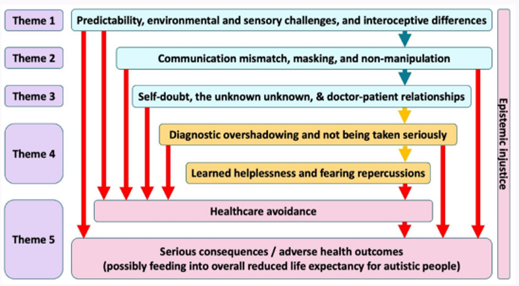
In Shaw et al model’s, epistemic injustice is the overarching concept that runs alongside, what does it mean
not being believed or taken seriously as a knower
Can you remember who Jim Sinclair is? What did he co-found and pioneer
Autism Network International and the neurodiversity movement
Jim Sinclair also founded Autreat – what is this
retreat and conference for and by autistic people
Can you remember what acronym SPACE stand for as a framework for autism
sensory, predictability, acceptance, communication, empathy
In the SPACE framework, the model also distinguishes 3 types of “space” – what are they
physical, temporal, and emotional space
Under SPACE framework, name 1 practicality for Sensory – Sight
(any 1 of 3) turn off/down artificial lights, avoid highly stimulating decor, promote the use of sunglasses
Under SPACE framework, name 1 practicality for Sensory – Sound
(any 1 of 4) consider environmental sounds, reduce auditory clutter, avoid conversation in noisy environment, promote the use of noise-cancelling headphones
Under SPACE framework, name 1 practicality for Sensory – Smell
(any 1 of 4) avoid wearing perfume/highly scented cosmetics, avoid air fresheners, avoid highly scented cleaning products, consider ventilation/open windows where possible
Under SPACE framework, name 1 practicality for Sensory – Taste
(any 1 of 2) consider test and texture of medication, consider non-standard medication formulations where necessary
Under SPACE framework, name 1 practicality for Sensory – Touch
(any 1 of 3) avoid causal touch, promote sensory-friendly clothing choices, sensory aids such as weighted blankets
Under SPACE framework, name 1 practicality for Sensory – Temperature
(any 1 of 2) consider environmental temperature, adjust temperature where required
Under SPACE framework, name 1 practicality for Predictability
(any 1 of 4) give realistic information in advance, ensure clear signage in physical spaces, provide photos/videos of the physical environment and staff, allow waiting in a familiar environment
Under SPACE framework, name 1 practicality or Acceptance
(any 1 of 4) neurodiversity-affirmative approach beneficial, understand autistic stimming and monotropic thinking patterns, facilitate need for detailed factual information, understand distress behaviour
Under SPACE framework, name 1 practicality for Communication
(any 1 of 4) understand autistic verbal and non-verbal communication differences, know that communication ability is reduced by anxiety and sensory stress, clear unambiguous communications required, avoid phone-based appointment systems
Under SPACE framework, name 1 practicality for Empathy
(any 1 of 2) recognise that autistic people feel empathy but may display it differently, empathy towards autistic patients may be more challenging for non-autistic healthcare providers
What is expected and to be avoided under the SPACE framework of physical space
need for increased personal space and proximity to other people where possible
What 2 things should be allowed for under the SPACE framework of temporal space
increased time to respond to questions and decision-making
What is expected and to be allowed under the SPACE framework of emotional space
difference in emotional expression and solitude to recover if distressed
A systematic review by Doherty A.J. et al. (2020) identified six key barriers/facilitators to primary care access for autistic people and those with learning disabilities. Name them
Training; Knowledge and Awareness; Communication; Fear and Embarrassment; Lack of involvement in healthcare decision-making; Time
Approximately, what is the prevalence rate of ADHD in autistic people
late 20s% (28%)
Approximately, what is the prevalence rate of anxiety in autistic people
20%
Approximately, what is the prevalence rate of depression in autistic people
early 10s% (11%)
Au-Yeung et al (2018) studied perceived misdiagnosis in autistic adults. Are autistic individuals more likely to report receiving mental health diagnoses (compared to non-autistic participant)
yes
In Au-Yeung et al (2018) study of misdiagnoses of mental health in autistic adults – roughly what % of autistic participants disagreed fully/partially with their mental health diagnosis
over 40%
Au-Yeung et al (2018) identified two main themes explaining why autistic people disagreed with their mental health diagnoses – what were they (hint - confusion, consequence)
e
Can you remember how Juan (a late diangosed autistic adult) described the consequences of masking on his wellbeing
it is damaging and takes a huge amount of energy due to constant thinking
Define camouflaging
pressure to fit in with neurotypical social communication causes individuals with autism to develop coping strategies to compensate for this
What is the questionnaire that measures camouflaging
camouflaging autistic traits questionnaire (CAT-Q)
What are the 3 subscales of camouflaging identified by the CAT-Q
masking, compensation, and assimilation
Define masking
strategies used to hide autistic characteristics or portray a non-autistic person
Define compensation
strategies used to actively compensate for difficulties in social situations
Define assimilation
strategies that reflect trying to fit in with others in social situations
Which sex showed significantly higher camouflaging scores across all CAT-Q subscales
females
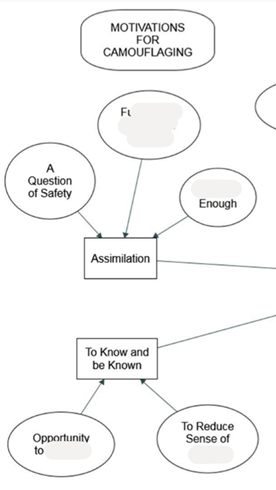
Complete these motivations for camouflaging
functioning member of society, normal, connect, stress
Briefly, what can be the consequences of camouflaging (3 thoughts)
questioning/betraying identity, draining, and not seeming autistic enough
Higher CAT-Q total scores were positively associated with higher scores on which two mental health outcomes
depression and anxiety (and stress)
Bradely (2021) found that all autistic adults believed camouflaging was harmful to their mental health – true or false
false, most thought it was harmful, but some thought it helped them too
Since some autistic people found that camouflaging helped them, what was the unexpected finding of longutindal findings on camouflaging and mental health differences (initial baselines vs end)
for people with higher initial levels of camouflaging, there was a decrease in mental health difficulties (and vice versa)
How does the environment influence tendency to camouflaging
autism-affirming (vs autism-stigmatising cues) reduce need to camouflage
Did higher levels of camouflaging and higher levels of anxiety replicate across countries in a cross-cultural research study on camouflaging
yes
What two subgroups of autistic people can the cross-cultural research study not generalise to
those with learning disabilities or are non-speaking
define autistic burnout – autistic burnout is defined as a syndrome resulting from ? and a mismatch of ? and ? without adequate supports
chronic life stress, expectations, abilities
What are 3 characteristic of autistic burnout
chronic exhaustion, loss of function, and reduced tolerance to stimulus
How is autistic burnout similar and different from depression
similar symptoms but trigger is different
How does the trigger for burnout and depression differ
burnout related to social interaction demands, masking fatigue, and overload
What two factors (each resulting from life stressors and barriers to support) contribute to “expectations outweigh inability” in Raymaker et al’s model of burnout
cumulative load and inability to obtain relief
Name 4 life stressors contributing to autistic burnout from Raymaker et al model
masking, expectations, disability management, and life-change stress
Name 4 barriers to support that prevent relief from burnout according to Raymaker et al
gaslighting/dismissal, poor boundaries/self-advocacy, can’t take a break, and lack of external resources/support/services
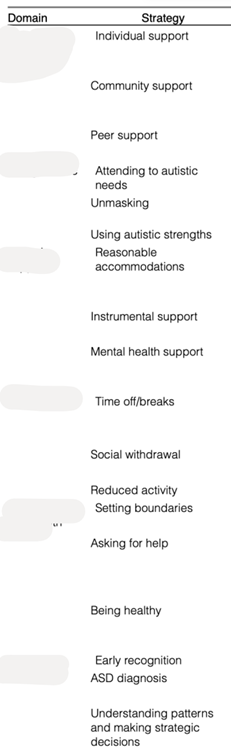
what are the 6 domains of potential solutions for autistic burnout (use the strategies within as clues)
acceptance and social support, being autistic, formal supports, reduced load, self-advocacy and health, self-knowledge
Name 4 experiences that are common to both autism and ADHD (shared traits in AuDHD)
sensory differences, intense focus on specific interests, rejection sensitivity, executive dysfunction
In Van der Putten et al (2024), between the autistic group and ADHD group, which group had the lowest total camouflaging scores
ADHD group
In Van der Putten et al (2024), which type of traits – autism or ADHD – best explained camouflaging levels in people with ADHD and/or autism diagnoses
autism traits
Approx. what proportion of autistic people also have a learning disability
1 in 3
Diagnostic criteria for learning disability include both significant limitations in ? and ? functioning
cognitive, adaptive
Menezes et al. (2021) found that autistic young people with co-occurring learning disability had greater unmet needs in which specific area compared to autistic peers without LD?
Mental health service needs (not medical care needs generally)
Why are autistic people with learning disabilities frequently excluded from research?
Difficulties with the consenting process
A systematic review on self-report methods for autistic adults with LD found striking gaps – what 3 gaps did they find
most measures were not validated for autistic people, few used adaptations or accommodations, and no studies were co-produced
Weir et al (2022) explored health burden between autistic and non-autistic adults, what 3 physical/health conditions were autistic women at higher odds of having
(any 3) arthritis, neurological condition, anorexia, ADHD, bipolar, depression, insomnia etc etc
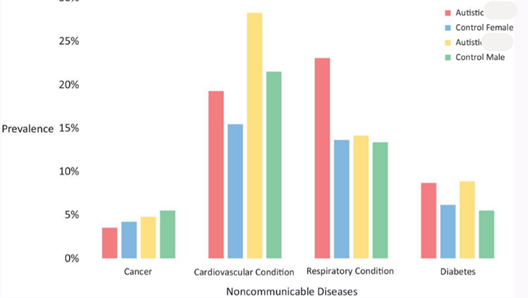
Do autistic females or males show generally higher prevalence of physical health conditions
autistic females
What physical health condition is strikingly more prevalent with autistic females
asthma
In these research studies on physical health, what are 3 biases of the sample
UK, female, highly educated
In one study comparing physical health conditions in control vs older autistic groups, what 2 conditions was significantly more prevalent in the older AU group
mild cognitive impairment and arthritic conditions
In the same study comparing mental health conditions in control vs older autistic groups, name 3 mental health conditions that were significant more prevalent in older AU group
any anxiety disorder (GAD, social anxiety, panic attacks), anorexia, personality disorders
What 5 reproductive/physical health features are more prevalent in autistic people assigned female at birth
higher BMI, reproductive health diagnoses, pre-diabetes symptoms, irregular poverty onset, and menstrual irregularities
One study surveyed autistic AFAB adults about primary care – roughly what % reported that primary care staff never seemed to know how their autism affected their menstrual experience
over 90%
The "Autism from menstruation to menopause" study (Grant et al., 2024) uses what research approach, and specifically includes which 3 often-excluded groups?
community participatory research, includes non-speaking/semi-speaking, those with learning disability, and those from marginalised ethnicities
What are 6 considerations identified in a systematic review on menstruation
education/skill development, preparation, personal awareness of puberty-related changes, management, support, impact of bleeding
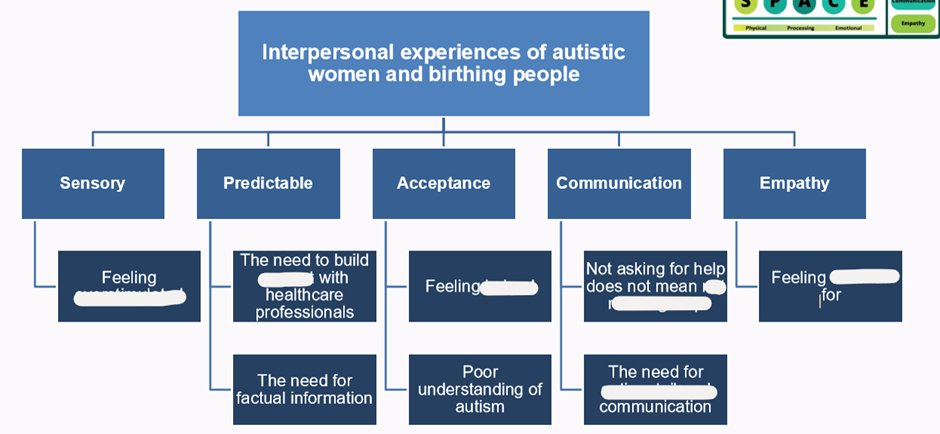
Complete how SPACE framework applied to autistic birthing experiences
overstimulated, rapport, judged, not needing help, autism-tailored, uncared
One study found autistic people had worse menopause symptoms than non-autistic people – name 3 types of symptoms recorded
(any 3) mental health/irritability, cognition/fatigue/functioning, sleep, increased sensory sensitivity, pain and headaches, communication changes
How does menopause symptoms affect autistic people and aspects of life
how they felt about themselves and impacted work and relationships
Interoception and monotropism are two underexplored explanations for physical health outcomes – what does each mean
interoception guides the sensing, interpretation and integration of the body and monotropism is the tendency to focus on single tasks
How can interoception help promote bodily autonomy and integrity – through what 3 aspects of daily life
self-awareness, emotional experience and regulation, and activities of daily living
Why is monotropism significant to autistic people’s physical health
hyper focus causes autistic people to fail to detect interoceptive signals (e.g. hunger, pain, need for toilet)
A key gap noted in interoception research is the lack of ________ research involving autistic people
Participatory (co-produced)