Lecture 3: Natural Selection
 Call Kai
 Learn
Learn Practice Test
 Spaced Repetition
 Match
Match Flashcards
 Knowt Play
1/21

There's no tags or description
Looks like no tags are added yet.
Name | Mastery | Learn | Test | Matching | Spaced | Call with Kai |
|---|
No analytics yet
Send a link to your students to track their progress
22 Terms
3 Components of Natural Selection
Variation
Inheritance
Differential reproductive success
VID
Natural Selection
process by which beneficial alleles increase in frequency over time in a population due to increased survival and reproductive success of individuals carrying those alleles
sorts on phenotype, not genotype
acts on phenotypes, but evolution consists of changes in allele frequencies
acts on individuals, but its consequences occur in populations
acts on existing traits, but new ones can evolve
faces several constraints, and does not lead to perfection
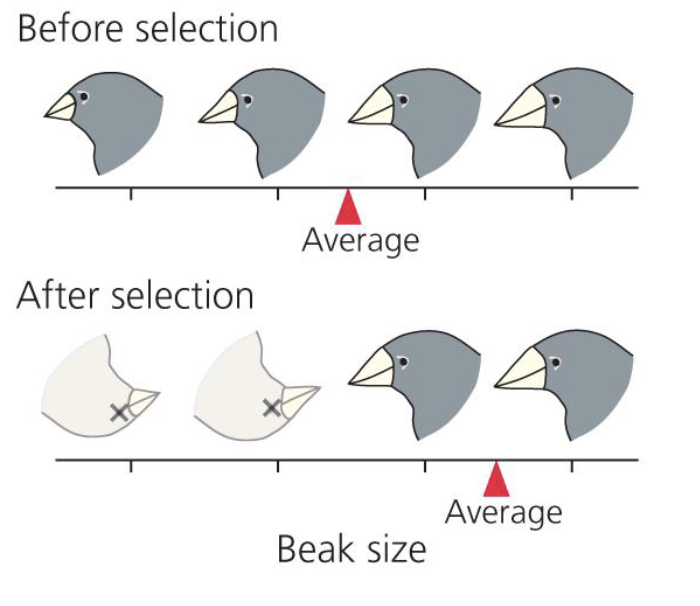
Mutations
source of variation
mutations occur randomly and independently of whether they will be favoured by natural selection
How to deduce whether natural selection occurs in the wild?
Variation
is variation present?
Inheritance
evolution via natural selection can only occur if variation is heritable.
this is tested by identifying the genes involved
Differential Reproductive Success
differences in fitness
measuring fitness is in measuring survival, after removing confounding factors
Trait Fitness
expected reproductive success of an individual relative to other members of the population
differential effect of trait on reproduction
small differences in fitness → large differences in populations over time
delete
delete
Adaptation
an inherited trait that increases an organisms fitness, and is the result of natural selection for its primary function
increases fitness to both abiotic and biotic environments
to be considered an adaptation, a trait must have been shaped by natural selection to serve the same primary functions that make it beneficial today
ex. WVS in Echinoidea adapted for feeding functions (which it exhibits today), you would not say it adapted for reproduction if that isn’t something that it currently exhibits/benefits from (even if they did at one point)
Exaptation
a trait that currently serves one function today, but which evolved from a trait that served a different function in the past
most complex traits will have undergone layering of adaptation and exaptation changes
ex. feathers
todays function: flight
original function: thermoregulation, sun protection, defense?
co-opted trait can be multi-purpose, and the original function may not be necessarily lost
Gene Duplication
entire gene or region of the gene is duplicated
second copy of a gene can undergo neofunctionalization
Hormone-receptor Pairs
lock and key systems, and exhibit of gene duplication
which came first?
does receptor evolve before signal exists
does signalling protein evolve before receptor
gene duplication could allow second receptor to mutate, and bind to the new hormone
Gene Sharing
protein recruited to serve second function elsewhere
How can a complex trait evolve?
co-opted from another trait
exaptation
intermediate steps also functional
complex trait serves new function
gradual, intermediate steps
each step itself adaptive
serve same function throughout
Evolution of Eyes
gradual steps
eyes at different levels of complexity exist today
suggest complex eye could have evolved through series of intermediate stages
each individual step is fully functional
complex focusing eye
simple photoreceptive layers of cells
Short term constraints on NS?
lack of sufficient variation
Long term constraints on NS?
physical constraints
co-evolution
lack of foresight
Physical Constraints NS
constrained by physical and mechanical laws
example: binocular vision
2 extremes: almost 360 vision, but limited depth perception vs. full depth perception, but limited field of view.
can’t have both full field view and stereoscopic vision with only two eyes
Coevolution
evolutionary change in one species can affect selective conditions for a second species
ex. plants and pollinators
Evolutionary Arms Race
form of coevolution where the species involved each evolve countermeasures to the adaptations of the other species
basically, much of what is significant about an organisms environment is provided by other organisms, who are themselves evolving through natural selection
ex. predator-prey interactions
NS Lacks Foresight
selection favours traits that are immediately beneficial, not traits that may be useful in the future
seen in the blindspot in human eyes
legacy of how our eyes evolved
cephalopods lack a blindspot
NS does not lead to perfection
Guppy NS
life history:
reside in streams, which are physically close, but separated by waterfalls. the separated populations are under different selection pressures
observed patterns:
female at upstream and low predation sites produced fewer offspring (but larger in size) than downstream
explanation:
upstream predators are small, meaning that the larger offspring will be safer from predation
downstream predators are bigger, meaning that the better life strategy is to produce as many offspring as possible
here, natural selection favours different life history strategies under different predation pressures
however, when experimentally manipulated, populations rapidly evolved in response to selection
E. coli evolutionary experiment
compared what happened to cell sizes across 12 genetically identical cell lines
would the same phenotypes evolve?
does NS happen in exactly the same way every time?
cell size and fitness both increased in all cell lineages over time
phenotypically, populations evolved in a similar manner
but despite starting with genetically identical cells, cell size increased more in some lineages than others. fitness was higher in some lineages than others.
NS operated in a similar way in all populations, but didnt take an identical path
NS and random events
NS is a predictable, repeatable process, but it is also affected by random events that can significantly affect the course of evolution
random events may be specific mutations, or orders of mutations