DM- Ch 3 Physical and Mechanical Properties of Dental Materials
 Call Kai
 Learn
Learn Practice Test
 Spaced Repetition
 Match
Match Flashcards
 Knowt Play
1/67

There's no tags or description
Looks like no tags are added yet.
Name | Mastery | Learn | Test | Matching | Spaced | Call with Kai |
|---|
No analytics yet
Send a link to your students to track their progress
68 Terms
Physical properties
• Based on the laws of physics
• Describe mass, energy, force, light, heat, electricity, and other properties
Mechanical Properties
Describe a material's ability to resist forces
Dependent on:
• Amount of the material
• Size of the object
• Shape of the object
Chemical Properties:
Describe the:
• Setting reaction of materials
• Decay or degradation of materials
Biologic Properties:
• Describe the effects the material has on living tissue
Density (PP)
• Material mass per given volume
• Measures how tightly matter is packed together in a certain amount of space
• "how much stuff is in a given amount of space"
Boiling and Melting Points (PP)
• Breaking of atomic bonds between atoms by thermal energy
• Temperature range vs. specific temperature
Vapor pressure (PP)
• Measure of a liquid's tendency to evaporate and become a gas
• As temperature increases, vapor pressure increases
Thermal conductivity (PP)
• Rate of heat flow through a
material
• Measured as heat flow over time
Depends on:
• Distance heat travels
• Area in which heat travels
• Temperature difference between source and destination
Heat Capacity (Thermal capacity) (PP)
Amount of heat that must be applied to an object to produce a change in its temperature
Specific heat capacity
• The number of heat units needed to raise the temperature of something by
one degree
Heat of Fusion and Vaporization (PP)
Heat of Fusion
• Amount of energy required to melt a material
Heat of Vaporization
• Amount of energy required to boil a material
Coefficient of Thermal Expansion (PP)
A measure of how the volume or length of an object changes in relation to the change in temperature
• Materials shrink when cooled, expand when heated
Close matching of the coefficient of thermal expansion is important
between the tooth and restorative materials to prevent marginal leakage
Percolation
Opening and closing of the gap between tooth structure and a restoration due to differences in coefficients of thermal expansion
Percolation results in
• Microleakage
• Tooth sensitivity
• Recurrent decay
• Discoloration
Interface
Gap between tooth structure and a restoration
Electrical Conductivity (PP)
How well a material allows electricity to flow through it
Good electrical conductors
Metals
Poor electrical conductors (insulators)
• Polymers
• Ceramics
Viscosity (PP)
Ability of a material to flow
High viscosity
poor wetting
• Low flow

Low viscosity
good wetting
• High flow
Wetting (PP)
• The ability of a liquid to wet or intimately contact a solid surface.
• Water beading on a waxed car is an example of poor wetting
Hardness (PP)
Measure of resistance of a solid towards deformation
A microhardness test that measures a material's resistance to indentation
Knoop hardness
• Enamel = 350
• Dentin = 70
• Porcelain = 400-500
• Acrylic denture teeth = 20
• Diamond = 7000
Durometer Measurements
Standardized way of measuring the hardness of materials like rubber or plastic
Durometer
A tool used to apply a consistent force to a material and measure the resulting indentation
Durometer determines the hardness of
• Impression materials
• Other elastic polymers
Abrasion Resistance (PP)
An ability to withstand the wear and tear of friction caused by mechanical force
- Goldilocks Principle—not too hard, not too soft,
just right
Restorative material too hard
wears away opposing teeth
• Porcelain vs. enamel
Restorative material is too soft
restoration wears away
Solubility (PP)
Amount of material that dissolves in liquid
Materials placed in the oral cavity
are exposed to various aqueous fluids
Excessive solubility in the mouth leads to
• Loss of material
• Recurrent decay
Water Sorption (PP)
Weight gained when a dental material is immersed in water
Material absorbs water and swells:
• Ex: cookie dunked in milk
Color (PP)
Describes how a substance interacts with light by absorbing and reflecting specific wavelengths of the visible spectrum
- Standardization by using shade guides when working with dental materials
Interaction of Materials with X-Rays Based on Atomic Number (PP)
Radiolucent or radiopaque
Radiolucent
• Some ceramic materials
• Denture acrylic resin
• Dark/black on radiographs
Radiopaque
• Metal restorations
• Materials with radiopaque fill
• Light/white on radiographs
Force (MP)
Weight or load applied to an object
• Push and pull on an object resulting from the objects interaction with another
object
Stress (MP)
Force divided by the area in which it is applied
• An internal resistance to deformation when under force
Elasticity (MP)
The ability of an object or material to resume its normal
shape after being stretched of compressed
Strain (MP)
The deformation of a material from stress
- The change in length divided by the original length
Strain measured as
• Fraction
• Percentage
Stress
Force per unit area
• Force that develops in a loaded object
• Proportional to load
• Related to size of the object
Stress formula
load/area
Stress is measured in
• Pounds per square inch (psi)
• Pascals (metric
Relationship of Stress and Strain (MP)
Distortion or deformation that occurs when an object cannot resist a stress
Proportional relationship
Strain is directly proportional to the stress applied
- Always occur together
Modulus of elasticity
• Stress/strain
• Characteristic of a material and its atomic bonds
• High modulus of elasticity = stiff material
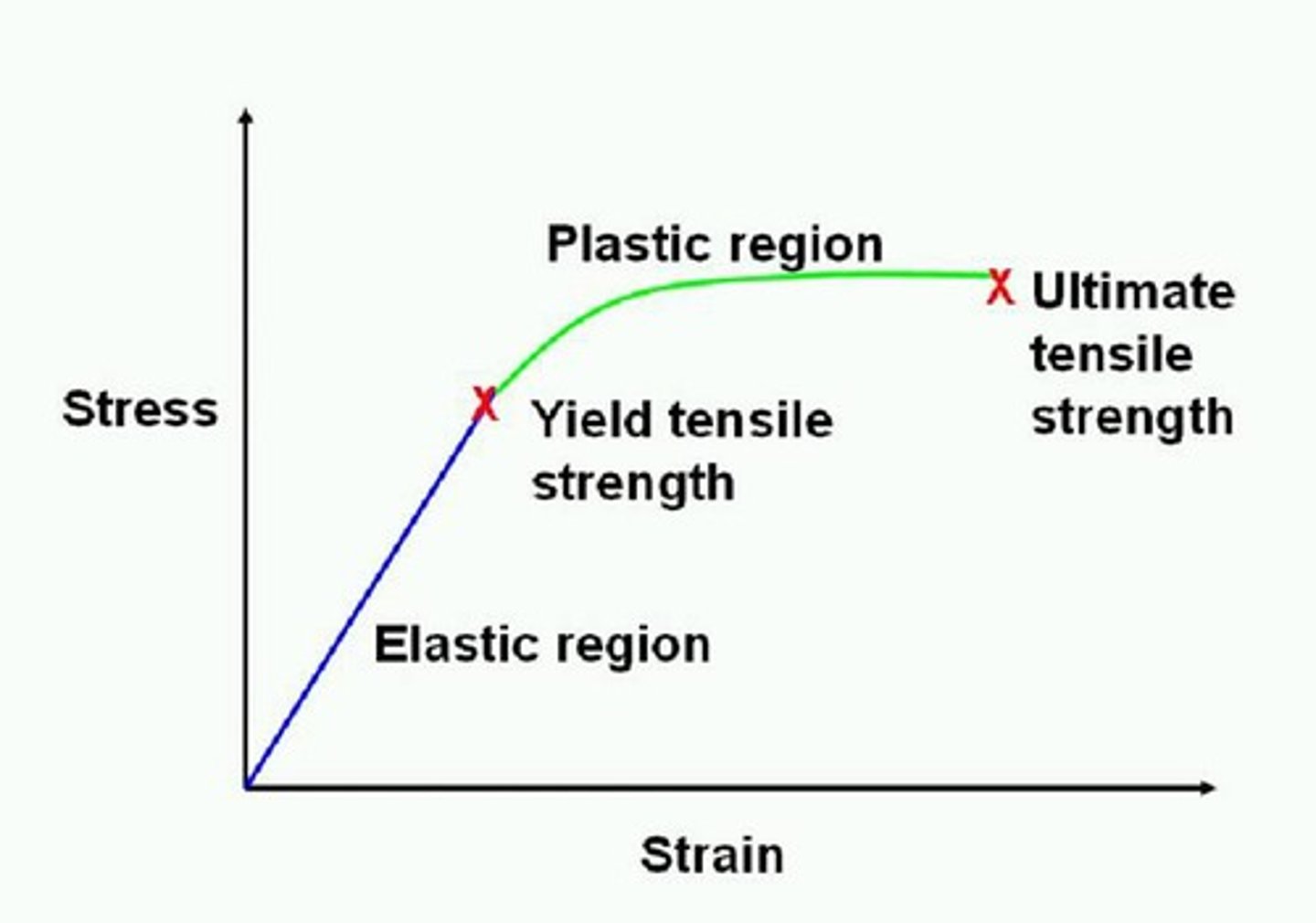
Stress-strain Plot/Graph (MP)
A graphical depiction of a materials behavior when subjected to increasing loads
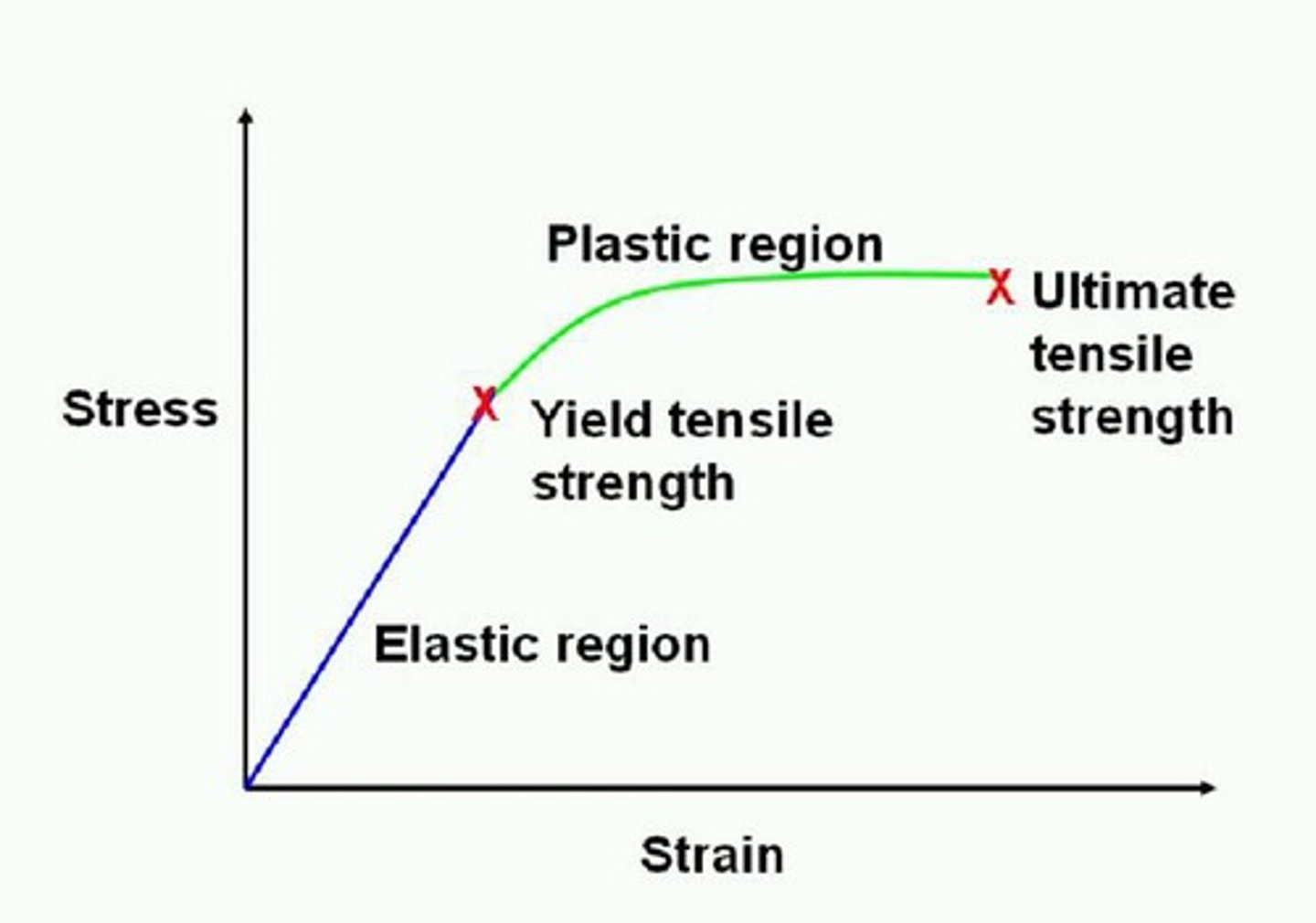
Stress-strain Plot/Graph shows
• Elastic deformation
• Plastic/permanent deformation
• Elastic limit, proportional limit, or yield point
• Ultimate strength
Types of stress (MP)
compression, tension, shear, torsion, bending
Compression
pushing stress
Tension
pulling stress
Shear (slip)
sliding stress
Torsion
twisting stress
Bending
compression + tension stress
Poisson Ratio (MP)
A mechanical ratio of strain in the direction of stress to the strain in the direction perpendicular to the stress
• A mathematical equation is used
Ex of poisson ratio
If you stretch a rubber band it gets longer and longitudinal strain is caused.
As the rubber band gets longer, it gets thinner laterally causing lateral strain
Resilience (MP)
Material has the ability to absorb energy without becoming deformed
Toughness (MP)
Energy absorbed up to the failure point on the stress-strain plot
Fracture Toughness (MP)
Measure of the energy required to fracture a material when a crack is present
Low-fracture toughness
• Glass
• Dental porcelain
High-fracture toughness
• Metals
Fatigue (MP)
Material/object failure due to being stressed repetitively for a long time, stress over time
Time-Dependent Properties (MP)
creep and stress relaxation
Creep
Small change in shape when an object is under continuous compression
Stress relaxation
Slow decrease in force over time